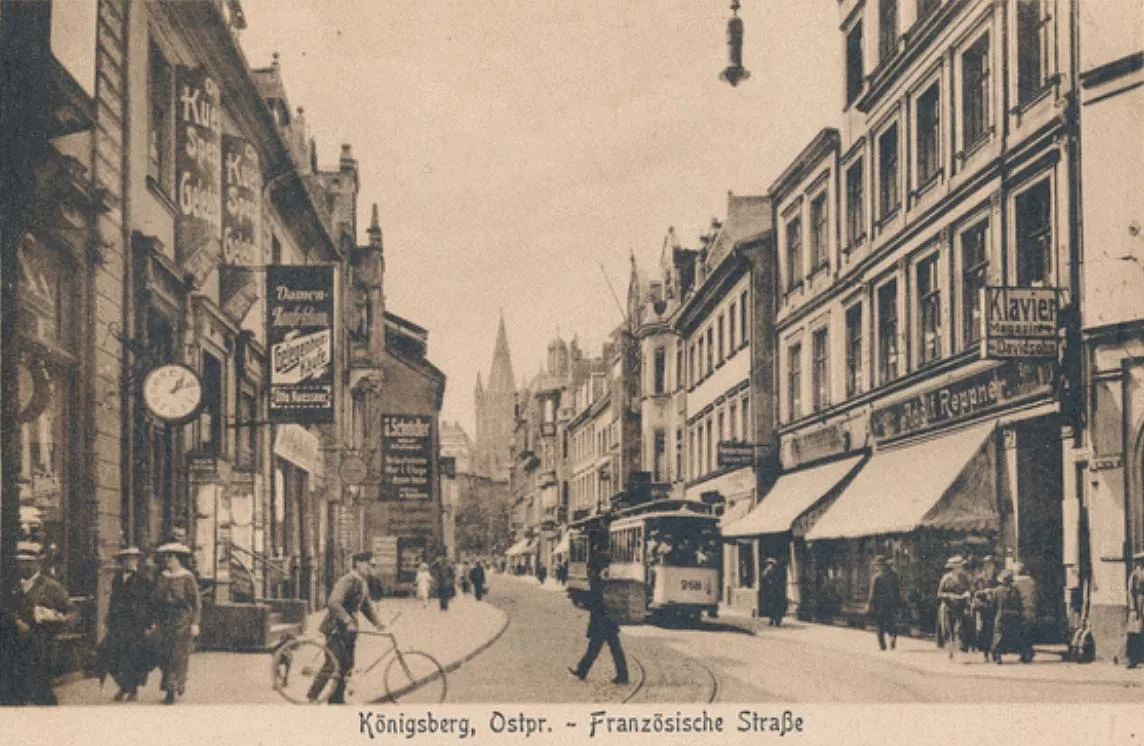
The Königsberg coffee house Siegel has very modest premises and in this respect lags far behind the Berlin Café Steheli1, but what bustling life surrounds us here!
From the first room we pass into a second room of about the same size, whose windows offer a very pleasant view of a garden with something monastic about it. The furniture on the ground floor, and indeed throughout the coffee house, is simple but comfortable and tasteful. The tables are piled with magazines and newspapers. Simonetti, Herr Siegel's friendly assistant, pours us coffee from a little silver jug, of a quality beyond all praise. The subtlest aroma of the divine drink caresses our nostrils. With every cup of coffee comes enough sugar to last a thrifty housewife a couple of days. We leave it to the gourmets who appreciate candied fruit to describe the taste and aroma of such delicacies, of which we understand nothing. The garçon hands us “Die Illustrierte”2.
A steep, finely wrought cast-iron staircase leads up from this room to a little restaurant of the same size.
In the upper room an abundance of the latest periodicals is combined with the balsamic aromas of the Orient, for here there is a fine selection of yesterday's newspapers, and moreover this place is favoured by cigar smokers and by those seeking quiet, especially in the afternoon and evening.
What is interesting is that in Siegel's coffee house we can observe the fusion of social and literary life that determines the entire daily routine of the establishment.
Early in the morning a few respectable gentlemen appear, old bachelors who prefer the tasty mocha to be had here to a cup of coffee at home brewed by an old housekeeper. Nor do they miss the chance to treat themselves to the pies, which are served here warm, straight from the oven.
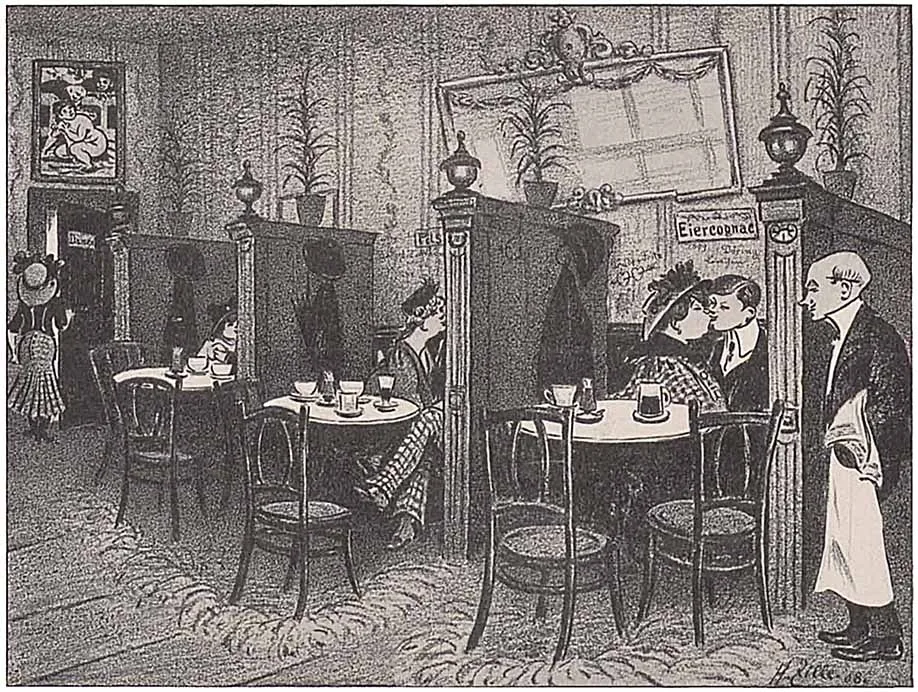
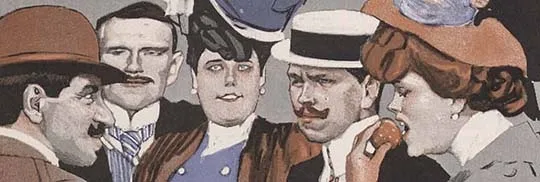
Waiter: “Looks like I'll have to cough again, or these gentlemen won't order anything more.”
Drawing by Heinrich Zille from the Munich magazine “Simplicissimus”, 1908.
Travellers come, and so do a few men of letters, who, especially in winter for lack of heating at home, set up a temporary refuge here for the greater part of the day – as Parisians like to do – in order to write here, find food for inspiration, conduct their affairs from here and go home only late in the evening.
Such a man of letters eats extremely little, but the same thing every day. In all other respects he is extremely modest and in no way disturbs the intellectual leisure of the other patrons. He warms himself in the cosy warmth of the stove, inhaling with the grandeur and resignation of a Stoic the appetising smells of baking that stream from it.
Little by little land inspectors and wealthy landowners drift in, who in the mornings drink a great deal of spirits, washing down their pies.
Then come the true gourmets. These are old libertines of the most jaded appearance. They drink several cups of chocolate to perk themselves up a little and, affecting indifference, leaf through the local daily papers. After them comes the turn of the young dandies. These, as a rule, take only bouillon and patties. Then whole families begin to arrive, dressed as if for a holiday, and single ladies in their best attire, who sit down in the lower room and let a few meringues melt on their lovely lips. At the same time a plump canoness of noble blood pays a visit, to treat herself to a couple of sweets and enjoy the impressive display of tortes in the coffee house window, recalling the days of her failed youth and, with luck, to find out the recipe for one pastry or another. And, of course, there are plenty of eternal Jews as they are portrayed in German popular anecdotes and newspaper feuilletons: they too want to pass for well-read intellectuals so as to show off their erudition at business meetings.
It is now twelve o'clock. This is the hour when the coffee house is visited by professors and doctors, who come here straight from their lectures, as well as by teachers from secondary and elementary schools. Sometimes one can see military men too, though on the whole they rarely frequent coffee houses. The so-called “working men of letters”, that is, journalists, also come in droves. They drink cup after cup of coffee, scanning the magazines and newspapers with a kind of feverish curiosity to find out whether their latest articles have already been discussed somewhere in the press, or whether there is at least a mention of them with a short quotation.
NOTES
1. The best-known coffee houses in 19th-century Berlin were small establishments that served as both cafés and confectioneries. One of the best in Berlin was Café Stehely (founded in 1820), located on the site of today's Jägerstraße, not far from the Gendarmenmarkt. Here anyone interested in social life – mostly well-to-do men – could come and enjoy drinks, desserts and conversation. The Berlin journalist Ernst Dronke described this café as “the Eldorado of Berlin's idlers” and as the city's “grandest and most frequented educational institution”. Although many other Berlin coffee houses had “reading rooms” filled with periodicals and magazines, Stehely was considered the best.
2. This refers to the newspaper “Illustrirte Zeitung”. It was published in Leipzig from 1843 to 1944 by the publishing house of Johann Jacob Weber.
SOURCE
«Königsberg und die Königsberger»
von Dr. Alexander Jung. 1846.
Chapter “Literarische Zustände”
Das Sigelsche Caffehaus
● Editor's note: Read on VisitPrussia.com an interview with the translator of German and, in particular, Prussian fairy tales, our regular contributor Tatyana Kolivay, who runs her own blog, where countless other parables, legends and fairy tales in her translation have been published.
Translated from Russian with the help of AI (Claude, Anthropic), October 2026.