I have loved the rain since childhood.
One of my first memories of rain is from kindergarten.
I was four or five. Kindergarten No. 100. The one on Dmitriya Donskogo Street. Builders have since gnawed away half of its yard.
But back then there was forest all around, and the only gnawers in the neighbourhood were squirrels.
Our whole group was out for a morning walk when suddenly a real autumn downpour began. We immediately ran to hide under a roof. The sky went dark.
All the children huddled together on the veranda in that darkness, their faces all wet, their eyes huge, with dilated pupils.
Some 25 pairs of equally huge eyes. And we all kept looking at one another. Thunder rumbled, and we instantly pressed against each other, as if in a few moments we had become truly close. Not just people who play together and roll a ball around, but close, fragile people in the face of some inexplicable natural phenomenon. Lightning flashed. And then suddenly – click – as if someone had switched off the sound.
The lightning flashed in complete silence, but nothing thundered any more. Only that unimaginably pleasant patter of rain on the autumn leaves.
And then a frightened child’s voice suddenly said:
– Natalya Sergeyevna, while there’s no thunder, can I run and have a wee?
I don’t remember now who it was. I doubt we ever met after kindergarten. But I have always wondered what became of that little person who ran off for a wee under my first rain and the silent lightning.
When I grew up, rain no longer seemed frightening. I simply knew that when it starts, you are bound to get soaked. Sometimes that was great, and sometimes not.
The worst thing is when it’s raining, there are puddles, you’re walking along the pavement hurrying to get under cover, and suddenly a car flies past and drenches you from head to toe. And then you run after it for a long time, shaking your fist in fury, and your trousers and jacket are covered in mud. You no longer go where you were going; you go back home, change your clothes and wash down your ruined day with hot tea.
I learned that puddles are not a universal phenomenon when I was studying in Ireland. It was early spring, with torrential rain every day. But there were no puddles, no mud, and no cars to drench you.
I never once managed to run after anyone there in anger and mud.
And yet I had believed that puddles were an integral part of rain. Rain, that is, can come without lightning, but never without drops from the sky and puddles. It turned out it can.
All it takes is smooth roads without potholes and the right camber, so that all the rainwater immediately drains into the gutters by itself. The rain stops, and you can actually watch the rivers of rainwater flowing away underground by themselves. The rain stops, and five minutes later there is just freshly washed wet asphalt.
The same goes for mud.
For a long time I couldn’t understand how that could be. Here, after the rain, you walk along the pavement and the backs of your trouser legs get spattered all over with unpleasant grey drops. And if it’s summer and you’re out for a stroll in light-coloured trousers, your day is over. But in Berlin – nothing of the kind. Walk in the rain as much as you like, and afterwards you can even keep your shoes on indoors and everything stays clean. It turned out the whole thing comes down to the fact that here, all winter long, special vehicles spread sand on the snow and ice. So that nobody slips. It does help against black ice, admittedly. But then we pay for it all spring and summer. All that mud – the kind you simply can’t get rid of at home – comes precisely from that sand, all that unpleasant spring slush, that melting snow mixed with sandy mud. The Berliners told me this:
– We spread special grit on the roads. It’s reusable. We spread it in winter, clear it off the roads in spring, and everything is clean again, and next winter we can spread it again.
Of course, this grit is more expensive than sand. But it can be used many times, so in the end it works out cheaper, and the environment certainly doesn’t suffer. There’s none of that sandy dust in the air. Clean clothes, clean lungs and a clean city.
That is why you can love rain in general, but in our city – only with a very difficult love.
But that’s not all.
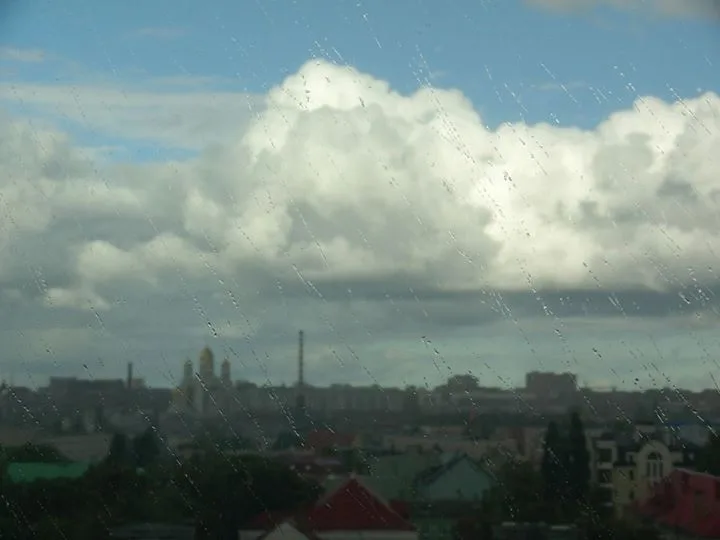
I have lived here all my life. With experience, of course, you slowly start to understand the local sky. You can look out in the morning and say with some probability whether it’s going to pour or not. You can, in the end, learn to trust certain weather forecasts. But all the same, every now and then you get caught somewhere in the centre, without a jacket, by a dense wall of that fine, nasty rain with the wind in your face. And, utterly defenceless, you make your way to some roof or other to wait it out and fully realise what it means when wet clothes cling to your body in the wind. The trouble is that we have few roofs of that kind under which you can take shelter. Of course, you can run to a shopping centre, but if the rain is November-merciless, only the wet threads of your insides will get there; you can hide in a café, but again only if you’re lucky. What matters is the architecture itself. Our buildings are built as if we had not 30 sunny days a year and 160 overcast ones, but the other way round.
I first appreciated the difference in Amsterdam, the world capital of rain. I suddenly noticed that no matter how often you get caught in the rain there, you always come out dry. At first it was hard to understand why. Every day you get caught in the rain, but you don’t get soaked, you don’t fall ill, you don’t cough. I asked some Amsterdam friends how this could be. And they answered very simply:
– We know it rains here all the time, so we thought about the rain when we built our city. We tilt the houses a little. We make the canopies a little longer. We try to make sure you can always be under a roof.
You are, so to speak, walking down the street, but you are always sheltered from the rain. We are used to it. We know our climate, we live in our city, and we want it to be comfortable to live in.
But that’s not all either.
We can’t very well demand that architects think about people and not just about square metres. That would be absurd. So there is another way.
Once we were caught in a terrible downpour in East Berlin. We had parked the car somewhere far, far away, we had no raincoats, we were in light clothes, with our beloved wind in our faces... everyone instantly took cover, but we had to hurry. A woman from the shop across the street saw us; she ran out, caught up with us, and there was such a pitying expression on her face, yet at the same time her face was smiling – you know, with those little rays of wrinkles with which the faces of kind fifty-year-old women smile. And she handed us an umbrella. I tried to explain that we wouldn’t be able to return it, we were leaving. But she waved her hand and said:
– But one day you will come back.
It is for things like this that you fall in love with a city. Nothing like this has ever happened to us here, not once in our lives. And we have lived here all our lives. It hasn’t happened not only to us but to anyone I know. I mean, I can easily imagine that when you leave friends’ place or a friend’s shop, they might give you an umbrella – they will give you an umbrella, and even forget to ask for it back. But for a stranger with a kind face to run after you down the street in the rain to save you... that I don’t remember.
And this is so much simpler and cheaper than tilting buildings or making canopies a little longer... the whole city could simply get itself free umbrellas or raincoats and hand them out at least to tourists, if we begrudge giving them to one another.
The first to do something in this direction were the people of Kaliningrad City Jazz. Huge respect. It all started with a fear of rain during the open air. The organisers were afraid that as soon as it began to rain, everyone would scatter. And it worked. Raincoats, umbrellas, and whether it rains or not, you stay at the concert, if only out of gratitude to those who thought about you. It is so simple and so immeasurably valuable. Just imagine that among the festival-goers there was some foreigner. And he was given a free raincoat. And then it poured, and the raincoat saved him. And now he is sitting at home on his island in Greece and, just as I now remember East Berlin, he remembers our wonderful city and the jazz festival where they think about people and hand out protection from the rain. And he tells this story every time someone says something bad about us. In reply, he tells them something good. That is better than any advertising. It is warmer than a billboard in the centre of Athens with a picture of our main square.
Rain can be magical! Remember “Singin’ in the Rain”, remember your first romantic adventures, remember the warm summer rain, when you want to tilt your face to the sky and catch the drops with your mouth.
And I remember the Curonian Spit.
We were opening the season then. The first days of May. It was already plus 25. The four of us drove to the Efa Dune and made our way to the viewing platform. There was no one around, and we decided to walk on the dunes. We know it’s forbidden, but we’ve been doing it since we were born. Why have dunes at all if you can’t walk on them? I realise I’m about to get carried away, but it’s hard to forget Bordeaux: there are dunes right by the sea there too, they move too, change their outlines too, lose sand too, but nobody forbids you to walk on them, to land on them with a parachute, to play basketball on them. Of course you mustn’t overdo it, you have to restrain our impulse a little, keep an eye on litter, but still. After all, being able to walk on the dunes once a summer is reason enough to settle and live here. Anyway, we went for a walk, quietly, looking at the tracks of all sorts of animals – we saw fox tracks, elk tracks, the tracks of a family of wild boar – and then suddenly, out of the corner of our eye, we sensed that it was getting noticeably darker. We looked at the lagoon, and there in the distance a small, beautiful waterspout was forming, sand and water swirling into a funnel, and for the first time in our lives we saw rain running across the water. You can actually see it rushing towards you, closer and closer, lightning, and we raced away from it, and it chased hot on our heels, thundering; it was wildly frightening and fun, we flew shrieking under the observation tower and plugged the gaps in the decking with some planks. We crouched down, and then it hit us. It roared, thundered and flashed! It was a great miracle.
We looked at one another with those same huge children’s eyes with dilated pupils. We were happy. It was the absolute, total happiness of four people caught by a hurricane under the viewing platform on the Efa Dune.
Some 12 or 13 years have passed since then, but we still remember it as the happiest day of our adult lives.
Days like that are worth living for. And rain is worth loving. Only you also need to love a little the people who live in a city with rain 160 days a year. We need to love one another. We live in the same city.
Translated from Russian with the help of AI (Claude, Anthropic), October 2026.