Aweiden
Aweiden is first mentioned in 1550. In 1579 the Aweiden estate was owned by the burgomaster of the Kneiphof, Johann Schnürlein. After a fire at the manor in 1660, the estate was resold several times until it passed to the state official Friedrich Kupner (1648–1719).
In 1785 Aweiden was classified as a noble estate and farm on the Pregel (Adelich Gut und Vorwerk am Pregel) with an oil mill nearby. The estate had eight households. By 1818 Aweiden had the status of a noble estate (Adlich Gut), and the number of households had increased to 11.
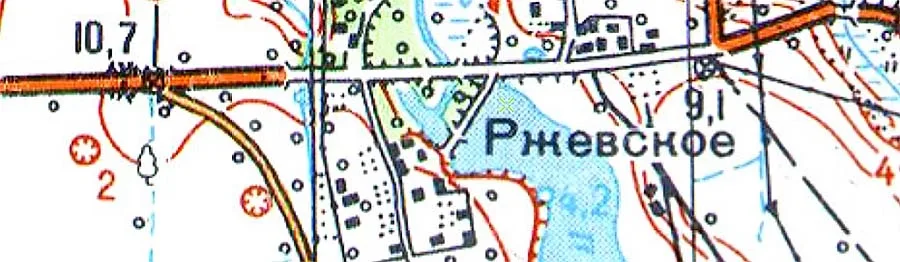
In the mid-19th century Aweiden was a knight's estate (Rittergut), forming from 1867 a Gutsbezirk (estate district) in the Landkreis Königsberg (merged into the Landkreis Samland in 1939). The estate belonged to the parish of Neuendorf-Steinbeck (Rzhevskoye, Kaliningrad – Rybnoye). The Gutsbezirk of Aweiden also included the farms of Milchbude (54°41'13'' N 20°35'00'' E) and Neuvorwerk (54°39'26'' N 20°30'01'' E) and the forestry of Catharinenwalde (54°37'17'' N 20°35'00'' E).
In the 19th century the manor of the Aweiden estate was used as a venue for gatherings of various kinds, mainly by the upper classes. In 1835 students of the University of Königsberg held a Kommers here for the first time — a university festivity with a banquet.
In 1862 a competition among pupils of the Friedrichskollegium gymnasium was held in Aweiden, with more than 500 participants. These competitions were a success and began to be held annually.
In 1866 the Königsberg – Bartenstein (Bartoszyce, Poland) railway line was opened. The line passed east of Aweiden. No station was provided on it for the residents of the estate, but a lineman's house was built.
In 1871 the Gutsbezirk of Aweiden had 18 dwelling houses, in which 50 families and three single men lived. Of these, the Aweiden estate itself had 12 dwelling houses, three houses were on the Neuvorwerk farm, one in Milchbude and two in the Catharinenwalde forestry. On 30.04.1874 the Gutsbezirk of Aweiden was included in the newly established Amtsbezirk of Aweiden. The owner of the Aweiden estate, Herr Perkun, held the post of head of the Amtsbezirk in 1887–93.
In 1879 the Gutsbezirk of Aweiden owned 663 ha of land (19th place in the Landkreis), and the estate's annual net profit amounted to 10,592 marks (14th place in the Landkreis). On 27.05.1893 the Catharinenwalde forestry, with landholdings of 103 ha, was transferred from the Gutsbezirk of Aweiden to the Gutsbezirk of Friedrichstein (Kamenka). It is known that in 1927 there was a school in Aweiden.
On 30.09.1928 the Gutsbezirk of Aweiden was abolished, and its main part (without the exclaves) was included in the rural municipality of Altenberg (Dorozhnoye). On 01.10.1933 the territory of the former Gutsbezirk of Aweiden became part of the municipality of Königsberg.
Amtsbezirk of Aweiden
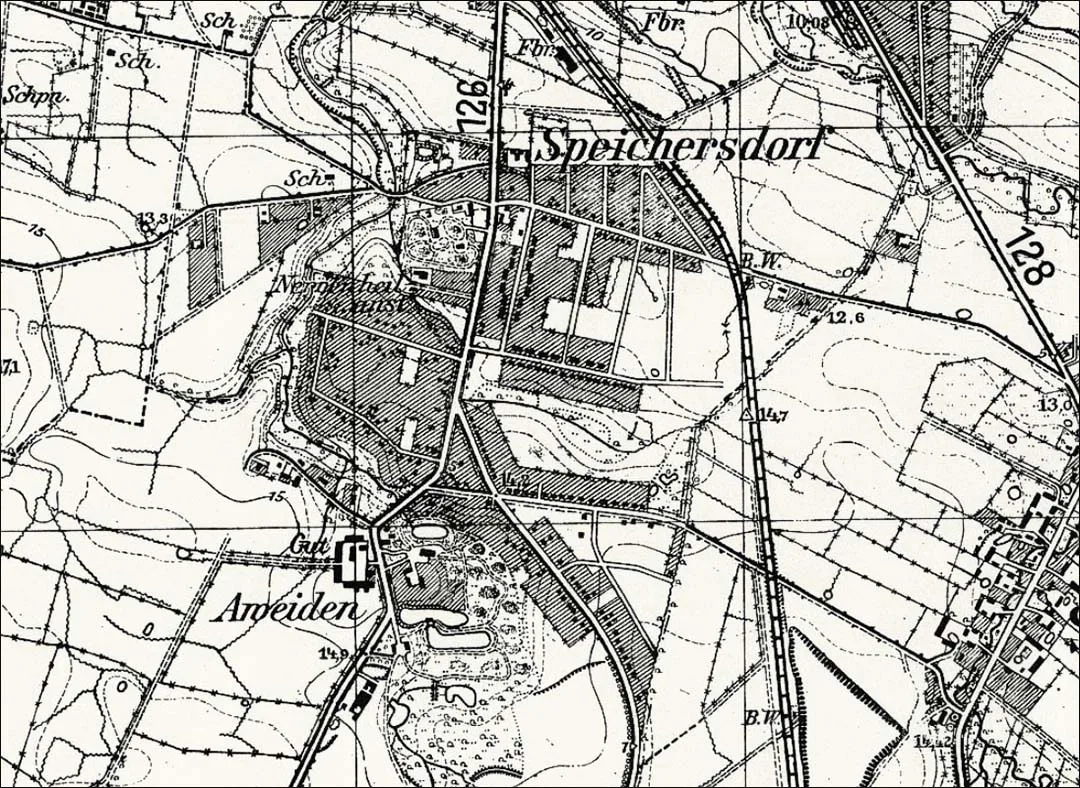
On 30.04.1874 Amtsbezirk No. 8, Aweiden, was established in the Landkreis Königsberg. It comprised the rural municipality of Altenberg (Dorozhnoye) and three Gutsbezirke: Aweiden (Kaliningrad, Yuzhny settlement), Rosenau (Kaliningrad, area of the Alley of the Brave) and Speichersdorf (Kaliningrad, Yuzhny settlement).
By 1883 the Amtsbezirk of Aweiden consisted of the rural municipality of Altenberg (Dorozhnoye), four Gutsbezirke — Aweiden (Kaliningrad, Yuzhny settlement), Mühlenhof (Kaliningrad, area of Yeletskaya and Yablochnaya streets), Rosenau (Kaliningrad, area of the Alley of the Brave) and Speichersdorf (Kaliningrad, Yuzhny settlement) — as well as the settlements and institutions of Klein Holländerei (54°41'40'' N 20°32'51'' E), Neu Holländerei (54°41'44'' N 20°32'20'' E), Neupregelkrug (54°41'34'' N 20°33'29'' E), the Artillery Range (Artillerieschießplatz) and Fort Schönfließ (Fort No. 10 "Canitz"). On 03.07.1890 Klein and Neu Holländerei were included in the Gutsbezirk of Mühlenhof (Kaliningrad, area of Yeletskaya and Yablochnaya streets). On 06.03.1891 parts of the Gutsbezirke of Aweiden (Kaliningrad, Yuzhny settlement) and Rosenau (Kaliningrad, area of the Alley of the Brave) were incorporated into the city of Königsberg. In 1895–1905 the territories of the Gutsbezirke of Rosenau and Mühlenhof became part of the municipality of Königsberg in stages. The Amtsbezirk of Aweiden now consisted of the rural municipality of Altenberg (Dorozhnoye) and two Gutsbezirke: Aweiden (Yuzhny) and Speichersdorf (Yuzhny). On 16.06.1927 the Gutsbezirk of Speichersdorf (Yuzhny) became part of Königsberg. On 30.09.1928 the Gutsbezirk of Aweiden was abolished; its main part went to the municipality of Altenberg (Dorozhnoye), and the Milchbude farm to the municipality of Seligenfeld (Kaliningrad, Dalnoye). Finally, on 14.05.1930 the municipality of Altenberg was transferred to the Amtsbezirk of Gollau (Poddubnoye), and the Amtsbezirk of Aweiden was abolished. On 01.10.1933 the territory of the former Gutsbezirk of Aweiden passed from the municipality of Altenberg to the municipality of Königsberg.
Speichersdorf
In 1785 Speichersdorf was classified as a noble farm and brickworks (Adelich Vorwerk und Ziegelei) with three households. In 1818 it appears as a noble farm with the same three households.
In the mid-19th century Speichersdorf was an estate forming a Gutsbezirk in the Landkreis Königsberg (merged into the Landkreis Samland in 1939).
The estate belonged to the parish of Neuendorf-Steinbeck (Rzhevskoye, Kaliningrad – Rybnoye). In 1866 the Königsberg – Bartenstein (Bartoszyce, Poland) railway line was opened. The line ran along the eastern edge of Speichersdorf. No station was provided on it for the residents of the estate.
In 1871 Speichersdorf had six dwelling houses, in which 20 families lived. On 30.04.1874 the Gutsbezirk of Speichersdorf was included in the newly established Amtsbezirk of Aweiden (Kaliningrad, Yuzhny settlement). The owner of the Speichersdorf estate, Schindelmeister, became the first head of the Amtsbezirk and held this post until 1882.
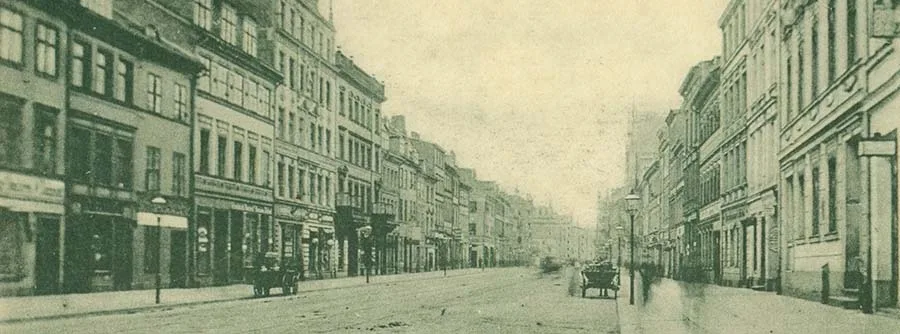
In 1879 the Speichersdorf estate owned 265 ha of land, and its annual net profit amounted to 5,974 marks. On 01.04.1905 almost 10 ha of the land of the Gutsbezirk of Speichersdorf became part of Königsberg. And on 16.06.1927 the rest of the Gutsbezirk of Speichersdorf was also incorporated into Königsberg. Thus the city district of Speichersdorf was formed, where, besides residential quarters (consisting mainly of workers' houses built in the early 20th century), there were several factories (engineering, steel structures, wine and vodka, flour milling) and a psychiatric hospital. In the 1920s the psychiatric hospital was reorganised into an old people's home.
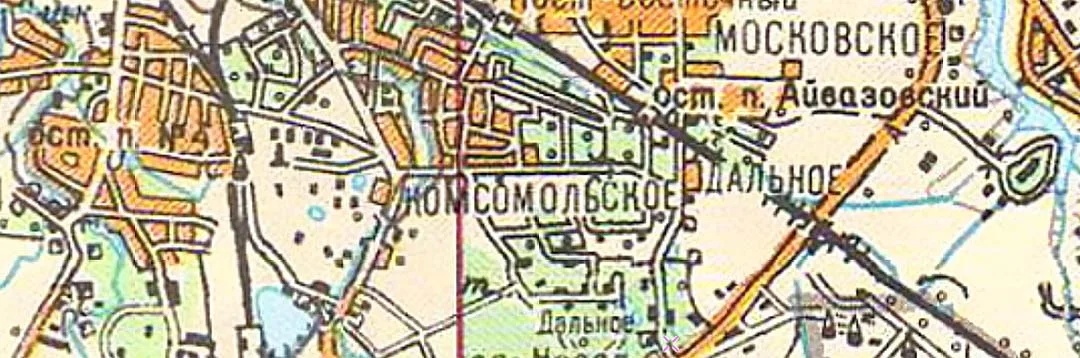
On 25.07.1948, by decision of the Kaliningrad city executive committee, the territory of the former Aweiden and Speichersdorf was named Yuzhny Gorodok ("South Town") within the Moskovsky district of Kaliningrad. By a new decision of 18.08.1949 the city executive committee renamed Yuzhny Gorodok the settlement of Yuzhny.
In 1960 School No. 37 opened in Yuzhny. During the 1970s–90s the new name of the settlement was used fairly widely. It was marked on maps and in bus routes. In the 1990s construction began of a residential neighbourhood between Internatsionalnaya St. and Yuzhny Boulevard. The neighbourhood was also named "Yuzhny", which somewhat blurred the meaning of this place name. In 2007, as part of an optimisation, School No. 37 in Yuzhny became one of the buildings of School No. 15.
As of 2020, the territory of the Yuzhny settlement within its historical boundaries includes the streets: Alley of the Brave (part), Angarskaya, Bronnitskaya, Gribnaya, Gruntovaya, Dvinskaya (part), Dvinskoy Lane, Klinskaya, Klinsky Lane, Luganskaya, Muromskaya (part), Okskaya, Oksky Lane, Olega Koshevogo (part), Ramenskaya, Sevastopolskaya, Sevastopolsky Lane, Solnechnogorskaya, Sudostroitelnaya (part), Shchadenko and Yakhromskaya. Part of the territory is occupied by the "Medik" and "Raduga" gardening partnerships, a military unit and the Veterans' Park (formerly Aweiden Park). Other significant facilities on the territory of Yuzhny include a building of School No. 15, Maternity Hospital No. 3, the Olympic Reserve College and a branch of the medical equipment and property supply centre of the Russian Ministry of Defence.
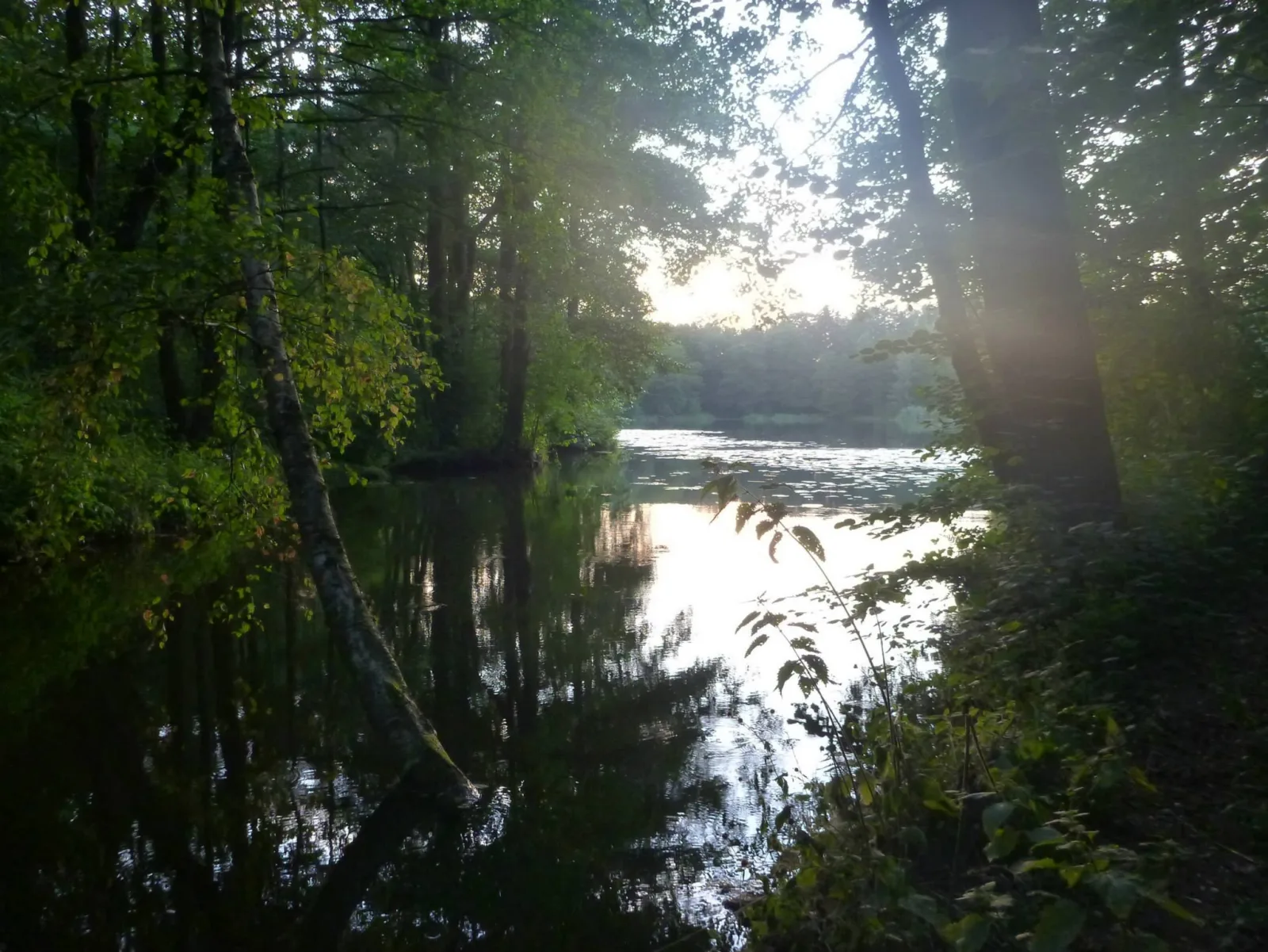
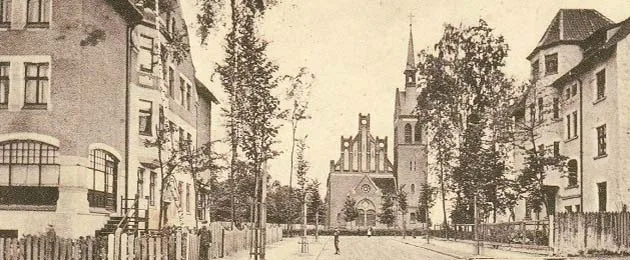
Sights: Aweiden Park (Veterans' Park), the former psychiatric hospital building (Maternity Hospital No. 3), the mass grave of Soviet soldiers (380 people, memorial of 1956).
Population of the Aweiden estate: 1818 – 130, 1871 – 191, 1905 – 150 inhabitants.
Population of the Gutsbezirk of Aweiden: 1818 – 130, 1867 – 215, 1871 – 268, 1885 – 240, 1905 – 166, 1910 – 185 inhabitants.
Population of the Gutsbezirk of Speichersdorf: 1818 – 50, 1867 – 120, 1871 – 116, 1885 – 175, 1905 – 186, 1910 – 231 inhabitants.
Composition of the population of the Gutsbezirk of Aweiden in 1871: Protestant Christians – 263, Catholics – 2, other Christians – 3, children under 10 – 82, literate – 152 (of 181 surveyed, 84%), deaf-mute – 1, insane – 1.
Composition of the population of Speichersdorf in 1871: Protestant Christians – 115, Catholics – 1, children under 10 – 34, literate – 59 (75%), blind – 1, deaf-mute – 1, insane – 1.
Population of Neuvorwerk: 1871 – 53, 1905 – 7 inhabitants.
Population of Milchbude: 1871 – 7, 1905 – 9 inhabitants.
Population of the Catharinenwalde forestry: 1871 – 17, 1905 – 4 inhabitants.
Translated from Russian with the help of AI (Claude, Anthropic), October 2026.