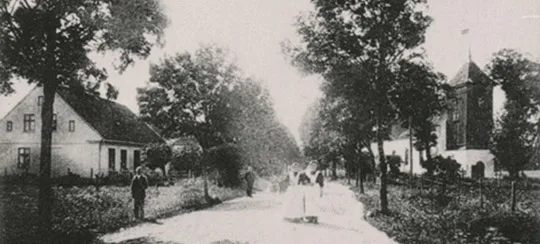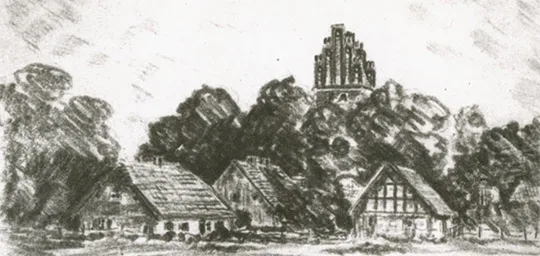
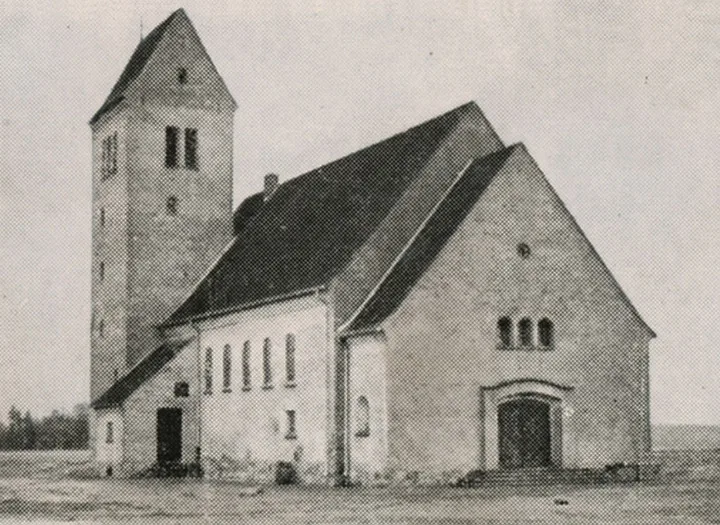
In the garden town of Stablack, then under construction, the foundation stone of a new Protestant church was laid on 29 September 1935, and as early as 31 July 1936 the topping-out ceremony was held. During the following months the interior was finished and decorated, and on 28 February 1937 the new church was solemnly consecrated. According to the programme of the celebration kept in the Preußisch Eylau archive, it ran as follows:
Celebration of the consecration of the church in the garden town of Stablack
1. Solemn handing over of the church key
2. Psalm 100 performed by the church choir
3. Congregational prayer
4. Consecration address (Consistorial Councillor Lawin, Königsberg-Juditten)
5. Psalm 103 performed by the church choir, etc.
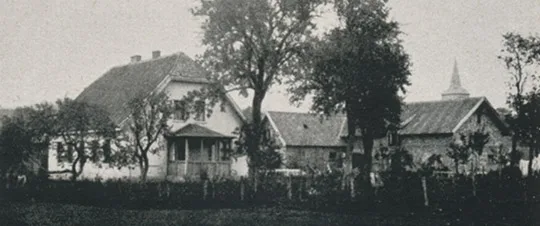
The new church was 25 m long and 12 m wide. It was a plastered brick building whose highest point stood 14 metres high. The tower was set somewhat apart from the altar space. On the left side there was a gallery, on the right side the organ gallery. The altar space was set apart (screened off). The building was heated by hot-air heating. The interior furnishings (altar, pulpit, pews, artistic decoration — paintings, icons and other objects) were brought here from the church in Klein Dexen and fitted the new building very well. The bells from Klein Dexen also moved here.
One of them survived the last war in the bell cemetery in Hamburg and is now in the church of Nordhorn in the western part of Lower Saxony. It is 80 cm high, with a lower diameter of 80 cm, and weighs 360 kg. It was cast in Königsberg in 1710 by Johann Jacob Dormann. Its inscription reads: "Glory to the Lord in the heavens".
From 1937 to 1941 the pastor of the new church was Franz Kolas (from the Klein Dexen church). After he was called up into the army, the chaplains of the Stablack garrison and training ground took care of holding services. According to the "Prussian Evangelical Book of Pastors from the Reformation to 1945", from 1943 to 1945 the pastor of the Stablack church was Arnold Schrenk; it is quite likely that he was a military chaplain.
The Stablack parish comprised the garden town of Stablack, the villages of the former Klein Dexen parish — Gallingen, Rositten, Gusehnen, Wackern, Skerwitten, Supplitten, Pompicken, Schlauthienen, Görken, Claussen, Gross Dexen, Roditten — and the local training ground.
Stablack Church came through the Second World War safely. Residents of Schlauthienen, who were still being used for harvest work in 1947 and were housed in Stablack, said that the church and its tower were unharmed. The church stood empty; its interior furnishings had been removed. In the first years after 1945 the church was used first as a stable, then as a place for showing films.
As of 2005 the church is used as a House of Culture. It is practically intact, except for the tower, which has been dismantled down to the level of the roof of the main body of the building.
Photos on this page: Bildarchiv Ostpreußen, bildarchiv-ostpreussen.de
Translated from Russian with the help of AI (Claude, Anthropic), October 2026.