LEGENDS OF PRUSSIA in the blog of Tatyana Kolivay.
— Hie frischen Redick, Volck!
— Hey, fresh radishes, folks!
— Dreege Speene, Frue!
— Tasty spinach, ladies!
— Hie frische Rieben, Volck!
— Hey, fresh turnips, folks!
— Hie frischen Krabben!
— Hey, fresh crabs!
— Hie frische Krebser!
— Hey, fresh crayfish!
The oldest cries of street vendors were heard on the streets of Königsberg most probably in the time of Duke Albrecht, but it is quite possible that women at its town markets were already shouting, chanting and praising their wares in the early Middle Ages. This custom survived right up to 1945, when the city of Königsberg ceased to exist.
— Kept Schabbelbohne, Zeloatgurk, Sellerie!
— Here you are, beans, cucumbers, celery!
— Ei Reddis, fresche Reddis! Steenpilz! Peterzilie!
— Hey, radishes, fresh radishes! Ceps! Parsley!
— Blubeere blau, wat goots Blubäre!
— Bilberries, bilberries! What fine bilberries!
— Na Zittrone wohlfeil — Zittrone!
— Here, lemons, cheap — Lemons!
— Appelzine — goode — Köpp — Appelzine!
— Oranges — goood ones — buy them — Oranges!
— Zooke-bäre! Apple, Apple!
— Tasty ones! Apples, apples!
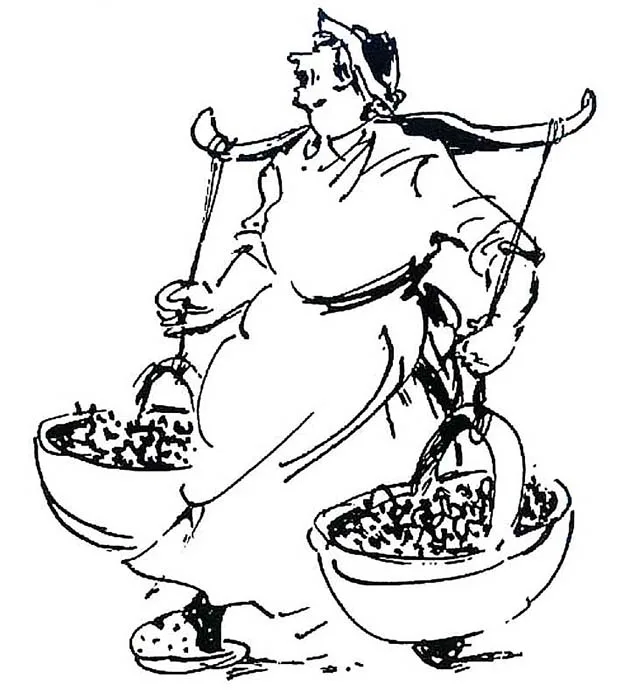
rang out melodiously from the lips of the greengrocer women, who carried on their broad shoulders yokes with elongated baskets woven from willow.
Carl Friedrich Zelter, an old friend of Goethe, a Freemason and director of the Berlin Sing-Akademie, heard these melodious chants during his stay in Königsberg from 22 July to 17 September 1809, quickly took up his pen and wrote down the melody:

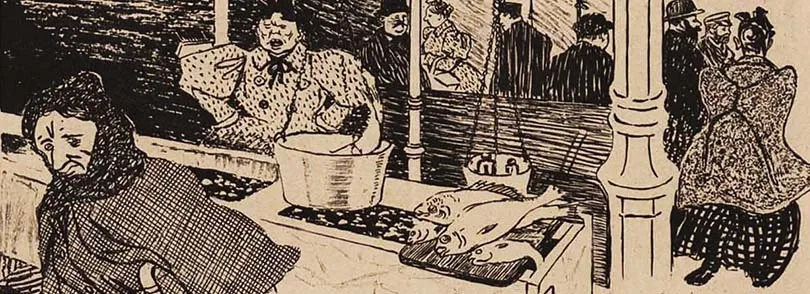
The fishwives dragged their little carts behind them and announced to the whole neighbourhood in booming voices:
— Fett — Streem — Laß! Dörsche — freesche Dörsche!
— Fat river salmon! – Cod, freesh cod!
— Na Karpe, Karpe — fresche goode Karpe, wohlfeil!
— Here, carp, carp — Fresh goood carp, cheap!
— Strämling — Kulbärsch — Späckflundre, Fruus!
— Baltic sprats — Perch — Fat flounder, ladies!
— Ei Broetzant — Ei Broatzant — Ei Butterzant — Fleetkräft! (Flußkrebse)
— Hey, fried zander — Hey, fried zander — Hey, buttered zander — River crayfish!
Also gone in our time are the boys who sold calamus1. In 1835 the painter Johann Ferdinand Bender, born in Königsberg in 1785, depicted two of them in his painting that once hung in the museum of Königsberg Castle. It shows the Wet Garden (Nasser Garten), where the little calamus sellers are cutting it up for sale. They gathered this plant at the Upper Pond and in the Castle Moat and sold it, calling out:
— Ihr Keept Kalmus!
— Buy calamus!
or shouted, cupping their hands to their mouths:
— Ei Kalmus, Kalmus drö Bundkes far e Dittche!
— Hey, calamus, calamus! Three bunches for a Dittchen!2
They disappeared when the custom of strewing white sand and calamus in front of houses was abandoned. And with them went the carter who called out all day long in a hoarse voice:
— Kä-ke, witt Sand!
— White sand here!
To a long-vanished era also belong the little girls who walked around the fair with an earthenware bottle in one hand and a jug in the other, pouring thin beer for thirsty passers-by with a little chant:
— Na, Lüd, drinke, wems durscht, drinke, drinke!
— Come on, people, who's thirsty? Drink, drink!
The same goes for the woman who sold hen's eggs. She also sold "Botterdwarg" — dwarf-sized lumps of curd cheese. And for the sausage sellers who took her place on the square in front of the Altstadt Church and who cried on foggy November evenings:
— Na, recht heete fette Worscht, recht heete!
— Here, really hot fat sausage, really hot!
Gone, too, are the knife grinders with their grinding machines, and the Slovenes and Croats who sold lottery tickets and fortune-telling sets, and gone is the tinker's wife who once cried in a drawn-out voice that carried for several blocks:
— Toppke binden, Toppke!
— Pots mended, pots!
And it was only in 1898 that a company with the telling name "Utilitas" ceased its unappetising activity, about which the philosopher Karl Rosenkranz had written as early as 1842 in his "Königsberg Sketches".
No longer could one hear early in the morning the cries
— Schütt opp! Schütt opp!
— Empty it out! Empty it out!
of the carters who took buckets with their nightly contents from the maids and emptied them into the tanks of their wagons, drawn across the whole city by patient little horses. The completion of the city sewerage system and the new English invention of the water closet made their trade in Königsberg unnecessary.
LEGENDS OF PRUSSIA in the blog of Tatyana Kolivay.
TRANSLATOR'S NOTES
1. Calamus (sweet flag) — colloquially called sedge. It grows in damp places or in shallow water — along the banks of streams, rivers and lakes, at the edges of marshes.
2. Dittchen (10-Pfennig-Stück) — a 10-pfennig coin.
Drawing: Erich Behrendt
Translated from Russian with the help of AI (Claude, Anthropic), October 2026.