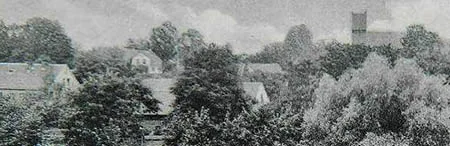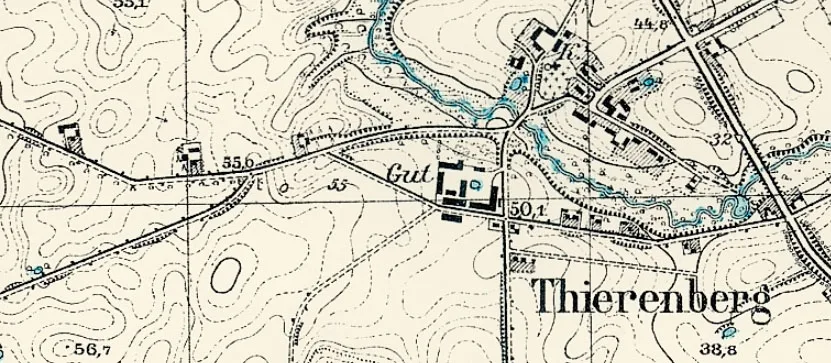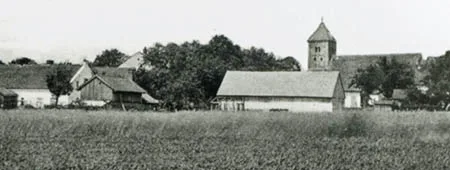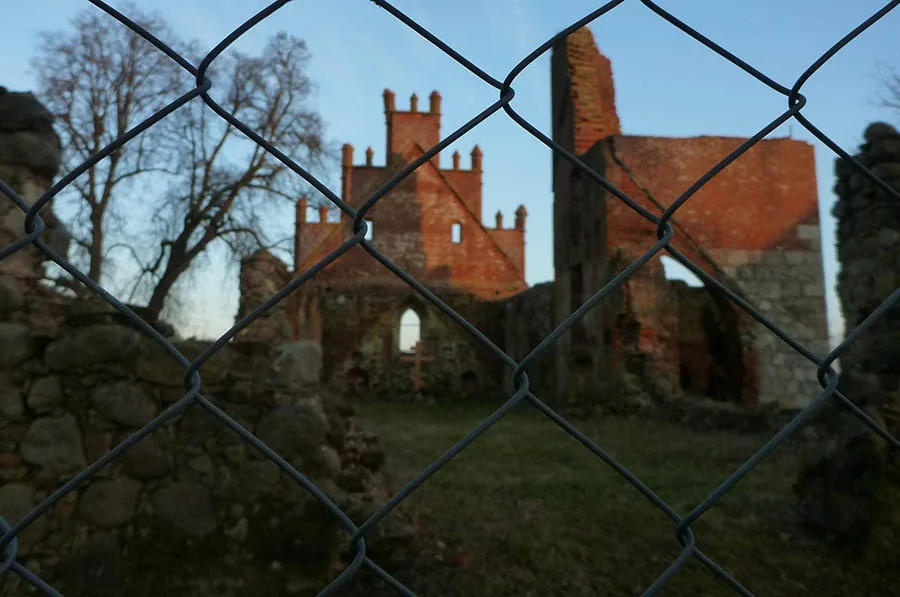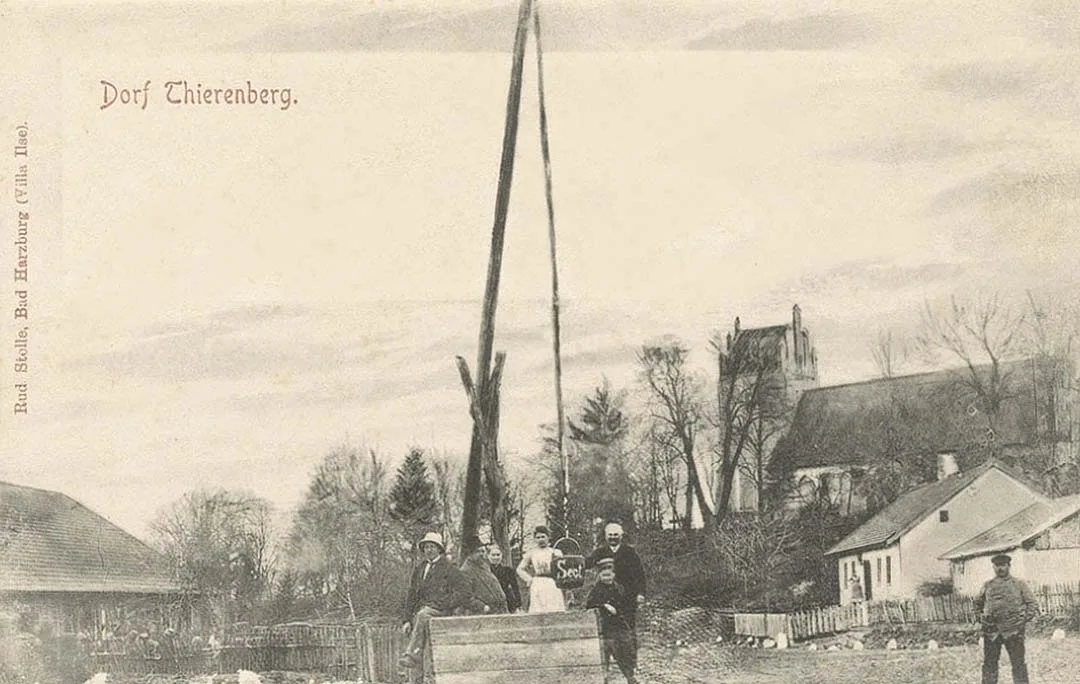
Thierenberg has been known since 1270, when the Landmeister of Prussia Conrad von Tyrberg (d. 1279) built a castle here, on the bishop's lands, in 1270–75 on the site of Prussian earthworks. In 1325 the settlement of Thierenberg existed, and a village headman was appointed. In 1330 a church was built. In 1348 the Thierenberg mill is mentioned for the first time. In 1357 the Kammeramt was moved to Thierenberg from Rinau (not to be confused with Rinau/Chaykino!). At the beginning of the 15th century Thierenberg Castle was rebuilt in stone. But by 1507 the castle had already fallen into disrepair and was considered incapable of defence. In 1508 Bishop Günther von Bünau granted the Thierenberg estate to Niklas von Niederbach. In 1618, when the Niederbach line died out, the estate passed to Karl von der Oelsnitz. Around 1625 the Order castle of Thierenberg was demolished. Only the name remained of it — the estate was still called the "castle". In 1638 the estate was acquired by Georg von Auer. In 1728 the Thierenberg estate was granted to a Prince von Holstein; it then changed hands several more times, becoming the property of the families von Kross, von Mongowt, von Batocki, Stein and Kröck.
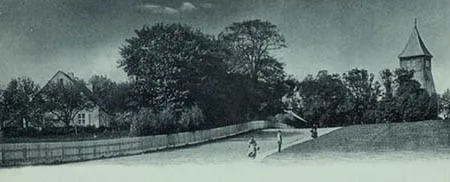
The church in Thierenberg was one of the oldest in Samland (the Sambian Peninsula). In 1511–18 it acquired an altar, and in 1581 a pentagonal pulpit was made.
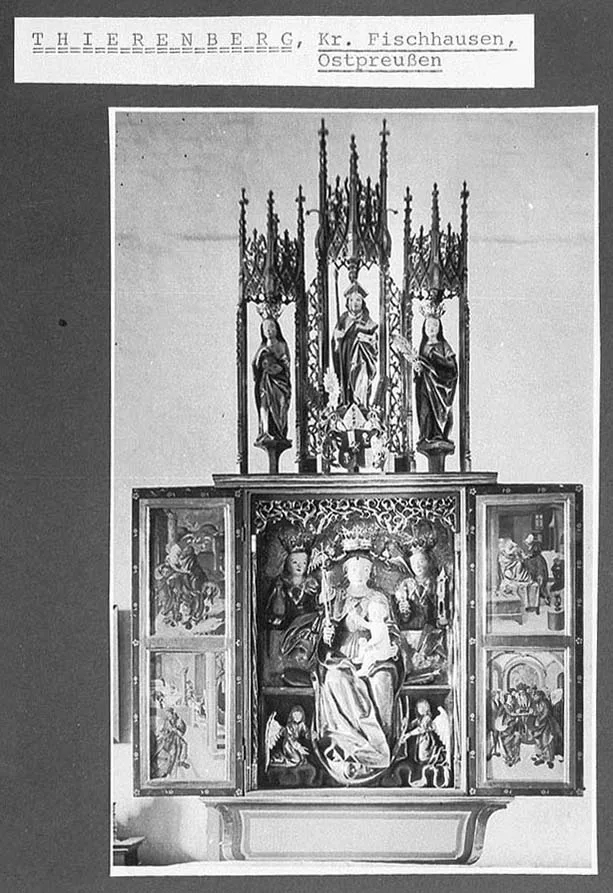
The altar of the Thierenberg church.
In 1785 Thierenberg is classified as a royal village with a church, a windmill and a watermill (Königlich Dorf mit einer Kirche, Wasser- und Windmühle) with six households. By 1818 the number of households had risen to 12, and the village's status remained "royal" (Königliches Dorf).
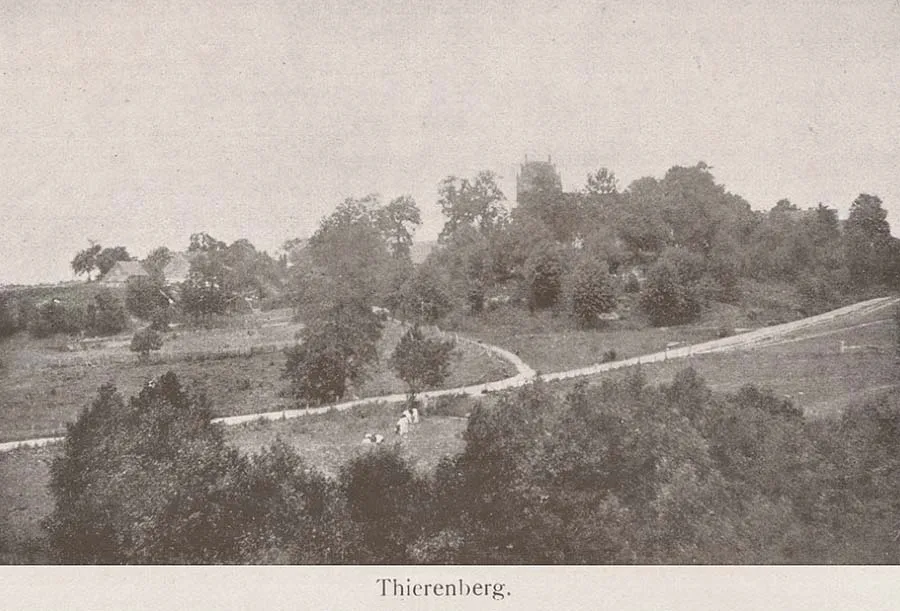
From the beginning of the 19th century Thierenberg belonged to the Kreis of Fischhausen (in 1939 merged into the Landkreis of Samland) and consisted of two administrative units: the Gutsbezirk of Thierenberg and the Gutsbezirk of Thierenberg Castle. The church in Thierenberg was the parish church for 23 surrounding villages and estates. The Gutsbezirk of Thierenberg Castle comprised: the Thierenberg mill (Mühle Thierenberg; Ryabinovka, part, 54°50'22'' N 20°07'30'' E), Markehnen (Krasnovka), Dulack (54°50'51'' N 20°07'07'' E) and Auerhof (Ryabinovka, part).
On 13.06.1874 Amtsbezirk No. 11 Thierenberg was established in the Kreis of Fischhausen, made up of three rural communities: Arißau (Ryabinovka), Cojehnen (54°49'16'' N 20°09'03'' E) and Norgau (Medvedevo), and three Gutsbezirke: Düringswalde (54°48'12'' N 20°05'16'' E), Thierenberg (Dunayevka) and Thierenberg Castle (Thierenberg, Schloß; Dunayevka).
The first head of the Amtsbezirk, in 1874–80, was the district deputy Kröck.
On 31.03.1877 the Vorwerk of Bärholz (Listopadovka) was separated from the Gutsbezirk of Thierenberg Castle as an independent estate and came to form a Gutsbezirk in the Amtsbezirk of Thierenberg. On 19.03.1884 another Gutsbezirk was separated from the Gutsbezirk of Thierenberg Castle — Markehnen, consisting of the Markehnen estate (Krasnovka) and the Dulack Vorwerk. Around 1886 the Gutsbezirk of Thierenberg (Dunayevka) became a rural community of the same name. On 20.10.1897 the Gutsbezirk of Auerhof (Ryabinovka, part) was separated from the Gutsbezirk of Thierenberg Castle. On 04.03.1899 the Düringswalde estate officially received the status of a Gutsbezirk. By 1908 the Amtsbezirk of Thierenberg was made up as follows: four rural communities — Arißau (Ryabinovka), Cojehnen, Norgau (Medvedevo) and Thierenberg (Dunayevka) — and five Gutsbezirke: Auerhof (Ryabinovka, part), Bärholz (Listopadovka), Düringswalde, Markehnen (Krasnovka) and Thierenberg Castle (Dunayevka).
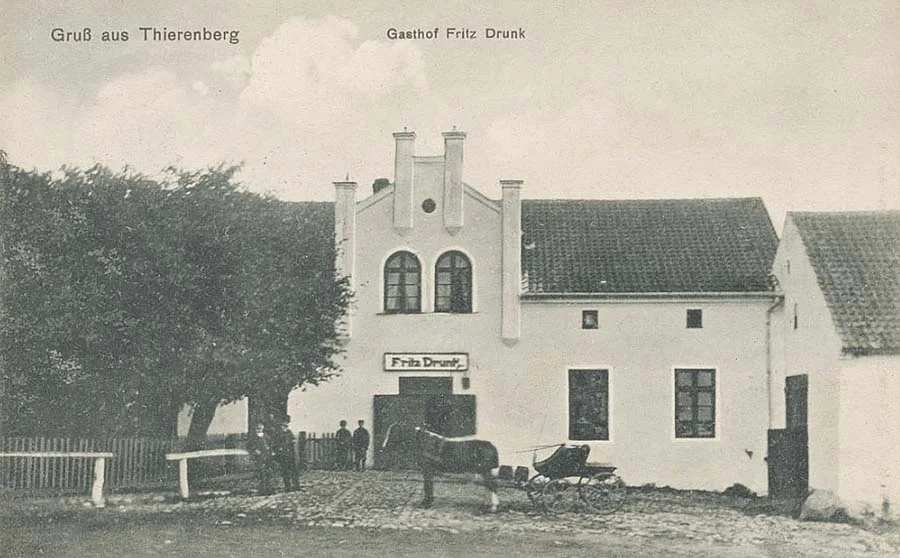
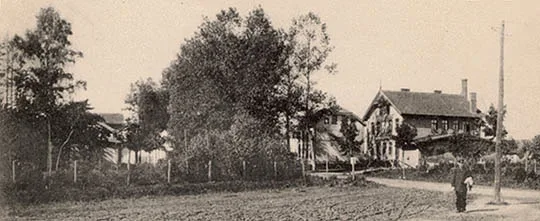
Fritz Drunk's guest house in Thierenberg.
In 1900 the Fischhausener Kreisbahn railway was built past Thierenberg, and a station was built on it.
On 03.09.1914 the Gutsbezirk of Thierenberg Castle was abolished. On 30.09.1928 the communities of Arißau (Ryabinovka) and Thierenberg (Dunayevka) and the Gutsbezirke of Auerhof (Ryabinovka, part), Bärholz (Listopadovka) and Markehnen (Krasnovka) were merged into the community of Thierenberg. At the same time the Gutsbezirk of Düringswalde was abolished and incorporated into the rural community of Norgau (Medvedevo). The Amtsbezirk of Thierenberg now consisted of three rural communities: Cojehnen, Thierenberg (Dunayevka) and Norgau (Medvedevo). Its composition did not change thereafter.
Thierenberg suffered heavily in the street fighting of 06.02.1945, when the Red Army's 91st Guards Rifle Division was encircled in the area of the settlement by the Wehrmacht's XXVIII Army Corps.
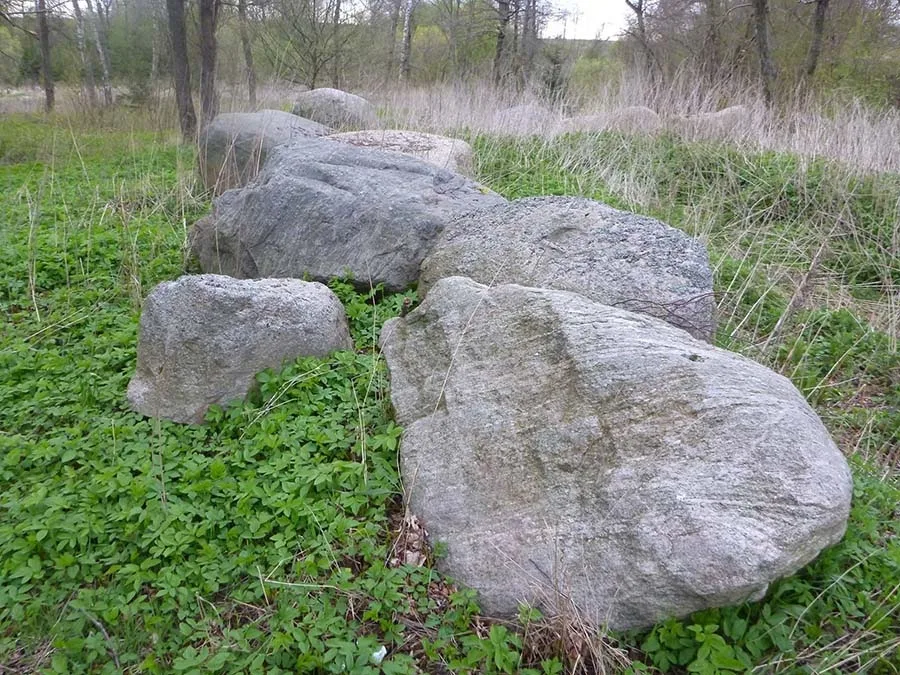
On 17.11.1947 Thierenberg was renamed the settlement of Dunayevka. On 05.07.1950 Mossicken and Lopsitten were merged and renamed the settlement of Rogachevo. Soon afterwards the houses and the ruins of the Thierenberg church were demolished to clear the ground near the airfield. By 1955 the settlement of Dunayevka was no longer located on the site of Thierenberg, but near the newly built airfield, 4.2 km north-east of the former German locality, including on the territory of the former villages of Lopsinnen and Mossicken (see Rogachevo). By 1975 the settlement of Dunayeva had been removed from the register and incorporated into the settlement of Rogachevo of the Romanovo village soviet. In the 1980s the airfield was made a reserve airfield, and then abandoned altogether. In the 2010s car races and car shows were held on it. As of 2018 there are no buildings on the site of Thierenberg; on the site of the settlement of Dunayevka there are the Lesnaya Tish holiday centre and the Dunayevka gardening partnership.
Bärholz
Bärholz is mentioned from 1875 as Berholtz, from 1820 as Baerholz, and around 1871 as Beerholz.
In 1785 and 1818 Bärholz appears in documents as a noble Vorwerk (Adelich Vorwerk) with two households.
In the 19th century Bärholz was a Vorwerk within the Gutsbezirk of Thierenberg Castle (Thierenberg, Schloß; Dunayevka) in the Kreis of Fischhausen (Primorsk; from 1939 part of the Landkreis of Samland). The Vorwerk belonged to the parish of Thierenberg (Dunayevka). In 1871 Bärholz had four residential houses, occupied by 10 families. On 31.03.1877 the Bärholz Vorwerk was separated from the Gutsbezirk of Thierenberg Castle (Dunayevka) and came to form the independent Gutsbezirk of Bärholz, which was included in the Amtsbezirk of Thierenberg. On 30.09.1928 the Gutsbezirk of Bärholz was abolished and incorporated into the rural community of Thierenberg (Dunayevka).
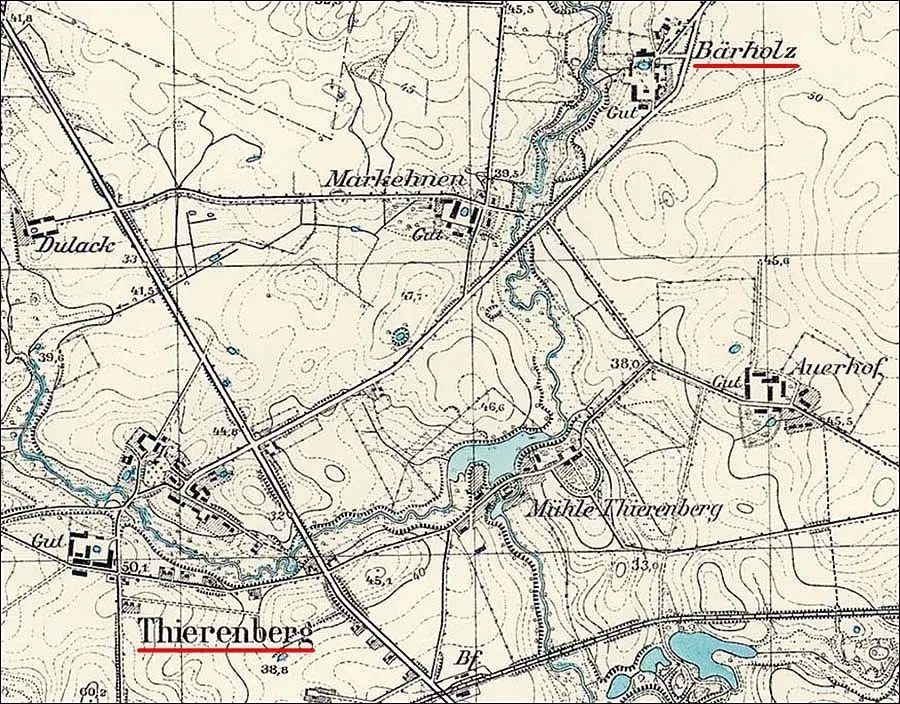
For reference
Population: 1984 — 240 inhabitants.
Population of the Gutsbezirk and community of Thierenberg: 1818 – 110, 1867 – 202, 1871 – 219, 1905 – 170, 1910 – 195, 1933 – 620, 1939 – 622 inhabitants.
Population of the Gutsbezirk of Thierenberg Castle: 1818 – 12, 1867 – 264, 1871 – 278, 1905 – 861, 1910 – 59 inhabitants.
Population of Bärholz: 1818 – 24, 1867 – 51, 1871 – 59, 1905 – 63 inhabitants.
Composition of the population of the Thierenberg estate in 1871: Protestant Christians – 218, Catholics – 1, children under 10 – 57, literate – 137 (85%).
Composition of the population of the Gutsbezirk of Thierenberg Castle in 1871: Protestant Christians – 276, Catholics – 2, children under 10 – 71, literate – 190 (of 198 surveyed, 96%).
Composition of the population of the Bärholz Vorwerk in 1871: all 59 Protestant Christians, children under 10 – 13, literate – 30 (65%).
Population of the Thierenberg mill: 1818 – 15, 1871 – 57, 1905 – 6 inhabitants.
Population of Auerhof: 1818 – 78, 1871 – 97, 1905 – 78, 1910 – 78 inhabitants.
Population of the Dulack Vorwerk: 1818 – 7, 1871 – 21, 1905 – 13 inhabitants.
Population of the Markehnen estate: 1818 – 33, 1871 – 63, 1905 – 76 inhabitants.
The parish of Thierenberg in the 19th–20th centuries comprised: Arißau (Ryabinovka), Auerhof (Ryabinovka, part), Bärholz (Listopadovka), Drugthehnen (Gusevka), Düringswalde, Dulack, Kirschappen (Druzhba), Klein Dirschkeim (Dvoriki), Klein Norgau (Ramenskoye), Cojehnen, Kompehnen (Nivy), Korwingen (Olkhovoye), the Kragau domain (Kragau, Domäne; 54°46'08'' N 20°09'08'' E), Lindenberg (54°52'52'' N 20°04'25'' E), Markehnen (Krasnovka), the Thierenberg mill (Mühle Thierenberg; Ryabinovka, part), Norgau (Medvedevo), Romehnen (54°51'24'' N 20°04'23'' E), Streitberg (54°52'37'' N 20°03'35'' E), Weidehnen (Shatrovo), Vogelsang (54°52'16'' N 20°03'38'' E).
Illustrations: East Prussia Photo Archive, Mikhail Ogorodnikov.
Translated from Russian with the help of AI (Claude, Anthropic), October 2026.