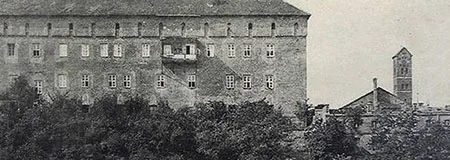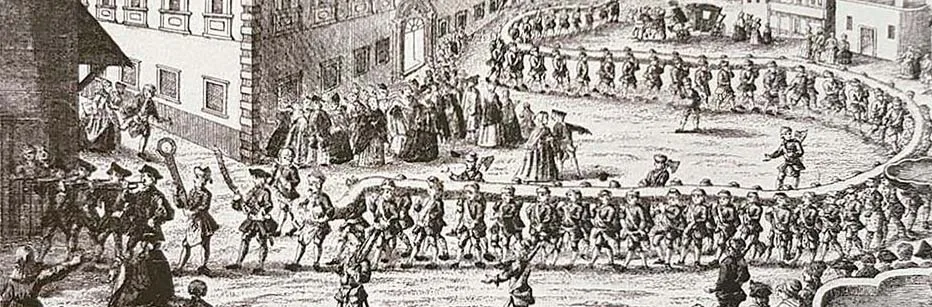
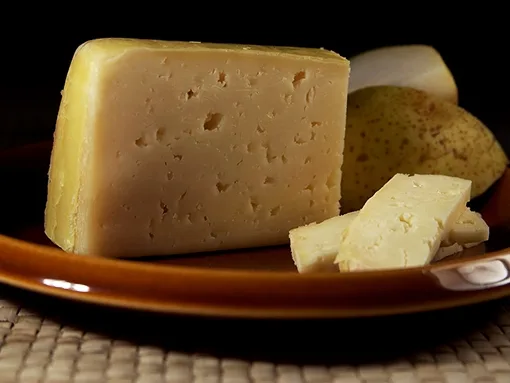
To give a fuller picture of the history of Tilsit cheese, let us go back several centuries to the time of the Swiss Reformation, when in 1525 Conrad Grebel founded a Protestant denomination in Zurich. In 1533 it was officially recognised in the Netherlands as well. The followers of this movement came to be called Mennonites, after the local religious leader Menno Simons. According to historians, the Mennonites were peaceful people by religious conviction. Their principled pacifism ran counter to the interests of the states in which they lived. Whenever the authorities tried to force Mennonites into military service, they would leave their homes in protest.
The first wave of mass emigration came in the mid-16th century. The Mennonites resettled in East Frisia, Northern Germany, and West and East Prussia. Although the Königsberg chronicles first mention them in 1579, the first Mennonite congregation in the East Prussian capital was not officially registered until 1722. As far as is known, the arrival of these new settlers noticeably revived Königsberg's business life. They set up lace-making, a tannery and a textile mill, a silk dyeworks…
The largest area of Mennonite settlement was the Memel Lowland, in the vicinity of Tilsit (today's Sovetsk in the Kaliningrad region).
They established themselves in this area from 1709 onwards and ran their affairs very successfully, engaging in farming and dairy husbandry. The centre of the Memel Mennonite community was considered to be the settlement of Pokraken, the site of today's village of Leninskoye in the Slavsk district. At the time, this corner of East Prussia was even called “Little Holland”.
According to one version, the world-famous “Tilsiter” cheese also owes its existence to the Mennonites. Cheese had of course been made in East Prussia before, but the Protestant settlers brought recipes from their homelands — Dutch and Swiss — which supposedly later became the basis for the new variety. According to this version, cheese production was set up on the Mennonite farm of Plauschwarren/Milchbude. The venture was taken up by Frau Westphal, née Klunk, the owner of one of the dairies in Tilsit. She dreamt of feeding East Prussia real Gouda. But the cellar of her house turned out to be too damp for this variety.
After lengthy experiments, in 1845 Frau Westphal produced for the first time an entirely new cheese with a wonderfully piquant flavour and a supple texture, which soon became famous in East Prussia and then in Germany. Later its taste came to be appreciated throughout Europe. The new variety was named “Tilsiter” after its place of origin.
It began to be made in many parts of East Prussia where Mennonites lived — in Tilsit (now the town of Sovetsk), Ragnit (the town of Neman), the Elchniederung area (the town of Slavsk), as well as in Preußisch Holland (now the Polish town of Pasłęk in Elbląg County, Warmian-Masurian Voivodeship) and elsewhere.
A couple of years after the creation of the “Tilsiter”, the Danish farmer Hanne Nielsen, posing as a local peasant woman, wormed her way into Frau Westphal's confidence. The “cheese spy” was an amateur cheesemaker who travelled in order to master the finer points of the craft. She made her way to Tilsit as well, to discover on the spot the secrets of the local cheese, which enjoyed great popularity in Europe.
Returning a few years later to her farm Havarthigaard (Havarthigaard) on the island of Zealand, Hanne began experimenting and created a new cheese of her own, which she called “Danish Tilsiter”. The result was a very mild, creamy cheese with small eyes and a slightly sweet taste. Only in 1952 did the cheese receive its official name, “Havarti”. There is reason to believe that its recipe was based on that very “Tilsiter” from East Prussian Tilsit.
Remarkably, Tilsit cheese became the object of a veritable hunt. For instance, the Swiss cheesemaker Otto Wartmann (again, according to rumour) also spirited away Frau Westphal's cheese recipe in 1893. Back home in the canton of Thurgau, he raised it to new standards of quality. And so the East Prussian “Tilsiter” became Swiss.
However, if other sources are to be believed, there was no theft whatsoever. On the contrary, it was thanks to Otto Wartmann (apparently after Frau Westphal's death) that production of Tilsit cheese to the original recipe was revived. Long before the Second World War, he moved from Memel to Switzerland with the recipes and set up its production on the Holzhof farm (canton of Thurgau). A very curious fact: on 1 August 2007 this small locality, where Tilsit cheese is still made to this day, was renamed Tilsit.
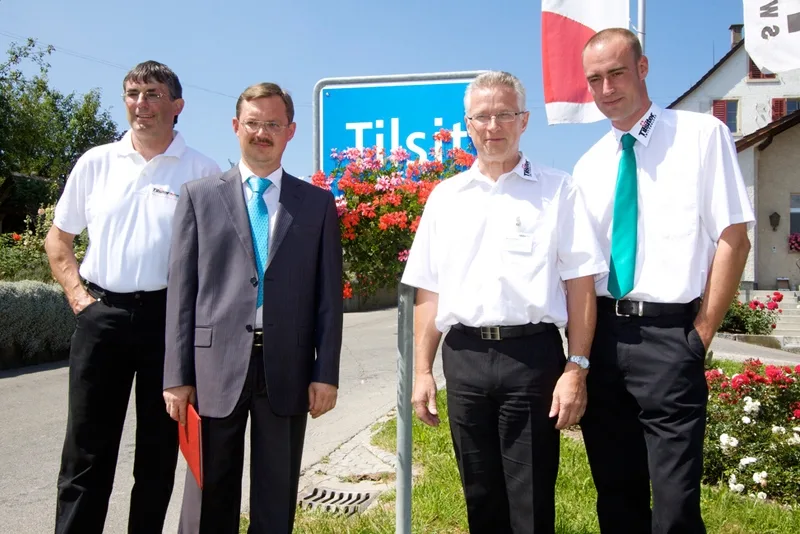
On 1 August 2007, Tilsit was officially “reborn” in Switzerland.
Incidentally, the mysterious Frau Westphal, who supposedly moved to East Prussia from Switzerland, is mentioned in many sources. But these rumours were dispelled by Kurt Schützler in his book “A Brief History of East Prussian Cheesemaking and Tilsiter Cheese” (Dr. Kurt Schützler, «Kurze Geschichte der Ostpreußischen Käserei und des Tilsiter Käses», 1933). According to Schützler's version, she was born Klunk in 1790 in East Prussia, in Schillen (Schillen, now the village of Zhilino, Neman district). At the age of 13 she moved to her Tilsit relatives, who were cheesemakers, on the Birjohlen farm belonging to the Braun family. There she learned to make Birjoler cheese — the very one that was later renamed Brioler (“Brioler”).
Kurt Schützler concluded that the original “Tilsiter” was created without any involvement of the Dutch or the Swiss. Judging by Klunk's notes, it had been made since 1790, and solely for household use. Later she began selling it at the weekend markets held in Tilsit.
In 1822 Klunk married and became Frau Westphal. She moved to Tilsit with her husband and took up the production of “Brioler”, word of which had already reached Königsberg itself. Business went so well that in 1840 she opened a dairy in Tilsit that was quite sizeable for its time and stayed afloat for five years. After that Frau Westphal (probably widowed by then) bought a small farm at Milchbude near Tilsit, where in 1845 the genuine East Prussian “Tilsiter” was in fact born. Did some foreigner of Dutch or Swiss origin take part in its “birth”? In Kurt Schützler's opinion, this is quite possible. There is evidence that Frau Westphal attempted to reproduce the taste of Swiss cheese on a tip, as we would say today, from one of her Swiss fellow cheesemakers. But this, too, is merely one of the versions.
There is an Old Prussian legend about the origin of Tilsit cheese, according to which it was known in our region long before the days of the Teutonic Order:
On a hill near Tilsit there lived a giant with his daughter. Their countless herds of cattle grazed on the broad meadows along both banks of the Memel. The cows were magnificent and well fed, thanks to the lush grass of the Memel pastures. Their milk was so rich that it yielded splendid sweet cream and golden-yellow butter. And there was so much milk that no one knew what to do with it all. So the giant's daughter learned to make cheese from it. It was yellow as gold and soft as butter. She added spices to it, and the cheese had a piquant, unforgettable taste. The giantess treated the peasants who lived nearby to her cheese, but she kept the recipe a secret. No matter how hard the neighbours tried to make it themselves, they never succeeded. In the end they nicknamed the giantess the Milk Princess, and they were very angry and envious of her. At first the nickname amused her, but then the girl grew angry and decided to teach the envious ones a good lesson. She invited all her neighbours to her castle and set a large wheel of cheese before each of them. The guests greedily fell upon the treat, but immediately broke their teeth: the cheese was made of stone. The giantess burst out laughing and with one sweep of her hand swept them all into the castle dungeon. In vain did the greedy, envious neighbours try to get out. They begged for mercy and swore never to mock her again. After a while the girl's heart softened and her anger passed. She forgave the peasants, pulled them back up and seated them at her table. For a long time they told her about their hard lives, drank honey beer and ate the real cheese she served them. When everything had been eaten and drunk, the hostess showed her guests her cheese dairy and explained how she made her cheese. The peasants remembered everything and soon began making the same golden cheese with its spicy flavour. And from that time on, the recipe for Tilsit cheese has been handed down from generation to generation.
There are many such tales about the origins of Tilsit cheese, in a variety of versions. Perhaps, as in fairy tales, there is a hint of truth in them? Be that as it may, Tilsiter undoubtedly conquered Europe. At the beginning of the 20th century, the cheese dairies producing Tilsiter joined together in an association. In 1926, with the support of the Königsberg Chamber of Agriculture, the Association for the Promotion of the Dairy Industry was founded. In 1928, in the small village of Saußeningken, which no longer exists (the site lies near the village of Vishnevka in the Slavsk district), a school training specialists in Tilsiter production was opened on the premises of the local cheese dairy. In 1932, local Tilsiter producers voluntarily introduced quality control of the milk delivered to their dairies, which also had a positive effect on the quality of the cheese. As a result of these efforts, 46 local producers received awards at the 1938 Eastern Fair (Ostmesse) in Königsberg.
By the late 1930s, more than 50 dairies were operating in and around Tilsit, producing over 4,600 tonnes of Tilsiter cheese a year. Surprisingly, however, it was not a registered trademark.
After the Second World War, production of East Prussian Tilsiter ceased for obvious reasons, although the buildings of the cheese factory survived in Sovetsk (Tilsit). A few years ago the town was visited by a delegation of Swiss producers from Tilsiter Switzerland, who proposed reviving the production of Tilsit cheese in its region of origin. The project received support, and in early October 2016 a new cheese dairy in the town of Neman (Ragnit), a satellite town of Sovetsk, began producing the original local cheese, Tilsiter, according to the old recipes.
Translated from Russian with the help of AI (Claude, Anthropic), October 2026.