The Order's Studs
A Horse of Fire
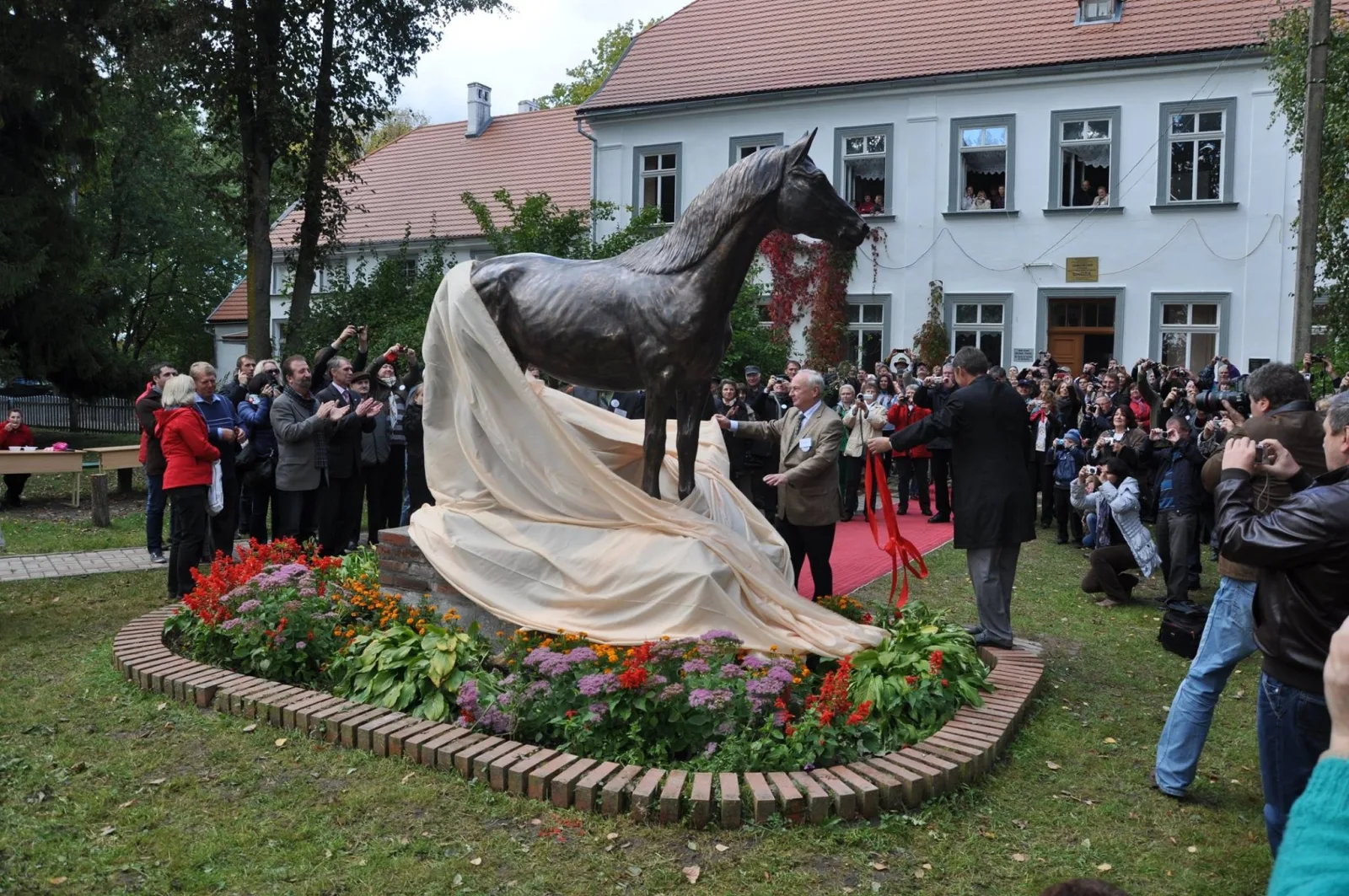
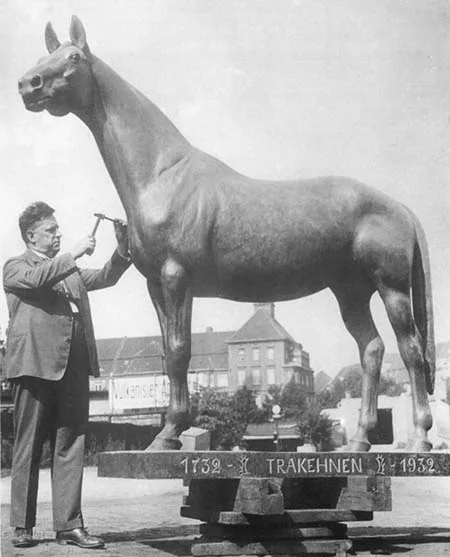
The original life-size bronze stallion by the sculptor Reinhold Kuebart (Reinhold Kuebart, 1879–1937) was erected in Trakehnen in 1932 to mark the 200th anniversary of the breed developed by Prussian breeders. Today the original statue remains at the Timiryazev Academy in Moscow.
In the Soviet Union its fate was, to put it mildly, a hard one. This was especially true in the early 1950s, when the head of the Communist Party, Khrushchev, called horse breeding an unproductive branch of agriculture and effectively outlawed it.
After that pronouncement, the number of breeding horses fell sharply. At the beginning of 1949 the largest stud, the Kirov Stud Farm, had 378 mares, 177 of which had been born at the Trakehnen stud in East Prussia. By 1953, as a result of the deliberate culling of the herd, only 18 of them were left. At other studs the situation was even worse.
And so, in the postwar years, our country destroyed not only the work of the Prussian kings but also centuries of selective breeding whose roots reach back to the 13th century, when the state of the Teutonic Order was being established on Prussian soil, and a good horse cost so much that a large peasant family could have lived on that money for three months without denying itself anything.
The Order maintained more than 30 studs. The number of horses ranged between 10,000 and 15,000. For the most part these were native Prussian horses.
Generation after generation, they were improved by heavy “knightly” stallions and by swift Eastern beauties brought back from the Crusades.
Peasants had no need for thoroughbreds, so the small native horses, blood relatives of the wild forest tarpans, were well suited to their purposes. The Germans called them “Schweike”, meaning “dirty ones”. By the middle of the 17th century, however, these small but hardy animals had died out completely. Yet even today one comes across bay horses in the Trakehner breed with a black stripe running along the back – a legacy of their wild ancestors.
The Work of Kings
In 1701 the first King in Prussia, Frederick I, brought 1,000 saddle horses and 30,000 draught horses to Prussia together with his court. In all, his stables counted 1,310 head of “truly Prussian, most excellent horses”. These were descendants of those very knightly and Eastern beauties. But the plague epidemic of 1709–1711 left almost none of them alive.
In 1713 Frederick I was succeeded by Frederick William I, and horse breeding in the country took on a truly royal scale. The king not only devoted great energy to strengthening the army but also issued an edict on improving horse breeding in Prussia. On the advice of the Prince of Dessau, in 1725 Frederick William I decided to bring his studs together in one place, and personally drew up a plan to drain the marshes – the former hunting grounds of the Lithuanian princes between Gumbinnen and Stallupönen.
Six hundred soldiers from Memel, assigned to the work, dug an entire network of drainage canals over six years. Later the king added to this land the Trakehnen estate (from the Latvian “trakis” – “forest by the marsh”) and bought the estates of Wikinlauken and Jodszlauken.
On the reclaimed land rose stables “distinguished by their graceful simplicity”. In the summer of 1731 the first consignment arrived – 1,101 horses. The official founding year of the Trakehnen stud, however, is generally considered to be 1732.
Over time, however, the king's interest in the stud waned, things went badly, and efforts to improve the breed came to nothing. On top of that came another misfortune: the pastures began to turn back into marsh, which led to a shortage of fodder and, as a consequence, to the loss of horses. Weary of Trakehnen's problems, in 1739 Frederick William I gave it to his son Frederick (the future Frederick the Great).
Despite everything, the crown prince was struck by the changes that had taken place in a land once devastated by the plague. In East Prussia, which had become the most fertile province of Germany, towns and villages had been rebuilt, fields were being cultivated and trade was flourishing… A happy corner of plenty. The heir to the throne settled in Trakehnen and set about putting the estate in order.
Domhardt and Lindenau
In that same year of 1739, a year before his death, Frederick William I appointed Johann Friedrich von Domhardt, regarded as a first-class expert in horse breeding, as head of the stud (Oberstallmeister). It was he who first moved away from haphazard crossing of horses of different breeds to breeding by lines, which is considered the key factor in pedigree horse breeding.
But then misfortune struck again: the growing herd soon led to a shortage of fodder and overcrowding in the stables. The king would not hear of building new ones, and all breeding work was entirely subordinated to the needs of his court. Frederick II either took the best horses for the royal stables or gave them away to courtiers. As a result, only the poorest horses were left at the stud. By some miracle, though, Domhardt managed to persuade the king to return 32 high-bred Trakehner stallions to the stud.
In 1756 the Seven Years' War broke out; Trakehnen was plundered and, according to the sources, the best horses were driven off by Cossacks. Once again it was Domhardt who saved the stud from complete ruin. The war sobered the king somewhat. He no longer spared any expense on horse breeding. Breeding work on the Trakehner continued.
These were horses without equal, as Frederick saw for himself more than once: with Trakehners, the sandy road from Berlin to Potsdam could be covered in just two hours.
Domhardt, meanwhile, was already consumed by the idea of breeding pedigree stallions to cover peasants' mares. But the king once again sank into apathy, citing his old age. Domhardt, however, had no intention of abandoning his plans. In 1779 he established a covering stable on his own initiative. At first few took advantage of the free “services” of the pedigree Trakehner stallions – the peasants had always been wary of anything new – but within a few years demand for the well-bred “sires” had multiplied.
As a sign of reconciliation and in recognition of his services, Frederick the Great ennobled Domhardt and his descendants, sending to Trakehnen, as a token of “his highest favour”, stallions of English and Turkish blood, which played an invaluable role in improving the Trakehner breed.
Johann Friedrich von Domhardt died in 1781, and until the death of Frederick the Great in 1786 the stud was run by officials from Königsberg. Trakehnen then passed into state ownership, and what were perhaps its finest years began. The new king, Frederick William II, ordered that the stud's income be used to buy breeding stallions, and entrusted the management of all horse breeding in the country to the Oberlandstallmeister and hereditary horse breeder Count Carl von Lindenau, who, carrying on Domhardt's work, effectively laid the foundations of Prussian state horse breeding. The young count saw the main goal of breeding as producing riding horses, and believed the surest way to achieve it was to use English Thoroughbred and Arabian stallions in the breeding programme.
As a result, after a time Trakehners came to be in enormous demand even beyond East Prussia. Lindenau also introduced the branding of all horses of the breed – “a single seven-pointed elk antler” on the right thigh.
A curious story is associated with Lindenau's name. He once gave orders for mares to be covered by bulls and cows by stallions. He had supposedly seen such animals at the zoo in Kassel. But Friedrich von Brauchitsch, who had by then taken over the management of the stud, flatly refused to carry out such an unthinkable experiment.
War After War
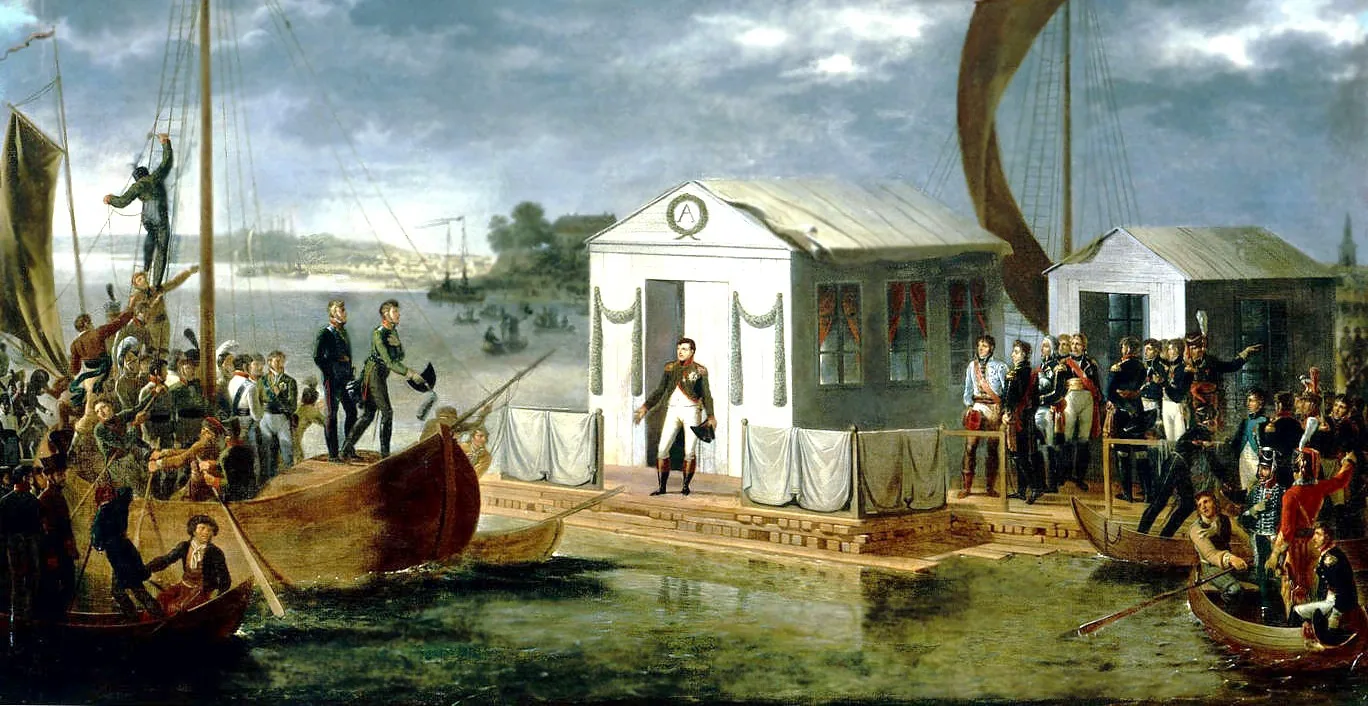
The outbreak of war with Napoleon interrupted breeding work for a long time. In January 1806 the Trakehnen stud was evacuated via Memel to Count Zubov's estate of Shavli in Kovno Governorate. Many horses died along the way from exhaustion, disease and cold. The hardships of restoring the war-ravaged estate fell on the shoulders of the master of the royal travelling stables, Wilhelm Karl Friedrich von Burgsdorff. During almost thirty years of service he restored the stud and the rural stables, improved the manor, and established strict breed records. In the administrative building he set up a museum with portraits of famous horses, and he opened schools for the children of the stud's workers. Trakehnen was now a small state in its own right, with a hospital, a school, an inn, a post office, a brickworks and a herd of cows.
For a while, however, the stud had no luck with von Burgsdorff's successors. A certain Mülheim did not last even a year in the post, and the dashing Landstallmeister Max let the records fall into such disarray within 4 years that his successor, cavalry major Friedrich von Schwichow, whom German hippologists describe as a “gifted master breeder”, had to spend several years restoring them. When he finally succeeded, he was replaced by Gustav von Dassel, who was no master breeder but had undeniable organisational talent. The hussar major staked everything on breeding very large horses for rural horse breeding, which were to become an inexhaustible army reserve. Every year Dassel sold more than three thousand horses to the army. Purchases kept growing, helped in no small part by the Franco-Prussian War of 1870–1871.
But after the First World War, when the Treaty of Versailles forbade Germany to maintain an army, East Prussian horse breeding lost its main market.
A relatively brief period in which the breed grew stronger began in 1922, when Count Siegfried von Lehndorff was appointed Landstallmeister of the stud. Under his leadership, stallions appeared here whose presence in a horse's pedigree is still a guarantee of its quality today. In 1931, however, following a conflict with the Minister of Agriculture, the disgraced count was forced to leave his post and swap places with Dr. Ernst Ludwig Carl Ehlert, who had been running the stud at Braunsberg.
The new director made his own contribution to improving the breed. He used to say: “In Trakehners, inner harmony must be a consequence of their outward appearance.” During his directorship, Trakehner horses were tested under saddle and in harness, while breeding work was carried out at the same time to select for obedience and good temperament.
Famed for their rare combination of elegance and tenacity, Trakehners flourished for almost two centuries, but during the Second World War disaster struck.
In 1944, when the Soviet offensive began, the stud was evacuated to Graditz, Neustadt and Perlin. The horses left behind met a different fate: in August 1945 they were transported to the Kirov Stud Farm in the Rostov Region. Although the Trakehner horses became a momentous trophy for Soviet horse breeding, they turned out, as the saying goes, to be unwelcome guests… After the notorious plenum of the CPSU Central Committee in 1953, Soviet horse breeding suffered a genuine tragedy. Trakehner horses, too, stood on the brink of extinction. There was no use for them: the cavalry of the Soviet army had been abolished. Nor was there any use for them in the countryside, given the rapid pace of mechanisation. It was a time when shop windows were piled high with horsemeat sausage...
Zapros, by Pepel out of Zaponka
The situation only began to improve around 1957, when the Kirov stud struck a mutually beneficial deal with Polish horse breeders: they gave them 14 mares and received Thoroughbred stallions in return. Work began in the service of Soviet sport.
Trakehners soon proved themselves to be excellent sport horses. In 1970 the Soviet rider Elena Petushkova won the world dressage championship on a Trakehner stallion named Pepel.
Incidentally, German breeders did not miss the chance to acquire his offspring, born to Zaponka and given the strange name Zapros.
In September 1997 Russia became a member of the international community of breeders and lovers of the Trakehner horse, united under the aegis of the German Trakehner Verband, and gained the right to brand its horses with the double seven-point elk antler bearing the symbol “K” adopted for Russia. And horse breeding in the homeland of the Trakehner breed, the Kaliningrad Region, is now actively pursued by Yuri Mikhaylovich Luzhkov, known to the whole world in earlier years as the mayor of Moscow. Whether he will succeed in reviving the tradition, time will tell. We hope that Yuri Mikhaylovich will not refuse to tell us how things are going for him.
Sources:
Архивы ЗАО «Кировский конный завод»
Борислав Камзолов. «История Тракененской лошади»
Джудит Дрейпер. «Лошади и уход за ними»
E. Joachim, Johann Friedrich von Domhardt. Ein Beitrag zur Geschichte von Ost- und Westpreußen unter Friedrich dem Großen
Translated from Russian with the help of AI (Claude, Anthropic), October 2026.