"All crossed by paths unknown that wander on
Through rocks of darkness and through dunes of light,
Washed by the foaming billow of the sea,
Laced with the silver threads of rivers, lay
The land.."
…It happened in that great, ever-memorable time when, in the Holy Land, during the reign of the Roman Emperor Augustus, our Saviour Jesus Christ was born. The stargazers of the city of Salura in Bithynia, in Asia Minor1, wishing to know whether people lived in the north, and if so, how far away, left their homeland to seek the answer and set off on a long journey. Among them was a certain man named Divo, or Divonius2, who left these notes to posterity. The travellers passed through the whole of Tartary3 and the lands of the Rus, crossed the territories of the Wends and the Alans in Livonia, and at last, after long ordeals and the perils of the road, they reached Prussia.
Well, let Divonius himself continue his story....
"Having crossed the great waters of the sea, we landed on a shore that was desolate and wooded but had no fixed name of its own. This land was called now Sargatia, now Gelida, now Vatina4. On one side it was washed by the sea, on the other by a great river.
There were no villages, no fortresses, no towns here — only, here and there on the riverbanks, stood wretched huts built of reeds, just as beavers build their lodges there.
We had barely managed to get out of the bogs and marshes onto firm ground when night overtook us in the midst of that dreadful wilderness. And no sooner had darkness fallen than the virgin forests around us filled with the roaring of wild beasts. The growling of bears and lynxes and the howling of wolves, carrying across the valleys and hills, echoed a hundredfold all around. At last, somewhere far off in the depths of the forests, came the mighty bellow of the aurochs, those powerful bulls, and even the surrounding trees trembled at it!"
"And here," Divonius continues, "where, under the protection of gigantic trees reaching to the clouds, the lush grass of the marshes feeds every forest creature at all seasons of the year, people live! But they live not only here, among wild monsters. We met several Wends from Sarmatia, whose language we partly understood. They told us that the neighbours call the people here Ulmigers, because they are accustomed to settle on riverbanks under the willows5.
Out of reeds they also make cloaks, which they wear on their bare bodies.
And yet, however wild their appearance, the faces of the Ulmigers are handsome and their character amiable. They are simple-hearted and modest, and very friendly towards strangers besides.
They know no gods and instead worship the Sun and the Moon. But they worship them without veneration and without prayers — they merely gaze in wonder at the heavenly bodies when these appear in the sky in their bright radiance.
Their food is fish and their drink is water. When the rivers freeze in winter, a winter torpor comes over them too, and for the most part they either sleep or sit idle by the fire in their huts. They know no arts and can neither write nor read. Their speech, unlike that of southerners, is monosyllabic and full of peculiar intonations. A stranger can only try to understand these people by their gestures, the expressions on their faces and their deeds."
"Just as in the south, where one may meet many peoples who differ in language and customs yet often live side by side in one state, so in the north these remote places are inhabited by various tribes. Besides the riverbanks, they also like to settle on the seashore.
And while in the south settlements and fortresses spring up quickly side by side, and great cities grow in friendly valleys and by the rivers, here in the north, seeking shelter from the harsh cold winds and the wild beasts of the nearby forests, people build their dwellings apart from one another and yet live in close unity as a closely knit and contented people.
But among them there is one in whom the common soul of the people dwells! He is called the chieftain, the elder. Everyone he takes under his protection obeys the chieftain. People call both their land and themselves by his name. Everyone around submits to him, however many communities and clans may live on his land.
However, there are many such elders. There is no single common name for the whole land through which our path lies. One district is called one thing, another something else, if the tribal chieftain there is just as influential and strong!
And the strength of these tribes, expressed in the might of their chieftains, lies in their custom of taking three wives at once. But it also lies in fighting with a strong and brave hand against the wild beasts of the forests, or in punishing a neighbour who has tried to take what does not belong to him! The more successful a warrior is in battle, the greater his power; the more harm he does to his neighbours, the safer his crops in the fields; the more sons are born to him, the more huts he will build, and the farther along the riverbank his domains will stretch!
The farther inland we went, the more often the names of people and places changed. But it seems to me that, although many tribes inhabit this land, they differ little from one another in essence.
All of them use the same methods of reckoning time. They keep count of the days and of the changing phases of the moon by notches on wood or knots on cords.
Among all the tribes here," Divonius concludes his account, "there is one custom: on his father's death the son inherits his wives as well. And, as his father once did, the son, on coming of age, builds himself a dwelling. Returning from campaigns in foreign lands, the men bring back for themselves — either taking them captive or obtaining them for a ransom — three wives, and always Slavic women! But few children are born to them…"
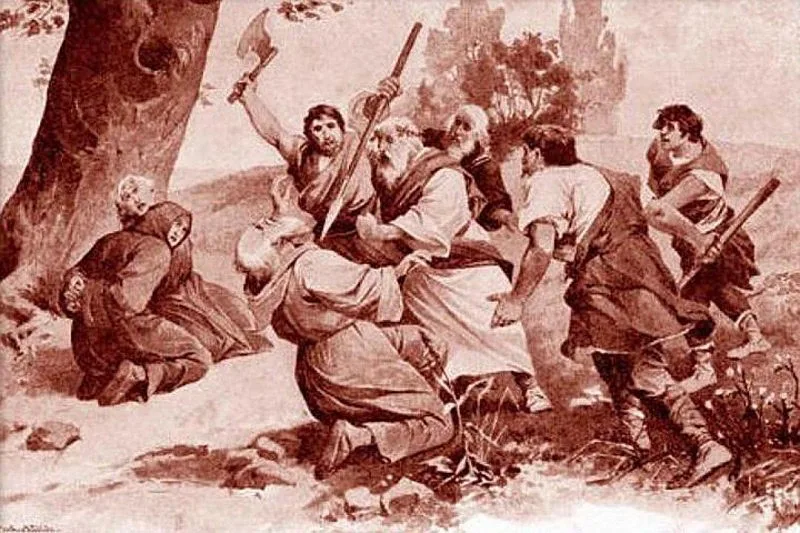
Thus the Bithynians learned about the way of life and the customs of this people. The winter season forced them to remain in those parts, but when summer came they fell ill and all died, except for one, called Divonius. This last one, while returning home, died at Płock in Masovia, where he left behind certain notes which, as has been said, later came into the hands of the provost Jaroslav. And Jaroslav passed them on to Bishop Christian6.
And now we are reading them.
TRANSLATOR'S NOTES
1. Bithynia (Gr. Βιθυνία, Lat. Bithynia) — a historical region, ancient kingdom and Roman province in the north-west of Anatolia (Asia Minor), between the Bosporus and the river Sangarius. The largest cities of Bithynia were Nicomedia and Nicaea.
2. The author of the notes is called Divo (Diwo) or Divon (Diwones). Here I have rendered his name as Divonius, since he came from Asia Minor, a Greek or at least Hellenised region.
3. Tartary — a geographical term used in Western European literature and cartography for the vast regions stretching from the Caspian Sea to the Pacific Ocean and to the borders of China and India. In European sources Tartary became the most common name for Central Asia. The area formerly called Tartary is also referred to in modern English-language usage as Inner or Central Eurasia.
4. The notes of Divonius are briefly mentioned in "Slavic Antiquities", published in Moscow in 1837. Here, in particular, is what it says about the names of the lands:
"The description of this people given here and the names of the lands mentioned above, Sargatia, Gelida, Watina, assure us that this tale concerns the most northerly people of present-day Rus: the Chukhontsy, or better still, the Lapps. Sargania, meanwhile, should be sought in the vicinity of the river and town of Sergach, and the ancient dwellings of the Votes in the St Petersburg Governorate.
("Slavic Antiquities". Pogodin edition, Moscow, 1837. Link)
5. The Prussians called their land the "Island Kingdom" ("Ulmigania", "Ulmigeria", "Ulmerigia" in the Gothic variant) — until the 12th century the Sambian Peninsula was considered an island bounded by the waters of the Baltic Sea and the rivers Pregolya and Deima.
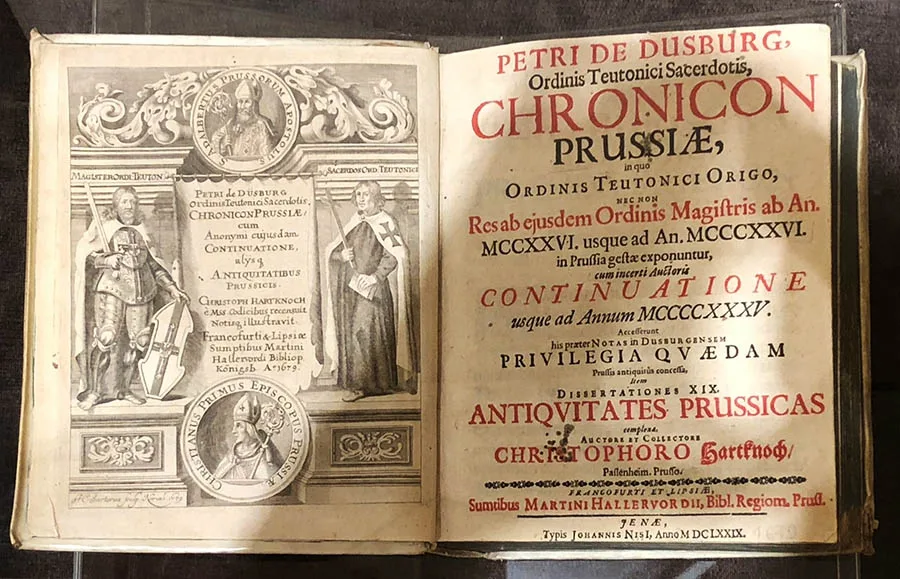
6. "No sooner had the Bithynians learned about the way of life and the customs of this people than the winter season compelled them to remain in that country; but when summer came, they fell ill and all died, except for one, called Divon (Diwones). This last one, while returning, died at Płock, where he left behind certain notes which later came into the hands of the provost Jaroslav. Jaroslav sent them, together with the Cyrillic chronicle, to Bishop Christian."
("Slavic Antiquities". Pogodin edition, Moscow, 1837. Link)
● Editor's note: Read on VisitPrussia.com an interview with the translator of German and, in particular, Prussian fairy tales, our regular contributor Tatyana Kolivay, who runs her own blog, where countless other parables, legends and fairy tales in her translations have been published.
Translated from Russian with the help of AI (Claude, Anthropic), October 2026.