A hundred and eighty years later, during the famous Moscow Thaw, one of his admirers reflected: "He appeared, it seems to me, unlike anyone else. He is not only a fantasist but full of genre, everyday life, authenticity. Sometimes he gets muddled. They say he wrote drunk." The author of these lines, Yuri Olesha, creator of the famous fairy-tale novel "Three Fat Men" (and, incidentally, no stranger to alcohol himself), asked:
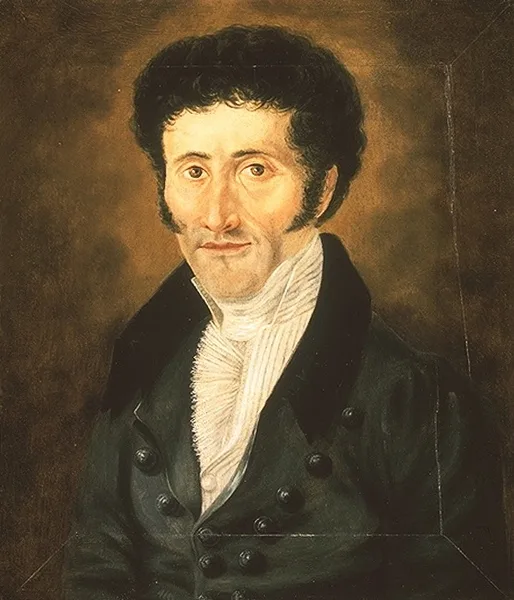
"Who was he, this madman, a writer unique in world literature, with raised eyebrows, a thin nose curving downward, and hair forever standing on end? There is evidence that while writing he was so frightened of what he was depicting that he asked his wife to sit beside him."
The life of Ernst Theodor Amadeus Hoffmann, born into the family of the royal court lawyer Christoph Ludwig Hoffmann, who was married to his own cousin Louise Albertine, née Doerffer, seems to have gone wrong from the very start. His parents' family was no island of staid, respectable matrimony. Just three years after Ernst Theodor's birth it came to divorce, a rare thing in those days. The children were divided: the elder son was left with his father to be brought up, while the future Romantic moved with his mother into the house of Grandmother Doerffer.
The strange child's talents began to show from an early age. One after another. First the artistic one: the boy clearly had a gift for drawing. Then the musical one: the young Hoffmann taught himself to play several musical instruments, displaying perfect pitch, a bottomless memory and an impressionability that frightened his relatives. At 14 he began taking lessons in music and composition from the cathedral organist Podbielski and, at the same time, lessons in drawing from the painter Saemann.
Finally, already in his youth, he was seized by a passion for writing.
At 19, in the shortest possible time (all his life Hoffmann would write, and later dictate, his works very quickly), he wrote two novels, which have not come down to us, in imitation of his literary idols of the day, Jean Paul and Rousseau.
At sixteen, following family tradition, Hoffmann entered the law faculty of the University of Königsberg. At seventeen he acquired a mistress: a married lady nine years his senior. The affair with the flighty Dora Hatt, who bestowed her favors on other admirers besides the young student, with its scandals, clashes with rivals (verbal ones, thank God) and attempts to flee Königsberg to wherever his feet would carry him, dragged on for four years. During the only successful attempt to leave, Hoffmann made his debut as a professional painter: in Glogau in Silesia (now Głogów in Poland), together with a local master, he painted the walls of a Catholic church.
After his final break with Dora, the future classic, who by then had already passed his first final examination and was working as a court investigator, hastily got engaged to one of his cousins in order to dull his heartache. That year (1797) his father died, having outlived the wife he had abandoned by only a year. Hoffmann, having passed his second law examination the following year, obtained, after much effort, an appointment to the capital of the kingdom, where his maternal relatives lived. He stayed with them, beginning his service as a referendary at the court of appeal. The young lawyer continued to prepare for his third and final law examination, which he passed successfully a year and a half later.
Besides his work at court and his diligent study of the law, he lived for his art, composing singspiels: music for plays generously furnished with vocal numbers.
Unfortunately, fate did not spoil him at first: theaters were in no hurry to stage the works of an amateur musician, even one who diligently took lessons from well-known composers and was friends with the famous Carl Weber.
After the third examination, which finally confirmed Hoffmann's membership of the legal profession, he was appointed to Posen. A year and a half of service at the Posen district court ended in a tremendous scandal: caricatures he had drawn of members of the local beau monde, including, dreadful to say, his immediate superiors, began to pass from hand to hand. As punishment Ernst Theodor was hastily transferred to the small town of Płock near Warsaw. Every cloud has a silver lining: the punishment brought the obstinate young man personal happiness. A letter flew to Königsberg announcing the end of his engagement to his cousin, and Hoffmann, now in love, married a Polish woman, Michalina Trzcińska, whom he affectionately called Mischa (not suspecting that in Russian this is a man's name).
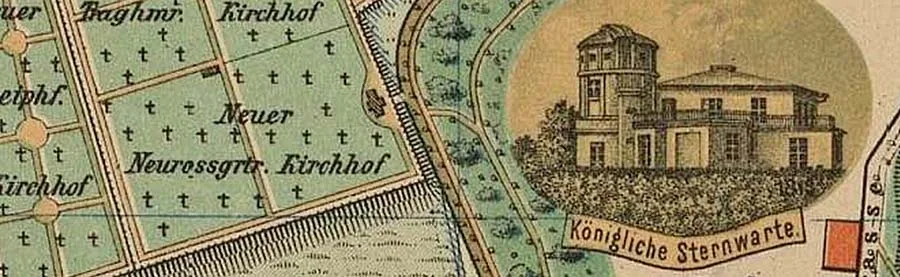
In January–February 1804 Hoffmann visited his native city for the last time in his life: he met his friends, called on the daughter of his unfaithful mistress, Malchen Hatt, whose mother had died by then, and left for Warsaw, where he had obtained a post. And not only that.
He was invited to take part in the decoration of one of the newly built palaces, at whose grand opening he conducted his own symphony.
The local theater staged his musical play for the first time. Mischa presented her husband with a daughter, who was named Cäcilia. So everything was going well. Everything except European politics.
In that year, so fortunate for Hoffmann, Napoleon went to war with Austria and, having routed the Austro-Russian army at Austerlitz, soon invaded Prussia. Having occupied the kingdom, the French put an end to the activities of all Prussian civil servants. Hoffmann was dismissed. There followed fruitless attempts to earn a tolerable living with his artistic talents, an enforced separation from his wife and daughter, who escaped poverty by staying with relatives in Posen, moves in search of work (Berlin, Glogau, Bamberg), illnesses, the sad news of the death of little two-year-old Cäcilia… And yet another calamity: love. A passionate, unrequited feeling for young Julia Mark, to whom he gave singing lessons. A love that nearly wrecked Hoffmann's family life and drove him to madness, to the thought of a double suicide with his beloved, following the example of the dramatist and novella writer Heinrich von Kleist, who had ended his life in that way a year earlier.
In despair Hoffmann turned to writing. His first Romantic novellas were published in the Berlin "Allgemeine musikalische Zeitung." In 1814 his first collection of fantastic prose, "Fantasy Pieces in the Manner of Callot," came out in two small volumes. A year later the dark novel "The Devil's Elixirs" was printed.
Finally, the fairy-tale opera "Undine" premiered successfully, and his talent as a composer was noted by Beethoven himself.
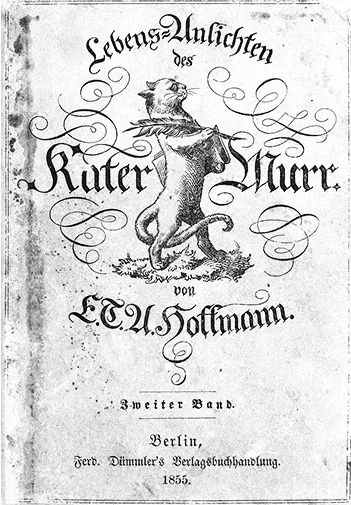
"The Life and Opinions of the Tomcat Murr"
Cover of a German edition (1855)
But his dream of becoming Kapellmeister at an opera house remained a dream. And Hoffmann had to return once more to the duties of a judicial official. From then on he was not in want; material well-being came, without luxury but with dignity. The trials of the war years left their mark on the way of life of the writer and composer. To put it plainly, his fondness for wine and for long evenings in taverns with friends began to take on an increasingly morbid character.
But his creative ascent continued. In the six years of life that remained to him after the triumph of "Undine," Hoffmann created his most accomplished literary works. These are the large two-volume novel in novellas "The Serapion Brethren," which includes the famous tale "The Nutcracker and the Mouse King"; the fantastic-satirical novel "The Life and Opinions of the Tomcat Murr"*; and the short tales "Little Zaches," "Princess Brambilla" and "Master Flea."
In the last year of his life the clouds gathered over the writer again: the tale "Master Flea" was persecuted by the censors, and Hoffmann himself was threatened with prosecution. But the author of the seditious tale, stricken with paralysis, died on 25 June 1822 in Berlin at the age of 46.
Hoffmann possessed a furious imagination. His fantasy is whimsical and capable of astonishing, but here is what is interesting: it is a fantasy drawn from the depths of everyday life. Like all the Romantics, he waged war on philistinism, on that smug complacency of the ordinary citizen, alien to all ideas and impulses of inspiration.
What could he set against the first edition of the consumer society, which rules the modern world even more than it did in the writer's day? Only art and love. It is no accident that musicians play such a role in his stories and novels.
And, of course, it is no accident that the writer's genius inspired the musical geniuses of the nineteenth century to create the famous ballets "The Nutcracker" and "Coppélia" and the opera "The Tales of Hoffmann."
It may seem strange, but in Germany, right up to the 1920s, Hoffmann was not considered a significant writer worthy of rapture and admiration because of his "lack of seriousness." He was far more popular in France, England and, above all, in Russia. Gogol admired Hoffmann's work and in his "Petersburg Tales" not only mentioned his name but at times clearly imitated him. Dostoevsky considered him a genius and read his complete works, all seven volumes, in German. The great reformer of the stage Vsevolod Meyerhold wrote articles under the pseudonym "Doctor Dapertutto," borrowed from a story by Hoffmann. Another Russian director, Alexander Tairov, staged "Princess Brambilla," which remained in the repertoire of the Moscow Chamber Theater for many years. The cinematic genius Andrei Tarkovsky wrote the screenplay "Hoffmanniana," in which he intricately wove together episodes from the writer's life and the characters of his works. Unfortunately, a film was never made from this screenplay. But Hoffmann's fortunes in the cinema have been quite successful. Over a hundred years, more than sixty film adaptations, film-ballets and animated pictures based on his works have been made in Germany, England, the USA, Japan and, of course, Russia.
The latest news of Hoffmann on screen: in 2015 the Italian master of horror Dario Argento announced that he was preparing to shoot a film based on the novella "The Sandman."
Ernst Theodor Amadeus Hoffmann continues to entertain and frighten, to amuse and to make us think. His native city remembers the great author, and the idea of making the image of Hoffmann's character, beloved all over the world by children and adults alike, the brave toy Nutcracker, an unofficial symbol of Königsberg-Kaliningrad does not seem at all sacrilegious.
Translated from Russian with the help of AI (Claude, Anthropic), October 2026.