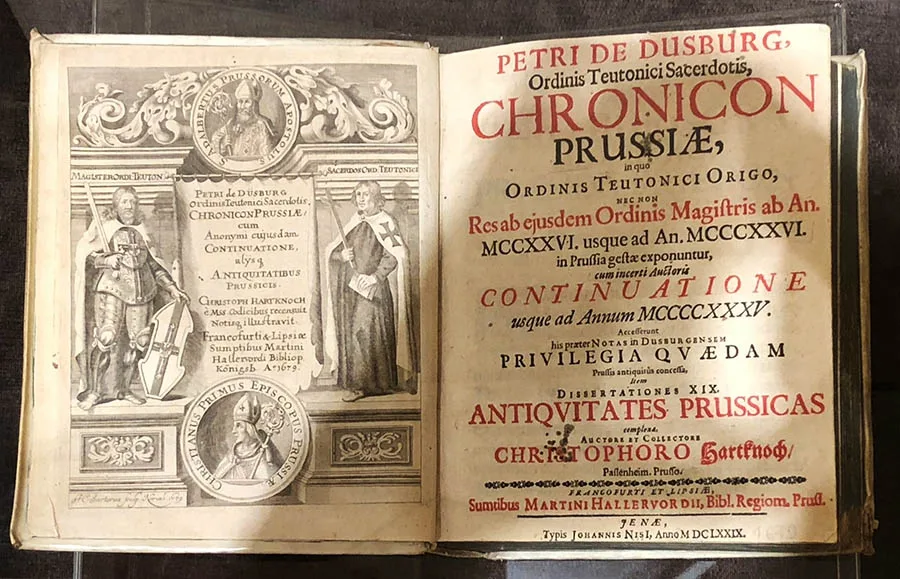
Simon Grunau, "Chronicles of Prussia" (1520), in 2 volumes. Volume I.
And the duke said:
"In namen Gotis amen. I, Konrad, Duke of Masovia, Kuyavia and Dobrin, of my own free will and with the consent of my heirs, give to the worthy German Order in perpetual possession the Kulm Land as a bulwark for it in defending the Christian people against the raids of the Prussian pagans. And if the knight brethren conquer the Prussian lands, they must share them with us. They must also give every support to the Polish dukes in their strife with the Prussian pagans, neither in word nor in deed act against the ducal heirs, and in no way do harm to Poland.
Upon this the duke gave his hand to the brethren, as did his duchess, Agafia, his sons Bolesław, Casimir and Siemowit, and all the nobles present here gave their hands. Drawn up, sealed and with a prayer sent to the Most Holy Pope."
The brethren sent this ducal charter to the Grand Master, Brother Hermann, and he passed it on to the Pope. And the Pope confirmed that he was taking the Prussians under the protection of the patrimony of Saint Peter1.
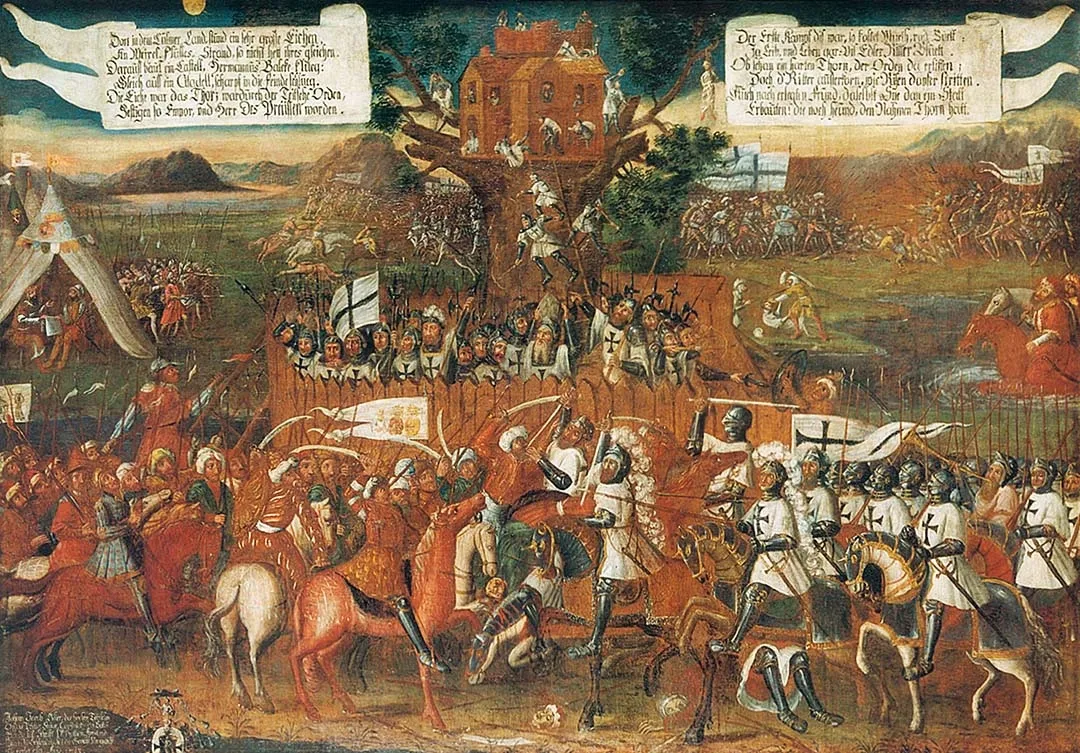
Meanwhile Duke Konrad of Masovia began building a fortified castle on the Vistula for the needs of the brethren, so that they would have a place to live and to shelter from the raids of the Prussians. The site of the castle was not chosen by chance. It was sacred to the Prussians. In a hallowed grove there stood a huge oak, one of those great oaks of the Prussians where they honoured their gods and brought them sacrifices.
This oak, like its other brethren, was of incredible size, and when Hermann von Balk, the first Landmeister of Prussia, came to this country and saw it, he seized the place, despite the desperate resistance of the Prussians.
And since the oak was so huge, the Landmeister had it fortified so that it would serve his men as a watchtower, a Turm2, and as a stronghold against the pagans, who kept trying to win it back.
And so the castle was built: large tree trunks were taken and driven into the ground, then walls were put up around an area four Morgen3 of land across, and in the middle of the fortification stood the oak. Around the castle walls a deep moat was dug, spanned by drawbridges by which one could enter the castle. The brethren called it Vogelsang — Birdsong — because it was built in wooded country, and from it one could hear the birds singing in the trees. And Vogelsang stood on the spot where Thorn Castle4 later arose.
The Prussians never managed to take Vogelsang, though they stormed the castle many times, losing their best warriors beneath its walls.
And for the greater safety of the brethren, the duke had another castle built nearby, on the other bank of the Vistula, and called it Nieszawa5. He gave it to the knights, so that if the Prussians attacked, they could cross by boat to Nieszawa Castle and find protection there. It was built in exactly the same way as Vogelsang, and both had been built by 1231.
At that time there was a great pestilence in Prussia, about which Bishop Christian writes: "...the Prussians rushed into the forests like wild beasts, and wise men said that the Prussian pagan gods had died, and that the crusader brethren had been sent into these lands to convert the pagans to the true faith...".
Later a town grew up around the fortress of Vogelsang, which, after the oak, was also called Turm, or Thorn6. This, however, is not the same Thorn we know today. Every spring the river washed away the banks of Old Thorn (Alt Thorn), and so the town was moved a mile further from the water, to where modern Thorn stands today. Fragments of the walls of old Thorn can still be found in excavations. Among the people there is a belief that ghosts can still be met there, and so no one goes there between midnight and first cockcrow.
TRANSLATOR'S NOTES
1. In Simon Grunau's text: "und er nam Preussen an wie ein gut vom patrimonio Petri..."
Patrimony (from Latin patrimoniālis — literally "paternal"). The Patrimony of Saint Peter is the official name of the Vatican, given at its creation in 756 by Pepin the Short.
2. Turm (German: Thurm) — German for "tower".
3. Morgen, morg (from German Morgen, "morning") — an obsolete unit of land area in medieval Western Europe and, in particular, in the Polish–Lithuanian Commonwealth, equal to approximately 0.56 hectares.
Originally a morg meant the area that one man could plough or mow with a single harnessed horse in the course of a working day (that is, from morning until noon), and its size — depending on the quality of the soil, the horses harnessed and the tools — varied in Europe from 0.33 to 1.07 hectares.
4. In his "Chronicles of Prussia" Simon Grunau merges the fortresses of Vogelsang and Thorn.
5. Nieszawa; Nessau /or Nissau/, also Nieszawa Castle.
Simon Grunau's text has: Nyeschova, now called Dybau; Dybau is evidently Dybów Castle.
6. Thorn — modern Toruń (Polish: Toruń, German: Thorn) — a city in northern Poland on the Vistula River.
● Editor's note: Read on VisitPrussia.com an interview with the translator of German, and in particular Prussian, fairy tales, our regular contributor Tatyana Kolivay, who runs her own blog, where countless other parables, legends and fairy tales in her translation have been published.
Translated from Russian with the help of AI (Claude, Anthropic), October 2026.