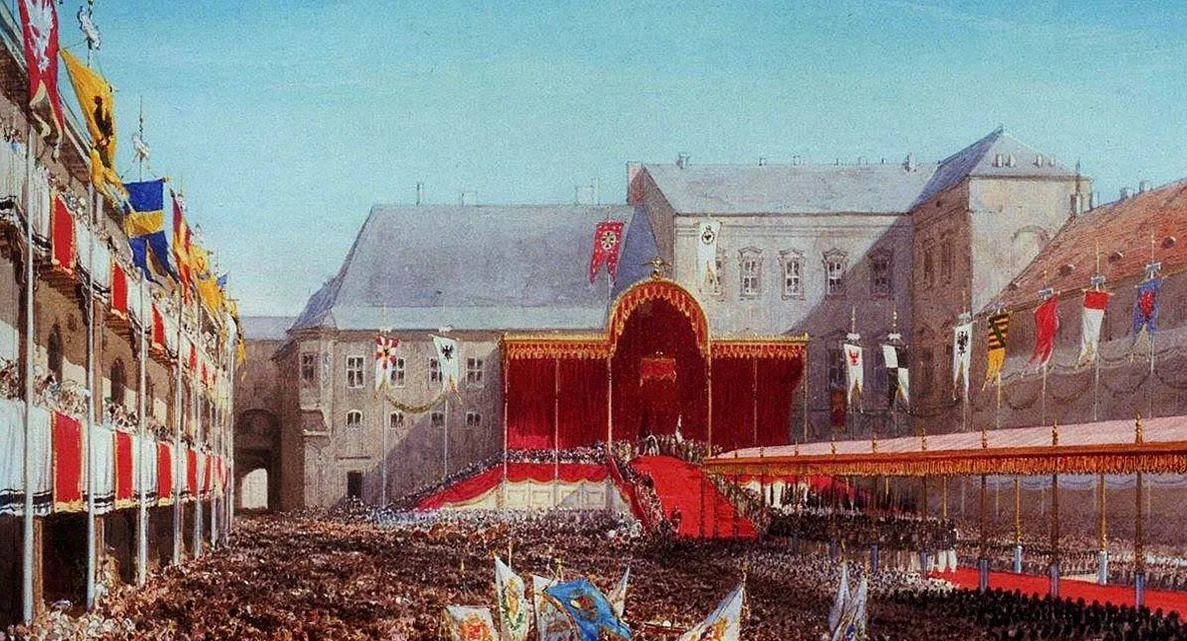
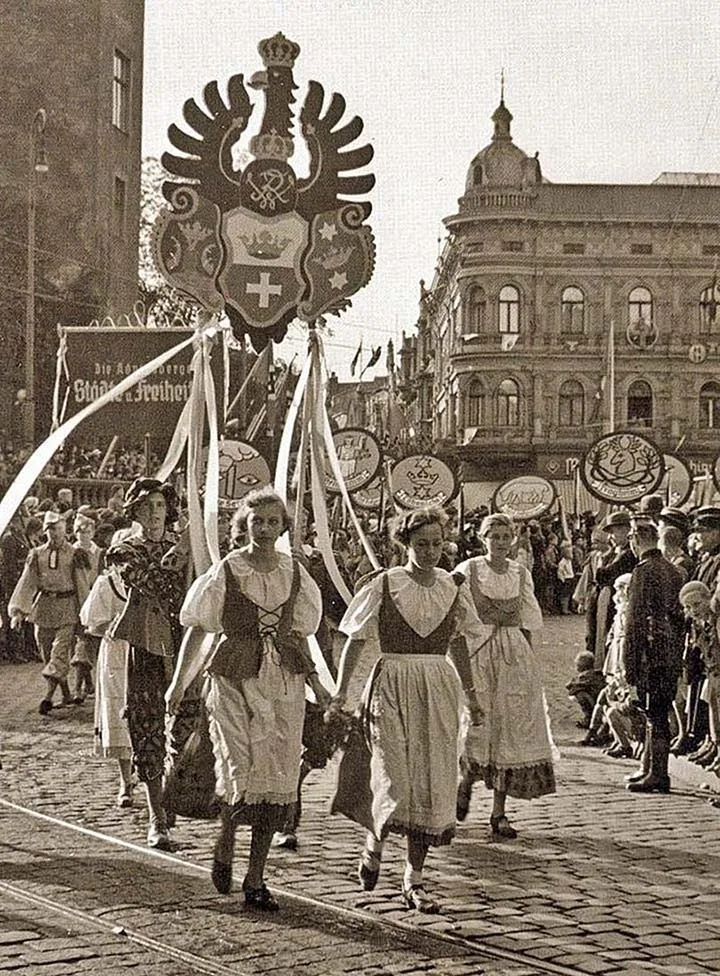
There were several city markets. In the centre of Königsberg there was, for example, the Steindamm market. It began at the Berliner Hof hotel and stretched along the whole Steindamm as far as Gesekusplatz. People jostled, tasted, haggled and bought willingly. Because back then even a single pfennig was worth something. Just think: a packet of cigarettes cost only 10 pfennigs! On Gesekusplatz the butchers traded in their wooden stalls, which were always taken down after the market closed. As a rule, every housewife had her own butcher, from whom she always bought.
If she bought a lot, the butcher would add something as a gift. A piece of tasty sausage or brawn, known locally as "Bautz".
Fried sausages, thickly spread with mustard, were tasty and eaten with relish despite being cheap: for five pfennigs you could buy a fairly large piece of sausage.
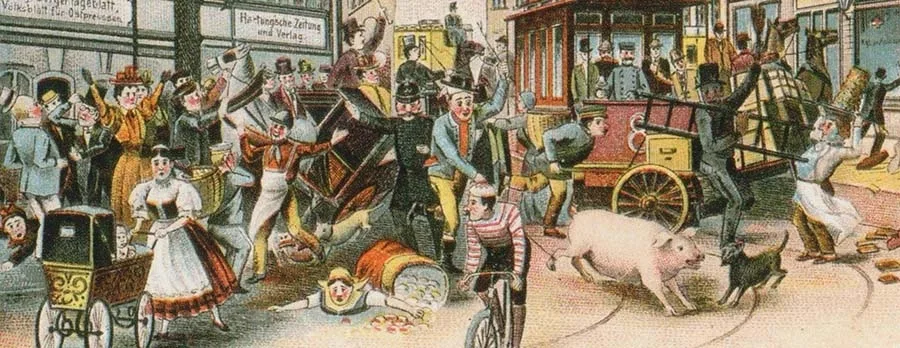
So on market days the Steindamm market was crowded from morning till night. Every now and then a horse-drawn cart would roll unhurriedly past. When several women stopped in the middle of the street for a chat, the coachman would crack his whip loudly. Then they would scatter, laughing.
Incidentally, the first tram was also running at that time. It had, as people used to say, an "oat-powered engine" and "whip ignition". At the front, next to the driver, hung a little bell. It rang "ding-ding", and off the ride went. All the tram lines passed through the city centre.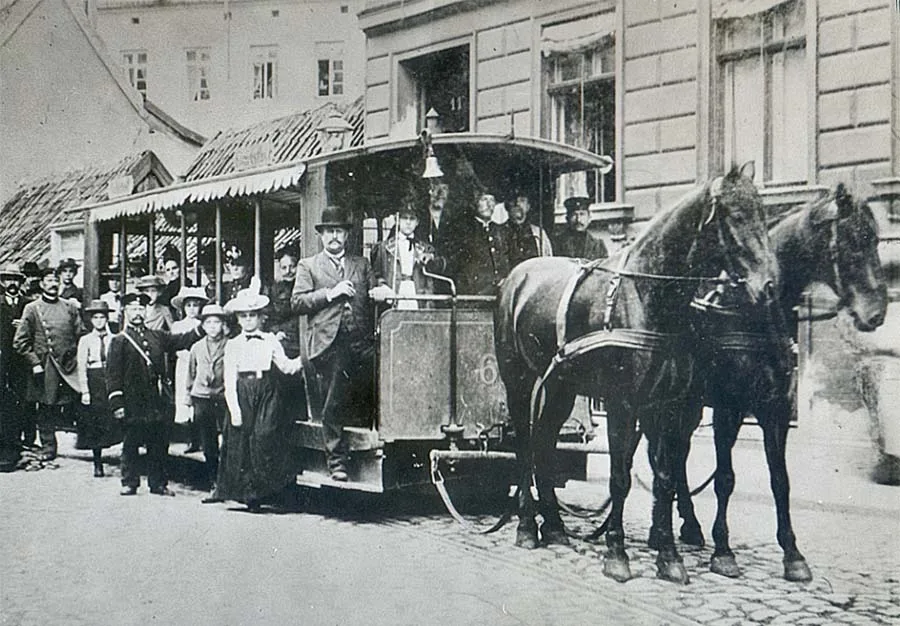 The last Königsberg horse tram.
Even old ladies could get on and off while it was moving. Not that they needed to, though. When the horse tram came by, an elderly woman would wave her umbrella, the little tram would stop, granny would be helped aboard, and the ride would continue.
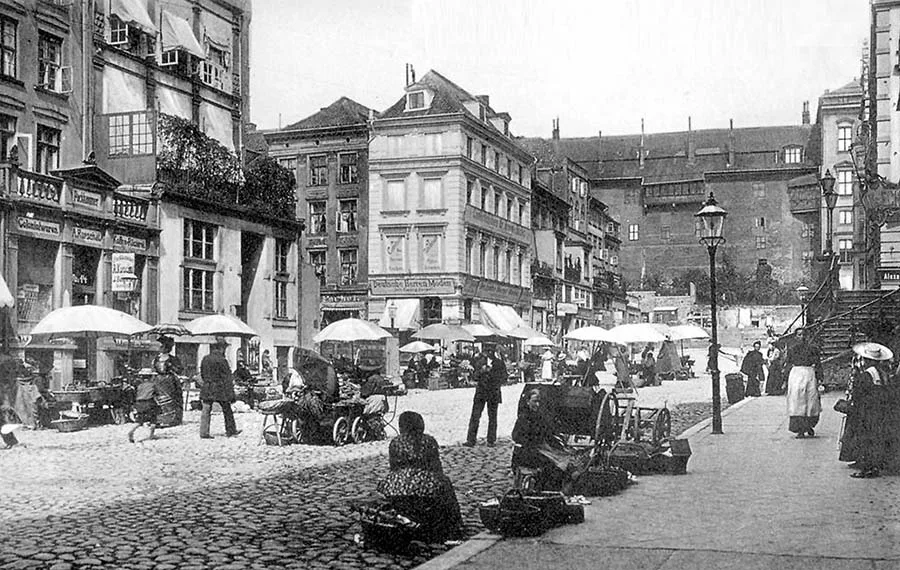 The Altstadt Market before a department store, out of proportion to the street, was built on it at the end of the 1920s.
The same hustle and bustle reigned in front of the old town hall, at the Altstadt Market. Here stood two large trading halls known as "Packkammern" („Packkammern“), Heller and Rosenfeld. What wasn't there to be had in them!
Advertisements beckoned: "Friedlander & Rosenfeld's Packkammer, Marktstraße. A large selection of the most elegant autumn and winter hats in the latest Paris fashion, skirts with double-layered flounces, ties and neckerchiefs for every taste. Hurry! Autumn sale."
On market days trade here was particularly brisk. In the Altstadt Packkammern all kinds of colonial goods were available. This was where the farmers spent their earnings.
Walking from the Altstadt Market along the Wassergasse, lined with all kinds of shops, one could get through a side lane down to the Pregel and the Fish Market.
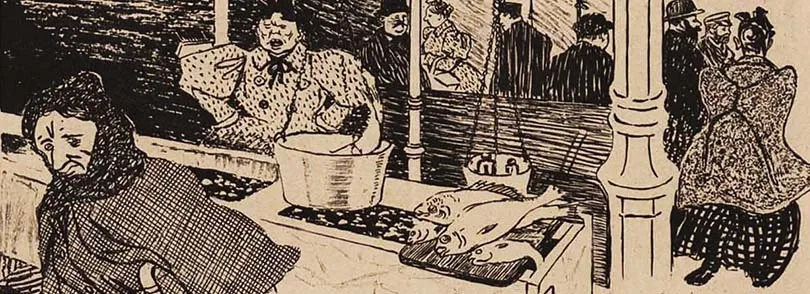
Here the fishermen moored their sailing boats. Boxes of fish stood in long rows along the quay, their contents — from eels to flounder and cod — wriggling, flapping and glittering with scales.
The fishwives of the Fish Market were the true embodiment of the Königsberg spirit. They were never at a loss for words and did not mince them either.
"Well, madam, what'll it be? Looking for something special?"
"I really don't know... Your live fish have such dull eyes!"
"Oh, my fine lady, you'll have eyes like that too when you're dying."
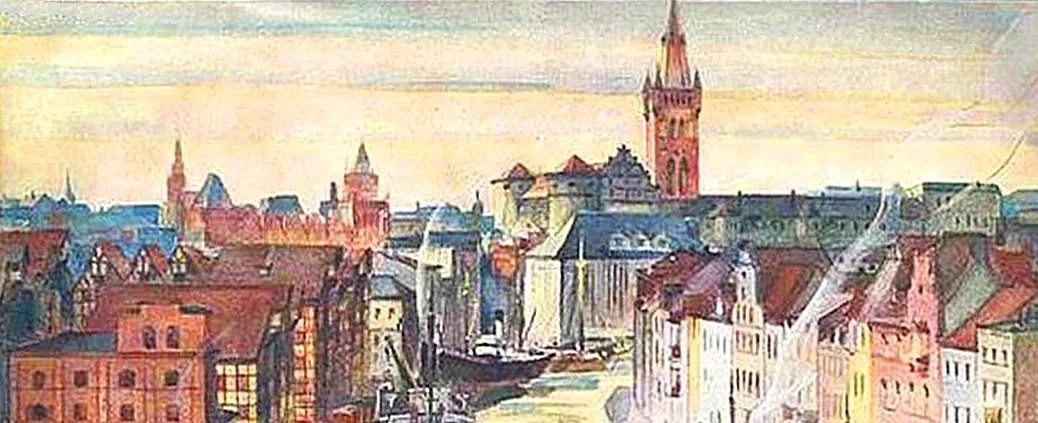
Yes, yes, that's how it was. But let us linger a little longer on the Pregel, that lazy lump which did not smell of Nivea cream even on holidays. Nevertheless, it somehow managed to form an island in the middle of the city. That was the Kneiphof. Beyond the Green Bridge the arms of the Pregel joined again in all their breadth and depth, which made Königsberg an international port city.
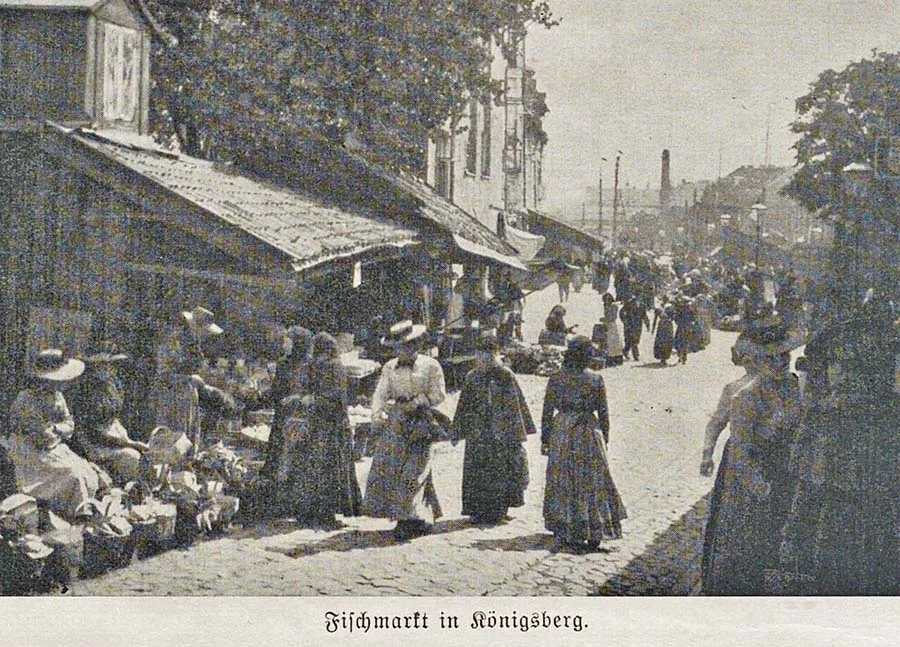 The Fish Market on the bank of the Pregel.
From the old railway bridge to the Hundegatt, that is, to the Shop Bridge and the Green Bridge, the historic warehouse district of the Lastadie grew up. The warehouses, mostly granaries, towered right by the quayside.
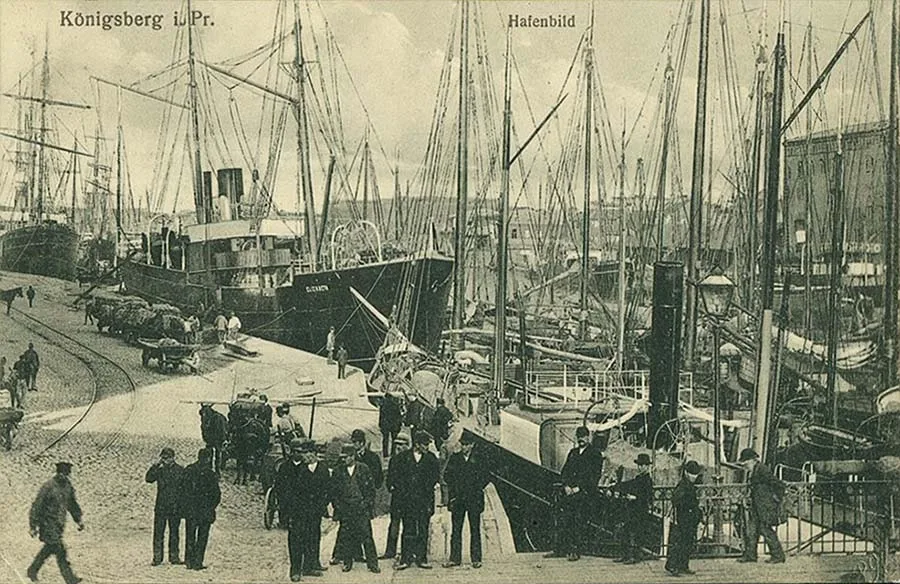 The port of Königsberg. The start of the Great Cranes quay in the Vorstadt. On the right, the railings of the Green Bridge.
English, Norwegian, Swedish, Finnish, Russian, Turkish and Greek ships lay there. Their cargo was grain, pulses, herring, colonial goods, chemical fertilisers, coal, iron, cement and timber. What ships there weren't here! Cargo steamers of every type. Graceful sailing ships with impressive rigging, reminiscent of Captain Morgan's pirate vessels. The "empty ships" were then towed out by tugs. Their way led towards Pillau, into the waters of the lagoon and then out to sea.
The ships were unloaded by hefty strongmen. They were called Stauer — "stevedores". Hoisting onto their shoulders a heavy sack that could weigh close to two hundredweight, they would run nimbly, swaying, with it from the steamer along the gangplanks to the warehouse or to a railway wagon, and then back again for the next one.
The stevedores were tough guys and sometimes earned so much in a single day that they could live comfortably on it for a week.
Once upon a time old Königsberg was surrounded by thick fortress walls and ramparts, through whose embrasures one could see the mirror-like surface of the moat which, one might say, girdled the whole city. The moat was deep, its banks overgrown with willow bushes. Green slopes rose from the water right up to the walls of the fortress.
In the 1920s, in place of the fortifications, there appeared handsome rows of trees and shrubs, shady paths and benches inviting one to rest. Here, on summer evenings, after the day's labours and heat, the local people could enjoy the cool of the evening. Or, as they put it, "get a breath of fresh air".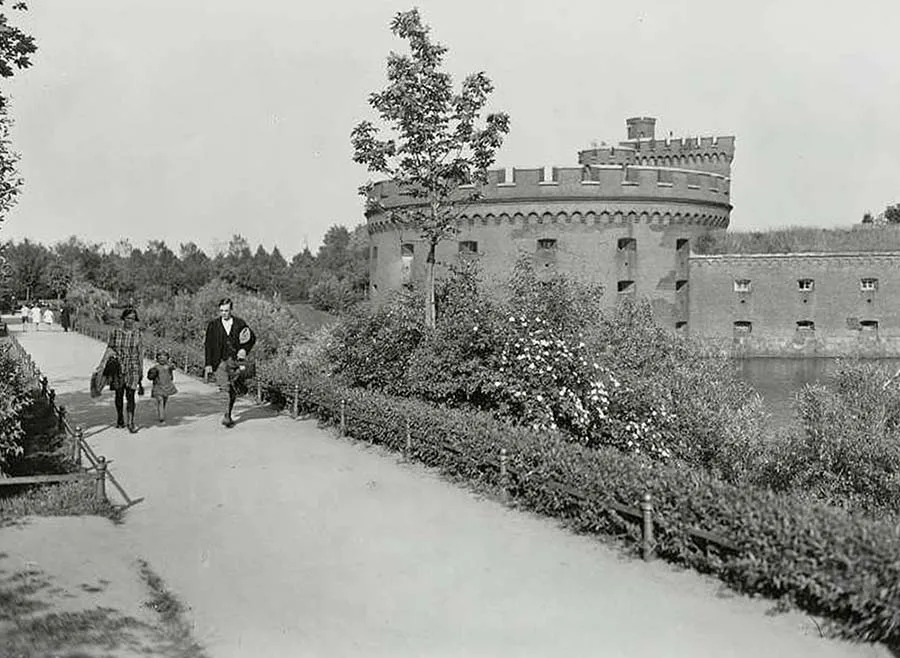 The Schneider Belt. A young family strolls along the promenade by the Wrangel Tower.
The park ring known as the "Schneider Belt", laid out on the former fortress rampart that encircled the city, was named after its creator, the Berlin landscape architect Ernst Schneider, who was invited to Königsberg specially for this task.
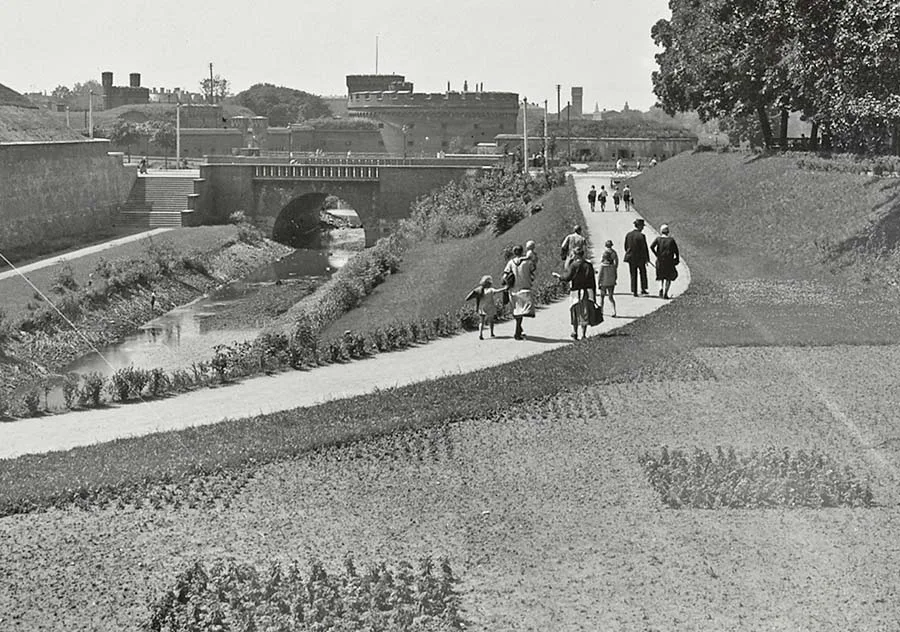 The promenade on the Lithuanian Rampart. On the left the Rossgarten Gate can be seen, straight ahead the Dohna Tower.
Since Königsberg had a strong garrison and the barracks stood practically right next to the city gates, "military life" was in full swing in the city: military marches rang out, regiments paraded in formation, drills were held, and the bugle calls of "reveille" and "tattoo" sounded regularly. And, after all, soldiers were very popular with the local girls. Why not? They were all strong, well-built young men.
Also stationed in Königsberg was a regiment of heavy cavalry — the Wrangel Cuirassiers. On special occasions the cuirassiers wore gleaming helmets and breastplates, white uniforms and long, shiny black riding boots; their horses' bridles and reins gleamed, and their lances were decorated with the squadron colours.
At the head of the cavalry band rode the drummer and the bandmaster, who wore a full beard and conducted with outstretched arms in time to the drumbeats.
He was carried by a noble black horse, steered by reins that ran from the stirrups. The rider counted the stars, the horse counted the stones. In time to the cavalry march came a squadron of prancing, matching, beautiful horses. East Prussia was their homeland. And every regiment had its own choir.
The 43rd Infantry Regiment, for example, had a drummer dog that pulled the big drum on a little cart during the march. It was a large, strong St Bernard, and it served its regiment for a long time. On its collar it proudly wore a lance corporal's badge. The St Bernard was on the regiment's rations and was everyone's favourite.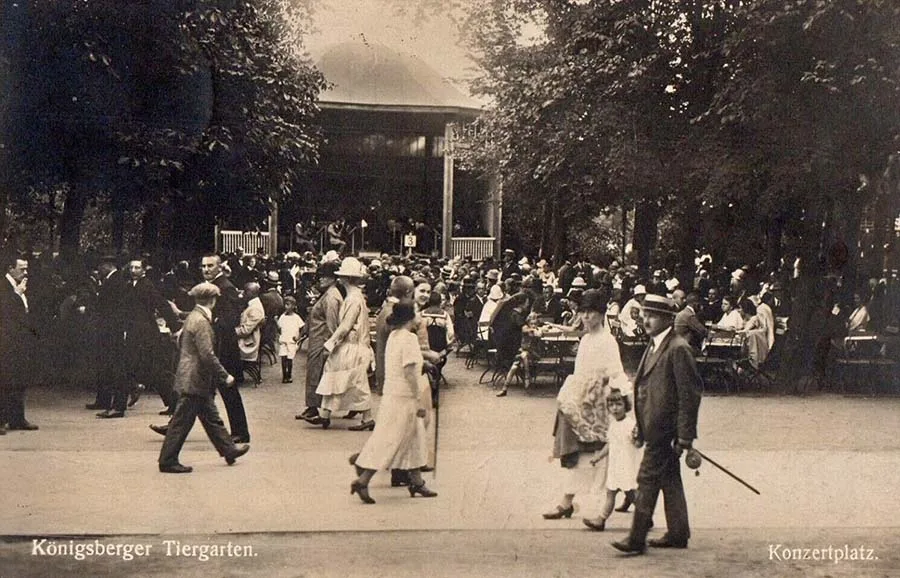 The audience on the Concert Square of the Tiergarten.
On Sundays in spring and summer, when Königsberg's beautiful parks and green squares beckoned people to leisurely walks and rest, afternoon concerts were also held there. They were given in turn by different regiments.
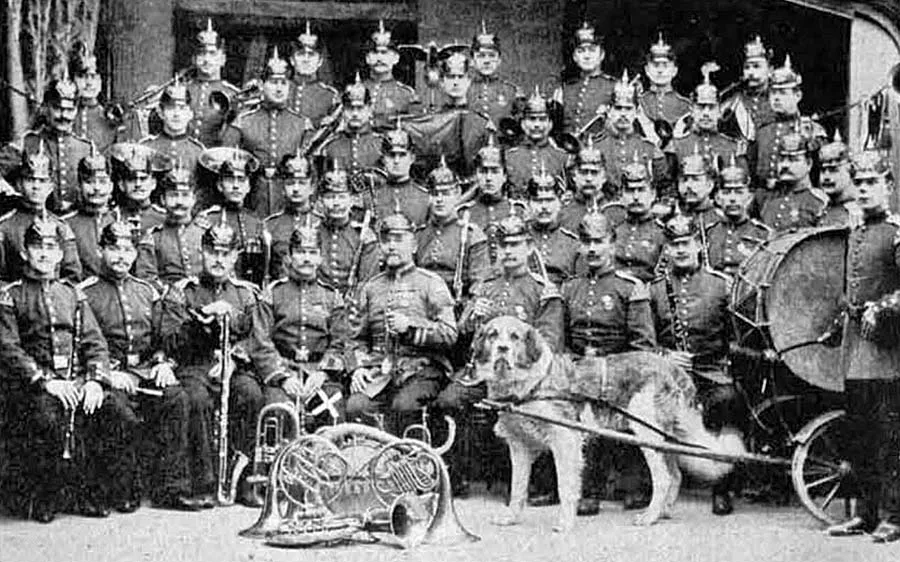 The Königsberg drummer dog with colleagues.
Usually on the promenade of the Castle Pond, that pearl of Königsberg, or on the Paradeplatz in the Königsgarten. Young and old would begin to crowd round this square long before the concert started, chatting carefree in the shade of the dense chestnuts and limes.
But now the band has arrived, and the musicians form a circle. The music stands are set up and the scores placed on them. The bandmaster stands waiting in the centre. The audience crowds around. And now — a sharp tap of the baton on the sword, and the music begins…
"Alte Kameraden" (Old Comrades)! Who does not know this army march by Carl Teike, a former Königsberg policeman? It was composed in 1889. It is said that when Teike, a musician in the regimental band, handed the score to his bandmaster, the latter told his subordinate: "We have enough marches already. Throw it in the stove!"
Fortunately, the composer disobeyed, and his piece remains to this day one of the most popular and most frequently performed German military marches.
"The Tales of Hoffmann", "Mignon", "Martha" — Franz von Suppé, Johann Strauss, Paul Lincke, Franz Lehár — all these melodies set the cheerful hearts of the Königsbergers aglow.
The highlight of the city's summer concert programme was the grand concert in the Tiergarten. It was held on a Saturday specially chosen for the purpose. The musical evening opened with the "Pilgrims' Chorus" from Richard Wagner's "Tannhäuser". The main item on the programme was usually Heinrich Saro's "Battle Music", an impressive musical depiction of the events of 1870–1871. At some moments it could be heard far beyond the Tiergarten… The musical spectacle ended with a rousing choral performance of the old Christian hymn "We come to pray before our Lord...", sung together with the musicians and the band by everyone present at the concert. The climax was the biggest fireworks display of the year, with musical accompaniment.
...But now the fireworks have faded, and only the eternal lights of the sky remain — the stars...
LEGENDS OF PRUSSIA on the blog of Tatyana Kolivay.
Source: Ostpreußen-Warte, Folge 06 vom Juni 1954.
Illustrations: Bildarchiv Ostpreußen, bildarchiv-ostpreussen.de.
Translated from Russian with the help of AI (Claude, Anthropic), October 2026.