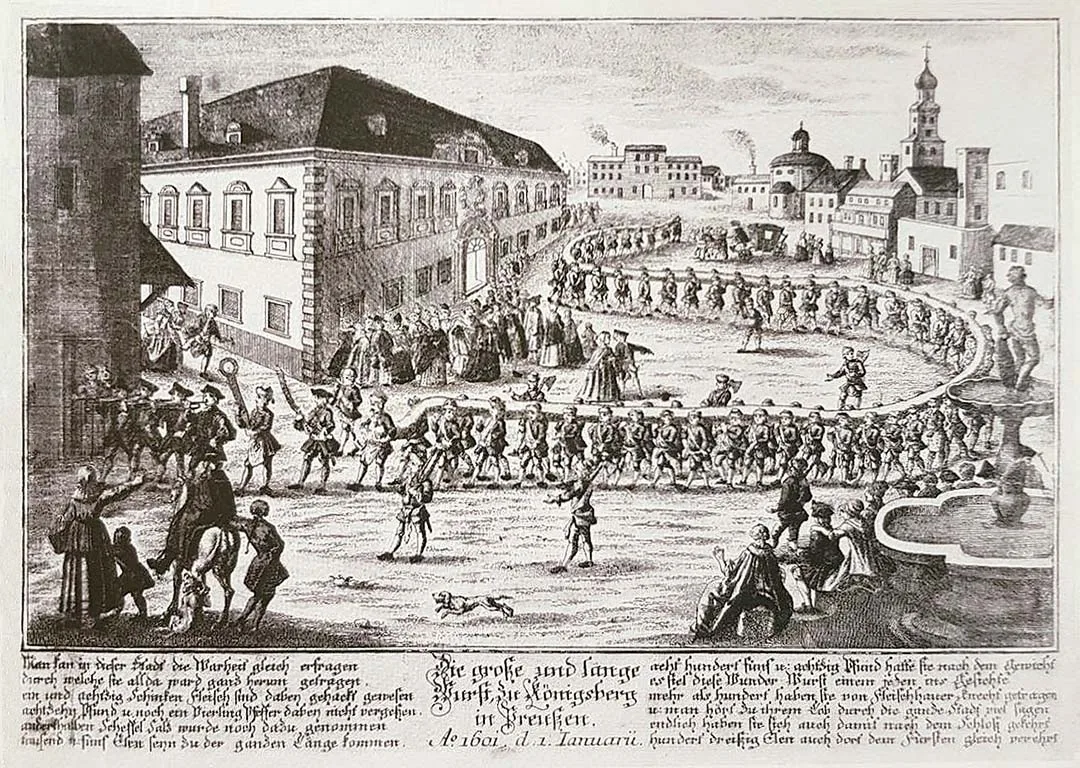
In 1558 this sausage was 198 ells1 long. It was carried by 48 men.
In 1583 the sausage was made from 36 hams. It was weighed on scales and came to 434 pounds2, or almost 11 stone (1 stone being 40 pounds) It was 596 ells long and was carried by 91 men, not counting the guild elders walking in front and behind and the attendants walking alongside. For the occasion all the butchers were dressed in fine, neat clothes: each wore a white shirt over his other garments and they all had the same shoes on their feet.
The butcher who carried the sausage at the front wound the rope several times around his neck, leaving the end hanging loose behind him. All the other butchers followed him, carrying the sausage on their shoulders, so that it sagged a little in the gaps between them. And the last butcher, like the first, also wound the end of the sausage rope around his neck, leaving it hanging behind.
The procession made its way to the castle of Margrave George Frederick3. The giant sausage was made only during periods of mourning for the high nobility of Prussia, when other entertainments were forbidden.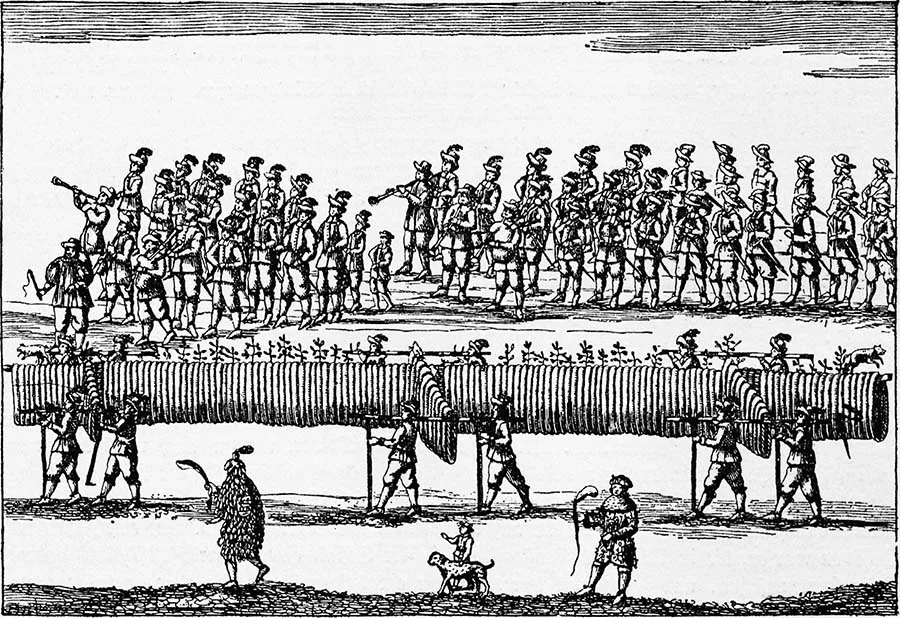
Such sausages were very costly, since each time they were made longer and longer and stuffed with the finest pork.
The casing required a great many thin intestines, fitted one inside another.
After carrying the giant sausage through the town, the butchers' guild presented it to the bakers.
The bakers in turn, on the Day of the Three Magi3, returned the gift by presenting the butchers with an enormous loaf baked from three Scheffel4 of wheat flour.
In 1583 no fewer than five such loaves were made. To bake them, two huge bread ovens were built in the courtyard of Königsberg Castle, with a large opening made between them. The ovens were then fired, and the loaves, lying thanks to this opening in both ovens at once, could bake evenly.
Both the sausage and the loaves were eaten by the butchers and bakers together. To this end the two guilds invited each other as guests.
TRANSLATOR'S NOTES
1. The ell is an old measure of length, equal among different peoples to roughly 50 to 78 cm.
2. The pound is a unit of mass, in different countries — from 450 to 500 g.
3. George Frederick of Brandenburg-Ansbach (1539–1603)
Duke, nephew of Albrecht of Brandenburg, Margrave of Brandenburg-Ansbach. In 1575 (according to other sources, in 1578) he obtained the guardianship of Albrecht Frederick. He pursued a policy fairly independent of Poland and put an end to Prussia's political and cultural stagnation. By drawing up numerous guild statutes he reduced conflicts between the guilds in the duchy and raised the standard of craft production. During his regency Prussia enjoyed relative economic prosperity, and new areas around the towns (common lands) were developed. He lived in Königsberg, with interruptions, for eight years, and the rest of the time ruled Prussia from Ansbach.
4. The Feast of the Three Magi (Three Kings) is celebrated on 6 January.
5. Scheffel — a bushel ( an old dry measure for grain ); a pail.
SOURCE
Иоганн Грессе, «Книга легенд прусского госудраства» (нем. Johann Georg Theodor Grässe, «Sagenbuch des Preussischen Staats»), Глогау, 1868/71.
LEGENDS OF PRUSSIA in the blog of Tatyana Kolivay.
———————
In 2008 the local publishing house Zhivem brought out "The History of Königsberg Castle", a book by the well-known Russian historian and archaeologist Vladimir Kulakov of the Institute of Archaeology of the Russian Academy of Sciences, which includes a separate chapter on the celebration of Long Sausage Day. The full book is available on Prussia.Online.
The Sausage Festival: Pagan Sacrifice and Guild Celebration
In the towns surrounding Königsberg Castle, many changes took place during the reign of Duke Albrecht of Brandenburg. Guild organisations revived, and foreign trade and cultural ties were actively strengthened. Public life in the Prussian capital became more open. Freed from the sinister shackles of strict Catholic codes of conduct, it was literally swept by a wave of festivals and celebrations of every kind. Among them, a prominent place belongs to the famous Sausage Festival.
Here is how this joyful event in the life of the town is described by Königsberg's best-known historian, Fritz Gause: "The 'Festival of the Long Sausage' was held eight times, and it was merriest at the New Year of 1601. Whereas in 1520 the sausage was only 41 ells long (about 20 m — V.K.), in 1601 it reached an incredible size — 1,005 ells. Three masters and 87 journeymen used 81 hams and 18 pounds of pepper to make it. 103 journeymen in festive dress carried the sausage, weighing 885 pounds, on their shoulders. With banners and music the procession moved from the butchers' inn to the castle, where a piece of the sausage 130 ells long was handed over as a New Year offering to the ruler of the land (that is, the Duke or his representative — V.K.).
The column then made its way to the burgomasters of the three towns. The procession ended near the bakers' inn in Löbenicht, where the butchers and bakers together ate the considerable remainder of the sausage and a great deal of other food."
Judging by this description, the festivity looks at first glance like straightforward advertising for the products of the Königsberg butchers' guild.
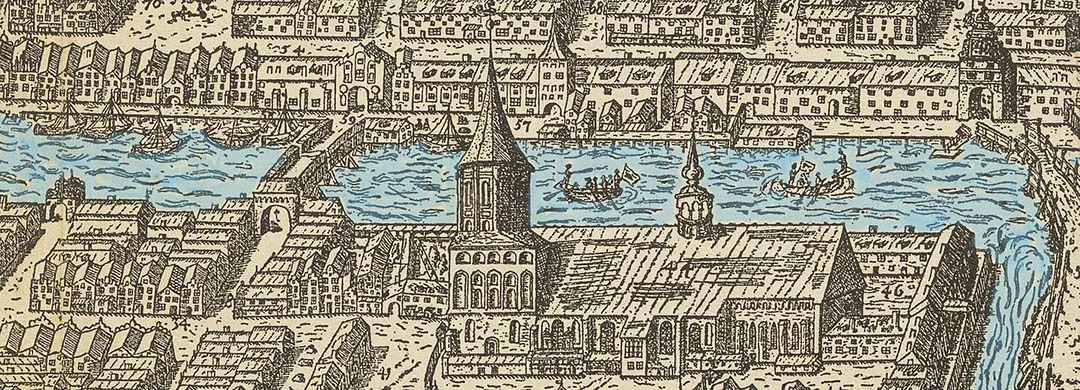
The sausage procession began on the island of Kneiphof (now mistakenly called "Kant Island"), where the guild leaders had their splendid houses. Having marched along the main street of the island town (until 1724 Königsberg consisted of three towns of merchants and craftsmen), called Kneiphöfsche Langgasse (German for "Kneiphof Long Street"), and having left Kneiphof through the famous Krämertor, the Shopkeepers' Gate (where the stepped approach to the overpass bridge now stands), the masters and journeymen headed for the Castle, where they laid the fruit of their labour — the longest of sausages — at the feet of the ruler of the Prussian state or his deputy. A tasting followed, conducted in the castle courtyard by representatives of Königsberg's noble and merchant elite. Finally the festival ended in Löbenicht, the most "popular" of the towns of old Königsberg, with the last of the sausage being eaten and broad merrymaking by the "heroes" of the occasion themselves — the butchers and sausage makers.
In fact, this pattern of festival is not so much an advertisement for Königsberg sausages (though there is that too!) as an echo of the sacrifices performed by various ancient Germanic tribes at the beginning of the 1st millennium AD.
The cultic origins of the "Festival of the Long Sausage" are indicated above all by the product at the heart of the celebration — pork. For the Celts and the Germanic peoples, pig meat was sacred.
This was apparently a consequence of the pig being among the first animals domesticated by the Indo-Europeans, as early as the Neolithic. The "Salic Law", which became a genuine code of laws (customary law — jus vulgaris) for the Franks of the Merovingian period, provided penalties for stealing boars and pigs intended for sacrifice. The traditional time for this sacrifice among many Germanic peoples was February, called Sporkelmonat (Low German dialect for "piglet month"). The Angles and Saxons, for their part, sacrificed cattle to the gods in November.
It may be supposed that the principal sacrificial animal — the boar — and the products associated with it (meat and sacrificial blood, put into intestines and turned into sausage as a long-keeping food) were offered to the heads of the Germanic pantheon — Wodan and Donar (later Odin and Thor).
It is telling that the Königsberg "Festival of the Long Sausage" falls in the cold season, the time nature itself designed for eating long-keeping foods. True, its exact date was later tied to the Christian feast of Christmas, a fate that often befell festivals in Western and Eastern Europe that had arisen within ancestral cults in the impenetrable depths of antiquity.
In the Renaissance, alongside the revived interest of rulers and of the most varied strata of European society in the pre-Christian past of their peoples, the tradition of holding a sausage festival appeared in many towns of the various German states.
Rooted in deep cultic traditions, these celebrations outwardly looked like triumphs of gluttony that helped townspeople choose the most worthy supplier among the many butchers' shops.
In Berlin such a festival still exists today as a kind of exhibition of the achievements of German meat-industry specialists. To this day a sausage festival, in the form of a fair that has practically merged with the annual harvest celebration (Oktoberfest), is held in the spa town of Bad Dürkheim in south-west Germany. In specially built, colourfully decorated pavilions, guests at this truly meaty festival are offered samples of sausages from every corner of Germany. An obligatory feature of the Bad Dürkheim sausage festival is the drinking of young wines — an indispensable feature of the October festival in the Rhineland.
In 1961 the sausage festival tradition crossed the Atlantic Ocean. It took root in the small town of New Braunfels (Texas), founded in the 19th century by German immigrants.
Thus the festival of fragrant meat, born at the beginning of the 1st millennium AD in the quiet of ancient Germanic sanctuaries, strides proudly across our planet, having become a celebration for all the people and a tribute to the best producers. And the scenario of the Königsberg sausage festival gives special prominence to the Castle as the seat of power and law, which in the minds of the townspeople effectively replaced the former sacrificial sites of the ancient Germanic peoples and Prussians — places that for them, too, had been both cultic and administrative centres.
Vladimir Kulakov's book "The History of Königsberg Castle" is available on Prussia.Online.
Translated from Russian with the help of AI (Claude, Anthropic), October 2026.