How the burials came about
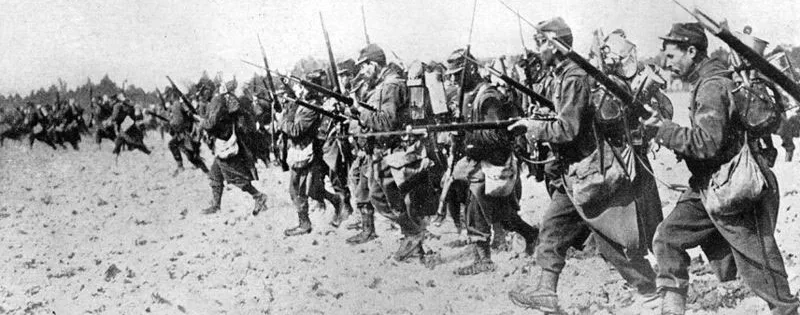
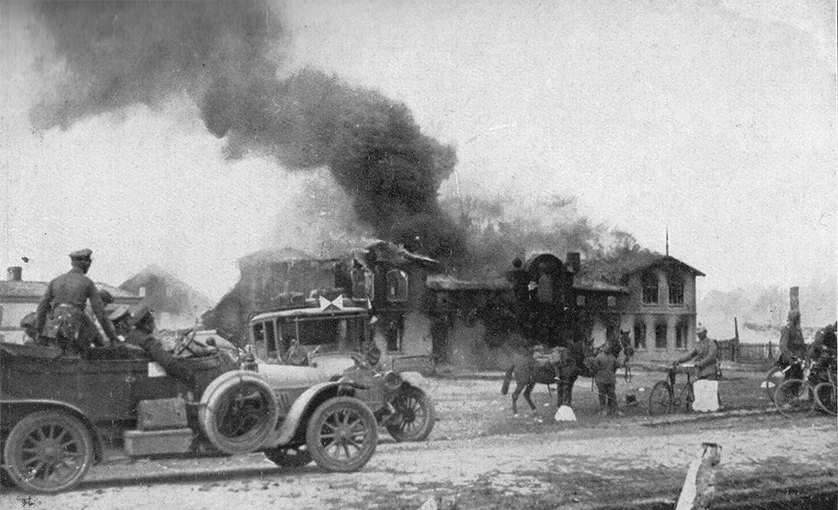
Indeed, in 1914–15 East Prussia became the scene of fierce fighting; from August 1914 to March 1915 battles and engagements took place on its territory: the Battle of Stallupönen, the Battle of Gumbinnen–Goldap, the Battle of Tannenberg, the Battle of the Masurian Lakes, the battle in the Augustów Forest and other, smaller ones. Numerous war graves scattered throughout the region became a silent reminder of those events.
After each battle, special detachments of the military units, often together with local residents, searched the battlefield and saw to the burial of their own and the enemy's fallen. If there was a cemetery nearby, the dead soldiers were buried there, but more often this had to be done directly on the battlefield, where they had met their death.
The Germans buried both their own and the enemy's dead, in this case Russian soldiers. But the Russian troops did not leave the bodies of their enemies on the battlefield either. Here, for example, are the recollections of the cavalryman Georgy Goshtovt, set down in his book "His Majesty's Cuirassiers in the Great War" (1938): "In the village of Gross Laut the bodies of the killed German cuirassiers of the march squadron of the 3rd Regiment were collected and buried".
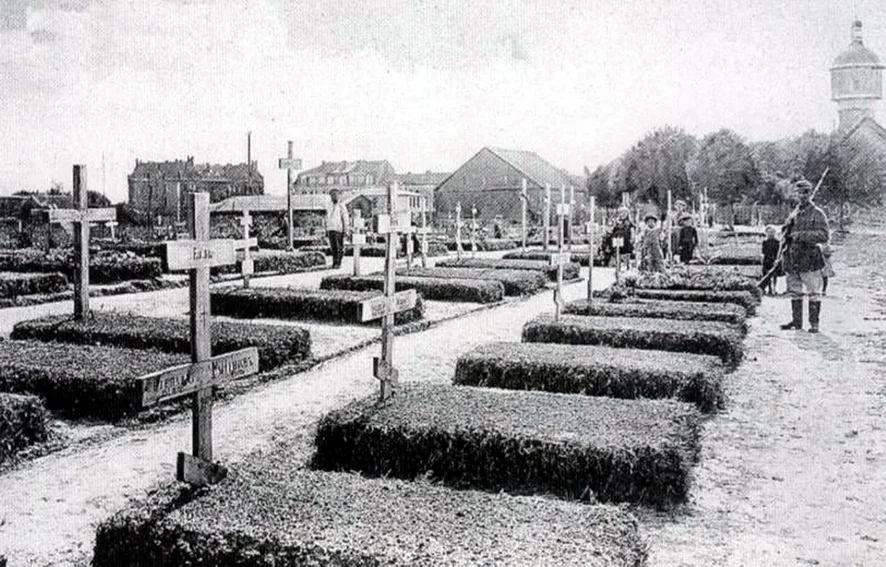 War cemetery in Goldap, Republic of Poland, 1914/15. Photo from Bildarchiv Ostpreußen (www.bildarchiv-ostpreussen.de).
Soldiers' burials were somewhat more orderly in towns that had garrison cemeteries or where part of the municipal cemetery was allotted to the reserve military hospitals. In a number of towns it was even possible to bury the dead in cemeteries according to religious denomination — Protestant, Catholic, Jewish. The fallen were laid to rest with military honours; whether it was a German or a Russian soldier made no difference. The graves of Russian soldiers, like all burials in the cemeteries where the enemies had found their last rest, were maintained and kept in order by the community.
After the First World War, reburials in large military cemeteries began wherever there were graves of German soldiers. These measures were carried out in accordance with the Geneva Convention on the right of the fallen to burial. For East Prussia and the burials on its territory this was of little significance, since the local population "was closely attached" to the fallen. In most cases the residents refused to have the graves moved to common military cemeteries, and sometimes even reburied their loved ones who had fallen on other fronts in local cemeteries.
This attachment was explained by the fact that in 1914–15 this territory had been defended by local East Prussian and West Prussian regiments.
The gravestones bear surnames that were found in most of the towns and villages of East Prussia.
The numerous soldiers' graves sometimes considerably hindered the cultivation of fields, but not a single landowner insisted on reburial; on the contrary, he was proud that he could tend a war grave on his land. Communities and private landowners competed in caring for the graves; in summer they were buried in flowers and greenery, and the graves of Russian soldiers were not forgotten either. Since their compatriots could not visit them every year, in many cases church congregations and youth groups took on the care of these graves.
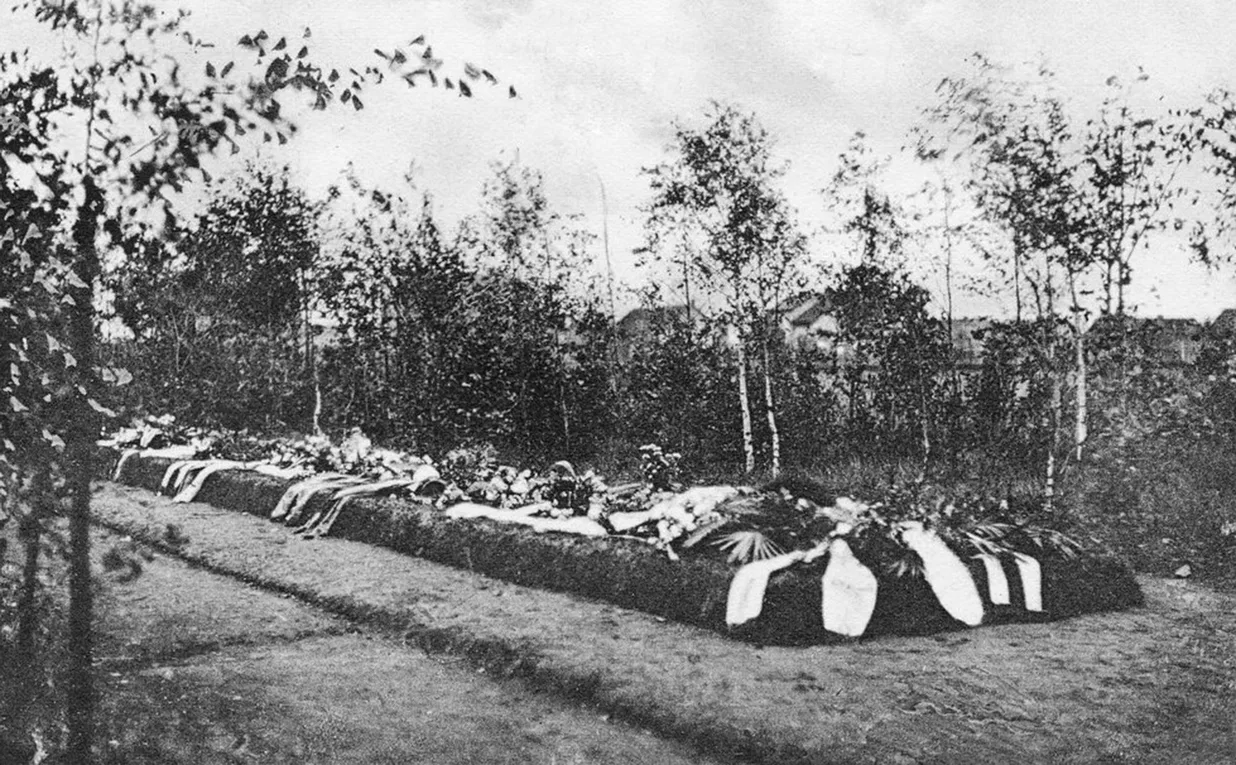 War cemetery at the "Forest Cemetery", Tilsit/Sovetsk, 1914. Photo from Bildarchiv Ostpreußen (www.bildarchiv-ostpreussen.de).
The main large First World War burial sites in East Prussia*
As of 1939 there were about 2,200 war burial sites in East Prussia, ranging from large cemeteries to single individual graves, in which more than 61,000 people rested. Besides the Germans and Russians buried there, there were also representatives of other countries — Austrians, British, Belgians, Romanians and French — who had found themselves in East Prussia as prisoners of war.
In terms of the number of burials, they can all be roughly divided as follows:
– cemeteries with a small number of burials, from 1 to 20 people — approximately 4/5 of the total number of cemeteries, i.e. 1,750–1,800,
– with 500 or more burials — 10 cemeteries,
– with 1,000 or more burials — 5 cemeteries,
– the rest are cemeteries with between 20 and 500 burials — more than 400 of them.
The largest cemetery was the military hospital cemetery in Königsberg (Kaliningrad), called the New Military Cemetery (Neuer Militaerfriedhof). In this cemetery 2,904 soldiers found their rest, of whom 2,624 were German and 263 Russian, as well as Austrians, British, Romanians, an American, an Italian and a Frenchman.
The second, only slightly smaller burial site was the military cemetery in Heilsberg (Lidzbark Warmiński, Republic of Poland), where 2,761 people were buried: 2,081 Russians, 506 Romanians, 53 French, 49 British, 45 Belgians, 19 Italians and 8 Serbs. Most of them had been prisoners of war in the nearby camp and died during a typhus epidemic.
In the cemetery in Orlau (Orłowo, Republic of Poland), 1,427 soldiers were buried as a result of the heavy fighting in the area of this town during the Battle of Tannenberg.
The burial site in Mattischkehmen (Sovkhoznoye, Nesterov District) was created directly on the field of the Battle of Gumbinnen–Goldap; one of the fiercest clashes between Russian and German troops took place here. 1,084 soldiers are buried here.
1,000 soldiers are buried in the Forest Cemetery in Tilsit (Sovetsk). Originally soldiers who had died in the military hospital were buried there, and later prisoners of war as well.
Of the large war burial sites now located in the Kaliningrad Region, two more stand out. The first is in Göritten (Pushkino, Nesterov District), where a total of 797 people rest, 601 of them Russian soldiers. The second is the burial site in Gawaiten (Gavrilovo, Ozyorsk District), where 734 soldiers are buried.
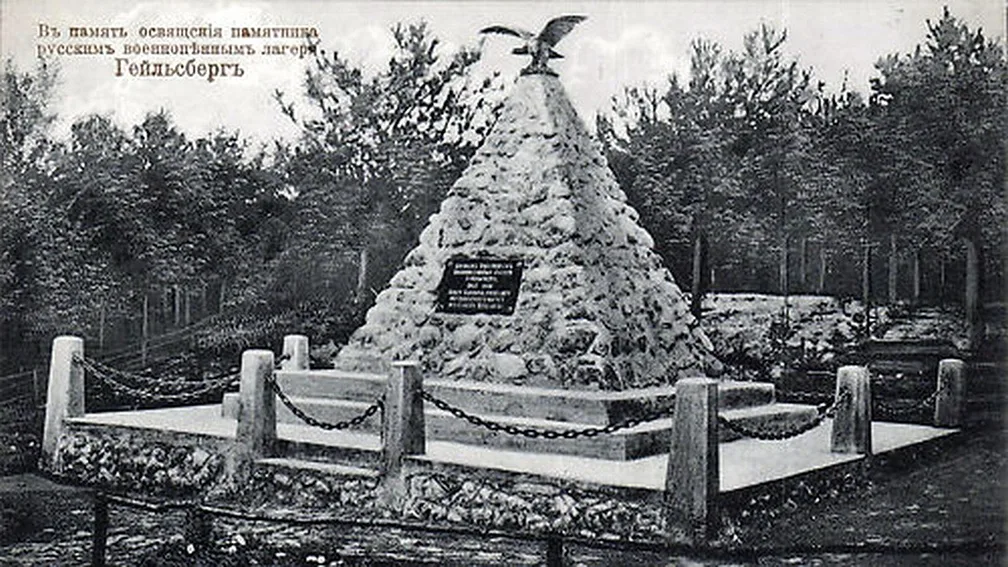 Memorial to Russian prisoners of war at the war cemetery in Heilsberg / Lidzbark Warmiński, Republic of Poland. Photo from Bildarchiv Ostpreußen (www.bildarchiv-ostpreussen.de).
The landscaping of war cemeteries in the first half of the 20th century
On the whole, all burials, whether large cemeteries in towns or single graves in the forest, were kept in proper condition, and crosses or slabs were placed on every grave. True, at first all war graves looked the same — earth mounds with simple wooden crosses.
The battles of the First World War were still raging, and in Russia competitions were already being held for the landscaping of war cemeteries and for designs of memorials for them.
For example, there is a known design for a tomb monument to soldiers killed in the First World War, developed by the architect Iosif Langbard and awarded first prize by the Imperial Society of Architect-Artists. The competition was held on the instructions of the Main Council of the All-Russian Society for Perpetuating the Memory of Fallen Soldiers (1916).
Competitions in which well-known architects took part were also held in Germany. For example, several designs for war cemeteries by the architect Friedrich Lahrs are known, published in a special issue of the yearbook of the Deutscher Werkbund**.
In Königsberg in 1917, an exhibition of small architectural forms was held in Luisenwahl Park (today the "Central Park of Culture and Recreation" in Kaliningrad), at which designs for grave crosses and slabs intended for war cemeteries were shown.
Architectural journals*** published articles with designs for the landscaping of war cemeteries, and separate catalogues and collections were issued.
The designs included proposals for planting "heroes' groves". And in the end such groves did appear in Gerwen (the settlement of Priozyornoye, Gusev District) and Memel (Klaipėda, Republic of Lithuania).
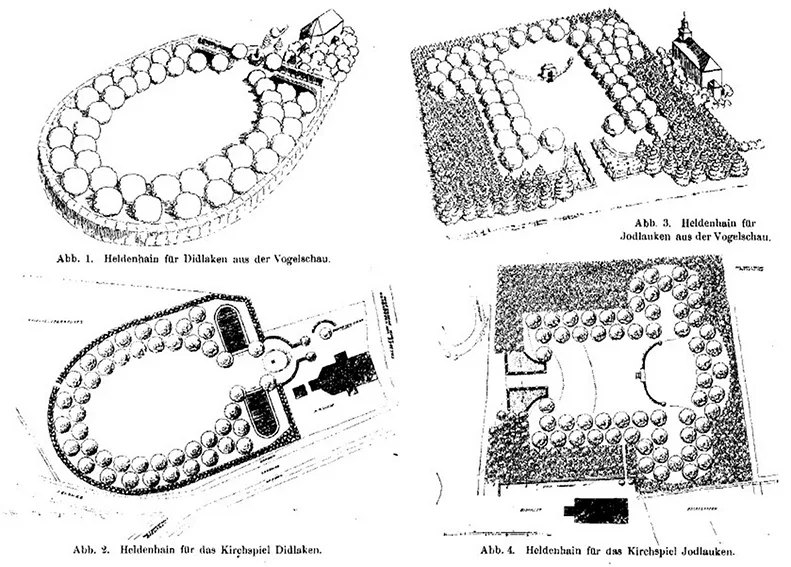 Designs for heroes' groves in the district of Insterburg, 1916. H. Phleps. Vier Heldenhaine für den Kreis Insterburg//Zentralblatt der Bauverwaltung.
As a result, by the tenth anniversary of the events of 1914, landscaping work had been carried out at many burial sites. Concrete crosses and slabs were installed, and monuments and memorials erected. In each Kreis (district) certain construction firms engaged in the landscaping of burial sites operated, and soon corresponding advertisements could be seen in magazines and newspapers.
The grave crosses were not distinguished by architectural refinement; they were small, bearing the image of the Iron Cross and a brief inscription: the surname, regiment and date of death of the soldiers. The Russian crosses and slabs, on the other hand, mostly bore an Orthodox cross and a laconic inscription stating the number of those buried, for example "Hier ruhen 6 unbekannte russische krieger" ("Here rest 6 unknown Russian soldiers").
Memorials to soldiers who fell in the First World War
On the eve of the tenth anniversary, memorials began to be erected in honour of local residents who had fallen on the various fronts of the war. In almost every locality of the province, various monuments and memorial signs were erected to the inhabitants of the town or parish (Kirchspiel). For the most part these monuments stood near churches, built of dressed stone, with marble slabs listing the surnames of the parishioners. Or they were huge boulders with the image of the Iron Cross or a German helmet and a laconic inscription, for example:
"Den Helden die Heimat" ("The Homeland — to Its Heroes");
"Treue um Treue" ("Loyalty for Loyalty");
"Unseren gefallenen Helden" ("To Our Fallen Heroes").
In garrison towns, too, memorials were erected in honour of regimental comrades who had fallen in the battles of the First World War. They mostly stood near barracks or in parks.
Memorial plaques listing the names of parishioners who had fallen in the war appeared in churches of various denominations. Such plaques were also found in public buildings: for example, to the theatre staff who had fallen, in the Municipal Theatre in Tilsit; in memory of the teachers and pupils of the Friedrichsschule in Gumbinnen; to the fallen employees of the post office in Insterburg; to the fallen graduates of the Kneiphof Gymnasium in Königsberg, and many others.
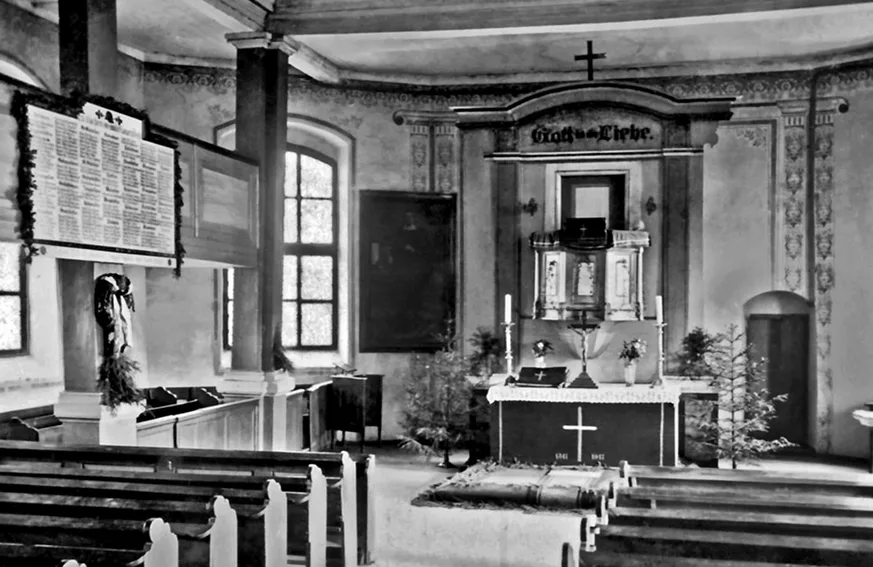 Memorial plaque in the church of Gawaiten/Gavrilovo, Ozyorsk District, 1930s. Photo from Bildarchiv Ostpreußen (www.bildarchiv-ostpreussen.de).
Somewhat unusual First World War memorials were the so-called "Iron Soldiers". The "Warrior in Iron", "iron soldier" or "nail man" was a propaganda symbol in Germany during the First World War. In essence it was a charity campaign aimed at raising funds for the needs of the front, the treatment of the wounded or aid to the families of the fallen. The tradition has its roots in Vienna, where since the 16th century there has stood, and still stands, a spruce trunk into which blacksmiths drove nails, believing that it brought good luck.
From the spring of 1915, this tradition of driving nails into a wooden sculpture of a knight, called the "iron soldier", began to spread throughout Germany. Wooden sculptures of knightly defenders began to appear in parks and squares: Siegfrieds, Rolands, St Michaels; later they were given the likeness of Hindenburg, and plaques in the shape of the Iron Cross, the imperial eagle or the town's coat of arms also began to appear. By making a donation, anyone could receive a particular nail (they were all iron, only painted accordingly): iron, silver or gold, depending on the size of the donation. In this way the sculptures were covered with nail heads and really did become iron.
This patriotic movement did not bypass East Prussia either. In October 1915, a sculpture of an iron knight by the sculptor Stanislaus Cauer appeared in Königsberg.
It was set up on the Paradeplatz in a special rotunda and stood there until June 1916. Later the statue was placed in the city history museum and then destroyed in the August bombing raids on Königsberg.
In Insterburg (Chernyakhovsk), too, a wooden statue of Hindenburg was erected near the district administration building. In Angerburg (Węgorzewo, Republic of Poland) a sculpture of a knight with the face of Hindenburg, the Iron Cross on his chest and the imperial eagle on his shield also appeared in the park. In Gumbinnen (Gusev), the so-called "Hindenburg plaque" was set up on the square by the Government building — an Iron Cross with the inscription "With God to Victory". And in Pillau (Baltiysk) it was a lifebuoy bearing the image of the Iron Cross. There were various sculptures or plaques in other towns of the province as well, but unfortunately not one of them has survived to this day.
By the beginning of the Second World War there were in the province, as already mentioned, more than 2,200 war burial sites from 1914–15, as well as more than 150 various memorials dedicated to the events of the First World War. All of them were preserved in excellent condition and served as a silent reminder of those events.
The post-war and present-day state of the First World War burial sites and memorials will be covered in the next part of the article.
__________
* According to Dehnen M., Raschdorff W. Heldenfriedhöfe in Ostpreussen. Königsberg, 1939.
** «Kriegergräber im Felde und Daheim» Jahrbuch des Deutschen Werkbunde 1916/17. München, 1917.
*** For example, the journal "Gartenkunst" No. 29 (1916) or the collection "Kriegergräber. Beiträge zu der Frage: wie stellen wir unsere Kriegergräber wurdig erhalten".
Translated from Russian with the help of AI (Claude, Anthropic), October 2026.