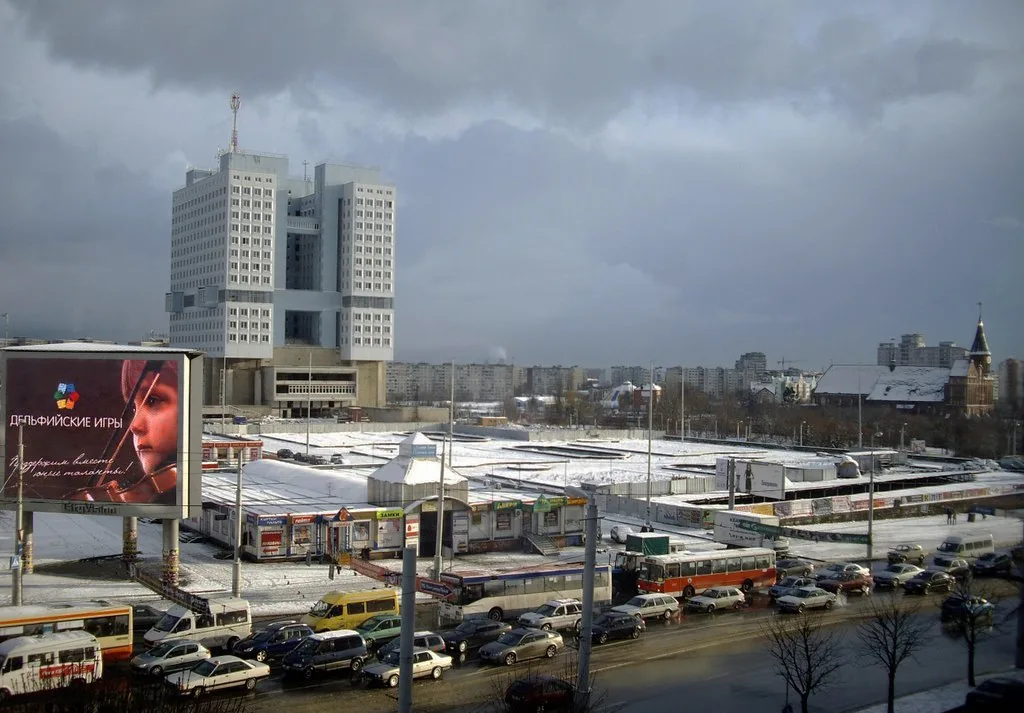
Kaliningrad's resemblance to European cities is probably limited to having residential districts. Nobody here has heard of a historic or financial centre. That, however, is not the worst of it. Far sadder is the fact that the city has no heart. How it has made it to 70 without this vital organ, God alone knows. But the fact remains: where the heart should be stands a huge dead building, staring out at the world through the empty eye sockets of its windows.
An attempt to remedy the situation was made a year ago, when the international architectural competition Heart of the City was held to decide the fate of Kaliningrad's central area. More than a dozen architects from different countries took part. And here is the surprising thing: almost all of them found it possible to keep the House of Soviets.
Let it stand and remind us of the USSR
It is hard to say why this happened. One could, of course, suppose that they simply liked this highly ambiguous structure. One could assume that the competitors had heard in passing that the House of Soviets has owners who are not yet ready to part with it, and so decided not to aggravate the situation. But most likely the foreign and out-of-town specialists were simply seeking the compromise that all sorts of local experts had talked so much about before the competition began.
It should be noted that in Kaliningrad the prevailing opinion has long been that if this city has a complex, multi-layered history, then its architecture ought to be the same. It is taken for granted, as it were, that every era, including the socialist era, must be reflected on the Royal Hill. And if so, the architects probably thought, then let the House of Soviets remind us of the USSR. Since it is so dear to Kaliningraders and since it is already there.
The jury's official position was voiced by one of its members, the well-known German architect Hans Stimmann, who stated that the building should be kept for the sole reason that it is part of the city's history.
Post-Castle
The castle that stood on the Royal Hill until 1968 is also part of history. Yet, unlike that of the House of Soviets, its fate was not clarified by this competition. Some architects proposed keeping it; others thought it enough merely to hint that it had once existed. In particular, the concept of the St Petersburg architectural practice Studio 44 (headed by Nikita Yavein), which took first place, provides for a modern building on the castle site whose outline only partly recalls the Royal Castle. The organisers of the competition, however, did not expect specific architectural designs from the participants. They were to propose a general concept for the centre of Kaliningrad.
What the Royal Hill will look like should become clear after a new international architectural competition, preparations for which are already in full swing. On the website of the Heart of the City bureau one can read that a hundred participants from all sorts of countries have been admitted to the competition, including such exotic ones as India, China, Iran, Lebanon and the UAE.
The competitors are to present a spatial design for a "Government Historical and Cultural Complex", provisionally named "Post-Castle". It is to house a conference hall for 1,500 people, an archaeological museum and a Museum of the History of the Castle.
– The complex can look any way you like, — explained the head of the Heart of the City bureau, Aleksandr Popadin, at an April meeting with Kaliningraders in the Chekhov Library. — The artists' imagination is not limited by anything. At the same time Popadin noted that he personally thinks it sensible to rebuild at least part of the castle. For example, the west wing, which housed the famous Muscovites' Hall, and the church in which the Prussian monarchs were crowned. He also believes the Haberturm (Oat Tower), which stood on the other side of the castle, could be recreated.
A cake with a cherry on top
Needless to say, the competitors face an incredibly difficult task. And I have serious fears that, in trying to solve it, many of them will follow the well-trodden path of compromise. That is, they will try to make everyone happy – both those to whom the House of Soviets is for some reason dear, and those who dream of the Royal Castle being rebuilt.
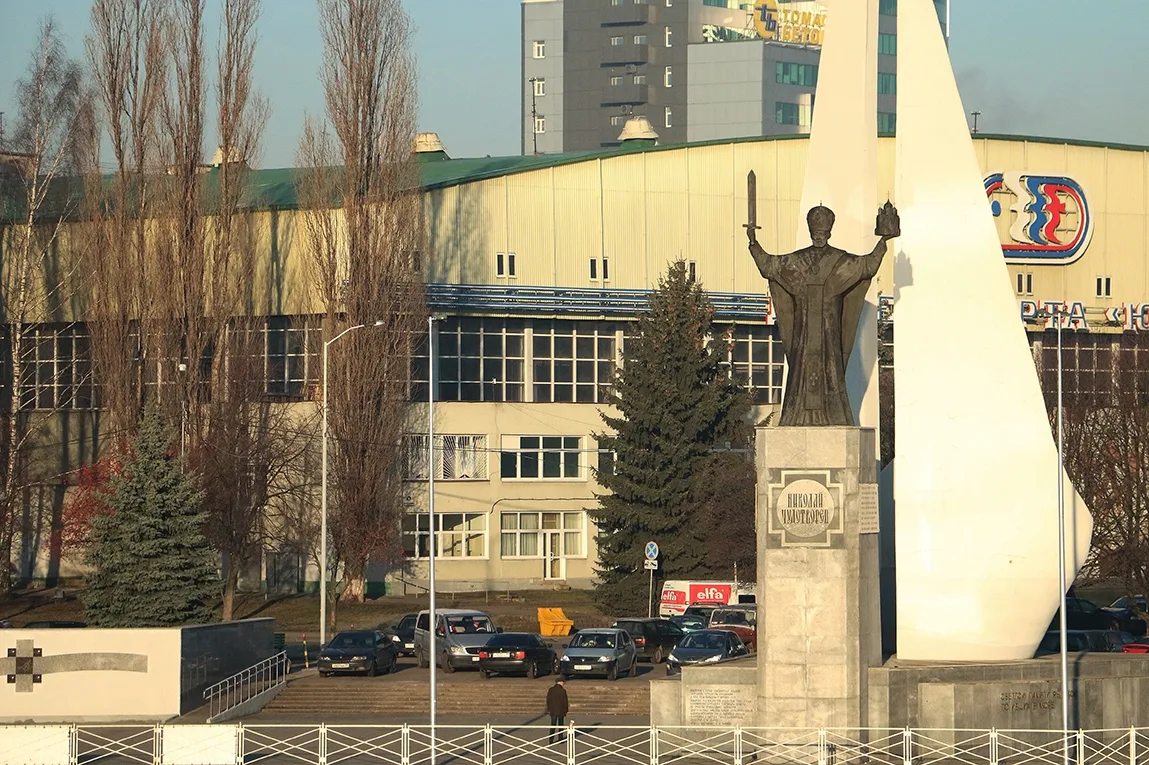
Yet it seems that compromise is far from appropriate everywhere. It is necessary in politics, in business, in family life, after all. But in architecture it often only does harm. You don't have to look far for examples. Look at Victory Square in Kaliningrad. A big white church has been built there that warms the souls of believers; a huge column topped with an order, dear to the hearts of veterans, towers there; there is a modern shopping centre for lovers of shopping and dining out. This astonishing "dish" is seasoned with fountains for children, benches for young people and flower tubs for those drawn to the soil...
You could say that Victory Square is the embodiment of a city-wide consensus. Compromise made material. But on the other hand, it is a truly desperate architectural cacophony, whose stylistic hodgepodge lacks, perhaps, only a Lenin monument. It was a mistake to move him to the House of Arts. He certainly would not have spoiled the existing composition — on the contrary, he would have served as the cherry on this absurd cake.
Of course, Victory Square is not the only place in Kaliningrad where you can see this kind of "hotchpotch": all over the city German red-brick houses stand next to Soviet aerated-concrete boxes and modern buildings of varying degrees of "masterpieceness". In a certain sense our city (and not only the city – the whole region) is a sort of sanctuary of architectural compromises. And now, it seems, another one is in the offing. Then again, it may well be that this time Kaliningrad will happily manage to avoid it and finally get a healthy heart, not torn apart by contradictions. It's about time…
P.S. This text was written before the competition results were announced. Unfortunately, the guarded optimism expressed at the end of the article was not justified. The competition (the results were announced on 9 September) was won by the most compromising of all the compromise projects. Its author, the young architect Anton Sagal, proposed both keeping the House of Soviets and rebuilding some elements of the castle, linking them with buildings in a contemporary style.
So everyone should be happy: lovers of antiquity, those to whom the Soviet period is dear, and those who are not indifferent to modernism. But one still feels somehow uneasy for the city…
Photo: Yury Bardun.
Translated from Russian with the help of AI (Claude, Anthropic), October 2026.