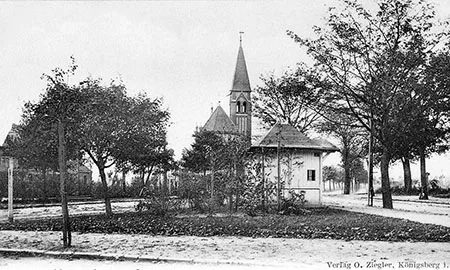

Ludwig Bechstein
"The German Book of Legends"
Leipzig, 1853
"The first Christian priest to bring the light of Christianity to Prussia was Saint Adalbert. He came from Poland, where he had preached the teaching of Christ, and then carried the word of God to Pomesania. From there he went on to Danzig1, and then to Samland2.
But here, near the amber town of Fischhausen3, where the ruins of the Chapel of Saint Adalbert still stand forlorn on the Baltic shore, he was attacked by a crowd of pagan Lithuanians led by a priest, who stoned him and killed him.
When the Polish king Bolesław the Brave learned of this evil deed, he ordered the saint to be brought to Poland so that he could be buried there with all the honours due to him. But the pagans demanded as much gold for the body as it weighed.
The King of Poland sent them gold in a quantity clearly sufficient to meet this demand. The dead saint was laid on one pan of the scales, and all the gold sent by the king was placed on the other — but the pan with the body did not move.
Then the king's envoys threw their own gold onto the pan with the gold as well — all in vain. The Prussian priests whom Adalbert had baptised came and gave their gold — to no effect. And there was also a little old woman there who, seeing people throwing their gold onto the scales, wanted to make her own humble contribution to the ransom for the saint's body. She had only two pfennigs, and these she tossed onto the gold in the pan. At that very moment the pan sank under the weight of the gold lying on it, and the other pan with the saint's remains shot up high. To balance the scales, they began little by little to take the gold off the lower pan, and only when the two pfennigs the little old woman had thrown were left lying at the bottom did the pans come into balance — and that was the price of the murdered saint."
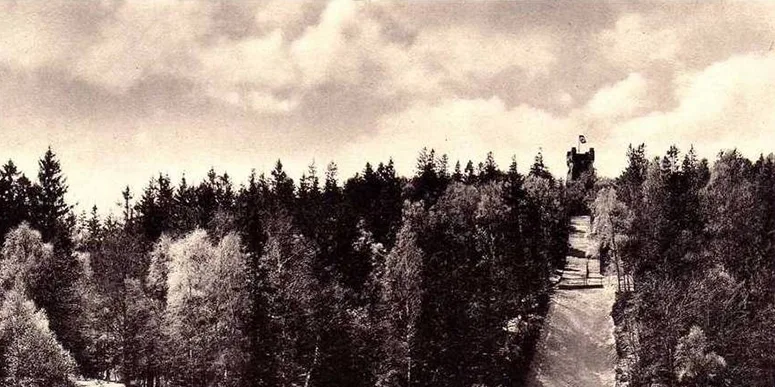
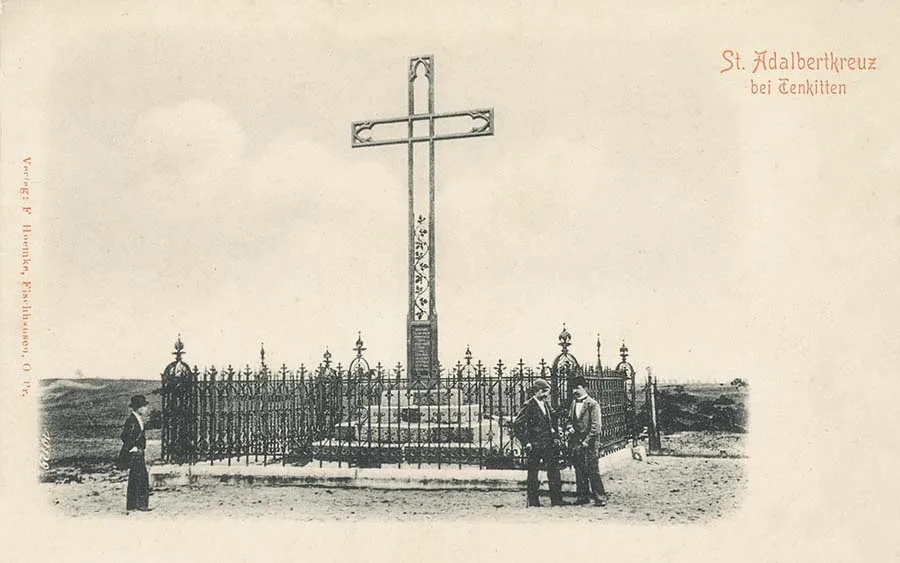 The Cross of Saint Adalbert at Tenkitten (before 1945)
Rudolf Friedrich Reusch
"Legends of Prussian Samland"
Königsberg, 1838
"Between Fischhausen3 and Pillau4, where on all sides, as in a sandy desert, nothing can be seen but the monotonous waves of the dunes, near the hamlet of Tenkitten, there rises a tall black cross erected here in memory of Saint Adalbert. The cross stands on the seashore, on the very spot where the saint was killed on 23 April 997. This cross of black cast iron is 26 feet high; it was set up in 1831 at the expense of Countess Wielopolska on the foundations of the old chapel, destroyed by storms as early as the 17th century5. Legend has it that when the Chapel of Saint Adalbert was built it stood about a mile from the seashore, whereas now the spot is scarcely two hundred paces from the sea. That is how the sea has advanced upon the land over all these centuries9.
The remains of the former chapel now lie hidden beneath a thick layer of sand washed up by the sea. The altar, however, was moved to the church of nearby Lochstädt Castle6. The wings of the altar are decorated with four scenes from the life of the saint.
Adalbert, accompanied by his faithful companions Gaudentius and Benedict, landed at the mouth of the river Pregel7 and tried to preach Christianity in several places. But these attempts ended in failure: the preachers were insulted, humiliated and threatened with reprisals — indeed, with death itself.
Only by fleeing from their pursuers could Adalbert and his companions save their lives. Once he landed on the south-western shore of Samland and spent five days in a settlement, deliberating with his companions whether it would not be better to leave the lands of these pagan tribes and return home.
And at that time Adalbert's faithful companion Gaudentius had a dream. In it he saw a chalice half filled with wine. The chalice stood on an altar. And just as Gaudentius was about to drink from it, a church servant came up to him and said that this chalice was meant for Adalbert; tomorrow he would drink from it. Then Gaudentius woke up and, trembling, told Adalbert his dream, but Adalbert answered him: "All is in God's hands, both dreams and waking! Do not put your trust in deceptive dreams!"8.
The next day they went on their way with prayer and, having passed through dense, deserted forests, found themselves near a cultivated field, where they settled down to rest. They did not know that they had come onto land sacred to the Prussians, which the uninitiated were forbidden to enter on pain of death.
Soon, with wild cries, a band of pagans fell upon the travellers and bound them. And then Adalbert remembered the dream of the day before and began to comfort his companions, saying: "What is nobler than to give one's life for Jesus Christ!" At that moment the pagan priest Siggo rushed out of the crowd at Adalbert and with all his strength thrust a sharp spear into his breast. Then the other pagans came running and drowned their anger in the blood of the holy man. He was pierced with seven spears, and, with his arms outstretched, Adalbert fell to the ground in the shape of a cross and died there. But even his lifeless body was not left in peace by the raging crowd: they cut off his head and set it up on a pole. The body was left lying on the ground.
When Duke Bolesław of Poland learned of the martyr's terrible end, he resolved to ransom Adalbert's body from the Prussians at any price. The Prussians demanded as much silver as the saint's remains weighed. And the duke agreed to this condition.
The legend tells us that the martyr's body, when it was weighed, proved so light that it did not weigh even a pound...
_______________________
1. Modern Gdańsk.
2. The Kaliningrad Peninsula.
3. Modern Primorsk.
4. Modern Baltiysk (until 1946 Pillau, Ger. Pillau; Pol. Piława; Lith. Piliava — Pilyava)
5. Tenkitten — modern Tanketino (Pol. Tenkity, Ger. Tenkitten)
6. Lochstädt — a castle of the knights in the town of Baltiysk, Russia. Now in ruins.
7. The modern name is Pregolya (Prussian Preigara, Preigile, Ger. Pregel) — a river in Russia flowing into the Baltic Sea, or more precisely into the Kaliningrad (Vistula) Lagoon.
8. In the Middle Ages it was believed that drinking church wine in a dream was a very bad omen.
9. As early as the 11th century a small chapel appeared on the site of Saint Adalbert's death, built by order of the Danish king Canute.
In 1831 a majestic Cross of St Adalbert was erected here. It was made of cast iron and was eight metres high.
During the Second World War the cross was destroyed. In 1997, for the millennium of Saint Adalbert's death, the municipal authorities of Baltiysk and its Polish twin town Elbląg (Ger. Elbing — a historic Prussian town, centre of the ancient Prussian region of Pomesania) decided to restore the cross. The new cross is made of steel and is ten metres high. Standing on the seashore, the cross is clearly visible to all passing ships.
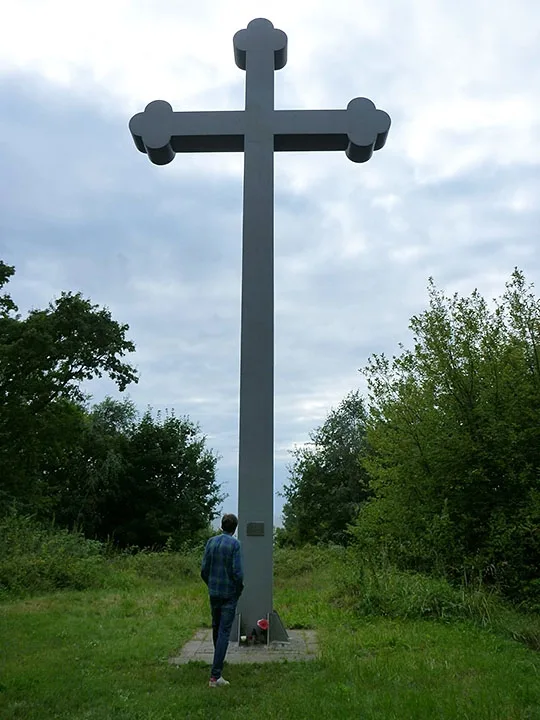
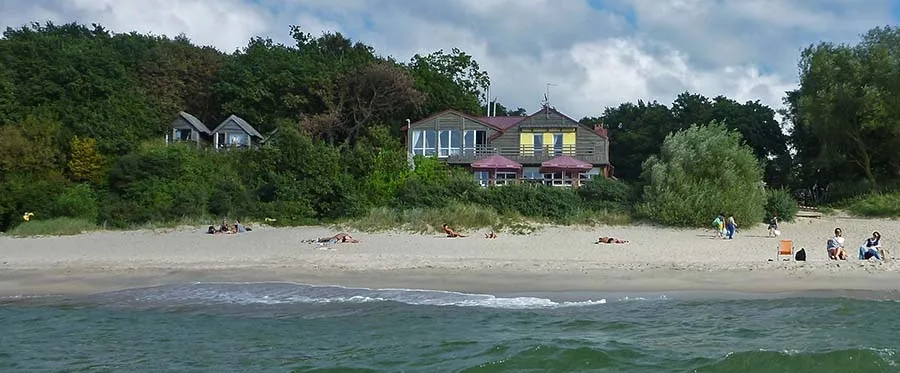
Memorial Cross of Saint Adalbert
near the "Vitland" art village outside Primorsk.
HISTORICAL BACKGROUND
Adalbert of Prague (Lat. Adalbertus Pragensis, also known as Vojtěch or Wojciech (Cz. Vojtěch, Pol. Wojciech); 955, Libice nad Cidlinou, Czech Republic — 23 April 997, Prussia, now Kaliningrad Region, Russia) — Bishop of Prague (982–989, 993), a Catholic saint. He is especially venerated in Bohemia, Poland and Hungary.
By birth Vojtěch belonged to the powerful Czech princely family of the Slavníks. Vojtěch had six brothers, one of whom, Radim (also known as Gaudentius), also became a well-known churchman and the first bishop of Poland. Vojtěch's family lived in the town of Libice nad Cidlinou.
In the spring of 997 Adalbert (Vojtěch) set off with his brother Gaudentius (Radim) and his friend Benedict to preach Christianity among the Prussians.
On 23 April 997 he met his death at the hands of Prussian pagans not far from present-day Primorsk. Soon after the bishop's death his remains were ransomed by Bolesław the Brave, the weight of the gold paid being equal to the weight of the great martyr's relics, and laid to rest in the cathedral at Gniezno. Just two years after his death Vojtěch was canonised by Pope Sylvester II. The canonisation was timed to coincide with the founding of the first Polish archbishopric in Gniezno.
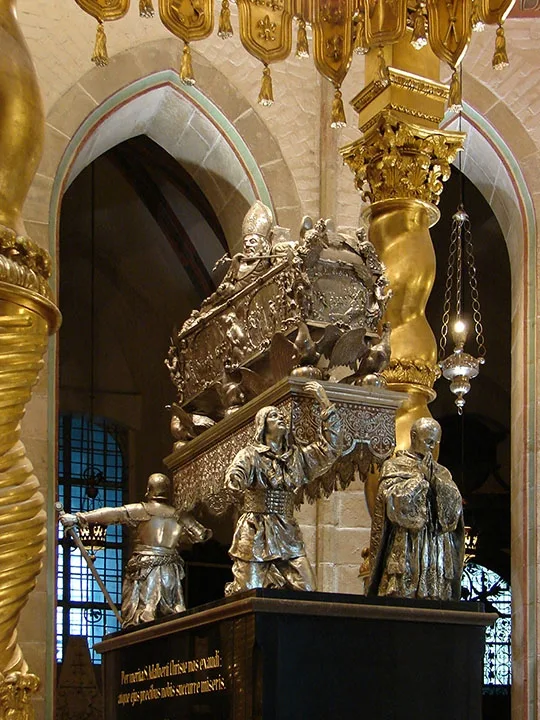
Silver memorial to Saint Adalbert
in the cathedral of Gniezno (Poland).
BIBLIOGRAPHY
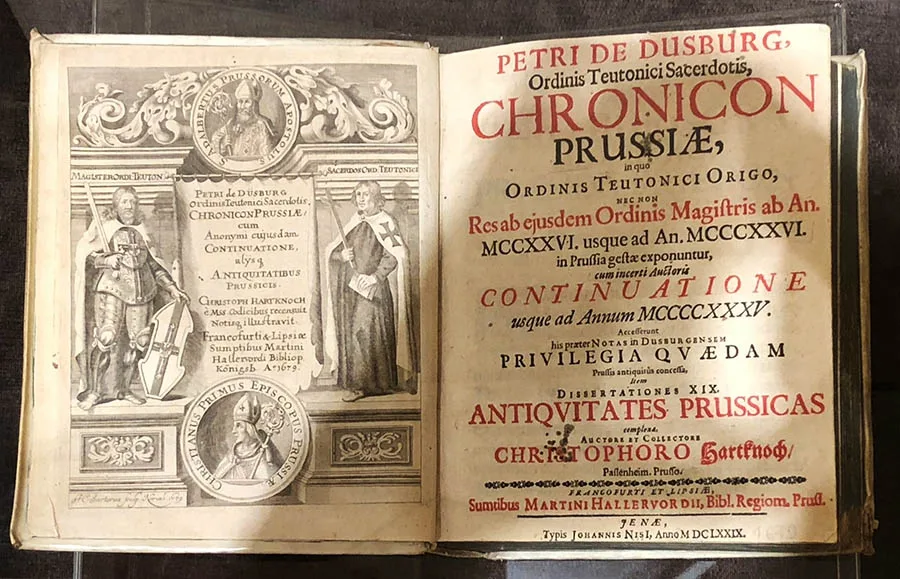
1. Rudolf Friedrich Reusch: Sagen des Preußischen Samlandes. № 90. "St. Adalbert". Projekt-Gutenberg.org
2. Ludwig Bechstein, Deutsches Sagenbuch, 1853. Sagen.at.
3. Adalbert of Prague. Wikipedia.
● Editor's note: Read on VisitPrussia.com an interview with the translator of the legends of Saint Adalbert, our new contributor Tatyana Kolivay, who runs her own blog, where countless other German parables and fairy tales in her translations have been published.
Translated from Russian with the help of AI (Claude, Anthropic), October 2026.