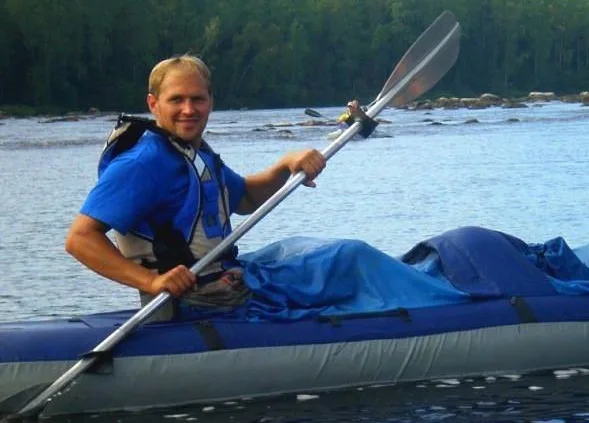
— Aleksey, could you tell us how your passion began?
— Quite by chance – I love anything active. I happened to buy a second-hand kayak, which, by the way, is still alive and on the water. That's where it all started. Before that my friends and I used to go out on inflatable life rafts. But rafts aren't very stable, so I like kayaks better. Over time I built up my fleet to 4 kayaks.
— Is kayak touring an expensive pleasure? Who can afford to buy a kayak?
— If we're talking about buying a kayak, that puts it in the expensive tourism bracket, because a kayak costs around 25–30 thousand and up. On the other hand, today there are people and individual firms in our region that offer a "go for a paddle" service and organise more serious trips. In the end, you can simply rent a kayak. Last year renting a two-seater would have cost you 600 roubles. On social networks, above all on VKontakte, there are special groups where you can find this information.
— In Europe, and in Russia too, kayak trips are a widespread form of active recreation. How popular are they in the Kaliningrad Region?
— As far as the Kaliningrad Region is concerned, the water section of tourism is well developed here. We have experienced people in the region who travel far: the Altai, Karelia, Bashkiria – that is, routes of a very serious difficulty grade. But if you talk about the local Kaliningrad places where people paddle, kayak trips aren't very developed. Serious sporting events gather 15–20 kayaks at most.
— Which rivers in the region do the main routes follow?
— Let me say straight away that there are two main factors in choosing a route.
First, the distance from Kaliningrad: the farther away, the harder it is to get there. Second, the gradient of the terrain – the closer to Kaliningrad, the flatter and more sluggish the rivers.
Taking these factors into account, in my opinion the most conveniently located river is the Angrapa, which flows for 85 km from Ozyorsk to Chernyakhovsk. It's fairly easy both to get onto the Angrapa and to leave it. I can certainly also recommend the Lava: Pravdinsk–Znamensk, 50 km. But that's a calmer river; it flows through more or less flat country.
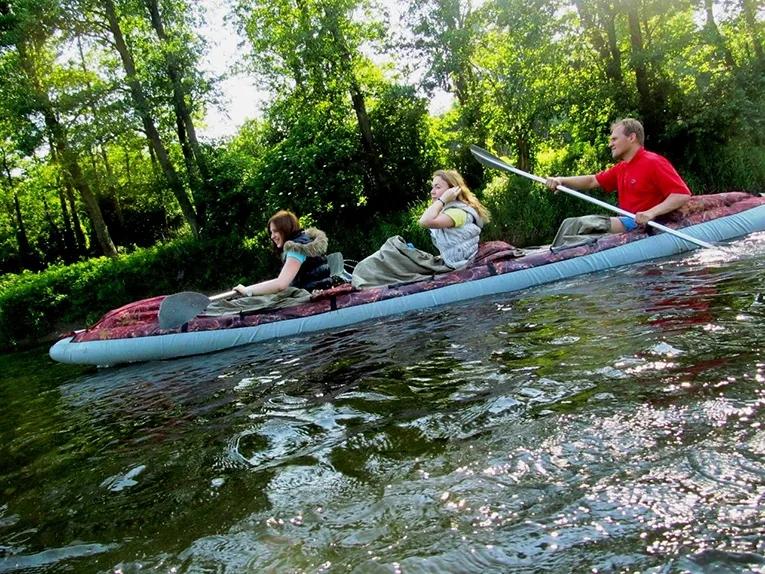
Kayaking on the Lava River.
The Sheshupe leaves a pleasant impression, but unfortunately the stretch you can paddle without entering the border zone is short: only about 33 km, from Krasnoznamensk to the village of Lesnoye. If the water level is good, you can do the Pissa: from the Gusev area down to where it joins the Angrapa, finishing in Chernyakhovsk. Sometimes we'd do some sawing, that is, clear away trees and branches hanging over the water, and we travelled the Krasnaya River specifically for that purpose. Incidentally, there's an agritourism farmstead there whose owner rents out kayaks. Well, he cleared a 3 km stretch all by himself. For the Krasnaya that's a real feat. In one day we managed to clear just 1.5 km. Both the Pissa and the Krasnaya are fast-flowing, pleasant rivers in our region.
We have another good, long river – the Kornevka, but unfortunately it's blocked with fallen trees. Ironic as it sounds for our region, it's a typical mountain river. It's dangerous to paddle, because the current can drag you under a tree. The hydrodynamics of the Kornevka are amazing. Of course, individual stretches can be cleared, but there's no guarantee a tree won't fall in the next month. All attempts to clear it have come to nothing.
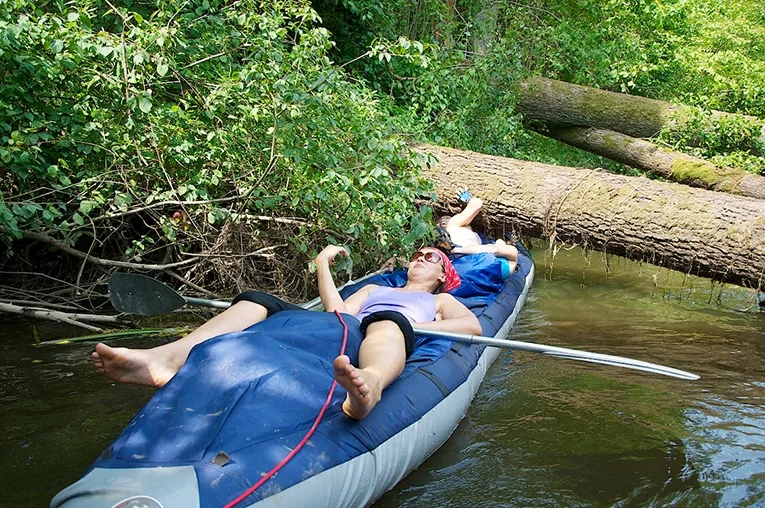
"Crawling" under a logjam, the Pissa River.
— I've heard a lot of good things about the kayak routes in the Polessk and Slavsk districts. What do you think of them?
— On the one hand, the Slavsk and Polessk districts are wonderful places. I'd even call them "Kaliningrad's Venice". There are more waterways there than roads. But on the other hand, the landscape is flat, so you have to keep paddling, paddling and paddling. For example, the hardest water trip of my life was on the Matrosovka, which flows through the Slavsk district. The Matrosovka is a serious, huge river, much bigger than the Pregolya. We ran into a strong headwind that time. Nobody found it easy, and when we came out into the Curonian Lagoon along the Tovarnaya River, we realised there was no point going any further. The children were crying, the men were timidly turning in circles and saying that's not where we needed to go.
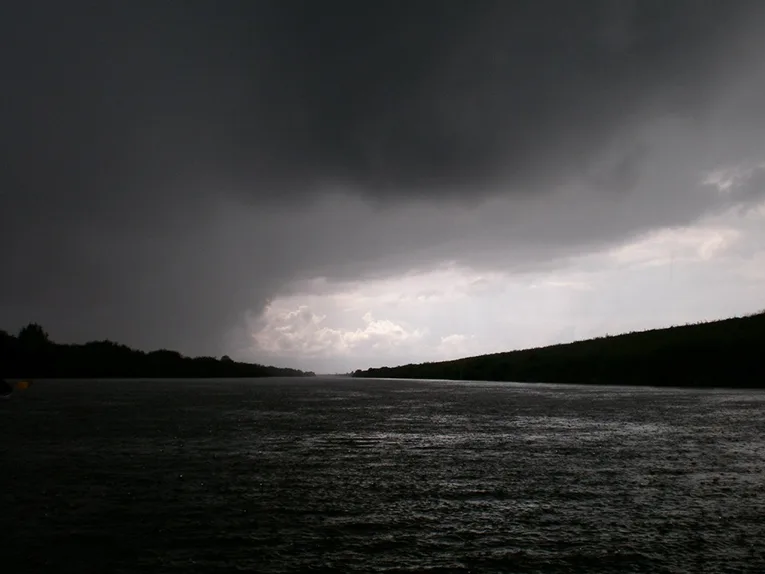
A downpour on the Matrosovka River.
— How long does a kayak trip usually take?
— Here's my recommendation. Even if you're afraid of spending the night out, don't go for just one day, because more time will be spent getting to the starting point, preparing your boat and then getting back home. On the other hand, two or three days is the maximum our routes allow. Planning longer routes is very difficult. If you spend a long time on the kayaks, it essentially turns into paddling on the spot: fishing, resting, lazing on the beach. But if you keep moving downstream, the Angrapa takes about three days, the Sheshupe a day – at most you can stretch that route to two. On the rivers of the Slavsk and Polessk districts you can of course paddle longer. The current doesn't push you anywhere; you can go in any direction. And planning your own routes in general is a very interesting subject. It's actively discussed in many groups on VKontakte. I'm very grateful to those who aren't stingy and post their route write-ups, so that newcomers can see where it's worth going.
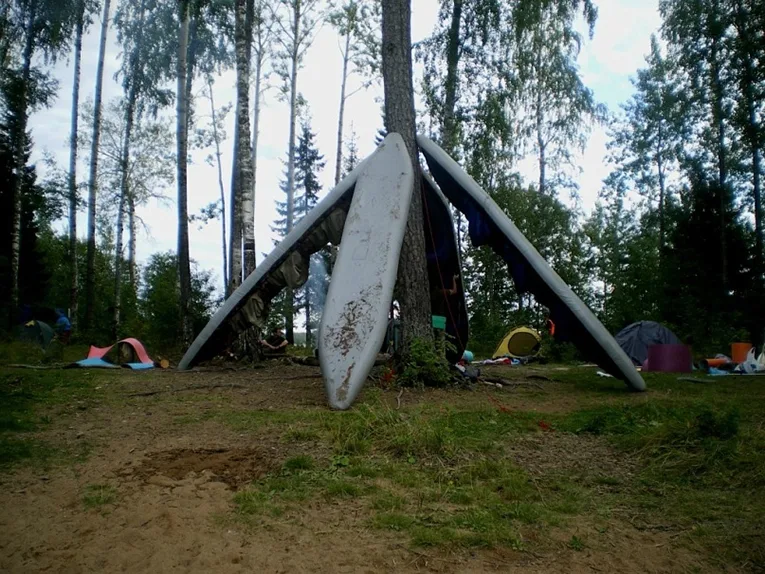
Drying the kayaks.
— What are kayak trips for you – recreation, competition, or something else?
— Even though we've taken first places in competitions, for me it's still just one branch of tourism. I'm a tourist from head to toe: I started out with hiking, then moved on to water tourism, and now it's cycling. Every time I feel like picking up the paddles, the first thing I do is try to find an interesting route. And often, even on hikes, you keep an eye out for rivers for water routes. Once, for instance, we were just walking around the centre of Vilnius, saw the Viliya, which flows into the Neman, and decided we had to paddle it. The result was a seven-day grade-one water trip through Lithuania.
— Aleksey, you've been kayaking for years. In your opinion, what are the main problems with kayak trips in the Kaliningrad Region?
— Basically, there are no problems, because the rivers are extremely safe. Kayaks are perfectly suited to our rivers. And on the whole, even on the most visited and popular rivers there are plenty of camping spots and firewood along the banks. Kayak trips are a relaxed and comfortable form of tourism. Compared with hiking, you don't have 25–30 kg hanging on you to carry; everything floats along in the kayak. I took my son on a three-day water trip when he was 5, and last year I saw with my own eyes a little girl only a year and a half old being taken on a trip.
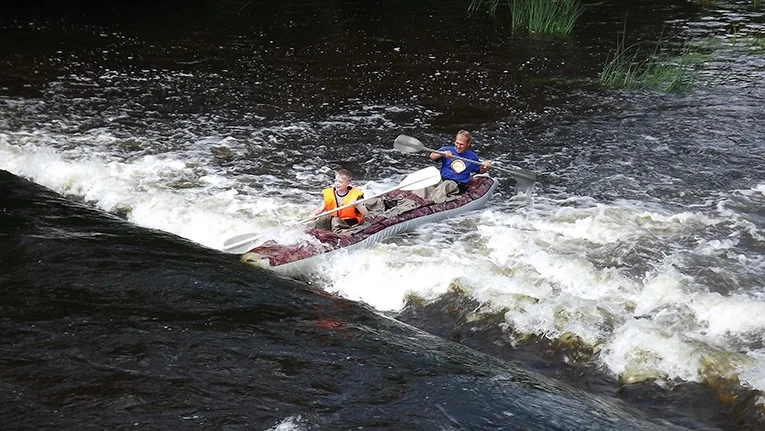
Storming the dam at Mayakovskoye.
— Have you ever capsized in all your years of touring?
— Let me say straight away that capsizing a kayak here isn't dangerous, because where our rivers flow fast they are, as a rule, knee-deep at most. Sometimes shallower. And where they're deeper, the water is simply flat and you couldn't capsize if you tried. I've only had a kayak tip over twice in the Kaliningrad Region. Most often it happens through lack of skill. Once I capsized on the Krasnaya when the current was strong. The second time I was simply gawking and misjudged the distance to a tree hanging over the water.
— And what about rapids here?
— There are no natural rapids in the Kaliningrad Region, but there are some interesting artificial obstacles. Among them are the dam at Mayakovskoye on the Angrapa and the hydroelectric dam near Znamensk on the Lava.
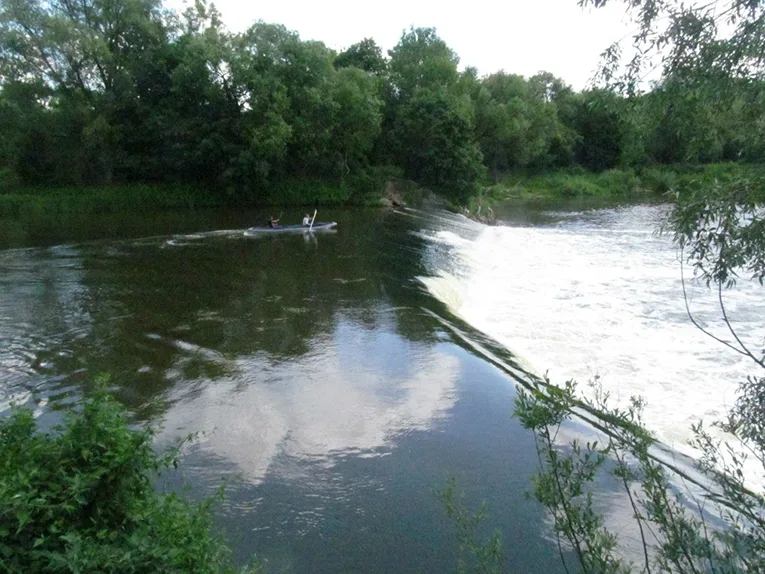
Negotiating an artificial obstacle on the Lava River.
And then there's the hydroelectric dam in the village of Priozerye on the Pissa. None of them are dangerous; all can be passed without special training, as long as there's water in the river. Incidentally, in July and August – the best months for kayak trips – we sometimes have a problem with low water levels in our rivers because of scant rainfall. Then the waterweed grows very thick. Once, for example, we set off down the Pissa and our paddles literally got stuck in the weed. A trip like that turns into torment.
— In Kaliningrad you often come across Polish information brochures in Russian describing Polish kayak routes with superbly developed infrastructure. What's the situation with kayaking infrastructure in the Kaliningrad Region?
— There isn't any. The most we can boast of is that some individual owners have a certain number of kayaks. And, accordingly, they have the means to transport them.
That's where the infrastructure ends: there are no landing stages built specifically for kayaks, and no slipways for launching them.
Admittedly, kayaks aren't particularly demanding in that respect. Of course it would be nice if, as in Poland, we had rental stations along the rivers. But unfortunately there's nothing like that yet. On the other hand, that may be for the better, because kayak trips here haven't turned into such a mainstream thing where, roughly speaking, a kayak trip is a two- or three-hour fairground ride. I think that would seriously spoil people's impressions and emotions.
— So infrastructure for kayak trips is practically non-existent in the Kaliningrad Region. In that light, how would you assess the prospects for kayak tourism in our region?
— The most important thing is that we have decent people who own lots of kayaks and offer real, full-fledged kayak routes. Many of these routes have great value as guided excursions. Some of them are educational in terms of flora and fauna. Others focus on hydraulic engineering structures: the wonderful locks on the Lava, the Matrosovka and the Masurian Canal.
And in the tourism context, more and more Kaliningraders are paying attention to this kind of recreation.
By the way, even Poles come here, because they want not only to paddle down a river but also to pitch a tent on the bank and light a campfire. In Poland that kind of thing is practically impossible. What they have is, as they say, just "joyrides".
— Do our neighbours often come here to paddle the rivers?
— On the one hand, there have been several organised events when an international kayak trip went from Poland into the Kaliningrad Region along the Łyna–Lava. A mobile border checkpoint was even set up on the river for the occasion. On the other hand, Polish kayakers in the Kaliningrad Region are, of course, a great rarity. The Kaliningrad Region isn't all that attractive even for its basic types of tourism – sightseeing or health tourism – let alone niche types. Especially since our landscapes and rivers are similar to the Polish ones.
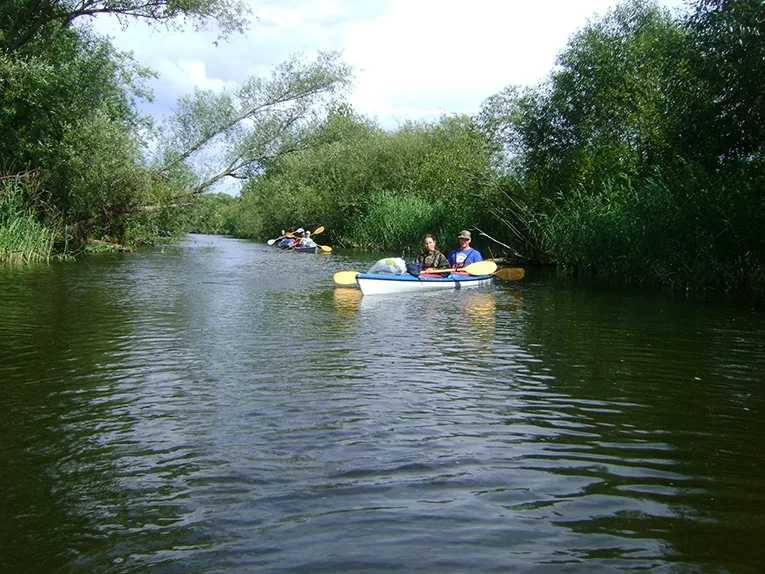
Tovarnaya River.
Our special highlight could be combining kayak routes with places of interest. Then a route becomes unique. Admittedly, it will still remain the romance of "wild" tourism: a tent on the bank, a campfire. And of course, developing this sphere takes a certain organisational effort. At the very least, information brochures or catalogues should be available on the Polish market.
— Then a question about organisational effort. Our authorities are very fond of writing all sorts of concepts for developing tourism in the Kaliningrad Region. Is there a place for kayak tourism in these concepts?
— More no than yes. First, it's amateur sports tourism. Second, to put it in market terms, it's not the kind of tourism that is financially attractive to our local authorities. Kayaks aren't yachts. It's like people picking mushrooms in the forest: it makes no difference to anyone either way, but the mushrooms grow and people enjoy picking them.
Photos: Aleksey Anokhin
Translated from Russian with the help of AI (Claude, Anthropic), October 2026.