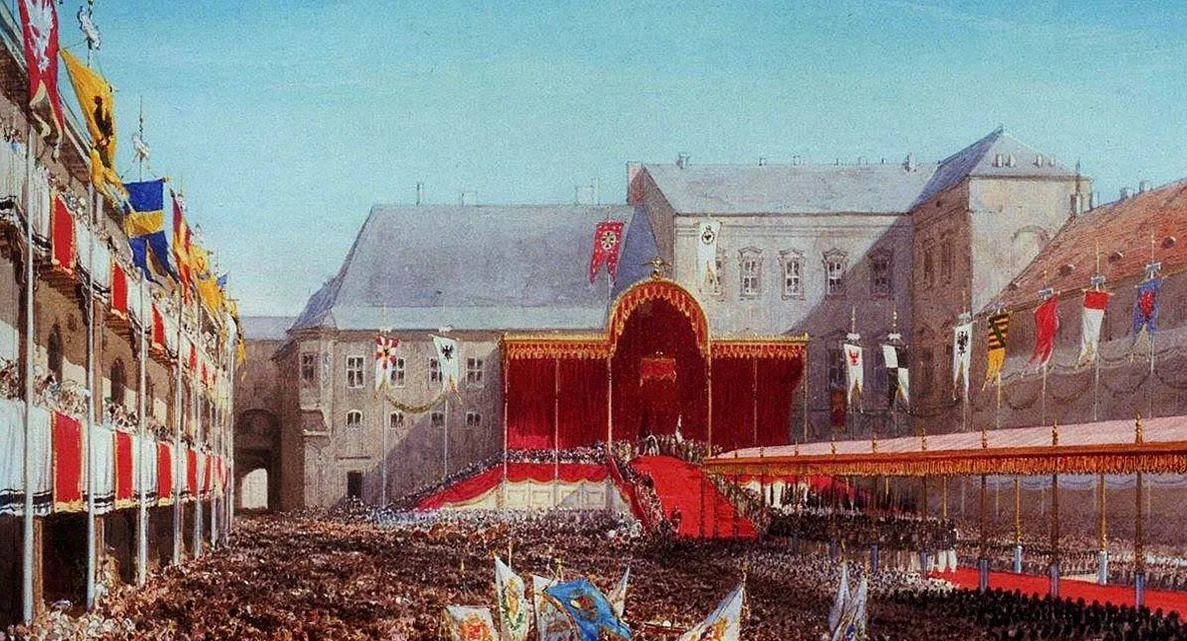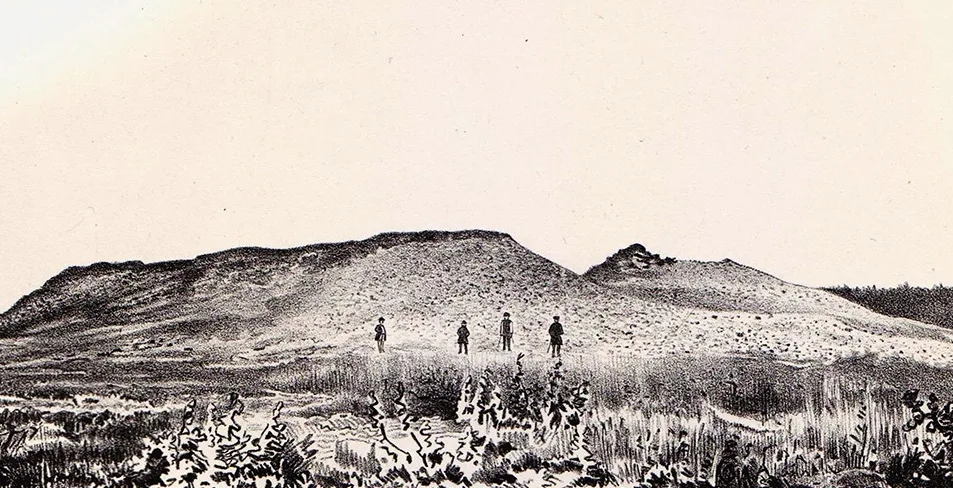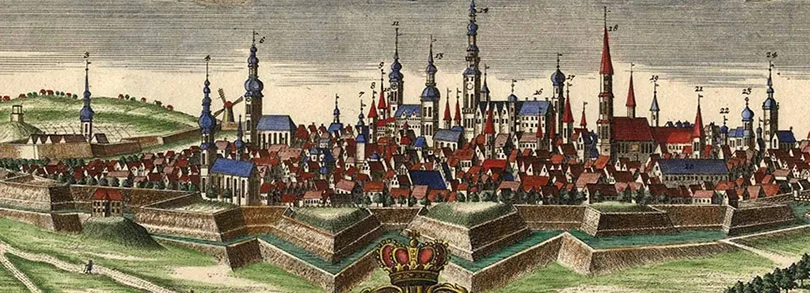
Yet the bastions of the first rampart ring witnessed some of the most remarkable, fascinating and significant events in the history of our region. They saw the proclamation of the Duchy of Prussia's independence and the coronation of the first Prussian king. It was through their gates that Napoleon and Fermor rode into the city, along their ramparts that Immanuel Kant took his walks, and their design that the young Tsar Peter examined in order to embody its features in the not yet built St Petersburg. The fate of the city was bound up with them for a full 200 years.
A Fresh Wind and Gunpowder Smoke
The arrival of a new age in Europe is usually associated with the Renaissance. Of course, the mere mention of this remarkable period in human history conjures up the works of Raphael and Leonardo da Vinci, Nicolaus Copernicus's heliocentric system of the world, and the medical research of Paracelsus. But a new age also dawned in the art of war, including fortification. The reason was the adoption of firearms by European armies. Now infantry armed with arquebuses and muskets, reinforced by artillery, which had not yet become a separate branch of the armed forces, became the main force on the battlefield, one that knightly cavalry could no longer withstand.
As soon as artillery outgrew its infancy, all the old fortification solutions in the form of stone walls and towers became obsolete at a stroke.
Stone and later cast-iron cannonballs smashed masonry, striking the fortress's defenders with fragments of brick and stone. Now, regardless of the thickness and height of the walls, it was only a matter of time before breaches were made in them, through which detachments of assaulting troops would pour into the fortress. Conversely, castles and fortified towns built around walls and towers were very poorly suited to housing fortress artillery. Only small guns could be placed on top of a wall, and they were easily vulnerable to enemy fire. The towers were too small and cramped to house guns, and the use of black powder turned castle towers in which light cannon could be mounted into veritable gas chambers. As early as the 15th century Europe began searching for new forms of fortification capable of resisting all-crushing siege guns.
For Prussia, the new age arrived when Albrecht of Brandenburg took office as Grand Master. These were, frankly, hard times for the Order. The entire system of the Order's state was stubbornly sliding towards collapse. And the cause was not even the defeat of the Order's army at the Battle of Grunwald (1410), nor its inability to rein in the wilful town councils, which had exhausted the Teutonic Order in the Thirteen Years' War of 1454–1466.
The Order's rule, which forbade its knights to own property or have families (and therefore heirs), was in direct contradiction with the foundations of feudal society and its system of values.
The Order had run its course as a corporation united by the aim of conquering Prussia and establishing the Christian faith there. Having become a fief of Poland, it was a vestige on the body of a Europe that was now building nation states based on the power of the monarch and the self-awareness of the people as his subjects. And the Reformation that swept northern Germany drove the last nail into the coffin of the Order's state.
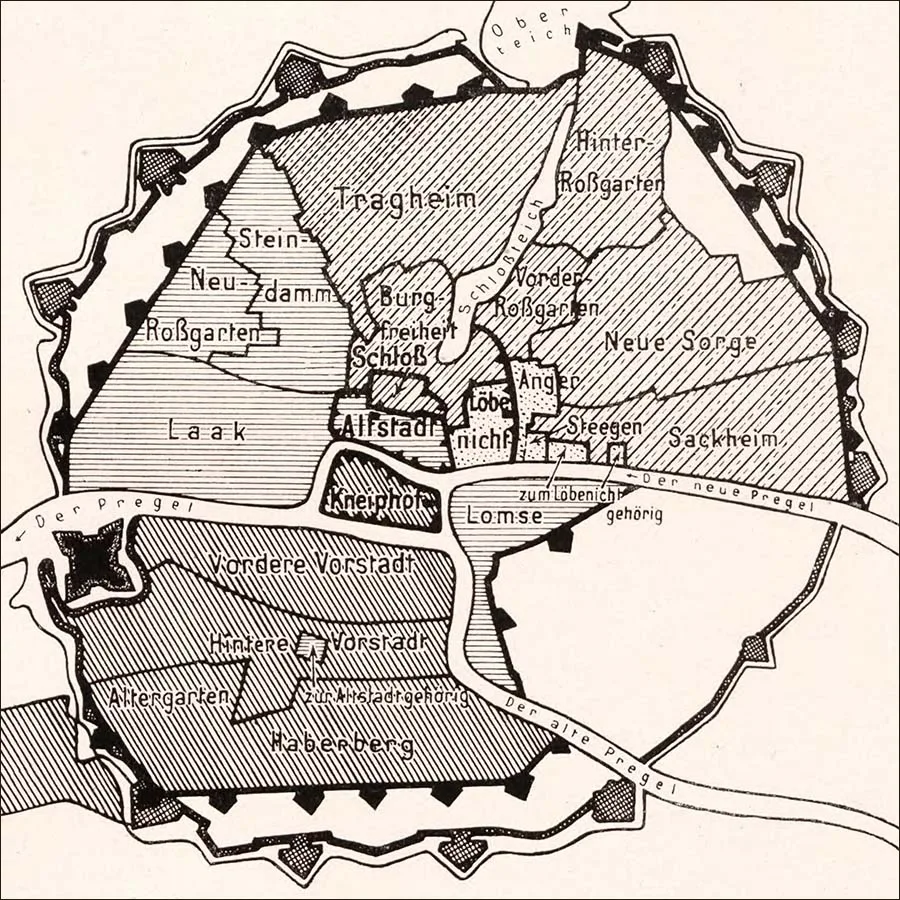 Three lines of Königsberg's fortifications from different eras: the medieval one, when each of the three towns on the Pregel had its own fortress walls (centre); the first common rampart ring of the 17th century; and the second rampart ring, built in the mid-19th century (farthest from the centre).
When Albrecht abolished (secularised) the Order, he inherited from the Teutonic era a whole network of castles scattered across the duchy. These castles were listed in the text of the Treaty of Kraków, under which the new duchy accepted the Polish king as its suzerain. In addition, towns such as Altstadt, Löbenicht, Kneiphof, Friedland (Pravdinsk), Heiligenbeil (Mamonovo) and others had their own defensive walls. Realising that all these fortifications were long outdated and that building new ones was beyond the means of the ducal treasury, Albrecht took the only right decision for the time: to live in peace with his neighbours, which was backed by Poland's obligation to act as the duchy's protector in the event of an attack from outside. During this period Prussia was to close the gap with the European level of science, education and culture, while continuing to build the state and strengthening the position of Luther's teaching in the duchy. This peaceful period in Prussia's life continued after Albrecht's death, during the nominal reign of his son Albrecht Frederick. As a result, when the Thirty Years' War (1618–1648) broke out in Europe, Königsberg had utterly outdated fortifications in the form of a knights' castle and town walls, which by then posed no serious obstacle to European armies.
The Age of Bastion Fronts
And what of Europe? By this time fortifications in Europe had undergone striking changes: the stone wall had been replaced by an earthen rampart that could withstand cannonball hits successfully for a long time. Towers, meanwhile, gradually became lower and wider, and were eventually replaced altogether by bastions.
The pentagonal shape of the bastion is believed to have been proposed by Albrecht Dürer, the great artist, mathematician, philosopher and fortification engineer.
The stretch of rampart between bastions came to be called the curtain, and two bastions with a curtain between them a bastion front. Directly in front of the bastion front was a ditch, and beyond it the glacis: an open space sloping down towards the attacking enemy. It was across this glacis, devoid of any natural cover, that enemy detachments had to advance under fire from the fortress artillery. The batteries and soldiers stationed on the rampart had an undeniable advantage: the profile of the glacis was shaped so that cannonballs and bullets, when fired, skimmed along its surface. There was then no need to change the aim or fire ranging shots if the enemy changed position.
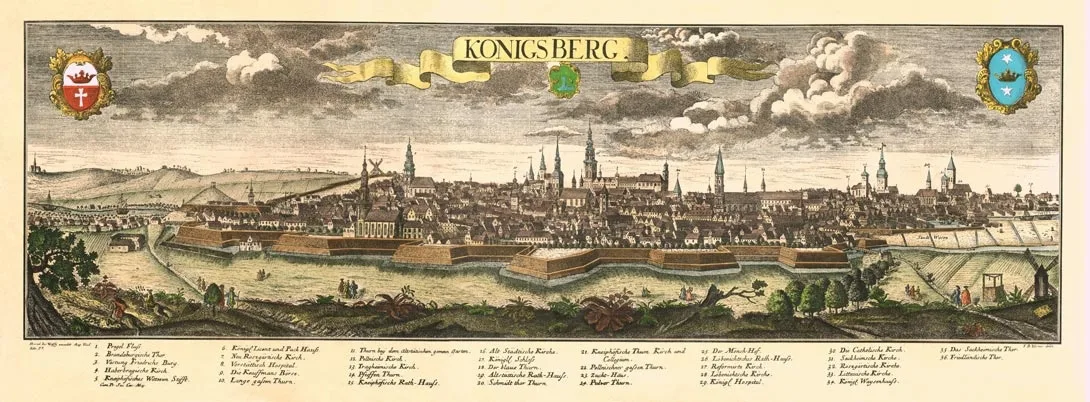
The bastions of Königsberg's first rampart ring.
A high rampart gives a far greater firing range than the attackers have. In addition, the glacis shields the foot of the rampart from return fire by the enemy artillery, which, among other things, is forced to fire along an unfavourable high trajectory, and all this under constant counter-fire. Those detachments of besiegers that managed to cross the glacis, get over the ditch and reach the earthen rampart came under deadly flanking musket and artillery fire from the bastions. The batteries on their flanks are covered by the faces of the bastions and are therefore invulnerable to artillery fire from long range. They enter the battle intact against an enemy already badly battered, cutting him down with point-blank fire. Finally, an attack on the bastion itself is subjected to the same crossfire from the bastion under attack, the adjoining curtains and the neighbouring bastions.
The construction of a bastion belt results in a system of fortifications in which each work covers its neighbours with fire and is itself covered by them.
Once the concept of the bastioned fortress described above had finally triumphed over the diehards with their stone walls and tall towers, all that remained was to work out the optimal profiles of the rampart and the trace of the bastion. This was taken up by mathematicians (including the above-mentioned Dürer). Several systems of proportions and methods of tracing bastions were developed for fortresses of various sizes and shapes, and every designer considered himself the creator of the ideal form of the bastion front. The enthusiasm for mathematical methods of fortress design even took somewhat exaggerated forms, since in pursuit of "correct" geometry fortification engineers sometimes ignored the natural lie of the land, as if to illustrate the saying "it all looked smooth on paper, but they forgot about the ravines".
If You Want Peace, Prepare for War
But let us return to Königsberg and the history of its fortification. The Thirty Years' War, in which the states that had embraced Protestantism opposed a league of Catholic states, is sometimes called by historians "the real first world war". There is some truth in this, for although not all the states of Europe took part in it militarily, it affected every European territory in one way or another. Just as after the two world wars of the 20th century, the Thirty Years' War was followed by a new post-war world order: the Westphalian system.
In this war the Duchy of Prussia, by now ruled by the Brandenburg Hohenzollern dynasty, faced a dilemma: as a Lutheran state Prussia ought to have supported the Protestants, but as a vassal of Poland, the Catholic League.
George William, Duke in Prussia and at the same time Elector of Brandenburg, therefore did everything he could to avoid hostilities and remain neutral. He succeeded only in part. On 6 July 1626 a Swedish landing force of 8,000 soldiers unexpectedly came ashore at Pillau (today's Baltiysk). It was commanded by one of the main heroes of that war, the Swedish king Gustavus II Adolphus. His aim was to seize Poland's Baltic coast, which would have made the Baltic an inland sea of the allied Protestant states. Königsberg itself did not interest him, as Gustavus Adolphus had already counted it as a town in his rear. He was, however, surprised that the capital of the Duchy of Prussia was completely unprepared for defence in the midst of a general war. It was the Swedish king who persuasively (that is, with the threat of military action) insisted that the duke immediately begin building modern fortifications around the city, so that it would not fall into the hands of his enemies without resistance. There is, admittedly, another view, according to which the duke decided to build the fortress on his own initiative, since both the Polish and the Swedish sides constantly threatened to seize the city if Prussia's neutrality was not respected. The calculations for the rampart ring were made by the Königsberg mathematician Johann Strauss, the construction design was by the architect Conrad Burk, and the building work was directed by Burgrave Abraham zu Dohna.
The embankment of the city was largely completed before his death in 1631, and the bastion belt was finally finished by 1634.
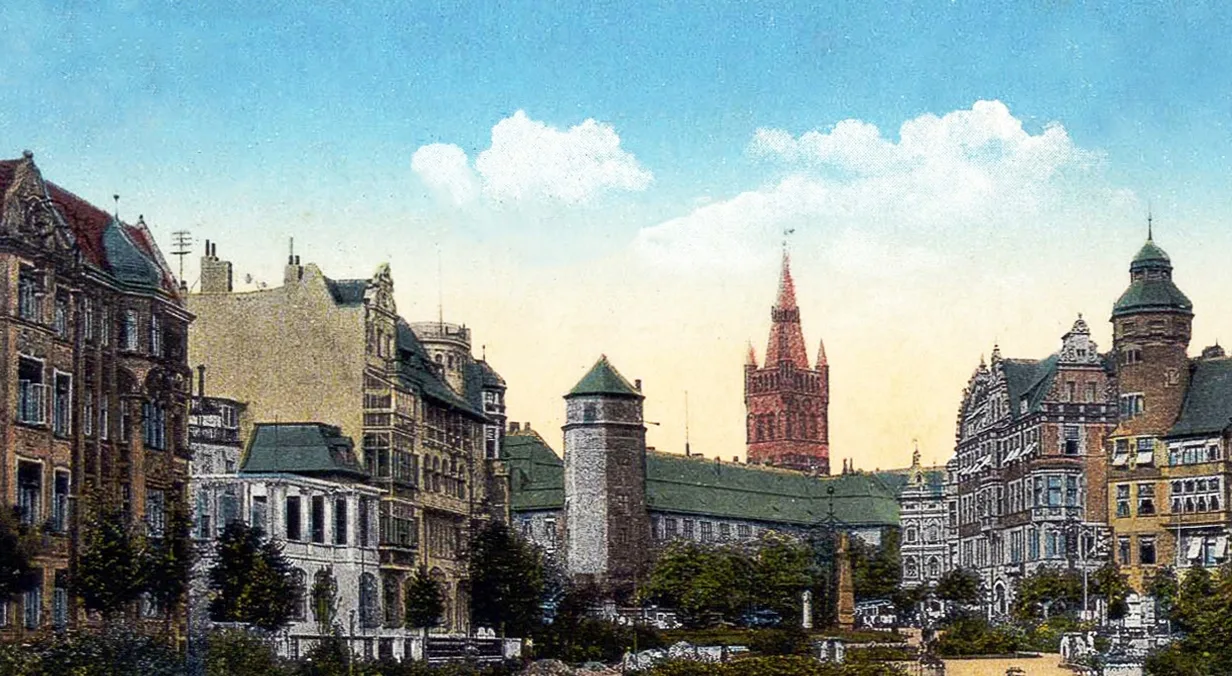
So what did Königsberg's new "armour" look like? First of all, the fortress was large, perhaps even one of the largest in Europe. It consisted of 26 bastions, eight half-bastions and nine town gates. According to military historians, its defence required a garrison of 15,000 soldiers. There was no such army in the entire duchy. (A full garrison appeared in Königsberg only 100 years later, under King Frederick William I.) The ramparts and bastions were made of timber and earth, without any underground chambers. Many of the gates bore names familiar to us: the Rossgarten, Sackheim, Friedland, Brandenburg and Ausfall Gates. They stood relatively close to the gates of the same names belonging to the second rampart ring, built much later, which have survived to this day. The Steindamm Gate stood right in front of today's entrance to the Europa shopping centre facing Chernyakhovskogo Street. The Ausfalltor ("Sally Gate") stood on the site of the wing of the Kaliningrad Law Institute building that faces Generala Butkova Street. The Holländerbaum ("Dutch Log") gate stood on Marshala Bagramyana Embankment in front of the approach to the two-tier bridge. The Brandenburg Gate stood on Zheleznodorozhnaya Street in front of the Russian Post sorting centre. The Friedland Gate stood on Dzerzhinskogo Street, where the fork of the new flyover bridge is now. The Neue Sorge Gate stood on the site of the right wing of the Kronprinz barracks. The Tragheim Gate stood at the intersection of Chernyakhovskogo and Gorkogo Streets.
The Rossgarten and Sackheim Gates stood in the same places where we are used to seeing them today. In 1765 another gate was cut through, first called the Gumbinnen Gate and in 1811 renamed the King's Gate.
The town gates were fortified stone buildings with a passage through them, covered by a hipped tiled roof. Next to each gate was a casemated guardroom. The bastions of the town ramparts had no names of their own. In terms of today's streets, the bastion belt ran along Chernyakhovskogo, Generala Galitskogo, Generala Butkova, Zheleznodorozhnaya, Olshtynskaya and Oktyabrskaya Streets and Litovsky Val. On Lomse Island (Oktyabrsky Island) it is difficult to relate the defensive rampart to today's streets.
A Fortress Within a Fortress
The construction of the rampart ring was completed in 1657 with the building of the Friedrichsburg fortress (fort). The initiator was the Duke of Prussia and Elector of Brandenburg Frederick William, known as the "Great Elector". During his reign not only did the duchy gain independence from the Polish crown, but the struggle for power with the urban nobility also intensified. In essence, the question was whether Prussia would become an absolute monarchy or, like Poland, turn into a "nobles' republic". Since the whole power struggle was being played out in Königsberg, the fort was built to bring the town councils to heel.
Built according to all the canons of the bastion trace of the day, the fort became the key to the city from the sea. From then on no ship could enter the city's port without coming within the sights of its formidable artillery.
All the more so because a boom barrier was installed next to the fort: the Holländerbaum, the "Dutch log". A second such barrier, the "Lithuanian log", closed off the city further downstream. Thus, in the event of unrest or rebellion, the city found itself in a state of siege without any particular additional effort on the duke's part.
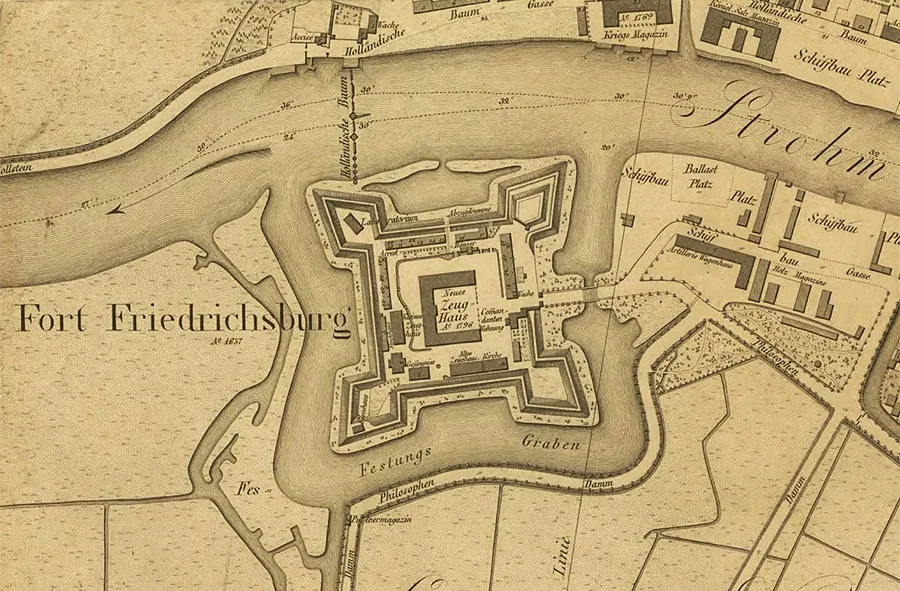
Fort Friedrichsburg on a map of 1815.
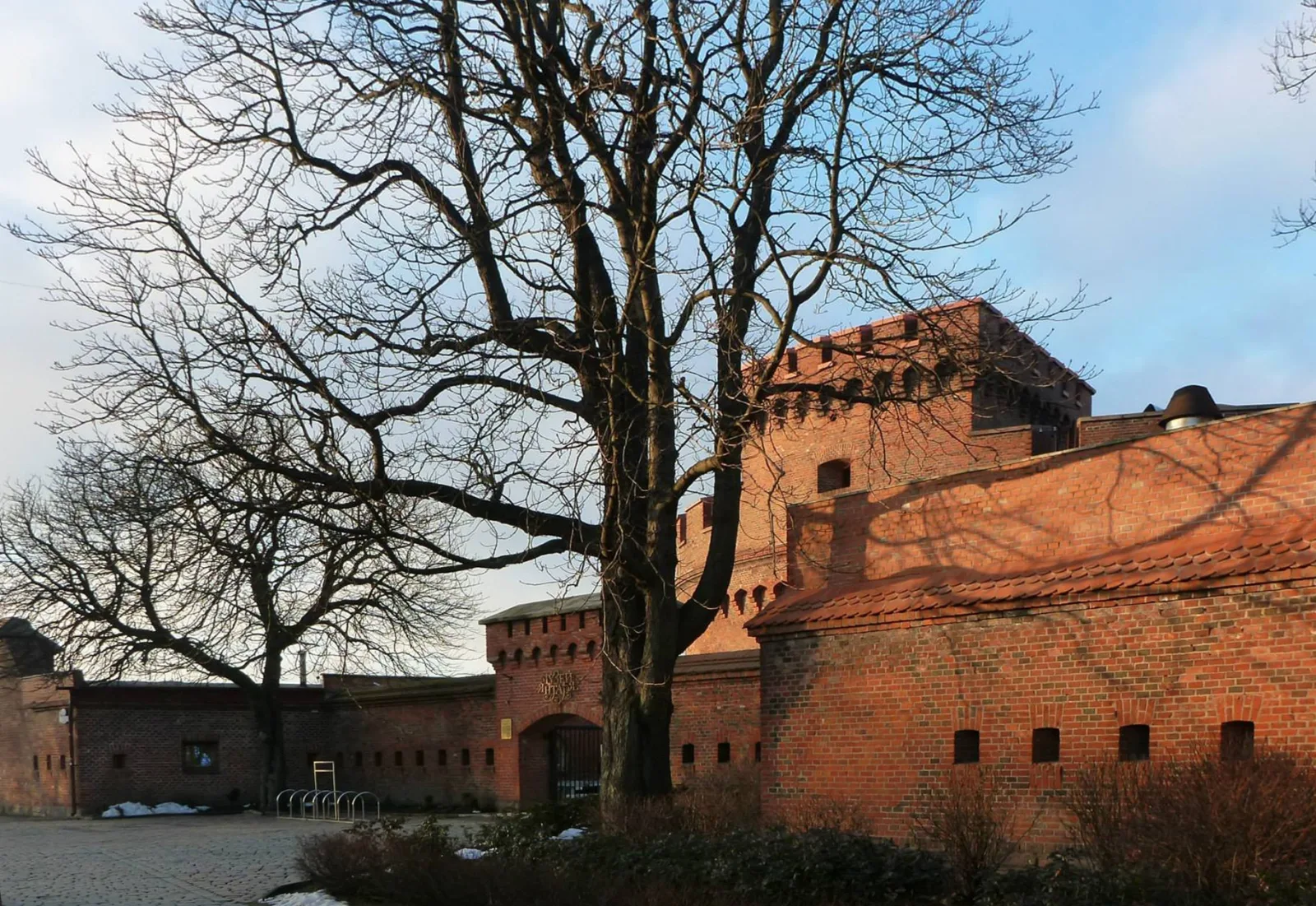
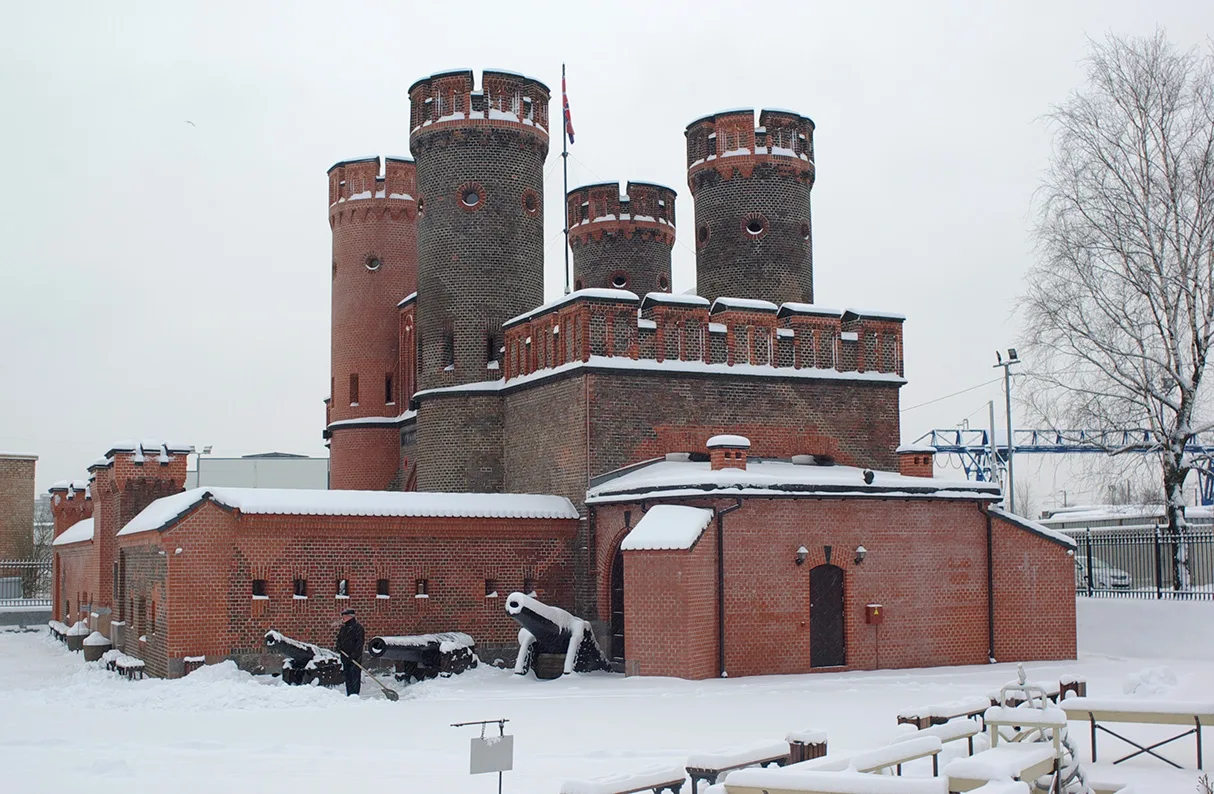
Fort Friedrichsburg had the shape classic for the fortification of the time: a regular geometric figure, a square. In each of its corners stood a bastion. The side facing away from the Pregel was additionally covered by a triangular ravelin. The fort was designed by Christian Otter, a mathematician educated at the Albertina who became one of the fathers of the so-called "Dutch system of fortification". The fort's four bastions had names of their own: Rubin, Smaragd, Diamant and Perle. They were built of timber and earth. Inside the fortress was a courtyard used for parades and drill by the garrison. Thanks to the fort's exceptionally advantageous position, when in the 19th century the question arose of demolishing the rampart fortifications and building a new bastion ring, Friedrichsburg was the only one of the old structures to remain in place, undergoing only a thorough reconstruction. Today all that remains of the fortress is the entrance gate, built in 1852 during the fort's reconstruction.
For Russian history Fort Friedrichsburg is notable because in 1697, within its walls, Pyotr Mikhailov, a non-commissioned officer of the Preobrazhensky Regiment, better known to us as Peter the Great, passed his mortar-firing test with distinction, for which, after returning to Moscow, he later received a certificate recognising him as "perfect in the throwing of bombs, a cautious and skilful artist of fire".
Historians of fortification maintain that in Peter's plans Fort Friedrichsburg later became the prototype for Kronstadt, the fortress that is the key to St Petersburg. At any rate, the logic can be traced.
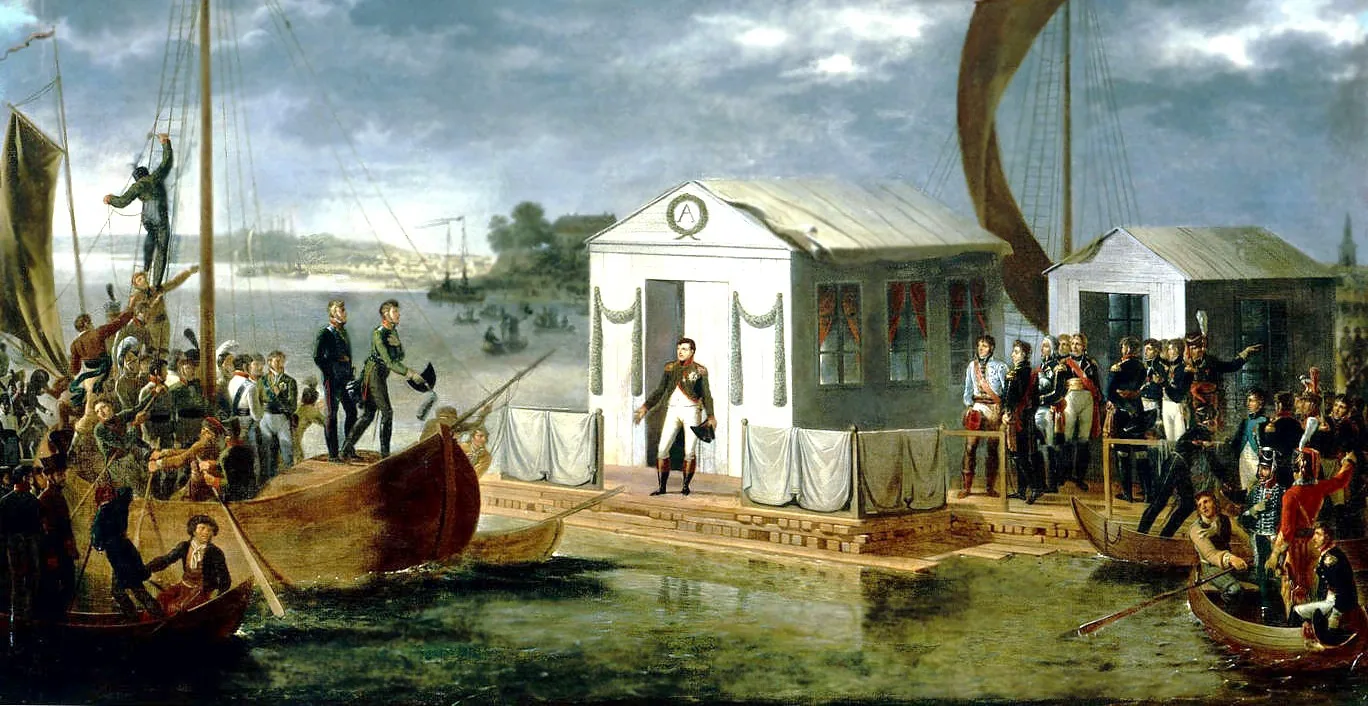
When George William gave the order to begin building the rampart ring, he could hardly have imagined that this military construction, so needed by the city, would in effect play no role in its fate. No noticeable military role, to be precise. During the existence of the first rampart ring, a foreign army entered Königsberg three times. But each time the situation was such that whether Königsberg endured all the hardships of a siege or its burgomaster handed the keys to the city and to Fort Friedrichsburg to the commander of the advancing troops (as happened in January 1758 when the Russian army approached the city) made no difference to the further course of the war. In 1807, after the Russian army's defeat at Friedland, the fortress of Königsberg bristled against Napoleon's troops for the first time in many years, but for exactly one day. On 14 July the fortress commandant ordered the garrison to take up defensive positions on the badly eroded earthen bastions, but on the 15th he was already ordered to surrender the city and join the retreating Russian army. In between, the city was briefly shelled by French artillery, which did it no significant damage. Even more quietly, and entirely without a fight, the French left the fortress of Königsberg in January 1813, and Wittgenstein's Russian detachments entered the city after them. With that, the military history of the earthen fortifications came to an end. And the clearest confirmation of this was the construction, in 1813, of the Königsberg Observatory on one of the bastions. Symbolic? Perhaps so. Just as symbolic is the fact that Immanuel Kant's favourite walk, known as the Philosophers' Dam, ran right past the bastions of Fort Friedrichsburg. Isn't it far more pleasant to realise that our city was a citadel of philosophy, astronomy and mathematics, and not just a "den of Prussian militarism"?
Translated from Russian with the help of AI (Claude, Anthropic), October 2026.