
Naturally, in the media of the regions bordering the Kaliningrad region (the Pomeranian, Warmian-Masurian and, to some extent, Podlaskie voivodeships) Kaliningrad regularly makes the news. Local outlets write about Kaliningrad within the topics that matter most to their region. The reason for this interest is obvious. Many residents of Polish border towns and villages engage in "legal smuggling" of petrol, so they look for information about the situation at the border and the like. For example, the Gdańsk edition of Gazeta Wyborcza published my article about the launch of a cargo ferry service between Kaliningrad and Germany. But there are also many national media outlets that are watched, listened to and read all over Poland. In them the Kaliningrad region comes up less often, and mainly in two respects. First, there is news related to military matters, appearing against the background of tension between Russia and the West.
Poland's only border with Russia is its border with the Kaliningrad region, where large military forces are concentrated.
Second, there are, of course, the topics of Polish-Russian cooperation in the border region.
Journalists from major Polish outlets usually turn up in the local border traffic zone (on both the Polish and the Russian sides) when some interesting political events take place, to check whether they have affected the level of mutual trust between ordinary citizens of the two countries, including business relations. The main topics covered include the entry into force of the local border traffic agreement, Russia's annexation of Crimea, cases of Poles being beaten up in the Kaliningrad region and of Kaliningraders being beaten up in Poland, sanctions and counter-sanctions, and the 2018 World Cup, which will probably come up even more often soon.
I managed to find an interesting publication in the daily Polska The Times in June last year. The article appeared in a Polish newspaper, but the paper is part of the media group that publishes the famous London Times. The author of the report, headlined "Kaliningrad, a piece of Russia on the Baltic Sea", is not a Polish journalist but a member of the British paper's staff, Tom Chesshyre. In Poland the text was printed in translation, so it is hard to speak of any characteristically Polish point of view here. Nor will I quote from it: the article is fairly standard – I would put it in a box labelled "Kaliningrad for beginners". It has Kant, amber, the Curonian Spit. Königsberg Castle and the House of Soviets are both mentioned in a single sentence. The only point worth noticing is the description of the border. For EU residents who have forgotten border controls, or perhaps never even known them, this is probably one of the main attractions of a trip to the Kaliningrad region.
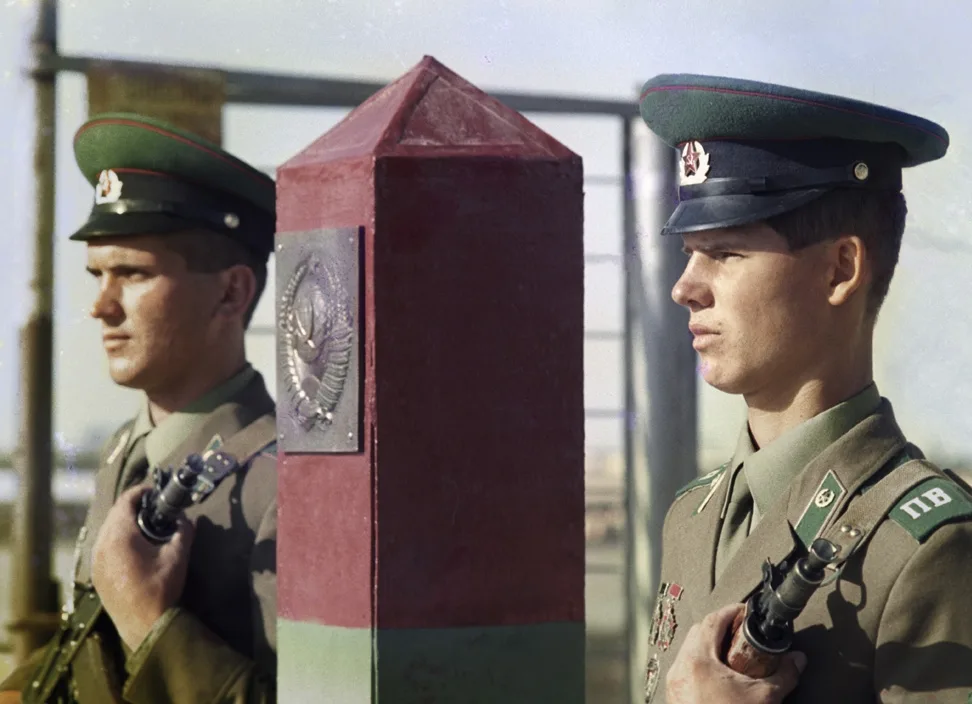
Whereas they would most likely fly to Moscow or other Russian cities, to Kaliningrad they have to go by car or bus. And this is where the exotic comes in: the border with its installations, its border guards, its strange sense of threat.
If you are not used to encounters with uniformed officials, the sheer number of them at the border may make you feel that you have done something wrong... Perhaps this could be turned to advantage for tourism, with shows staged, especially before the 2018 World Cup? (Just kidding!) A border is a border – a serious matter, as the British reporter quite rightly conveyed in his text.
In March 2015 the Polish Newsweek, drawing on reports by the Polish Press Agency, wrote about the growing militarisation of the Kaliningrad region. No surprise there: against the background of deteriorating relations between Russia and NATO, the presence of significant military forces in the region is an important issue bearing on Poland's national security. The author of the article wonders whether there are Iskander missile systems capable of carrying nuclear warheads in the Kaliningrad region. This topic comes up regularly in the Polish media, and I find it hard to comment on it other than by repeating myself: Poland's interest in this question is justified and entirely understandable.
So, moving back along the timeline, we arrive at 2014, when exemplary Polish-Russian relations in the border zone were threatened by the events in Ukraine. The atmosphere of those days is conveyed by Jagienka Wilczak's report in the major weekly magazine Polityka and, even more strongly, by the television programme "Po prostu" ("Simply") of the popular TV journalist Tomasz Sekielski.
The Polityka journalist examines the state of Polish-Russian relations on the Polish side of the border, having visited the border town of Bartoszyce. In March 2014 someone there told her that local border traffic would soon be abolished and the border closed. The Polish consul confirmed the rumours about rumours, saying that the Polish Consulate in Kaliningrad was receiving a huge number of calls asking about restrictions on issuing visas and crossing the border.
Although the Polish Foreign Ministry was actively denying reports that the local border traffic scheme would be closed at that time, people on both sides of the border were worried.
The article quotes officials, for example the mayor of Elbląg, Jerzy Wilk, who spoke of his wish to maintain good relations with Kaliningrad partners. Mutual trust was put to the test by the diametrically opposed reactions of many Poles and Russians to the events in Ukraine. The Polityka reporter describes various incidents and rumours of hostility both towards Russians coming to Poland and towards Poles visiting the Kaliningrad region. It should be noted that practically none of the stories told was officially confirmed. The Polish journalist was told as much even at the Russian consulate in Gdańsk – it had received no complaints. Yet the tension was palpable, and the journalist managed to convey it in her article. She spoke to a Greek Catholic priest from Bartoszyce and to Russians visiting the resort of Mikołajki. The two sides, arguing with each other at a distance, were absolutely sure they were right, and a dialogue between them was hard even to imagine. I remember that time well too, and although the problems are still there, the atmosphere has fortunately calmed down. The dust has settled, and I can see that both sides want to continue mutually beneficial cooperation, even at the price of keeping quiet about certain issues. The local border traffic agreement remains in force. The rumours remained rumours.
The Polityka report came out in March 2014, and in September of the same year, almost immediately after Russia imposed its food embargo, the popular Polish TV journalist Tomasz Sekielski set off for Kaliningrad. His personal popularity and the fact that "Po prostu" is broadcast on the first channel of Polish state television are reason enough to pay attention to it. This programme takes us back once again to the nervous atmosphere that reigned in the region in 2014.
The presenter visited the Central Market, where he and his film crew captured an old woman expressing a wish to "hang US President Barack Obama".
Other market women praised the actions of Putin and the Russian government, arguing that the embargo on European food would help Russian producers develop and allow them to increase their market share. Even so, rising prices were already noticeable at the time. Tomasz Sekielski talks to deputies of the regional Duma and listens to their point of view. There is practically no commentary from the programme's author, but a critical view of what was going on is expressed by the Kaliningrad journalist Aleksey Shabunin. The most interesting moment of the programme came when the Polish journalists noticed that the same cars were constantly following them and tried to shake off the surveillance. The result was a story about the Kaliningrad region as a closed place, heavily guarded against outsiders.
That is exactly how closed and dangerous Kaliningrad seemed in Poland until recently. All of this, of course, stems from the region's history as a closed military base, and also from the 1990s, when Poles were first able to visit the region. Elements of this narrative are still present in the Polish media space. Quite recently the Polish journalist Tomasz Lis appeared on a programme on the German television channel ARD, talking about the difficult situation for the media in Poland after the latest elections. In particular, he mentioned Kaliningrad as the place to which anonymous internet trolls threaten to take his body.
In the end, to the average Pole (and, more broadly, the average European) Kaliningrad seems a dangerous and incomprehensible place, where one can "take bodies".
And finally, one more example illustrating attitudes towards the Kaliningrad region, which I found on one of the major internet portals, Interia. In the men's section, at some unspecified time (I could not find the date of publication), but certainly within the last three years (as shown by the mention of the hit "Witaj Lidl, witaj Biedronka" by the band Parowóz), an article appeared under the headline "Kaliningrad – Abandon hope, all ye who drive in here". The piece is full of sensationalist "juicy facts", although it starts off quite ordinarily: the agreement on visa-free travel has come into effect, the border crossings cannot cope with so many cars, there are queues, Poles go over for petrol, Russians for groceries, and Parowóz sings about it. Then the story gathers pace. On most roads in the Kaliningrad region there is a speed limit of 70 km/h, but not everyone keeps to it: Ladas and Volkswagens are overtaken by luxury cars, new BMWs and Mercedes. Behind the wheels of these cars are supposedly local gangsters or officials – or, as the author notes, both in one person. "The driver of such a car spends the first half of the day in an office as an official, signing papers and drinking coffee, and then he puts on a leather jacket and dark glasses, gets behind the wheel of this [i.e. luxury] car and goes off to do real business." Then the author moves on to the next topic. If you enter the region not from Elbląg but from the direction of Suwałki, through the border crossing at Gołdap, you end up in Gusev, which the article calls a "hillfort" and also one of Europe's centres of drug addiction, where the most common cause of death is AIDS. "Dozens of syringes with needles are rotting on the ground ..." Next comes a description of an illegal casino in Ozyorsk, where a certain Tatyana, an employee of the town administration, supposedly worked (as a side job). Further on we read that in Kaliningrad itself, a city that is undoubtedly the region's criminal hub, shoot-outs are a matter of course. According to the journalist's information, whose sources he never names, sometime around 2012–13 a certain Andryukha Kaliningradsky was recognised by the criminal community in Kaliningrad as a "thief in law". By the end of this "elegant" piece we learn that some 20,000 people in Kaliningrad are engaged in prostitution. And what about ordinary residents?
"Residents try to live their own lives, without crossing paths with either officials or bandits. Although in this most militarised region of Europe the most beautiful beaches have been turned into firing ranges, the Russians pay no attention – they spread out their blankets and set up beach umbrellas next to barbed-wire fences. Only occasionally is their rest interrupted by a landing from the world's largest hovercraft, the Zubr."
To be honest, I do not know how to comment on what is written in this article, but I confess that I liked the text very much as a kind of literary work, with its own internal logic and coherence. From reading it one cannot tell whether the author has ever actually been to the Kaliningrad region, and no sources of information are given. But on the whole the piece attracts an audience precisely because of its pseudo-sensationalism.
Unfortunately, the Polish reader living far from the border zone, who does not visit Kaliningrad personally and cannot follow the situation here, is ready to take this kind of thing at face value. As already mentioned, because of a certain mystique that has grown up around the Russian exclave since the war, Kaliningrad usually figures in Polish discourse as a semi-mythical city, something like Gotham City in the Batman films. That is why some Polish tourists coming to Kaliningrad expect precisely post-Soviet exotica and something that will turn their trip into a real adventure. If such a view of the city and such expectations exist, perhaps it is worth playing on them and using them to attract tourists?
____________________
* The title of the article, "Close Stranger" – a fine metaphor for our neighbourly relations – refers to a well-known book and film, and also to a major regional project devoted to developing cooperation between Russian, Polish and Lithuanian cultural organisations. The "Close Stranger" project offers neighbours a good opportunity to get to know each other better.
Translated from Russian with the help of AI (Claude, Anthropic), October 2026.