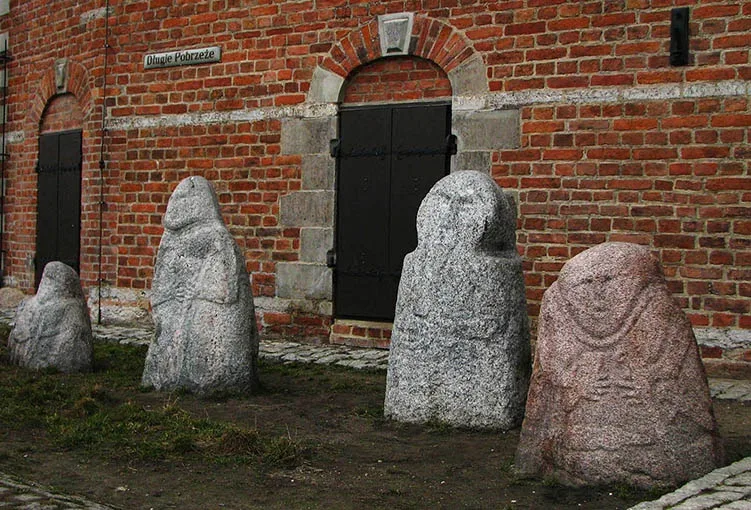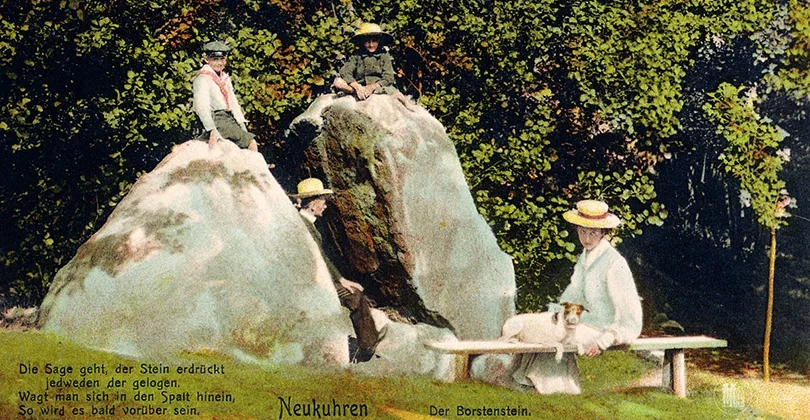
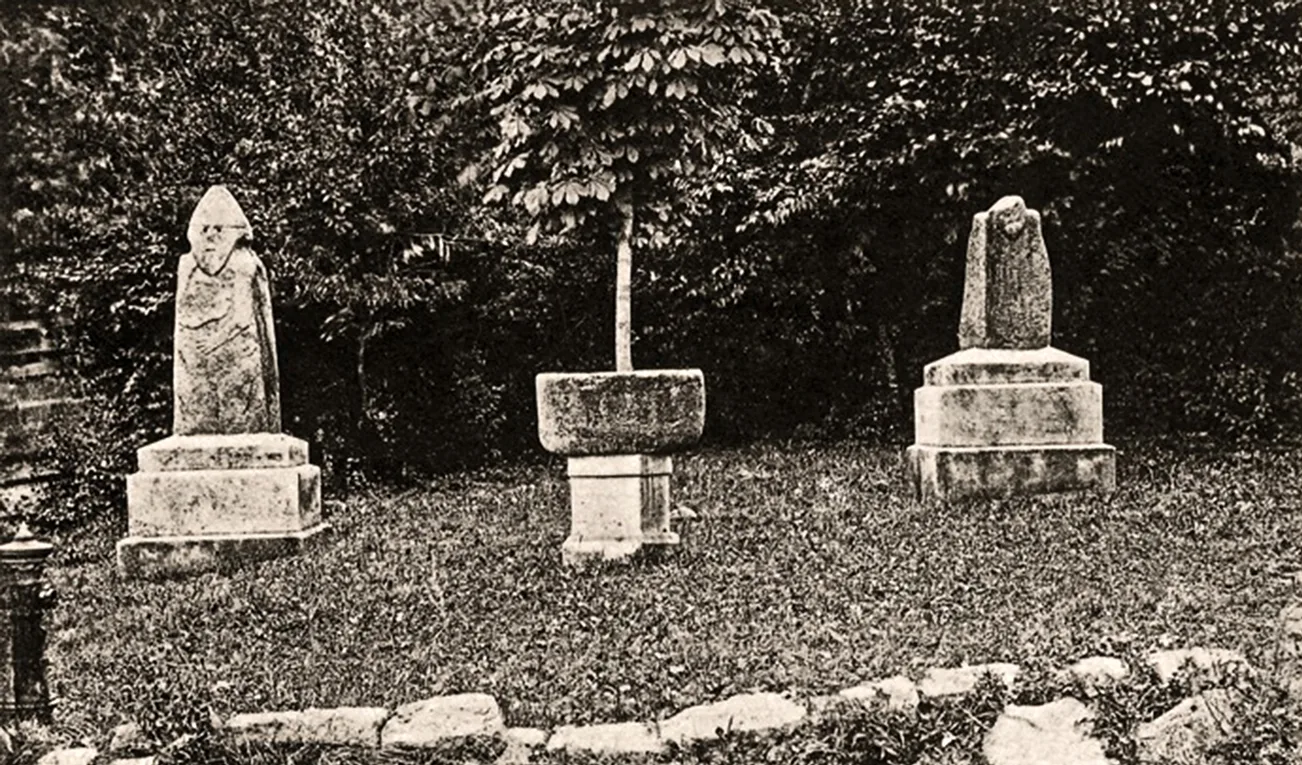
I will begin by mentioning a theory not included in the previous text, according to which the stone sculptures in question were made in the time of the Order by colonists, who in this way depicted the Prussians. The latter were perceived as close “others” — warlike, armed, bearded people with rhytons (horns for libations) and other curious objects. The Polish researcher of the Prussian statues Jerzy Łapo once wrote about this. Much to the regret of the supporters of this theory, it hardly corresponds to reality, since the form and the meaning of the most authentic images have no direct analogies in the folk art of Northern Europe of the second half of the 13th–14th centuries (except perhaps the earlier West Slavic “idols”). Nor are such statues known either in the territories of the other Western Balts (Curonians, Scalovians) conquered by the German orders, or in Livonia, where there is much more stone suitable for such sculptures.
At the same time, the example of folk legends and other written mentions, recorded mainly in the 19th century, shows that the colonists’ perception of the Prussian stone sculptures was not simply strange or distorted, but quite consistent with the everyday realities surrounding the eyewitnesses.
The main and most obvious image for the mind of an ordinary person of the late Middle Ages and the early modern period looking at the Prussian “babas” was that of a “petrified person”. Usually the character of a legend is turned to stone for some sin or misdeed. A number of the legends and tales about the “babas” quoted further in this text have been published in the new edition “Tales, Myths and Legends of Ancient Prussia”*.
First I will tell the legend of one of the most striking Prussian statues, from Mózgowo-Laseczno (Iława district, Poland). It is 1.43 m high. It depicts a man in a “smock” tied with a belt carrying a sword, with a small beard, holding a drinking horn in his right hand and in his left a strange object resembling at once the hilt of some “dagger” and, in a way, a “krivule” — the symbol of power of the Prussian priests, which later passed to the village headmen of East Prussia. Today the statue stands by the walls of the Archaeological Museum in Gdańsk.
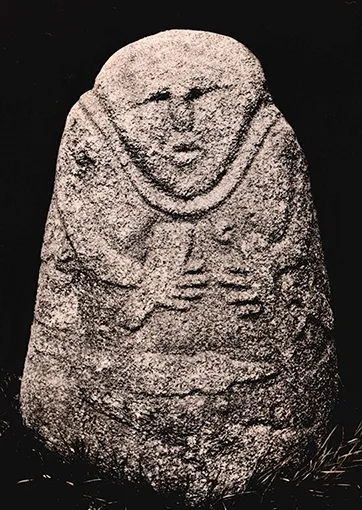
The stone “baba” from Mózgowo-Laseczno.
Photo from the archive of Herbert Jankuhn, Schleswig.
The “Blasphemer” of Mózgowo
“Once, on the boundary between the villages of Mózgowo and Laseczno, there stood a stone figure whose height and expressive human outline had long aroused the interest of the local people. They called this figure ‘the Blasphemer’, because, as was said everywhere, there once lived in Mózgowo a rich man who owned three manor farms [estates, – author’s note]. He was greatly annoyed by the rains that fell incessantly at harvest time, which prevented him from gathering the grain from his fields and so reduced his profit. He cursed God, who in his opinion was to blame for all this. One day this godless man snatched up a loaded revolver [the object in the sculpture’s left hand?, – author’s note], ran out into the field and fired the pistol three times into the cloud-covered rainy sky — as if he wanted to hit the Almighty with his bullets. At that very moment a terrible thunderstorm broke over the village. Lightning struck again and again from the dark clouds and terrible peals of thunder were heard without cease; the pouring rain soaked all the grain that had been bound into sheaves and laid out in the field. When at last the storm died down and the sky grew quiet, the rich man was still standing in the field. He stood there in the posture in which he had fired, holding the revolver in his hand, but he had turned to stone and only blinked his glassy eyes, burning with rage. Where the bullets fired from the pistol had struck, black spots could be seen. The villagers wrote a letter to the emperor, respectfully asking what they might do with the petrified man standing in the field. The emperor replied that he should be buried. But this proved impossible. In vain they tried to move the stone figure with six harnessed horses. They could not even shift it from the spot, so deep had it sunk into the ground. This was reported to the emperor with a request to fence the figure with an iron railing, so that the petrified figure would look like an ordinary monument.
If this man blasphemed, he must not be buried; if such was the end of his life, so he must stand in the open field, so that everyone can see him.
People came from all around to look at the petrified man, for he stood there for many years as a warning to posterity. Once they wanted to use the statue to build the wall of a stable and, with great difficulty, dragged it into the yard of a large estate. But the next day the figure was not there; it had returned to the field. Many more times they tried to move the stone man, but each time he returned to his place. Then they decided to leave him alone.”
The legend of the “baba” from Mózgowo combines several archaic motifs:
1. The pursuit by the thunderer Perkūns of some enemy (usually a chthonic one, but here a fighter against God);
2. The transformation of the “unbeliever” into stone (recall the Old Testament story of Lot’s wife, who was turned into a pillar of salt).
Also of interest is the location of the stone in the legend — in a field, that is, possibly on the boundary between lands, which may indicate the original location of the statue or its later use as a boundary stone.
“Petrified girls”
In most of the legends about the Prussian “babas”, however, it is not men but girls who turn to stone, which is probably connected with the hierarchically lower position of women in patriarchal Christian society. Thus in the first publication I mentioned the so-called “Nasty Girl of Skirwieten” — the only authentic stone “baba” found on the territory of today’s Kaliningrad Region. Until 1891 it stood in a field on the boundary between the villages of Husehnen-Rossiten-Wackern (roughly between the villages of Pogranichnoye and Dolgorukovo in the Bagrationovsk District). According to a folk legend, “a girl cursed by her mother for laziness turned into this stone”, and perhaps for other misdeeds too.
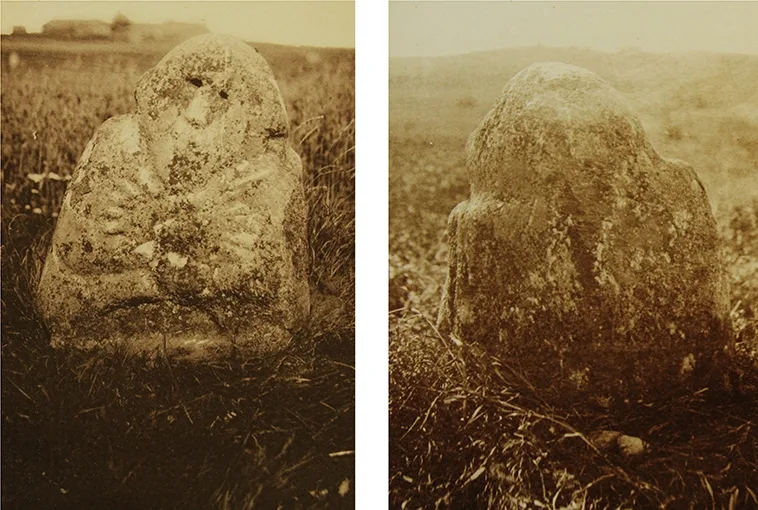
The “Nasty Girl of Skirwieten” in the field between the three villages, before being taken to the Prussia Museum.
Photo by Adalbert Bezzenberger, 1891.
The image of a daughter turned to stone because of her mother’s curse is fairly popular in East Prussia. Here are a few more examples. In one of his legends R. Reusch reports a stone from Woydiehnen (now the village of Listovoye, Zelenogradsk District) in Sambia, shaped like a stooping woman. On one side she held a bunch of keys, and on her belly a bundle of flax. And this is what the legend says about the stone: “While all the peasants went to church on Sunday, one woman went out to work in the field, hanging a bunch of keys from her belt and winding a bundle of flax round her waist. And so, with her back bent, she toiled by the road. The villagers passing by cursed the woman with these words: ‘May you turn to stone just as crooked as that!’ And the curse came true.” The severity of the curse is confirmed by the folk (?) name of the statue, “the Sabbath-Breaker” (from German Sonntagsschänderin). The stone was last mentioned by K. Becker in his 1893 book; its further fate is unknown.
There are similar stories about other Prussian stone sculptures that have not survived. Thus the appearance of the “baba” from Lubawa (Iława district, Poland) is linked to a legend according to which “a mother cursed her daughter because she had not come back from town for a long time. People say they saw tears flowing from the eyes of the stone”. A story with a mother’s curse is also attached to two other anthropomorphic statues from the territory of “Polish” Prussia. One stone from Targowo (Warmian-Masurian Voivodeship, Poland) was known as “the Wicked Girl”.
It is believed that the mother cursed her daughter because on a Sunday, instead of going to church, she went into the forest for berries…
Wolfgang La Baume links this stone with a statue from nearby Rańsk (Warmian-Masurian Voivodeship, Poland), which the locals called simply “the Stone Lady” and which had a similar fate. “Petrified girls” cursed by their mothers for laziness, apostasy or dishonour are also mentioned at Śliwa (Warmian-Masurian Voivodeship, Poland) and Sudwa (Warmian-Masurian Voivodeship, Poland). The latter was named by the locals “the Petrified Water-Carrier”. “For the unfortunate girl, whom her mother had sent to the town pump to fetch water, could not resist on her way back and went to a dance. The mother waited and waited for her young daughter and, when she never came, exclaimed in anger: ‘Let her turn to stone!’”.
And, of course, the most famous Prussian statue associated with the image of the “petrified girl” is linked by popular rumour with none other than the mythical Prussian princess Guste Balde (Guste Balde/Gustabalda), who, thanks to Friedrich von Anhalt, came in 1769 to be called the daughter of the Prussian king Widewuto. From 1715 this sculpture stood in one of the churches of Bartenstein (now Bartoszyce, Poland), “numbered” among the saints together with Bartel, of whom more below. And this is what a local legend says about her:
“There is a large human-like stone in Bartenstein, which formerly stood in St John’s Church, then in the town market square, and was later moved to the school garden. They say a girl named Guste Balde turned into it. Once, on the way to Mass, she kept complaining to her mother that her dress was not as fine as the others’. Her mother grew angry with her for this and said in anger: ‘May you turn to stone, you shameless girl!’ And at once the curse came true.”
As the Polish researcher of the mythological stones of the Prussians Seweryn Szczepański remarked: “A parent’s curse in traditional society must have had a special magical power.” That is why the phenomenon of the Prussian stone “babas” so often finds such an aetiological explanation in the popular mind of the pre-industrial era.
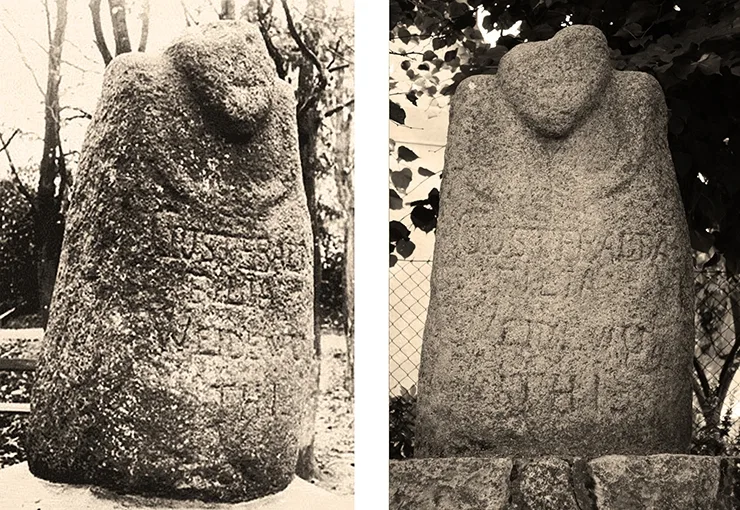
The petrified “princess” Guste Balde, Bartenstein (Bartoszyce).
Photographs from the 1920s and 2006.
“The Enchanted Soldier”
Sometimes stones that were not quite anthropomorphic were associated with the image of a petrified person. For example, a large rectangular granite boulder from Śliwa (Warmian-Masurian Voivodeship, Poland), which reminded some of a dead man, others of a coffin, and still others of a “stone mother” or even a “petrified girl”. But it became best known as “the Enchanted Soldier”. This is what the legend tells about it:
“On the boundary between the villages of Śliwa and Boreczno (Schliewe, Schnellwalde) a couple of years ago there stood a huge stone. It was so big that even a tall man was not half as big as it. It was a soldier, enchanted and imprisoned in the stone. In the upper part of the stone the outlines of his face could be clearly seen. Who can know who turned him to stone? In former times such things happened more often. The soldier had a helmet on his head and held a pack of cards in his hands. Many people saw the soldier emerge from the stone and wander around it. But if they wanted to look at him from close up, the soldier vanished, and the curious could see only his face on the stone. And nothing more. In the end it was decided to break up this stone. The workers laboured with great zeal to break it. But they could not overcome it. Seven times they tried in vain. At last a woman came and set to work, and at once, at the first attempt, she managed to break it. After that the pieces of the stone were walled into the wall of a house in Śliwa.”
The Baltic and Slavic “idols” walled into the walls of churches were discussed in the first article; now let us look at other functions and images ascribed to the Prussian stone “babas” by the popular mind.
“Bartel”
One of the best-known Prussian sculptures is the so-called “Bartel”, depicting a bearded man in a pointed helmet holding a rhyton in his right hand at his chest. “Bartel” was the first of the Prussian stone “babas” to be mentioned in written sources (in 1706). At first it stood by the Old King’s Gate of Bartenstein (now Bartoszyce, Poland) and served as a hitching post for horses; it was also considered a kind of fetish that brought good luck. In 1769, on the initiative of Friedrich von Anhalt, already mentioned here, the sculpture was moved to the square by the town hall and “adorned” with a gilded headdress resembling a bishop’s mitre, and furnished with inscriptions in Ancient Greek and Hebrew declaring that this was a statue of the patron of Bartenstein, St Bartholomew. In 1818 the statue was moved to the square by the school, after that it ended up in the Jewish cemetery, and then — in 1902 — “Bartel”, together with the “Guste Balde” mentioned above, was taken outside the town and set up at the crossing of two roads, where they still stand. And this is what the legend says about him:
“Near the town of Bartenstein, on a hill on the bank of the Alle, among the ruins of a castle, there is a large stone shaped like a man. They say it is the ruler of this land himself — Barto — who once at sunset, when enemies came and his castle collapsed into the river, turned to stone. And to this day people call this stone ‘Bartel’. They also tell of treasures hidden in this hill, and of a secret passage that leads there from the nearby church.”
Here we are dealing no longer with a “guilty” daughter or a “sinner”, but with a kind of hero — the mythological lord of Barta, Barto-Bartel, turned to stone.
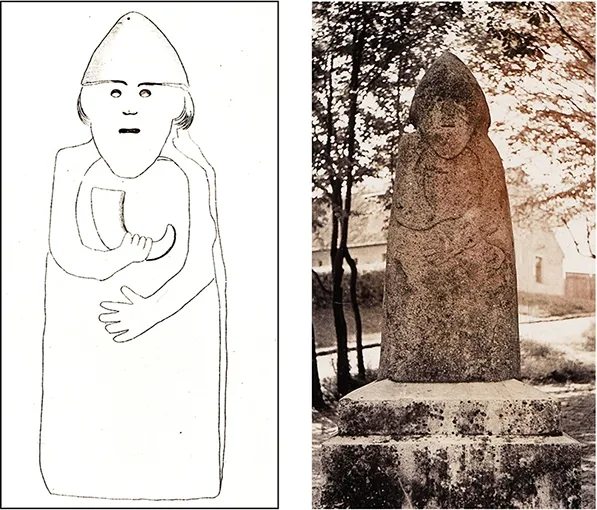
“Bartel” in a 19th-century drawing and in a photo by Carl Engel from the 1930s.
Potrimpus, the monk and the Frenchman
There are other examples of a respectful attitude to the Prussian sculptures. Thus the now lost “baba” from Christburg (now Dzierzgoń, Poland) was called by the locals “Potrimpus” — the name of the Prussian god of youth, harvest, rivers and springs. And some others were called “monks”, such as the anthropomorphic sculpture from Susz-Nipkowo in Pomesania (Warmian-Masurian Voivodeship, Poland), depicting a bearded warrior with a large round head, a rhyton in his right hand and a sword at his belt, known among the people as Mönch (monk). In Seweryn Szczepański’s opinion, the very shape of the sculpture, resembling a monk in a habit, and perhaps the statue’s hands folded on its chest, may have guided popular perception.
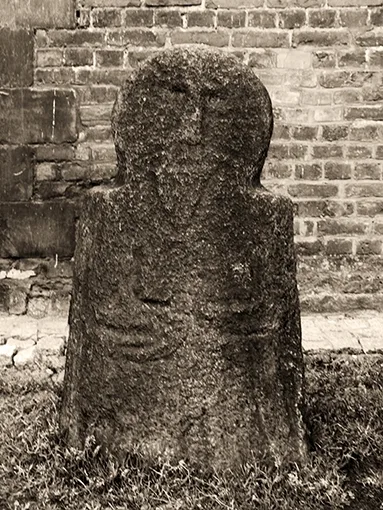
The “Monk” from Susz-Nipkowo.
Photo by the author, 2007.
Interestingly, in the vicinity of Susz (Iława district, Poland) another Prussian “baba” was known, called “the Nun”, apparently as a counterpart to the “Monk” from Susz-Nipkowo. The fate of this sculpture is unknown. In one source a small Prussian sculpture with a sword and a rhyton from Gałdowo-Jędrychowo (Iława district, Poland) is also called a “monk”. In this case we do not see a negative context in the local people’s perception of monuments belonging to another culture, but rather a respectful attitude towards them. Both “monks” stand today by the Archaeological Museum in Gdańsk, together with the “Blasphemer” from Mózgowo.
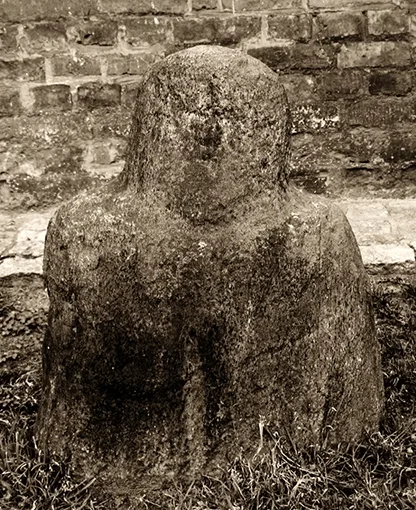
The “Monk” from Gałdowo-Jędrychowo.
Photo by the author, 2007.
There is also another layer of legends about the Prussian stone “babas”, connected with specific historical events of the early modern period. For example, the following is told about the fate of the sculpture from Jelitken in Masuria, which was dug up in the 1840s and in 1877 handed over to the Prussia Museum in Königsberg (today it is on display in the Kaliningrad Regional Museum of History and Art):
“In 1656, for fear of a Tatar raid, one of the local villagers hid the statue together with money. For many years this story has been passed on by word of mouth, but no one has ever found the treasure.”
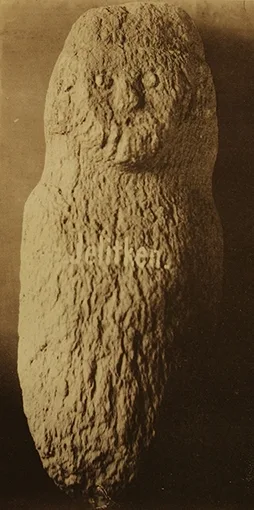
The statue from Jelitken in the Prussia Museum.
Photo by Adalbert Bezzenberger, 1891.
Another stone sculpture, from Wejsuny in Masuria — this time of doubtful origin — was named “the Frenchman”, since it is believed that this statue, 1.4 m high and 0.3 m wide, was carved by one of the local inhabitants in memory of the stay of Napoleon’s troops here. Perhaps this is so, as the shape of the sculpture’s headgear suggests; or perhaps a more archaic “baba” was used to make the new “monument”, as has happened before in history.
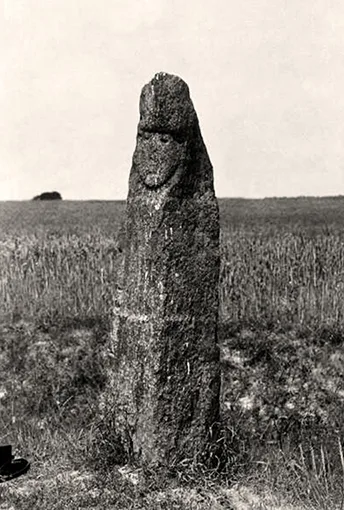
The “Frenchman” from Wejsuny.
Photo by R. Dethlefsen, Archive of the Conservator of Monuments of East Prussia (Olsztyn).
Thus the legends and simple oral tales of a passing era convey entirely new meanings in the perception of what was once Prussian reality in the landscape. The sculptures of presumed gods, ancestors, chieftains or heroes become in the popular mind at best “potrimpuses” or “monks”, or are mythologised in a new way, like “Bartel” and “Guste Balde”, but mostly they project the fear of the incomprehensible in the form of ideas about people turned to stone for their sins or for not observing generally accepted dogmas. Time, like a game of Chinese whispers, brings us scraps of words and voices which often can neither be truly heard nor joined into coherent cultural texts. That is why the phenomenon of the Prussian stone “babas” remains a mystery for us today too.
_______________
* The edition “Tales, Myths and Legends of Ancient Prussia” was prepared with the participation of the author together with colleagues from Kaliningrad, Poland and Lithuania within the project “Crossroads 2.0”. It mainly contains translations of legends from the well-known collections of R. Reusch, W. Tettau and J. Temme, E. Pohl, as well as from less-known editions such as “Sagas and Tales of Kreis Rosenberg” by G. Templin or “Folk Traditions of East Prussia” by E. Lemke, published in the second half of the 20th century.
Translated from Russian with the help of AI (Claude, Anthropic), October 2026.