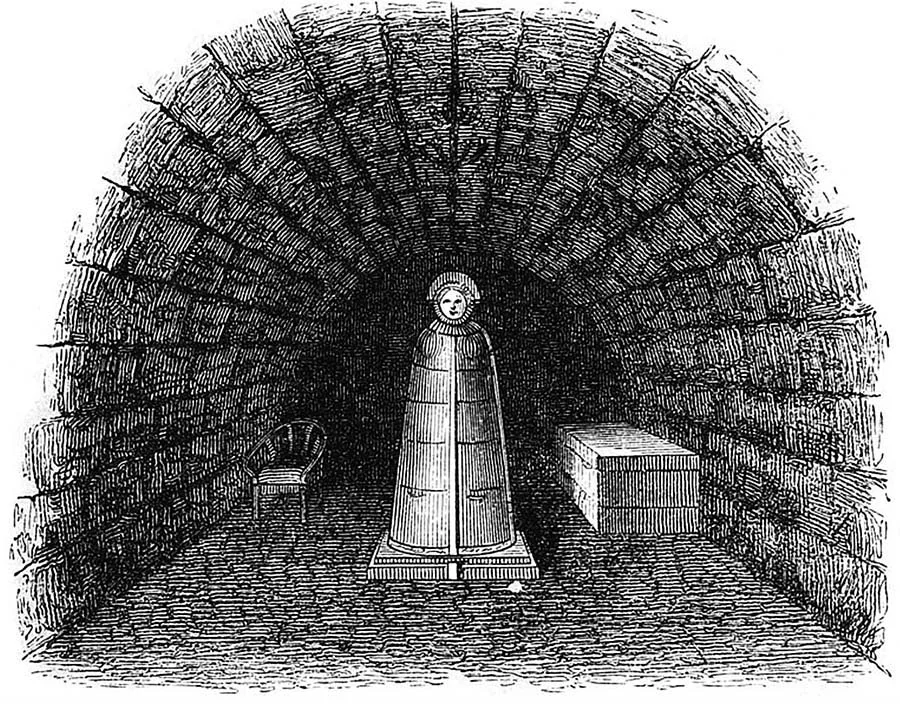
It was triggered when the condemned man, as he approached, stepped on a spring in the floor. The Maiden would then rise, open her "arms" and clasp the doomed man in a tight embrace, at the same time driving into her victim the many sharp spikes that bristled from her. The condemned died in terrible agony. Of the wretches who met their death in her embrace it was said: "the Iron Maiden has kissed him". Similar mechanisms also existed in the age of the Inquisition1. At night people often heard a dull noise like the knocking of mill wheels, and everyone took care to give this part of the castle a wide berth.
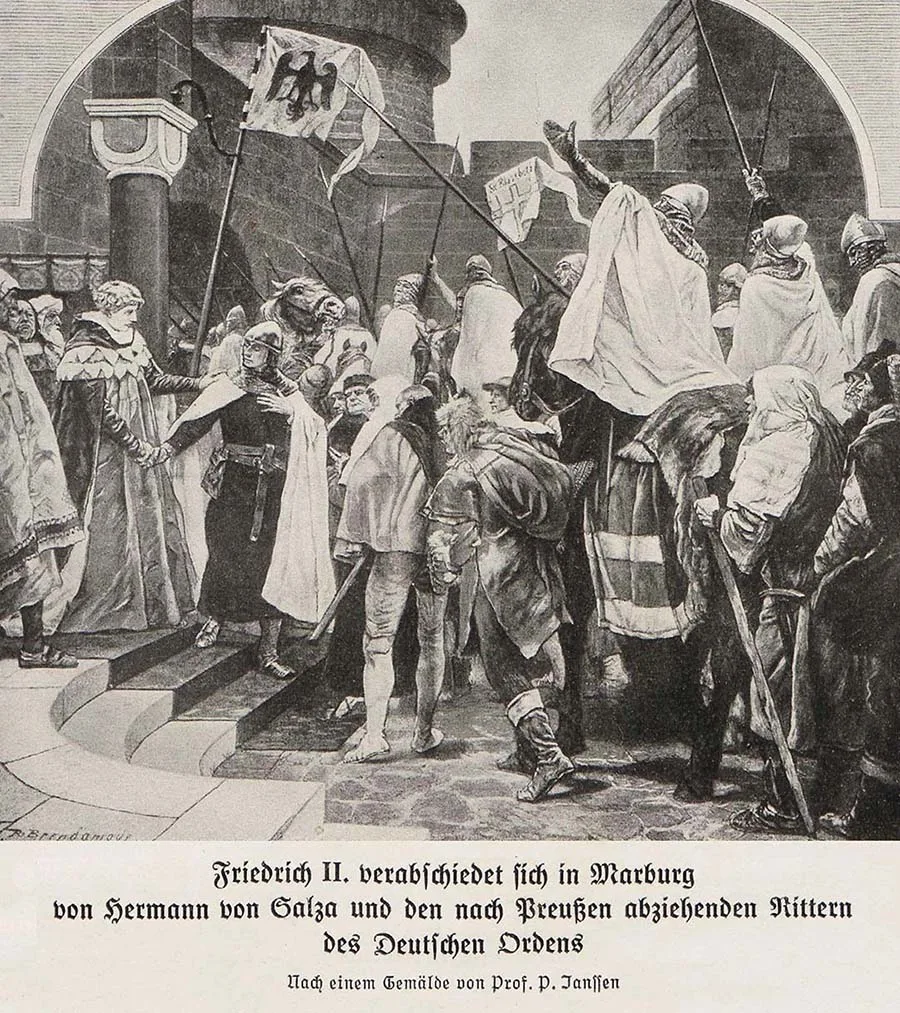
The commandant of the fortress of Breslau at that time was Werner von Bruneck, and he had a daughter, Maria, a clever, well-educated girl and, most importantly, a very beautiful one. One day a knight named Hermann von Salza2 came to the castle on business of the Teutonic Order. The Order of the Templars had only recently been abolished, and the property of the Knights Templar had to be dealt with in proper fashion... It was this business that young Hermann had been charged with. And it was then that he saw Maria and could not remain indifferent to her charms...
Hello, I'm your maiden!
He liked her very much, and she liked the noble warrior even more. But the young man did not want to turn the beauty's head with empty promises, for he could not marry her, having taken a vow of celibacy on joining the Order. And so brave Hermann began to think about how to leave Breslau as soon as possible.
On the evening before the day of his departure he wrote a letter to the knight von Bruneck and another to his daughter, and then went out for a walk. On the way back, however, the young man lost his way in the passages of the vast castle, which he did not know very well, and instead of reaching his room found himself in a corridor at the end of which a light was flickering. The knight walked towards it and found himself in a small hall. The floor here was of stone, and there were doors to the left and right. A lamp hung from the ceiling, giving off a dim light. All around reigned a deathly silence.
The young man had never been in this hall before and was about to turn back when the castle bell struck midnight. Suddenly everything around him began to move: the walls trembled, doors creaked open and shut again, the floor began to shake slightly, and somewhere beneath it came the grinding of the cogs of a gigantic mechanism. Hermann felt uneasy, but his sword hung at his side, and with it he had nothing and no one to fear. A gust of wind swept through the hall. The lamp almost went out, but then suddenly flared up with new strength. All at once plaintive cries rang out. The voices belonged to a woman and a man.
They came closer, and then a girl with flowing hair and bloodstained clothes ran into the hall, followed by a man in iron armour. The armour was crushed flat, and blood was streaming through it. Both ran across the hall and vanished through a door that flew open before them.
No sooner had the ghosts disappeared than the creaking of wheels was heard again, along with plaintive moans, which died away after a few seconds. But as soon as the last sound had faded, both figures appeared in the first door, and it seemed the scene was repeating itself.
Then Hermann drew his sword and pointed it at the ghosts, crying: "Who are you?" They froze on the spot, their eyes fixed on the cross on his cloak, and said nothing. Hermann repeated the question, and instead of answering the man nodded to him, beckoning him to follow them. The knight hesitated, and the man's deathly pale face became imploring. Then the young man wrapped himself more tightly in his cloak and followed the ghostly pair.
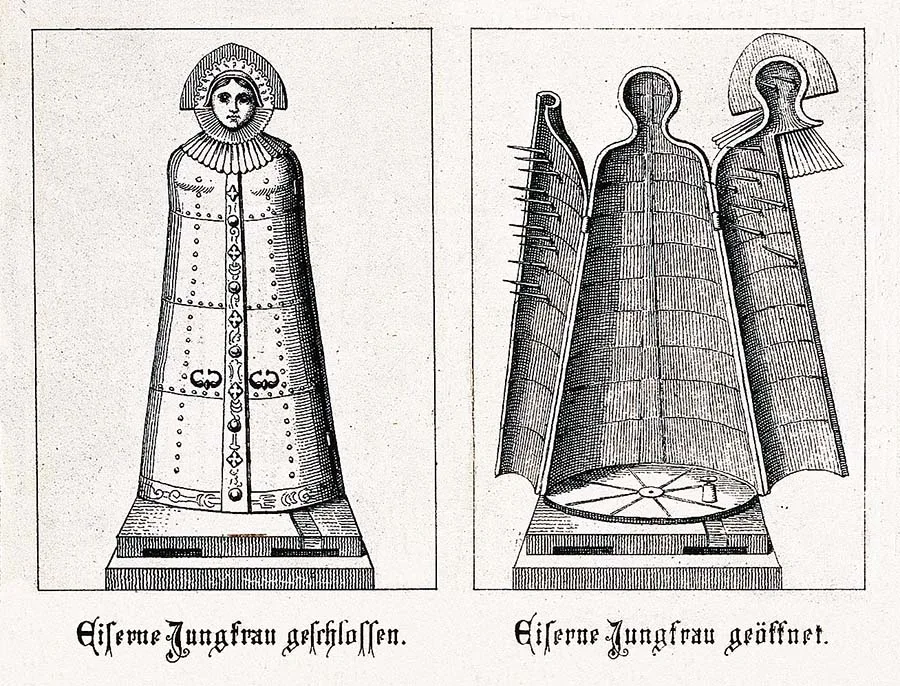
The Iron Maiden closed (left) and open.
Suddenly Hermann found himself at the edge of a lighted pit, in the depths of which he saw the gigantic outline of the seated Iron Maiden. In wild despair the male ghost drove his companion into the pit and plunged in after her himself, whereupon the terrible creaking of wheels was heard again, and cries, moans and the death rattle.
Seized by indescribable horror, Hermann stepped back into the hall and saw that the two unfortunates were standing there once more. They seemed to be waiting for him to pronounce their sentence.
The young man tried to keep his presence of mind and asked whether there was anything he could do for them. Then the man pointed to an inscription above the door leading to the devilish machine. Hermann read: "Renunciation leads to salvation". At once the knight grasped the deep meaning of these words and understood their grandeur. And then he said in a firm voice: "I renounce!" At that the man's face lit up with a smile, and he handed him a scroll of parchment that he had pulled out from under his bloodstained armour. And when the hand of the dead man touched the living one, there was a loud bang, the lamp went out, the walls shook… it seemed the whole building was collapsing, and the knight lost consciousness.
When he came to, he saw that he was in his own room, the door was locked from the inside, and outside it was broad daylight. He might have taken everything that had happened to him the night before for a vivid dream, had the scroll of parchment not been lying before him. Hermann stared at it in silence, and while he was lost in thought, his squire knocked at the door with the news that during a violent storm that night the side wing of the castle, in whose dungeon the Iron Maiden stood, had collapsed.
This strange news prompted him to unroll the scroll. The text, in Latin, written by a hand long since turned to dust, told the story of a knight who had seduced a nun, and of a nun who for love of the knight had forgotten her vows. As punishment, both apostates were sentenced to death in the embrace of the Iron Maiden. But even after death the sinners were to live through their terrible death again and again, until they met a knight prepared to renounce his love of his own free will and thereby save two restless souls.
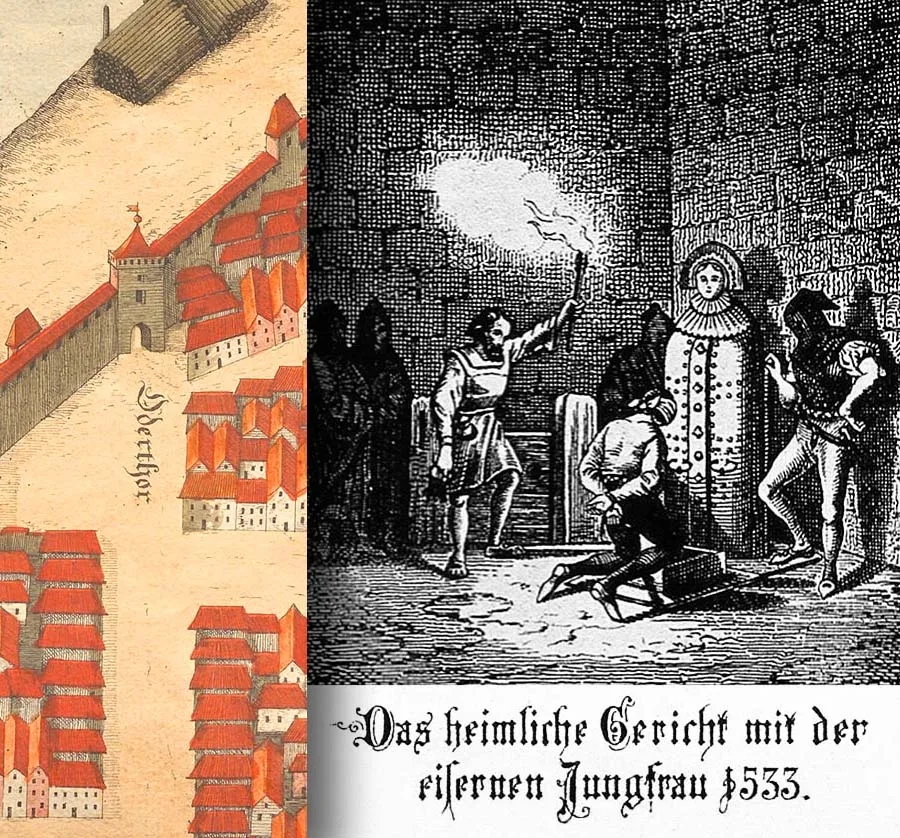
Even a cast-iron alibi counted for nothing against the "arguments" of this Maiden.
Hermann read: "Mortal whom heaven has chosen to be my saviour, know this: there is another good — immeasurably higher than love and the possession of a beloved woman. Woe to the men who sacrifice their duty and their calling, exchanging them for a woman's faithless love.."
The knight could read no further and exclaimed: "You are right, unhappy man! There is a valour for a man higher than love for a woman!"
The young crusader hastily left Breslau, and when he returned a year later he found the beautiful Maria married to another. The knight Hermann von Salza kept his vow of renunciation and became one of the most famous Grand Masters of the German Order, whose name never failed to strike fear into his enemies.
And of the former imperial castle nothing remains today but a fragment of an ancient wall.
TRANSLATOR'S NOTES
1. "...As an eyewitness recalled, after the capture of Toledo the legendary French general Lasalle visited the local palace of the Inquisition. The numerous instruments of torture struck the imagination of the seasoned soldier, who had looked death in the face more than once. And one of these instruments was, in its way, the height of the executioners' sadistic and refined imagination. In an underground hall, in a niche, stood a statue depicting the Virgin Mary. On her head was a gilded halo, and in her right hand a banner. The folds of a silk robe fell from her shoulders, yet beneath them a cuirass could be seen. On closer inspection one could see that the whole front of the figure was studded with spikes. Her arms were hinged and were moved by a special mechanism. One of the servants was ordered to show the 'statue' in action. The Maiden slowly opened her arms, as if about to press someone tenderly to her 'bosom'. At that moment, instead of a person, a grenadier's knapsack stuffed full was pushed towards her. The statue pressed it hard against herself, and when, on the general's orders, the servant parted her 'arms', everyone saw that the spikes had pierced the knapsack to a depth of several inches, and it remained hanging on her 'bosom'..."
2. Hermann von Salza (German: Hermann von Salza, c. 1179–1239) — Grand Master of the Teutonic Order (1209–1239).
SOURCE
1. Johann Graesse, "Book of Legends of the Prussian State" (Johann Graesse. Sagenbuch des Preussischen Staats).
2. Widar Ziehnert, "Prussian Folk Legends, Fairy Tales and Legends" (Widar Ziehnert. Preußens-Volkssagen, Mährchen und Legenden).
● Editor's note: Read on VisitPrussia.com an interview with the translator of German, and in particular Prussian, fairy tales, our regular contributor Tatyana Kolivay, who runs her own blog, where countless other parables, legends and fairy tales in her translation have been published.
Translated from Russian with the help of AI (Claude, Anthropic), October 2026.