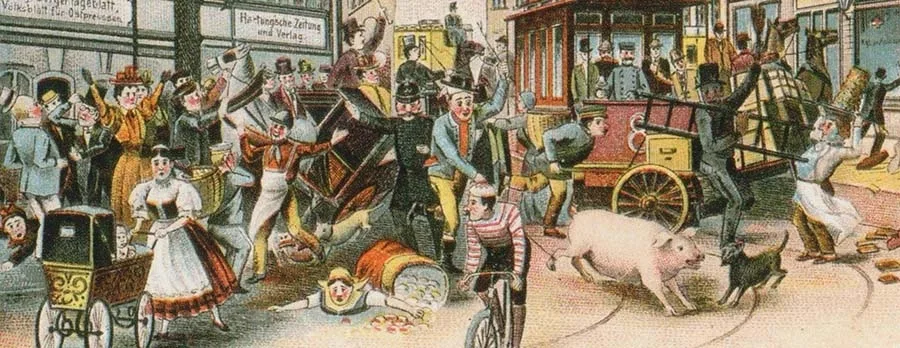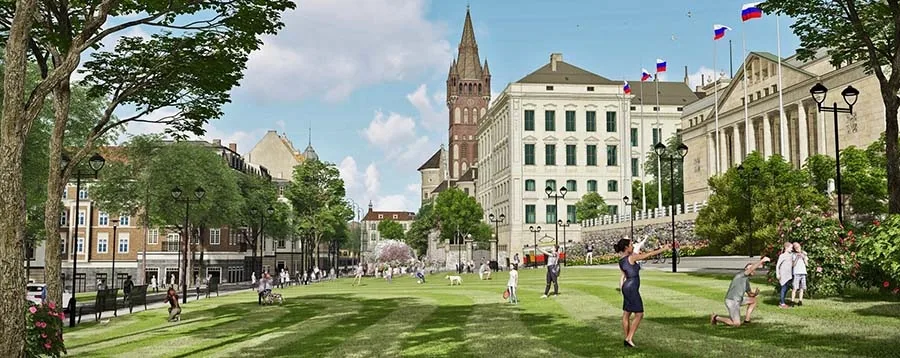
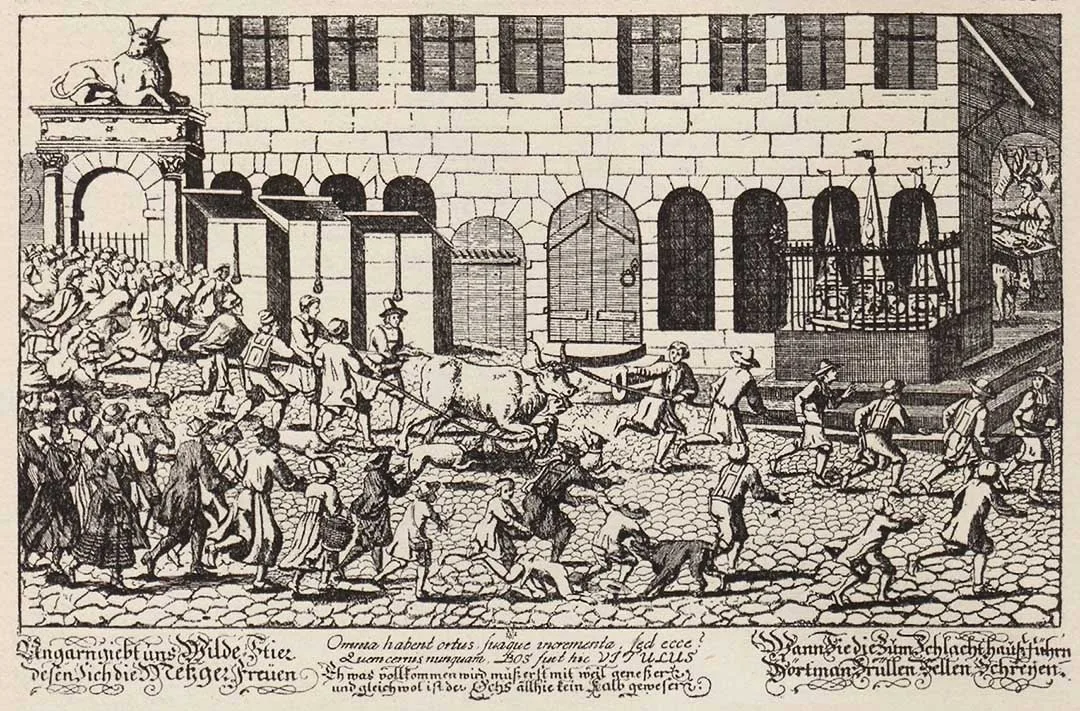
It walked with a wreath of flowers on its head, its horns were gilded or silvered, and its tail was decorated with flowers and bright silk ribbons. Music played loudly1. The apprentice boys led the ox to the Junkergarten2 in Altstadt3, where it was put on show.
There, in the Junkergarten, those who wished to play for the Fair Ox gathered. Stakes were taken from them and handed over to one of the respected elders. Usually, within a few days, by the end of the fair, more people wished to take part than was possible, and then those whose stakes were the highest were chosen. (Today we might say that the ox was, as it were, sold off piece by piece at auction to the highest bidders.)
Finally, in the Junkergarten, the chosen players began to throw dice for the ox's meat, fat, offal, liver and so on.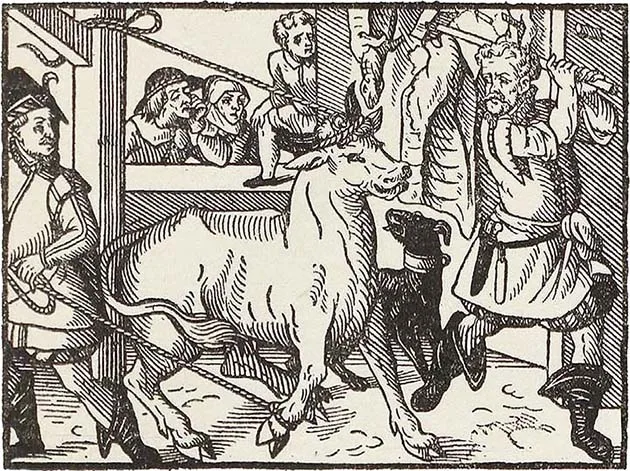
There is evidence that in some years the number of such Fair Oxen at the Pentecost festival could reach two, three or more.
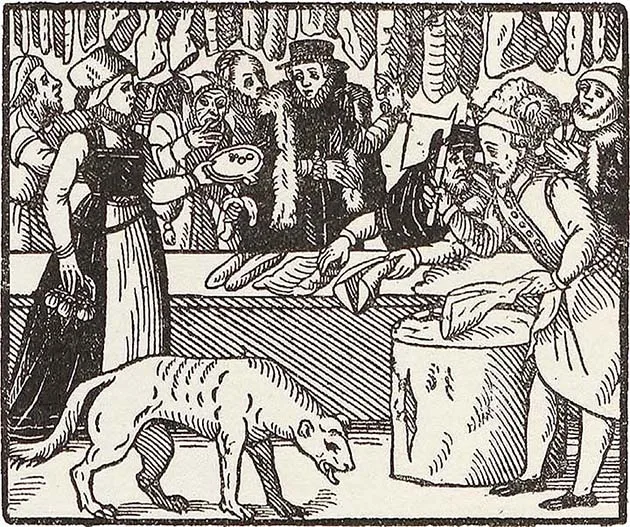
The last documented ceremonial procession of a festively decorated Fair Ox through the city streets took place in Königsberg more than 250 years ago, on the Saturday before Pentecost, 21 June 1766.
Echoes of this old custom survive in a saying used of a dandy:
"He's decked out like a Fair Ox" or
"He's decked out like a Pentecost ox"4.
The custom of slaughtering the Pentecost ox for a subsequent festive meal existed in many European countries and, in particular, among the Masurians until the 19th century.
LEGENDS OF PRUSSIA in the blog of Tatyana Kolivay.
TRANSLATOR'S NOTES
1. Throughout the days of the Pentecost fair the court musicians played. This was called Hoff-Recht /in the old spelling/, "Court Right".
2. Junkergarten: "the Junkers' Garden".
In the Middle Ages the Junkers were understood to be the upper bourgeoisie, merchants and brewers, as distinct from the lower middle class of craftsmen, small traders and elementary school teachers. Only in the Renaissance did this unofficial status begin to extend to military men and officials in the duke's service. The Junkers of the Middle Ages, the upper middle class, were a caste apart. They had their own Junkerhof, "the Junkers' Court", and Junkergarten, "the Junkers' Garden", where they met and celebrated holidays. In the Junkerhof and the Junkergarten everything was regulated according to rules. Each guild had its own place, its own "corner".
3. Altstadt (German for Old Town): a settlement of German colonists that arose by the walls of Königsberg Castle, which gave rise to the city.
4. "Er ist geputzt wie ein Jahrmarktsochse."
"Er ist geputzt wie ein Pfingstsochse."
SOURCES
1. Preussische Allgemeine Zeitung. 1960.01.06
2. Hermann Frischbier. Preussisches Wörterbuch. Ost- und westpreussische Provinzialismen in alphabetischer Folge.
3. Karl Faber. Die Haupt- und Residenz-Stadt Königsberg in Preußen.
Translated from Russian with the help of AI (Claude, Anthropic), October 2026.