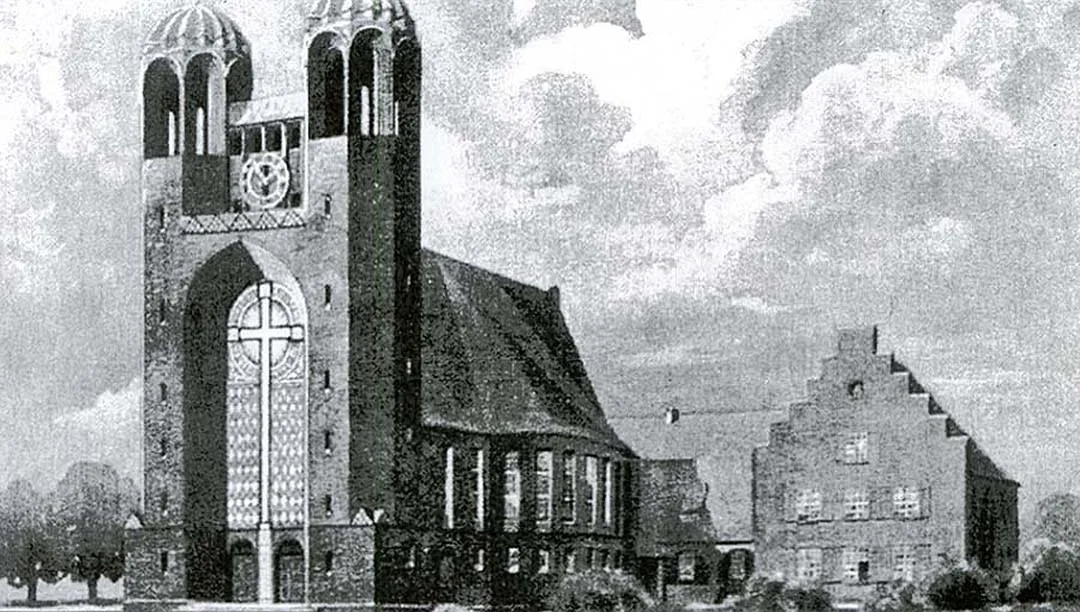
Construction was directed by the architect Arthur Kickton of Berlin, Privy Senior Building Councillor. The church was consecrated on 7 May 1933.
The building has a wide, projecting double tower faced with clinker brick, with a vaulted blind niche in which a huge white cross is depicted.
On the south and north the church has semicircular projections; on the east the parish hall adjoins the church. The interior is strictly divided; the pulpit and altar are combined and crowned by a crucifix. The walls, columns, gallery parapet and pews were kept in grey tones with white and black trim. The ceilings were multicoloured. Opposite the altar was the choir gallery, with an upward-soaring view of the organ. The organ had 38 stops.

The church came safely through the British bombing raids of 1944 and the storming of the city in 1945. Only the south dome of the tower was damaged.
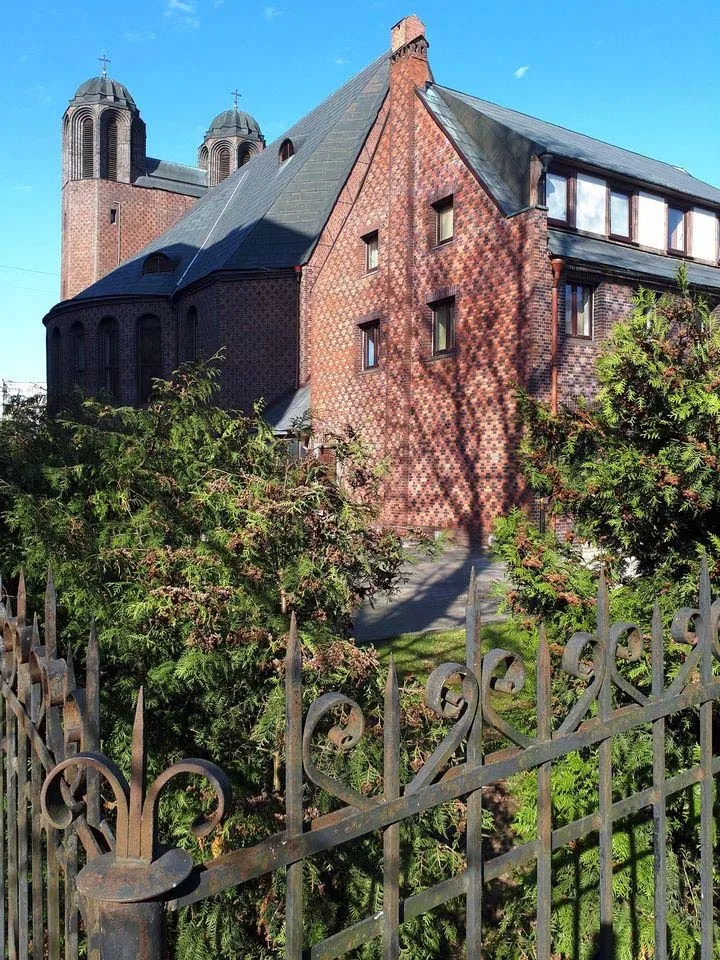
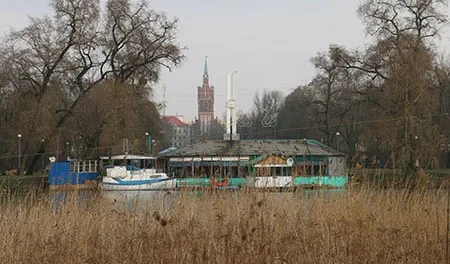
In 1945–1946 a fish sales outlet was set up in the church. Later the church building was used as car repair workshops. But during a major fire it burned out completely, causing the roof to collapse. After all this, in the 1950s the remains of the church were handed over to a fishing gear factory. In 1961 the monuments protection commission of the Culture Department decided that the church should continue to be used only as a factory. It was repaired, a roof was put on, and the interior was divided into two floors.
In 1988, after the decision to hand the church over to the Orthodox Church, reconstruction work began under the direction of the architect Yury Zabuga.
The south dome was restored. While building work was still going on, Orthodox services began to be held in the church. In 1992 the church was consecrated.
Photo: Mikhail Ogorodnikov
Translated from Russian with the help of AI (Claude, Anthropic), October 2026.