Legends of the hills in eastern Sambia
Plots similar to the Sambian tales are typical of other hillforts of historical Prussia as well. First let us go to the east of Sambia — a territory once inhabited by people of the same Prussian culture as the west of the peninsula. Here, too, there are Prussian hillforts — the earthen mounds of once mighty castles and of grounds for popular assemblies and rites. This is what a legend published in 1903 by Jonas Basanavičius — the patriarch of the Lithuanian national revival, who also studied the Lithuanian folklore of East Prussia — says about one of them.
“Pilgarbs”:
Amid the water meadows by the Deima, in the Labiau district, rises a hill 45 feet high and a hundred paces long and wide — Pilgarbs [from Old Prussian Pilis — castle, Garbs — hill]. In the centre of the hill there is a deep 5-foot pit filled with stones, so deep that even two hop poles will not reach the bottom. They say a castle sank into the earth there. Once, children picking berries near this hole saw several strange creatures, large and small, come out of the pit. Another time, a musician and his son, walking past the hill, saw a girl who began calling them to come and play for her. At once she opened a door in the hill, on its western side by the road, and led the travellers inside through darkness lit by torches. As soon as the music began, the girl started to dance, and soon another joined her — dressed all in black. When they stopped playing, the girls, in gratitude to the musicians, filled their bast shoes, which they had taken off, with dry oak leaves. The younger one, angry, threw all the leaves out of his shoes as soon as he came down from the hill. But the older one, when he was already nearing home, found that the laces tying his bast shoes suddenly snapped – so heavy had they become — for all the leaves had turned into gold coins! Seeing this, the son was upset, for in his shoes only the few leaves that remained had turned to gold.
Musicians (especially wandering ones) often figure in stories connected with objects of pre-Christian heritage. Usually the action takes place at night, when the musician somehow finds himself at a hill, a stone or in a bog and becomes the guest of “unclean forces”. The inhabitants of such places — in our case a cursed castle — strange creatures from another world, probably understood also as “spirits of the dead”, are glad of living visitors.
This may be connected with archaic rituals in which the living visited pagan cult sites during the feasts of the dead. In the minds of the living, ghosts (=the dead) rejoice when they hear music and can touch their past life. Of interest is the location of the “entrance” to the castle hill of Pilgarbs in the west — on the side of the setting sun, which may further point to an “otherworldly” context of the story. And, of course, the motif of gifts from the underground dwellers — gold that at first is not gold — characteristic of many East Prussian tales of hillforts, is present in this story too.
The plot of a castle that “sank into the earth” is here, as in other similar legends, connected with the category of “the past of others” — people of the pagan era who, in the Christian mind, are transformed into mysterious beings, monsters or spirits.
It is unclear which of the Prussian castles on the banks of the Deima lays claim to the title of the “Pilgarbs” of the legend. Several Prussian hillforts are known up the Deima from today’s Gvardeysk to Polessk. The most likely candidates belonging to the former Kreis Labiau are two Prussian hillforts — both “Schwedenschanzen”1, lying almost opposite each other on different banks of the Deima: Kl. Pöpplen near the village of Rechki and Balance (Preussenberg) south of the village of Marksovo.
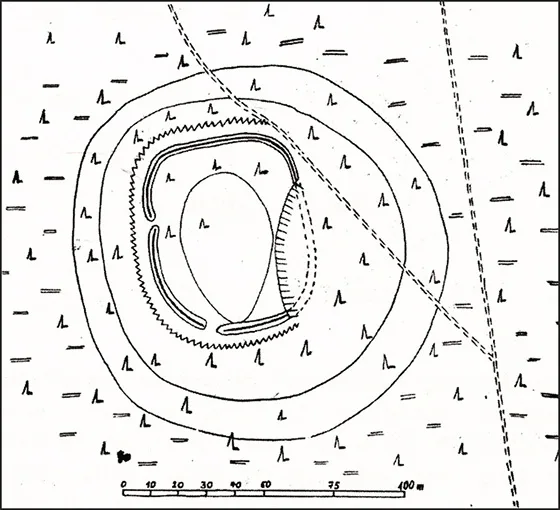
Plan of the Prussian hillfort of Klein Pöppeln (Schwedenschanze)
from A. Wendt’s 2011 book, after a drawing by H. Crome, 1940
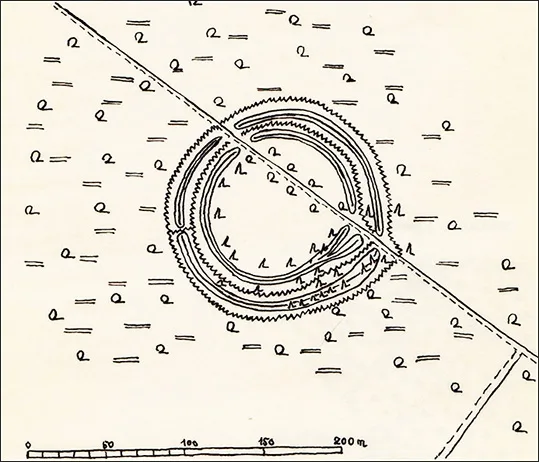
Plan of the Prussian hillfort of Klein Droosden (Schwedenschanze).
Drawing by R. Grenz after a drawing from H. Crome’s 1939 article.
These are medium-sized hillforts, surrounded along their perimeter by ring ramparts (“Preussenburg” has several) and having several entrances. It is not known whether the Swedes used these Prussian structures in the Thirty Years’ War and the Northern Wars of the 17th–18th centuries, since there is no direct evidence of it, unlike the “Swedish trenches” of Juditten (Rucheynaya Street in Kaliningrad). At the same time, the name Schwedenschanze, which is not typical of all the Prussian hillforts of Sambia, may conceal a hint at the archaic meaning of these places — Old Prussian *swent or Lithuanian *švent, “holy”. Such a meaning, together with the design of these hillforts (round shape, several entrances, as at the Kl. Droosden hillfort), may hint that sanctuaries existed here until the middle or end of the 13th century (see Schwentischken, near the village of Pugachyovo). Over time, the “Swedes” probably became in popular imagination the same kind of mythological characters as the “giants” — certain cultural forefathers, heroes.
Legends of the Prussian hillforts of Nadrovia
Let us go further east in the region — to Nadrovia. Here, two kilometres from Norkitten (Mezhdurechye), in the village of Bochagi, stands the mighty Prussian fortification of Worpillen-Schlossberg (from Old Prussian Wārapils — old castle), first mentioned by Johann Michael Giese and identified by the Kaliningrad archaeologist Vladimir Kulakov with the Nadrovian Romowe.
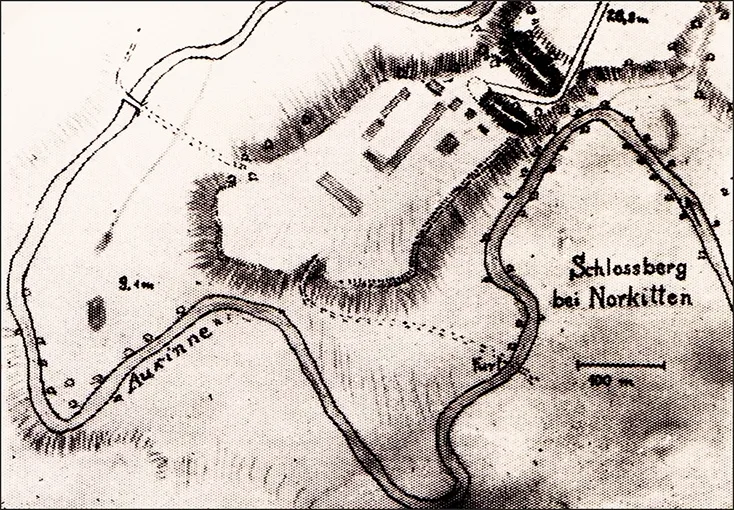
The Prussian hillfort of Warapils-Schlossberg, also known as the hillfort
near Norkitten (plan drawing from a 1935 article by H. Crome and W. Grunert).
This is what a legend published in the same collection by Basanavičius tells about it:
“The hillfort at Norkitten, in the Insterburg district, looks from afar like a huge forest, for it is entirely overgrown with trees; it lies 60 feet from the river Auxinne and stretches its long ridge for 70 paces. Once, long, long ago, a peasant from Užbundžiai [Bubainen/Berezhkovskoye] was walking to church over this hill. And on the hill he saw a girl dressed all in black. The girl began to beg him to come back to the same place in two weeks. And after that, in the third week, he was to come here again and kiss the creatures living here [monsters, ghosts?], so as to save her and everyone here. For a long time the traveller refused, but in the end he listened to the girl. And when he came two weeks later, he saw that the girl was all white from head to toe. But in the third week, when he came to the appointed place to kiss the “monsters” — he took fright and ran away. Behind him he heard the girl’s cry: ‘Now we are lost, lost for ever!’ From the cemetery, or hillock, not only at night but also by day, a sow with piglets comes out. And also, both at night and by day at twelve, two girls have been seen here combing their hair and bathing in the Auxinne. They say a sunken castle lies beneath this hill.”
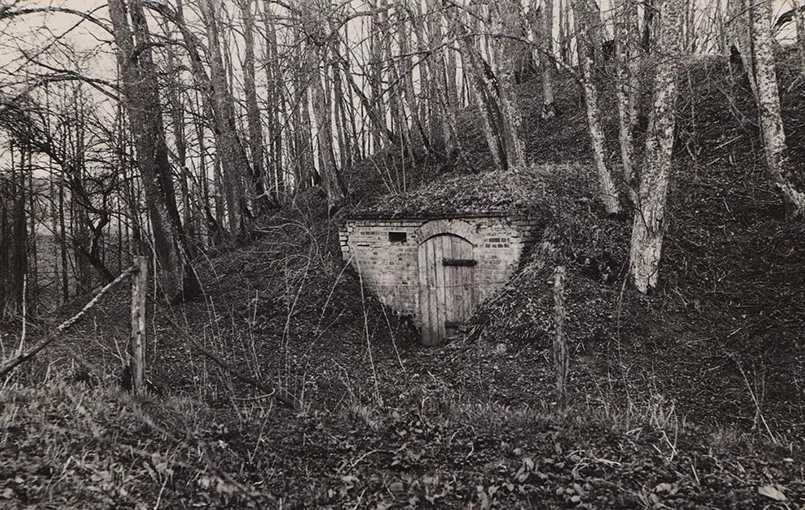
“Entrance to the Underground Chambers”. A farm building
by the eastern slope of the Norkitten hillfort (R. Grenz Archive).
We have already come across the plot of an enchanted “princess” and a cursed castle in the legends of the Sambian hillforts. Here appears the motif, popular in European fairy tales, of “kissing” the unclean forces, which is also found in the legend of the Vorpile-Varapils hillfort near Tilsit.
As in the previous legend, attention is drawn to the contrast between the colours of the two girls’ clothes, or the change of colour of one of them — black and white, colours important for understanding the sacred among the Prussians. Black is usually associated with chthonic, underground forces.
The same applies to the image of the sow that unexpectedly appears at the end of the legend. The pig was an important sacrificial animal among the Balts and is a deep archaic symbol that often figures in folklore. The image of enchanted girls or fairies combing their hair and bathing is not rare in pan-European folklore either. Besides, we should not forget the “laumės” — mythical beings of the Balts, similar to the Russian rusalkas — female water spirits with many mythological functions. Probably this muddled story preserves a hint of the special significance of this place in pre-Christian times, when it may have been not only an administrative but also a cult centre of the Nadrovian Prussians.
The most famous castle hill of Nadrovia is, of course, the hillfort-castle of Kamswikus-Tammowischken (the village of Timofeyevka near Chernyakhovsk). The place is first mentioned in the “Chronicle of the Prussian Land” by Peter of Dusburg (1326) in connection with the capture of a Prussian stronghold in Nadrovia by the Order in 1274. Articles on Kamswikus-Tammowischken by Gennady Razumny and Yevgeny Kalashnikov can be read in the first issue of the local history journal “Nadrovia”, 2002. The Order’s fortification of Tammow, which arose on the site of the captured Prussian hillfort and existed until the beginning of the 15th century, is described in detail by Anatoly Bakhtin in his 2005 book on the castles of the region.
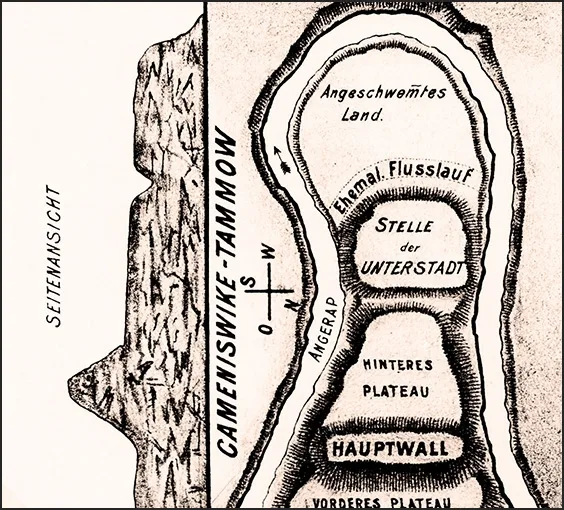
Plan of the earthworks of the Prussian Order castle of Kamswikus-Tammowischken
(drawing by M. Löbel, Journal of the Insterburg Antiquarian Society, vol. 6, 1900).
Archaeological investigations were carried out on the hillfort and in its surroundings before the war and again in our time, yielding material from the Stone Age to the Early Middle Ages.
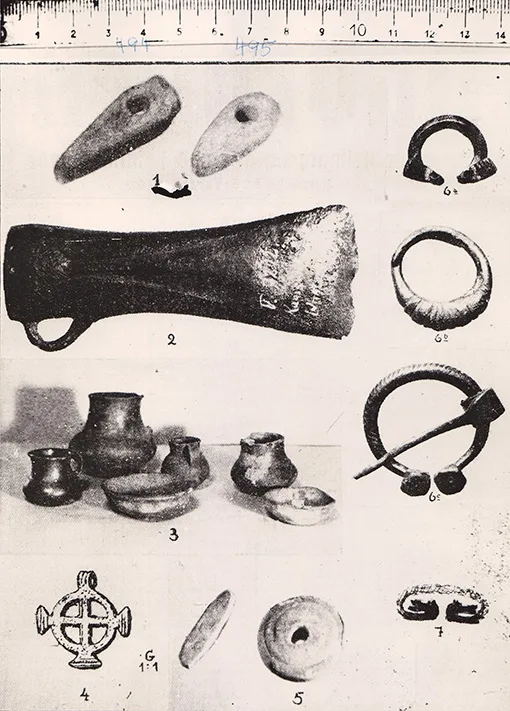
Archaeological finds of different periods discovered at the hillfort
of Kamswikus-Tammowischken and in its surroundings (photo from the R. Grenz Archive).
But what do folk tales say about it? One legend, published in the collection of Tettau and Temme in 1865, runs:
“Not far from Insterburg, on the right bank of the Angerapp, before it joins the Inster, rises the hill of Kamswikus. Even before the coming of the Order a castle stood here, whose owner gave the hill its name. Kamswikus was a cruel and merciless man whom his subjects remembered with horror. It went so far that he put his own wife in chains and walled her up alive in the castle dungeon. But this made him even more wicked; life in the castle became even more merciless and criminal, and he treated the people even more cruelly. This at last made the gods angry, and they flooded the whole castle with water. But the lady buried there in the cellars found no rest. She was condemned to appear in the form of a black cow. Her husband, in the form of a black wildcat, drove her before him. Others tell that they were accompanied by a black horseman who constantly swung a whip over them. Thus they could often be seen at midnight racing through the forest thicket. Kamswikus’s son often protected people from his father’s wrath, but it cost him his life. In gratitude a monument was raised to him. An iron cross, later found and kept before the war in the church of Insterburg, was made for this monument. Next to the hill they used to show his grave — a stone 25 paces long and 24 paces wide. At night the fairies of the hill bathe in the river flowing nearby, but they do not let themselves be overheard. If a person approaches them, they hide in the hill, where they live in bright, splendid chambers.”
Judging by the legend, the special importance of this hill as a kind of “central” place in the region, an administrative centre belonging to a Prussian noble2, is evident. It is not known what lay behind the particular cruelty of the castle’s lord — new powers granted to him by the Order after baptism, or the harsh everyday life of pre-Christian Prussia? In this confused and inconsistent legend, images of a “flood” and of Germanic mythology slip through, in the form of the “Wild Hunt” and fairies. The latter may have developed among the local people from more archaic beliefs about the laumės mentioned above — female water spirits. The motifs of the black cow as a chthonic (sacrificial?) animal and of splendid chambers hidden beneath the castle hill are also found in Baltic folklore. Interestingly, the image of a cow associated with Kamswikus-Tammowischken also appears in another tale from the book by Jonas Basanavičius mentioned above:
“The hill of Tammowischken, ‘Kampsvikalnis’, belonged around 1810 to the landowner Krüger, whose family has long since died out. It so happened that one of his cows would vanish somewhere every evening on the way home and come back an hour later completely milked. In time the owners noticed that in the evenings she went to that very hill. Realising that such a cow was of little use, the master decided to sell her to the neighbours for 6 thalers. The next evening the cow vanished again and, as usual, came back later already milked, but with a little bag holding 6 thalers tied to her horn. The owner took the money. But the following evening the cow went to the hill again and did not come back. And no one ever saw her again.”
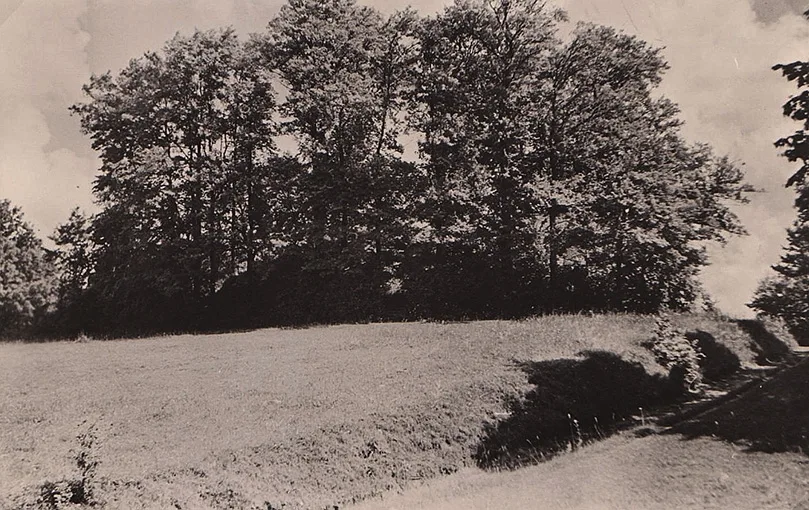
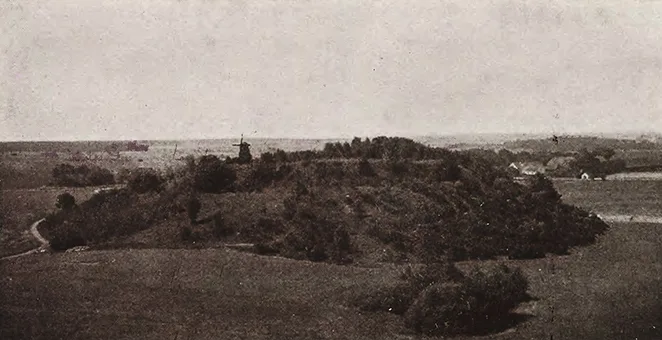
View of the rampart of the Kamswikus-Tammowischken hillfort (photo by Carl Engel, 1932, R. Grenz Archive).
With some probability, the image of the cow with the money that the strangers wishing to buy her — most likely for slaughter (she gave no milk) — were to pay, and her subsequent disappearance, may be connected with pre-Christian ideas of sacrifice and gift. Moreover, the mention of a cow returning “milked” from the magic hill indirectly hints at the “underground dwellers”, laumės and other spirits inhabiting the cursed castle, who, according to popular belief, could take milk from cows.
In the archive of the archaeologist Carl Engel, who devoted a good deal of time to studying the hillforts of the Prussians and their neighbours, one can find a story called “The Enchanted Princess of the Castle Hill of Wisborienen (Pillkallen district / Nesterov District)”:
In ancient times a castle stood on the river Šešupė, in which a beautiful princess lived. One day a wicked witch put a spell on the princess and turned her into a yellow dog. And the castle sank into the earth. There the dog guards it. Every Midsummer Night this dog comes out to people. If someone guesses the dog’s name, she will turn back into a princess, and the castle will rise again from under the earth. But no one guesses, and the dog vanishes in sorrow, awaiting the next eve of the summer solstice, which may bring her the long-awaited deliverance.
In this legend the already mentioned motifs of the cursed princess and the castle sunk into the earth intersect with an original, yet archaic, way of releasing her — one simply has to “say her name”, which no one knows, since the so-called “princess” belongs to another culture and era.
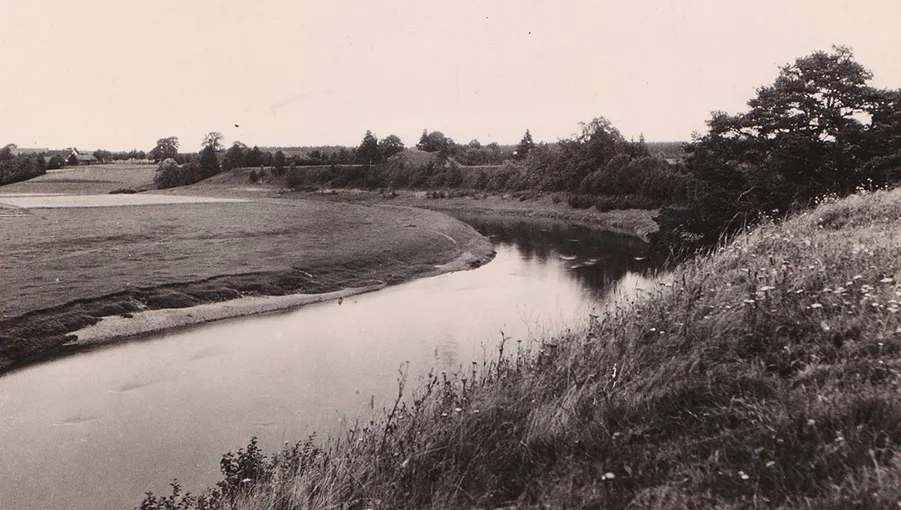
The bank of the Šešupė with a view of the hillfort (photo by Carl Engel, early 1930s, R. Grenz Archive).
The Korallenberg height and Mount Rambynas
Finally, I would like to present two legends from the border regions of the Prussians: from the Curonian Spit and from the land of the Scalovians. In H. Fuchs’s 1971 collection, which includes folklore texts of the inhabitants of the Curonian Spit, there is an interesting tale, “How the Castle at Rossitten Sank into the Earth”:
“Not far from Rossitten stands the Korallenberg hill. From afar it looks like a huge house with towers, buried in sand to the very top. Several centuries ago a beautiful castle stood here. But in time evil spirits took hold of the castle and its owners. Old people, seeing this, whispered: ‘The castle has not long to stand here.’ These rumours reached the princess who lived in the castle. The girl grew sad — could no one really help her? And then she had a dream in which a voice said: ‘Invite to the castle a man who does everything the other way round, and you will be saved.’ The next morning, full of hope, the girl went down to the village. The lads gathered below shouted over one another: ‘I’ll do it! I’ll drive those spirits away! I’ll go, all right!…’ But no one knew what really had to be done. And when they learned that ‘everything must be done the other way round’ — it seemed to them easier than easy. But then, whispering among themselves, they began to ask: ‘What exactly must be done the other way round? How is it done?’ And soon, after talking with an old man, the princess learned that one had to ride a horse up the hill backwards and lead it into the stable the same way. A fisherman named Spannagel remembered everything and at once harnessed his horse, doing everything the other way round. Already near the castle gate the girl noticed that the ‘Spannagel’ (from German Spannagel — the pin holding the shaft) was inserted in the usual way. And she began to shout: ‘Turn the Spannagel round!’ But the fisherman thought he was being told to turn round and drive back — that was his name, after all. And no sooner had he taken a step than he found himself several miles from the castle. Behind him he could still hear a terrible crashing and thunder: it was the castle sinking into the earth.”
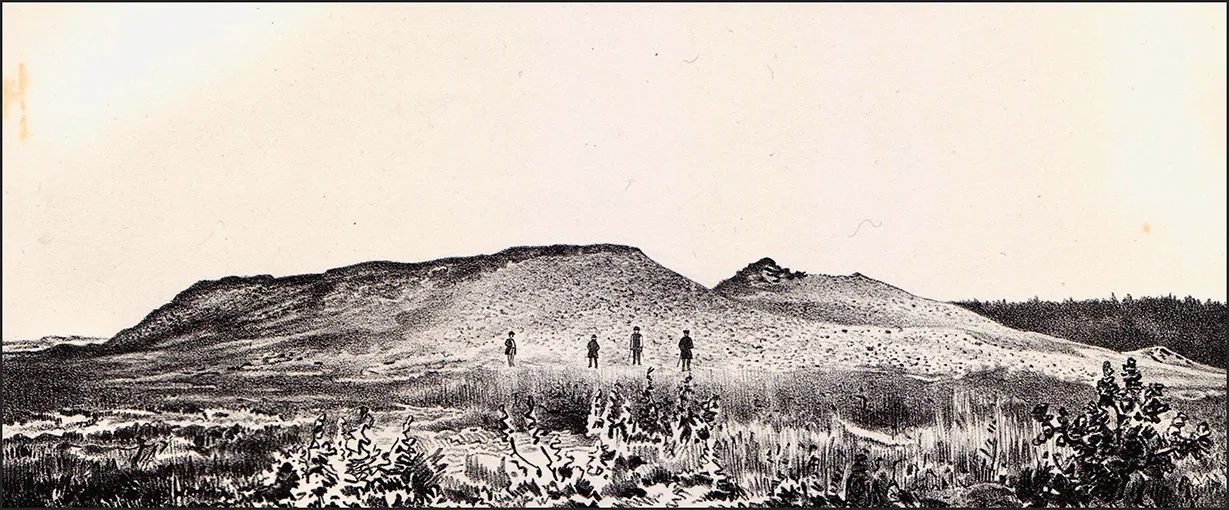
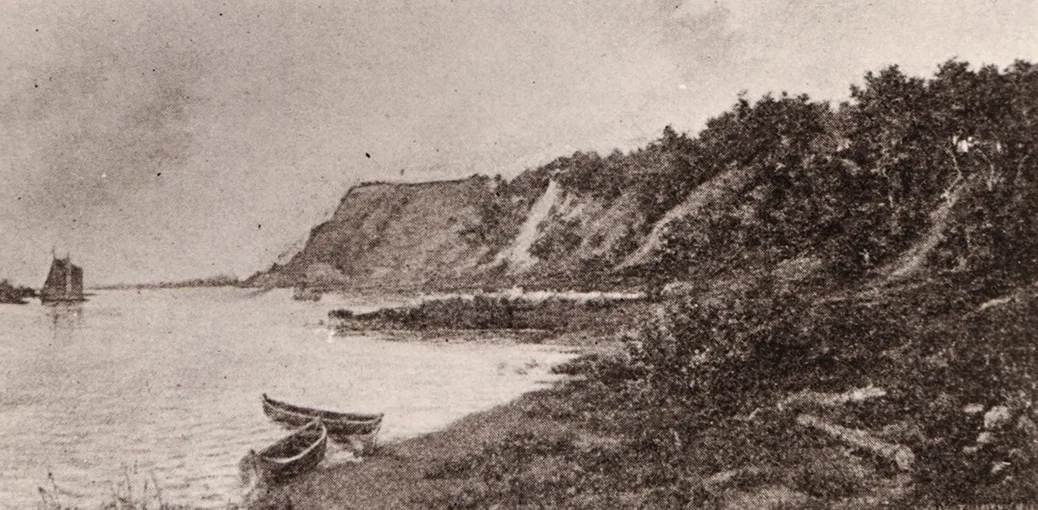
View of the Korallenberg near Rossitten (drawing from P. Schiefferdecker’s 1873 article
in the proceedings of the Physical-Economic Society of Königsberg).
The plot of the legend about a cursed castle that sank into the earth with its “princess” because a magical rescue task was performed wrongly recalls the motifs of the legends about the largest Sambian hillforts, Galtgarben and Gross Hausen. Perhaps the people of the peninsula who settled on the Spit brought their superstitions and folklore with them. Thanks to the archaeological research of Paul Schiefferdecker and Vladimir Kulakov, we know today that on one “coral” or “royal” height (south-west of today’s Rybachy), known in the literature as the Korallenberg, there really was in the Early Middle Ages a relatively small, most likely seasonal, settlement of the Prussians and their neighbours. In addition, the emergence of the legend may have been influenced by the Order castle in Rossitten (the village of Rybachy), of which little remained by the 18th century.
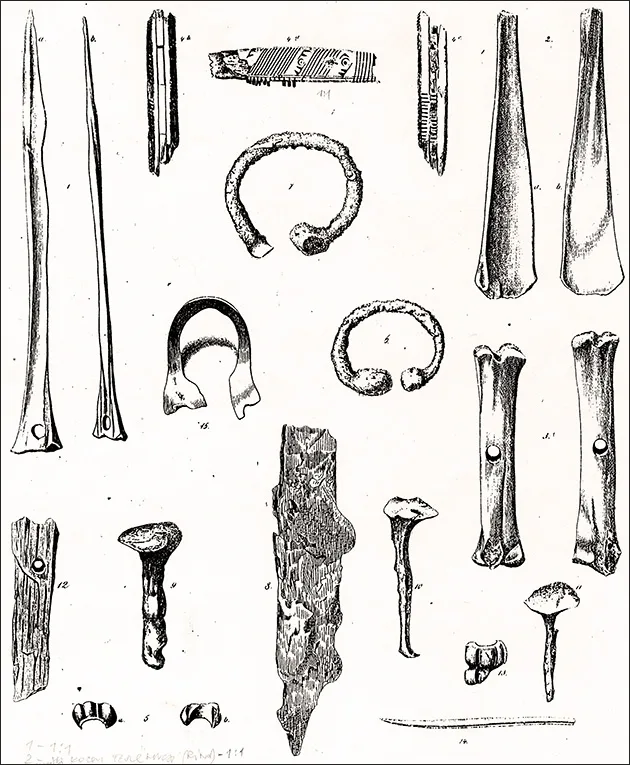
Finds from the Korallenberg (drawing from P. Schiefferdecker’s 1873 article
in the proceedings of the Physical-Economic Society of Königsberg).
Rumours and legends did not pass over what was probably the main sanctuary of the Scalovians — neighbours of the Prussians — which later became a Lithuanian holy place: Mount Rambynas, or, as the Germans called it, Rombinus, which stands on the opposite bank of the Neman, facing the town that now bears the river’s name. I will tell you about the sacrificial stone of Rambynas, famous throughout Prussia and Lithuania, another time. And now I turn to the legend “The Ghosts of Rombinus” from the collection of East Prussian tales by Tettau and Temme already mentioned:
“On one dark, restless night a skipper sailing down the Memel (Neman) noticed some flickering movement on the holy hill of Rombinus, at the very spot where the sacrificial stone had once been. And soon he realised that it was nothing other than spirits. He clutched his cross, for he had only recently been baptised. But the spirits did not vanish; they became ever clearer, until he saw children in white clothes. They waved to the sailor and plaintively begged him to take them across to the other bank, promising to pay him in gold and jewels for it.
Moved by pity and by the promised reward, the skipper landed at the foot of the hill. The little spirits began jumping into the boat, carrying treasures with them in baskets. As soon as it began to grow light, he discovered to his surprise that there was nothing but coal in those baskets. This mockery by the spirits, which punished his curiosity, angered the sailor, and he began throwing the coals into the river. And they sank at once. Then the laughter of the spirits rang out, and the skipper began waving his oar in the air in vain. To no avail — the ghost children had vanished. With the first rays of the sun, which lit up the deck as well, he saw that where the coals had been, something was glinting. It turned out to be a piece of real gold. Only now did he understand what kind of coal he had thrown away. The skipper clutched his head, began to shout and tear his hair, but in vain — no one heard him.
This gold came from the depths of the hill and was kept beneath the sacrificial stone. And no person, especially an ungodly one, can find it. And to this day the treasure lies peacefully in the depths. Although all the inhabitants of that area have heard that once a golden hoe was found in the hill of Rombinus, at the place of the long-vanished sacrificial stone.”
View of the holy mount Rambynas before the collapse of part of its slope, photo of 1898 (R. Grenz Archive).
Thus, over the centuries, the sanctity of ancient sites in the minds of the local population turned into myths about hoards and treasures hidden there, connected with the underground dwellers and other “unclean forces” — mysterious ancestors. The leitmotif of the “holy” turned into something “useful”, such as unexpected enrichment, more comprehensible to an everyday world view. Likewise, the “sacredness” of such places was gradually replaced in the popular mind by certain “Swedes”, who had also been here long ago and whom by the 19th century no one had seen and hardly anyone remembered.
A collection of legends and tales about the hillforts, sanctuaries and other interesting hills of historical Prussia could fill a very thick book, given the possible historical and mythological interpretations of these texts. So in my next publications I will tell you about other sites of our region, this time natural ones — stones and trees that have left their traces not only in the landscape but also in the legends and folklore handed down from the depths of the centuries.
_______________
1. Schwedenschanze translates from German as “Swedish shelter” — a name widespread in Northern Europe for prehistoric monuments — hillforts, sanctuaries and fortified settlements, which popular memory associates with the series of Swedish military campaigns of the first third and the second half of the 17th century.
2. Noble — from Latin for “well-born”: the term used in medieval German chronicles and documents for members of the local Prussian aristocracy; the term “witing” is also found.
Translated from Russian with the help of AI (Claude, Anthropic), October 2026.