The editors would like to thank the Königsberg City Museum for their help in selecting the illustrations.
More than a hundred years ago, on 21 May 1896, a zoo opened in Hufenpark, on the banks of the deep Freigraben ravine (Freigraben, now the Parkovy Stream), in Hufen, a near western suburb of Königsberg. For many years Hufen had been a favourite retreat of aristocratic families, who kept country houses surrounded by gardens there, and it was gradually becoming one of the city's busy commercial districts.
Lord Mayor Karl Selke (1836–1893), who held this office from 1875 to 1893, had planned to open a zoo as early as 1889, since the idea was extremely popular in the city at the time; but, as usual, its realisation was held back by a lack of funds in the municipal treasury. Nevertheless, in 1891 a small private menagerie did open on the grounds of the Villa Friedericia estate on the bank of the Freigraben. Owing to a lack of money for the animals' upkeep, and to their deaths from unprofessional care, it lasted only a year. But a start had been made.
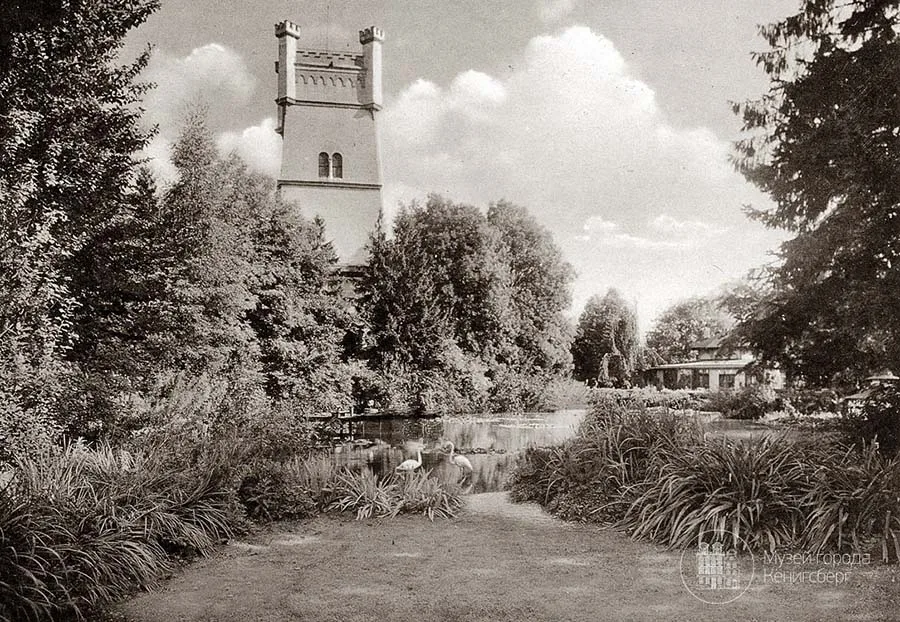 The observation tower rises above the “flamingo corner”.
The opening ceremony of the Königsberg Zoo took place on 21 May 1896 in the main building of the German Industrial Exhibition, which was being held on this site that year, in a large hall seating 2,000 people that had been prepared especially for the occasion.
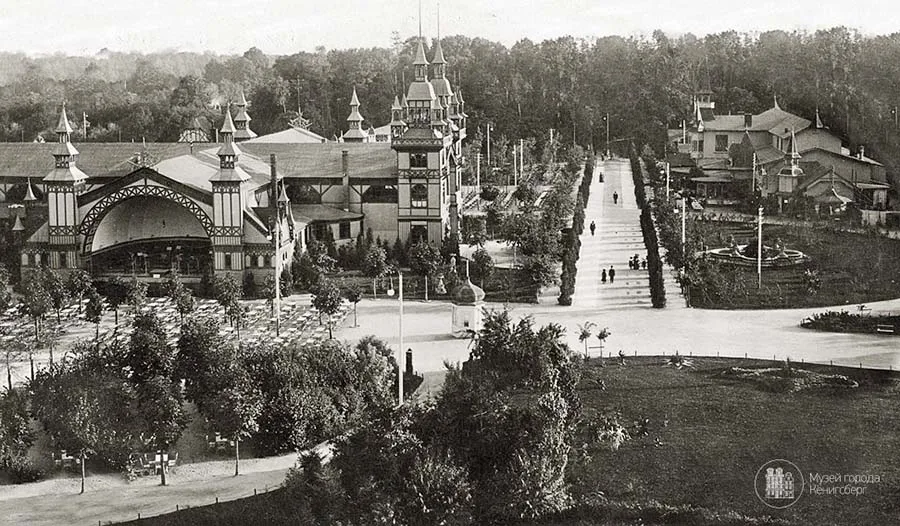 View from the Observation Tower towards the main entrance. On the left, the Concert Hall; on the right, the Main Restaurant.
The prehistory of the Königsberg Zoo began in 1895, when, to mark the fiftieth anniversary of the Polytechnic Trades Association, the North-East German Industrial and Trade Exhibition was organised on the banks of the Freigraben stream, in the grove of Hufenpark (Hufen-park). Its director was Privy Councillor Hermann Claaß, a dental technician and respected citizen. Thanks to the efforts of this energetic administrator, the exhibition, which had a noticeable impact on Königsberg's industrial and business circles, was a considerable success.
While the exhibition was under way, Herr Claaß proposed that its grounds, buildings and infrastructure should afterwards be used to establish a municipal zoo.
Carrying out these plans eventually cost 400,000 marks, spent on setting up the zoo. Of this sum, 237,860 marks were spent immediately: on buying the plot in Hufenpark from its owner, the restaurateur Redotte (125,000 marks), and seven and a half hectares of land belonging to the Hardershof estate from its owner, Frau Beek (90,000 marks), as well as on buying the wooden buildings standing on the exhibition grounds (the observation tower, the main building, etc.) — 22,860 marks. In addition, further sums were later spent: 15,000 marks on landscaping the park grounds and the pond, 100,000 marks on purchasing animal enclosures, and 162,000 marks on other organisational needs, including the purchase of animals and of saplings for laying out an arboretum of exotic trees. The funds for establishing the zoo were provided by private individuals.
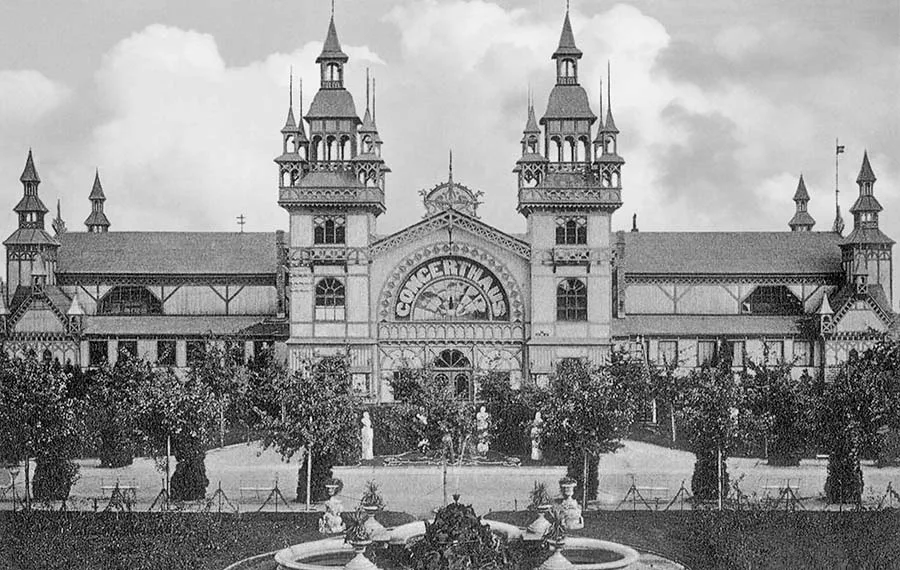 The grand façade of the Concert Hall.
The first meeting of the zoo's Public Council took place on 10 August 1895. Ninety-two people from various walks of life gathered at the Villa Hufenpark, which would later house the administration; they formed the core of the corporation that took on the costs of establishing and maintaining the zoological garden.
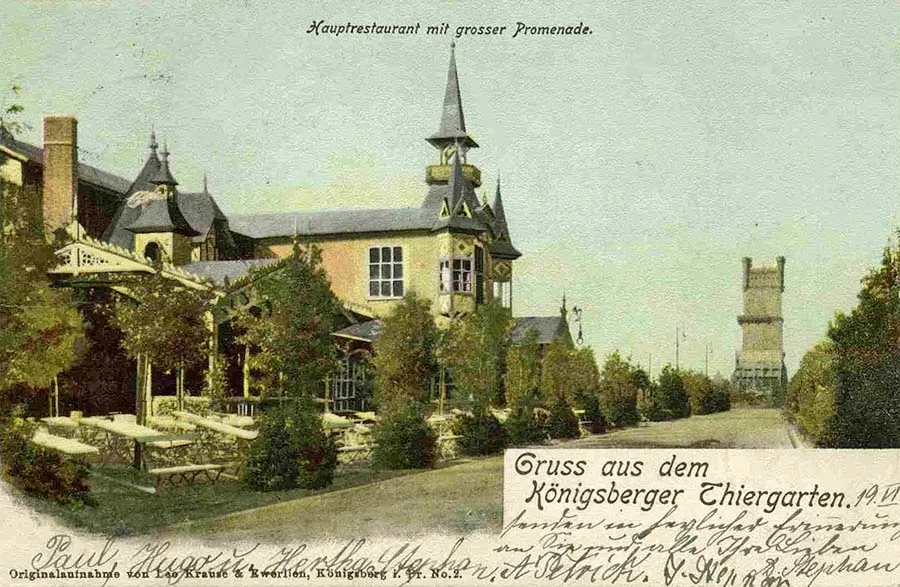 The Main Restaurant on the central promenade.
The chairman of this historic meeting was Dr Maximilian Braun (1850–1930), Privy Councillor, professor of zoology at the University of Königsberg and, from 1890, director of the Zoological Museum. In his speech he said that Königsberg, as a university city, ought to have a zoo to serve as a base for scientific research and for students' practical work, as well as for public education. He planned to create conditions in the new zoo that came as close as possible to nature, so that “visitors would feel like guests of the animals”.
Given the varied interests of those present, the final version of the project also took other proposals into account: to create a landscaped garden ensemble and to provide facilities for sport, for concerts and exhibitions, and for the recreation of the townspeople.
Preparations lasted from August 1895 to May 1896, but already at the end of August the Tiergarten Animal Lovers' Association (Tiergarten), a charitable society, was founded. Its presidium was elected and a working committee was set up under Mayor Paul Kunkel. The first technical director to be appointed was none other than Hermann Claaß, who was always full of ideas and projects and had successfully organised various civic events. Later, when the zoo acquired the status of a legal entity, he became its first director, in May 1897. In the early years, the curator for zoological matters was Dr Johannes Müller.
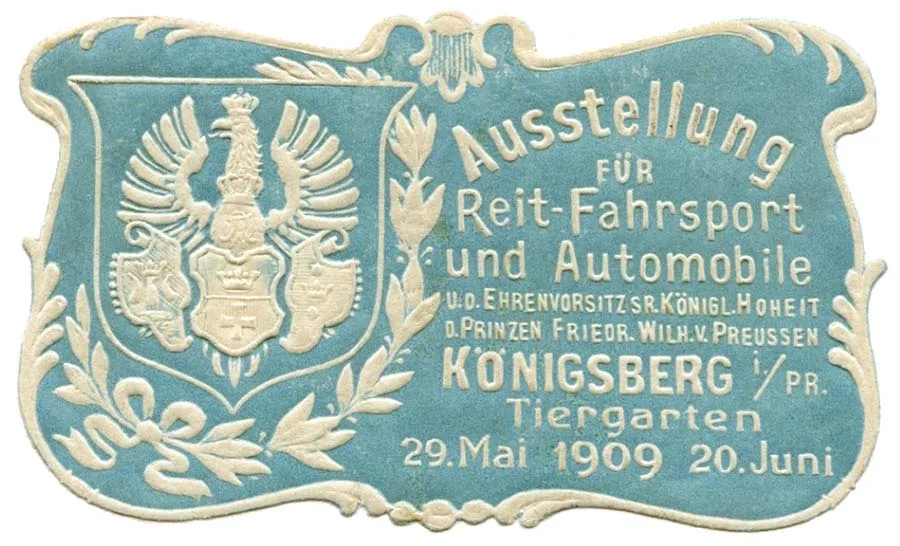 Advertisement for a horse and motor show in the Tiergarten.
Hermann Claaß held the demanding post of director for sixteen years, until his retirement on 31 March 1913.
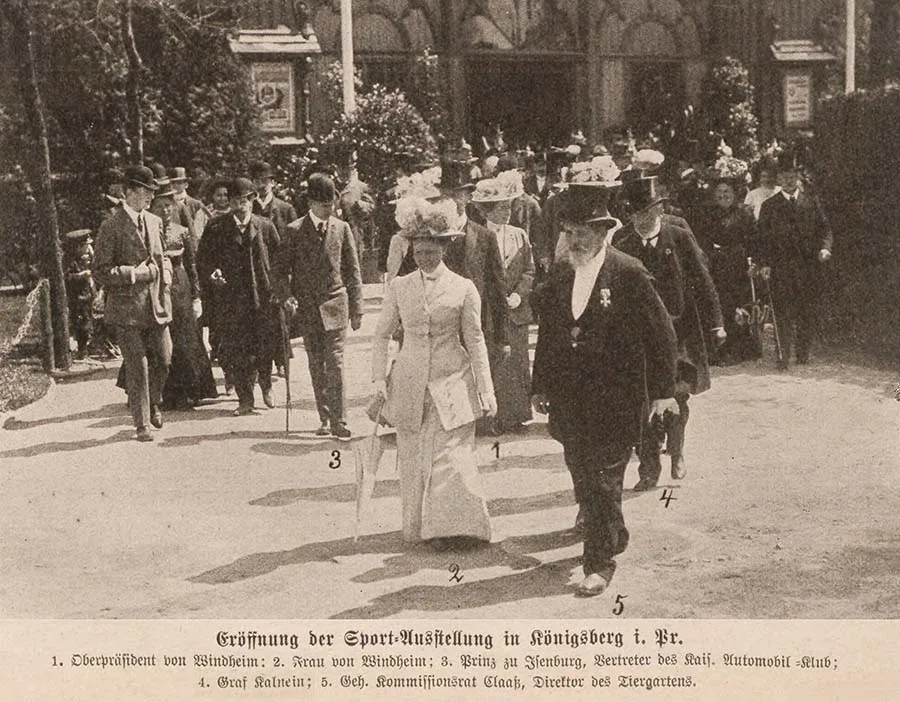 Hermann Claaß (5) escorts the wife of the Oberpräsident, Frau von Windheim (2), while Herr von Windheim himself follows behind them (1) in the company of the Prince of Isenburg (3) and Count Kalnein (4).
As early as 1901, in recognition of the first zoo director's merits, one of Hufen's prettiest streets, not far from the main entrance to the zoo in the Luisenhöh quarter, where Claaß had bought a villa, was named after him (today Svobodnaya Street). A year after his death (in 1914), a monument to the zoo's founder was erected on the main avenue, in the centre beside the illuminated fountain and the flowerbeds. The work of the sculptor Walter Rosenberg, it is a bronze sculptural group showing a boy surrounded by a panther and her two frolicking cubs.
On the stone pedestal there is a bronze relief of Hermann Claaß's head and the inscription “Dedicated to the memory of H. Claaß, Commercial Councillor, organiser and first director of the Zoo”.
In 1934 the monument was moved to the glacis by the King's Gate, and after the war it vanished without trace. Many years later, however, in 1992, thanks to the efforts of the Russian-German society “Monuments of Königsberg” (Gedenkstätten Königsberg), it was found in private hands and returned to its pedestal. The bas-relief on the pedestal had been irretrievably lost; for the zoo's centenary it was recreated, on commission from the German side, by the well-known Kaliningrad artist Igor Isaev (the bas-relief was cast in Germany), and finally, in 1996, it resumed its historic place on the granite pedestal.
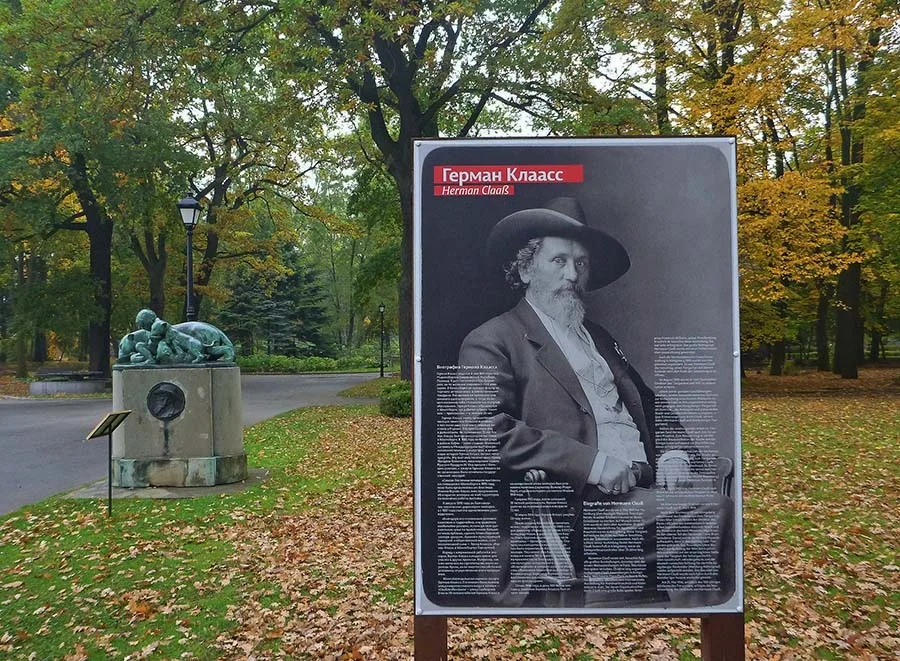 Monument to Hermann Claaß by Walter Rosenberg (left, 1913) and an information board with a portrait of the Tiergarten's first director.
The zoo grounds, with their natural landscape, were designed in the style of an English landscape park, laid out on the banks of a deep ravine around the existing native vegetation and somewhat “embellished” with introduced tree species.
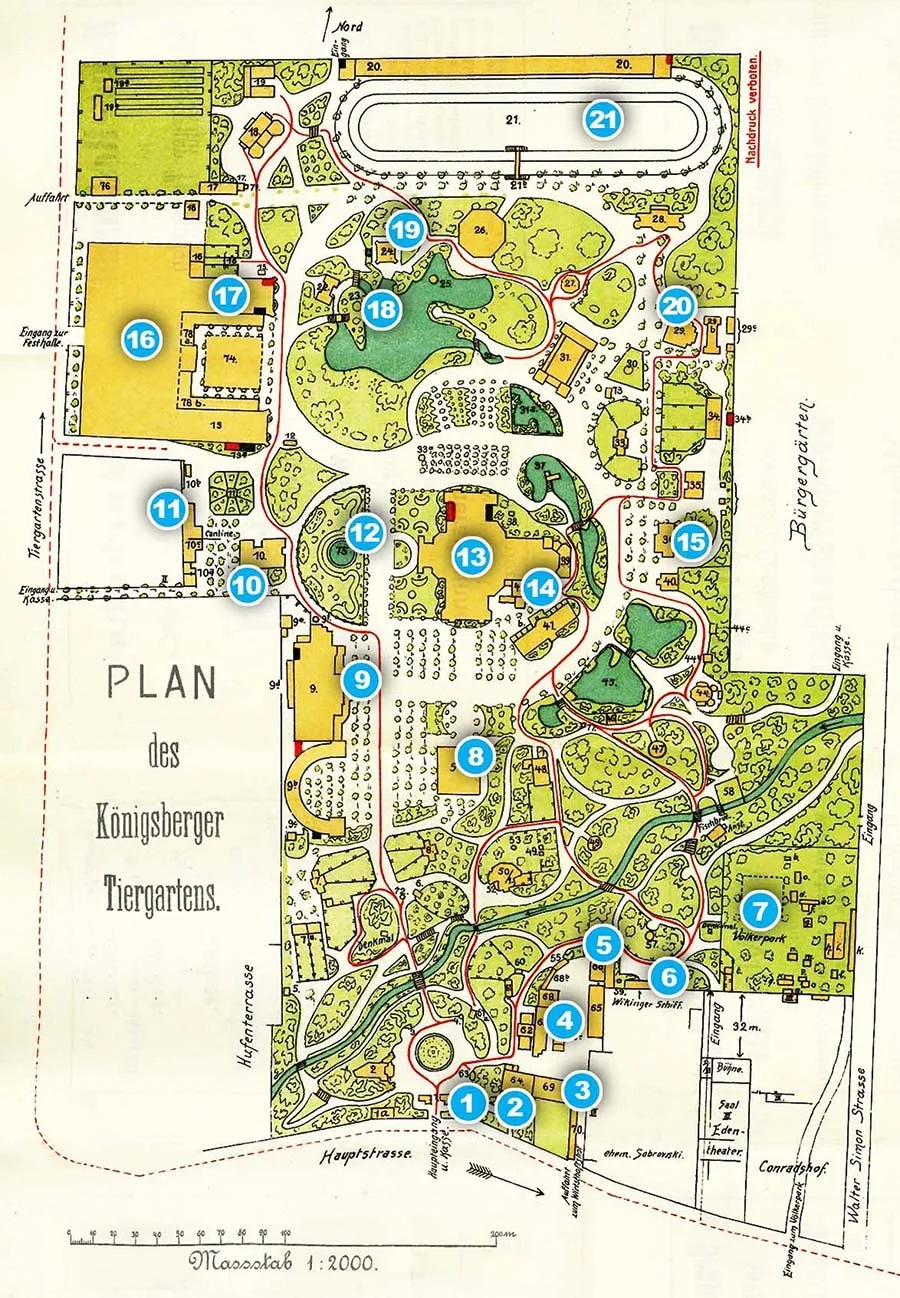
Plan of the Königsberg Tiergarten during Hermann Claaß's directorship (1897–1913).
1. Ticket office; 2. Administration building; 3. “Hufenpark” Restaurant; 4. Plant nursery; 5. Stables; 6. Viking ship (Drakkar); 7. People's Park; 8. “Wickbold” beer hall; 9. Main Restaurant; 10. Reading room; 11. People's Restaurant; 12. Fountain with goldfish pond; 13. Concert Hall; 14. Wine cellar; 15. “Ponarth” beer hall; 16. Large hall for festive events; 17. Gymnasiums; 18. Illuminated musical fountain; 19. Observation Tower; 20. Dairy house and mineral spring; 21. Cycle track, tennis court and riding arena.
The park's landscapes were reshaped by the landscape architect Model and his assistant Wichulla, while Schefer became head gardener. The course of the high-banked stream was altered somewhat to give it greater scenic variety, reflected in the views of a wide artificial backwater in the eastern part, a narrow channel with a waterfall in the central part of the park, and a narrow rushing torrent near Hufenallee (today's Prospekt Mira), on the boundary between the park and the city.
The selection of animal species was discussed by the “Tiergarten” council and subsequently assembled and supplied by the firm of Carl Hagenbeck of Hamburg — 900 animals of two hundred and sixty species (two Ussuri tigers were brought from Russia).
Besides the plants typical of East Prussia, the collection included more than 50 species of trees exotic for Königsberg, brought from other countries, among which conifers were particularly prominent.
The city's residents and public were very widely involved in solving the zoo's problems. Some of the zoo's projects were financed through voluntary contributions from the public, while the rest of the money came from patrons — industrialists, merchants and other wealthy citizens. The “Tiergarten” association launched a lively discussion among the townspeople about the design and layout of the zoo grounds. Every citizen was invited to express an opinion on the development of the zoo, a major project created entirely on a charitable basis.
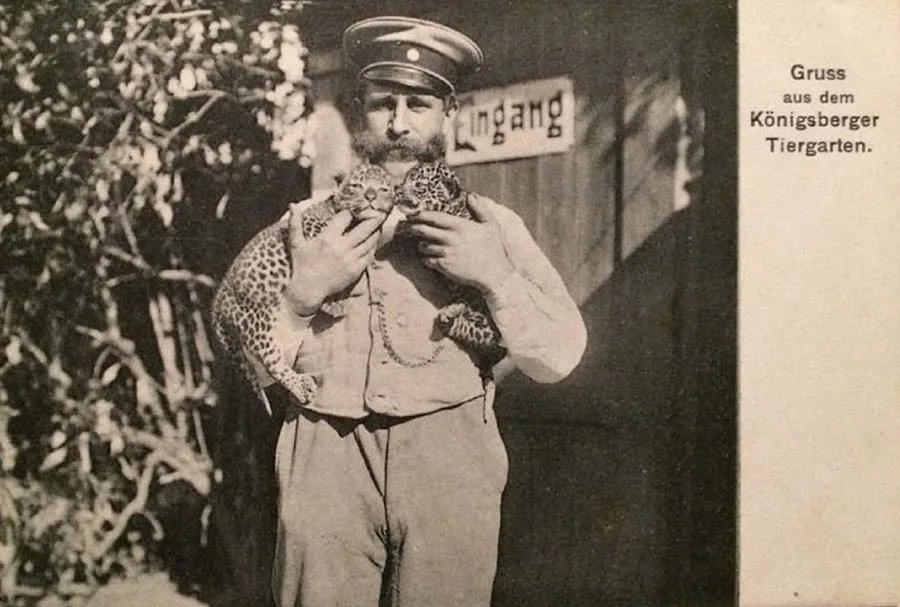
Within the very first decade of its existence, the Königsberg Zoo became one of the townspeople's most popular places of recreation. From May to September it was open from 7 a.m. to 11 p.m., and for the rest of the year from 8 a.m. until sunset.
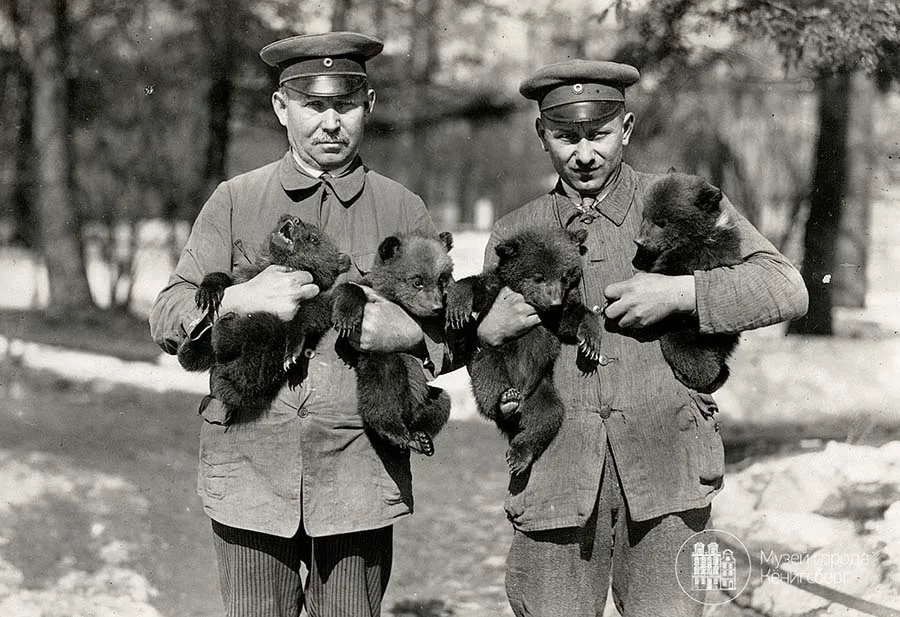 Zoo staff with leopard cubs and bear cubs born in Königsberg.
The first entrance was on Zoologicheskaya Street (Tiergartenstraße); in 1910 the entrance was moved to the southern part of the zoo. In 1910 a single admission ticket cost 50 pfennigs, 20 for children, and a semester ticket for students three marks.
The founders' work earned great recognition from the townspeople, the public and fellow scientists: in 1897, 2,900 season tickets were sold, and by 1898 the number of annual tickets had already reached 25,000; in 1904 the zoo, recognised as one of the best in the country, hosted a conference of the directors of zoos from all over Germany.
In 1897, a year after the opening, the zoo was home to 983 animals; the collection was constantly growing, and by 1910 it had reached 2,126 animals belonging to 405 species — the largest number in the zoo's entire history. The commercial success was plain to see.
A number of factors contributed to the enterprise's prosperity: the varied composition of the menagerie, the opportunity to observe the life of native and exotic animals at close quarters, the zoo's convenient location in a green, aristocratic district, the picturesque scenery of the romantic “gorge” — a deep (up to 25 m) ravine overgrown with hornbeams, along whose floor a turbulent stream rushed — the large “Duck Bay” pond, the beautifully laid-out central area with its avenues, lawns and flowerbeds, the creeping roses and the thoughtfully selected arboretum, an extensive network of walking paths, and a wide variety of leisure activities.
There were concerts every day, winter and summer: in summer in the open air, in winter in the large Concert Hall with its organ. In summer, on Sundays and Wednesdays, there were symphony concerts. The public was also attracted by such pleasant pastimes as visiting the restaurants, the wine cellar, the milk cafés and Liedtke's confectionery, where the marzipan buns so beloved in Königsberg were baked; cycling; the “fun house”; the children's playground; the wooden terrace of the reading room, which offered a fine view of the rather gloomy ravine; and two music pavilions for orchestras. The choir of the Teachers' Association performed regularly, and other song festivals were held frequently.
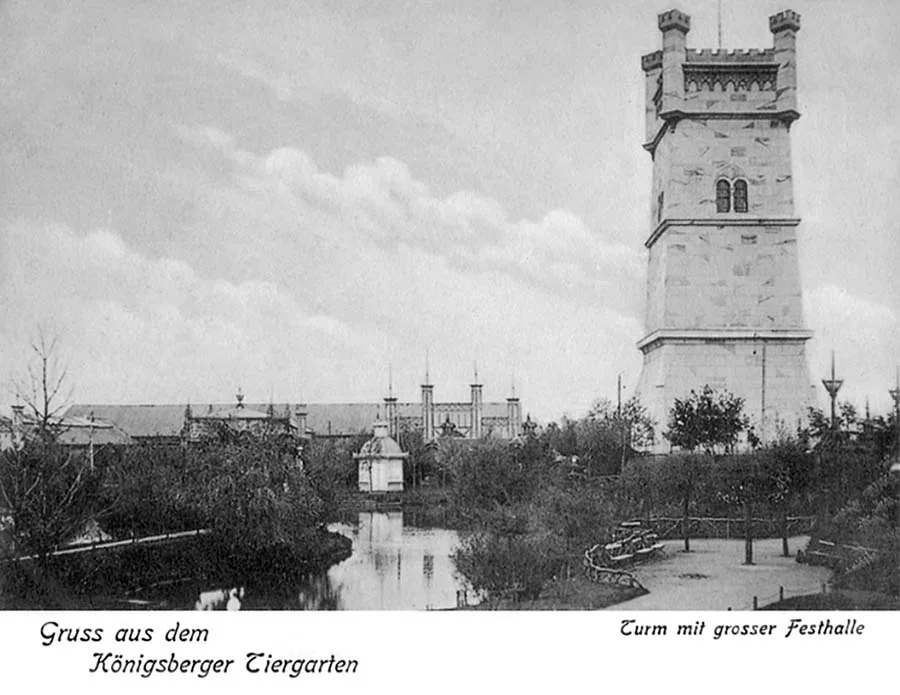 The Observation Tower and the Large Hall for festive events.
There were two restaurants: one, with a multitude of open-air tables, was the “people's” restaurant; the other — the largest restaurant in Königsberg — stood in the western part of the zoo on the Tiergartenstraße side, and an oak avenue led to it from the street entrance.
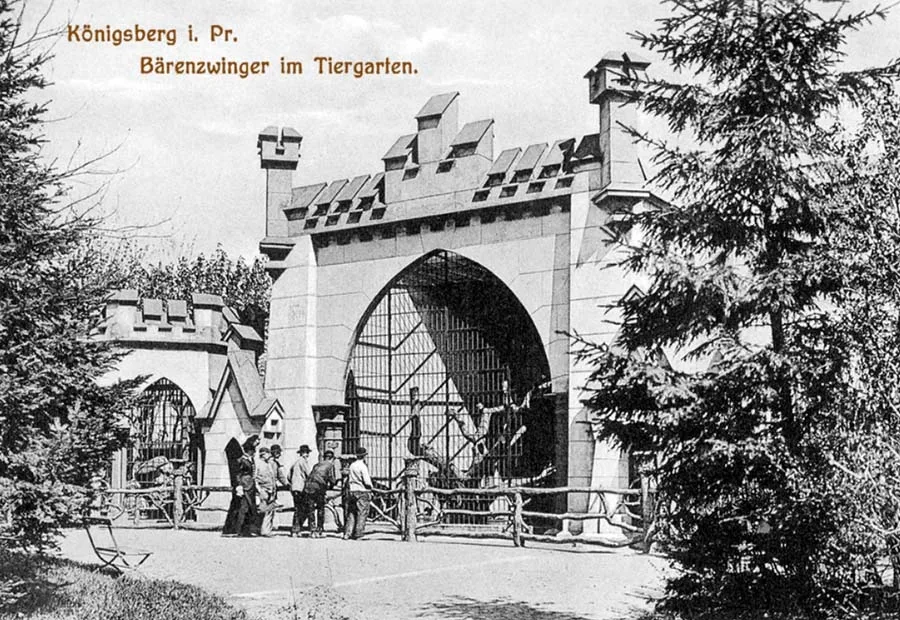 The Bear Castle was always a popular spot.
The zoo frequently hosted not only various civic events but also projects initiated personally by Hermann Claass that brought in good revenue (for example, a major project of regular exhibitions of the way of life of exotic peoples — Laplanders, North Africans and members of other peoples who were invited to Königsberg). Among the civic events, the 21st Prussian Song Festival, held in July 1903, deserves mention. All its participants received specially cast bronze commemorative medals, bearing on one side an image of a musician with a lyre and two angels, and on the other an elk's head framed by oak leaves and the inscription “Königsberg in Prussia. Tiergarten. 1903.”
The numerous concerts of that time took place in the zoo's Concert Hall, one of the buildings left over from the industrial exhibition. It was here too that the city celebrated, in 1908, the centenary of the Municipal Ordinance.
In 1906, before a large crowd, the Society of Aeronautics Enthusiasts launched a balloon from the zoo grounds to what was then a considerable height — 300 metres — from which lovers of such amusements, having bought a ticket for 3 marks, could admire views of Königsberg and its surroundings.
In 1910 one of the zoo's wooden buildings — the main restaurant at the Tiergartenstraße entrance — burned down, but as early as 1911 a new Baroque-style stone building, the Society House, was erected on its site to a design by the architect Otto Walter Kuckuck, who taught at the Königsberg School of Arts and Crafts (its red-brick building survives on Sommera Street) and built many villas and residential houses in Königsberg.
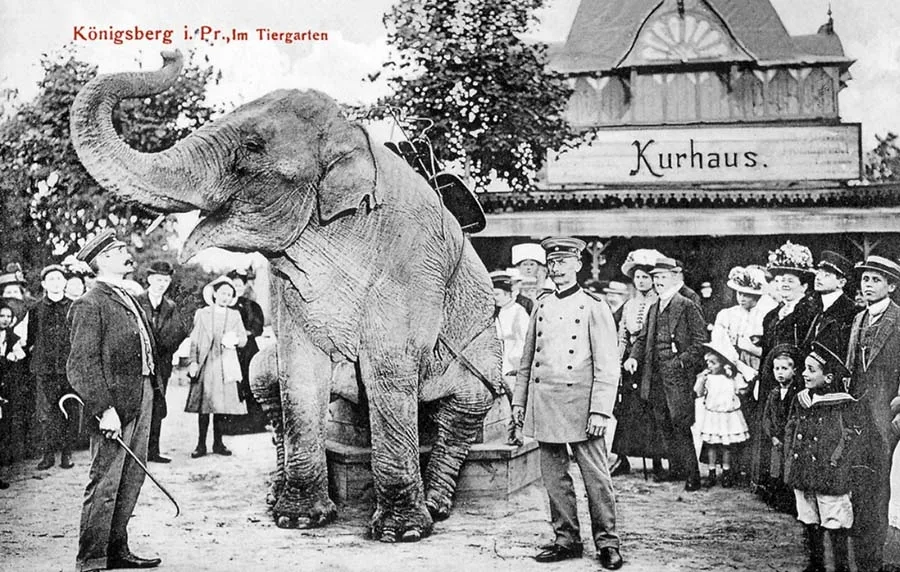 Jenny the elephant was loved by young and old alike!
The Society House, with its new restaurant, open terrace on the second floor and palm hall, was the centre of attraction for visitors to the zoo.
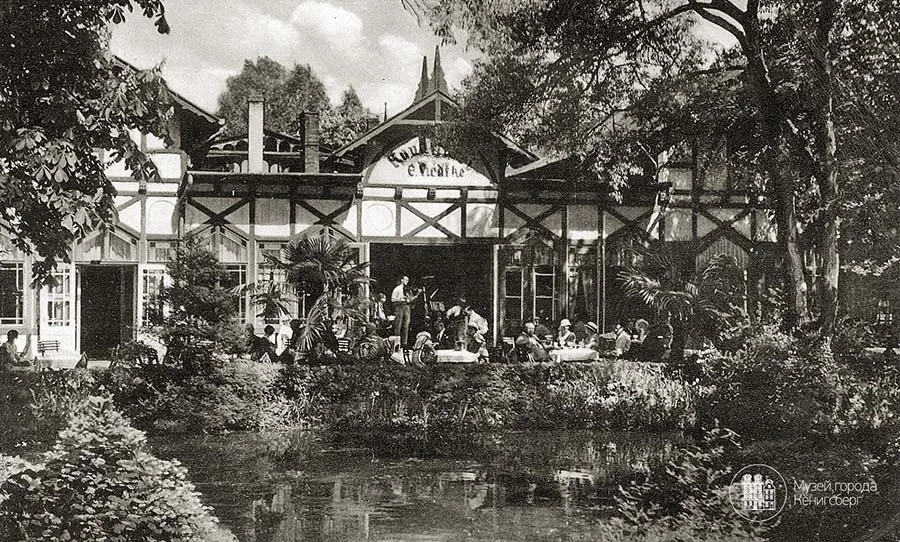 A café at the zoo on the shore of a cosy little pond.
This building, whose name can be rendered as House of Public Assemblies or House for Social Gatherings, had a great many rooms of various sizes for what we would now call master classes and for choral singing, as well as a huge concert hall seating 3,000, and halls for soirées, balls and festive performances. The building was elongated in shape, and because its many rooms were of different heights, it had a complex roof. The restaurant was especially popular. The open terrace on the upper floor offered a view of almost the entire zoo. The southern wing of the building did not survive the war.
During the bombing raids of 1944 and the fighting on the zoo grounds in 1945, the building partly survived, and after the war it took on a new role as the elephant house.
The "old" ruined elephant house of the Kaliningrad Zoo ("old" because a new one has since been built) probably still remembers the days when it was one of the largest restaurants in the city. At the beginning of the 21st century it awaits either demolition or restoration. For many years now its twisted wrought-iron balcony railing has been creaking about this, reminding zoo visitors that our city has more than a few strange places and that nothing here should come as a surprise…
One of the most remarkable events in the zoo's history was the opening on its grounds in 1912 of Germany's first open-air ethnographic museum, modelled on the Scandinavian museum at Skansen park in Stockholm. There the ethnographer A. Hazelius had assembled a museum village of old wooden buildings, which he opened to the public in 1891. The aim of such museums was to preserve architectural monuments and to present them within the landscape, in their natural historical setting, as a complex and an ensemble.
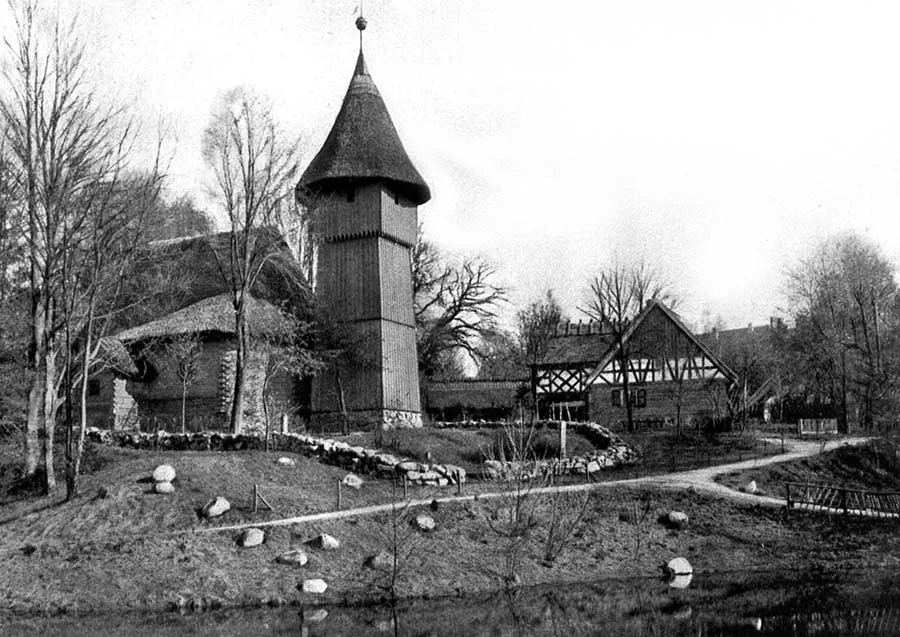 The East Prussian Ethnographic Museum was an important part of the Tiergarten.
The founder and director of the Museum of East Prussian Rural Life was Professor Richard Dethlefsen, a conservative by conviction who championed the preservation of traditional peasant life and Prussian history.
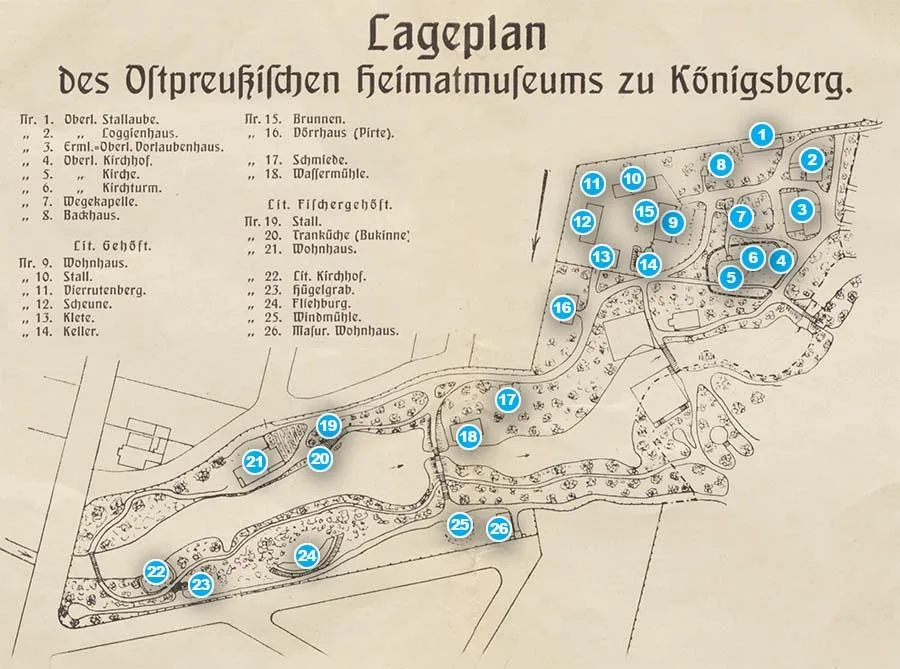
Plan of the East Prussian Ethnographic Museum in Königsberg.
1. Oberland stable. 2. Oberland farmhouse. 3. Ermland-Oberland farmhouse with open gallery. 4. Oberland churchyard. 5. Oberland church. 6. Bell tower of the Oberland church. 7. Wayside chapel. 8. Bakehouse.
Lithuanian farmstead
9. Farmhouse. 10. Stable. 11. Granary for storing the harvest. 12. Barn. 13. Storehouse. 14. Cellar. 15. Well. 16. Drying house. 17. Smithy. 18. Watermill.
Lithuanian fisherman's farmstead
19. Stable. 20. Fish smokehouse. 21. Farmhouse. 22. Lithuanian churchyard. 23. Burial mound. 24. Fortified hillfort with ramparts. 25. Windmill. 26. Masurian farmhouse.
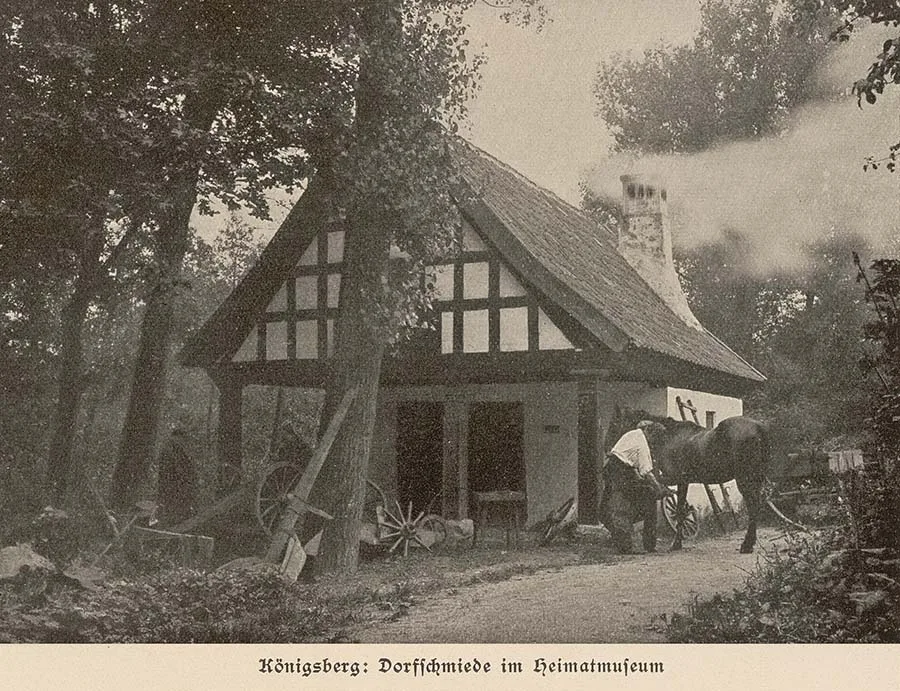 The smithy in the Ethnographic Museum.
The museum lay on the banks of the Freigraben ravine in the southern part of the zoo, covered just over three hectares and had its own entrances from Brahmsstraße (Brahmsstraße, now Bramsa Street) and Liststraße (List-straße). Here, amid the natural vegetation, in the shade of hornbeams and beeches, stood buildings of the old Prussian way of life that was already vanishing at the time, serving a variety of purposes: peasant houses — Prussian, Masurian and Ermland — a forester's house, a Lithuanian fisherman's hut, a farmstead yard, a bakehouse, a smithy, a brewery, a windmill, a wooden church, an old fortification and other buildings of ethnographic value that were in danger of disappearing at the beginning of the twentieth century.
Within the landscape of the stream's ravine, the buildings of the museum village were arranged as follows: where a footbridge now spans the ravine from Nosova Street to Rimskogo-Korsakova Street, there was a small dam, so that the stream running through the ravine formed a backwater pond stocked with trout, its clear, flowing water spilling over to form a waterfall.
Along the right bank of the ravine, beneath a canopy of hornbeams, a long avenue ran from the Brahmsstraße entrance past an ancient Prussian earthwork — a flieburg (Flieburg) — and past a mill that had once stood on the stream of the Schönfließ estate (the Beek canal, which stretches from the Pregolya and drains the area of today's Baltiysky and Moskovsky districts), to a spacious elk enclosure and then on to the Liststraße exit or deeper into the zoo, where visitors were first greeted by the "Bear Castle" and its inhabitants. On the left bank of the ravine stood the fisherman's house, then the smithy, and further south the Lithuanian farmstead from Gilge (now the village of Matrosovka, Polessk District), representing the homestead of the ethnic Lithuanians who inhabited the north-eastern part of East Prussia. The farmstead consisted of a two-storey wooden dwelling house. Its cowshed, barn, klete (summer house) and cellar were arranged so as to form a spacious yard in the centre. Nearby stood an old wooden church from Reichenau (now in Poland, near Ostróda), a house with a loggia and two Masurian half-timbered (timber-framed) houses. Between the last exhibits of the museum and the southern entrance from Hufenallee (Prospekt Mira) lay the service yard and the administration building.
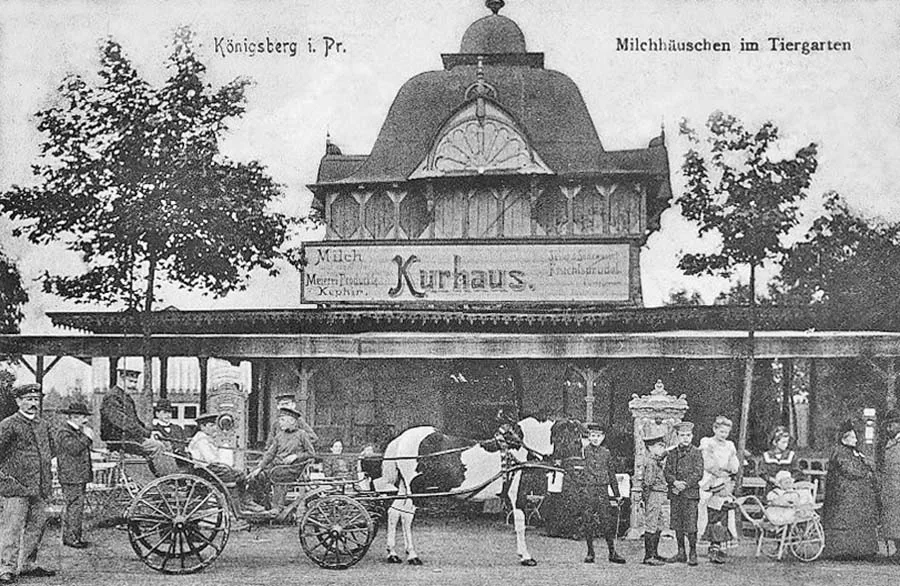 The milk house was built next to the mineral spring.
Together, the zoo and the Ethnographic Museum covered an area of just over twenty hectares: 3 ha for the museum and 17.6 ha for the zoo.
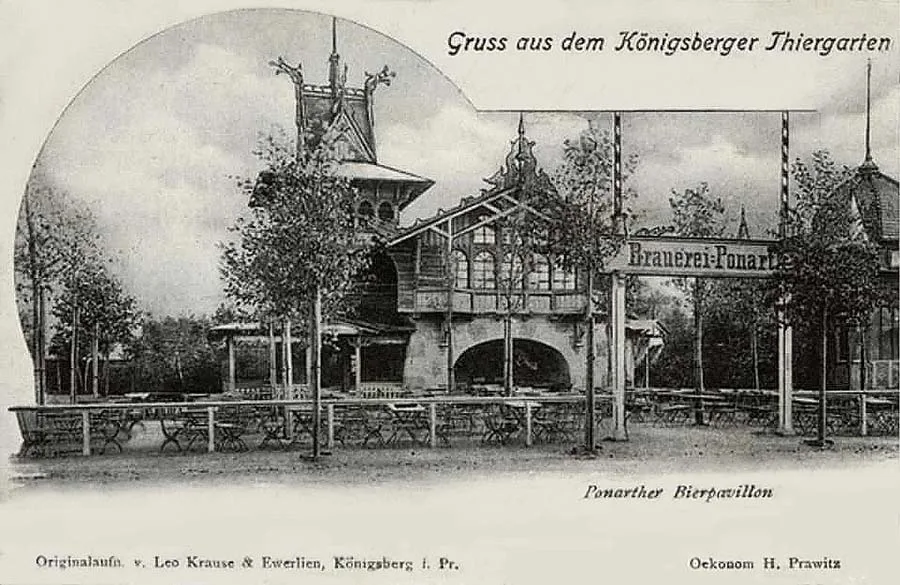 The pavilion of the Ponarth brewery.
On certain days the village came to life: the fisherman caught fish, the blacksmith struck his hammer, the mill turned, and the beer flowed freely... The museum's exhibits aroused great public interest and drew crowds of visitors right up until 1938, when, as part of the reorganisation of the zoo, they were gradually moved to Hexenberg (Hexenberg), north of the town of Hohenstein (German: Hohenstein, now Olsztynek, Poland).
By the end of its second decade, thanks to enterprising leadership and public support, the Königsberg Zoo had reached its heyday.
After Hermann Claaß stepped down, the post of zoo director passed, for the period from 1913 to 1930, to Max Emil Meißner (Max Emil Meißner), who had previously run the zoo in Posen (now Poznań, Poland). Very soon, on 17 August 1914, the zoo was forced to close for three and a half years owing to the outbreak of the First World War. Most of the staff were called up for military service, and the zoo's buildings were turned into uniform depots. It was a difficult time: there was nowhere to buy feed and no money to buy it with, and the number of animals had to be drastically reduced.
When the zoo reopened its gates to the townspeople on 1 July 1918, a record attendance was registered — the takings for a single day amounted to 70,159 marks. It was a triumph of public gratitude, yet many difficulties lay ahead as a result of the post-war crisis and inflation.
In 1919 the wooden concert hall burned down and, for lack of funding, it was never rebuilt.
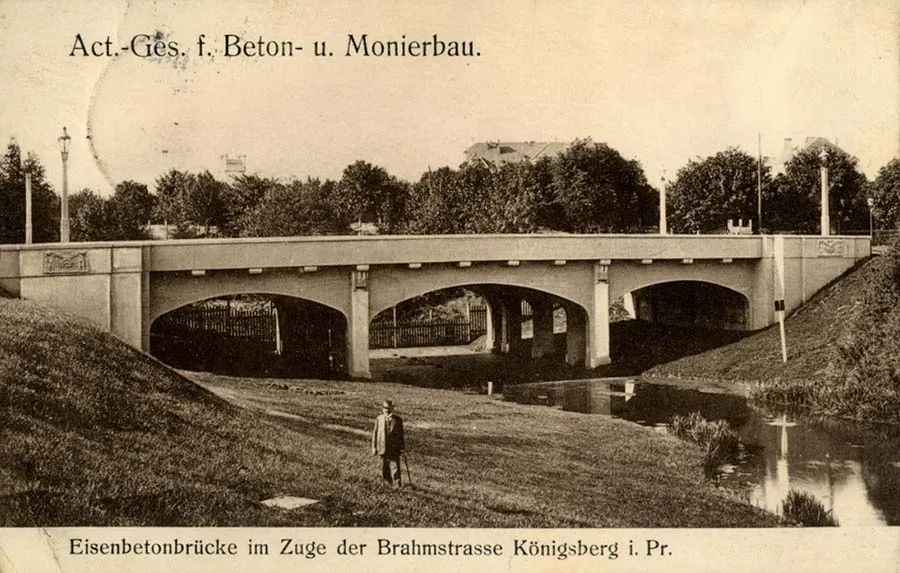 Bridge over the Parkovy Stream (Hufenfreigraben) on Brahms Street.
In that same difficult year, on 26 September, the first East German Fair (Ostmesse) opened at the zoo. It was a great success, and as a result Reich President Friedrich Ebert recognised the Tiergarten Society as an organisation serving the public good.
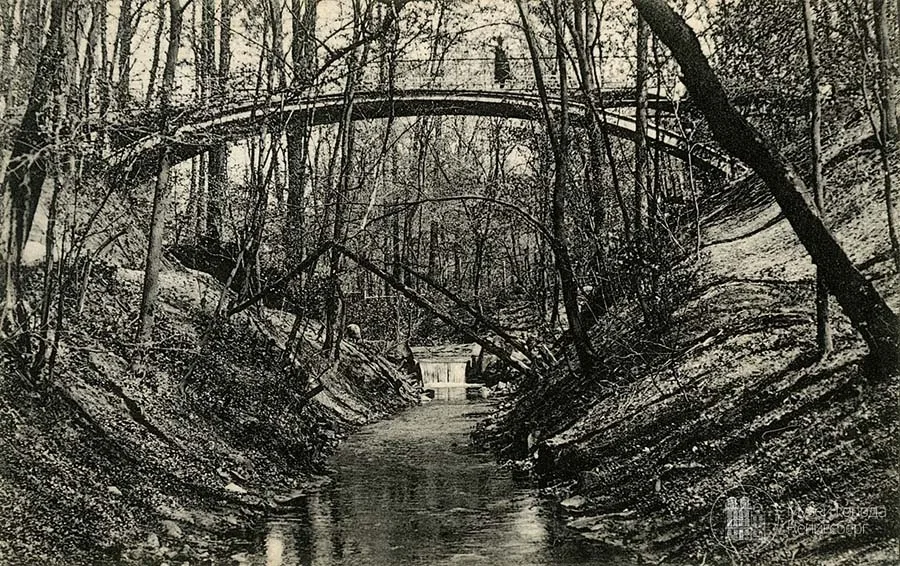 Footbridge over the Parkovy Stream on the Tiergarten grounds near the Hufenallee (Hufanallee, now Prospekt Mira).
The hardest period for the zoo came in 1920, when its stock had dwindled to a mere 380 animals. By the zoo's 25th anniversary, celebrated on 21 May 1921, the number had risen to 565. On the day of the jubilee, 40,000 people of Königsberg came to visit their zoo. By 1924 the number of animals had grown to 700.
The economic crisis left the zoo with debts of 150,000 marks, and the Society of Animal Lovers considered giving up its status as a public charitable organisation and placing the zoo under municipal administration. Nevertheless, thanks to the support of the townspeople, high attendance, the strictest economy on the part of the management and the energetic work of new board members, the Tiergarten Society managed to preserve its independence and reduce its debt.
The zoo's finances gradually began to stabilise.
From 1930 the post of zoo director was held by Dr Richard Müller (Richard Müller). Financial problems continued to trouble the management, which was forced to sell off the part of the zoo grounds adjoining the Hermannallee (now Tchaikovsky Street) and the Hufenallee (now Prospekt Mira) in order to spend the proceeds on improvements. Extensions were added to the main building housing the restaurant, a large reception hall was fitted out inside the building itself, and new enclosures for the animals were built as well.
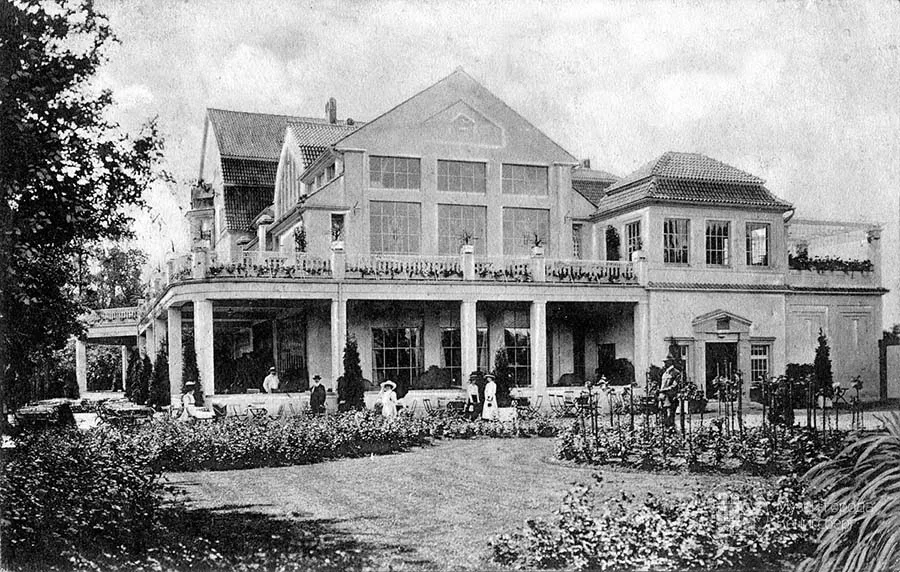 The Tiergarten Gesellschaftshaus, which now houses the zoo's administration.
In keeping with established city tradition, festivities and celebrations were held at the zoo.
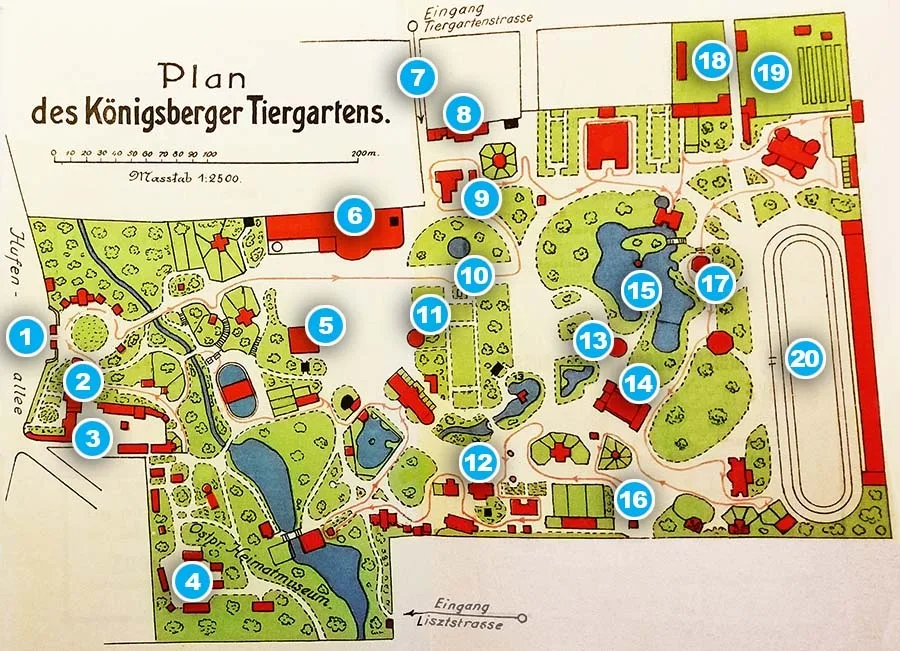 Plan of the Tiergarten (1930).
1. Main entrance; 2. Administration building; 3. Zoo photo studio; 4. East Prussian Ethnographic Museum; 5. Mineral water pavilion; 6. Gesellschaftshaus; 7. Tiergartenstraße entrance; 8. People's Restaurant; 9. Sperm whale skeleton; 10. Monument to Hermann Claaß; 11. Music pavilion ; 12. Ponarth Brewery pavilion; 13. Music pavilion; 14. Café Benter; 15. Illuminated musical fountains; 16. Milk stall; 17. Observation tower; 18. Service yard; 19. Plant nursery; 20. Tennis courts.
On 22 June 1930 the Singers' Association celebrated here the 700th anniversary of the death of Walther von der Vogelweide (Walter von der Vogelweide, 1170–1230), the medieval Meistersinger (folk singer). In the centre of the zoo, next to the fountain surrounded by flowerbeds, a monument of pink granite by the sculptor Georg Fuhg (Georg Fuhg) was erected.
In that same year of 1930 the sculptor Erich Schmidt-Kestner (Erich Schmidt-Kestner), who from 1926 to 1933 headed the school of crafts and sculpture on Königstraße (now Frunze Street), presented the zoo with a bronze sculpture of his own making, "Two Greyhounds at Play" (in the post-war years it long remained in "private" hands; it is now on display in the Kaliningrad city art gallery). Another sculpture, which was not a gift to the zoo but now [early 21st century] stands in front of the monkey house on a charmingly laid-out flowerbed, is a life-size figure of an orangutan in pink porphyry by the sculptor Arthur Steiner (Arthur Steiner).
He made the sculpture in 1930 and placed it in front of his house on the Krausallee. Many years later the orangutan found its home in the zoo.
A poster from the 1930s advertising the zoo as one of the city's sights announces: "The foremost attraction of the city and the province! Magnificent flowerbeds. Illuminated fountain. A rare wealth of animal species. Aquarium. Library. Reading room. Daily concerts by first-class bands under the finest conductors. Exhibition and concert halls. The very best restaurant! Confectionery. Horse riding. Tennis courts. The most delightful pastime for every visitor!"
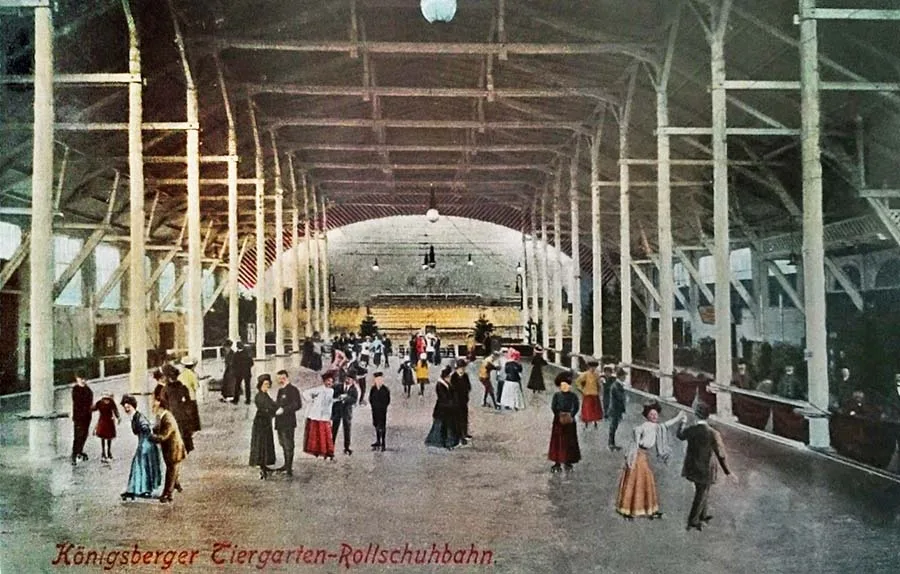 The roller skating rink added a touch of energy!
In 1933 the National Socialists, newly come to power, ordered the zoo management to renovate the old buildings without delay and to draw up a plan for new construction – without providing any financial assistance.
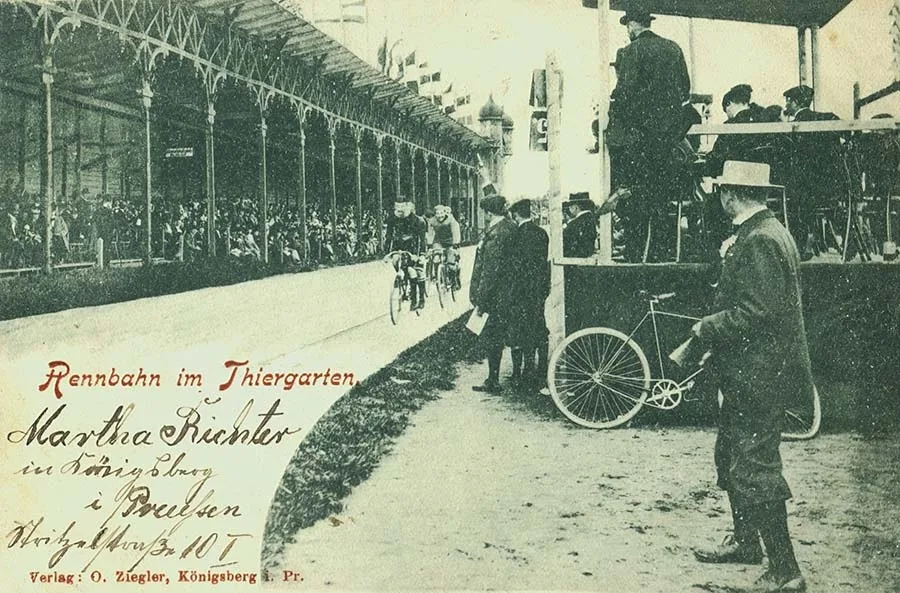 The cycling track in the Tiergarten appeared in the year the zoo opened (1896).
To keep the zoo going, wealthy citizens declared their willingness to place 50,000 marks a year at the board's disposal from 1931 onwards for ten years, right up to the zoo's 50th anniversary; in addition, a lottery was organised in the city for the benefit of the animals. Nevertheless, in the dark times of fascist rule in Germany, the Tiergarten corporation chose to dissolve itself, and the zoo passed into the hands of the municipal authorities.
The patrons' support enabled the management to begin restoring the dilapidated buildings. On the site of the old aviary an octagonal aquarium for tropical fish was built, along with quarters for antelopes, elks, deer, mouflons, sea lions and polar bears, a children's area with young animals, a monkey house, and a sunken stone enclosure for exercising and displaying animals next to the main entrance on the Hufenallee (Prospekt Mira); on the eastern side of the garden an elaborately constructed bear enclosure, the so-called "Bear Castle", was laid out.
The old cycle track in the northern part of the park gave way to eight tennis courts. At the same time the Tiergarten Tennis Club was founded.
These innovations drew still more visitors. In the memories of those who were children in the pre-war years, the zoo remains the most vivid impression of their childhood: there was so much to see and so much good to eat. True, the buns, the cocoa made with real milk, the condensed milk and other treats were far from cheap and often beyond reach, but one could always have a glass of delicious soda water and, above all, look at the familiar and dearly loved animals (the children were especially fond of Jenny the elephant, the tiger and the ever-amusing animal babies).
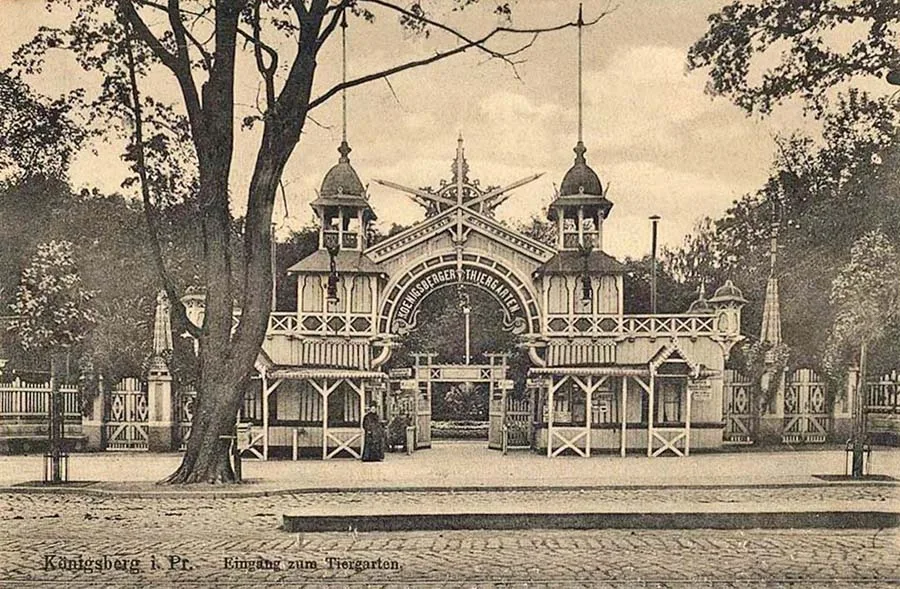 The main entrance (1910–1933) on the Hufenallee (Prospekt Mira).
For the children of Königsberg, a ticket to the zoo was a reward for good marks at school, a Christmas present, a birthday surprise.
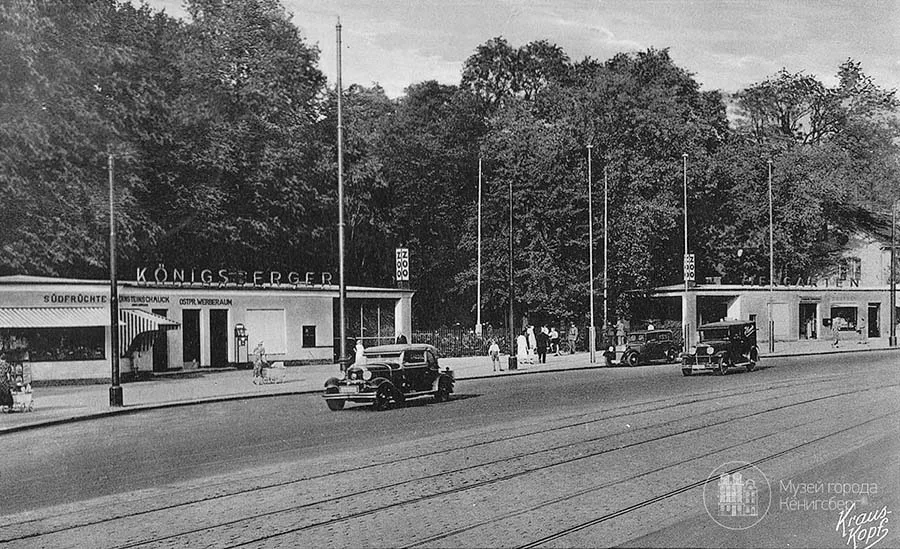 The main entrance, built in 1934 to a design by Siegfried Saßnick.
In 1933–1934, the zoo's entrance on Hufen-Allee (Prospekt Mira), in place since 1910, was replaced. Once a very beautiful, bright wooden gateway in the pseudo-Chinese style, adorned with elegant turrets, it had fallen into disrepair. Its successor was a stone portal designed by the well-known city architect Siegfried Saßnick (1903–1971), and a new fence was put up around the zoo at the same time. This is in fact the very entrance from Prospekt Mira that we use today: modest and functional.
The portal, an architecturally designed entrance, formed part of a unified landscape and architectural ensemble that also took in other spaces of the zoo, the landscaped sports grounds of Walter-Simon-Platz and the square in front of them with its bronze monument to General Yorck. The left wing of the portal housed zoo ticket offices and shops selling amber jewellery and tropical fruit. The right wing also held ticket offices, along with a pet shop where one could buy fish, cats, rabbits and other animals, as well as books about them. Between the two wings of the portal, a graceful maidenhair tree (Ginkgo biloba, endemic to China) and a mighty, frost-hardy bur oak (Quercus makrocarpa, endemic to North America) were preserved, and they still grace the entrance to the Kaliningrad Zoo today. The animal figures that greet visitors from the top of the stone portal were installed after the war.
Description of the Park and Arboretum
According to specialists, the zoological garden's landscape design follows predominantly the style of Chinese parks, which is to say natural parks. Chinese gardens were distinguished by the beauty of nature, enhanced by the human hand, with an endless variety of shifting views opening up from their numerous paths. This aim was achieved, with a German accent, in the Königsberg Zoo. There were pavilions in the Chinese style, and water features, the indispensable attributes of a Chinese garden, occupy a considerable part of the grounds. Park sculpture is sparse; far more often, hillocks, lawns and the banks of ponds are set with large natural boulders, an echo of the Japanese “rock garden”. Many of the enclosures took the form of little houses with intricate multi-tiered roofs, and the small bridges and gazebos, in harmony with the landscape, also lend oriental notes.
However, the central ceremonial part of the zoo grounds was laid out, as is customary in park design, entirely in the Baroque style. It was filled with geometric carpet flowerbeds, while the children's playground in the north-west of the grounds was decorated with a “labyrinth”, a section of intricately tangled garden paths edged with clipped greenery. This device of Baroque garden and landscape art later became widespread in European park design, has successfully passed down through the centuries and has lost none of its relevance today.
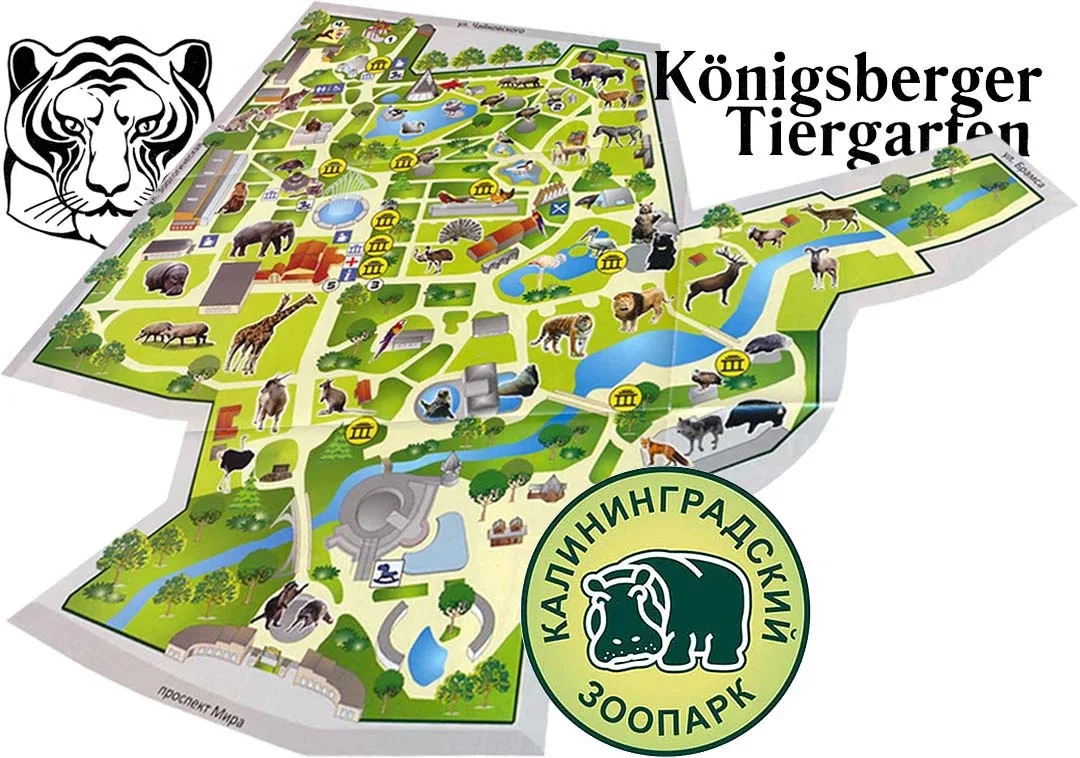
A 1936 plan of the Königsberg Tiergarten marks not only the animal houses but also the cafés, snack bars and other establishments, as well as monuments, flowerbeds, walking paths, courts, toilets and so on. Down to the smallest detail, it demonstrates the wide range of attractions the zoo offered as a pleasure garden. Every visitor could buy this plan at the ticket office.
The park had two main entrances: the southern one from Hufen-Allee (Prospekt Mira) and the northern one from Hermann-Allee (Tchaikovsky Street). There were also three exits in the eastern and north-eastern parts and two in the western part. The animal exhibits occupied only 20% of the zoological garden and ran along its periphery. The central part was a recreation area with a semi-open spatial structure, created by avenues and free-standing trees that drew the eye with an unusual crown, bright foliage or an extraordinary shape. At the centre of the zoo, carpet “parterre” flowerbeds spread out across a bright open space, while individual trees, mostly chestnuts, cast lacy shade. They were planted fancifully in complex and therefore mysterious patterns. Enclosed, shady spaces were found only in the stream's hollow and around the large ornamental pond with a fountain in the northern part of the garden.
The southern part of the park held the administrative building (just inside the fence, to the right of the Hufen-Allee entrance), a deep open stone-lined enclosure for exercising and displaying animals, and quarters for the mouflon and small wild cats. On both banks of the Freigraben stood the buildings of the open-air museum of Old Prussian architecture. Here too, across the stream on a high hill, stood the wooden “Reading Room” with its carved railings, which offered a wonderful view of the deep ravine, the old woodland park on its banks, the elk paddock and the “duck pond”. In this part of the park a bridge linked the main entrance with the rest of the garden, and 20–25 m below it the swift, turbulent stream roared. The Hufen ravine was preserved in its natural state as a natural feature of great scenic appeal, its beech and hornbeam woodland forming a continuous shady canopy along the banks of the stream.
Today [early 21st century] there are far fewer trees, chiefly because the beeches have died out, and the structure has changed from enclosed to semi-open, formed mainly by hornbeams and self-seeded maples. Animal exhibits now line both sides of the stream. This is also where the children's town built in the 1970s–80s stands, and here part of the bank has collapsed. The green area at the entrance includes the surviving trees, the maidenhair tree and the bur oak, as well as a group of conifers: savin juniper, eastern arborvitae, Sawara cypress, the columnar form of common juniper, and the blue form of Colorado spruce. In the Königsberg zoo, this stretch of the path leading from the entrance into the park was lined with Serbian spruce, the garland form of Norway spruce, glaucous Colorado spruce, white spruce and white fir.
North of the stream with its five little bridges, the central part of the park housed penguins, a sea lion, a polar bear, antelopes, deer and a winter enclosure for flightless birds. It also contained a number of buildings: the Gesellschaftshaus with its restaurant, an exhibition pavilion, a music pavilion and a concert stage, along with the monuments to Hermann Claaß and Walter von der Vogelweide and large flowerbeds. There is an interesting story connected with the deer paddocks and the avenue of ash trees that bordered them to the north. After part of the zoo's land was sold off, the paddocks ended up almost on its western boundary. On the other side of the fence, on former parkland, the Hufen Gymnasium was built in 1915. The ash trees outlined the road to a firing position and hid it beneath their crowns. Until the 1920s, a small part of the zoo by the southern entrance belonged to the military authorities, because Hufen-Allee (Prospekt Mira) was a strategic road. A lunette has survived in the zoo: an earthwork lying outside the First Defensive Rampart, which ran not far from the zoological garden, roughly where Gvardeysky Prospekt runs today.
On the west, the central section was bounded by a double avenue of English oak, lined on both sides by narrow flower borders*; an identical avenue marked the entrance to the zoo from Tiergartenstraße (Zoologicheskaya Street). The concert ground and exhibition pavilion were surrounded by clumps** of chestnuts, lime trees and oaks planted in intricate geometric figures that reminded some of Masonic symbols. North of the large carpet beds (one large semicircular bed and eight smaller rectangular ones) lay a large pond with the illuminated, high-spouting "Geyser" fountain and creeping roses on its green grassy banks, and a tall Moorish-style observation tower with a square platform, a balustrade and four corner turrets. In the tower's basement there was a freshwater aquarium where, once a year in spring, the East Prussian Fishermen's Association presented young commercial fish to the public (now [early 21st century] this spot is occupied by a waterfowl house with a pointed tin roof). It was here that the greatest number of exotic plants were planted: hiba arborvitae, variegated box elder, Veitch's fir (also known as Veitch fir, Lat. Abies veitchii), Nordmann fir, Weymouth pine, shingle oak and pin oak, Pseudotsuga, or Douglas fir, weeping silver birch, black pine, Rosenthal's arborvitae, cucumber magnolia, Turkish hazel, Lawson cypress and its thread-leaved form, Japanese larch, Serbian spruce, Sitka spruce and white spruce; two English oaks were planted next to the parrot and snake pavilion. This part of the park has now been lost "owing to the expansion of the exhibits": ostriches and domestic fowl are now kept here in place of all the trees listed above. The avenue of century-old oaks has survived only in part, the patterns of chestnuts and limes are gone, the semicircular flower bed has been turned into a round fountain, and the post-war plantings (mock orange, rhododendrons, Swedish whitebeam, staghorn sumac, junipers) "lack a unified compositional design", that is, they are random. Of the pre-war exotics, the hiba arborvitae, white fir and box elder have survived.
Further on, in the northern part of the park, were kangaroos, emus, seals, small birds, monkeys and predators; here, too, was the "pheasant meadow", and a confectioner's stood in the shade of chestnut trees. At the very northern boundary of the zoo, the one that now faces Chaykovskogo Street, were the tennis courts and the tennis clubhouse. In the early 20th century they were bordered along their long (southern) side by a pony-riding track lined with lime trees, on the west by oaks, and on the east by chestnuts, oaks and hornbeams planted on the earth bank of the courts' eastern stand, which provided dense shade over its amphitheatre. Among the trees, two specimens of an exotic form of English oak, Cuculata, with spoon-shaped leaves, and a Wilson's poplar stood out. The plantings on the eastern stand have not survived; bison enclosures now occupy the spot. And the tennis court grounds no longer even belong to the zoo. Not far from the courts grew a weeping European beech, black locust, cut-leaved black elder, Swiss stone pine, mountain pine, a northern white cedar with peculiar "twisted" shoots, a purple multicoloured thuja, Austrian (black) pine, Oriental spruce, a tulip tree (!), a white-variegated variety of box elder, and Wieri maple.
One could leave the park through the northern exit onto Hermannallee (Chaykovskogo Street) along a path bordered by a clipped hornbeam hedge. Here, in the north-western part of the zoo, lay part of the utility zone, which still serves the same purpose today: the garden nursery and the vegetable garden, enclosed by a clipped green wall of hornbeam; the exit was lined with ash trees (they have survived and are now more than 100 years old); there were also kennels, a pony stable and a wind turbine supplying electricity. At present [early 21st century], the zoo's utility zone has been extended to take in the area up to the intersection of Zoologicheskaya and Chaykovskogo streets, which houses the veterinary service, the boiler house, the kitchen, the stable and the garages.
Along the western boundary of the park stretched the entertainment zone: the Gesellschaftshaus with its restaurant (in the south-west), the open-air People's Restaurant (north of the Tiergartenstraße entrance) with a sperm whale skeleton displayed opposite it; a little further north were the children's playground and the enclosure for young animals, surrounded by plantings of maple and ash. Between these two areas lay an intricate maze of clipped box in a thoroughly Baroque style, inside which a "house of laughter" with distorting mirrors had been set up. Beyond were the aviary for birds of prey, the cages of predators, the tiger house sheltered in the shade of lime trees and Far Eastern trees (Manchurian and Japanese birches have survived), the otter and fur seal ponds beneath a dense canopy of limes, maples and ashes, among which an old solitary weeping European beech stands out, the aquarium and terrarium housed in a single building with an open pool for an alligator, framed by clumps of oak, and the elephant house.
The entertainment function of this area, as indeed of the entire zoo, has now been lost: there are no restaurants, playgrounds or "house of laughter" any more. Part of Tiergartenstraße (Zoologicheskaya Street) has been incorporated into the zoo: it now accommodates a hippopotamus house with a pool and enclosures for the elephant and the giraffe. Part of the ruined Gesellschaftshaus was given over to the elephant house. In place of the People's Restaurant building stands the administration building of the Kaliningrad Zoo, with the monkey house and the winter garden next to it. The small ponds and the circus ground have been lost. The trees are mostly new plantings, and part of the open space is used for further greening: rows of thuja and English oak along the paths, extensive flower beds opposite the monkey house, and groups of conifers planted on the site of the former circus ground.
The eastern part of the park housed the main animal exhibits: the "Bear Castle", the monkey house, enclosures for bison, hippopotamus, wolves and jackals, camels and llamas, kangaroos, zebras and antelopes, the "crane meadow", the "duck cove", parrots and snakes, beavers, raccoons, and the elk paddock on the bank of the stream. Even here, however, there was a pavilion of the Ponart brewery with numerous long tables and benches, where one could drink beer in the open air. Then again, nearby, south of this pavilion on high ground, stood the reading room, and to the north the music pavilion and the confectioner's, surrounded by chestnut trees, next to which grew a magnificent beech (it has survived and is now at least 180 years old). Along its periphery this part of the grounds was planted with the groups of trees already mentioned that surrounded the "duck pond": weeping European beech, black locust, mountain, Swiss stone and black pine, spoon-leaved English oak, tulip tree, Oriental spruce; to the north it was bounded by a one-sided lime avenue, while the rest of the open space, with its ponds, enclosures and so on, was adorned by solitary trees: horse chestnut, weeping common ash, Norway maple, Douglas fir, Young's weeping birch. On the east, the boundary of the park was emphasised by a hedge of northern white cedar (it has not survived).
The historical plantings of the eastern part of the park have largely survived, but in its central, once open section Norway spruce, small-leaved lime, English oak and red oak have been planted, and there is also a great deal of self-seeded maple and black alder, the latter a sign of waterlogging and excessive soil moisture.
The zoo's artificial ponds deserve special attention. Before the war they curved in an arc around its central section and formed a single system, fed by an artesian well on the park grounds and draining into the Freigraben stream.
The largest, purely ornamental pond, with the illuminated "Geyser" fountain, had a very indented, complex shoreline, an artificial headland in the west and an artificial island with a footbridge in the east. A dense wall of trees, predominantly conifers, surrounded the pond (black, mountain and Swiss stone pine, Veitch's fir, northern white cedar, Oriental spruce). Their dark needles were set off by English oak, small-leaved lime, common ash, European beech and Wieri silver maple. On the bank, on an artificial mound, stood that same Moorish-style observation tower with the freshwater aquarium in its basement. West of this pond were small special display pools for otters and the fur seal. A second, smaller ornamental pond graced the area in front of the Liedtke confectioner's. Its banks, laid out as a green lawn, were covered with creeping roses, above which rose solitary trees with mighty crowns — an English oak and a horse chestnut (both have survived).
Further south lay three display ponds: one for herons, with a small island of shell rock adorned with a Chinese pavilion (the islet survives) and surrounded by ash trees and conifers; the shallow “Crane Meadow” pond, edged with green lawn and accented by a larch and a Norway maple; the “Duck Bay” pond, with a raccoon house on its bank and a planting of Canadian hemlock, pin oak, weeping silver birch, Veitch’s fir, white fir, Douglas fir and Nordmann fir; and a beaver pond surrounded by solitary specimens of ash and Nordmann fir. These ponds have since been merged and are used to display birds.
The system of ponds ended in large pools for polar bears, penguins and the sea lion, separated by “ice cliffs” made of cement stone. Nearby grew a sycamore maple, a silver maple and a Norway spruce.
This pool has survived entirely in its historical form, but this part of the park has lost the illuminated fountain, the music pavilion, the observation tower, the decorative function of the large pond and a number of trees. On the site of the observation tower, a concrete-and-glass pool for marine animals has been built. Some of the old trees have survived: century-old lindens, a horse chestnut, ash trees, a Veitch’s fir, a Wier’s silver maple, a purple-leaved European beech, a European beech that grew near the music pavilion, and a pedunculate oak. Among these trees are numerous self-seeded Norway maples and poplars.
From 1938 to 1945 the director of the zoo was Dr. Hans Georg Thienemann, a well-known zoologist and the son of Johannes Thienemann (1863–1938), professor of ornithology, founder of the ornithological station at Rossitten (now Rybachy) on the Curonian Spit and author of a book on the birds of the world that was widely known at the time.
British bombing raids in 1944 forced the director to send the most valuable animals to what he considered safe places — estates in the vicinity of Königsberg. For example, several valuable animals, including two Przewalski’s horses, were taken to the Heyde-Waldburg estate (now Pribrezhny), which belonged to the family of the Counts zu Dohna. But these wartime efforts of the scientist and administrator proved futile: in the end, all the animals perished.
After the war, H. G. Thienemann and some of his colleagues continued their work at the zoo in Duisburg (Germany), which had opened in 1934 and whose collection numbered more than 2,000 species (there, too, as in Königsberg, only a few animals survived the war — a donkey, an ostrich, flamingos and sheep). In Duisburg, following the traditions of the Königsberg zoo, Thienemann organized attractions, trained-animal shows, an animal theatre, falconry displays and more. Within a few years the zoo was receiving 411,000 visitors, and in 1965 it welcomed a million: that was the year Dr. Thienemann died.
During the storming of Königsberg in April 1945, fighting raged directly on the zoo grounds. In issue No. 14 of the newspaper “Vestnik” for 1994, the local historian A. Gubin quotes a story from Yu. Borev’s book “Staliniana”: “Military commanders were summoned to Stalin to work out the operation to take Königsberg. He asked them: ‘And how are you planning to take the zoo?’ No one could answer, since no one had given it any thought or understood what he meant. Stalin explained: ‘There is a unique hippopotamus in the Königsberg zoo. It is of great value. You must try to take it alive.’ The plan of the operation had to be revised to take the hippo’s interests into account. During the battle, paratroopers were dropped onto the zoo. The surviving paratroopers took the hippo prisoner alive.”
The hippo was found on the outskirts of the city, in a pond, badly frightened and with nine wounds. In a memorandum to the commander of the Baltic Military District, the city commandant, Major General M. A. Pronin, reported that the city’s military commandant’s office had taken under its protection several animals remaining on the grounds of the former German zoo. The hippo was entrusted to the care of the military feldsher V. P. Polonsky, and his treatment was mentioned many times in newspaper articles about the zoo. In February 2000, however, the journalist S. Volkov quoted the feldsher’s notes in their original form in “Nezavisimaya Gazeta” (the documents are preserved in the State Archive of the Kaliningrad Region), and their tone is deeply touching: “Hippopotamus. 18 years old. Size large. Name ‘Hans’. Was wounded 7 times. And 2 times self-wounding. 13 days was without food and water. History of treatment of the Hippopotamus (in brief). Took on treatment of the Hippopotamus from 14 April t.y. (this year). First gave help with water. After that tried to give him milk. Next time ground beetroot. The Hippopotamus started eating. But after 3 days refused. I hurried to give the Hippopotamus vodka. Gave 4 litres. After which the Hippopotamus started asking hard for food. First I gave him an enema (4 buckets of distilled water). After which started feeding him. The Hippopotamus tried to go out, but as he was drunk – he dropped himself. Side wound (25x27 cm). Depth 4 cm. Other wound (6x7 cm). The Hippopotamus started eating, but does not relieve himself. I gave another enema (4 buckets of distilled water). The Hippopotamus started relieving himself. 2 weeks passed. The Hippopotamus eats poorly. I decided to give vodka, 4 litres. The Hippopotamus started eating, well. But again constipation came out. I gave one more enema (4 buckets of distilled water). The Hippopotamus relieves himself, but eats poorly. I decided to give vodka (4 l). And the Hippopotamus started eating excellently. There were days without appetite. I got rid of them by changing the food.” “Results of treatment. Managed to save the hippopotamus. Not leaving him for 21 days. After 1 mo. and 19 days. I achieved full health and am now training the hippopotamus — riding on the hippopotamus around the park etc.”
On 24 July 1945 Vladimir Petrovich Polonsky wrote to the director of the Moscow Zoo about the need to send the hippo and other animals to Moscow, “since the animals are not suited to the conditions here, namely to wintering.” Whether Moscow ever replied is unknown. Hans the hippo died in 1950.
On 27 June 1947 the Council of Ministers of the RSFSR adopted Resolution No. 461, “On Measures to Restore the Economy of the City of Kaliningrad and the Kaliningrad Region,” which also provided for the re-establishment of a zoo in the city on the basis of the German zoological garden.
In 1947 the zoo opened to its first visitors, who could see some of the surviving animals of the German zoo (a badger, a roe deer, a donkey and the hippo), as well as animals caught in the local forests. The ruined buildings were cleared away, bomb craters filled in and the ponds cleaned. Until 1947 the zoo, together with the former Luisenwahl park, formed part of the Park of Culture and Recreation, which united these two large green areas of Kaliningrad. On 26 February 1949 the zoo became an independent municipal institution, directly subordinate to the department of cultural and educational institutions of the city executive committee. From 1 March 1953, by decision No. 277 of the city executive committee, the zoo was placed under the committee’s culture department. By decision No. 712 of the regional executive committee, the zoo was transferred to the culture administration of the regional executive committee as of 1 January 1962. The first director of the Kaliningrad Zoo was A. D. Zulumatov; the post was subsequently held by V. M. Shteyn, P. D. Minakov, L. A. Vershinin, N. S. Chumarova and L. A. Voronina. [Since 2011 the zoo has been headed by Svetlana Sokolova.]
In 1984 the zoo’s collection was quite impressive — 387 species and 2,043 individual animals; a fairy-tale town for children was opened, paths were laid out, and flower beds and lawns were planted.
In 2003 the zoo covered an area of 16.7 ha, with two hundred enclosures and other facilities, one toilet and several small kiosks selling drinks, sweets and the like. The grounds suffered from excessive soil waterlogging, which was undermining the foundations of buildings and rotting the roots of plants. The Parkovy Stream carried polluted water through the zoo, hardly in keeping with the recreational role of a cultural institution with an educational mission. The banks of the stream were strewn with litter and put to improper use…
The zoo's arboretum deserves no less attention than its bestiarium (collection of animals); it gives the grounds a special aura. In 1922, during a tour of the zoo by members of the German Dendrological Society, its head gardener Schäfer (Schäfer), who was also a member of the society, named fifty-four species of trees and shrubs worthy of the attention of interested specialists, among them ginkgo (maidenhair tree); bur oak, red oak, pin oak and the spoon-leaved form of pedunculate oak; Lawson cypress and its thread-leaved form; the silver-variegated box elder, the common box elder and the white-variegated box elder; Schwedler's Norway maple; sweet chestnut; horse chestnut; Douglas fir and its glaucous form; blue Colorado spruce, serpentine Colorado spruce and columnar Colorado spruce; Serbian, white, oriental and Sitka spruce; Nordmann (Caucasian) fir; Veitch's fir, white fir and subalpine fir; weeping European beech; black locust (false acacia); Japanese barberry; cut-leaved black elder; Swiss stone pine, mountain pine, Weymouth pine and black (Austrian) pine; liriodendron (tulip tree); Rosenthal's thuja and northern white cedar (twisted form); Japanese thujopsis, or hiba; eastern hemlock; cucumber-tree magnolia; paper birch and weeping silver birch; Turkish hazel (tree hazel); Japanese larch, and others.
Among the plants of the Kaliningrad Zoo listed in the flora inventory for 2000 are a number of particularly valuable ones: ginkgo, Amur cork tree, the umbrella-shaped form of horse chestnut, purple-leaved sycamore, Schwedler's Norway maple (with reddish leaves), the weeping and purple-leaved forms of European beech, red oak, the pyramidal form of pedunculate oak, Caucasian oak, the weeping form of common ash, black locust, Crimean and silver lime, cut-leaved silver maple, white-variegated box elder, white fir, metasequoia, Young's birch, Kobus magnolia, Japanese barberry, hiba, Sawara cypress, the thread-leaved form of Lawson cypress, Nootka cypress, Wilson's poplar and Turkish hazel. More ordinary plants, commonly found in modern gardens and squares, are represented by Swedish whitebeam, Nanking cherry, cotoneasters, Japanese quince, weeping willow, rhododendrons, azaleas, blue spruces and the like — in post-war plantings and those of recent decades.
The zoo's arboretum has undoubtedly undergone considerable changes: many of the tree species planted before the war are gone (some perished during the fighting on the zoo grounds, others simply grew old, still others suffer from waterlogging or cannot withstand the pressure of visitors), but new species of trees and shrubs are being planted. In today's [early 21st century] zoo the flowerbeds, rockeries and small but highly decorative green corners beside the animal enclosures are very beautiful; the winter garden in the glass conservatory is impressive, and the young pyramidal oaks, a small ginkgo sapling and the little trees planted by delegations from the Baltic countries are a delight to the eye. And yet, according to data provided by the zoo staff, in 1985 there were 150 species of trees and shrubs, in 1996 — 110 species, and the 2000 list contains only 64 species, among which three age groups of trees can be distinguished: hundred-year-old, fifty-year-old and twenty-year-old.
The zoo remains green thanks to the efforts of dendrologists, but Nordmann fir and subalpine fir, the tulip tree, sweet chestnut, Douglas fir, eastern hemlock and a number of species of spruce, pine, thuja and other trees no longer grow there, and they would evidently not be easy to grow again. Perhaps the rapid passage of time is to blame — yet a hundred years is far from the limit of such trees' lifespan… In all the city's parks the range of plant species is becoming poorer. Perhaps the fashion for exotic plants is passing? Perhaps, as usual, there isn't enough money…? Perhaps it is a different sense of time — fewer exotics, more fast-growing plants, undemanding as to climate and soil, and instantly impressive?
In 2003 the zoo turned 112 years old. Its water supply and drainage system, the aviary, the lion house, the eagle enclosure, the stone exercise enclosure, the pool for marine animals with its "ice cliffs", the "Swan Pond", the flights of steps, the bridges and the main entrance have all survived and been in use since the early 20th century. The zoo is falling into disrepair, the range of tree species is becoming commonplace, the architectural monument "Gesellschaftshaus" threatens to collapse, the animal collection is maintained with great difficulty, and the Parkovy Stream, which already collects runoff from the entire city, turns into a cesspool as it passes through the zoo.
Nevertheless, the zoo is still a source of pride for the people of Kaliningrad: they come here as families and bring their guests to see the animals that live here. The "park" in the Russian word zoopark seems to have lost its meaning. But the pleasure of watching the animals would not be so complete without the many-named, many-coloured, lovely greenery of the old and new trees, their silent and proud beauty, which deserves attention, care and, ultimately, investment.
The multifunctional zoo grounds of the early century, where animal exhibits occupied only 20% of the park area, formed a natural landscape complex with an almost natural woodland and a picturesque stream, only slightly "embellished" with little bridges, ponds, pavilions and exotic plants and thereby transformed into a landscape park. The animals were kept in conditions close to their natural habitats, in artificial mini-landscapes with a judiciously chosen spatial structure of plantings, while visitors could look forward to many amusements and "quiet recreation". In the zoo's present-day landscape organisation this principle of a sensible arrangement of zones has largely been lost. The neglected state of the grounds rules out any sense of rest or of "admiring nature". “Tiergarten” meant a zoological garden… The garden and the animals are symbols of paradise…
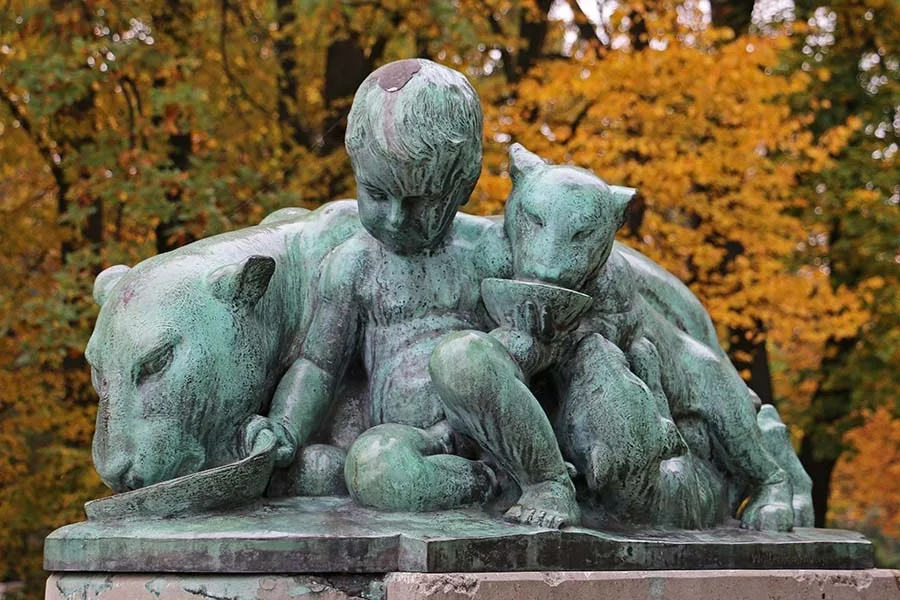 Monument to Hermann Claaß by Walter Rosenberg (1913).
…Nature is something we have borrowed from our descendants. A sensible debtor understands that there will be no second loan. Far from every Russian regional capital has a collection of animals, let alone a zoological garden with a historic 19th-century arboretum.
Photographs: Königsberg City Museum, Mikhail Ogorodnikov, East Prussia Photo Archive.
__________________
* Rabatka (border bed) — a rectangular flowerbed in the form of a narrow strip along a garden path, fence or wall, planted with one or several plant species. A rabatka usually has parallel sides. It is one of the elements of landscape architecture. Depending on whether they have an edging, rabatkas are divided into one-sided and two-sided.
** Kurtina (clump) — in forestry, a group of trees or shrubs of a single species within a mixed forest.
Translated from Russian with the help of AI (Claude, Anthropic), October 2026.