A third catastrophe could have occurred in 1700, after the rout of the Russian army at Narva at the very beginning of the Great Northern War. After it, Charles XII intended to march deep into Russia, on Novgorod and Pskov, and then on Moscow. This was, without doubt, another turning point in our history. Had Charles carried out his plan, he might well have succeeded, knocked Russia out of the war, cut off its territory in the north-west and replaced the tsar on its throne. The last of these would have been the most important. What Russia would have become without Peter I is impossible even to guess today.
Fortunately, Charles's plan, perfectly correct from the Swedish point of view, stemmed not from strategic design but, on the contrary, from youthful hot-headedness. So his old, wise generals talked their king out of the march on Moscow. They were convinced that, militarily, Russia no longer posed any danger; besides, it was poor and sparsely populated, the distances there were enormous and there were no roads. It was far more convenient and pleasant to smash Poland, which is what the Swedes set about doing, thereby signing their own death warrant. Only 9 years later they got Poltava, after which Russia passed in a single day into a new geopolitical quality, gaining entirely new opportunities as a result. In the middle of that same 18th century it most regrettably failed to realise these very opportunities in the course of one of the many forgotten wars — the Seven Years' War (1756–1763).
This war could quite justly be called a world war, since it engulfed not only the whole of Europe but was also fought in America (from Quebec to Cuba) and Asia (from India to the Philippines). On one side was a coalition of Prussia, Britain and Portugal, on the other France, Austria, Spain and Sweden. In addition, each coalition included several states that no longer exist. The general course of this war is best described by the well-known Russian phrase "You can't make sense of it without half a litre of vodka". Accordingly, there is no point in doing so; this is only about Russia.
Practically from the very beginning of the war Russia, then ruled by Elizabeth Petrovna, sided with France and Austria. And this made the position of Prussia and its allied German states, to put it mildly, very difficult.
After all, Britain had no intention of fighting on the Continent; for it the aim of the war was to take overseas colonies away from France and Spain. The Germans, meanwhile, found themselves completely encircled by three very powerful states whose combined forces were almost three times greater than theirs. The only advantage of the Prussian king Frederick II (the Great) was the ability to operate on interior lines, rapidly shifting troops from one direction to another. In addition, Frederick possessed talent as a military commander and a reputation for invincibility.
True, at the beginning of the Seven Years' War the Prussians lost a couple of battles to the Austrians, but they won far more victories. Moreover, they inflicted a crushing defeat on the French army, formally much stronger, after which their position ceased to seem hopeless.
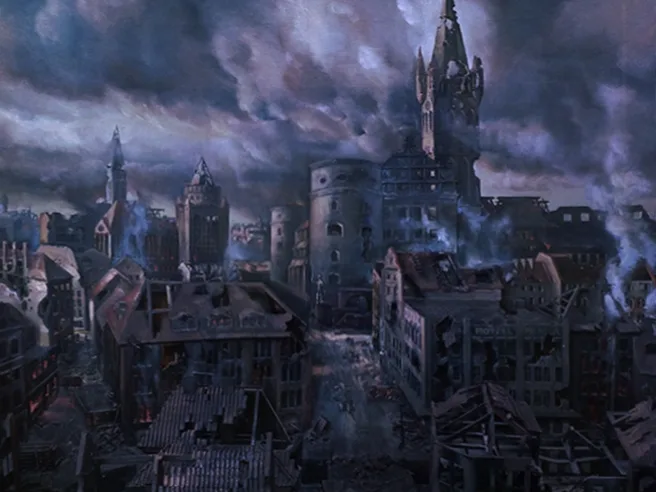
But then, as the English military historian and analyst Liddell Hart wrote, "the Russian 'steamroller' at last got up steam and rolled forward". In the summer of 1757 Russian troops under the command of Field Marshal Apraksin invaded East Prussia. In August the first serious battle between the Russian and Prussian armies took place near the now vanished village of Gross-Jägersdorf, on the territory of today's Kaliningrad region.
By that time almost everyone had forgotten about the Russians' victories over the Swedes; the Russian army was not taken seriously in Europe. And the Russians did not take themselves seriously either.
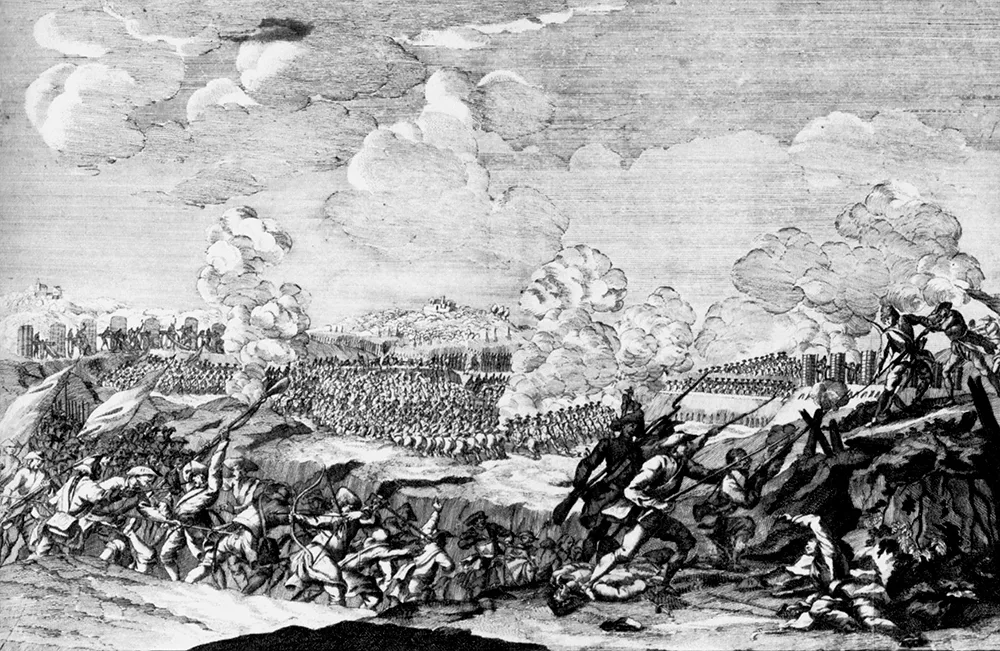
That is, the situation of the Great Northern War before the Battle of Poltava was repeating itself exactly. That is why the German corps of Field Marshal Lehwaldt, 28,000 strong, boldly attacked Apraksin's army, which was twice as large. And at first the attack had a chance of success, since the Russians had only just crossed the river Pregel and were struggling through wooded, marshy terrain in complete disorder. In such a situation numerical superiority lost all significance. However, the day was saved by the exceptional steadfastness of the Russian infantry, the excellent work of the Russian artillery and, finally, the sudden blow of Major General Rumyantsev's brigade against the enemy's flank and rear. The Prussians could not withstand it and began to retreat, and soon the retreat turned into flight. In this battle the Prussian army lost 1,818 men killed and 603 taken prisoner, and another 303 deserted. The Russians lost 1,487 men killed.
All the more surprising was Apraksin's subsequent conduct: he not only failed to exploit his success but began to retreat and left the territory of East Prussia. For this he was justly brought to trial, but died of a heart attack before the verdict.
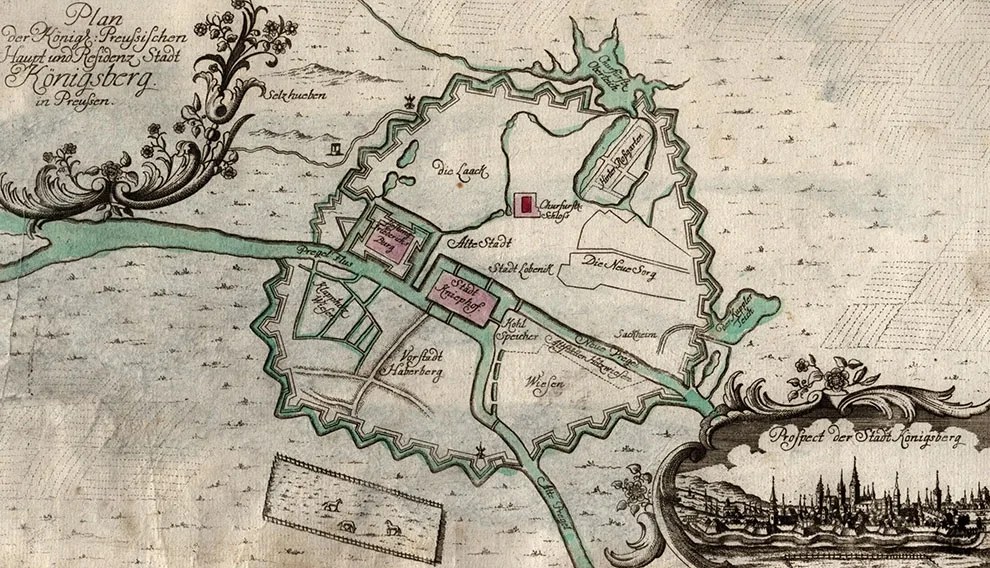
In 1758 the Russian army was headed by Field Marshal Fermor. He very quickly occupied the whole of East Prussia and had its population swear allegiance to the Russian Empress. Among those who took the oath was the great philosopher Immanuel Kant, who lived his whole life in Königsberg (Kaliningrad). After this the Russian troops marched on Berlin. The main battle of the 1758 campaign took place, as a year earlier, in August, near the village of Zorndorf (today in western Poland). The 42,000-strong Russian army faced 33,000 Prussians under the command of Frederick the Great himself. They managed to get into the Russians' rear and attack the "Observation Corps", manned exclusively by recruits. These, however, showed astonishing steadfastness, enabling the whole Russian army to turn its front and give Frederick a head-on battle. Which very quickly turned into an uncontrolled and unmanageable hand-to-hand melee in clouds of dust.
The battle turned out to be perhaps the most brutal of the entire Seven Years' War.
The Russians lost 16,000 men killed and wounded, the Prussians 11,000.
Neither army was able to continue active operations.
Nevertheless, the campaign as a whole was won by the Russians. They failed to take Berlin, but East Prussia remained theirs. Prussia's position was eased only by the fact that its troops spent the whole year successfully beating the French.
In 1759 the Russians changed commanders again; this time it was General-in-Chief Saltykov. The decisive events of the campaign again took place in August (they could have been decisive for the whole war, but, alas, were not). In Silesia (today, again, Poland) the Russian army joined forces with the Austrian army and gave Frederick a general battle near the village of Kunersdorf.
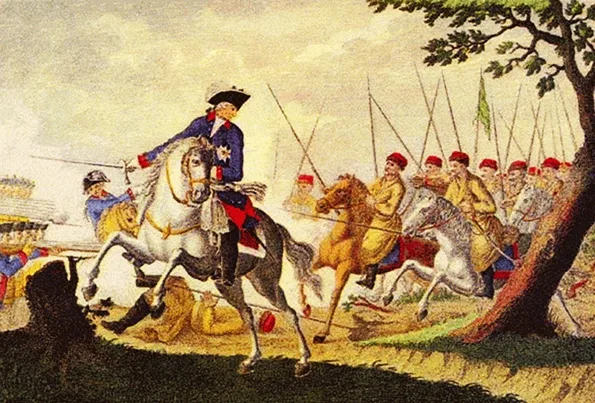
In this battle the Russians had 41,000 men, the Austrians 18,000, the Prussians 48,000. As at Zorndorf, Frederick managed to get into the Russians' rear, but they had time to turn their front. Against the weakest, left flank of the Russians the Prussian king used his signature invention — the attack in oblique order, which had until then successfully broken the defences of any enemy. And at first at Kunersdorf everything also went very well for him. The Prussians seized one of the heights dominating the battlefield and a considerable part of the allies' artillery. Victory seemed so obvious to Frederick that he sent a message about it to Berlin. Forgetting that "it is not enough to kill a Russian, you must also knock him down" (he had said this himself after Zorndorf).
However, the Prussians' assault on the second dominating height did not succeed. The Russian infantry proved in no way inferior to the Prussian, and the oblique order got bogged down in its defence. Then the Prussian cavalry under the command of General Seydlitz was thrown into the attack. It too was considered the best in Europe. But it turned out that the Russian-Kalmyk cavalry was, again, in no way inferior. Saltykov followed the course of the battle closely, shifting reserves to where they were needed. Without having been granted even 0.01% of Frederick's fame, he clearly outplayed him precisely as a commander.
By evening the Russian commander realised that the Prussians had run out of reserves,
whereupon he gave the order to advance, as a result of which Frederick's army
instantly fell apart and fled. The only time in the entire war.
In the Battle of Kunersdorf the Russians lost 5,614 killed and 703 missing, the Austrians 1,446 and 447 respectively. Prussian losses amounted to 6,271 killed, 1,356 missing, 4,599 taken prisoner and 2,055 deserters. In reality, however, after the battle Frederick had at his disposal no more than 3,000 soldiers and officers who were fit for combat and obeyed orders. The Russians recovered all the artillery lost at the beginning of the battle, taking some Prussian guns into the bargain.
The battle was the largest of the entire Seven Years' War and one of the most outstanding victories of the Russian army in its entire history (doubly outstanding because it was won not over the Turks or Persians but over the best army in Europe). All the surviving participants in the battle received a medal inscribed "To the Victor over the Prussians" (pictured below).
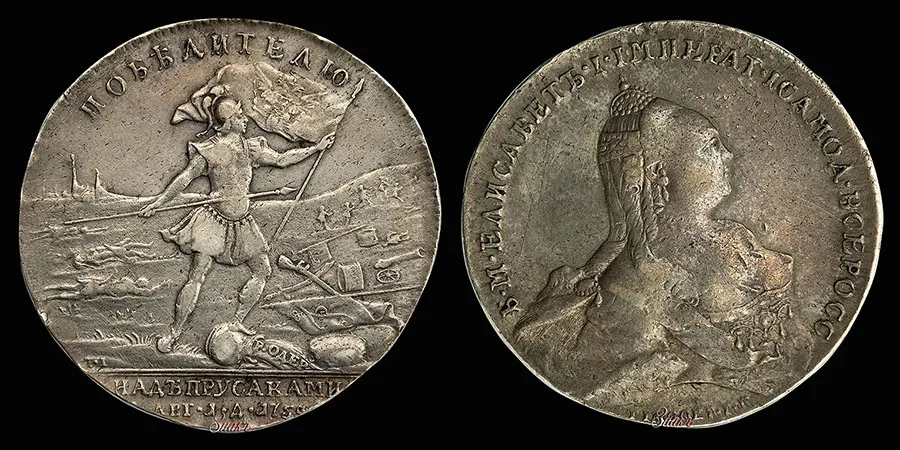
After the war Prussian emissaries travelled around Russia for many years buying up these medals for large sums, in order to erase their catastrophe from history. Judging by the fact that today at least 99% of Russian citizens have no idea about the Battle of Kunersdorf, the emissaries accomplished their task successfully.
However, the disappearance of the battle from popular memory was partly due to the fact that it brought us absolutely zero political results, although all the Russians and Austrians had to do was occupy Berlin and dictate the terms of surrender to the enemy. But the "sworn allies" quarrelled over further action and undertook nothing at all, giving Frederick the opportunity to restore his forces. In the end the Battle of Kunersdorf really did become a turning point, only in quite the wrong direction.
In October 1760 small Russian and Austrian forces even managed to take Berlin, but only very briefly: when Frederick's main forces approached, they withdrew of their own accord. The Prussians won several more victories over the Austrians, but their resources were rapidly running out. Then, however, Elizabeth Petrovna died, and at the beginning of 1762 Peter III, an admirer of Frederick, ascended the Russian throne. He not only returned all the Russian conquests to his idol (first and foremost East Prussia) but also sent a Russian corps to fight for Frederick against the Austrians.
Only half a year after his coronation Peter was overthrown and killed;
Catherine II recalled the corps, which had never got round to fighting, but she did not
re-enter the war. Thanks to this, the war ended in victory for the Anglo-Prussian coalition.
First and foremost through England's seizure of most of the French colonial possessions in North America and India. But Prussia too, contrary to all initial expectations, suffered no territorial losses in Europe.
Politically, Russia gained nothing and lost nothing from the war, ending up where it started. Militarily, the Russian army alone suffered not a single defeat, winning one truly outstanding victory, and thereby, for the first time in its history, established itself as unquestionably the best in Europe and consequently, as far as that era is concerned, in the world as a whole. However, this gave us nothing except moral satisfaction.
In terms of its long-term historical consequences, the Seven Years' War, given the missed opportunities, proved truly tragic for us. Had Prussia been crushed (and after Kunersdorf this was an accomplished fact), it could not have become the "gatherer of the German lands", and most likely a united Germany, which unleashed two world wars in the 20th century, would simply never have arisen. And even if it had appeared, it would have been much weaker. Moreover, had East Prussia remained part of Russia, the First World War, even if it had begun at all, would have taken a completely different course. There would have been no catastrophe of Samsonov's army; a direct and short road to Berlin would have been open to the Russian army from the outset. So it may well be said that the first step towards the catastrophe of 1917 was taken on the day after the triumph of Kunersdorf.
Incidentally, after Peter III returned East Prussia to Frederick, the great philosopher Kant did not swear allegiance to the King again, declaring that an oath is taken only once. It can be considered that he remained a Russian subject to the end of his life. That is why his present-day cult in the Kaliningrad region is quite logical: he really is our great compatriot.
Translated from Russian with the help of AI (Claude, Anthropic), October 2026.