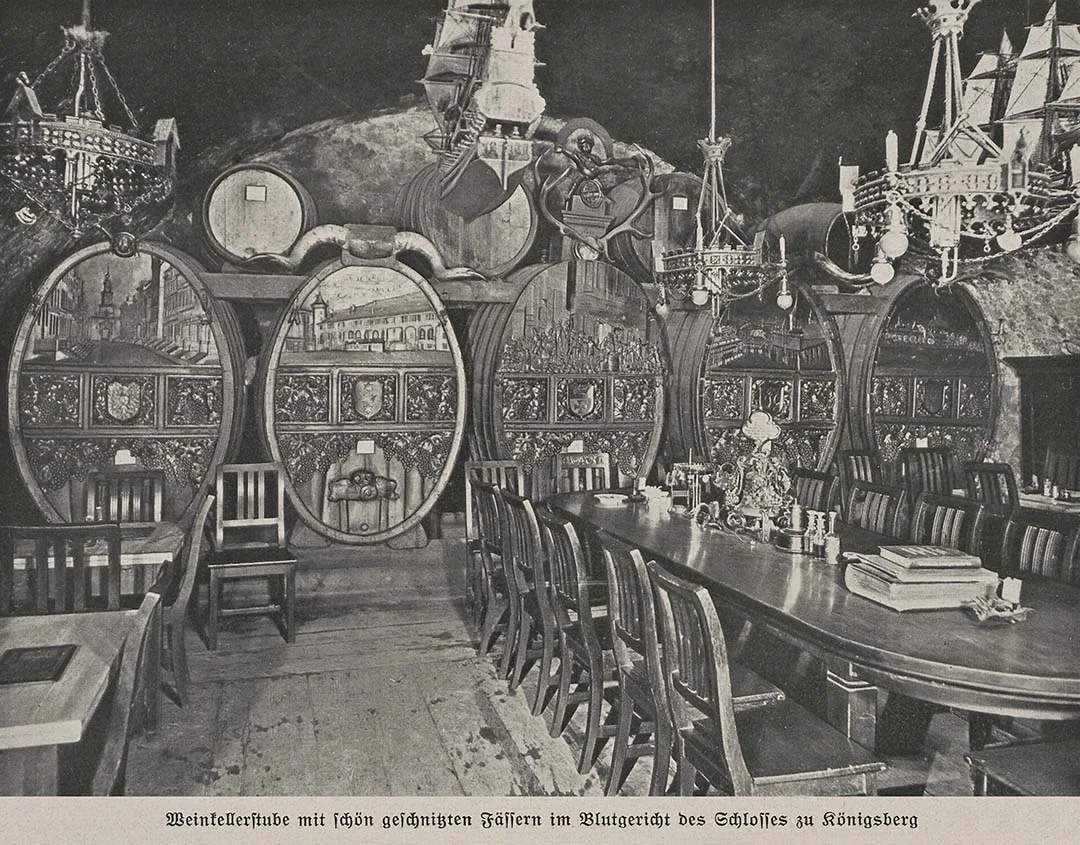
The wine cellar in the north wing of Königsberg Castle, with the rather sinister name "Blood Court" (Blutgericht), was famous throughout Germany. Its entrance was in a small annex beneath the tournament gallery, built in 1613. Inside, cosy, originally decorated rooms on several levels seemed to invite one to drink.
Here was the "Great Hall" with five huge barrels and models of sailing ships hanging from the ceiling, and there was the "Torture Chamber", also with five large barrels, richly carved, on which sat Bacchus entwined with vines.
The chamber was approached through the "torture passage" with two grinning stone gargoyles. There was also the "Remter"1 with six stuffed owls watching everything that went on with their glass eyes. There were military and civilian rooms. Merchants and lawyers gathered in them. The wine was served by cellarmen in leather aprons2.
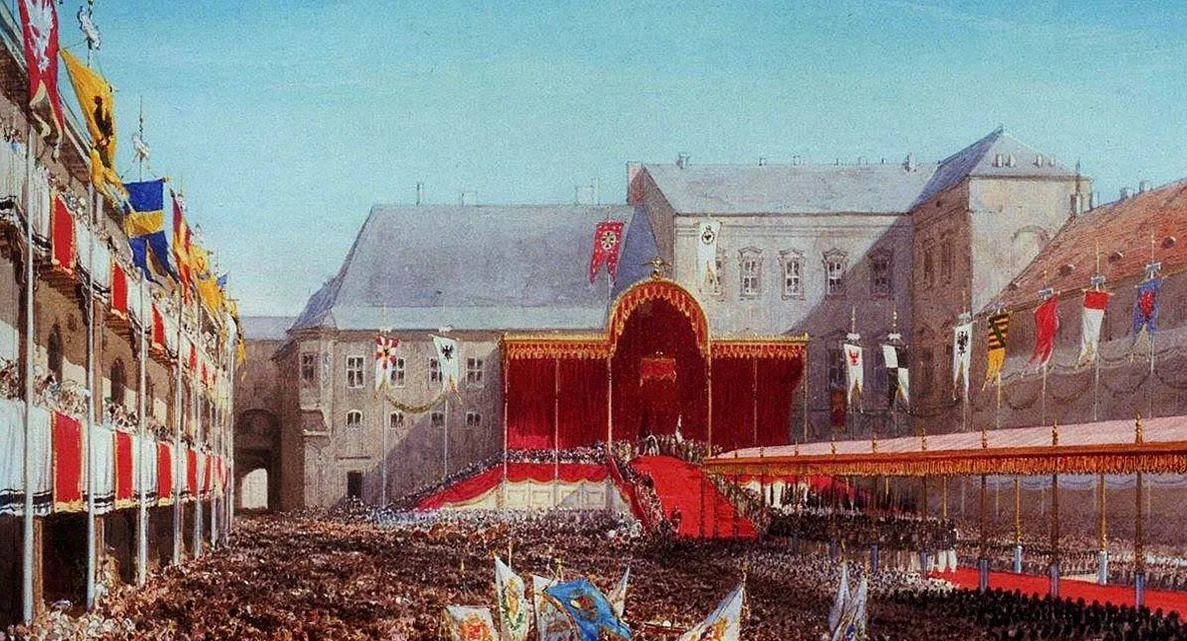
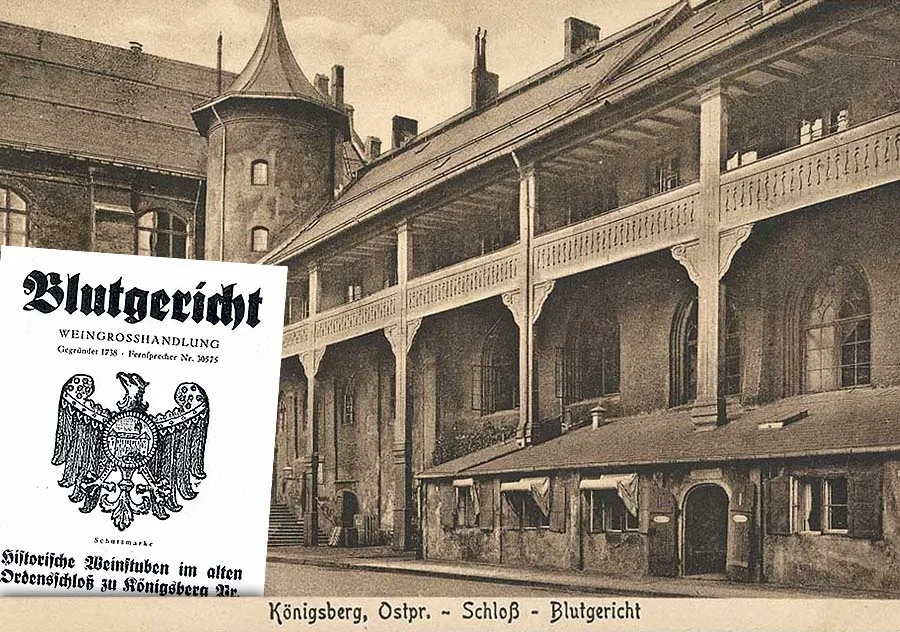 The entrance to the "Blutgericht" was from the castle courtyard (right).
The wine list included Rhine wine, Nahewein3, Bordeaux, Burgundy and the house original "Blood Court No. 7" – a thick, viscous, fortified red wine.
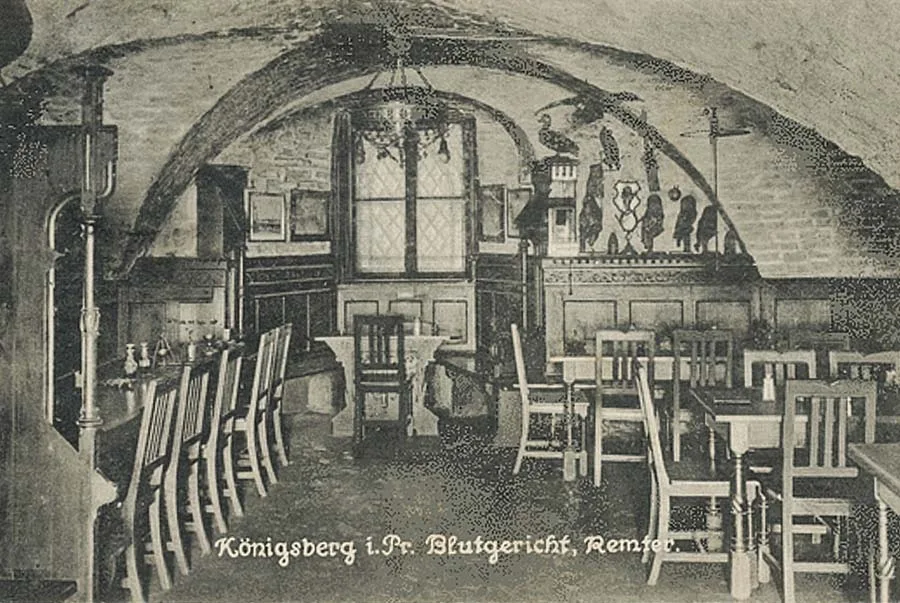 The Blutgericht "Remter" with its stuffed owls.
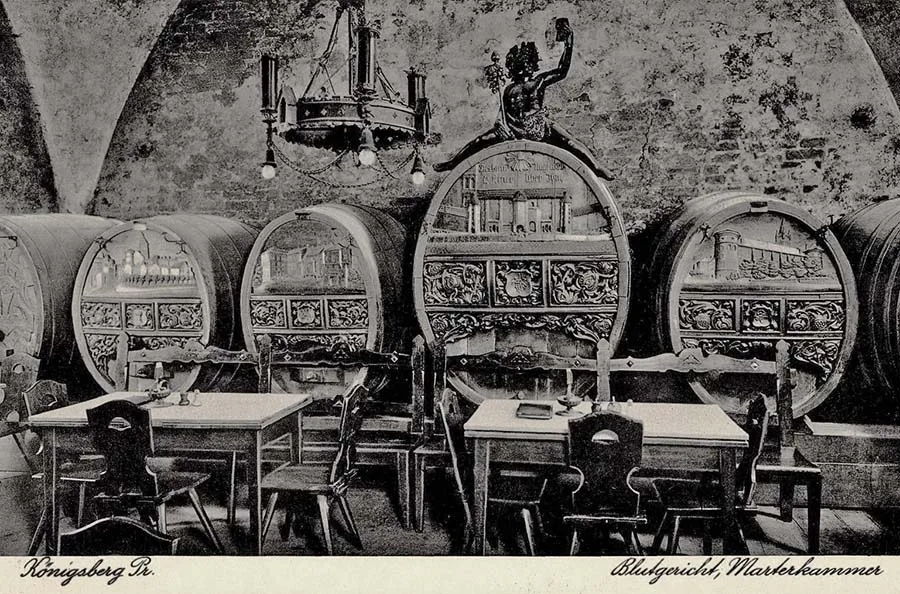 The "Torture Chamber" of the finest European wines in the cellar of Königsberg Castle.
Where did this wine restaurant get such a terrible name? In the 17th century the court of justice moved into the former apartments of the Grand Master and the Marshal. Below it were cells for prisoners with telling names: the "Great Bell", the "Pepper Room", the "Spanish Needle", the "Torture Chamber". People did not forget this; they gossiped about the "Iron Maiden" with two swords in her hands and about the "Hell Door", which cut off the head of a person condemned to death, after which the head fell straight into the Cat Brook (Katzbach). It was in these very rooms that the restaurant was set up!
In 1732 the wine trade in Königsberg was given fresh impetus by the Salzburg immigrants Balthasar Schindelmeisser (Schindelmeisser) and his son David.
The name "Blood Court" appeared only in 1827 and remained a glorious page in the history of the city on the Pregel right up to the last tenant of the cellar, Karl Matzdorff (Matzdorff).
Besides the wine cellar in the castle, the following were also popular: "Ehlers" ("Ehlers") in Altstadt at Bergstraße 5; "Jüncke" ("Jüncke") on Kneiphöfische Langgasse 10; "Knoop" ("Knoop") at Grosse Schlossteichstraße 8; and the "Ratskeller" ("Ratskeller") at Altstädtische Langgasse 24.
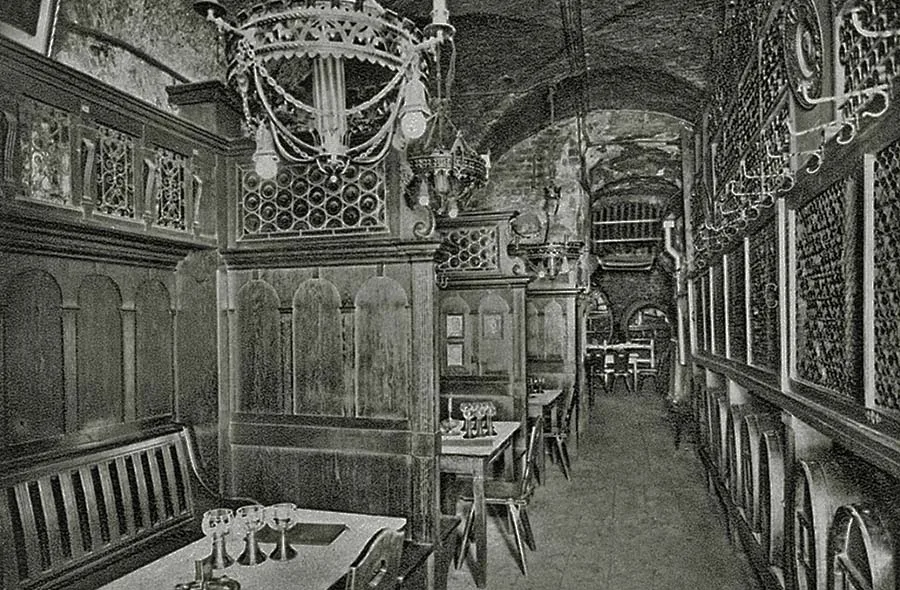 The "Torture Corridor", in that same castle vault.
"Steffens und Wolter" ("Steffens und Wolter") was housed from 1810 in a magnificent four-storey Renaissance house built in 1635 at Kneiphöfische Langgasse 27.
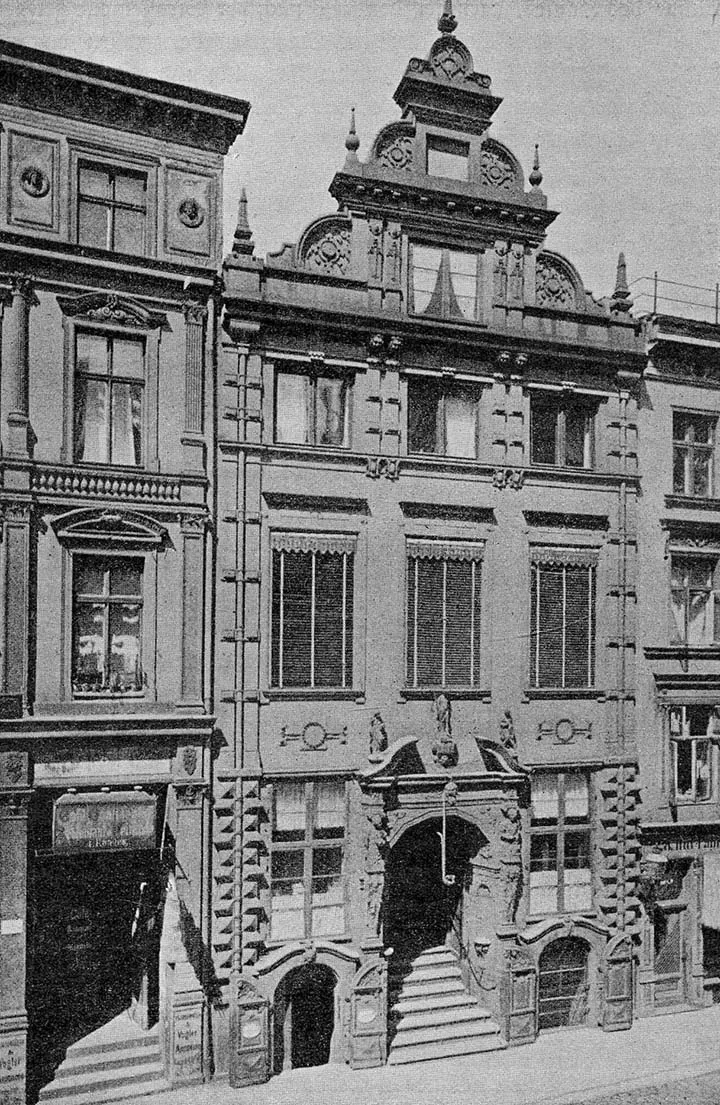
The entrance to the wine cellar at Kneiphöfische Langgasse 27.
A sandstone portal adorning the entrance to the staircase, two entrances to the cellar, a rich façade, a lacework gable. An inner vestibule portal with rich wood carving. At the back of the building, a covered gallery and a staircase of Gotland sandstone.
There stood a table called the "Millionentisch" (Millionaires' Table) – a huge round table; guests sitting at it enjoyed a splendid view of the Pregel.
The waiters who served the wealthy shipowners and merchants wore blue-and-red striped uniforms and large leather aprons. "Sehlenther und Co." ("Sehlenther und Co.") at the corner of Kneiphöfische Langgasse and Magisterstraße was founded in 1850. At the end of the 19th century its owner was Robert Johannes (Johannes), and from 1914 Hermann Weide (Weide).
SOURCE
Mühlpfordt H. M. «Königsberg von A bis Z. Ein Stadtlexikon». Aufstiegverlag, 1983.
TRANSLATOR'S NOTES
1.Remter (from Latin refectorium – refectory) – in the standard layout of a Teutonic Order castle, this was the name of the brethren's main refectory and common room. The Remter was usually on the first floor, the floor of state rooms. In the castles of important commanderies the Remters were large and heated.
2. A waiter at the "Blood Court" was called a cooper ("der Küfer") and was traditionally dressed in a "krupsh" – historically styled clothing (a warm blue shirt and a leather apron).
3.The Nahe (German: Nahe, Latin: Nava) – a river in Germany, 125 km long, a left tributary of the Rhine. Hence Nahewein (German: Nahewein) – a traditional German wine produced on its banks in the Nahe (Nahe) wine region in western Germany, which is famous for its outstanding white grape varieties.
Translated from Russian with the help of AI (Claude, Anthropic), October 2026.