
(Continued.)
Parts 1–3. Part 4. Part 5. Part 6. Part 7.
Letter 61. My Stay in Königsberg
Letter 62. The Arrival of Korf
Letter 63. In Korf's Service
Letter 64. Korf's Character
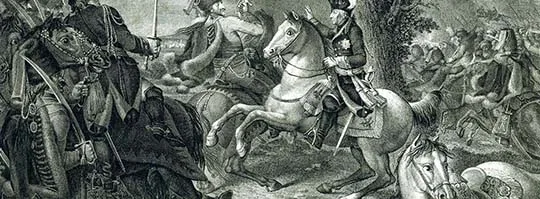
Letter 65. The History of the War
Letter 66. The Battle of Zorndorf
Letter 67. News from the War
Letter 68. Buying Books
Letter 69. Amusements and Diversions
Letter 70.
Letter 71.
Letter 72. Pleasure Gardens
MY STAY IN KÖNIGSBERG
Letter 61
My dear friend! In telling you in my previous letters of what befell me during my stay in Königsberg, I stopped at the point where I was living attached to the local Kammer and occupying myself with clerical work. Now, continuing my narrative, I shall say that however hard and tedious this life was for me at first, it became just as pleasant and merry afterwards. I was obliged to go to the Kammer both before and after dinner in the manner described and to write without cease only at the beginning, and for no more than two weeks, for during that time I had to enter in the book all the receipts and expenditures there had been from the start of our entry into Prussia up to my appointment to the Kammer. But once I had accomplished this laborious task, there was far less writing for me, and at last it became so little that I did not get as much as a page to write in a whole day. Consequently I could finish this small work in half an hour, and not only was there no longer any need for me to go to the Kammer after dinner, but sometimes even in the mornings I had nothing at all to do and could, with the permission of my little old councillor, absent myself, and sometimes even stay at home the whole day.
This circumstance, which gave me more leisure and free time, was as pleasant to me on the one hand, in that I could devote more time to my own pursuits and live as I pleased, worrying about nothing and not fearing that I would be sent off somewhere on detachment or on guard duty, as it was, on the other, harmful and injurious, in that it imperceptibly began to draw me close again to my former friends and acquaintances. All of them envied my quiet and almost idle life, and many did not fail to start visiting me often again as soon as they learned that I had got more free time and spent the afternoon hours at home. These visits of theirs, though not disagreeable to me, were harmful in that, to return them, I too had to call on them at times and waste time in pursuits wholly empty and not in the least suited to my inclinations. They occupied themselves mostly either with card-playing or with conversations that were not only meaningless but sometimes downright indecent and unworthy, and I found no taste in any of it, but was obliged merely to look on and listen. Among them all there was not a single one who had any inclinations at all like mine, and with whom I could have taken pleasure in talking of things that brought me more delight. And even those who were somewhat better and cleverer than the others had become so corrupted in the few weeks of their stay in this city that they were no longer like themselves, and one could hardly hear a single sober word or a decent conversation from them any more.
For all that, I was of necessity obliged to see them often, and, if not to take any real part in all their doings and pursuits, at least to keep company with them and frequently to spend time together, especially on outings.
All this again exposed me to great danger of becoming little by little infected with the same poison of debauchery with which they were all infected.
But never was I in such great danger from them as during the very great fair held in Königsberg around this time. This fair takes place here once a year and, beginning about two weeks before St Peter's Day, lasts right up to that day itself; and as people come to it not only from all of Prussia but from the whole Kingdom of Poland, the throng of people was then tremendous. The whole city was in motion, and all the most distinguished streets teemed with people of both sexes. For me, who had never yet seen such great fairs, this spectacle was as new and astonishing as it was pleasant. Above all, my attention was drawn by the Polish Jews, who came here to the fair to the number of several thousand. Their strange black garments embroidered along the edges, their funny little skullcaps and their whole appearance had so much that was odd and unusual about them that we could not look at them enough. And as, besides them, a multitude of other diverse peoples walked the streets in various clothes and attire, new and hitherto unseen sights presented themselves to the eye every day. Most particularly, the whole part of the city beyond the river, which bears the name of Haberberg, was filled with a terrible multitude of people. Here one long and wide street held several thousand of them, because it was the chief centre of the whole fair, and on it was carried on not only the principal trade but also all the fairground amusements customary in German lands. To these belonged in particular a popular theatre, set up in the middle of the street and entirely open. But do not think that this theatre was anything of consequence. No, my dear friend, these fairground theatres have scarcely a shadow of a theatre about them and bear only the name of one. On a platform made of boards laid on a few trestles and raised some three arshins above the ground, wings daubed any old how are set up at the sides and at the back, and from behind them comes out a moustachioed harlequin dressed in motley, who, with the help of two or three actors or actresses, strives with all manner of grimaces, contortions, silly and coarse jokes and blather that is sheer nonsense to make the foolish rabble laugh and to amuse it, while it gapes at him open-mouthed and in wonder. There is no order of any kind and no connection in the performances, and all the actions and blather of these players were so absurd and incoherent that one could not watch them or listen to the nonsense they talked without feeling a certain revulsion, and one would have had to be as foolish as the people were foolish if one wished to be amused by this spectacle. Nevertheless, this theatre was always surrounded by a countless multitude of spectators, and a great many of them showed very great pleasure; and that alone was enough for the players, who usually have their own particular aims in it. For you must know that the people who amuse the public in this way with their silly comedies receive no pay for it from the public, but are hired for the purpose by the keeper of the theatre, who is usually a so-called "Marktschreier" (a market crier), or seller of quack medicines, and they use this device solely to draw the people to his theatre as the place from which he sold his medicines.
He set about this selling several times a day, and every day after the players had performed some little piece.
No sooner is it over than he steps onto the stage with his little caskets and medicine chests and, taking each remedy out of them one by one, begins to show it to the people and with a tremendous shouting to describe and extol its marvellous effects and powers. It was comical every time to watch these doings and his most zealous efforts to deceive the people and assure everyone of the supposed reliability of his medicines, and more comical still that the people let themselves be deceived and bought them from him with the greatest eagerness. No sooner has he shown some remedy, described its powers and effects and announced its price, than at that very instant a multitude of handkerchiefs comes flying at him from the crowd, thrown to him by those wishing to buy it, with as much money tied up in them as he had announced. And then, with the help of two or three boys, he begins to collect this money and, tying the remedies up in those handkerchiefs, to hand them down from the stage to their owners. When everyone has been satisfied with one remedy, he takes out another, and then a third, and goes on so with all of them, spending several hours at it, for as long as the crowd is still large. And as soon as the people have dispersed somewhat, he goes off behind the wings, and in his place the players come out again and start calling the people together once more to hear and watch a new comedy; and when enough of them have gathered, the comedy begins again, and after it again the praising and selling of medicines. This way of coaxing money out of the foolish people seemed to us, for its unusualness, very strange and astonishing. Yet this swindler not only never came off the loser, but coaxed a great deal of money out of the people, although in truth all his medicines consisted of mere trifles and worthless things, such as powders, pills, little plasters, roots and other such knick-knacks, none of which produced anything like the effects that were preached for them. However, as a multitude of merchants with various wares came to this fair from various German and better cities, and these wares really could be bought more cheaply than at other times, the whole city was truly in motion because of it, and there was not a house left whose inhabitants of both sexes, especially on fine and pleasant days, did not drive or walk out to the fair, if not to buy, then to look and stroll about it. In a word, the whole two weeks during which this fair lasted could be regarded as one uninterrupted festival and holiday for this city, and on fine days one could see all its inhabitants in the streets in their very best finery and clothes.
All these circumstances, and especially the last, prompted all our gentlemen officers to visit this fair daily. We used to go there every day, gathering in crowds and companies, and spent the greater part of our time strolling about it and about the whole city, and did so not so much to buy goods as to look at the people and at all the inhabitants of Königsberg and to get to know them. Many of our fellows, especially the more nimble among them, had long been impatiently awaiting this occasion as one at which they could more easily make the acquaintance of those inhabitants of Königsberg whom they particularly wished to know, and gain entry to houses in which they found something attractive to themselves. And some of them did succeed in attaining what they sought. Others, on the contrary, sought occasions to strike up new acquaintances with visitors from Poland, especially with the noblewomen from there, and used various tricks and deceptions to seduce them. Still others wandered everywhere with the same thoughts and looked for female acquaintances among the young women of the town.
Most of them, however, had nothing on their minds but gambling, squandering and outright debauchery, and some did worse still. They engaged in all sorts of brawling and unpardonable pranks, and sometimes in the most shameful excesses.
In a word, this fair was a time of real temptation for everyone, and it would take far too long if I wished to describe everything our officers did and undertook then, and to what pranks and dissipations this fair gave occasion for many.
Now imagine, my dear friend, what danger I was exposed to then, living in the midst of such company and obliged every day to be together with such people and to go with them all over the city and keep them company. For with such a general stir of people and with the most beautiful weather we had then, it was quite impossible to sit at home alone; and even had I wanted to, my comrades would in no way allow it, but would drop in on me and drag me out against my will. And I truly do not know what would have become of me and how I would have preserved myself from all the evils and temptations to which I might have been exposed on this occasion, had it gone on for long. The only means I used for my salvation was that I kept away, as far as I could, from the gangs of the most worthless of our fellows, and attached myself mostly to those who were somewhat more sedate than the rest. But since even these were not entirely free from the poison of the dissipations of that time, I could never have remained unscathed and preserved myself from harm, had I not once again been helped by a special occurrence that I least expected, and had the invisible hand of the Lord not once again drawn me forcibly back from the abyss along whose edge I was then wandering and staggering. For it so happened that at the very time when this accursed fair was at the very height of its bustle, when my comrades had so accustomed me to strolling with them that I was already beginning to go with them willingly and to accept their invitations, and when some of them, as I learned afterwards, had formed a secret band {A group, a company; cf. the modern "to act as a band".} and conspiracy against me and, having prepared a veritable pit {A gap, a chasm, a trap, a snare.} for me and such a temptation as it would have been very hard for me to escape, came on purpose to fetch me, so as to call me out and lead me with them just like an innocent victim to destruction – at that very moment, when I, knowing nothing of all this, had not only agreed to go with them but had already stepped down from the porch of my quarters... there came running up to me, almost breathless, a messenger from my commander, my brigadier Numers, with the order that I should not walk but run to him at once and not linger a single minute at home, for, said he, there was the most urgent need of me.
I was astonished and did not know what to think of this unexpected and so hasty summons. The matter was quite unusual for me. Never before had it happened even once that this commander sent for me and asked for me for anything, and I had so little to do with him that sometimes for a whole week I happened not only not to speak with him but not even to see him.
Is it some complaint against me from someone? – I thought to myself. – And am I being called to answer for something?"
I knew that such complaints were not infrequently brought to the commanders against officers of our regiment, especially against those who were more inclined than the rest to rowdiness and all kinds of pranks, and that some had been punished for it. To heighten my confusion still further, I remembered that one such gang of them had, on the very day before, caused a tremendous uproar and commotion at the fair with their rowdiness, and that I had happened by chance to be present, and I knew that people were then intending to lodge a complaint against them.
"Ah," I thought, "is it not a complaint {Instead of a petition, a grievance.} against these friends, and have the petitioners not mixed me up in their affair too?"
My heart began to tremble at the recollection of this incident, and all the blood in me was stirred up. Although I was in no way mixed up in that affair, yet, having happened to be there by chance, I had even tried to restrain them and talk them round; but the affair in itself was very bad and nasty. Some of our fine fellows, the most dissolute of the officers, happened to see a whole company of young girls strolling about the fair. Captivated by their beauty, they stuck to them like pitch and tried in the most impudent manner to make their acquaintance. At first they approached them with various caresses, courtesies and greetings, and as this succeeded, some of them, who unfortunately had been drinking at the time, went further and began to take certain offensive liberties with them and, among other things, to invite them to visit the quarters of one of them, which were right next to that very spot, and one even so far forgot himself as to try to kiss one of them by force. The girls did not like this; they were none of them of the meanest condition, but, as one must suppose, daughters of local townsfolk of middling condition, and not the sort to be able to comply with the wishes of these gentlemen. They at once began to cry out and call for their mothers and relatives, who were then buying wares at another stall, and to complain to them of the insult done them. These took their part, and one man began to reprimand them. Our gentlemen found this vexing. They answered him with rudeness and contempt. He, as it happened, was not one to give way either. He answered them in kind. They began to swear at each other, and this led to a quarrel between them and such noise and shouting that a multitude of people came running to the spot. At that very moment I happened to be walking along that very street with one of my friends, and to see this great crowd of people and hear the shouting. Out of sheer curiosity we wanted to come closer and find out the cause. But how astonished we were to see a whole gang of our officers making a row and swearing at the Prussians, and one even so enraged that he had struck one of them in the face and, seizing him by the hair, was about to drag him about and beat him with a stick.
We both rushed in and, not letting him carry out this foolish undertaking, tried to break up the quarrel.
In this we succeeded, though not without difficulty, for as far as our own men were concerned, we soon persuaded them to stop playing the fool; but it was not so easy to calm the vexed Prussians, especially the enraged relative of the injured girls. And only my knowledge of the German language helped me to talk this German round and lay all the blame for the incident on the circumstance that the officer who had insulted his kinswomen and himself was tipsy and not then in his full mind and senses. With this the quarrel came to an end, but the German went off threatening not to let the matter rest, but to lodge a complaint where it was proper.
This vexing incident came back to my mind then, and I hardly doubted that this German had lodged a complaint, and I guessed that those officers had surely already been found and that I was being called as a witness and to explain everything that had happened. I asked the non-commissioned officer who had been sent whether he knew why I was being summoned and whether there was some petition or complaint from anyone.
"I don't know," he answered, "only there are many people at the governor's, both men and women, and many of the Germans were handing him papers."
"What? At the governor's?" I asked in astonishment. "Were you sent by the governor, then?"
"No," he said, "but I am on orderly duty at the governor's, and it was Mister Brigadier Numers who sent me. He came out from the governor's with the Ober-Kommandant and the town major and ordered me to run quickly to you and tell you to be so good as to come to him at once at the castle."
This threw me into still greater confusion. I no longer doubted that I had been sent for on the governor's orders, and I could not understand what need the governor could have of me, for we had not even seen him yet, since he had arrived only the day before. All my comrades were likewise astonished at it and did not know what to think. But as I could not delay and had to go, they took leave of me, expressing their regret that they would not have me with them that day and that I would have no share in the entertainment they had prepared. I did not know then what these words meant, nor was I thinking then of asking them about anything; but afterwards I learned that they had had the vilest intention, and that by this unexpected tearing of me away from their gang, fate itself, caring for my welfare, had wished to save me from a very great temptation and trial.
After they had gone I did not delay, but, learning that I had to go to the quarters of the governor himself, I only hurried to put on a different uniform and, having set my hair to rights, set out on my way, with my heart far from in its proper place and so sunk in various reflections that I scarcely saw the road I was walking along.
What the reason for all this was and why I had been summoned, you shall hear, my dear friend, hereafter {Bolotov was summoned in order to verify his knowledge of German and to appoint him translator in the chancellery of the governor-general.}; and now allow me, stopping at this point, to end my letter and to tell you that I am yours, etc.
THE ARRIVAL OF KORF
Letter 62
My dear friend! In my last letter I stopped at the point where I was hurrying to Brigadier Numers, who had summoned me, at the very castle where I had been going every day before. But never had I made that journey in so anxious a spirit as this time! The almost evident certainty that I was being asked for on the orders of the governor himself, and perhaps to go to him in person, and the rumour that went round about this governor, as yet unknown to us, that he was a man of very hot and quick temper, and a German by birth into the bargain, threw me into great confusion. It was well known that all Germans were particular defenders of all their co-religionists, and the uncertainty whether this one might not be just like Herr Lieven of Reval, who came to my mind then, unsettled my thoughts still more and filled me with fear that on this occasion I might suffer the hangover from someone else's feast, and bear some reproach and censure for the pranks of others, or at least give the governor a bad opinion of me at our very first encounter. I was already preparing in advance every possible justification of myself and devising speeches and words to say before the governor, should it come to his questioning me about it or showing his anger, and I approached the castle with a trembling heart.
Now, pausing for a minute, I shall tell you, my dear friend, a little more about this governor, of whom I have not yet had occasion to speak to you. He was one of our grandees of the court of that time, was called Baron Nikolai Andreyevich Korf, and, though in rank no higher than a lieutenant general, was held in considerable esteem at court and in the favour of the Empress then reigning herself.
This favour had been won for him not by his own merits, which were very, very modest, but by the circumstance that he had previously been married to Madame Skavronskaya, who, by reason of a certain kinship, was in the Empress's special favour.
Through her he had obtained both ranks and wealth, and through her he was even at this time still among the notables and held in esteem, although his wife had died some years before. For as her other sister, his sister-in-law, was married to the then Grand Chancellor, Count Mikhail Larionovich Vorontsov, and this grandee was very powerful, he supported this brother-in-law of his as well and procured for him this governor's post, which was then very illustrious, for this office carried with it the administration of the whole Kingdom of Prussia, although, for that matter, he was not overly fit for it, and his talents were so undistinguished that, although he had spent his whole life in Russia and had lived to old age, he still could not, even then, write in Russian, nor even sign his name in it, but always signed it in German. From this alone one may already draw conclusions about the rest.
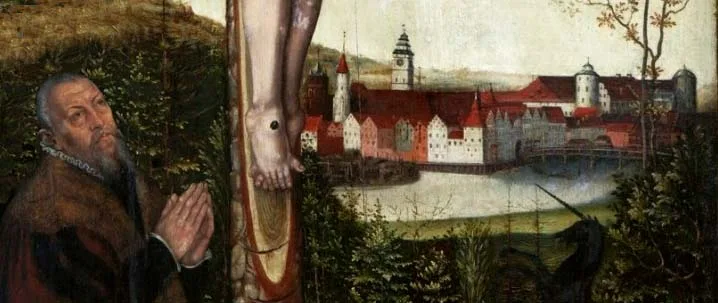
But be that as it may, he was chosen and appointed to administer this important post, which was equal to that of a viceroy, and arrived among us in Königsberg with tremendous pomp and a numerous retinue. All the city authorities and the best people met him with ceremony and escorted him to the castle, as the place assigned to him for his residence. Here he settled in the very apartments where in former times the dukes and sovereigns of Prussia themselves used to live, and from the very moment of his arrival he began to live and conduct himself with such splendour and magnificence that from that time all of Königsberg came alive, as it were, and everything in it took a different turn. But enough of him for now; you will hear more from me later, and now I shall return to the continuation of my own story.
It was before this very splendid and illustrious grandee that I was then preparing to appear, without having the slightest idea why or on what business. I confess that, having heard so much about his character, I approached the castle in fear and trembling. But oh, how greatly mistaken I was then in my thoughts! I ought not to have feared, but rejoiced, had I been able to foresee then what consequences would in time follow from that summons of mine and what would happen to me afterwards. Now I bless the hour at which I was then sent for, but at the time neither I nor any mortal could have foreseen it.
No sooner had I reached the castle than the man sent for me was already waiting for me at the gate and, catching hold of me, led me up the stairs at once to the governor's antechambers. I found them filled with a multitude of people of every kind: there were many of our military men, there were many town inhabitants of every sort, and among them some whom I could conclude to be petitioners. I searched with my eyes to see whether I would catch sight of the German about whom I was most uneasy, and one seemed to me to resemble him.
"So!" I cried out secretly to myself. "It is he, the cursed fellow! And all these troubles surely come blazing from him!"
But no sooner had I uttered these words in my mind than the doors from the inner apartments opened and His Excellency himself appeared, wearing his blue riband and his stars. He was proceeding through this room, accompanied by many persons of rank, to inspect the other rooms of this castle. As I had not yet chanced to see this illustrious grandee, I fixed my gaze on him with a trembling heart and, to my surprise, found him not at all as I had imagined him without having seen him. Instead of sternness and ferocity, his face showed me only features expressing something melancholy. He was no longer young, tall, very fair of complexion and of a peculiar cast of face: there was neither any particular pleasantness in it nor cruelty; there was nothing captivating and nothing repellent.
All this calmed me somewhat, but I had not yet collected my spirits when my commander, Brigadier Numers, caught sight of me. "Ah, so here you are!" he said and, at once turning away, stepped up to Mr Korf. "This is the officer," he said to him, "of whom I reported to Your High Excellency." His Excellency at once looked round at me and, having looked me over from head to foot, saw fit not only to halt his progress but, stepping a couple of paces closer to me, began to speak to me with particular graciousness. "I have heard, my friend," he said to me, "that you can speak German and write well, and Mr Brigadier Numers recommends you to me as being of good conduct." I made him a very low bow and had not yet managed to say anything in reply when Mr Numers took up his words and began again to assure him of my abilities and diligence. The little old man, my colonel, who happened to be there at the time as well, also joined in the conversation and assured the general in German that I was the best officer in his regiment, that my father had been his predecessor 55, and that the whole regiment could say nothing of me but good. "Just so," my captain Gnevushev, who happened to be there too, added to this, "he is of my company, and I for my part can testify that he is worthy of every praise, and all the officers of our regiment can say the same."
Such a general recommendation from everyone, and the general's attentive regard of me, turned the eyes of the whole numerous retinue following Mr Korf upon me. It was as if a great mountain had fallen from my shoulders, and I stood almost beside myself with joy and pleasure at hearing so much praise of myself from everyone and such recommendations as I had least expected. For all that, I did not know what all this was leading to and what exactly it might mean.
But as I could at least now see clearly that I had been summoned not for the reason I had thought but for something else, I took heart considerably and could now answer His Excellency's further questions more boldly and with a calmer spirit.
"That is very good," he said, "it is praiseworthy and flattering for a young officer to earn such honour; but tell me, pray, my friend, can you translate from German into Russian?" "I can, Your Excellency!" I said. "But not very well, and I have had little practice in translating!" "Oh no, Your Excellency," my captain broke in, "he translates quite nicely, and I have had occasion to read his translations." "Well then, very good, my dear fellow!" said the general. "Stay here and take the trouble to translate a few papers for me." Then, turning to one of his councillors who was walking behind him, he ordered that some papers be given to me and a place found for me where I might work on them, and he himself went on further with his retinue.
Such an unexpected turn confused and astonished me. I had least of all thought and expected that I had been summoned only for this, and that I would be obliged to set to work straight away. But my confusion grew still greater when the said councillor, taking me by the hand that very instant, led me through many rooms and, bringing me at last to one very remote and very large room, sat me down at a table and, bringing an inkwell and paper from another, pulled a whole bundle of papers out of his pocket and politely proposed that I should try my strength and abilities on them and endeavour to translate them as quickly as possible; and then, leaving me alone, he went away.
"Well, there's a thing!" I said to myself, following the departing councillor with my eyes. "Out of the blue, our fine fellow is caught like a mouse in a trap, and instead of strolling and making merry like the others now, be so kind as to sit and toil. But very well! Let us see what this translating is like..." Then I began to look through and sort the papers left with me, and seeing that there were more than ten of them, I exclaimed: "Oh! oh! oh! What a heap of them! You couldn't translate them in three days and nights!.. I thank you most humbly!.."
So I exclaimed, not yet knowing their contents; but when I began to examine and read further, my displeasure grew still greater. I saw that these were all petitions submitted to the governor by people of various conditions among the inhabitants of Königsberg, and all written in such a strange, obscure, muddled and clumsy style as I had never yet happened to read, and which would have made the best of translators sweat; and what struck me even more, many of them were written in their downright stupid and muddled chancery style and filled with a multitude of Latin words and such terms as I had never even happened to hear. In a word, many of them were such that they simply would not go into my head, and I did not understand a tenth part of what was written in them. "Oh! oh! oh!" I cried out then, shaking my head. "What am I to do with them, and how am I to translate them? Well, to put it plainly, a fine goose I am now! And did the devil himself prompt me to say that I can translate? Well, what will you do now! Glad or not, you must be ready and take up the pen."
In a word, this circumstance so confused me, and the translation of these papers seemed so difficult to me, that my heart began to beat from it just as it had beaten before from fear, and I was no longer glad of all the praise I had heard of myself a few minutes before, nor of all my knowledge of the German language. For several minutes I did not know what to do.
But as the thing was already done and there was no undoing it, I sighed and grieved, chose one that was smaller and whose style seemed to me easier and more intelligible, took up the pen and began to translate.
But I had hardly written a few lines when the difficulty of the translation began to seem greater to me by the hour, and I began to feel fully the whole burden of this task.
Since I was unaccustomed to translations of this kind, at almost every line I met with new difficulties and with passages that simply would not go into my head and which I did not know how to render in Russian. Having struggled for several minutes over one and come to a complete dead end, I threw it aside and took another paper in the hope that it might be better and easier, but a short trial proved to me that this translation was even harder than the first; I snatched up a third, but it was no better than the previous ones, and harder still. "Lord have mercy!" I exclaimed. "What devils wrote all this, and shall I find even one that makes a little more sense?" At last I came upon one that was somewhat more intelligible than the others, and, though with difficulty and not quickly, I translated it.
At that very moment the councillor mentioned before came in to see what I was doing. "Well, my dear fellow," he said to me, "is your work going well?" "Well, sir!.." I answered him. "My work is going badly! I have never yet had to translate writings of this kind, and there is a great deal in them that is quite incomprehensible to me, and especially in many of them there are words and whole phrases in Latin, which, not knowing that language, I do not understand at all." "Oh, my dear fellow!" he said. "Somehow or other! And as for the Latin words and those you do not understand, you may ask me. I shall not count it a trouble to explain them to you. Meanwhile, however, have you translated anything?" "Here, I have translated one," I said to him, handing it over. He read my translation and seemed to be pleased with it. "That is quite decent already!" he said and, taking both the translation and the original, went away from me. A few minutes later he came back and told me that His Excellency had ordered him to convey his goodwill to me and at the same time to tell me that I should now go to my quarters, and the next morning come there again and continue my work.
This news was not very pleasant to me. "God be with you," I thought to myself, "and with all the goodwill of His High Excellency and with all your praises; I would rather have nothing to do with you and stay at home living as before."
And so, in great chagrin and vexation with the governor, with everyone and with myself, I went to my quarters and grieved the whole rest of the evening over what had happened to me. But as there was nothing I could do to help myself, the next morning I dragged myself reluctantly to the castle again and into the former ducal halls, which, however, despite all their ancient magnificence, seemed to me then a veritable prison, for my vexation with those cursed and muddled papers was so great that I was charmed neither by the ancient architecture nor by the woven historical tapestries with which that spacious hall was hung, in which, in complete solitude, I had spent about two hours the day before at head-splitting work: instead I cursed everything in the world and did not wish to honour them even with a glance.
On arriving there, to my surprise, I saw this whole room already filled with a multitude of people. Several tables had already been set up in it, and various chancery clerks were sitting at them, writing.
I could easily guess that these rooms had been assigned to the governor's chancellery, and my guess was right. Mr Korf had brought with him all the necessary officials to found a Russian gubernia chancellery in Königsberg. With him were two councillors, two secretaries, a protocol clerk and several copying clerks, namely chancellery clerks, under-clerks and copyists; in a word, a complete chancellery, and it was housed, for the time being, in these rooms, and the one where I had been writing the day before was made the clerks' room, and the other, adjoining it, the judges' room, and there the councillors and secretaries sat with the protocol clerk.
No sooner had I arrived than the said councillor, who alone of them all was a German by birth, brought out to me from the judges' room the first secretary and with the following words handed me over to him: "Here, Timofey Ivanovich, is the man, the only one you were lacking."
This secretary seemed to me to be stuffed with the most foolish clerkly arrogance. Instead of being friendly to me or greeting me, he would hardly deign even to look at me, but with a certain rudeness and contempt replied to the councillor: "But is he capable of doing this work?" "He will get the hang of it!" said Mr Baumann, for that was the councillor's name. "And until then we shall help him somehow." "That's another matter!" replied the secretary with a smirk and, glancing at me as if with a certain contempt, went into the judges' room.
Such a reception at the first meeting was very unpleasant to me. "What the devil is this?" I thought to myself. "The general himself did not treat me so haughtily as this proud fellow." But no sooner had I thought this than he came out again and brought me not only the former papers but several new ones besides and, almost tossing them onto my table in passing, said: "Be so good, be so good as to translate all this – let's see your skill!"
Such rudeness vexed me; and however patient I was in such cases, I could not bear it calmly this time and refrain from saying to him: "I shall translate as well as I am able, sir; and if it does not please you, then I beg you not to hold it against me. I have never been a translator, nor did I seek this work out of eagerness; I was summoned here against my will, I did not seek it."
These words were said very much to the point and had their effect, for, as far as it seemed to me, from that time on he began to treat me more politely, or at least far less rudely than at first.
But although I had got rid of this gentleman in this way, I had not thereby set my own business right, for I still had to translate, and to translate a great deal. And so I set to my tedious work and wished, just as if to spite this clever secretary, to carry it out as well as possible, so as to win praise from the councillors thereby.
But I truly do not know whether I would have managed to accomplish it as I wished, had not a chance occurrence given me great and unexpected assistance in it.
Hardly had I, sitting alone at a separate table, begun my work when a Prussian Obersekretär from the chancellery of their chief government came into our room, accompanied by two German chancery clerks.
This Obersekretär had been ordered to sit at certain hours together with our councillors and to communicate with our chancellery on the affairs of his own; and as the whole part of the business relating to the internal administration of the Kingdom of Prussia was to be conducted by him and by our said councillor Baumann in German, and both of them always had a great deal of writing, the said two Germans had been brought in to copy their papers and attached to our chancellery, and, by my particular good fortune, it so happened that they were seated at the same table as I.
I cannot describe enough how glad I was to get these two companions. Both were decent people, and as soon as they noticed that I was translating from German documents, they considered it their first duty to make friends with me in German in the most courteous manner and to strike up an acquaintance with me. The circumstance that they could not speak a single word of Russian, and that of all our chancery clerks no one except me could speak German, prompted them to it all the more. Being here as if in a forest, among people they did not know and who did not understand them, they were glad beyond words to have found a man with whom they could converse; and I rejoiced no less in their company, but my joy sprang from another cause. I did not doubt that the accursed German chancery style which vexed me most of all in my translations and was quite unintelligible to me must be familiar to them as chancery clerks, and I resolved to make use of their knowledge and ask them to explain to me the meaning of certain expressions and words. Nor was I mistaken in my opinion and expectation. No sooner had I, being equally friendly to them, become acquainted with them and told them of my need, than they agreed with the greatest willingness to explain every doubtful word to me, especially the Latin phrases, and to render them so clearly in plain and ordinary language that it was no longer hard for me to understand their full meaning and express them in my own language. In a word, they delighted and obliged me infinitely by this, and brought it about that before dinner I was able to translate the greater part of the papers given me, and so properly and well that I thereby put to shame the conceit of Mr Secretary and forced him willy-nilly to admit that my translation was quite intelligible.
As for the two gentlemen councillors, they could not praise me enough for my diligence and zeal and most kindly asked me to continue working further.
Having won such a victory over the haughty secretary, I now began to continue my work with less displeasure, and soon this gentleman himself came to have need of me: one of the inhabitants of Königsberg came to us with whom he needed to speak, but as the man could not speak Russian and he knew nothing of German, necessity itself forced him to ask me to take the trouble of interpreting between them. Putting aside all my former vexation with him, I willingly agreed to fulfil his request, and this little service had the effect that he not only ceased to despise me but, becoming well disposed towards me, extended his goodwill so far that, when at that very time the general's adjutant came to call them all to dinner, he asked me whether my quarters were far away and, hearing that it was about two versts to my quarters, cried out: "Why, brother, then why should you walk such a long way home to dine? You can dine together with us. By the grace of Nikolai Andreyevich we always have a table ready for us, and you can always eat together with us. Come along, sir! I shall report it to the general himself."
I was astonished at such an unexpected change in this man, so hateful to me until then, and willingly followed him into the general's inner apartments. Here he did indeed report it to the general, who not only approved his proposal but, as everything about me and my translations had already been related to him by the councillors and by this very secretary, who enjoyed his particular confidence, wished to go further and express his goodwill to me in person. I was called to him at once, and no sooner had I entered than he turned to me and said: "I am very pleased, my friend, with your labours: you translate quite well. So come to my chancellery every day and help us further, and always dine with me here with the secretaries: why should you go such a long way to your quarters!"
I made him a very low bow and was entirely content with his kindness; and as by this very thing I became, as it were, attached to his staff, from this time there began once again a quite different kind of life for me, and a period of it that was especially memorable for me.
In my letters to come I shall describe it to you in more detail, and now, ending this letter, I remain ever yours, etc.
IN KORF'S SERVICE
Letter 63
My dear friend! The above-mentioned attachment of mine to Governor Korf's staff, least of all expected and, though not formal, yet private, marked a very important and truly memorable epoch in my life. For from this stay of mine with this general there flowed such consequences as had a great influence on all the subsequent days of my life. And as the most important of these consequences was that I changed in my whole moral character, and this change laid the very first foundation of all the well-being of my days, I can only conclude that it came about not by chance, but by a special dispensation of heaven and by the working of the Lord's providence, which has always cared for me. It pleased His holy will that this occurrence should befall me then, producing a great and, for me, most blessed change in all my circumstances of that time. However, I shall refrain from telling you in advance what you are to learn later and in due time, and will only say that even now I cannot sufficiently thank God when I recall this occasion, nor marvel enough at what a peculiar circumstance, and seemingly the merest trifle, gave the first impulse to it all.
It consisted in the following. Mr Korf, preparing for his journey from Petersburg to Königsberg and gathering all the people needed to found a gubernia chancellery there, although he took every possible care to fill his staff with all the necessary and capable people and officials, and could do this the better because he had been given permission to take them from wherever he pleased, yet it pleased the will of heaven that neither he nor any of the officials he had chosen remembered at the time that, on arrival in Königsberg, his whole future chancellery would be in constant communication with Germans and would have to deal not with Russians alone but with the German people as well, and that for this they had urgent need of a translator.
This circumstance had gone clean out of their heads, and they did not realise that they had forgotten it until they had already arrived in Königsberg and it came to founding the chancellery itself. Then, but too late, they came to their senses and saw their mistake.
They all regretted it extremely. The general himself grieved over it beyond words and was vexed with his secretaries for not having reminded him, while they laid all the blame on him and on the councillors, who ought rather to have known and remembered it. In a word, they all accused one another; but as this did not help, and they needed a translator, and the secretaries, who did not understand a single word of German, gave the general and the councillors no respite, demanding that they provide the chancellery with an interpreter and translator, this very thing was the reason why the general at once began asking the Ober-Kommandant, Mr Treyden, and Brigadier Numers, who were then governing Königsberg, whether they had anyone among the officers capable of performing this duty, and it pleased fate that I should be the first to come to their minds. They told the general about me, and this very thing was the reason for my being sent for, as mentioned before, and for my landing in this place and having to perform the duties of both interpreter and translator.
Such are the small and remote causes that the Lord's providence sometimes employs to build up the well-being of those whom it pleases Him to bestow it upon. But I shall now return to the continuation of my story.
No sooner had the general, in the manner described above, publicly expressed his goodwill to me before everyone and ordered me always to dine at his house, and I had gone out again into the room where a separate table was laid for us, than all the lower officials who made up his staff surrounded me and began to get acquainted with me and make friends with me as their new comrade and colleague. Here were both our secretaries, the protocol clerk, the general's adjutant, an Italian living with the general, and some others besides, all people still unknown to me. But none of them all got to know me so quickly and was so friendly to me as the general's adjutant. He was a young fellow, and although a priest's son, the son of the archpriest of the Preobrazhensky Regiment, he had been brought up so well that there was nothing in him resembling his origin, and he yielded in nothing to the best nobleman. His knowledge of languages, his fondness for books and learning, his being of the same age as I, and his most amiable and good disposition were the reason why we became acquainted almost in an instant and grew fond of each other, and I can say that I was always content with his friendship. But never did he oblige me so much as on this first occasion. He was the first to make friends with me, and no sooner had he learned that I understood languages and was likewise a lover of learning than conversations began between us, and he became so attached to me that he seated me beside himself at table and throughout the dinner tried to regale me as a guest.
This table of ours was separate from the general's and in another room next to his dining room, but hardly any worse than the general's, and so abundant both in dishes and in drinks that one could not wish for better; and what was best of all, there was none of the constraint and ceremony at it that was observed at the general's own table, where he dined with his councillors and guests, of whom he always had several.
But with us complete freedom reigned: everyone said what he liked, and joked and laughed with one another, and no one was shown any particular deference, all of which made these dinners the more agreeable.
Having eaten and drunk our fill at the general's table, we went back to the chancellery and, taking up our work, sat there until dusk itself, so that I returned to my quarters only at night.
Walking home this time, I was in various stirrings of spirit. I did not know whether to rejoice or to grieve over so unexpected and sudden a change that had befallen me... On the one hand, I did not dislike having landed in a place so illustrious, in my opinion. Being with the general who was then in command of all of Prussia, and being attached, so to speak, to his staff, flattered my ambition. I cherished the hope that, by becoming better known to this grandee, I might win his further favour and perhaps, through him, make my way in the world. On another hand, I was flattered by the circumstance that here I would always be among the best people and see and know everything that went on; on a third, I did not dislike the fact that I would always have a table ready and a good one, and would have no need to cook at home and sometimes content myself with a very meagre table. On a fourth, it was not unpleasant to me either that through this appointment of mine to the post of translator I was being drawn further and further from the regiment and from all the hardships bound up with military service and, in that time of war, from the very dangers – all this gladdened and cheered me. But when, on the other hand, I recalled my difficult and tedious translations, of which I had grown as sick as of bitter radish in that one day alone, when I imagined that I would have to go to the chancellery every day and sit over them from morning till night without cease, and lose entirely all my former liberty, so dear to me, these thoughts greatly diminished my pleasure and troubled me unspeakably. Most of all I grieved that I would thereby be bound hand and foot and would not have a single minute, so to speak, free for myself, nor any time that I could use for my own curious pursuits. However, as I had once resolved neither to push myself forward for anything nor to refuse anything that came of its own accord, I consoled myself with the hope that perhaps in time this post would not be as hard as it seemed to me then, and in this I was not mistaken, as you will see from what follows.
And so, trusting in God and expecting everything from time, I went to the chancellery again the following day and from then on began to go there daily. We usually sat every day both before dinner and after dinner, right up to the evening. And as there was a very great deal of business, and it multiplied from hour to hour, and many of the matters were important, the general himself usually came there and sat for several hours, and for that reason, so that he might come in more conveniently, it was moved after a few days to other rooms, which were nearer to those in which he lived, and, though not as spacious as the first, were far cosier and more cheerful.
They were on the same floor, but in the very best and most cheerful corner of the whole castle, and lay right above the Kammer.
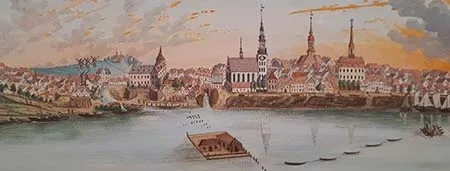
Here, by special good fortune, I was given a separate and the very best little corner room, divided from the other clerks' rooms by a plank partition; and as there were only the above-mentioned German clerks together with me, I was very pleased with this change; here we had, as it were, a separate German chancellery: none of the other clerks disturbed us, and we were at peace. To our still greater pleasure, we had two windows, from which the view extended very far, and we could survey not only one of the principal streets, running past our windows right beside the castle, but also the whole lower part of the city and the part beyond the river 56. At one of these windows I chose a place for myself at a separate little table, and at the other window I seated my companions, with whose companionship I grew more content from hour to hour, for not only did they help me a great deal with my translations in the manner described above, but besides that I had another benefit from them, namely that in idle moments I could practise conversation with them and thereby become from hour to hour more accomplished and knowledgeable in the German language.
As for my work, it was hard and almost unbearable for me only at the very beginning and until I had grown somewhat used to it; but as soon as I had learned all the special terms used in their chancery style and had grown used to their whole style, my translations became much easier and more bearable for me, and besides that they began little by little to diminish, and within a few weeks it came to the point that sometimes in a whole day I did not get even two sheets to translate, and some days passed entirely without work; yet in spite of that I could in no way absent myself, for every now and then I was obliged to interpret, or translate orally for our secretaries, what was said to them by local inhabitants of various conditions who came to us daily, and likewise to tell them their answers, and for this purpose I had to be in the chancellery almost without ever leaving it.
Now, before telling of further events, I shall pause for a minute and tell you, my dear friend, in somewhat more detail about the various officials who then made up our general's staff, so that you may see more clearly from this with what people I had most to do and to deal with daily at that time.
The foremost about the general were our councillors. There were two of them, and both sat together with the general, and at first even lived in the same castle, only in other apartments. One of them was a German and was called Ivan Nikolayevich Baumann, and the other a Russian, of the family of the Volkovs, and was called Aleksey Alekseyevich. But the latter was not with us long, and afterwards left for another post, and in his place was promoted another German, by surname Mr Westphalen, who had also come together with Korf and, having until then lived with him, had served him as private secretary and conducted his correspondence.
With both these foremost persons and constant companions of the general we were all on the whole content. Both were quiet, good-natured people, and both very diligent in their duties.
But as they far surpassed us in rank, and were moreover both Germans, we had no close dealings with them; they kept themselves somehow aloof from all of us, and from neither of them did we see anything, beyond courtesies, either bad or good.
As regards me, they were both fairly well disposed towards me, especially Mr Westphalen, for, being a learned man, he was pleased by my inclination towards learning and the reading of books. He sometimes entered into conversation with me and on every occasion honoured me with his praise. But beyond this I saw nothing from him, although he and Mr Baumann remained with us for the whole duration of our stay in Königsberg.
Besides these, we had two more collegiate councillors, one of whom was called Mr Kalmann and was appointed to the Königsberg Kammer in place of my former commander Numers, and the other Mr Klingstedt, appointed to a similar Kammer in Gumbinnen, but living for the most part in Königsberg; with these two gentlemen, however, we had even less to do.
But our Russian lower officials were not like that. The most notable of these was the first secretary I have already mentioned. He was called Timofey Ivanovich Chonzhin and was then a very important person among us. The whole chancellery rested almost on him alone. He was the principal conductor of all business and enjoyed, besides, such confidence from the general that he sometimes even argued with him loudly. All this, as well as his base origin – for he had risen to this dignity from the very lowest clerical ranks – was the reason why this man was stuffed with the most foolish clerkly arrogance and was so haughty that he sometimes drove everyone out of patience. He maintained this character throughout his stay in Königsberg and carried this folly so far that even on those very occasions when he himself had need of us, he would in no way lower himself and become friendlier. In a word, he bore himself loftily towards us and would in no way treat us amiably and with such openness as all the others did, and for that we all inwardly disliked him, though we showed him outward respect. For that matter, in clerical business and the usual clerks' tricks he was a very capable and so nimble a person that he alone of all of them knew how, in this place, to enrich himself, and so cunningly and skilfully that it could hardly be noticed.
As regards me, this man was, so to speak, neither fish nor fowl. I saw no particular good from him, nor did I see any ill. Knowing his power, I tried to please him and on all occasions when he needed my services, which I willingly rendered him; but for all that I could gain nothing more from him than some small kindnesses, which he showed me now and then, and in so cold a manner that they could in no way touch me. But it must also be said that none of us enjoyed any special friendliness or kindness from this man.
As for the other secretary, who was called Mr Gavrilov, he was of quite a different make. There was not the slightest pride or haughtiness in him; he was kind to all, indulgent and agreeable in his manner.
But, unfortunately, he was given in the highest degree to an intemperate and dissolute life. He had already come to us with his health quite worn out by intemperate living, and here, launching into everything and anything, he ruined it further still and grew so weak that at last he was unable to perform his duties, and for this reason left us after some time.
Though this man, during his stay with us, was friendly to me every time, and though I was content with the goodwill he showed me, yet as our characters did not agree with each other, I did not become very attached to him myself, but tried to keep away from him.
The third chancellery official was the protocol clerk, Mr Dyakonov, by name Yakov Demidovich. He was incomparably better than both our secretaries and more worthy both of love and of respect. He was a simple man, but very kind, steady, well disposed and friendly to all, and for that he was loved by all of us. To me myself he showed friendly kindness and goodwill, and I can say that I was at all times content with his friendship and considered him a good friend of mine.
These three persons were all the most important officials of our chancellery. As for the other lower chancery servants, they are not worth the trouble of mentioning in detail. They were all our usual Russian clerks, all drunkards and good-for-nothings, and among them all there was not one who deserved even slight attention, which is why I shall pass them over in silence as deserving only contempt, all the more so as I was too far removed from any dealings with them; I shall only say that they all loved and respected me.
But the Germans, my companions, were not like that. Though they also bore the title of chancery clerks, they had nothing resembling our clerks. One of them was there permanently the whole time and was called Grünmüller, while the other changed, and at first was Mr Oleus, then Mr Pickart, and finally Mr Caspari. All of them, as if hand-picked, were people of good conduct and lovable characters, and all were kind, friendly and well disposed towards me, and I can say that their company was of great benefit to me. For not only did they help me to pass my idle time in pleasant and sensible conversations, but as some of them were fairly learned and well read, I also benefited from them in much knowledge, and I was always content both with their kindness and their friendship.
With all these people I had to do every day in the chancellery, and they were all, so to speak, my colleagues and companions. And now I shall tell about the others in the general's suite, with whom I likewise met daily, especially at table.
Of one of them I have already mentioned to you in passing a little while ago, namely of the general's adjutant, Mr Andreyev, for so he was called after his father. This man in a short time conceived a special friendship for me and found such pleasure in conversing with me that he often came to me in the chancellery and spent an hour or more in various friendly and affectionate conversations with me. At such times we would talk about everything: about books, about learning, about drawing and other things; and as our characters agreed in many respects, we were never bored. In one thing only I did not agree with him: in that he gave himself up too much to vanity and in his foppery sometimes went as far as folly, so that our chancery folk laughed at him. For that matter, as he was a man of little weight with the general, I could get no other benefit from him beyond friendship and kindness alone.
The other and last person who made up our table company at that time was a certain Italian by the surname of Mornini, a lively, cunning and most intelligent person. He lived at that time privately with the general, holding no known post, and had come with him from Petersburg. The general was very fond of him and, as one must suppose, employed him on some secret affairs and hidden commissions. At least nothing about it was known to us. This man, too, took a special liking to me from the very start and throughout the time he lived with the general was very friendly to me, so that I was extremely content with his friendship and goodwill. He had apartments of his own and also often came to me on purpose for conversation, and at times I too sat with him for a while and listened to his tales of Italy and other European places where he had chanced to be, for in his time he had travelled a good deal and seen much of the world, so that he could be regarded as a fine rover or adventurer. And as he was, besides, a very great lover of reading books and spent all his idle time reading, this too attached me to him a great deal, and I can say that I owe to this man as well much of the knowledge I acquired while living in Königsberg.
Of these various persons, then, consisted the company in the midst of which I had to live and spend my time. Later it grew by several more persons, but of that I shall speak in due time; and now, as my letter has already grown long enough, allow me to end it here this time and tell you that I am, etc.
KORF'S CHARACTER
Letter 64
My dear friend! In the first days or weeks of my stay with the governor so little of note or worthy of remark happened to me that I do not remember anything worth telling you; it all consisted only in our having such a mass of business that we were obliged to work without a break from morning till night, and the morning dawn drove me out of my quarters, and the evening twilight, or rather the night itself, drove me back into them. And as I spent all my days in the chancellery without leaving it, I thereby soon became acquainted with all my above-mentioned companions, and besides had occasion to get to know our chief commander somewhat more closely. And as I have not yet portrayed his character to you, I must now do so and tell you once and for all what this then famous ruler of the Prussian kingdom was like.
He was a kind man, but had very many shortcomings in his character. As regards his intellect, one may say that by nature it was fairly good, but, as one must suppose, insufficiently sharpened by his upbringing in childhood, and therefore all the knowledge of this grandee did not extend very far, but was very, very modest, and whatever he knew he had acquired by mere habit, living at court and in high society; and therefore he was not so much fit for civil administration and knowledgeable in matters relating to it as he was well versed in everything that belonged to court and society life. In this respect he was fairly accomplished; but as for matters belonging to administration, and especially written ones, he was, for lack of practice, very unfit for them, and he lacked a great deal of what he needed to be, in the circumstances of that time, a good governor and ruler of this conquered kingdom.
And I do not know how he could have managed everything, had he not been helped by the councillors, and above all by that secretary Chonzhin of whom I told you in my previous letters and who later even became an assessor with us.
Although he could speak and read Russian fairly well, this was still far from sufficient; he had to give decisive resolutions daily on many of his affairs, and, unfortunately, on affairs that were for the most part important and brooked not the slightest loss of time or delay, because on them depended not only the government of the whole kingdom and all its internal order, but also the supplying of the whole army, which was abroad and on campaign against the enemy, with everything it needed. And for this he lacked both quickness of mind and swift and unerring decisiveness, and therefore he was obliged for the most part to rely on what our secretaries and councillors would say, advise and write. For all that, his ambition and high opinion of himself were so great that he tried to conceal this shortcoming as far as possible and to keep up the appearance of deciding all matters by himself. And this naturally often gave occasion not only to frequent confusion in business but also to many mistakes, all the more so as the crafty secretary, taking advantage of this weakness, often for his own interests led him into very great errors and into matters in no way consistent with his important office of the time. To make matters worse, owing to his complete inability to write in Russian, he could not himself compose anything, nor even correct what had been written, and this gave this cunning man the most welcome opportunity to deceive and dupe him at will. It often happened before our very eyes that he plainly perceived that something had been written wrongly, and grew angry about it and swore, and sometimes tore up the paper several times and ordered it to be rewritten, but how it should be written differently he was far from able to explain properly and order; and therefore for all that he did not attain what he wanted, but was obliged in the end to sign the same thing, only written in other words. This alone can already show you, my dear friend, what our governor was like in point of intellect; and now listen to what he was like in point of heart and temper.
The rumour that went round among us even before his arrival, that he was a man of quick and hot temper, was not only true but fell far short of the truth. Experience showed us incomparably more, and I do not know how and in what words to portray to you the moral character of this man; I shall say only briefly that now, as I write this, I am already in the sixtieth year of my life, and in the course of these years, although I have seen many people, I have never yet happened to see or find one like him, one so much given to anger and scolding as this man was. Truly one may say, as the proverb goes, that in this respect everything in him had got out of order.
For anything and everything, and not only for real matters but sometimes for the merest trifles, he would grow angry and flare up in extraordinary rage and shower everyone, whoever it might be, his servant or his subordinate, with cruel abuse and curses.
With his servants and household he lived in incessant war and fighting, and to all his subordinates he was so unbearable that of all who had dealings with him not one remained without being aggrieved by him. And this happened so often that truly not a single day passed on which he did not several times raise a tremendous war and quarrel with them and shower them with thousands of oaths and insults, and often this was repeated and renewed by him several times within a single hour. In a word, any trifle and the most insignificant misstep could provoke him and inflame him to the greatest wrath. In this respect, for all his fame, grandeur, wealth, honour and eminence, he was the unhappiest man in the world, because his spirit was in almost incessant unrest and vexation, and almost all the hours and minutes of his life were poisoned by displeasure, and because of this very thing his best amusements and diversions were imperfect. Indeed, he would get himself so angry that he actually fell ill from it and even took to his bed. And more than once it happened that he begged and implored all his subordinates in the most touching manner not to make him angry; but nothing was further from their minds than to anger him deliberately, and everyone, for the sake of his own peace, avoided it and guarded against it in every possible way.
Now judge what it was like for us to live with such an outrageously hot-tempered and irascible commander! Must he not have seemed to all of us a veritable beast and monster? Ought we not all to have hated him and fled from him as from some monster, and feared him? Ah, my dear friend! He did indeed seem so to us at first, and to me especially, and no sooner had I seen this trade of his than I lamented a thousand times that I had fallen under his command, and wished I were rather a thousand versts away from him than living with him and enjoying his insults. But ah, what can habit not accustom us to, and what can it not make bearable for us! All of us became more than convinced of this truth by our own experience and learned that a man can get used to the bad as easily as to the good, and that even the bad may be far from so keenly felt by him as soon as he has grown somewhat used to it.
And so I shall tell you that it was hard for us to live and to get used to bearing the abuse and anger of our general only at first, and afterwards we grew so used to them that we thought nothing of them, and instead of hating him, we all loved him.
You will be surprised at this, but you will cease to be surprised when, to explain this riddle, I tell you further that our general, however bad he was on this side, and bad in the extreme, was just as good on the other, in that he was not at all rancorous and had by nature the kindest heart. No sooner would such a whim and folly of his pass (and, fortunately, it usually lasted only the shortest time) than he became meeker than a lamb and turned into the kindest and friendliest man in the world, and one could say whatever one liked to him. And this was the reason why we pitied him more than we were vexed with him, and willingly forgave him his abuse and curses, for we were certain that no consequences would come of it and that his former good disposition towards everyone would not change in the least thereby.
And as he had, besides, this good quality in him, that he did no one any real harm but was rather inclined to beneficence, we loved him for it.
Having thus described part of his moral character, I shall now go further and tell what else was known to me about him. However great the said vice and shortcoming was in him, he knew very happily how to drown it out by the brilliance of his outwardly splendid and magnificent life and by his pleasant and amiable manner with all the inhabitants of this city. Being fairly rich himself, and receiving besides a very large salary, and on top of that 6,000 roubles a year for his table, which was a very great deal at that time, and being childless and having no one to leave his estate to, he lived throughout his time in Königsberg truly gloriously and magnificently, and not as a lieutenant general, but as some sovereign prince or at least a viceroy {Vice-king.} would have had to live. In a word, he spent here not only his whole salary but all his own numerous revenues. Clothes, carriages, livery, horses, servants, table and everything else were on so splendid and magnificent a footing with him that he drew the attention of all the inhabitants of Prussia to himself; and as he added to all this in time very frequent entertainments of all the most eminent inhabitants of Königsberg at his house and strove to provide amusements of every kind, of which I shall speak hereafter in its proper place, the whole city thereby came alive, as it were, and his rank became as important to everyone as if he were in fact some sovereign duke and monarch, and he won the love of the whole Prussian kingdom.
Such was the governor we had then! Now I shall tell you that no sooner had he looked about him than his first concern was to make the acquaintance of all the most distinguished Prussian noble families living in the city. There were a fair number of them here around this time, and among them were some counts and barons, such as, for example, Count Stanislawski, Count Keyserlingk, Count Finck and some others, and among the ladies there were not only countesses and baronesses but even princesses, such as, for example, the Princess of Holstein-Beck; and of noble families, especially ladies, there were a great many. He at once visited all the most distinguished houses himself, and in order to get acquainted with all the rest as well, some time after his arrival he gave a great feast for everyone, and then a ball, to which all the gentlefolk of both sexes were invited.
On this occasion we saw for the first time all the Prussian nobility who were there, and as his adjutant was employed to invite them and could not manage the task alone because of the multitude of houses, I was employed to assist him on this occasion.
For me this business was entirely new and unusual. I was given a saddle horse and had, according to the register {List, roll.} given me, to seek out all the noble houses in the city, invite the gentlemen and ladies there, and then, together with the adjutant, receive them at the castle and do my best to entertain them in every way during the dinner and the ball. I had never yet been engaged in any such matters, but out of obedience and to please the general I tried to perform my duty as well as possible. My friend the adjutant helped me with his advice and example, and with his help I managed everything so well that my general was pleased with me. Moreover, for my trouble I was more than rewarded by the pleasure I had in being present at this feast and celebration. There was a very great multitude of guests of both sexes, especially ladies and maidens; and as I had never before happened to be at gatherings so numerous and distinguished, both the gathering itself and the dances and music captivated all my senses and thoughts, and I could not look at it all or marvel at it enough. And this was the reason why later too, when we had similar festivities, I willingly went to watch them and took upon myself without demur any tasks and commissions, whenever any were entrusted to me by the general, even though, by his habit portrayed above, I too sometimes got the same two or three not very smooth little words with which he often, almost every day, generously showered his poor adjutant.
In this way I began to lead a new kind of life, quite different from the former, and little by little to grow used to my new post. And as my labours were sweetened by the pleasure of being always among people, of being able to hear, see and learn everything that went on both here in the city and in the army itself, which was on campaign and from which the news received became from hour to hour more interesting, more curious and more important, and with all that I always had a good table, I grew used to it very quickly, and it not only became more bearable to me, but I even began to find pleasure in it and soon ceased to be bored by it at all.
One thing only burdened me, namely the long walk to my quarters, especially late in the evenings and in foul weather; but from this burden too I was soon relieved, for no sooner had I mentioned it to my companions in the chancellery than they all began advising me to change my quarters and find others somewhere nearer the castle. I myself had long been thinking of this, but at first I did not want to part so soon with my beautiful and cheerful quarters; but as the daily walking had at last become too tiresome to me, and I saw that I hardly used my quarters at all, for I only happened to spend the night in them, while the whole day from morning till evening I spent at the castle, I was glad at last of any quarters at all, as long as they were nearer, and began in earnest to request and look for other quarters. But unfortunately it so happened that the houses in the nearby streets were at that time all either partly occupied by billets or, for various reasons, exempted from billeting, and I could find no other than half a verst from the castle, in the house of a butcher. These little quarters were not as cheerful as the former ones, but as they had two rooms and I could fit into them comfortably with my servants, I yielded to necessity, requested them for myself and without further delay moved there with all my belongings.
Now, without going further, I shall describe these new quarters of mine to you.
They were in one part of the Steindamm suburb, on a street running from the castle past the theatre and not far from the Steindamm church, which later became our church. The house was small, with only two storeys, of which the owner lived on the lower, while the upper, consisting of two rooms and a little entrance hall, was cleared entirely for me. Of these, I put my servants in the one at the front, and assigned the other, at the back, to myself. The entrance to our floor was from the street by a narrow staircase going up, and quite separate, so that we had no dealings with the owner. And the view from my rooms extended over that very spacious meadow which I mentioned before under the name of the parade ground and which lay inside the city, between the Steindamm, Sackheim and Tragheim suburbs; while the windows of the other room looked onto the street. So my little quarters were not very cheerful, but I was at least content that, owing to the low ceilings of the rooms, they were fairly warm and quiet, and that I had a much shorter walk.
As for my landlord, he was, as mentioned above, a butcher, and consequently a man deserving so little regard from me that I hardly knew him by sight; and all the benefit I had from him consisted solely in buying from him every day, for money, excellent sausages, or raw sausages, which were so tasty and filling that one of them fried in a pan with a good wheaten roll was enough for my supper. And I grew so used to them that they were fried for me daily, and in that alone my suppers usually consisted the whole time I lodged in those quarters, for our dinners at the general's were so filling that we could, if need be, go without supper, and I considered it superfluous to cook suppers for myself, apart from their sausages.
Moreover, as by moving to these quarters I had now gone far from the regiment and from the places where it was billeted, this separated me from all my former friends and regimental comrades and broke off completely all the connection I had had with them, so dangerous for me, so that from that time I hardly ever saw them, and of what went on and was done among them I had no knowledge any more, for none of them wanted to come all that way to see me, and even if they had thought of it, they knew they would never find me at home.
In this way I was freed from their pernicious company, and I can say that this point in time was especially worthy of note in my life; for as far as I can remember myself, it was from that very time that I began – despite all my youth at that time, for I was only in my twentieth year – to become from hour to hour more sedate and thorough in my thoughts and to apply myself more to the reading of books and to learning, which afterwards turned to such great benefit for me.
However, it must be said that various other causes and chances contributed a great deal to all this.
Of these, I regard as the first, the most important and the truly saving circumstance for me the fact that I was then so firmly tied to the chancellery that I could not absent myself from it anywhere in any way, and thereby a bridle, very necessary for a young man, was placed upon me, as it were, by fate itself; for, young as I was, even if I had sometimes taken it into my head to go somewhere and amuse myself, then, and especially in the first weeks, I could not even think of it, but was obliged to sit in the chancellery without leaving it, and not only to work but to expect at every minute that I might be called for and given some new task. And through such constant presence at the castle I was preserved from all the temptations to which I might easily have been exposed had I had more freedom.
The second and no less fortunate circumstance for me I consider to be that in our whole chancellery company and the general's staff, apart from the above-mentioned adjutant, there was no one of my own age, no one who could be a companion to me and call me out and take me somewhere with him; they were all much older than I, and of such qualities and characters as did not in the least resemble mine at that time. Although some of these gentlemen did sometimes leave the chancellery in turn and went to taverns and other places they needed, and they often had gatherings and parties among themselves, and although these gentlemen all loved me and were friendly to me, it never occurred to any of them to call me out and take me with them to their quarters or to the places where they went. And I do not know whether my youth was the reason they did not wish to honour me with their company, or that I was an outsider and did not properly belong to their band, or whether it was particularly pleasing to my beneficent fate, which cared for me; but be that as it may, it is certain that, living among them and having close dealings with them every day, I was in fact very far removed from them all and, being always among people, I lived apart and as if in complete solitude. For as they never invited me, and I myself was not importunate and did not force myself on them, I never went to them, but knew only my quarters and the chancellery. And this afterwards turned to my great benefit, for later I saw that these gentlemen were of such qualities that, by going to them or with them to all those places, I would not have learned much good from them, but would sooner have harmed and spoiled myself.
As for my coeval, the adjutant, the poor fellow was bound hand and foot even more than I, and could not stir an inch from the general himself; consequently his acquaintance could not be harmful to me either.
The third fortunate circumstance for me was that as, after the first few weeks had passed, my written work began not only to diminish but often to cease altogether, so that sometimes I sat for several hours entirely without work, these idle hours, owing to my habit since childhood of constant occupation, began to grow tedious to me, so that, being occupied with nothing, I sometimes even pined from it. This circumstance was the reason why I took it into my head to bring along from my quarters a few books in reserve for such occasions and to occupy myself in idle time with reading them, for there was nothing else to be done there. And from this many benefits came to me, for, first, I was occupied in idle hours with an exercise useful to myself and gained more and more knowledge from hour to hour; second, I was spared boredom; third, I prevented my thoughts from being occupied, out of idleness, with other subjects that might turn to my harm and detriment; and fourth, finally, by this very thing I gave occasion to my friend the adjutant to praise to me a little book he knew, namely "The Moral Reflections of Count Oxenstierna" {"Opinions" (moral) on various occasions, with rules and reflections of Count Oxenstierna", translated from the French by Kudryavtsev. The second edition, "Reflections and Moral Rules of Count Oxenstierna", translated from the French by I. Nechayev.}. He praised it to the skies and so fired me up with it that I resolved without fail to buy it, and, finding a free hour, ran off to look for a bookshop and ask for it.
The day on which I did this was for me a truly blessed and extremely memorable one, for on that very day it pleased fate to open to me, so to speak, for the first time the door into the temple of learning and to show me its charms. I cannot describe enough with what rapture I was struck on entering the bookshop there, in which I had never yet been even once. One of my German companions undertook to take me there and show me the out-of-the-way lane, unknown to me, in which it was situated. Never having been in proper and large bookshops, I was struck by the sight of a tremendous multitude of unbound books, lying not only in piles on the shelves but also spread out on all the tables and counters, so that their titles could be surveyed and seen at a single glance. I did not know where to turn my eyes and to which of them, which to examine first and which after. I spent several minutes as if in a frenzy, and did not so much look over them as devour them all with my eyes. Had it been possible, I would have grabbed them all for myself – so charmed was I by this sight, so unusual for me. But my pleasure was greater still when, asking for the "Oxenstierna", I heard that not only was it there, but, despite its size, it was so cheap that the greater half of the money I had with me was left over, and I could buy with it several more books whose titles took my fancy.
With very great pleasure I ran from there to the bookbinder to have them bound, and meanwhile noted with particular attention all the streets and lanes by which I should go to this shop in future.
And indeed it was often honoured with my visits and brought me inestimable benefits in later times.
Receiving my "Oxenstierna" from the bookbinder the next day, I set about reading it that very hour. For several days I read it without tiring, and although it was not one of the very best, it was of very great benefit to me then. The author spoke in it of everything in the world, and of our human life; he instilled in me a great many very good thoughts, such as served me as a great incentive to an orderly life and to keeping as far as possible from vices; and, best of all, he gave me a taste for further reading of books like it. In a word, I am very much indebted to this book and grew so fond of it that I even took it into my head to translate some articles from it in my idle time; and even now I cannot look at it without a certain feeling of gratitude towards it.
Such, then, was the concurrence of various circumstances that caused and furthered the said initial change in my thoughts and conduct which took place in me at that time, and from then on, with the help of heaven, so beneficent towards me, or, more properly speaking, of divine providence caring for me, I went further and further from hour to hour, as if up a ladder. But of this I shall tell hereafter and in due time; and now, since my letter has already grown too long, allow me to stop at this point and tell you that I am your constant friend, etc.
THE HISTORY OF THE WAR
Letter 65
My dear friend! In telling you in detail in my previous letters about everything that happened to me in the first months of our stay in Königsberg, I became so absorbed in it and talked so much about these trifles that I completely forgot about our war of that time and its continuation. Although from this time the history of this war is not closely bound up with my own, since I no longer took any part in it myself, yet, as I had already begun to describe it briefly earlier, I hope you will not object to the continuation of a brief account of the further events that took place during it, if not of all, then at least of the most important.
And so, going back a little, I shall tell you, my dear friend, that while we were marching from Toruń to Königsberg in the manner described above, and little by little getting used to living here, and spending our time not so much in labours as in merriment, the fire of war was already blazing everywhere in the world, and the earth in many places was crimsoned with human blood. The last time I wrote to you about this war, I had occasion to tell you what terrible and great preparations were being made in all the belligerent lands for its continuation, and how many powerful armies had been made ready to act against one another as soon as spring broke. Nor did this fail to come about. No sooner had spring begun to break than military operations began at once. This beginning was made by the King of Prussia and his allies, and so early that no one could marvel at it enough. I have already partly mentioned to you before that the so-called allied army, consisting of Hanoverians, reinforced by a small number of Prussian troops and led by Duke Ferdinand of Brunswick, began its military operations at the very beginning of this year, even in the depth of winter, and what great successes it had already had.
In a very short time the French were forced not only to abandon all the advantages they had gained over their enemies, but to return beyond the river Rhine in disgrace and with the loss of a multitude of men. Yet the allies of the King of Prussia gave them no peace even there.
The brave Prince Ferdinand of Brunswick, sent by the King to command these allied troops, was the first to open this year's campaign, as early as the month of March, and undertook a truly very important and difficult enterprise. It consisted in driving the French entirely out of Lower Saxony and Westphalia; but as their number still amounted to as many as 80,000 men, while he had no more than 30,000 of those very Hanoverians who, three months before, had been about to lay down their arms altogether, all the skill and dexterity of a great general were required for it. To this it must be added that the French army was no longer commanded by the former feeble Duke of Richelieu, but by Monsieur Clermont, newly sent by the French court, who was likewise reputed a skilful general. For all that, this change helped the French little. Duke Ferdinand began to make such skilful movements that he soon forced the French to withdraw and clear entirely all the Brunswick, Wolfenbüttel and Hanoverian lands; after which he marched straight on the town of Minden and, joining the other detachments that were on the Weser, besieged this town without delaying a minute. Count Clermont did send General Broglie with a corps to reinforce this town, but this general could find no opportunity to undertake anything important against the allies, and was forced merely to witness how they took this town and captured the whole garrison in it. This event, and the taking of all the other fortified towns which the French had seized in the German land, and the successes of the Hanoverians everywhere, forced the French to withdraw entirely from the bounds of the German lands and to take up cantonment quarters beyond the Rhine, which the allied troops then also did in order to rest, having taken as many as 11,000 men of the French troops prisoner on various occasions.
Meanwhile, while this was taking place on the Rhine and at the most distant edge of the theatre of war of that time, the King of Prussia himself was not idle either. What worried him most of all was us, and our very great preparations to enter the very heart of his Brandenburg lands. Prussia had been abandoned by him and was entirely in our hands. He felt that he could not adequately defend a country so remote from his other lands, and therefore no longer troubled about it. But the defence of Brandenburg was not so trifling a matter; and as troops were also required for other places, he tried to help himself in this case by cunning and by disposing them so conveniently close to one another that, in case of need, he could at once unite them for some decisive action. The circumstance that it was not known where our army would go – into Silesia or straight into the Mark of Brandenburg – made him uncertain; however, he prepared for both these cases and, knowing well enough our sluggishness and customary slowness, resolved to take advantage of this circumstance and, before our arrival, to gain some advantages over the Imperials.
In this disposition he detached against us only the smallest number of troops and posted them on the Pomeranian borders, not so much to hinder our march as to observe our movements.
His certainty of our clumsiness was so great that he did not even add to them the small corps commanded for him by Count Dohna, which had been assigned to guard and defend this whole region, but sent it to invest the Swedish fortress of Stralsund. He himself, without the least delay, set off with his main forces into Silesia to besiege the chief Silesian fortress of Schweidnitz.
His setting out on this campaign took place very early, at a time when neither we nor the Imperials themselves were thinking of a campaign at all; and his haste in this matter, on which its whole success depended, was so great that he managed, still in March, not only to arrive there but to open the trenches, and by the 4th of April to bring them up to the glacis and the palisade itself, and on the 5th, having made an assault, to force this fortress to surrender on terms. In a word, this enterprise succeeded for him in the most desirable way, and the taking of this chief fortress did not cost him even a hundred men; and he took prisoner on this occasion two generals, 173 officers and as many as 5,000 rank and file.
Having taken this fortress, he once again employed a famous stratagem, or military deception. Having resolved to fall unexpectedly upon Moravia and seize the Imperial fortress of Olmütz, he concealed his intention so well that the Imperials were completely deceived and, judging by the preparations the King had made, thought he was going into Bohemia, and therefore gathered their troops there and took up position near Náchod. But instead the King, on the 6th, set off into Moravia and, gathering his troops near Troppau, marched with such haste that his troops covered 40 miles in three days, and on the 22nd of April he was already near Olmütz, while the Imperials at that time had not yet even stirred from Bohemia.
The whole of Moravia was then almost without defence. General de Ville, who commanded the few troops guarding it there, let his infantry into the fortress, and himself retreated with his cavalry to Brünn. The fortress was besieged by the Prussians as soon as their cannon had been brought up, and they hoped to take it as easily and as quickly as Schweidnitz. Everyone else thought the same at the time, all the more so because this fortress was not one of the important ones, nor such as could withstand a formal siege and long halt the swift flow of the King's successes.
The main Austrian magazine was at Leitomischl, on the Moravian border.
There seemed no likelihood that Daun could arrive from distant Bohemia in time to defend it and keep the Prussians from seizing it. The King did indeed intend to carry this out, and at the same time to invade Bohemia from that side and thereby draw the Imperial army away from ours. But this project was a secret which the King wished by every means to hide from the Imperialists. He forbade the whole army, in the strictest terms, to dare to write anything at all from the army for six whole weeks. His light troops were already raiding as far as the borders of Austria itself. In the very capital of the Empire, Vienna, people already feared that the King of Prussia might soon arrive and appear before its walls. In a word, everything promised the King great successes and foretold momentous events; yet, contrary to all expectation, quite the opposite came to pass.
The siege of Olmütz dragged on; General Marschall, who was shut up in it, put up so brave a resistance that the Prussians could in no way take it, and Daun thereby gained time to come to Leitomischl, cover the magazine and reinforce the Olmütz garrison with a larger number of troops. This happened most opportunely, for the siege of the town had already lasted since the 16th of May, and the approaches had been brought right up to the glacis. The Prussians had already fired as many as 180 thousand cannonballs and bombs into it, and nothing remained for them but to storm it.
For all that, Daun, upon his arrival, saw that it was utterly impossible to relieve the town without giving the Prussians battle; but since no one could know its outcome beforehand, and the loss of a battle might bring very calamitous consequences for all of Austria, Daun judged it more advantageous to try to avoid battle and to content himself with surrounding the entire enemy camp and cutting it off from all convoys and reinforcements. The brave Laudon, who from a good soldier had become a superb general, commanded the Imperial light troops. Under his leadership they always got the upper hand of the Prussians in every small engagement that took place, and this kind of warfare, which harassed the Prussians exceedingly, at last succeeded as desired and forced the Prussians to abandon the siege. At the beginning of June Daun learned that a relief force was coming to the King of Prussia from Silesia with a great convoy of munitions and money: he sent Generals Laudon and Siskovich to destroy it, giving each of them 6,000 men. They fell upon this relief force almost at the very moment when it was about to enter the Prussian lines, and routed it completely. They killed as many as 3,000 Prussians, took 400 men prisoner, captured 12 cannon as booty and seized almost the entire convoy.
So painful a loss, and the lack of everything needful, forced the King to abandon the siege of the town and withdraw from it.
The Prussians ascribed this failure chiefly, first, to the fact that their engineer colonel Balbi had made a mistake and begun to drive the approaches towards the town from too far away, 1,500 paces from the fortress, so that much time passed before they could be brought up to the glacis, and much powder and shot was wasted to no purpose; and secondly, to the loss of the said train, which consisted of 3,000 wagons and which, because of its length, they had no way of defending all at once on the road from the attacking Imperialists. These managed the affair so well that out of the whole multitude of wagons and carts barely two hundred and fifty succeeded in getting through to the Prussian camp, 37 of them carrying money.
The whole world was then astonished at Daun's prudence. He relieved the town from siege without losing a single man. He knew how to avoid battle and at length brought his adversary to the point where it was as dangerous for him to risk a battle as to continue the siege, and thereby forced him to abandon it. Yet the King, too, won no less fame for his prudence on that occasion. Not only did he carry out the retreat with such skill that the Imperialists could do him no harm in the process, but he also marched in a direction no one had thought of. For instead of retreating into Silesia, he suddenly turned towards Bohemia, straight towards its capital, Prague, and at the beginning of July encamped at Königgrätz. Daun and Laudon followed him, one on the right hand and the other on the left, and encamped opposite him at Lubschau.
Let us now leave both these armies standing in that position and see what was happening meanwhile in other places.
As unsuccessful as the siege of Olmütz was for the King of Prussia, so successful, on the contrary, was the beginning of that summer's campaign for his allies, the Hanoverians. His kinsman, the famous Prince Ferdinand of Brunswick, meeting the French army under the command of the Prince of Clermont at Krefeld, won a complete victory over it. This victory might have had very vexing consequences for the Austrian Netherlands. The Prince of Brunswick, having defeated the French, advanced further, took many towns, entered the Netherlands, took the town of Roermond, and his light troops carried their raids even to the gates of the capital, Brussels; but fortunately the victory won soon afterwards by the French Marshal Broglie over the Hesse-Kassel troops under the command of the Prince of Isenburg at Sandershausen somewhat mended matters and the French's bad situation. After this victory they entered the town of Minden, and the whole Hanoverian land lay open to them. This so upset all of Prince Ferdinand's undertakings that he was forced to abandon all his conquests, cross back over the Rhine and march towards Münster.
Such were the events among our allies, and now it is time for us to turn to our own army and see what we were doing meanwhile and what was happening with us.
After all of Prussia had been occupied by our troops, our commander-in-chief, General Count Fermor, as has already been mentioned, deployed in a cordon along the Vistula. The army remained in this position until the spring floodwaters broke, and during this time he only sought to occupy with our troops, in the same manner, the suburbs of the city of Danzig as well, just as all the other Polish-Prussian towns had been occupied: Elbing, Marienburg, Kulm, Graudenz and Thorn. But this intention of his did not succeed. The inhabitants of Danzig did not want it, the ministers of other powers took their side, and so the matter had to be dropped. As soon as spring began to open, one corps of troops under the command of General Panin was ferried across the Vistula and ordered to encamp near the small town of Dirschau, and some time later the whole army crossed the Vistula at Dirschau and encamped on the far side.
Everyone thought then that our army would, without the least delay, set out further on campaign and, taking advantage of the King's absence, hasten to enter the Brandenburg lands and extend its conquests further; but the opposite happened, and, to the astonishment of the whole world, it stood in the said position doing nothing for several weeks on end. No one knew what to conclude from such slowness, and whether we really meant to fall with armed hand upon the Silesian and Brandenburg lands or not. But the reason for it was perhaps that we were waiting for other troops of ours marching directly through Poland, and especially the new, so-called Observation Corps, which was advancing at a very slow pace. But be that as it may, our army stood idle until almost June and did nothing, and did not set out on campaign until the end of May, and even then got only as far as the small town of Konitz, and, halting there, again stood for several weeks.
At this place the whole army at last came together, and General Fermor, detaching a separate corps under the command of Count Rumyantsev to invade Prussian Pomerania, himself turned left and marched with the whole army into Lesser Poland, and a few days later arrived at the Polish city of Poznań.
While this was going on, the advance troops of the corps sent to Pomerania, under the command of Major General Demiku, entered the borders of Pomerania at the small town of Ratzebuhr, not far from the town of Neustettin. In this town the Prussians had posted a cavalry captain with several dozen hussars and dragoons to observe our movements.
He tried to capture one of our detachments, but was himself so encircled by our troops that he had to cut his way through ours three times and barely escaped to Neustettin.
This was the first hostile action of that year, and the Prussians did not fail on this occasion, too, to blacken the conduct of our troops in the eyes of the whole world. They cried everywhere that our troops, upon entering the Prussian borders this time as well, had committed inhuman barbarities and the same cruelties they had committed the year before under Field Marshal Apraksin. By order of their court, reports were published that one could not read without vexation. They wrote that after the above-mentioned skirmish the said town of Ratzebuhr, with all the neighbouring villages, had been given over to the Cossacks for plunder, and that they had not only robbed and utterly laid them waste, but had committed unheard-of inhumanities. According to them, the chests and coffers in every house had been broken open, the grain trampled and grazed down, the cattle, sheep and horses driven off into Poland and sold there for next to nothing, and the inhabitants, although they willingly handed over everything they had, had been mercilessly flogged with whips and tortured. Pastor Hensel of Lomin first had a hand cut off and was then shot with three pistol balls. Landrat Osten of Burzen and several other pastors were flogged half to death with the knout, from which the Landrat died; and another Osten, an old man of sixty-five, was wrapped in straw, which was set on fire, and left like that, so that he lost his life. As for the outrages committed upon women of every rank and age, they are beyond description, and so on. "Having in this way laid waste," these reports went on, "half of the Neustettin district, this corps continued its march to the lordship of Draheim in the Neumark, and devastated in the same manner the said lordship together with the Dramburg and Arnswalde districts in the Neumark. But as soon as they learned that some troops sent from Küstrin were coming against them, they retreated across the river Drage back into Poland and tried to make raids only where they did not expect to meet resistance."
That is how the Prussians wrote about us, and perhaps they had reason for it, for no one can vouch for our Cossacks. Yet it is also true that no one knew how to lie so shamelessly as the Prussians, and that it was nothing new for them to spin outright lies now and then, or at least to make an elephant out of every fly. But leaving this aside, I shall return to the continuation of my story.
Our main army, having stood for some ten days at Poznań and fully prepared to enter enemy territory, at last set out on the 1st of July and marched straight into Silesia, directing its march towards the Prussian town of Frankfurt on the river Oder.
Various small enemy detachments met it immediately upon its entry into the Prussian borders, and our advance troops had to fight them without cease. For as soon as the King received news that our army was approaching the borders, he ordered General Count Dohna to abandon the blockade of the Swedish town of Stralsund and hasten to the place where we intended to enter, to try to delay and hinder our march as much as possible, and to defend that country against our troops by every means. This general, having only a small corps, took up position beyond the river Oder at Frankfurt, and, to delay and obstruct us, sent out Generals Kanitz, Malachowski and Platen with a detachment, and these did not fail to do everything that was in their power. But since their detachments were too small, they could achieve nothing of importance against so numerous an army as ours then was. Though they tried to dig in at some of the small towns through which we had to pass, and to hinder and harass us at the crossings of certain rivers, they were always forced to yield, with losses, to a force far superior to their own.
All the same, since Count Dohna with his corps had taken up such a position at Frankfurt that our army could not conveniently cross the great river Oder at that place, as the army had at first intended, Count Fermor resolved to leave the borders of Silesia, which he had entered, and, turning right, to enter the March of Brandenburg and, crossing the river Warthe again, to march via Landsberg towards the Prussian fortress of Küstrin, built almost in the middle of the river Oder, and to try to take this fortress so that it would be easier to cross the said river Oder there. General Count Rumyantsev, with a separate corps consisting mostly of cavalry alone, he sent further to the right, towards Stargard, to look for a crossing over the Oder still further downstream and at another place. Having made these dispositions, he set out at the end of July on the return march from Königswalde and marched with such haste that on the 3rd of August he reached the village of Gross-Kammin, only one mile from Küstrin, and encamped there.
No sooner had he arrived at this place than it was decided to attack Küstrin the very next day. This fortress, built 200 years before that time, had no outer works on this side. It was surrounded on one side by the river Oder, and on the other — that is, on ours — by a swampy marsh, which, however, was not so wide that we could not bombard it.
For all that, it was regarded as a very important and strong fortress, and in that hope the inhabitants of all the surrounding country had brought into it their best belongings and property for safer keeping.
To attack it, General Stoffeln was sent with an advance guard consisting of 2,000 grenadiers and a certain number of light troops. This general, on coming before the fortress and its suburb, saw, contrary to all his expectation, a whole corps of Prussian troops, some six thousand strong, drawn up in front of the marsh that separated the town from the suburb. This sight at first halted him and forced him to fall back somewhat; but General Fermor, who himself came up right behind this general, ordered the said grenadiers at once to advance on the very houses of the suburb, and at the same moment had cannon brought up and, placing them in the open field without making any trenches or batteries, had a most furious fire opened on the bridges separating the town from the suburbs. And at the same time the grenadiers were to fall upon the Prussian troops with such fury that these were forced to flee in the greatest disorder and save themselves across the bridges into the town.
Meanwhile the whole army followed this advance guard and, coming up to the fortress, took position before it. And since we had excellent artillery at that time, Count Fermor, without a minute's delay, ordered it to bombard the place most furiously. Our artillerymen did this with such skill that the town caught fire from the third bomb and within a few hours was reduced to ashes. This particular misfortune befell the town on the 2nd of August, and came about chiefly because that fatal bomb happened to fall into a magazine filled with straw, which stood not far from the powder cellar. This caused so terrible a fire that not only were all the buildings in the town reduced to ashes in less than 6 hours, but the inhabitants themselves barely managed to escape to the other side of the river Oder, from where they were forced to watch all their houses and property being devoured by the flames.
The condition in which the unhappy inhabitants of this town then found themselves was truly terrible and pitiable. One of them described it in the most vivid colours in a letter of his from Berlin; and since this letter shows most clearly what a wretched state these unfortunate people were in, I shall pass it on to you word for word.
"I hereby inform you," he says, "of the lamentable destruction of the town of Küstrin and of the cruel lot that has struck all the inhabitants of this ruined place and forced me to take refuge here in a state of mind befitting the occasion. On the 2nd of this month, at three o'clock in the afternoon, a rumour thundered through the whole town that Russian hussars and Cossacks had appeared on our town fields in front of the short dam.
This rumour threw the whole town into all the greater agitation because it was already known that the entire Russian army had changed its line of march and, turning towards Landsberg, was approaching Küstrin.
From the towers, belfries and town ramparts one could see, among the hussars and Cossacks, some persons of distinguished rank riding about on English horses covered with nets and looking at the town through spyglasses. But when several cannon shots were fired at them from the fortress, they withdrew again. This occurrence was at once reported to Count Dohna, who was stationed at Frankfurt, with a request to strengthen the garrison of the fortress, which was immediately done, and along with this a new commandant, Colonel Schack, was sent.
"On the 3rd news came that General Fermor had dined that day with many other generals at Vietz, two miles from Küstrin, and that they had talked about the previous day's reconnaissance, the position of the fortress, the making of batteries and what to undertake the following day. In spite of this, we in Küstrin felt no fear as yet and slept peacefully that night, until at 4 o'clock in the morning we were woken by an exchange of fire between our hussars and the enemy's, and by several cannon shots. We ran up the towers and saw the whole field beyond our suburb, right up to the forest, covered with enemy light troops and our own, firing at one another. But towards ten o'clock we saw through a spyglass a huge column of enemy infantry coming from Tamsel and Warnick towards our vineyard hill. No sooner had it approached this hill than, placing its cannon on it, it opened so fierce a fire of grapeshot on our hussars that they, together with the rest of our troops, were forced to retreat into the fortress in great haste. After which not even half an hour had passed before the enemy threw so many bombs and carcasses at us that our town at once caught fire in three places, and the fire, because of the close and crowded buildings, grew so strong that it could no longer be put out at all. This, and the incessant flight of bombs, threw all the inhabitants into such fear and bewilderment that everyone began to think only of saving his bare life and of escaping into the fields.
"There were so many of these bombs and incendiary shells that it seemed as if the whole sky had opened and sent down upon us a rain of fire, and so wherever one looked one saw houses collapsing and killing their owners. No one could even think of putting out the fire, and everyone who could still move took to flight. Infants at the breasts of their despairing mothers, the sick lying in their beds, barely had time to abandon everything and leave the perishing town half-naked. Nothing but groans and pitiful cries and sobs could be heard on every side, especially from those who had fled across the river Oder and saw from there the fire and smoke devouring all their property and belongings and carrying them off into the clouds.
A great multitude of people perished then in the very fire and flames. Many others were crushed by collapsing houses and suffocated in the cellars where they had sought refuge from the bombs.
I myself barely had time to throw on my clothes before bombs were already bursting over my head with a terrible crash. Then there was nothing else to think of but saving my wife and children. They leapt from their beds and, just as they had been sleeping, half-naked, had to hurry after me and leave all our property and means as a sacrifice to fire and flame. We had not yet reached the square when a bomb that fell at our feet threw us to the ground and burst with a most terrible crash. Fortunately its fragments did not harm us. All the people were rushing and running out through the gates, and everyone hastened to save himself in whatever he had on, abandoning everything he had in the world. Several hundred followed us, as half-naked as we were, leaving their houses, and in them many left several thousand in money. We have lost everything; I managed to save only my own life and those of my household, and I thank God even for that.
"It is not only we, the inhabitants of this town, who have been made unhappy, but also many people from elsewhere who had fled to our town with their best belongings, and on this occasion a great many church vessels, sent here from various places for safekeeping, also perished. Moreover, many people are missing and we do not know what has become of them. The heat and blaze of the fire and flames were so great that even the very cannon in the arsenal melted. The bridge over the river Oder burned down entirely, and even the very piers built to hold back the ice were burned down to the water. In a word, the spectacle was most horrible, such that I doubt whether there has been a like example in the world since the destruction of Troy and Jerusalem, of a town perishing in so terrible and lamentable a manner within a few hours and being swallowed up by fire and flame. For all that, the town ramparts and fortifications remained whole and unharmed."
That is how this Prussian town perished from our cruel bombardment. But since only the houses had burned while the fortifications remained whole, and the garrison, despite this and despite all our repeated demands and the strongest threats made to it, would by no means surrender, our men were afterwards forced to begin a formal siege; and a special courier was dispatched to the court with news of this so successful and sudden burning of the town.
But my letter has grown so long that it is time to end it and leave the account of further events for the future, so I shall close it by telling you that I am ever your respectful, etc.
THE BATTLE OF ZORNDORF
Letter 66
My dear friend! The said burning of Küstrin made a great stir in the world at the time. Many blamed us for such a wanton ruin of the poor inhabitants, while others excused it by the custom of war already established in the world, which permits such actions. As for us, who were then in Königsberg and received news of all events in the army almost daily, when we heard of this we could not help rejoicing at the occurrence, for none of us doubted that, having suffered such a calamity, the town would not be able to hold out long and would soon be forced to surrender. I cannot describe to you with what impatience we awaited every day after that the courier who would be carrying the keys of the town of Küstrin to the court; so convinced were we that the town would soon be in our hands. Yet fate was pleased to decree otherwise and to bring about what we least expected.
Not many days had passed when Colonel Rosen galloped through Königsberg as a courier to the court. We all tried with the utmost curiosity to find out what news he was carrying, and heard that he had been sent with news of a most fierce battle that our men had fought with the Prussians; and although it was said that ours had won it and gained a victory over the Prussians, the colonel looked so cheerless and dejected that we did not know what to think and began to have some doubts. We remained in this uncertainty no more than two or three days, that is, until the post arrived and brought us the Berlin newspapers. But imagine, my dear friend, what our vexation and grief were when we saw from them that our army had engaged the King himself and had supposedly been utterly routed by him, so that the number of our killed alone came to 20 thousand men, and that they had taken from us 103 cannon, 27 standards and the whole field treasury, amounting to 85 thousand rubles. We were stunned as we read this; but what was most unbearable of all for us was that they wrote of their own loss in killed as amounting to no more than 563 men. Such a shameless lie was all too obvious. "Have mercy, gentlemen," I said to those who believed it, "can it be that our men had no hands and only stretched out their necks and let themselves be cut down without any defence? They themselves say that the battle went on the whole day and was most fierce.
How then can the losses on the two sides be so wildly out of proportion? No," I went on, "there was certainly a battle, but it was somehow not like that; it went otherwise."
This did indeed console us somewhat; and soon afterwards it turned out that my guess had in fact been right, and that this victory was far from being as great for the Prussians as they had at first boasted. But so that you may have a clearer idea of this glorious and memorable battle of ours, I shall tell you the whole course of it in more detail.
As soon as our army, in the manner described above, had approached the Brandenburg borders and entered them, the King of Prussia was immediately informed of it. He was then in Bohemia and intended to march on Prague to take that Bohemian capital. Nothing could have been more vexing to the King of Prussia than this news, and especially the complaints brought to him about the ruin and devastation we were causing. His head was full of grand designs, and his heart full of hopes of gaining great advantages over the Imperialists; and in the very midst of these far-reaching plans he saw himself forced to drop everything and rush to us as fast as possible to try to defend the very heart of his state from our attack. To add to his vexation, he received news that even the Swedes, freed from the blockade at Stralsund, had entered his lands unhindered and were already approaching his very capital, Berlin. All this forced him to snatch up 14 battalions of infantry and 33 squadrons of cavalry and not march, but run to the defence of his Brandenburg. The speed of this march was so great that in two weeks he covered more than 120 miles, or about 900 versts, and, to our particular misfortune, still managed to reach Küstrin in good time. He arrived at Frankfurt-on-Oder at the very time when our men were besieging Küstrin, and all our cannon shots could be heard there. His vexation was so great that, stopping there for the night and standing on the porch of a house watching the troops pass by, he stood as if stunned and did nothing but take snuff at every one of our shots he heard. And when he came to Küstrin and, seeing its pitiful state, learned that the commandant had committed great blunders in the defence of the fortress, and the latter, seeing his anger, began to make excuses, he was so exasperated that he said to the commandant: "It is not with you I am angry, but with myself, for having made you commandant."
Thus raging and burning for revenge on us, he did not delay a single minute, but, joining forces there with Count Dohna's troops, resolved to cross the river and attack us at once. But since it was impossible to cross at Küstrin itself, the bridge having burned, he chose another place for his crossing, a few versts below Küstrin. There a bridge was ready for him in an instant, and, taking advantage of our carelessness and our neglect of that spot, he took his whole army across in a single night, and so successfully that our men did not manage to hinder him in the least; not only did he not lose a single man in doing so, but he thereby cut us off from Rumyantsev's corps, which was further down the river Oder and at a considerable distance from the army.
No sooner had he crossed this important barrier than, making use of every minute and giving us no time to prepare to receive him properly, he marched off at once with his usual agility and speed to attack our army.
He thought no otherwise than that, finding us in disorder, he would beat us all like swine, and he hoped for this all the more because his army at that time was not much smaller than ours. But in this opinion he was deceived. General Fermor, foreseeing the King's intention, managed to withdraw from the town in good time and take up battle order in a very advantageous place. Our whole front was covered by a marshy stream, while the flanks were covered by the villages of Quartschen and Pieker, and the whole army was drawn up in a great square, or quadrilateral. The King was delighted to find it in such a position. He considered such a disposition of troops for battle the worst of all, for since the whole interior of such a square or quadrilateral was crammed with wagons and cavalry and the most essential baggage, all this not only greatly hampered the movements of the troops during the battle, but had the consequence, advantageous to the enemy, that not one of his cannonballs was wasted, but each did damage by flying into this enormous heap of people, and when it flew harmlessly over the front line, it hit the cavalry and baggage inside the square and smashed them; and so it is no wonder that in this battle a single enemy cannonball happened to kill and wound a full 48 men in one of our grenadier regiments. And what confusion these cannonballs caused among the said baggage inside the square is beyond description.
No sooner had the Prussians begun to open a most fierce fire on our front from their artillery, especially from the heavy guns, than their cannonballs soon began to smash, overturn and tear apart the chests, wagons and other vehicles and throw them into indescribable confusion; and since the horses that had broken loose from many of them went wild and galloped straight into the front and the ranks, this increased still more the confusion and disorder that had already arisen, so that our commanders saw then, but too late, that they had done very badly. To remedy this evil at least somewhat, they only then set about driving all these superfluous loads and baggage out of the square; but in doing so they spoiled the whole affair still more and so tied their own hands. For at that very time the King of Prussia began to outflank our right wing in order to strike us, as was his custom, in the flank with the oblique order, and, confident of defeating us, wished, to complete our destruction, to make even our retreat impossible, and to that end had sent his light troops ahead and ordered all the bridges and causeways across the rivers, streams and marshes behind our army to be destroyed and ruined; and our baggage, driven out of the square and finding them destroyed, was forced to halt, and a vast quantity of it piled up there; and from this arose such a terrible jumble that, although our commanders saw then that the position of their troops ought quickly to be changed, it was already too late and impossible, for the King, without losing a single minute, attacked our right wing with the greatest force and haste and thereby forced it into battle, whereupon a most fierce fire suddenly blazed up, both from cannon and from small arms.
It happened that on this flank there stood the so-called new Shuvalov or Observation Corps, made up of the very best men, but men who had never been in action or under fire.
For all that, it withstood the whole fierce Prussian fire with the utmost possible bravery and held off the whole onslaught of the Prussian grenadiers, so that they were at first forced to halt; and when at that very moment our cavalry, seeing the exposed Prussian left flank, charged it and bravely cut into it, they fell into disorder and gave way. No sooner did Fermor see this than, taking it, though much too early, for a complete victory, he ordered the front of his square to be opened in some places to let through the cavalry he had sent to pursue the fleeing enemy; but this spoiled the whole affair. For as it galloped off with great shouting and yelling and raised a terrible dust, and this, unfortunately, was carried together with the smoke by the wind onto our second line, so that such darkness arose that nothing could be seen close at hand — the said second line of ours, taking it for the enemy, opened a heavy fire on it from behind, while their brave general Seydlitz, who had come up with his cavalry to support the retreating Prussian troops, met it in front and struck it with great impetuosity in three columns; so that in an instant it was not only overthrown but driven to the point of galloping onto its own infantry; and at that very time another corps of Prussian cavalry fell upon our infantry from the side, and this produced utter disarray there; and since in the dust and smoke our men became completely intermingled with the enemy, there began such a murderous fight as no pen is able to describe.
The Prussians, all of whom had been strictly enjoined before the battle began to give no quarter to anyone, cut down everyone their sabres could reach, without any mercy and with such fury that even the flames of the village of Zorndorf, which was then burning, could in no way hold them back; and several regiments of Prussian dragoons, galloping through the flames, also fell upon our infantry and slaughtered them, while their brave general Seydlitz, having beaten our cavalry and finished with that, undertook another and almost unheard-of feat. Seizing his cuirassier regiment, he attacked, sabre in hand, our main battery, made up of heavy guns, and, having taken it, fell upon the infantry as well; and since it was thus attacked and mercilessly struck in front and behind and on the flanks, it is no wonder that all its bravery was of no avail, but our whole right wing was thrown into disarray and into such disorder that there was no longer either front or lines, and the soldiers, broken up, now exchanged fire with the Prussians in little groups and no longer so much fought as turned and sold their lives very dearly to their enemies. The Prussians themselves say that they then beheld a sight such as they had never yet seen. They saw everywhere Russians in small and large groups and crowds who, having shot off all their cartridges, stood as if made of stone and defended themselves to the last drop of blood, and that it was easier for them to kill them than to put them to flight. Many, though shot through and through, kept on their feet and went on fighting as long as their legs could carry them; others, having lost an arm and a leg, lay on the ground and still did not cease to defend themselves with their other, sound arm and to harm their enemies, and hardly any of them asked for quarter.
With such ferocity did both sides fight in this bloody battle.
And to all this was added yet another misfortune. Since, as described, our whole right wing had been thrown into confusion and broken, and many had been driven into the marshes and chased right back to the baggage, our soldiers threw themselves upon the sutlers' casks of wine that came in their way and, smashing them, drank the wine like beasts and drank themselves senseless. In vain did the officers and their commanders stave in these casks and let the wine run out onto the ground: the soldiers lay down on the ground and sucked this beloved drink of theirs from the very earth. And how many of them died there from the wine alone, how many perished from the frenzy alone that the wine produced in them! Many, in their stupor, threw themselves upon their own officers and killed them; others wandered about aimlessly like madmen and lunatics and listened to no one, whoever gave them orders.
That is what happened on our right wing and how they fought there from early morning until midday; but on the left nothing had happened until then, and now its turn came too. The Prussians attacked it as well, but here they found not the men of the new corps but old regiments and men who had seen the enemy before, and therefore not only were they unable to break them, but were themselves overthrown and put to flight. They were already fleeing like cattle before the eyes of their King himself, and our men were pursuing and slaughtering them without mercy; they had already driven them into the marsh and seized their battery; very little was lacking for a great turn in this affair, extremely unfavourable for them; victory had already begun to incline wholly to our side; the King himself was already in such danger that his pages were killed right beside him, and one of his adjutants was taken prisoner, and he himself had already quite despaired of victory — when suddenly that same Seydlitz comes galloping here too with his cavalry, and not only halts our men in their onrush but also his own fleeing troops, and renews the whole ferocity of the battle. He withstands all the fierce canister and musket fire directed at him, and then himself attacks our cavalry. Their disordered infantry forms up again and, taking heart, supports him in the attack and renews the fight with us. And all this produced on this wing too the same murderous and disorderly fighting as there had been on our right wing, and the fury on both sides was so great that one of our soldiers was found who, though himself already mortally wounded, lay on a Prussian who was also dying of his wounds and was gnawing him with his teeth; and in the end it came to the point that both sides had shot off all their powder and began to fight with swords and bayonets, and went on so until the coming of night put an end to this mutual slaughter and forced both us and the Prussians, who were already exhausted, to take rest. And then it was seen that both armies, in the smoke and darkness, had turned their fronts round and stood across the battlefield in such a way that half of the killed and wounded remained with us and the other half with the Prussians, and many of our cannon had fallen into the hands of the Prussians, and no small number of Prussian ones had fallen to us; and that was the reason why both sides had some right to claim the victory, while in fact hardly anyone had defeated anyone. For all that, we lost more in this cruel and bloody battle than the Prussians.
They lost no more than 3,400 men killed, plus 7,000 wounded and up to 2,000 taken prisoner, in all a little over 12 thousand, and we took 26 cannon and several standards as booty.
And we lost up to 10,000 in killed alone, and as many again in wounded and prisoners, so that our whole loss came to as much as 21 thousand, among them a great many generals, staff officers and subalterns; of cannon we lost more than a hundred, and of standards 37. And all this came about because the King of Prussia, enraged with fury against us, had strictly ordered at the very beginning of the battle that we be shown no mercy at all.
However, this misfortune was ascribed chiefly to our so very glorious new Observation Corps, which not only was the first to waver, but, falling upon the casks of wine and smashing them, got drunk and afterwards went rampaging about without any order and firing indiscriminately at friend and foe alike. The disorder was so great that our generals lost all command, and instead of putting the troops in order, were forced to think of saving their own lives. And since our troops were so intermingled with the enemy's that no one knew where to run or where to rally, it is no wonder that the best and most zealous generals fell into the enemy's hands as prisoners.
Among them were two lieutenant generals, Saltykov and Count Chernyshev, Major General Manteuffel, and two brigadiers, Tiesenhausen and Sievers. A great many were wounded; but most of all people grieved for the general-in-chief, old Browne, who received more than 17 wounds to the head.
All night after this cruel and bloody battle both armies stood under arms on the field of battle, and neither could rightly claim the victory. Next morning the battle was about to begin again. Everyone advised Fermor to venture it, and happy we would have been if he had followed this advice. We could surely have won and routed the King completely, for he had hardly a single charge of powder left. But fate, it seems, was pleased that the glory of that day should go not to us but to the King of Prussia. Count Fermor lost his nerve and did a most foolish thing: he wrote a letter to the enemy general Dohna asking for a three-day truce to bury the dead, and for a passport to be given for the wounded General Browne to travel. Such an extraordinary step, as yet without precedent, made the enemy proud. Count Dohna answered him with a similar but most haughty letter. He said that since the King, his sovereign, had won the victory, he would take care of the wounded. And this vexing, thoughtless and extremely ill-timed correspondence afterwards served the King of Prussia as proof that he had won. But even that was not enough: our glorious General Fermor did something worse still: instead of trying his strength once more, he withdrew that day to his wagenburg and thereby let the victory slip from his hands; and this retreat of ours gave the King grounds openly to assert his victory and to glory in it.
For all that, he himself was so weak that he did not even think of pursuing us and troubling us further; but that very same day he too led his army back and himself returned to Küstrin.
Thus ended this famous event; and although it cannot be said that the King defeated us completely, all the advantage of this battle at least remained on his side, for our army, having lost not only a great many men but almost all its artillery and its treasury, was no longer in a position to undertake anything more; and instead of advancing further, it was forced to retreat little by little, further back, and at last to return altogether to its former winter quarters in Prussia, while the King of Prussia was free to return with his troops to Silesia again and arrive there in good time to check the successes being won by the Imperialists.
However, our misfortune was greatly furthered also by the fact that not all of our army took part in this action, but a very large corps of it, under the command of Count Rumyantsev and Stoffeln, happened to be several miles away and could not arrive in time for the battle. To add to the misfortune, circumstances did not allow this corps to reach the main army the next day either, where it would have come in very handy and could have routed the weakened King completely. One of our senior generals, namely Prince Aleksandr Mikhaylovich Golitsyn, having left the battlefield, galloped up to this corps half dead with fright and assured it that our whole army had been utterly routed and that there was no salvation for it; and this forced the corps, instead of hastening to the battlefield, to think of its own safety and of retreating by roundabout ways back to the place where our wagenburg had been left. In a word, the whole concurrence of circumstances was unlucky for us, and the only benefit that came to us from this battle was that our troops won glory in it by their indescribable bravery and invincibility. The King himself was horrified to see with what steadfastness and fearlessness our infantry fought, and the Prussians themselves wrote in their reports that it was easier to kill us than to make us flee, that our soldiers let themselves be killed beside their cannon and beside the casks of wine, and that shooting a man through and through was not yet enough to bring him down completely. In a word, from that time on all the Prussians began to think differently of our troops and ceased to regard our soldiers as the swine they had taken them for before. But the peasants were so furious with them that, when the Prussians rounded up several thousand of them and made them dig pits and bury the dead, they threw into them not only the corpses but even the gravely wounded who lay helpless on the battlefield, and buried them alive. In vain did these unfortunates cry out, beg for mercy and, groaning, strain their last strength trying to struggle out from under the corpses; but fresh heaps thrown on top of them crushed them and deprived them of their last breath. Prussian writers themselves were not ashamed to note this circumstance in their histories of the war, as well as that not very praiseworthy trait of the King of Prussia himself, who, when our captured generals Count Chernyshev, Saltykov, Sulkowski and others were presented to him after the battle, cast a contemptuous glance at them, turned away from them and said:
"I have no Siberia to which I could send them, so throw them into the casemates of Küstrin. They prepared such fine quarters for themselves, so let them stay in them now."
This order of his was indeed carried out, however much Count Chernyshev was vexed by it and voiced his displeasure to the commandant of Küstrin. He asked him: "Are casemates really meant to be the lodgings of generals?" But the commandant answered him: "You, sir, did not leave a single house in the town intact where quarters could be assigned to you, and so you must be content with these." And so, however angry they were, they had to climb into these stone vaults built under the town ramparts. However, they stayed in them only a few days, and the King then allowed them to rent quarters in the Küstrin suburb, which had escaped the fire.
From that time until winter nothing of importance happened between us and the Prussians, apart from the first siege and bombardment of the Pomeranian coastal fortress of Kolberg. Major General Palmbach was sent on this expedition, but it too was unsuccessful. This general thought to frighten the town with the same kind of burning as Küstrin. He sent several times to demand its surrender; but when this was refused him, although he stood before it for a whole month and bombarded it without cease, he could do nothing to the fortress. All his efforts to set it on fire were fruitless. He was therefore forced to dig trenches, and although with them he came considerably close to the town, his corps was too small and he could not venture an assault; and when to this was added the misfortune that the ships sent to him with provisions and munitions were wrecked at sea by bad weather, and he ran short of provisions, he was at last forced to abandon the siege and withdraw from the town in shame.
Thus ended that year's campaign of ours against the Prussians, which may justly be considered unfortunate, for we lost a great many men, artillery, munitions and money, and with all that achieved nothing and had to see, to our vexation, that we had been deceived in our hopes of Mr Fermor, and that in practice he was far from being as skilful a commander and general as we had at first thought; for it afterwards became known that he had made many mistakes, and besides, a great contributing factor was that he was disliked by all the soldiers.
But that year's campaign ended quite differently in Silesia and Saxony. Our allies, the Imperialists and the French, succeeded in avenging, and more than amply, all the losses the King of Prussia had inflicted on our army, and he lost there what he had won from us.
No sooner had we begun our retreat with our army than the King, leaving Count Dohna with a small corps against us and sending General Wedel to Brandenburg to drive off the Swedes, set off himself in great haste with the best part of his troops to help his brother, Prince Henry, and rescue him from his plight; for one must know that while the King, as described above, was marching against us and dealing with us, the skilful General Daun and his Imperialists had not been idle: having sent General Harsch with 20,000 men to besiege the Silesian fortress of Neisse, he himself marched straight into Saxony to drive the Prussians out of it. There Prince Henry, the King's brother, was with them, and was already being hard pressed by the Imperial army. Daun wanted to press him from the other side and, joining forces with the Imperial army, to drive him out of Saxony altogether and take the capital, Dresden. And he might perhaps have accomplished this had he not had against him so skilful a commander as Prince Henry. The latter, despite all the efforts of both Imperial armies to force him into battle, knew how to find means of avoiding it every time, and by various movements and manoeuvres kept them occupied so skilfully that he dragged the business out until the King of Prussia himself managed to come to his aid. The whole world was again astonished at the amazing agility and speed with which the King flew from us to Saxony, and with what skill he knew how to wreck all the designs and undertakings of Daun and the Imperial army; but the Imperial commander, Count Daun, also won extraordinary fame in the process. All his movements and manoeuvres were so prudent that, although the King had grown stronger than him by joining with his brother, he could find no suitable occasion or place to attack him as he wished. Daun himself now began to avoid battle and to take up such advantageous positions that the King could in no way venture to attack him, which led him to change his intention and, separating again from his brother, to hasten to Silesia to relieve the fortress of Neisse. But no sooner had he set out on this march with his army than Daun, without the least delay, followed hard on his heels and managed so well that at one place, getting ahead of the King, he lured him into a spot so cramped and so unfavourable for him, and so advantageous for himself, that the King's favourite and best friend, the Prussian Field Marshal Keith, seeing this, said to the King: "If the Imperialists leave us in peace this time, they all deserve to be hanged." But Daun was not so foolish as to let so desirable an opportunity slip from his hands: he did indeed attack them at Hochkirch, and after a very stubborn and bloody battle was so fortunate as to smash the King to pieces, kill as many as 10,000 of his men, take more than 100 cannon, more than 30 standards and the greater part of his baggage and all his tents. In a word, the King had never yet suffered so great a loss and damage, and this was for him just like a retribution for defeating us and a punishment for his excessive boasting.
Here he lost not only a great many troops but, what was most painful of all for him, his best friend, the above-mentioned Field Marshal Keith, for whom he could not grieve enough.
At almost the same time the French, under the command of the Prince de Soubise, also defeated the Hesse-Kassel army at Lutterberg. This increased the King of Prussia's vexation still more. Yet even amid all these misfortunes he did not lose his heroic spirit in the least, but won still greater fame by his deeds. He knew how to take such measures and, after his defeat, made such movements that he brought it about that none of these victories had any harmful consequences for him. Although Daun wanted to profit from his victory and, returning to Dresden, take it, he did not succeed; out of pity for the city and not wishing to ruin it by bombardment, he was forced to give up the investment of it and end the campaign by returning once more to Bohemia, while the King of Prussia succeeded in relieving the town of Neisse from siege as well, and in passing the winter in peace once again, and had the satisfaction that, despite all the great military events of that summer, he remained master of all his former territories and lost no more than 30,000 men in all the battles; whereas the losses suffered by all the allied powers warring against him were reckoned at up to 100,000 men.
Such were the events of that summer, and in such a way was it pleasing to the providence of the Lord to dispose them. Again no one had thought that they would come to such an end, and that the shedding of so much human blood would be in vain and produce no important result.
Now, having told you about that summer's war, it is time for me to return to the continuation of my own story. This I shall do in my next letter, and, ending the present one here, I shall say that I am your, etc.
NEWS FROM THE WAR
Letter 67
My dear friend! While the war was raging in Brandenburg, Pomerania, Silesia and Saxony in the way described above, and many thousands of people were perishing in vain, we went on living in Königsberg in the most peaceful manner, just as if we were in a friendly country or in our own fatherland. Nothing disturbed our peace or kept us from indulging in various amusements. Only the unpleasant rumours we received about our military affairs troubled us somewhat; and even that not too much, for since we had no personal share in the calamities and hardships endured by the men in the army, we did not feel them, and occupied ourselves only with curious questioning of those arriving from the army about everything that was happening there, and with reading what was then being written about it all in the newspapers.
Never had so much been written about any battle as about the said battle of Zorndorf, or, as some called it, of Küstrin. For since both sides wanted to claim the victory, both at first told many lies and either concealed something or claimed too much for themselves, and this gave rise to various and repeated objections, explanations and proofs on both sides, which is why the newspapers of the time were very interesting.
But however hard our side tried to hide its shame and defend the honour of our arms, it was difficult to hide the truth itself from the eyes of the world.
We ourselves, who were then in Königsberg, however much we wanted at first to believe that it was true that we had won and what our side said, and that everything the Prussians wrote was untrue, the lists by name of all the killed and wounded officers that finally arrived opened our eyes and made us judge differently of this supposed victory of ours, for the number of officers alone killed, wounded and taken prisoner was so great that even if it had really been true that we had won, the victory would in that case too have been bought too dearly; for according to our own gazettes, printed and published throughout the whole state, the number of staff officers and subalterns killed alone came to 211, plus 415 gravely wounded, who may just as well be counted as killed, plus 238 lightly wounded, plus 75 taken prisoner by the Prussians, so that the total came to just under 1000 men. A number such as we had never yet happened to lose, and which plunged our whole fatherland into tears, sobs and sighs; for since all these officers were for the most part our nobles and the actual owners of their villages and estates, inasmuch as all the nobility served at that time, there remained hardly a single noble house in Russia that was not grieved and did not mourn the unhappy fate of some close friend or relative. In a word, that summer's campaign was most calamitous for Russia, such as she had never yet had, and one she would long remember.
In such circumstances you can easily conclude that we had particular reason to thank God that we had not happened to be in it together with the other regiments; instead we lived all that summer in Königsberg and made merry. From the said gazettes we saw that there was not a single regiment that had not lost a great many of its officers that summer; so how easily the same might have happened to ours, had it been in the army with the others. But no one, I think, was so pleased about this as I was. Several times it came into my mind that, had I been in the army, I might very easily have been among those unfortunates and be lying on the fields of Zorndorf under the corpses of the dead; and therefore on every occasion I thanked my fate for having led me away from it and spared me. And such reflections had a great effect on me in an extremely critical situation for me, which I shall now tell you about.
It was before the onset of autumn and soon after the above-mentioned battle. The army, having lost a great many men both at the battle of Zorndorf and in other small engagements, required reinforcement.
For this there was nothing else to do but gather even the last troops remaining in various places in Prussia and add them to the army. And so orders were at once sent out by the commander-in-chief to all places, and all the remaining regiments were told to march to it and hasten as fast as possible. This lot befell both our regiments as well, which had until then kept the guard in Königsberg, for since experience had shown that large guards were not very necessary here, it was ordered that only the third battalions, with the weakest men unfit for campaigning, be left to keep them, and all the rest, with the best men, were to march in haste to the army.
This order was for us just like a thunderbolt. All our officers were grieved and dismayed on hearing it. They had grown so used to the dissolute and, for them, merry life here that no one wanted to part with it. I myself was troubled on hearing of it. The circumstance that, although I was then attached to Korf, I had not been struck off the regiment's rolls, and had been taken by him only privately and for a time, troubled me. To make matters worse, our former old colonel had retired from our regiment at just about that time, and in his place came a new colonel, Prince Dolgorukov, who, although we were assured that he was a good man, was as yet known to no one, being new. His first task was to get to know all the officers of his regiment. I too had to present myself to him; and since the others had already told him quite enough about me, he received me with particular kindness, and although he regretted that I was absent from the regiment, he told me to call on him more often.
Such were the circumstances when the above-mentioned order reached the regiment. Until then I had seen neither harm nor good from this new colonel. But then, when he began going through all the officers of our regiment in order to leave the most useless ones with the battalion, he sent for me too. When I came, he told me that, having heard so much about my zeal for the service and my particular abilities, he did not in the least doubt that I too would want to go to the army together with them. "Certainly!" I answered, for in my haste I could think of nothing else to say to him. The question was entirely unexpected for me, for to say "I don't want to" seemed to me not only bad but altogether improper.
"In that case," he went on, "kindly get ready for the march, and I shall see to it that you are released to the regiment." "Very well," I answered. "Our preparations are not great, and we are always ready to march."
Having said this, I left him with an uneasy spirit, for it must be admitted that, in spite of all the zeal and devotion to the service he praised in me, his order was not at all cheering to me, and I was far from having as much desire to accompany them as he thought, but would much rather have stayed in Königsberg. I had grown so used to my life in that city then, and had come to love it so much, that I could no longer find any comparison between it and the laborious and dangerous military life, and gave the former infinite preference over the latter. All the advantages and pleasures of my life at that time came to my mind then, and all the good things I was enjoying, and the thought that I would lose all of it made them still more pleasant to me. The proverb says that we only learn the true value of things when we lose them, and that is very true.
The situation then proved it to me most clearly. Never had my life at that time seemed so pleasant and precious to me as in those minutes. I was already beginning to regret having been so quick with my answer to the colonel; and the more I thought about it, the greater grew my vexation with myself for having been so careless and, without a moment's thought, declaring at once my consent to leave with the regiment. "What devil pulled my tongue?" I said to myself. "Was I in my right mind and senses? What kind of zeal, what kind of eagerness is this? Not a soul will ever hear of this zeal and diligence of yours! Truly, no one will thank you for it, and you will astonish no one by it, but you will, as sure as anything, lose your peace, your safety and a thousand advantages you have enjoyed until now, and without any need expose yourself again not only to all the former toils, hardships and trudging about, but to the very dangers too. Things cannot always go as well as last year; then it was easy for us to make war, but now — don't you hear how hot it gets? If not this year, then another, and if not on that occasion, then on another, your turn too will come. They will cripple and maim you just as nicely as many others, and then you may swagger and boast of your wounds, but what is done is done. No one will even hear of your zeal and diligence, and you will have to drag out a miserable and unhappy life for ever; and that would still be well, if it stopped at that and nothing worse happened. Once they knock off the fine fellow like the others, everything goes down the drain. A bullet is stupid and does not choose; it will hit me just as nicely as others, and then glory in it, if you like, and console yourself that you died on the bed of honour!"...
All the blood in me was stirred at the thought of this, and a cold sweat bathed my whole brow. "Wasn't I a fool and an utter idiot?" I said to myself. "What need was there for me to hurry with my answer? I could have held back, I could have said neither one thing nor the other and made some excuse, or at least left it to his will; let them take me and send me against my will, so be it, but now I have handed them the weapon against myself. The colonel thinks that I really want it myself, and will surely go pestering the general and demand that I be released without fail!... A fine fellow I am, truly! Nothing could be more foolish than what I have done..."
In such and similar reflections I spent all the time while I was walking to my lodgings, and my vexation with myself was so great that I was ready to bite my hands off and cursed myself with every kind of curse.
But it could no longer be changed, and since I took it for certain that I would be released, on coming home I told my servants to pack and get ready for the march. Both of them, hearing this, were grieved and alarmed even more than I was. "Oh, master!" the elder of them said to me, "how is it you couldn't get out of the march? What joy is there in going on campaign and suffering hardship while trailing about? Truly, they would have managed there without us, and you have good reason — you could have asked the general about it; maybe he wouldn't have let you go."
These words troubled me still more. I felt that he was talking sense and was vexed that this had not occurred to me earlier. But since it was then too late and improper to think of it, inasmuch as I myself had declared my consent to the march, I bit my lips and kept silent, only pacing up and down the room in vexation. The servant, seeing my distress, came at me again with his advice: "Really, sir, think it over," he said to me, "can't you get out of it somehow? You see what dangers there are nowadays. God be with them and their campaigns altogether! If we were here in one place, it would be healthier and better." "Oh, be quiet!" I shouted at him. "Don't pester me any more; I am sad enough without you; just do as you are told." "As you wish, sir," he said, "we won't hold things up, we'll pack quickly; only don't you grieve over it yourself afterwards — a good place is quickly lost but not quickly found again!" Having muttered this through his teeth, he went off to begin his work; for since the regiment was due to set out and march from Königsberg in two days, the preparations for departure had to be hurried.
For all that, his last words sank deep into my mind and gave me occasion for new thoughts and reflections. "Well, what if," I said to myself, "I really tried somehow, artfully, to get out of this march? I did give my word to the colonel, but couldn't I somehow contrive that the general would not release me?..." Thoughts of this occupied me not only all that evening but almost the whole night. I became so absorbed in reflecting on it that sleep itself seemed to have fled from me, and I hardly slept the whole night, but only tossed from side to side. Various ways and means came into my mind. I examined them up and down, but all seemed to me not very suitable. To ask the general himself about it seemed to me bad and improper; there was no one else I could rely on, and as for the colonel, that was not even to be thought of. My old rule — never to push myself forward of my own will and never to shirk anything — also came to mind. The uncertainty as to where one may gain and where one may lose troubled me no less than all the advantages I expected if I stayed. "Very well!" I thought to myself, "of course it would be good if I stayed, but how can one know whether it might not harm me if I fall away from the regiment? And even here, do I know for certain that things will always go well for me? Might not something unpleasant happen to me here too?"
"It would be another matter," I thought further, "if it all came about of itself. It would be another matter if, without any effort on my part, I were somehow left here! Now, if only the general himself took it into his head not to release me and refused the colonel's request."
This thought was delightful to me, yet I did not at all dare to flatter myself with this hope. The fact that I had so little work at that time that in a whole week I hardly got a single page to translate, and that the chancellery could almost do without me, did not allow me to nourish this hope. "Such bad luck," I said, "and on top of that there are no translations, though they might have helped me. At other times there are piles upon piles of them and I am sick of them, but now I would be glad of them, even if there were three times as many. What does it matter — so be it, even if I had to toil!"...
In these and similar reflections I spent the greater part of the night, but in the end remained still undecided what to do. But at last, remembering the old proverb that the morning is wiser than the evening, and resolving to rely on the divine will and expect everything from His Providence, I fell asleep and spent the rest of the night in peaceful sleep.
In the morning, having dressed and reminded my men to hurry with the packing and the repairing of our wagon, I went to the chancellery to await the decision of my fate, for I did not doubt that my colonel would be at the general's that day and that the talk would indeed touch on me. The above-mentioned thoughts and the unrest of my spirit had so upset my condition that I looked that morning more like a sick man than a healthy one, and this was so noticeable that when I arrived at the chancellery everyone began asking me whether I had fallen ill and whether something had happened to me. "No," I answered, "nothing!" and hastened to sit down in my place.
There I had barely had time to say to my comrades, the Germans: "Well, farewell, my dear friends! Tomorrow or the day after our regiment marches off on campaign, and I with it" — when our chief secretary came in to me in great haste and, handing me a very thick notebook, said: "Here, brother, now's the time to put your back into it! And mind you do it as quickly as possible. If need be, sit up the night; we have to send this by courier to the army, it's the requisition of carts with provisions and the marching routes, so there must be no hold-up!" "Oh, oh, oh!" I said, seeing this mass, "why, my dear sir, this can't be translated even in three days and nights; and besides, I truly don't know when I shall have time to do this work: our regiment marches from here the day after tomorrow and I have been ordered to get ready for the march with it." "And who ordered you that?" the secretary asked in surprise. "Our colonel," I said, "he sent a messenger for me yesterday and was pleased to order me." "Who's that?" he broke in. "Prince Dolgorukov? Ha, ha, ha! Prince Dolgorukov! Nonsense, sir! Is such a thing possible? As if we'd let you go! How would we manage without you? We are glad to have found such a man, and the colonel is pleased to be clever! Just look at him! A great lord he is, to take you from us." "But he meant to ask the general about it today," I said. "Let him ask until he bursts, it won't happen; not only he, but even if Fermor himself stood up for it, we wouldn't care. I shall go right now and report it to the general, and you don't even think about it, but start translating quickly." "Very well, sir!" I said. "But I had already ordered my men to pack for the march." "Nonsense, sir," he broke in, "send word; but wait, I'll send myself. Orderly! Run quickly to Andrey Timofeyevich's lodgings and tell his people not to trouble themselves and not to pack for the march."
Having said this, he went off into the judges' chamber and left me in a state I can in no way describe to you. The coming together of so many and so entirely unexpected circumstances both astonished and delighted me beyond measure.
My heart leapt with joy and contentment, and I did not know whether to believe my eyes and ears and whether to dare flatter myself with the hope that the secretary would really do what he had spoken of with such assurance. Above all I rejoiced that the matter had proceeded without any help on my part and had unexpectedly taken such a turn that I had no need to ask anyone or to seek it myself.
Never had I begun my translations so willingly as on this occasion. My desire to stay in Königsberg was so great that if there had been three times as many of them, I would not have groaned and would have been ready to sit up and toil not one night only but even three whole nights, if only this sitting up would help me; but, by particular good fortune, the translation that time was so easy for me that I was not writing but flying as I translated it.
While I was thus sitting and busy with my work, our secretary did indeed go to the general and told him so much about how indispensable I was and about the colonel's wish to take me into the regiment that the general even grew angry with our colonel for having ordered me in advance, and resolved without fail to keep me with him and to have his way. All this happened very opportunely, for no sooner had our secretary left him than our colonel arrived as well. He at once began to make representations about me; but since our general had already been forewarned, he did not let him say a word, but refused flatly, and, not content even with that, at once sent for me and ordered me to come to him. I knew and suspected nothing of this, but, guessing why I was being summoned and hovering between fear and hope, went to him with a trembling heart.
No sooner did the general catch sight of me than, turning to me with a kind look, he said: "No, my friend! I can by no means let you go, and you must definitely stay here with me and be counted with the battalion. But please don't grieve over it in the least; here too you will be rendering the sovereign the same or even more important service as in the army, and so you will lose nothing by it. Rely on me in this." I made him a very low bow and could easily conclude that his last words had been prompted by the representations of our colonel, who had praised me to him and expressed his regret that I, being a good officer, might through such absence from the regiment lose my place in the line of promotion; and so, turning to our colonel, who was standing right there, I was about to ask him, merely out of politeness, what he would be pleased to order, when he himself came up to me and said in a low voice: "What can be done, my dear fellow! I did everything I could, but you see for yourself it is not my will; so stay here, then." I was about to answer him, when the general, giving us no further chance to talk, said to me: "So go, my friend, and carry on with your work, and hurry, for God's sake, as fast as you can." Then I took my leave of them both and did not walk but flew to the chancellery with a heart filled with indescribable contentment and joy.
All the chancellery people met me with the question of what had happened, and on hearing it expressed their joy that I was staying with them.
Our secretary himself greeted me together with the others and, patting me on the shoulder, said: "Well, wasn't I telling the truth? Better live with us, brother! It may well be better for you here; and there, brother, there are others besides you to fight the Prussians. You won't astonish anyone, really, with a bullet in the forehead, while here at least there is no need to fear one." I did not fail to thank him for his care of me and asked for his continued goodwill and support, which he readily promised me, being pleased with himself that he had been able to do this.
Thus this affair ended, and, contrary to all my expectations, to my very great satisfaction. From that minute I no longer worried about the march, and, without the least weariness, sat not only the whole of that day but the greater part of the night over my translation, and the next morning, at first light, appeared again in the chancellery and worked with such zeal and eagerness that I finished my translation, to the secretary's great satisfaction, before the evening of that day. Then I hurried home to rest at least a little from so many labours. But no sooner had I reached my lodgings than a new apparition struck my eyes and threw my spirit again into very great confusion and unrest.
Now I am ready to lay you a wager that you will not guess what this was; for it could no more come into your head than it did into mine then, that it was the adjutant of our regiment, sent to me expressly by the colonel. I was astonished and did not know what to think when he told me that the colonel had sent him to me. "What for, my dear sir?" I asked him, troubled in spirit and astonished. "His Excellency ordered me to tell you," he said to me, "that if you wish to march with us, you may leave here secretly tomorrow morning, when the regiment sets out, and he takes it upon himself to protect you from any attacks that may follow from General Korf against you on that account."
Could anything be stranger, more astonishing, or rather more absurd and ridiculous than such a proposal? I was amazed on hearing it and so confused that for several minutes I did not know what to answer him, but only thought to myself: "Thank you kindly, really; a man is glad that he has unexpectedly managed to get out of the march so luckily, and His Excellency wants me to push myself forward for it, and moreover at no small risk to myself. What sort of fool would I be? Wouldn't I be out of my mind to accept this invitation?" But since something had to be said to the adjutant in reply, I collected my thoughts a little and fended him off as follows: "Listen, my dear fellow," I said to him, "although I would not want to fall away from the regiment, I truly do not know whether I can do what His Excellency is pleased to order.
Firstly, I was not preparing for the march at all and have nothing ready for departure, and secondly, how can I absent myself without permission, just like running away?
Not only have I been entrusted with a great many important papers to translate, at which I have been working day and night these two days, but besides that, in the Kammer I have on my hands the laced ledgers in which I enter every day the receipts and expenditure of all the revenues here; so how can I absent myself and leave of my own accord without handing them over? Why, they would court-martial me for it, and I could be ruined by it. Our general does not like to be trifled with; no one would protect me then from his persecution. His Excellency evidently does not know how powerful he is at court, but we know it well enough. So report this to His Excellency and tell him from me that, despite all my zeal and wish to be with the regiment, I by no means dare to do this, and I do not think that His Excellency himself would wish to make me unhappy by it." "Very well," said the adjutant, "I'll tell him all this, but what if he insists on it without fail, or goes further and orders you taken by force, what will you do then?" "That will be his will," I said, "and then it will not be I but he who will answer for it, but I can by no means leave of my own accord and secretly, and I repeat to you that I will by no means venture to do so and fear to transgress the general's orders. If by chance it reached the court, what would become of me?"
With this I fended off my good master adjutant: he went away from me empty-handed, and I, seeing him off and looking after him, said to myself: "Off you go, brother, off you go! And don't come our way again with such business. We haven't lost our minds yet, to do such nonsense of our own accord."
For all that, his last words threw me into great confusion. "Who knows!" I thought to myself, "he might really take it into his head to do it. A colonel in his regiment is like the devil in his swamp; his power is great. If he sends a squad and orders me taken and carried off by force, what will you do with him? You won't cry out for the watch, and, like it or not, you'll go. Our general won't even learn of it, and he only needs to get me out of the town, and then it's goodbye and farewell! Who knows when anything will happen, and meanwhile I'm with the regiment, with the regiment." In this and similar ways I reasoned with myself and with my men all that evening, and since they were no less worried than I, having learned of everything that had happened, they troubled me still more by putting it into my mind that if the colonel took it into his head to do this, he might do it that very night and have me secretly taken out of the town. "Yes," I said, "who knows; but I don't think he would want to do such a foolish thing and quarrel with the general over me." "That's so," my Yakov answered me, "but no one can vouch for him either; they say, sir, that he is a very bold man, and it wouldn't be a bad idea for us to lock up well for the night and, if they come, on no account to open the doors; let them make a racket and break them down by force." "Nonsense, you fool," I said to him, "we may lock up, if you like, but we can't possibly refuse to let them in; better to try somehow to let our secretary Chonzhin know about it quickly then."
"So be it," said my Yakov, "keep quiet then, sir; if anything happens, I'll dash off to him at once and tell him, and I know where he lodges. That will indeed be better."
Having agreed on this and going to bed, we did indeed lock ourselves in tightly, so that no one could possibly get in to us from the street, and spent the night in constant fear of being disturbed. I kept expecting them to come either to summon me to the colonel or to force me to leave the town there and then. However, my fear was in vain. The night passed without incident and we heard no noise, and no sooner had day broken than I, without a minute's delay, ran to the chancellery and did not calm down until I had reached it; for there I considered myself in perfect safety and said to myself: "Well! Now let them come and take me from here." However, it seems our colonel did not want to commit such a folly, for from that time on he left me in peace and marched out of the town with his regiment that day without sending anyone else to me.
It is impossible to describe with what pleasure I watched from my castle as these troops departed, and how impatiently I waited for them to be gone. Although I was sorry that the said incident had prevented me from saying goodbye to all my friends and comrades who were going on campaign to fight the enemy, I preferred my own safety to that pleasure, and wished them in absence a happy journey and a safe return, while I myself rejoiced at having remained in place and at peace. Yet my fear was so great even after the regiment had left that I did not return to my lodgings until night had fallen.
Thus I remained in Königsberg at that time, and though not struck off my regiment's rolls, I became now truly detached from it. What happened to me next you will hear later, but now allow me to stop at this point and end my letter, telling you that I am your, etc.
BUYING BOOKS
Letter 68
My dear friend! Having remained in Königsberg in the manner described before, and having thereby become detached from the regiment in a more substantial way, and flattering myself with the hope that I would not soon be sent back to it, I began to think of arranging my life in accordance with my circumstances at the time. My first concern was to get rid of my horses. Since I had no need of them at all and never used them, I did not want to feed them for nothing and spend a lot of money on it. Until then their keep had cost nothing: they went with the others in the regimental herd, and I did not have to bother about them. But since the regiment had left and autumn had meanwhile set in, I had nowhere to put them, and would have had to keep them at my lodgings and buy fodder for them, which was dear in those parts. I very soon grew tired of this, and therefore decided it was better to sell them and use the double ration money {Here: money allotted for feeding the horses.} I was then receiving for them on a better purpose, one more in keeping with my inclinations. This I did soon after the regiment's departure, and kept the money I got for them so that, if I were called back to the regiment, I could buy new ones with it.
Having cut down on this side of my expenses, I soon afterwards reduced them by one more circumstance. My servant Yakov suggested that I try to arrange that the other lodging, which had been assigned to me for my horses, should not be taken away from me; for since there was no yard at the place where I lodged in which I could keep my wagon and horses, I had another, worse one, where this servant lived with my horses. I was surprised at his proposal and asked what we would need it for.
"For this, sir," he said. "For some time now I have taken a fancy to trading horses. I buy them cheaply from our Russian carters who come here, and then either exchange them or sell them to the Prussian peasants here, and sometimes make a tidy little profit on it. So if we kept the other lodging as before, I could carry on my trade while living there, and also do cobbling {Shoemaking, from the Ukrainian «чеботы» (boots).} at my leisure; and the advantage for you would be that you would have no need to spend money on feeding and keeping me, but I could feed and clothe myself."
"That's very good, my friend," I said, "and keeping the lodging costs me nothing."
And indeed, I had only to say one word about it to our town major, and the matter was settled, and from that time on my servant lived permanently at this other lodging and, partly by his shoemaking craft, partly by the above-mentioned horse trade, not only fed and clothed himself but saved up a fair amount of money, which came in very handy for me myself later, as I shall mention in due course. As for my other servant, he lived at my lodgings and fed on the provisions due to me for an orderly. And so from that time the keep of both my servants cost me nothing.
Having freed myself from these two expenses, I began to cut down as far as possible on my other unnecessary expenses as well, which until then had devoured a great deal of my money. On food I hardly had to spend anything: dinner was ready for me every day at the general's table, and my suppers, as I mentioned before, were so light and cost so little that I spent little money on them. Even my sweet tooth, which until then had consumed a great deal of my money — because I had been fond of such treats since childhood, and at that time, owing to the great abundance of fruit on sale, especially of various kinds of cherries, plums, apples, pears and bergamot pears, there was the most tempting opportunity for it — I also resolved to curb, and to use that money better on what was needful. I did not play any games of chance, nor did I have time for them; and if I went now and then into the taverns along the way, it was for nothing else than to read the newspapers, or to drink coffee or tea, or to play billiards with someone, and even that not for money but only for the game. Finally, I resolved not to show off in my dress either, but to have only what was not shabby or shameful. I gave no parties or feasts, and had neither time nor anyone to give them with; consequently there was no need to spend money on that either. In a word, I arranged the whole manner of my life then on a sober and solitary footing, and so that after all my necessary expenses more than half of my pay and ration money remained.
But do not think, my dear friend, that with this reduction of my expenses I became a miser and skinflint and hoarded and hid away all the money left over. Oh no! I was very far from that, and I confess to you that I spent almost all of it down to the last kopeck.
Now, if you are curious to know what I spent it on, I will tell you frankly that I spent all of it on what my heart and all my inclinations strove for most, namely on buying books, paints and pictures, and on having various instruments and curious things made. My passion for all this not only did not diminish but grew greater by the hour.
Until then I had nevertheless restrained myself in this somewhat: partly the lack of spare money, partly the constant expectation that we would set out on campaign again, kept me from burdening myself with many books and other things.
The experience I had had near Riga, where we were forced to throw away all superfluous things, always stayed in my memory and kept me in constant fear. But as soon as our regiment had gone and I was assured that I would not be released to the army and had no reason to fear a campaign, I gave freer rein to the yearnings of my heart and plunged straight into the long-desired buying of books and other things.
I cannot even now remember without laughing with what pleasure, a few days after the regiment's departure, seizing a free moment, I ran to the bookshop I have already mentioned, and with what rapture I spent several hours there looking through and sorting the books. I brought into it a whole purse stuffed to the top with money, and did not carry a single kopeck out of it, but spent every bit I had with me on buying various books and works. And, oh God! What pleasure I felt then as, tying them up into a whole bundle, I carried it off with me.
"Well!" I said to myself. "Now there is something to read and something to occupy yourself with; now don't say you are bored: you have something to drive boredom away, if only you have the will. Now read any one you like and amuse yourself to your heart's content!"
Talking like this, I dragged my bundle straight into the chancellery. Everyone was amazed at the great number of books I had bought, especially when I began to lay them out and look through them all again. To no one did my conduct seem so astonishing as to the German gentlemen, my comrades.
"Oh, oh, oh!" they both cried out with one voice. "Why have you bought such a heap of them?"
"What do you mean, why?" I answered them. "To read, gentlemen. I have nothing to do in my spare time, and you know that I am a lover of reading."
"That's all very well!" they went on. "But do you really mean to buy all the books you read, and spend money on it?"
"Well, how else?" I answered.
Both my Germans smiled at this, and one of them, who was better informed about everything, said to me:
"No, Mr Sub-lieutenant: that will be too costly for you. You will soon run out of money to buy as many books as you need for your reading, and you will only spend your money without getting much benefit!"
"Why is that?" I asked him, surprised.
"Because," he answered, "there is a dreadful multitude of books in our shops, but among them there are not as many good ones as bad and worthless ones. You can never buy them all, so you will be buying them by choice. But choosing among them is very difficult, and it is always easier to make a mistake and buy such as are worth nothing and must later be thrown away, as has surely happened to you now. Please, allow me to look through them."
"Very well, help yourself, my dear fellow," I said, and let him go through them as he liked.
My German, settling down, at once began to go through them and examine them in his own way. He not only read the titles, but, for those unfamiliar to him, the very prefaces and several pages of the contents, and laid them all out in different piles. I watched him without taking my eyes off him and waited impatiently for what he would say at last. But how dismayed I was when, having gone through them all and taking the very smallest pile, he said to me:
"These are decent, and the money for them is not lost; and these," he said, pointing to another pile, "are neither one thing nor the other and are worth no more than reading once. These," he said, handing me a third pile, "I don't know, and although I cannot judge them directly, I have no doubt, and do not think, that there is much good in them either. But as for these," he said to me, pointing to the very biggest stack, "all of these you might as well not have bought at all: they are all worth nothing, and the money for them is simply lost."
"No, is what you say really true?" I asked, astonished.
"Certainly!" he answered. "I know all of them, and I am not going to deceive you."
"Oh, what a misfortune, and what have I done!" I cried out in distress.
"Yes!" said my German. "You were pleased to be a little hasty; you ought to have been more careful and not rushed to buy so many all at once. You could have bought such a book later, when you had read it or really learned that it was good."
In the sense of its content, the work itself.
"But have mercy, my dear fellow," I said, "how is one to know them, and when is one to read them there? There is such a multitude of them that I didn't know which of them to look at, and barely had time to read even the titles {Title pages — the first leaves, bearing the author and the title of the book.}."
"And it is just these titles," the German answered me, "that deceived you, sir. They are the hardest of all to judge good books by, and they are precisely what one should never rely on."
"But what is the better way, then," I asked, "and how could one avoid a mistake?"
"By reading them beforehand," he answered, "as I said before; but there is another way too. Among the books on sale there are some special little books containing advice for young people who wish to start a library, in which a brief and sensible critique of books of every kind is given, and advice is offered as to which ones of each class are best chosen and which, on the contrary, should be avoided. You ought to have provided yourself with such a little book first and, having become acquainted through it, if only cursorily, with the best authors and works, then proceed just as if by the book and choose those most recommended by the learned authors of these little books."
"Oh, what a pity," I said, "that I didn't know this and that you didn't tell me before. I really wouldn't have bought such rubbish, and now what am I to do with such a heap?.."
Having grieved and lamented over my carelessness, I finally asked my German whether he could get me such a little book as he had just spoken of.
"If you like," he answered, "and if you wish, I'll go to the shop right now and ask whether they have the one I know particularly well."
"How much you would oblige me," I said, "and I would be more grateful to you than I can say."
"What's stopping us?" my German broke in. "I'll go this minute. But wait, Mr Sub-lieutenant," he went on, snatching up his hat, "shouldn't I try to do you another service as well? These books," he said, pointing to the big stack, "are really of no use to you at all. Will you allow me to take them with me? I'll try whether I can't palm them off on the bookseller again and either get your money back for them, or persuade him that you will later buy other books from him instead, and that until then he should remain in your debt. Do you agree to that?"
"Oh, my friend!" I cried. "How could I not agree? You would oblige me infinitely by it."
"Very well, Mr Sub-lieutenant, we shall see and do everything that can be done."
Having said this, he snatched up my stack of books and ran off to the shop.
My joy then was very great, and the impatience with which I awaited his return greater still. I hardly left the window, but kept looking out to see whether he was coming back and whether he was bringing all my books back with him.
But somehow he was rather slow in returning. This surprised me and increased my impatience still more.
"What a strange thing," I said, "he should have been back long ago: the shop is not far. Perhaps the bookseller isn't in, or he is trying to persuade him and can't. Or perhaps he has gone somewhere else?"
But one hour had already passed and a second begun, and still he was nowhere to be seen.
"Lord, have mercy!" I thought. "This is quite an incomprehensible business; surely something special has kept him."
But at the very moment when, reasoning thus with myself, I was looking out of the window, I glance round — and there he is in the doorway.
"Well, well, well!" I cried. "Where did you spring from? And how did you come in without my seeing you? I kept watching the street you were supposed to come along."
"I dropped in at another place for a little while," he said, "and so came from the other direction."
"Well then, my friend," I broke in, and began to question him, "did you get that little book?"
"Here it is," he answered, taking it out of his pocket and handing it to me.
"And my books?"
"You see I don't have them with me."
"Surely you haven't got rid of them as well?"
"Just so."
"And the bookseller? I dare say he dug his heels in and did not want to take them back?"
"Not without some of that; but I talked him round and buttered him up. He is a kindly, accommodating man. I told him a few things about you and about your love of books, and in the end he agreed."
"Ah, my friend, how you have obliged me! But tell me, how did you leave it and what was settled: does he remain in my debt, or what?"
"Not at all; he was so indulgent that he even paid out the money."
"Is that true?"
"Quite true; here is your money."
"Well, thank you, truly thank you!" I said, taking the money he held out to me and rejoicing beyond words that he had got it back.
"But will you not be angry with me," he went on, "that I made so bold as to spend some three thalers of your money on a need of my own? I will return them to you whenever you please."
"My dear fellow," I answered him, "even had you spent all of it, I would not have said a word! You have done more than that for me, and you may be trusted with far more."
And indeed I was so pleased with him that I would have been ready to give him my last coins, had he asked me for them then. He had no need of them, however; instead, thanking me for my trust in him, he went on:
"Since you are so kindly disposed towards me, I must tell you something nice in return."
"What is it, my dear friend?" I asked in surprise.
"Why, this," he said. "As I was walking back here from the shop, a particular thought came into my head. After all, I thought, you buy books not in order to collect a large library — for what would you do with it? — but only in order to read them."
"Of course," I answered.
"So might I not spare you buying them altogether, or at least spare you squandering a great deal of money on them, and yet satisfy your love of reading in full?"
"But how can that be done?" I asked in surprise.
"There is indeed a way, if only you are willing. We have a house here whose owner keeps a vast number of the very best books of every kind and lends them to anyone who wishes to read — whichever books one likes — and takes only the smallest payment from his readers for it."
"What are you saying?" I cried. "Can it be true?"
"Just so," he answered, "and the payment is small, no more than one of our groschen, or by your reckoning one kopeck, a day. So would you not care to make use of this means? A great many people here read in this way."
"My dear fellow! Why, I would gladly pay not one but even three kopecks a day, if only I could enjoy such an advantage; but, as you yourself know, I have no time to go to him for this reading."
"Nor is that necessary," he answered. "He lends books to anyone to take home; and as a precaution, so that they should not go astray, he only takes a few thalers as a deposit at the very outset, which he afterwards returns as soon as one stops reading."
"That is better still," I cried with the greatest pleasure, "and how glad I would be if I could make this man's acquaintance."
"What is stopping you?" he answered. "We shall introduce you to him at once. I know where he lives."
"My dear fellow!" I cried, making him a very low bow. "I would be ready to bow down at your feet if you did me this favour: you would oblige me for ever. Could I not go there with you even now?"
He was surprised at my impatience and, laughing, said to me:
"Very well, very well, Lieutenant; since you want it so much, there is no need for you to trouble yourself and go there. I will spare you that too: the thing is already done. Not doubting that it would please you, I have already been there and settled the whole matter."
"What?" I asked, actually jumping up for joy. "Is it possible?"
"Just so," he answered, "and in proof of it, here is his receipt for the said money he has received as a deposit. Those three thalers I spent not on myself but on this."
"Is that true? Ah, how you have obliged me!" I said, making him a very low bow.
"And here," he continued, taking a little booklet out from his bosom, "is the printed catalogue of all his books: you need only mark any you like in it and send for the books with a note, and he will send them. I have already paid him 30 groschen for the first month."
My God, how delighted I was then by all of this! I was so pleased with what my German had done that I threw my arms round his neck, even kissed him, and could not find words enough to express my gratitude to him. Truly, had someone presented me then with something of great value, my joy and gratitude would not have been as great as they were at that moment. And as this happened by chance on my very birthday, that day long remained memorable to me, and I do not recall ever having spent it with such pleasure as at that time. Nor is there anything to wonder at in this: for one of my very greatest inclinations was then satisfied, and not in one way only but in many, since I still had a great many of the books I had bought, and I had unexpectedly gained an opportunity such as my heart could only have wished for. In a word, I cannot describe to you how pleased I was with the whole affair, and in what contentment I spent that evening and the greater part of the night after returning to my lodgings, reading and looking through my books and the catalogue I had received.
But I have chattered on so long that I have forgotten it is long since time to end this letter and to tell you that I am yours, etc.
AMUSEMENTS AND DIVERSIONS
Letter 69
My dear friend! You have, I think, already guessed that I would begin this letter with an account of how I began to make use of the unexpected advantage mentioned in my last letter. Nor were you mistaken, and I do indeed find it necessary to tell you about it. This point in time deserves particular notice in my life. I was then entering upon my twenty-first year, and from that very time my real reading of books began, which afterwards proved of such great benefit to me. Until then, although I had read books, all my reading had been only in snatches and scraps now and again; but from this time I sat down to it, so to speak, in earnest, and set about reading almost without interruption and without stirring from my place. The dull autumn season of that time, the long evenings that had set in, sitting every day in the chancellery until about ten in the evening, the great amount of idle time left over from my duties and translations, the circumstance that I was paying money for the books, little though it was, and my unwillingness to waste it but, on the contrary, my wish to profit as much as possible from this longed-for opportunity and to get through as many books as I could, and finally the most curious and agreeable subject matter of the books I read at the start — all this was the reason that I lost almost not a minute of idle time but spent it all on reading.
Now I will tell you what kind of books I read most at that time. Although through the booklet my comrade had bought for me I had learned of all the best books and works in every branch of German literature, and although, reading through my catalogue, I found to my particular pleasure that many of them were also to be had from that Königsberg resident from whom, on the very next day, I began to borrow books for reading, I did not rest content with that alone. I asked that same German, my comrade, who had procured me this opportunity and who had taken the trouble to show the way there to one of our chancellery soldiers, whom I had decided always to send for the books, to advise me in his turn which ones it would be best for me to read first and to mark them in the catalogue. He willingly did so and, having marked all those that were known to him and better than the rest, and having told me his opinion of their merits, advised me to make a beginning by reading the best German novelists. He said that in this way I would not only learn to read their books more quickly and come to know their language more perfectly, but would also most readily acquire a taste for further reading.
And besides, I could pass that dull season more cheerfully, especially in the evenings, for since they are full of curious matter, they could more easily occupy my whole attention and keep me from feeling boredom than books of another kind.
I agreed to this proposal all the more willingly because it accorded with my own inclinations. My "Cleveland" and some other novels I had read before had long since instilled in me a taste for them, and I had always read with particular pleasure books containing something historical.
And as that Prussian had a vast number of novels, among them all the best and most celebrated, I launched into reading them and applied myself to it with such diligence and zeal that I did not even know fatigue. My soldier had to go for books again and again, and soon it came to the point that not only the Germans, my comrades, but the owner of the books himself could not wonder enough at how fast I read them through, and in the end he came to trust me so far that he did not hesitate to send me as many as a dozen at a time, worth a good deal more than my whole deposit. But it must be said that I, for my part, always took care to keep my credit, and not only returned his books to him always undamaged and punctually, but also looked after them just as if they were my own, so that none could get lost, and this was particularly pleasing to him. I, for my part, gained from it the advantage that out of the many he sent I could make a choice and read those that were better than the rest and that I liked more, and leave the others, which seemed to me not so good and unworthy of my reading.
In such uninterrupted reading of novels alone I spent not only the whole of that autumn but the whole winter and even the greater part of the following summer, and their subject matter not only did not weary me but grew more agreeable with every day, and indeed made me ever keener on reading. I read a vast number of them then, and of all the best and most celebrated novels of that time there remained hardly a single one that did not pass through my hands and was not read by me from beginning to end.
Given the common charge against novels, that reading them does more harm than good and that they may often be deemed a venom and poison for young people, one might think that they had a similar effect on me too; yet I will solemnly declare of myself that they did me no harm whatever. However many of them I read, I noticed from all that reading no bad or harmful consequences for myself, either then or afterwards; my thoughts were not corrupted by them nor my heart spoiled, I was not tempted by them into any bad deeds, nor drawn into vices and a dissolute life; on the contrary, reading them brought me countless advantages and benefits.
My mind was filled with a multitude of new kinds of knowledge such as it had never had before, and my heart with tender and noble feelings, apt not to incline me towards but to turn me away from vices and bad deeds to which I might easily have become subject.
In a word, I can in no way complain of them or, for my own part, accuse them of harmful consequences; rather, I am much indebted to them for a great deal of good.
Perhaps this came about because, by particular good fortune, from the very start novels of the best kind fell into my hands, written by good and celebrated authors, with taste, and such that the beauty of virtue and good conduct and the vileness of vice and evil living were depicted in the most vivid and captivating colours; for since, having first read my fill of these, I learned good taste in novels, I was then able to choose between bad and good ones, and so could all the less be corrupted afterwards by the bad ones that now and then came into my hands, but could more easily despise them and not deem them worthy of my reading. And much, perhaps, was also owed to the prior disposition and state of my heart, which from childhood had more inclination to good than to evil and already had a sound foundation for the love of virtue.
But be that as it may, the said reading of novels brought me manifold benefits. The chief of them may be deemed this: that through much reading I became incomparably more knowledgeable and more accomplished in the German language. Not only did whole thousands of words and expressions which I had not known at all until then become familiar and intelligible to me, in passing and without any learning by heart, but I also acquired something of a taste for the very style of German writing, came to know its charm and beauty, and through all this imperceptibly prepared myself for an easier understanding and a readier reading of other and more useful works. The second, and no less important, benefit I gained from this reading may be deemed this: that by reading of events described in all states and in all parts of the world, I imperceptibly became much better acquainted with all of them, and especially with the most eminent cities in the world. I learned of and gained a fair notion of the various manners and customs of peoples, and of all that is good and bad in every state, and of how people live in this or that state and what is customary there. This made up for a great deal of the separate reading of geographical books and made me far more knowledgeable in that respect. No smaller a notion did I gain of the way of life of people of various ranks, from the rulers of the earth down to people of the lowest condition. Everyday, worldly life itself in all its various forms and conditions, and the world in general, became far more familiar to me than before, and I gained a clearer notion of many things of which I had previously had only a faint and imperfect one. As for my heart, through much reading it became filled with such tender and particular feelings that I perceptibly sensed a great change in myself and felt as if quite reborn.
I began to look at all the events of the world with no other than more virtuous eyes, and all this instilled in me a certain aversion to coarse and vile manners and to the company of depraved people, and drew me ever further from their society.
Finally, this brought the benefit that, since my idle time was for the most part taken up with reading alone, I was not only never idle, but apart from the business of my post was not occupied with any other affairs which might easily have distracted me from my useful pursuits and led me into some errors. As for the delight this reading of novels gave me, I do not know what to compare it to or how to describe it to you. Suffice it to say that it was unceasing and so great that even now I cannot forget that time and how pleasant and delightful it was for me. I still remember how I delighted not only during the reading itself, sitting through the long evenings without any boredom, but my head was so full of the stories and adventures I had read that even during the dullest walks at night from the chancellery to my lodgings they did not leave my memory, and on those dreary journeys I occupied my thoughts with them and took delight in them no less than while reading, and so did not feel the toil and vexation that went with walking over the muddy and slippery pavement.
But enough of my reading at that time; I must also tell you of another pursuit in which I engaged from time to time, which, though its object was mere amusement, was likewise innocent and permissible. It consisted of nothing other than dancing, or rather learning that art. You will doubtless be surprised at this and think it a thing not at all in keeping with the rest of my disposition at that time; yet it really was so, and I was prompted to it partly by my inclination since childhood for this pursuit, and partly by the balls with dancing that our general held now and then. Every time I happened to see them, I watched them with delight and every time inwardly vexed myself that I could not take part in them myself. But the lowness of my rank, my natural shyness and timidity, and above all my very inability to dance would not let me even think that I might ever share in this amusement; for although as a child I used to dance, I had never been taught this art, and so all my dancing then counted for nothing. And since I had never had occasion to dance again from that time on, I considered myself quite incapable of it, and therefore contented myself merely with watching how others danced and noting all their movements and turns, so that on returning to my lodgings I might teach myself this art at least a little. And this I did indeed do now and then in idle hours and, tra-la-la-ing minuets {Humming minuets.}, learned to make the steps and other turns.
And as this art was not so intricate that it could not be picked up, after some time I had learned it so well that at a pinch I could have ventured to dance in public too, and all I lacked was a suitable occasion.
No sooner had I got that far than, quite unexpectedly, the longed-for occasion presented itself. The same German who had acquainted me with the books procured me this opportunity too. One day, coming to us at the chancellery, he told me that in his neighbourhood there was to be a Jewish wedding that day, and asked whether I would not like to satisfy my curiosity and see it.
"That would be very good," I said, "I have never yet seen one. But how could it be done?"
"If you wish," my German answered, "let us go together. I will take you there this evening; you need only dress somewhat better, for it will be a fine and proper wedding."
"Very well," I said, "but will it not be improper for us to go without any invitation, of our own accord?"
"Oh no, Lieutenant! It is our custom that as soon as someone sets out to hold a public wedding of any distinction, any respectable person is free to come, and you gentlemen officers especially: you have a particular right to it. No host will say a single word to you; on the contrary, he will count it an honour; one need only behave properly and not start any insolence, noise, brawling or other unseemly conduct."
"Oh, as to that," I said, "nothing of the kind can come from me."
"That I know and am sure of," he answered, "and that is why I am proposing it to you." "Well, that's good, then!" I said. "Then please take me there and satisfy my curiosity."
Having agreed in this way, and having gone to my lodgings to put my hair in order and dress somewhat better, I called for him at the appointed hour, and as he was already waiting for me, we set off at once for this wedding. It was already full night by then, but he said that it was their custom for weddings always to take place at night. But how surprised I was when he led me to a huge stone house lit by a multitude of lights!
"Surely the wedding isn't here?" I asked.
"Right here," he answered.
"What are you saying!" I put in, faltering. "Won't it be improper for us to come uninvited? The wedding is evidently a grand one."
"Oh no!" he said. "Go in boldly and fear nothing. Here, I will go ahead and serve as your guide."
So saying, he went straight into the entrance hall; I followed him. No sooner had we entered the hall than the sound of a tremendous band struck my ears.
"Well, well, well!" I said. "There's even music here."
"And what did you think?" he answered. "Only common folk's weddings here are without music; if it is the least bit better, there is always music."
At that very moment the doors opened, and he pulled me in after him. The hall was enormous, lit by a multitude of candles and filled with a great crowd of people of both sexes.
I was surprised to see that among them all there was not a single person of the lowest sort, but everyone was properly dressed and observed every decorum. Some of them sat on chairs along the walls, some strolled about and talked among themselves; others, and these the most numerous, stood in groups watching several couples in the middle of the hall dancing a minuet, and dancing it properly. Everyone we met made way for us and showed us every courtesy and politeness. All this, being so unexpected, struck me beyond measure.
"What's this, my friend," I said quietly to my companion, "where have you brought me? This is nothing like a wedding, it's a real ball!"
"And what did you think?" he said. "With us it is always like this."
"For mercy's sake," I went on asking him, "do tell me, where are the bride and groom, and when will they be married and the wedding ceremony take place?"
"Oh, Lieutenant," he answered, "they were married long ago, earlier today, at noon and in another place, and what concern is that of ours; here there is only the wedding ball. They are married in their own homes, and only relatives are present."
"So this house does not belong to the host?" I asked in surprise.
"Oh no," he answered, "this house belongs to the town and is a public one, and those wishing to hold wedding balls simply hire it for the evening and pay the town hall a mere trifle for it."
"Well, sir," I said, growing more and more surprised, "that is a very good custom of yours, and so weddings cost the host little."
"Little indeed," he answered, "for the whole expense consists in buying candles and paying a small sum to the musicians; otherwise there are no suppers or refreshments here, and the playing of the music is paid for mostly by the dancers themselves."
"How so?" I asked, more surprised still.
"Why," he said, "you will see that for yourself. Let the minuet end, and then, if anyone particularly wants to dance something, he tells the musicians to play it and gives them a trifle for the privilege, a few groschen, and they strike up with all their might and play for as long as he likes."
"What a curiosity!" I said. "But please tell me, what sort of people are these who are dancing, and all those who are here?"
"Of every rank and condition," he answered, "except only the lowest sort: there are townsfolk here, there are good craftsmen, there are clergy, there are also good merchants with their wives and daughters; and among the young men, these dancers, there are a great many students studying at the university here, among them sons of good noble families. And in former times many of our gentlemen officers used to come here too, and they were the best dancers. In a word, there are people of every sort here, for everyone is allowed to visit these feasts, and what is more, if anyone does not wish to be recognised, he may come in a mask and masquerade costume."
"For mercy's sake!" I went on asking him. "When people of every sort are here, both known and unknown, can't all manner of things easily happen here — quarrels, for example, rows, disorder and the like?"
"Oh no!" he answered. "That never happens with us, and indeed cannot. Our police watch very strictly that nothing of the kind takes place at these gatherings. God forbid that anyone should take it into his head to undertake anything indecent or improper: at once he is taken by the arms, led out in disgrace and pushed out of the door, whoever he may be."
"That, truly, is very good!" I said. "But please, you told me this is a Jewish wedding; how is it, then, that I see no Jews here?"
"Oh, how can you not see them," he answered, "have you not noticed them? There are not many of them, true, but they are here: look there, those whose beards are not completely shaved, but a narrow strip has been left along the jaw, trimmed with scissors — those are all Jews, and they can be recognised by that alone; otherwise they are dressed just like the others, for only the best and wealthiest of them come here."
"And their women?" I asked further.
"These," he said, "can no longer be told from the others by anything: they dress just as well as the others. Look, can you pick out the bride herself among these dancers?"
"No," I said, having looked them all over, "they all seem to be dressed alike, and all very nicely."
"There she is," he said, pointing to the bride. "She can be told apart only because she is all in white and her head is adorned with flowers. And that is her groom," he said, pointing to a young and handsome fellow.
I then watched these newly-weds with particular curiosity and could not wonder enough at their whole behaviour, which was so proper that I would never have thought they were Jews had I not been told. At last I asked my companion:
"But where is the host himself? Please point him out to me."
"God knows," he answered me, "I don't know him, and whether he is here or not I truly cannot say; and what need is there to know about him? He is just as much a guest here as all the rest, and as he cares about no one, so no one cares about him."
"How funny and surprising," I said, "but, truth to tell, so much the better and freer."
At that very moment the polonaise that was then being danced after the minuet came to an end.
"Well, what will come now?" I said.
"A contredanse, I dare say!" answered my companion, and he was not mistaken in his opinion.
Suddenly we heard the voice of a young man calling to the musicians to play the "Réjouissance" {French — literally merriment, festivity.} and handing them some money. No sooner had he uttered this than an echo resounded through the whole hall, and a multitude of voices began to say:
"Réjouissance! Réjouissance!"
And all the young men began to look for partners and, leading out young women, to range themselves {To line up, to form in rows.} in two lines. As the name of this contredanse was well known to me, because I had seen it danced several times at the general's balls, and I had taken such a liking to it that I had learned both the tune and the figure by heart, I was then seized with a burning desire to dance it.
"Ah," I thought, "if only I could try dancing it! Perhaps I would not go wrong; I know the figure."
But my timidity was so great that I could never have ventured on it, had my companion not noticed that I was burning with desire but did not dare, and said to me:
The German. "Well, Lieutenant, would you not like to join them?"
I. "God knows! I have never yet danced this contredanse! True, I know its figure, but I am afraid of getting muddled and confused."
The German. "Oh, Lieutenant, go ahead; perhaps you won't get confused; and even if you do get muddled, it's no great matter, the people here are not of high rank, they will forgive you. Just take your place in the last couple, and by the time your turn comes you will have picked it up."
I. "So shall I go?"
The German. "Go, sir, and fear nothing."
I. "But where am I to find a lady? I don't know a single one."
The German. "What does that matter! Take any one you like; not one will refuse you, but will rather count it an honour to dance with you, if only she knows how."
No sooner had he said this than we saw a young and pretty girl running all over the hall looking for a partner, and then my companion said to me:
"There you are, what could be better — she is looking herself; go and address yourself to her."
I barely had the spirit to venture on it. I approached her just as she was passing us and said to her:
"Madam! Surely you lack a partner? Would you care to dance with me?"
"With pleasure," the girl answered me, visibly glad at my invitation. She gave me her hand and at once made to lead me to take our place among the couples.
"Madam," I said, holding her back a little, "would it not be better a little further down? For, I confess to you, I have never yet danced this dance — unless you will set me right."
"Oh, sir, with the greatest pleasure," she answered, and at once went to take her place where I wished.
My heart trembled within me as soon as I had taken my place in the line, and the minutes I had to wait until my turn came were the most agonising for me.
My whole spirit was in great confusion, and I stood more dead than alive, as if waiting for heaven knows what. But at last my lot was decided. I was caught up, swept along and made likewise to run, leap and turn, and that moment resolved all my doubt and my distrust of myself. I danced the whole contredanse without the slightest mistake and so correctly that my companion could not praise me enough. And from that time on he had no further need to urge me to dance: only the first moment had been necessary and hard for me, and once I had plucked up courage, there was almost no holding me back. I did not miss a single dance without dancing it along with the others, and grew so keen that my companion was almost sorry for it, and, sitting down in a corner, merely watched me. What pleased me most of all was that all the women danced with me with particular willingness, and not only did not laugh if at first I sometimes made mistakes in contredanses still unfamiliar to me, but each of them told me with pleasure where to go and what to do.
In a word, that evening was the most delightful of my life. I did not notice how it passed, and danced on so long that at last my companion came up to me and said:
"It is already past midnight, Lieutenant! Is it not time we went home? The newly-weds left and vanished long ago, and soon everyone will be leaving."
Only then did I come to my senses and realise that I had been keeping this good man. I offered him a thousand apologies and thanks for having taken so much trouble for me and, snatching up my hat, at once went off with him.
Thus ended that occurrence, and thus I will end my letter too and tell you once more that I am, etc.
Letter 70
My dear friend! The evening spent so merrily gave me so much pleasure, and the exercise of dancing pleased me so much, that it did not leave my thoughts the whole way as I was returning to my lodgings. I thanked my companion once more on parting from him and was extremely pleased with his service. And I had grown so keen on dancing that, walking on, I said to myself more than once: "Well, if I could only dance like this once or twice more, I would be well away, and could boldly dance even at the general's own balls." This wish of mine came true sooner than I thought or expected. No sooner did my said companion, the German, see me the next day than he laughed and said:
"Well, Lieutenant, you are a keen dancer, a real enthusiast! I had no idea of it, and had I known, I would long ago have found you an opportunity. Would you not care to amuse yourself with dancing again in the same way? The day after tomorrow there will be another wedding."
"What are you saying!" I cried. "Surely not another one like that?" "Not only like that, but better still! Right here close by, in the Altstadt town house, a well-to-do merchant is getting married. And if you wish, I will take you there too, only on condition that I need not sit there as long as yesterday, but may be free to leave when I please."
"Ah, my dear friend, you will oblige me beyond measure! And as for you, go whenever you like; I can stay on alone." "Very well," he said, "I will take you there too; and what is there to say — so long as you have the wish to dance. I will tell you each time as soon as I learn that there is to be a wedding somewhere. Here they are very frequent at this autumn season, and you can be at all of them if only you wish." "My dear fellow," I cried, "you oblige me so much, by God, that I truly do not know how or with what to repay you for it!"
Herr Pickart (for that was his name) did indeed keep his word.
He took me to that wedding too, which was in fact incomparably better and in every way superior to the first; not only was the house in which it was held much larger, but the company was more numerous too, and consisted of far better and more distinguished people.
There too I enjoyed myself enormously; for, being bolder by now, I joined in the dancing at once and danced until about three o'clock, so that I barely made it home from fatigue and slept like a log for the rest of the night. And before many days had passed, to my great pleasure, I was given through Herr Pickart a third opportunity to dance almost the whole night through at a wedding in the same way.
Through this threefold and prolonged exercise in dancing I became so practised and adept at it that all the various kinds of dances then danced in Königsberg became very familiar to me, and I could dance them all with ease and without mistakes; and this new art, acquired with so little trouble, came in very handy for me at that time.
For no sooner had our army returned from its campaign to the Vistula and settled here in cantonment quarters than our city filled with a multitude of people of every kind arriving from the army. Detachments and officers were sent from all the regiments for various goods and purchases. Many others came on their own business and stayed here for some time, among them many generals and brigadiers and other eminent people. As for the passage through our city of many persons of rank, partly from the army to Petersburg, partly from there to the army, it was almost uninterrupted; and as they all, as a rule, stopped in our city for several days, from all this, as well as from the Prussian nobility coming in from the districts to spend the winter in the city, our whole city came alive, as it were; and all this gave our general, who even without it loved a splendid and merry life, occasion to show himself on this occasion in all his brilliance. He let no eminent person pass through without entertaining him at his house in the finest manner. As for the generals who came to us and stayed in the city for several weeks, they were almost constantly at his house. There was not a day on which they did not visit him and were not entertained and amused by him in every way; he held numerous gatherings and dinners again and again. And to this was added the fact that he had by now become thoroughly acquainted with all the Prussian nobility in the city and had won their love and respect; and, above all, our general, despite his advanced years, had not yet abandoned the habit of his young years and a particular inclination for love intrigues, and it so happened that here he was especially smitten with a passion for a Prussian countess of the Keyserling family; all this prompted him to devise and invent every possible kind of amusement, and so there was not a single holiday or feast day on which he did not give all the most eminent people a magnificent banquet at his house, followed by a crowded ball.
Not one person of rank passed through our city for whom he did not likewise throw a little feast.
But even with all this he was not yet content; and as his said passion for Countess Keyserling grew by the hour and prompted him to seek the most frequent possible occasions to meet her, it soon came to this: besides all the holidays, particular days were set in each week for gatherings and assemblies either at his house or in other most eminent houses. And so almost every day either he had guests or he himself was a guest. But since none of the others could live as splendidly and lavishly as he, he established, in preference to the others, that every week, besides the usual gatherings for card-playing, there should be at his house on one day a general assembly and a ball, which usually lasted the greater part of the night. In a word, our city became an abode of pleasures and merriment, and amid the din of arms of that time the only place where one could find occasion to make merry and pass one's time agreeably; and the rumour of it that spread abroad drew a multitude of people both from the army and from all other places, and all the young men flocked there as if to some centre of merriment.
In such circumstances, judge what my pleasure must have been when I, living with this general and having acquired a taste for dancing in the way described, had the chance once a week, and sometimes several times, not only to enjoy watching the dancing at the balls but to take part in it myself. For however little I could at first flatter myself with the hope of ever taking part in it, it soon came to the point that people began to seek me out and press me to do so. There had been brought to us the Royal Prussian aide-de-camp Count Schwerin, taken prisoner by our troops in the last battle. As he was of very distinguished birth, and moreover a young fellow, fresh, graceful, nimble, a real beauty and a clever one, and had besides enjoyed the king's favour, he was not only not kept under lock and key by us but was shown the greatest possible respect by everyone. He lived among us quite at liberty and had with him, for form's sake only, two warders, young lads like himself, just as graceful, nimble and handsome. One of them was that very Orlov, Grigory Grigoryevich, who afterwards became so famous and played a great role in the world, and the other his cousin, Mr Zinovyev. Both were then still very junior army officers, no more than lieutenants, and both lived constantly with Count Schwerin in the same quarters, and did not so much watch over him as keep him company.
These three fine fellows were then our first and best dancers at the balls, and drew everyone's eyes to themselves as much by their good looks as by their elegance and good conduct.
Their affable and especially pleasant manner won them sincere respect and love from all of us; but no one was more distinguished in this than the said Mr Orlov. Even then he had so much that was good and attractive in his whole character that no one could help loving him. To me he was exceptionally affable and kind; for as their quarters were directly opposite the castle and he had to come to our chancellery almost every day to report to the general, we soon had occasion to become acquainted and to grow fond of each other. In a word, within a short time he loved me like a brother and never failed, on seeing me, to cry: "Ah! Bolotenka, my friend! (for so he usually called me) Hello, my dear fellow!" and to kiss me as if I were family.
This man's affection and constant kindness to me finally brought me the advantage that I could take part in all the amusements held at our general's. I have already mentioned above that he was one of our best and foremost dancers and, as it were, the soul of the balls. For no sooner had the elders opened the ball and, having danced a few minuets and polonaises, sat down to cards, than these gentlemen were obliged, at the general's request, to start contredanses with the young ladies and maidens and to keep up the gaiety of the ball for as long as it lasted; but this was not as easy for them to do as he had at first thought. They met with one circumstance that greatly hampered them, namely: we always had a great many young ladies and maidens, but young men able to dance contredanses and, as the saying goes, go at it for all they were worth, were, apart from them, so few that they sometimes could not muster six or seven couples. For although they were kept company by visitors from the army who happened to be at these balls, and not infrequently by the younger of the generals themselves, as, for example, Count Pyotr Ivanovich Panin and Mr Villebois and some others, yet as these were not always present and could not constantly partner them and go all out with them, they were in a real fix and did not know what to do. At first they made do somehow for a while; but as the balls at the general's became very frequent and they at last grew weary of the lack of companions, they began to seek out, from among all the young officers then in Königsberg who were fit for it, and in every way to win them over and persuade them to come to these balls.
On this occasion Mr Orlov turned his attention to me first of all. He at once began to talk me into it, and however much I excused myself on the grounds of my lack of skill and that I was in awe of the general and did not know whether it would please him, nothing helped.
At the very next ball after that he approached the general. "Well, Your Excellency," he said to him, "say what you will, there is no one to dance with. Would you not be pleased to order Mr Bolotov here? He could help you." "By all means, my dear!" said the general. "With the greatest pleasure; but can he dance?" "I think he can," said Orlov, "but even if he could not, we would teach him at once, if only to make up the figure for us; you need only give the order, for without your order he does not dare." "Why, why not!" answered the general, and at once came up to me and said in the kindest manner: "My friend! If only you can, then by all means dance; why should you be afraid of me? You will even give me great pleasure by it." That was enough for me; for as my soul had long desired this, I flew off with Mr Orlov that very instant and threw myself into it with abandon.
He was surprised at my skill and could not praise me enough for it; and the general himself, seeing that I danced properly and leapt and turned just as well as they did, was so pleased with it that he came up to me, patted me on the shoulder and said: "Bravo! Bravo, my friend! Please dance, and come here every time I have a ball!"
From that time on I did not miss a single ball, and on coming to them always danced until the very end, and God alone knows how great and manifold the pleasure I felt from it. True, at first it was somewhat hard for me to get used to it: never having taken part in such distinguished company, and finding myself obliged to dance, and even to leap and turn, with princesses, countesses and baronesses themselves, and not infrequently to stand in the same line with our very generals in their ribbons and orders, and especially with Mr Villebois, who had once been so terrifying to me, I sometimes felt great confusion and my heart was far from at ease; but what can one not get used to? No sooner had I found my feet a little than nothing troubled me any longer, and I danced with all of them with the same pleasure as with my equals; and this helped a great deal towards my always behaving more boldly with people of rank in the following years of my life than before that time. And my habit of dancing and the pleasure I felt in it were so great that, frequent as these balls were with us, I was still far from content with them all, but did not miss almost a single wedding in the city without going to it and dancing there too. To these, however, I no longer went alone but with several other officers whom I had got to know through the dancing at the general's, and these weddings were even more agreeable to us than the balls themselves, the more so because there we were the leading dancers and enjoyed far more freedom than at the balls, for which reason Orlov himself often went to them with us for company.
It was in such amusements that we then spent the whole autumn; and no sooner had winter come than our general provided us with a new pleasure.
He sent to Berlin for a whole troupe of actors, and as our city had a ready theatre, a fine stone one, theatrical performances began among us. These spectacles were still quite new and unusual for me, and as the actors played rather well, I very soon acquired a taste for them too, and came to love them so much that they delighted me even more than everything else, and I did not miss a single theatrical performance, which I could do all the more easily because they cost me nothing. For as the manager of the theatre had need of our chancellery, and indeed of me in particular, he out of courtesy presented me from the very start with a so-called Freibillet, that is, gave me the privilege of always attending free of charge.
I cannot describe how many and countless delights these theatrical spectacles afforded me. The frequent changes of programme, the comedies, prologues and tragedies I had never seen before, captivated me beyond measure by their novelty. I watched them not only with the greatest eagerness but also with the closest possible attention; and of all the spectators surely very few honoured them with such attention as I did. Every time I happened to be at the theatre, my whole head was full of what I had seen and heard, and I was occupied with it for the whole rest of the evening.
But even all this was not yet enough: our general, to perfect our merriment and to lend his splendid and magnificent life more brilliance, soon afterwards introduced masquerades as well. This kind of amusement was likewise quite new to me and never seen before, and so was able to delight me no less than the others. At first, however, I could not take part in them. They began small, so to speak as private parties in the governor's apartments; and as not all the local nobility had masquerade costumes, only a few of them gathered there. But this did not last long. No sooner had the talk and rumour spread that the general, not content with private masquerades, intended to give large public ones in the opera house and to allow everyone to take part in them, than everyone's head was turned, and all began to have masquerade costumes made. At once a multitude of masks was brought in, and all who wished to take part set about devising various inventions. I cannot describe how striking the first such spectacle in the great theatre hall was for me. Several hundred different masks, each stranger and more astonishing than the next, appearing all at once before my eyes, threw my sight into such disarray that I did not know which to look at first and which to admire more. But no mask seemed so fine and charming as the Moorish slave costume in which Orlov and Zinovyev were dressed. It was made entirely of black velvet and girded with pink taffeta sashes; the turban was adorned with beads and other ornaments, and the two of them, dressed alike, were shackled together with chains made of tin plate.
As both were tall and of equal height and both had a splendid figure, it is impossible to describe what a fine sight they made and how they drew all eyes to themselves. Among the ladies, the finest figure was cut that time by the Princess of Holstein-Beck.
She had formed a particular friendship with the young Count Schwerin and was dressed that time to match him, and most elegantly. But besides these, many others were distinguished both by the richness and by the singularity of their masquerade costumes.
That time I was among the spectators; and this amusement pleased me so much that I could have bitten my hands off for not having had a masquerade costume made for myself like the others. And so, no sooner did I learn that there would soon be another, even more crowded masquerade, than I was no longer so foolish, but contrived a splendid Spanish costume for myself as well. This masquerade was even better and incomparably more crowded than the first. It seemed that all the inhabitants of Königsberg had lost their heads and all wished to take part in it and to outdo one another in inventing special masks and ornaments. What masks and what astonishing sights were not to be seen there! There were not only various so-called quadrilles; there were not only masks representing various savage and European peoples, ancient and modern; there were not only masks representing various artisans and tradesmen, for instance millers, chimney sweeps, blacksmiths and the like, but even inanimate things, such as cupboards, pyramids and the like, had to take on a living appearance and walk about among the people. It is impossible to describe how astonished we were at first by these cupboards and pyramids moving and strolling about right there among the people, for the people hidden inside them could not be seen at all. But afterwards we could not laugh at it enough. In a word, this masquerade was most magnificent and had all the qualities of the best masquerades. We spent almost the whole night there in the greatest pleasure and danced until we were exhausted. Mr Orlov was dressed that time in the robe of the ancient Roman senators, which suited him so well that, admiring him, we told him several times: "You ought to be a great boyar and lord, brother; no costume has ever suited you as this one does." So we spoke to him, not knowing that this would actually come to pass for him and that we were, as it were, foretelling it.
It was in such manifold and very frequent amusements that we spent that whole winter, and never were they so numerous among us as around the beginning of the year 1759, at Yuletide. Throughout those two weeks there was something new every day, that is, either a ball, or a masquerade, or the theatre, or simply an assembly, and so on. And to all this was added yet another spectacle, entertaining and likewise new to us. In Königsberg, as in many other German towns of Europe, there is every year around Christmas also a so-called Christ fair.
It begins on Christmas Eve and lasts a whole week, and has this peculiarity: the trading is done not by day but only in the evenings and at night, by the light of lamps.
The whole small square in the Altstadt, mentioned before, is crammed with little stalls decked out with various wares and lit by a multitude of candles and lanterns; and as the trade is mostly in copper ware and confectionery, the glitter of the lights, reflected at once from the clean copper and pewter ware hung up everywhere and set out on all the shelves in the stalls, makes a rather pleasant sight.
The whole city awaits this fair as if it were some special holiday, and no sooner does Christmas Eve arrive than all the better townsfolk with all their families and small children come out and stroll the whole evening along the rows of these stalls. It is their custom on that evening to buy their small children sweets and toys and other little presents, and to bring or carry home the same for those who have stayed at home. And this is the reason that all the little children there await this day with the greatest impatience and rejoice in advance at the coming presents, which they call "the Christ".
We too did not fail to visit this fair on our free evenings and to share in the general pleasure; and it was in these pursuits that the year 1759 found us.
But as my letter has already reached its usual length, I will end it and say that I am yours, etc.
Letter 71
My dear friend! While we were spending the whole winter in Königsberg in the way described, amid countless pleasures and amusements, our army stood in cantonment quarters, disposed along the river Vistula and in the places and villages near it; and as its commander-in-chief, Count Fermor, had to travel to Petersburg to give an account of his actions and receive new orders, in his absence he entrusted the command of the whole army to the senior of the generals-in-chief then serving in it, Frolov-Bagreyev. We were surprised to hear this, for this general, having served all his life in dragoon regiments and lived to a great old age, was better fitted to sit in peace by the stove than to command so great an army, and was so little known that we had hardly ever even heard his name. But because he was senior in service to all the others, he could in no way be passed over, even though, being a quite simple fellow, he had not the slightest aptitude for it.
This circumstance was the reason why, in the course of that winter, amid our merriment, we were once thrown into extraordinary alarm. One day, quite out of the blue, we received news that a great commotion had arisen throughout the army and that the whole of it was preparing to set out on campaign in the middle of winter. We did not know what to think of it, for, thinking least of all about the war and the army, we knew nothing of what was going on there, far from us, and from the haste of the preparations for marching we concluded nothing else than that the King of Prussia, taking advantage of General Fermor's absence and knowing the decrepitude and weakness of our commander at that time, had surely resolved to make a surprise attack on our army; and as we could not place the slightest hope in our commander, we feared that some disaster might indeed ensue.
To increase our fear and apprehension still further, at about that same time we also received a secret order from Petersburg that we too, for our part, should take every possible precaution, and in case any danger were perceived from the inhabitants of Königsberg, then to strike fear into them we were to place Pechkränze, or pitch rings, on all the houses, and in case of extreme danger not to leave the city otherwise than by setting them alight and turning the whole city to ashes. Such an extraordinary and terrible order threw us ourselves into great perplexity, and struck such fear and terror into the inhabitants of Königsberg that for several days they all went about with hanging heads and forgot all merriment and amusements.
But fortunately this fear and apprehension did not last long. Before many days had passed we received news that all had calmed down again in our army and become quiet and peaceful, and this at once calmed us too.
Afterwards we learned that it had happened because the King of Prussia had taken it into his head to order a corps of troops to enter Poland from Silesia. No sooner had our court received news of this than our army too was ordered at once to leave its cantonment quarters and march to meet it; and the rumour of this so frightened the Prussians that they at once left Poland again and returned to Silesia, whereupon we too laid down our arms and settled down as before.
Meanwhile, however, our court was not very pleased with our campaign of the previous year and the losses suffered. There were many who criticised the whole conduct of our commander-in-chief; others laid all the blame on our new Observation Corps; finally there were also those who disparaged our very artillery, and especially Shuvalov's secret howitzers, ascribing to them an effect far less good than had been expected of them. All these various rumours gave our court occasion to send special envoys to the army to inspect our artillery; and so at about this time this inspection was carried out there in the presence of all the army commanders. And as it turned out that the said howitzers did indeed have certain shortcomings and imperfections, from that time on they no longer enjoyed such renown as before, and people began rather to talk of the unicorns, which were introduced into use among us at about this time.
Otherwise, in the course of that winter continuous and great preparations were made on our side for the renewal of the war in the coming summer and for its continuation with still greater force. However hard England tried, through her ministers, to induce our court to adopt neutrality, all her ruses and efforts were in vain. The courts allied to us persuaded the Empress not only to continue the war but to wage it with far greater vigour than before. They impressed upon her that her very honour demanded that she avenge the shame she had suffered the previous summer, and she followed this advice all the more willingly because she herself wished to restore the glory of Russian arms; and besides, it would have been shameful to abandon her conquests without need. All the efforts and solicitations of the King of Prussia to break this alliance were ineffective and fruitless. For all that, he used every means he could to bring it about, and his agents had to work and toil everywhere. At the French court they did manage to beguile Cardinal Bernis, who then directed all affairs, and brought him to the point of beginning a correspondence with the English court aimed at concluding a peace between them; but, unfortunately for them, this was discovered in good time and such measures were taken that the cardinal himself lost his post as a result. And the Duc de Choiseul, who took his place, put affairs in order again and once more undid everything the King of Prussia's agents had managed to achieve. They met with the same failure at the Turkish court as well, which they tried in every way to inflame and induce to start a war either with the Imperials or with us, and thereby to create the greatest diversion against us.
The King of Prussia spared no money and used enormous sums to buy the Turkish ministers and to seduce the young Sultan himself.
But his money and his labours were wasted. The Imperial and French ministers, for their part, did not spare presents either, and their amount outweighed the Prussian ones. The Turks judged it more profitable for themselves to take gains from both sides while living in peace and quiet, without exposing their fatherland to losses and the dangers of war. As for the Imperial court, there was nothing for him to do there, for since it was then the chief mainspring of the whole war and strove more than anyone for its continuation, all the King of Prussia's intrigues remained in vain.
All this greatly worried the King of Prussia and filled him with great apprehension, the more so because he could not place much hope even in his sole allies, the English. Although he very much wanted them to send a strong fleet into our Baltic Sea and pay a visit to our Kronstadt and the Livonian coasts, England was then so absorbed in her naval war with the French in Asia, Africa and America, and had developed such an appetite for the conquests made there and the advantages won over the French, that she considered it more profitable for herself to continue these than to batter herself, without any flattering hope, against the empty and bare Finnish crags and rocks.
For all that, our court greatly feared that this visit from the English might take place; and this very fear was the reason it sought in advance to conclude a special alliance with the Swedish and Danish courts and to agree that, to prevent it, a combined fleet should be stationed in the Sound to bar the passage of the English, which was indeed done the following summer.
Meanwhile our whole army was brought up to strength partly with newly levied recruits, partly with old troops that had remained inside Russia. All of these were ordered to march to Prussia, and their places were taken by newly levied recruits. In place of the lost artillery, a great deal of new artillery was delivered to the army; and as it had become known that the former commander was not liked by the army, it was decided to replace him too and choose someone else. The opening of the campaign, however, was entrusted to the same man, and so in the month of March he returned to the army and began to make all the preparations needed for opening the campaign as early as possible.
Our other allied courts, namely the Imperial, the French and the Swedish, were engaged in no lesser efforts and preparations. Great armaments were under way everywhere, and everywhere they were preparing to shed human blood anew and to fall upon the King of Prussia from all sides and with redoubled force.
But he, for his part, did not remain idle in the meantime, and what he could not achieve by his political intrigues he made up for by his other cares and devices.
And as his own state was small and could not supply him with a sufficient number of men to bring his army up to strength, having the whole Electorate of Saxony in his power, he made use of this forcibly seized principality and obtained from it by force a multitude of recruits. And not content with this, he enlisted a great many men in Poland itself; he also provided himself with the necessary horses and with magazines laid in everywhere. England, having refused him a fleet, supplied him with a sufficient sum of money and promised to help him, as before, with Hanoverian troops. In a word, the King too did not fail to make all the preparations needed for the new campaign and to prepare himself to repel courageously the many enemies surrounding him on all sides.
It was in these preparations on all sides for continuing the war that the whole of that winter passed. We, meanwhile, lived in Königsberg in peace and quiet, and thought less about that than about our amusements. Yet however much we were taken up with them, I did not abandon my former pursuits either, but spent all my idle time left over from the chancellery translations in unceasing reading of books. I was always surrounded by them in my corner or at my window, and no one ever found me sitting idle or, as the saying goes, twiddling my thumbs and loafing about the chancellery. During this time I read heaven knows how many novels, got to know all the best of them, and came to love them so much that, for a change in my occupations from time to time, I even took it into my head to translate one of them into Russian. So as not to overtax myself and not be tied up with this translation for long, I chose for it one small novel that I liked better than the others, and worked on this translation with such diligence that in a few weeks I had finished it completely. This was almost the first book I had translated from beginning to end, and the pleasure I felt from it was so great that, having at once made a fair copy of it with particular care, I had it bound in three volumes in a good binding. These books are still preserved intact with me today and serve as a memorial of my industry at that time. However, fate did not will that this translation should be printed, for at that time one could not even think of printing it, since all books were then printed in our country only at the Academy alone and at the state's expense. And later, when other printing houses were established and it would have been possible, this book suddenly came out in print, translated by someone else — and so my translation remained as it was: with which, however, I was afterwards content, for it was a beginner's work and not good enough to deserve printing.
It was in such pursuits and circumstances that the spring of that year found me.
At its onset the colonel of our regiment gave me a fright by demanding me back to the regiment; for as the army began to assemble to set out on campaign and all the regiments were ordered to gather in their absentees, our colonel did not forget me either and submitted through the chain of command a request that I be recalled from Königsberg, and the commanding generals did not fail to write about it to our general.
I cannot describe enough how this demand dismayed me. My heart trembled within me and all my blood was stirred up when our secretary brought me this paper and, handing it to me, said: "Look here, brother, what they write about you! They want you to go on campaign... Well, get ready!" With trembling hands I took this accursed paper from him, and my eyes almost refused to serve me as I read it. They went blank, and I did not understand a single word of what I was reading, so dismayed was I by this surprise. But I had not yet recovered from my first dismay and had not managed to read it all when the secretary snatched the paper out of my hands again and, without saying another word, rushed it off to the judges' room, leaving me with my thoughts shattered to dust and in a state I cannot possibly describe.
What worried me most of all was that I then had neither horses nor anything else ready for a campaign. I had been so sure that I would stay put that, having sold my horses and having my meals provided at the governor's table, I had thought least of all about a campaign and about supplying myself with the necessary provisions for the march. All this now had to be procured and prepared at once, and, most vexing of all, without the least delay, since it was demanded that I be released as soon as possible. Besides, I must confess that my stay in Königsberg had become so merry and pleasant for me that I did not at all want to part with this city and exchange the quiet and pleasant life here for the hard and dreary life of a campaign.
All my books and the pursuits I had loved until then became distasteful to me. I went about all that day with my head hanging, and, like one doused with cold water, did not know what would become of me after the said words of the secretary and his departure. As he had told me nothing further, I did not know what to conclude, and whether he had spoken in earnest in telling me to get ready for the campaign, or had been joking. The look with which he had uttered those words did flatter me with some hope, yet I did not dare rely on it. For all that, my dismay was so great that for the whole of that day I did not have the spirit to ask him about myself in more detail and to demand further explanation. To add to my dismay, not only did he himself not speak of it further, but went about all that day frowning and so angry that no one dared to address a word to him; nor did anyone else speak to me about it, as if they did not know that I was being demanded back to the army.
I could not wonder enough at all this and, not knowing what to conclude, resolved to keep in step with their silence myself and await what would follow.
But fortunately this uncertainty did not last long. No sooner had I, after a very restless night, come to the chancellery the next morning than one of our clerks came up to me and said: "If you'd give me something for a drink, sir, I'd show you something in secret." "Very well!" I said, taking some small coins out of my pocket. "Here is the money, ready; just show me, and the more pleasant it is, the more money there will be." "We'll see!" he said, and ran off. I did not know what this might mean, but only guessed that it was surely something concerning me, and my guess was right. A little later my copyist came out again and, with a wink, gave me to understand that I should follow him out into the passage. There, leading me into the most secluded corner, he pulled a paper out from his bosom and, handing it to me, said: "Read it quickly, sir; Timofey Ivanovich told me not to show this to anyone, and especially not to you." I was surprised to hear this, but my surprise grew still greater when, running my eyes over it, I saw that it was our general's written reply concerning me to the army. It stated that, as there was an indispensable need for me, I could by no means be released, but that a request would be submitted to Petersburg for translators to be sent; and when they were sent, I too would then be released to my regiment.
It was as if a mountain fell from my shoulders when I read this paper. I could easily see that I had no further reason to fear being sent off to the army soon, and, overjoyed at this beyond measure, I gave my clerk a whole half-rouble for a drink — so glad was I of the news he had passed on to me! He asked me, however, not to tell anyone about it, and even to pretend that I knew nothing of it. I willingly promised him to do so, and laughed inwardly when our secretary came to me that same day and, giving me something to translate, again began to hurry me and, as if trying to frighten me, asked with a smile why I was not packing and getting ready to leave. I then put on a forced, sorrowful look and, answering him in a piteous manner, said: "What's to be done, if nothing can be changed — it must be so, then. Had you wished, you could have kept me; but since that is what you want, I shall go." "Impossible!" he put in. "You saw how strictly they demand it. But just translate this; you'll still have time to get ready!" With these words he walked away from me, again without saying anything definite. But my heart was already much lighter. "All right," I said to myself, "now you won't fool or deceive me any more. I am ready to let you have your fun with me — only hurry up and send off what has been written about me!" And indeed he tormented me for more than a week, hurrying me every day to leave and every day holding me back again with translations, and did not tell me until he had, in his opinion, grown tired of tormenting me.
Then, as though knowing nothing, I thanked him for the favour and ascribed everything to his goodwill alone, and this pleased him most of all.
In this way this man helped me a second time; and it was also owing to his kindness that the request to Petersburg for translators was not pressed too hard. They were compelled to make it by sheer necessity; for as they could not themselves be entirely confident of keeping me with them permanently, the said request was indeed made, against any eventuality, but framed in my favour in such a way that it was in no way to be expected that it would be promptly carried out and the requested translators sent to us.
For all that, this incident could not leave my head for a long time. Despite the refusal given by the general and all the assurances of our secretaries, I was still afraid that circumstances might somehow change and that I might be packed off to the army; and I did not calm down completely until the army had set out on campaign and moved away beyond the Prussian borders into Poland.
But my letter is already long and it is time for me to end it; and so, breaking off my tale, I hasten to tell you the same thing, namely that I am yours, etc.
PLEASURE GARDENS
Letter 72
My dear friend! Having thus escaped the campaign once again, without any effort on my part, by chance, and having become still more assured that I would stay put and remain longer in Königsberg, I continued my former way of life and not only kept to all the same pursuits but added some others to them. No sooner had winter passed, and with it the long evenings so suited to reading books, than with the coming of spring our merriment, amusements and pursuits changed in many respects too. The balls and dances held at our general's during the winter, though they did not cease altogether, were now much rarer and less crowded. Most of the Prussian nobility had left for their estates, and there were few visitors from the army now as well. They had all gone off to their posts and set out on campaign, and all this diminished our winter merriment and curtailed it so much that balls and assemblies at the general's were now very rare, and when they did take place, consisted mostly of his best friends and acquaintances. He made up for this lack, it is true, by more frequent visits to the houses of the most eminent Prussian nobles who had remained in the city, and especially to his favourite, Countess Keyserling, and by walks with them in gardens and other places of amusement. But as these diversions and amusements were more private than public, we could not take part in them, and had to content ourselves with the great feast days alone, not one of which our general let pass without holding a grand banquet at his house, followed by a ball.
But as these feast days were rare, and we had grown too accustomed to dances and amusements of this kind for them to satisfy us, we tried to make up for this lack by seeking out town weddings and dancing at them; but as at last these too became rare because of the summer season, we were obliged to take refuge in walks in gardens and in pleasantly spending there the hours that our duties left us free.
Fortunately there were then in Königsberg a great many such gardens, which we were at liberty to visit and to spend our time in pleasantly.
They were scattered all over the city and belonged to private individuals; though not very large or splendid, some of them were quite fine and well kept. Their owners, to obtain some annual income from them, let them out to people who make their living by keeping taverns, and these, keeping such taverns in little houses standing in the middle of the gardens, lure people by them to visit, which is why in summer the gardens are always full of a multitude of people of every kind. Merchants go there, good townsfolk go there, students go there, and sometimes artisans too. In a word, entry is forbidden to no one except the lowest sort {In the sense of "base people" — serfs, bondmen.}, and everyone is free to sit there, or stroll, or amuse himself with various games, such as cards, skittles, fortunka {A gambling lottery game.} and the like. Only one thing is strictly observed: that good order, quiet and every decorum should always prevail, which is why you never hear any noise, shouting or other nonsense there; but all who visit these gardens, divided into parties, either sit together somewhere in a group, or stroll along the avenues and paths, or amuse themselves with some game, and pass their time in pleasure and laughter. No party disturbs another, and no one cares about anyone else, but all only try to show one another every courtesy and politeness. It was truly pleasant to see and come upon, here a small group of elderly people sitting quietly and peaceably somewhere in an arbour and playing their game of ombre; there others on benches, under the branches of shady trees, drinking the portions of coffee, tea or chocolate brought to them, or sitting with a pipe in their mouths and glasses of good beer before them and engaging in weighty and sober conversation. They take the beer to wash down their tobacco, and fine rusks baked from sifted rye bread to go with it. As for the young people, these occupy themselves more with skittles or the so-called "Lagenbahn" {Kegelbahn, a skittle alley.}, playing for money, it is true, but without any noise or shouting, and for the smallest stakes, not at all for the sake of winning but solely to pass the time. Elsewhere you will find them busy playing fortunka, or billiards in the house itself; and if anyone wishes to eat something, he can order something boiled or roasted from the provisions, and also have a glass of vodka, liqueur or wine, whatever is to be had in the house. Nothing more than this is sold there, and what there is, is all so good, so cheap and so snug {Secluded, cosy, comfortable.} that everyone leaves with pleasure.
For a long time I knew nothing of gardens and promenades of this kind, and it was none other than my same German comrade, Herr Pickart, to whom I was so much obliged for the books and the weddings, who acquainted me with them.
He, having arranged it with a comrade of his, took me to them one day, and I liked them so much that from then on, almost every Sunday, the day on which we were freer than on others, I used to go to such gardens to drink my tea or coffee after dinner and spend the whole rest of the time either playing skittles and fortunka or strolling; and not infrequently the two of them kept me company and played ombre with me there. And I can say that such outings never wearied me, but every time I returned from them to my lodgings with particular pleasure. I especially liked the quiet, gentle and serene manner of all who were there, and the courtesy shown by everyone. True, at first all the Prussian gentlemen shied away from me and avoided me as a Russian officer, but as soon as I began to speak to them affably in German, they, taking me for a native German, at once became quite different and exceptionally friendly. They willingly admitted me to their company and not infrequently entered into discussions with me, and even into political conversations. And as I willingly let them deceive themselves and take me for a German, and sometimes deliberately humoured them in their opinions, thereby confirming them still further in this error, it often happened that through this very means I learned from them much that could not otherwise have been learned and found out, especially concerning the military events of that time. Of these they were so well informed that I could not wonder enough; and how they managed to learn all the news so quickly and in such detail was quite incomprehensible to me, for I often heard about certain things from them two or three weeks before it was written in the newspapers.
Besides this, I often took walks along the streets and other fine places in the city, and especially along the earthen ramparts surrounding the suburbs, which served as a common promenade for the inhabitants of Königsberg. Every Sunday after dinner they were filled with several thousand people of both sexes strolling along them, and everyone considered this place the best promenade. And so indeed it was, for from their height one could let one's gaze range over the fields, and in many places it met with the loveliest views of the surroundings of this Prussian capital. At times we also went for walks outside the city itself, especially down the river Pregel. The ground there is low-lying and particularly fine and convenient for walking. It is cut through by a multitude of canals lined with avenues of trees, and along the main avenue there are many pleasure houses and taverns where those out walking may rest.
But however much all these outings occupied me, I did not on their account abandon my other pursuits either, and especially my books.
True, with the coming of spring and summer the time was no longer so suited to reading as the dull winter, since a greater number of tempting outward objects drew my attention to themselves and hindered reading; yet, though not with such vigour, I still kept at it, but now read not so much novels as books of another sort. The reason for this was that I had already read all the best novels, and only the leavings {Oborushi, oboryshi, oborki, obirki — leftovers.} remained, and such as I hardly wished to spend time reading; and besides, by chance there fell into my hands both those little books by Mr Sulzer {See note 15 after the text.} which this celebrated German author wrote on the beauty of nature. The subject matter they contained was quite new to me, but I liked it so much that I was utterly captivated by it. In a word, these two little books produced in me an effect which extended over almost all the days of my life, and were the foundation of a very great change that afterwards took place in all my feelings. It was they that first began to acquaint me with the wondrous order of the whole world and with all the beauties of nature, which afterwards gave me so many pleasant minutes in life and occasioned those countless innocent delights which afterwards made up a considerable part of my happiness.
No sooner had I read them than not only were my eyes, as it were, opened, and I began to look at all of nature with quite different eyes and to find a thousand delights where I had noticed none before, but a burning and insatiable desire was kindled in me to read more books of the same sort and to learn ever more about the whole order of the world. In a word, these little books were like a fuse that ignited the love of all the physical and other so-called natural sciences that had been nesting in my heart, unknown until then even to myself. From that moment I almost entirely left novels in peace and began to seek out all such books as had any bearing on these subjects; and since the German who supplied me with books had few of them, I did not in the least grudge money for buying quite new ones from the shop, and obtained them wherever they could be found. And no sooner had I become somewhat attached to them than I imperceptibly acquired a taste for poetic works as well, which are so closely and intimately related to them. And as my German had a fair number of books of this kind, I launched into reading them, and this so whetted my appetite that I imperceptibly acquired some inclination for versifying myself, and in idle hours now and then not only practised composing various little verses, but took upon myself the labour of compiling, for the easier finding of rhymes, a kind of poetic dictionary, which little book is still intact with me today and serves as a memorial of my love of poetry at that time.
For all that, fate, it seems, did not will to make me a poet.
Of all my labours of that time nothing came in the end, and though I remained a lover of poetry, I did not become a poet, and soon saw that nature had not endowed me with the gift required for it. In a word, the difficulty of finding rhymes soon wearied me, and as meanwhile I had taken up other and more important matters, I left poetry in peace.
However, as already mentioned above, I did not spend all my free time in reading alone; with the coming of spring and my growing love of books on natural science, my old love of drawing revived in me. Owing to the various changes mentioned above that had happened to me, and for lack of free time, I had not taken up brushes and paints for almost a whole year; but as that summer our business had diminished so much that I had a great deal of idle time left every day, having by now found my feet {In the sense — having freed myself.} in the chancellery to a good degree and having a room of my own in it, I took it into my head one day to try whether I might not do a little painting now and then between tasks in the chancellery itself! And as my small experiment succeeded as I had wished, and I saw that not only did no one censure me for it, but all even came to watch me paint and, admiring my little pictures, praised my industry and diligence, little by little I moved most of my paints and other drawing gear to the chancellery and practised drawing there between tasks, just as at home. A whole drawer in my desk there was filled with shells, glasses, brushes and the like, and I occupied myself with them for several hours almost every day.
Along with this, my love of other curious pursuits gradually revived too. Having the freedom to practise drawing in the way described, I painted at this time a great many pictures for a perspective box {Stereoscope.} and brought the whole thing to such perfection that all who saw it could not admire it enough. I brought it to the chancellery several times, and all our chancellery people praised me to the skies for it and always looked into it with pleasure. And it really was good: its proportions were so well judged and the pictures so vividly coloured from nature that they were able to deceive even our town major, Mr Miller. I cannot recall this incident without laughing. It happened at my lodgings. The said town major once happened to drop in on me to look at my lodgings, for some time before I had asked him to change them and provide me with better ones.
My box happened to be standing at the time on the window sill in my bedroom. It was the first thing that caught his eye.
"What is this you have here?" he asked.
"Why, look through the little glass," I answered. The major bent down and began to look; but how
surprised I was when a minute later he cried out in great astonishment:
"Well, well, well! But where is this street, and such fine houses? How is it I have never seen it till now? What a lot of quarters there are!"
So saying, he sprang back from the box and turned his eager gaze to the window, really thinking that he had seen and would now see a real street. I rolled with laughter, seeing how thoroughly he had been taken in.
"Tfoo, what the devil!" he cried, and began to spit and curse my box. "What deviltry is this! Why, I was truly taken in and thought I was seeing a real street. Is it possible — what a fool I was!"
I tried to cover his embarrassment by assuring him that not he alone but many others were deceived in the same way. Yet he was extremely ashamed, and this trifle resulted in my afterwards getting very fine lodgings, for he did his utmost to win me over and thereby persuade me not to spread the story about.
At that same time I also contrived at my lodgings another curious little thing, one that made many people come to me on purpose to admire it. Though it was a mere child's toy, in its essence it was not unworthy of notice, all the more so as it was my second invention in life worth recording. From the very beginning of my stay in Königsberg I had taken a particular liking to the fountains built here and there in this city, and as I happened to pass one of them every day from my former lodgings, I would often stop and admire, sometimes for half an hour, this water that shot upwards ceaselessly and held up a golden ball on itself. Seeing this fountain so often once put a very strange thought into my head, namely: I wanted to try whether I could not devise and make even a small fountain for myself, and contrive one that I could always take with me and set up wherever I pleased. A truly surprising and rather strange thought. At first I laughed at this notion of mine myself and considered the thing absurd and impossible. But what cannot a love of and inclination for curious crafts and arts bring about? The longer I thought about it, the fewer impossibilities I found, and at last I managed to sketch out in my mind a plan that seemed to me quite feasible.
No sooner had I devised it than, with my natural impatience, I wished to carry out my invention in reality.
The circumstance that I was then in a city full of all kinds of craftsmen able to make anything one might order spurred me on still more, but my lack of leisure until then had for a time held up the execution of this plan. But that spring, as I gained more leisure and became more assured that I would not go on campaign, I set about the matter and pressed on with the whole making of it, and with urging the joiners, tinsmiths, pewterers, locksmiths and painters to make quickly what I had prescribed for them, with such diligence that within about two weeks I had the indescribable pleasure of seeing my miniature fountain in existence and, by its working, giving me more pleasure than I could have thought or expected. In a word, this little thing, or rather toy, turned out as I had wished and truly deserved to be viewed with curiosity by anyone. The whole fountain, with all its accessories, fitted into a small painted box no more than about ten vershoks in length and breadth, and about three vershoks in height. Yet when this little box, set on a small table in the corner by the wall and the window, was opened, there appeared in it a lovely little round basin, adorned in the middle with one larger and around it with twelve small gilded figures, representing partly dolphins and partly frogs. From all of them spouted as many little fountains, matching the large one in the middle, whose jet rose more than an arshin and a half upwards and made a pleasant murmur and splashing. In a word, everything was so arranged that it was a pleasure to look at; and best of all, the supply of water from a tub placed up near the ceiling of that room was so skilfully hidden that no one could notice it. A long tin pipe, made up of various pieces fitting into one another, carried this water to the fountain and was so hidden behind the wall that it could not be seen at all. When the fountain had to be packed up, all the pieces of this pipe were slid into one another and then laid in the same box, which gave it the convenience that it could be taken anywhere and took up very little room.
Now I cannot describe how much this toy delighted not only me but everyone who came to see me. All who saw it could not admire it enough. For the main pipe in the middle of the basin I had made a great many different nozzles, by means of which the water could be made to spout in various ways, for example: sometimes in a straight jet upwards, sometimes scattering into a multitude of droplets like rain, sometimes in the shape of a star, and sometimes in the shape of a peacock's tail, and so on. In a word, I produced many different variations with it, and with all this both astonished and amused the onlookers. All our chancellery people did not fail to come to me as soon as they heard of it, and praised me to the skies for my skill and invention. This greatly increased their good opinion of me.
They did not fail to tell others about it with praise, and this alone was reward enough for me for the labour spent on making it.
But as much pleasure as I gave with this fountain to all who visited me, so much abuse did I receive for it from many others passing by my lodgings. But for this abuse I myself, or rather my foolishness and playfulness, was to blame. Among the other lead nozzles for the pipe of my fountain, most of which I contrived and made myself, it occurred to me to make one that was bent and set so that the water, when the fountain was turned on, would spout not straight up but in an arc to the side, through the open window, and, breaking into drops, fall onto the street. I would let the water into this nozzle whenever someone happened to be walking along the street past my lodgings, solely so as to laugh and roar at his surprise; for no sooner had the person drawn level with my window than he was suddenly sprinkled from above with many drops of water, like rain. Feeling them, the person would be surprised, look at the sky and in all directions, upwards, and, seeing nothing, wonder and not understand where the water had come from. And this sometimes led some, getting worked up {Irritation.}, to curse they knew not whom and walk off, showering me with fine blessings. But on no one did I play this joke so often as on women strolling along the street now and then with their taffeta {Taffeta is a smooth silk fabric.} parasols. As soon as I caught sight of such ladies, I would hide behind the wall so as not to be seen, open my fountain for a minute and aim it so that the water fell straight onto their parasols and made a noise with its falling drops. My God, what a noise and outcry they would raise then!
"Ach, Herr Jesu! Herr Jesu! {Lord Jesus.} Rain, rain, rain!" they would cry and start to run, while I split my sides with laughter, sitting in my room behind the wall and enjoying their agitation.
No sooner had I contrived this little thing and through it made the acquaintance of many craftsmen than my former love of hocus-pocus {Conjuring tricks, contrivances.}, which I had learned while still stationed in Estland, revived, and I wanted to equip myself with all the instruments needed for it. In an instant I made a great many drawings and flew with them to various craftsmen. They satisfied me, making them all as I wished, and my pleasure was very great when I saw them all in my possession as I had wished and could myself perform all the little tricks and feats I had learned back then. One may easily conclude, however, that I had no reason to boast of this art before anyone, but was content with it merely for myself; and I mention it only to show what I was occupied with at about this time and what an inclination I had even then for all kinds of contrivances and arts.
But that will be enough for this time. My letter is already rather long and has reached its usual bounds, and so, leaving the account of my further adventures to future letters, I will end the present one with a fresh assurance of my unchanging friendship for you, and that I am for ever yours, etc.
END OF PART SIX.
(To be concluded.)
SOURCE:
Болотов А. Т. Жизнь и приключения Андрея Болотова: Описанные самим им для своих потомков: В 3 т. Т. 1: 1738-1759 / Вс. ст. С. Ронского; Примеч. П. Жаткина, И. Кравцова. -- М.: ТЕРРА, 1993.
Some of the omitted chapters were added from:
Edition: А. Т. Болотов в Кёнигсберге (Из записок А. Т. Болотова, написанных самим им для своих потомков). Калининград, Кн. Из-во, 1990.
The remaining chapters were added from the first edition of the "Notes" (Supplement to "Russkaya Starina", 1870).
Translated from Russian with the help of AI (Claude, Anthropic), October 2026.