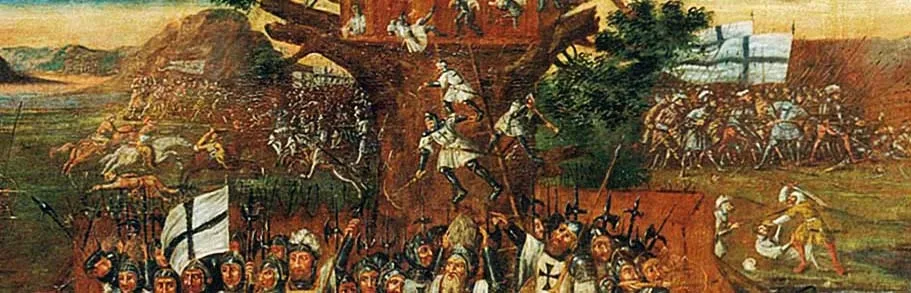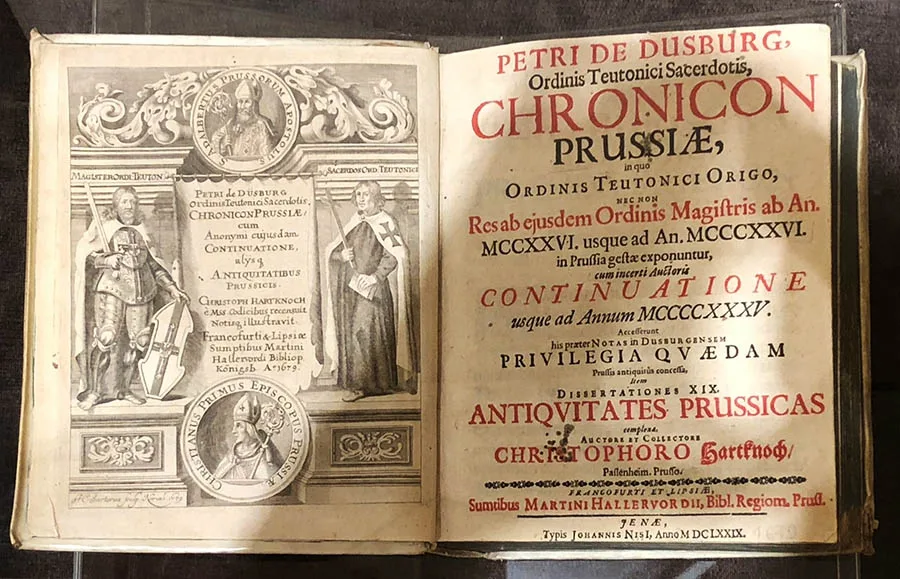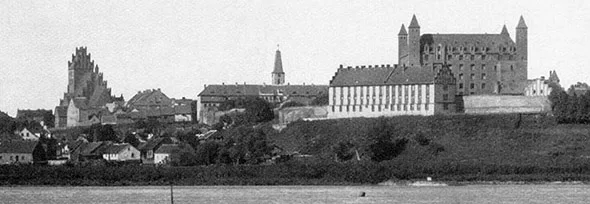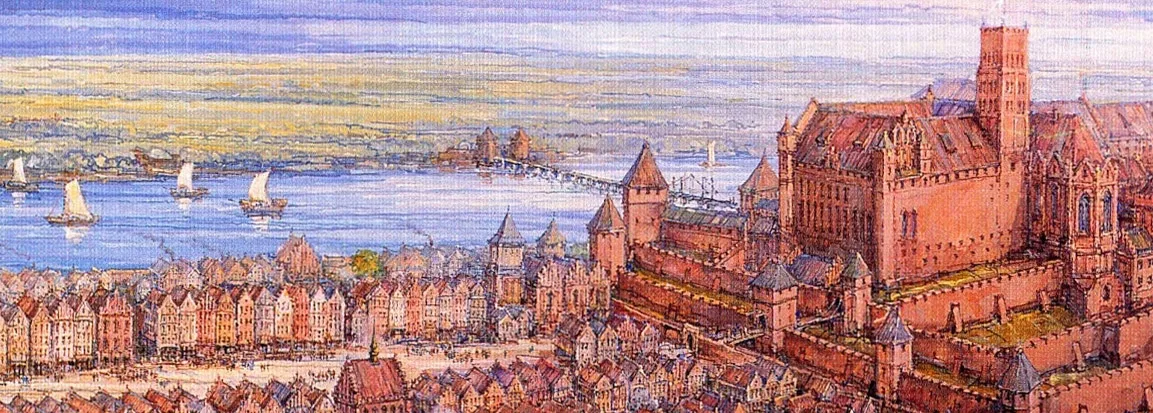
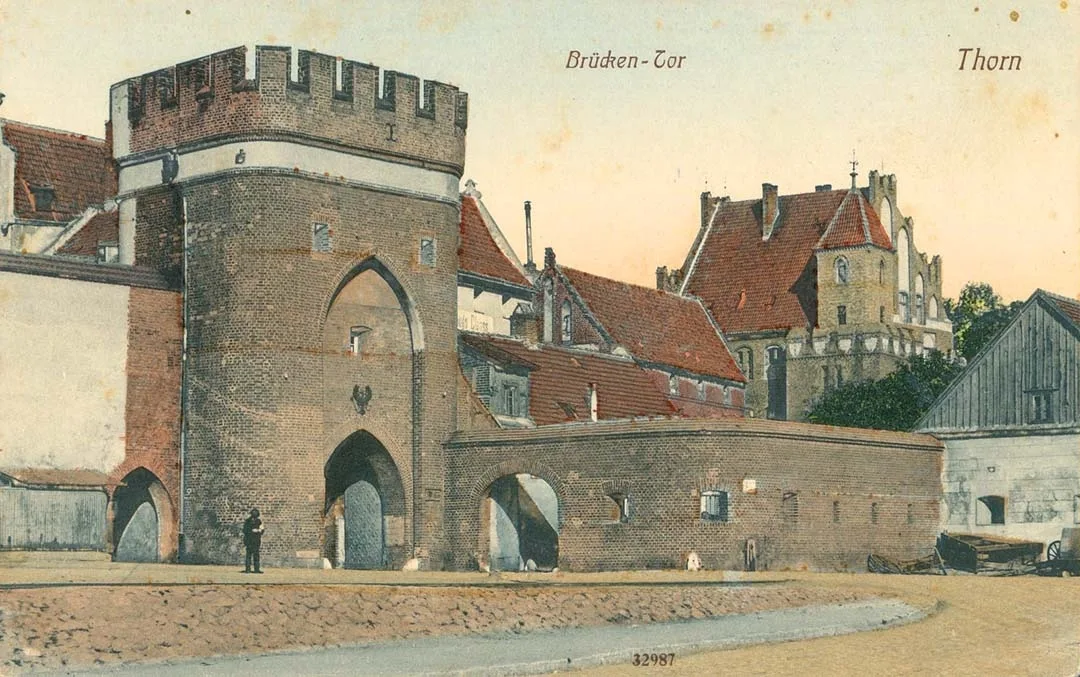
When first two and then another five brethren of the Order arrived in the Kulmerland on reconnaissance, they built, according to the legend recorded in the “Chronicle of the Prussian Land” by Peter of Dusburg, a kind of lookout post in an oak tree, which they surrounded with a palisade. There is every reason to believe that there never was any oak tree, and that the Order’s first fortification was in fact built of oak logs. A settlement immediately grew up next to the castle, and as early as 1233 it was granted town rights. However, in 1236, because of the river’s constant flooding, the castle was moved some seven or eight kilometres to the east, the new one being built on the site of an old Slavic stronghold whose ramparts had survived. The settlement, which already had town rights, moved together with the castle. Thorn and Kulm became the first towns with which the Order concluded an agreement setting out the terms of their existence on the Order’s lands. In drafting the agreement with the townspeople, Magdeburg town law was used, adapted to local conditions; it became known as Kulm law. This law was also applied in agreements with other towns in the State of the Teutonic Order, outlived the Order itself and was replaced by a new municipal code only in the 17th century. Kulm law was in force not only on the lands of the Order but also in Poland, including in towns on the territory of present-day Ukraine and Belarus.
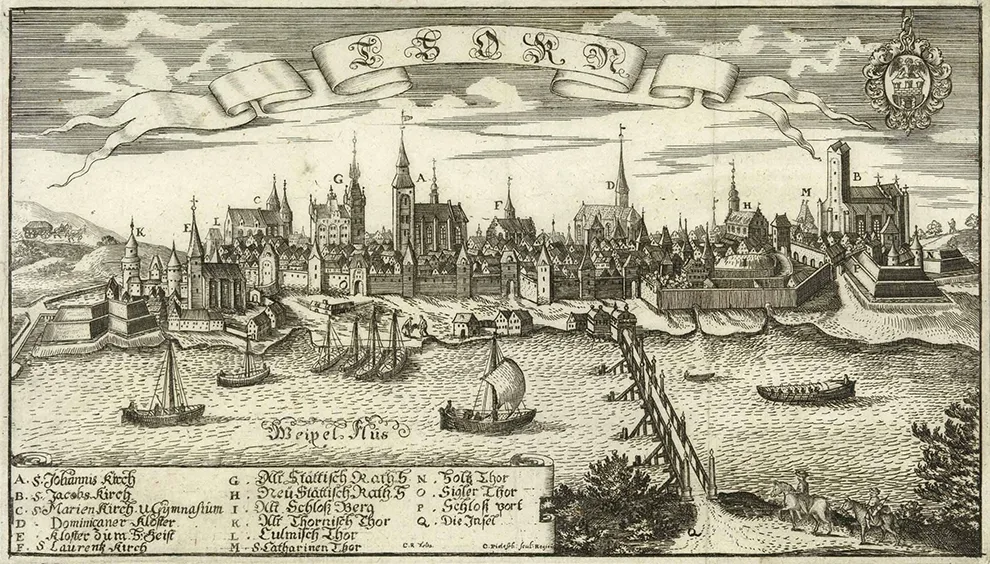
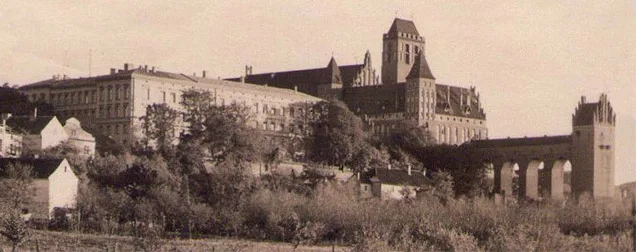
Even before the outbreak of the Prussian uprising in 1260, the castle began to be rebuilt in stone. The construction took several decades. The result was a castle of a shape somewhat unusual for the Teutonic Knights: a horseshoe whose ends were closed off by a rectangular wing.
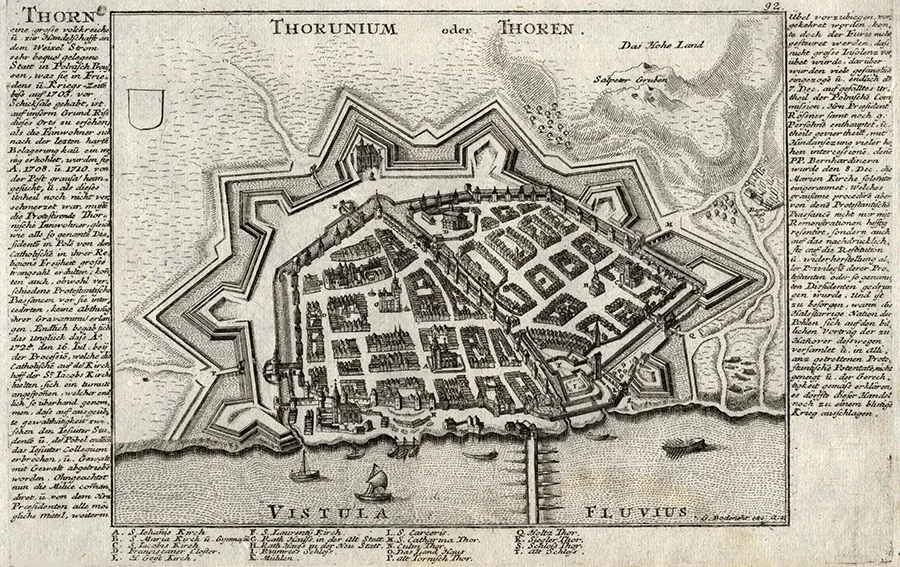
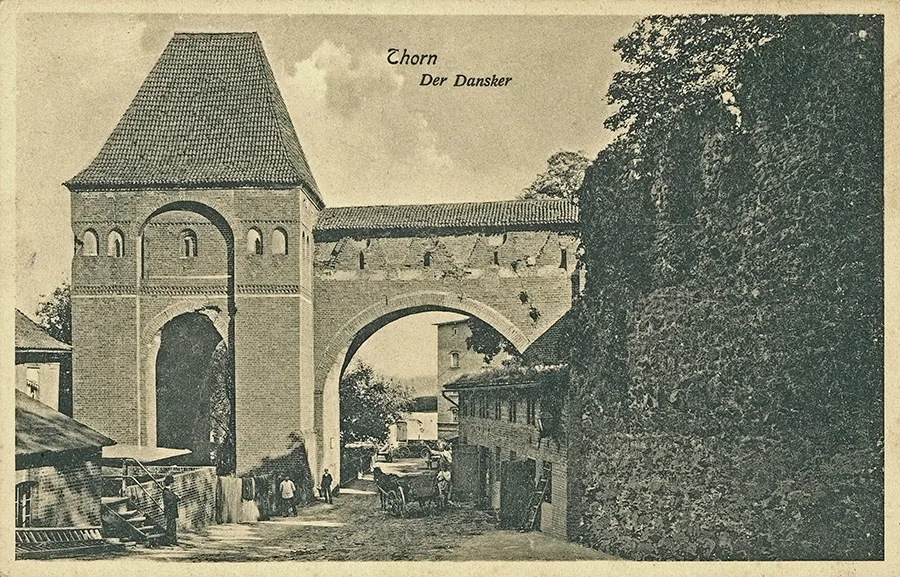
The castle had two towers built into its walls, a tall main tower inside the castle and a danzker tower projecting over the moat, which also served a defensive purpose in wartime. Around this complex, known as the Hochburg, or upper castle, a lower castle was built, consisting of several lines of defensive walls (from two to four) with gates and towers, as well as farm and auxiliary buildings. In size and in the number of its lines of defence, Thorn surpassed Balga, for example, yet the chronicles note that in the 13th–14th centuries its arsenal and garrison were smaller than those of the northern castles. At that time Thorn lay deep in the rear and was therefore out of reach of Prussian uprisings and Lithuanian incursions. At the same time, Thorn Castle and the town beside it were the most important economic centre of the Teutonic state. The castle owned several mills, a brewery and a smithy. On the eve of the Great War, the castle estate had a grain reserve of 550 tonnes, 500 horses, 400 cows and oxen, 3,000 sheep and goats and 600 pigs. The Order’s records also mention 5,000 wheels of cheese, four barrels of butter, 16 barrels of salted lard and many other provisions. In addition, Thorn periodically became a venue for negotiations and the signing of documents: in 1329 a treaty of alliance between the Order and Bohemia was concluded here, as were the two Peaces of Thorn that sealed the Order’s fate — the First (1411) and the Second (1466).
But at the beginning of the 15th century everything changed radically. The worsening of relations with Poland and the union of Poland and Lithuania meant that the flashpoint now lay in the south of the Order’s state, and Thorn found itself within the zone of likely hostilities. All the more so because the Chełmno Land itself had become a bone of contention between the Teutonic Knights and the Poles: the Poles disputed the lawfulness of its acquisition by the Order and questioned both the authenticity of the charter transferring the Kulmerland to the Order and the legitimacy of the provisions of the Treaty of Kalisz (1343). However, the outbreak of war did not bring the expected siege for Thorn and the other border castles, since both armies considered themselves worthy of an unconditional victory and therefore sought a decisive battle rather than frittering away their strength on attacking castles. Such a decisive battle might have taken place near Thorn, where the Polish-Lithuanian army crossed the border for the first time since the truce of 1409. The Teutonic Knights had prepared field fortifications in advance on the plain near Thorn, but the Poles judged the position unfavourable, then declined battle and withdrew into Poland, only to reappear on the Order’s territory considerably further east of Thorn.
After the Order's defeat at the Battle of Grunwald, the defence of the Order's capital, Marienburg, began. While the main fighting of that period was unfolding there, another Polish detachment approached Thorn. The castle's small garrison held out for two weeks but was forced to surrender to the superior enemy forces. After its capture, King Jagiełło granted Thorn to the Polish military commander and official Wincenty Granowski, but that same year Granowski was poisoned by agents of the Order. It is worth mentioning that Wincenty Granowski's wife, Elizabeth (Elżbieta) Pilecka, was the heiress to her father's enormous fortune, and after Granowski's death she went on to marry none other than King Jagiełło himself, who became her third lawful husband (another of Elżbieta's marriages had been declared unlawful and annulled). She did not remain queen for long, however: three years later she died, presumably of tuberculosis.
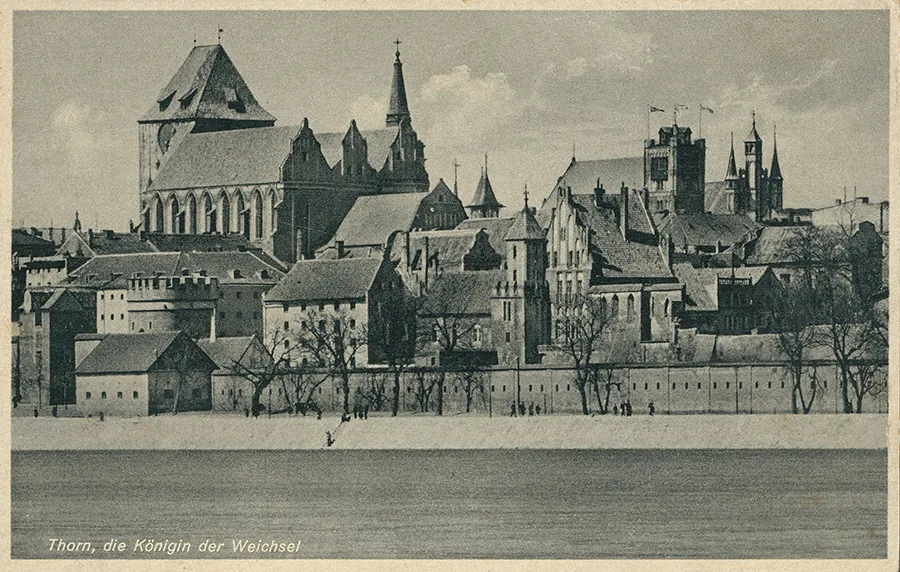
In 1411 the First Peace of Thorn, which ended the Great War, was signed in Thorn. Under its terms, Thorn Castle itself remained with the Order, and Eberhard Hallenfeld was appointed the new Komtur.
The castle had been badly damaged during the war, yet over the following 40 years the work to restore it was never completed owing to an acute shortage of funds. The castle arsenal, however, was modernised to some extent: as early as 1413 it comprised 19 pieces of artillery and hand-held firearms. Twice, in 1414 and 1422, Thorn Castle was besieged by Polish troops, since the First Peace of Thorn had not resolved all the contradictions between the Order and Poland, which led to two wars of low intensity. Both times the castle held. Between these events, moreover, there was a telling episode: in 1420 a fire broke out in the castle. The Komtur appealed to the townspeople for help, but they merely laughed at the knights' attempts to put out the flames.
Its proximity to the Polish border and the considerable Polish population of the town meant that Thorn became the stronghold and instigator of the towns' struggle against the Order. To begin with, in 1440 Thorn, together with 20 other Prussian towns, was among the founders of the Prussian Confederation of towns. The Order tried to have this confederation declared illegitimate; at first it lost the dispute, but later, with the backing of the German emperor, it succeeded in having the Prussian Confederation declared legally unlawful. By then, however, neither the towns themselves nor the course of history cared about such a ruling. The Order had ceased to be the undisputed master of its own land, and the development of European society, economy and warfare meant that the Order as an organisation was becoming superfluous there. Europe was undergoing an intensive process of forming fully fledged nations, at the core of which stood monarchs vested with absolute power. But since Prussia had no such monarch, the townspeople considered themselves free to swear allegiance to any overlord, be it the Polish king, the Order or anyone else. Nor did they see any betrayal of national interests in this, because such interests simply did not exist. From a military point of view, the Order, as a knightly organisation, had become an outdated structure. Now a hundred townsmen with clumsy arquebuses could, with a single volley, dispatch to a better world a dozen or two well-armed knights who had spent years honing their martial skills. Not long before, such losses would have marked a major battle and an irreparable loss for the brotherhood of the Order; now they could happen within a few minutes in the opening phase of a battle. The Order itself, too, increasingly resorted to the services of mercenaries, as this was both safer and more effective. Thus the role of the Order as head of state and as its military force was rapidly waning.
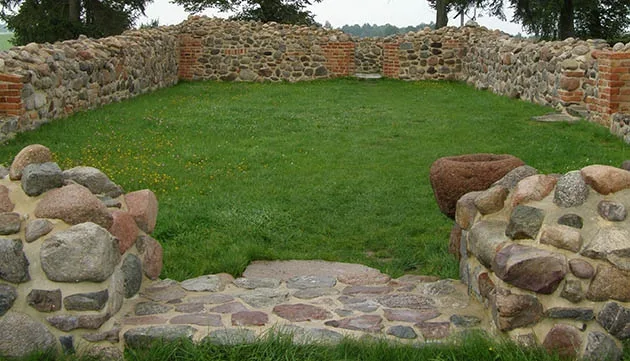
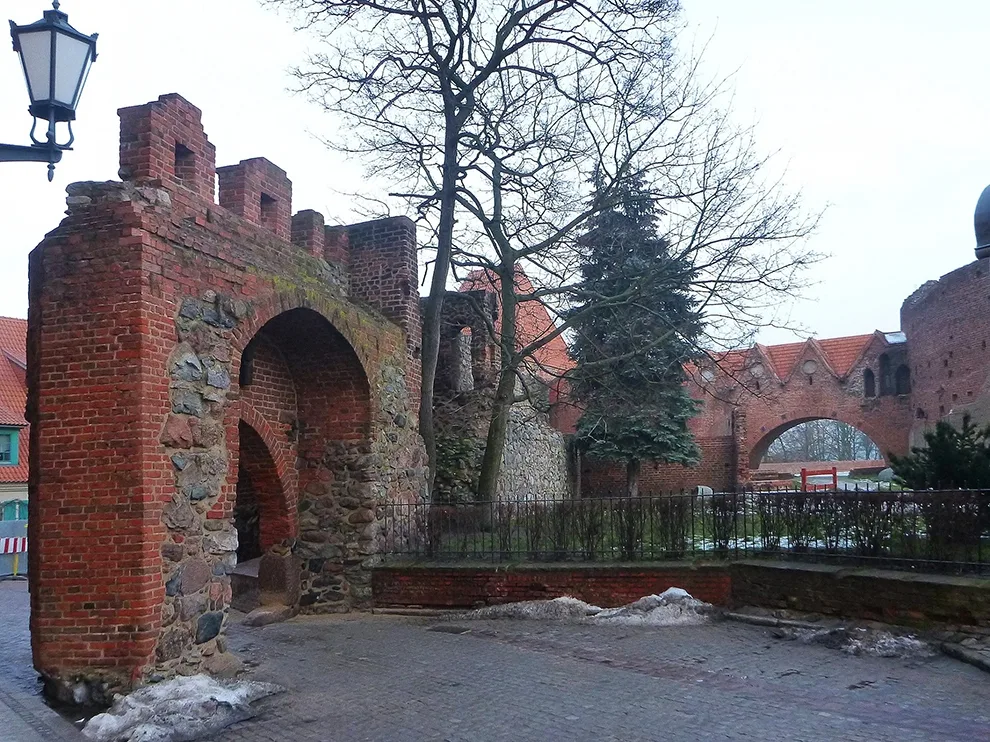 Ruins of the castle in Toruń. The town came through the Second World War unscathed. But its castle had been destroyed long before.
For Thorn it all began on 6 February 1454, on the third day of the Thirteen Years' War. On that day a delegation of Thorn's townspeople came to the castle and demanded that the Komtur come out to negotiate, which in itself was a flagrant breach of feudal subordination.
Astonished by such unprecedented insolence, all twelve knights of the castle decided not to open the gates and to ask the capital of the state what this démarche meant and how the castle garrison ought to respond. Naturally, they did not know that similar situations were already unfolding around dozens of the Order's castles.
Two days later a large town army appeared beneath the castle walls and demanded its surrender. Komtur Albrecht Kalb rejected the ultimatum, threatened the rebels with reprisals and prepared to repel an assault. Soon, however, it became clear that the castle could not hold out for long and that no help from the Order's army was to be expected. The Komtur then surrendered to the townspeople on condition that the defenders' lives be spared and that they be free to leave the castle. The Thorn magistracy then decided that the very presence of the Order's castle by its walls was a constant threat, and that the castle must therefore be demolished. The townspeople welcomed this decision with enthusiasm and began dismantling the castle for building material. Soon all that remained of it was the danzker tower and the ruins of the wings. After the war ended in 1466, Thorn found itself in the territory ceded to Poland. The castle was never rebuilt; on the contrary, its remains continued to be taken apart for bricks. Nevertheless, the danzker tower has survived to this day in a somewhat truncated form, and the arcaded gallery leading to it has also been somewhat altered. The tower and the ruined walls are now protected as a historical and architectural monument and are included in tourist routes.
Illustrations: Bildarchiv Ostpreußen, bildarchiv-ostpreussen.de, Mikhail Ogorodnikov
Translated from Russian with the help of AI (Claude, Anthropic), October 2026.