Between 1935 and 1944, when the castle was administered by the Administration of State Palaces and Gardens in Prussia (Berlin), the rooms inside it were used as follows:
West Wing
In the early modern and modern periods, the first, second and third floors of the west wing were occupied by the Castle Church, which had earlier hosted coronation ceremonies. According to a 1938 guidebook, admission to the church was free. Sadly, all of its sumptuous furnishings burned to ashes under British bombs on the terrible night of 29–30 August 1944.
The fourth floor of this part of the Royal Castle was named the “Muscovite Hall” (Moskowitersaal) in memory of the Grand Embassy of 1697. Here, on 30 September 1881, after the Prussia Museum moved from the Castle Tower into five new rooms in the north and west wings of the castle, a military history exhibition was opened (from 27 November 1925 known as the “Hall of East Prussian Glory”).
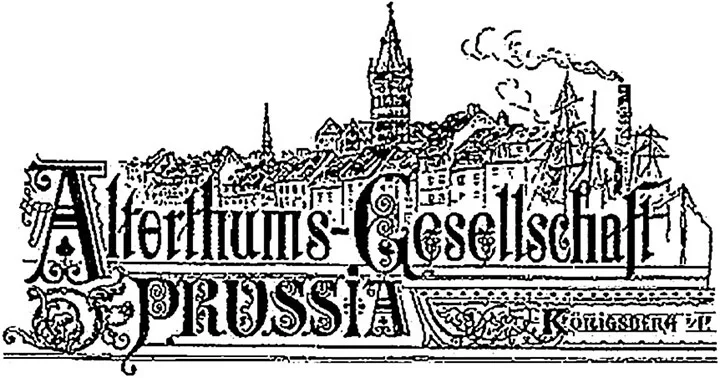
The very logo of the Prussia Antiquarian Society (see above), to which the museum belonged, featured the Castle Tower — the historical and cultural axis of Königsberg.
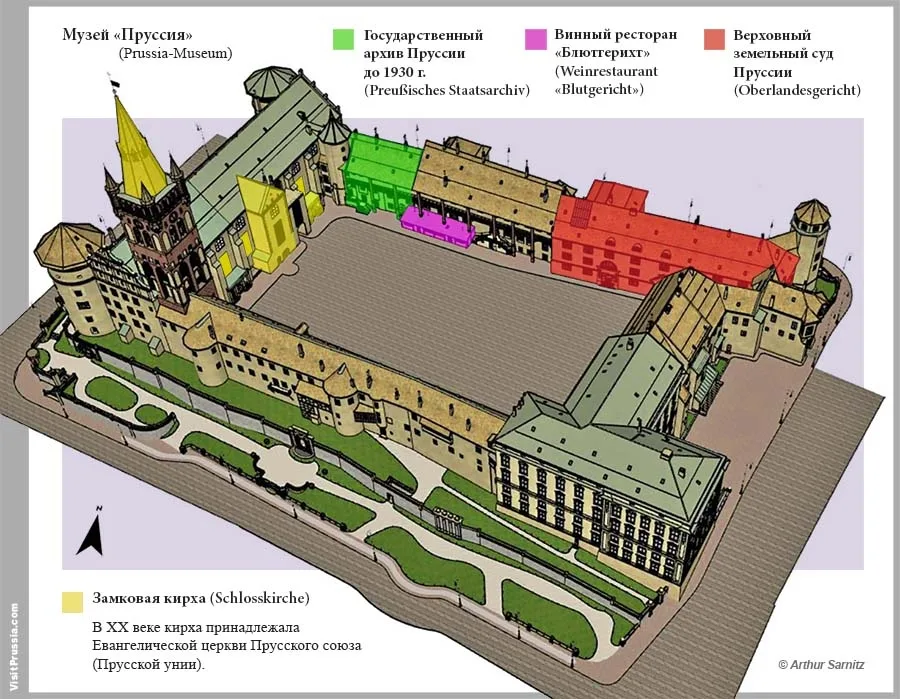 Königsberg Castle, from 1881 onwards, was gradually transformed into the main regional museum of local history; besides the museum, it continued to house a church, the state archive, a restaurant and a court.
Military relics had been kept in the Castle since as early as the beginning of the 19th century (?). All of them were later displayed in the “Hall of East Prussian Glory”. On 24 April 1924, the regimental colours of the units that had fought in the Battle of Tannenberg in August 1914 were handed over to the Prussia Museum. They, too, were given a place of honour in the “Muscovite Hall”.
In 1944, the colours, together with many other exhibits of the Prussia Museum, were evacuated to Lochstedt Castle (now on the outskirts of Baltiysk), where this part of the museum's collection was seriously damaged in the fighting of spring 1945. It was finally lost in 1947, with the involvement of a group of staff from the Kaliningrad Department of Culture led by A.P. Boyko, when a checkpoint was being built at the entrance to Baltiysk.
The walls along the staircase by which visitors climbed to the “Muscovite Hall” were hung with paintings of East Prussian landscapes and portraits of famous historical figures.
In the small anteroom before the entrance to the “Muscovite Hall”, a Renaissance ceiling had been preserved; it also held antique cabinets of local make and the table on which the Prussian crowns were laid during the first coronation ceremony in 1701.
Regimental colours of the 18th century were displayed on a special wooden balcony fixed to the east wall of the hall. The hall housed an exhibition of military equipment and weaponry. Among the exhibits were insignia and orders, uniforms, battle plans, and models of old cannon and fortifications.
Numismatic and sigillographic collections were also kept here. The coins in this collection may well have been Prussian issues of the early modern and modern periods. Could this have been the collection found in the 1950s by “seekers” who, as the local historian A.P. Ovsyanov points out, put its weight at 10 kg of silver?
One of the coins kept in the display cases on the fourth floor of the west wing fell down when the castle was destroyed and ended up in a wall opening on the eastern face of this wing's cellar.
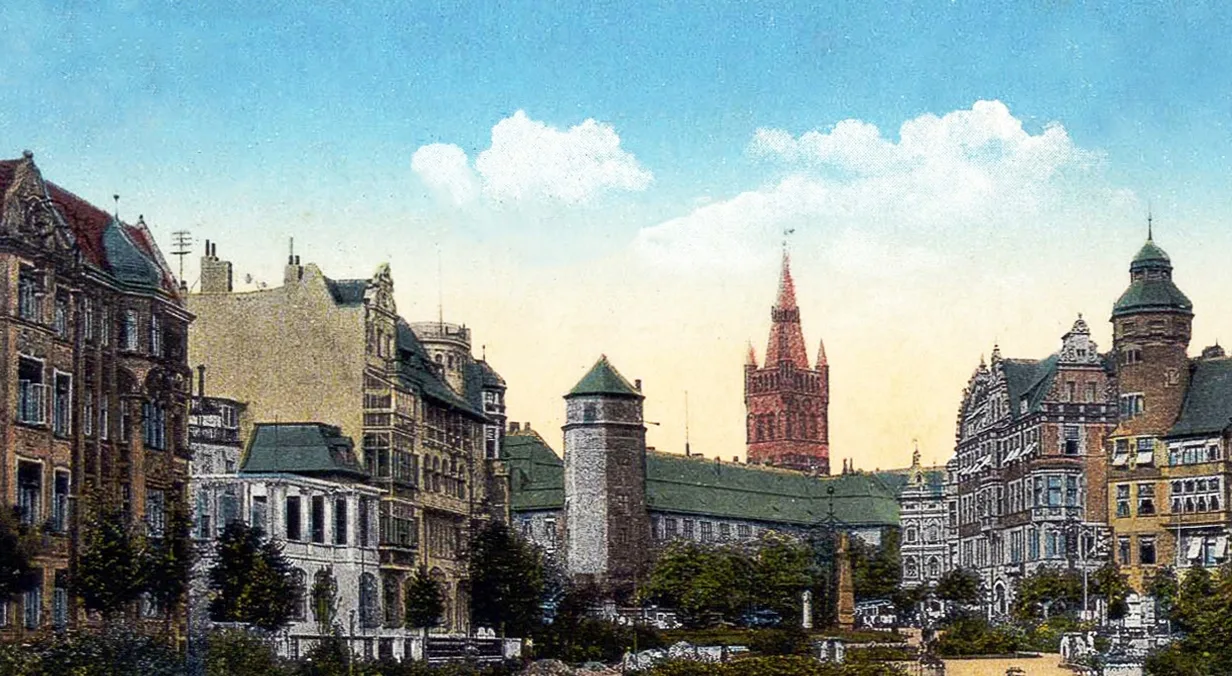
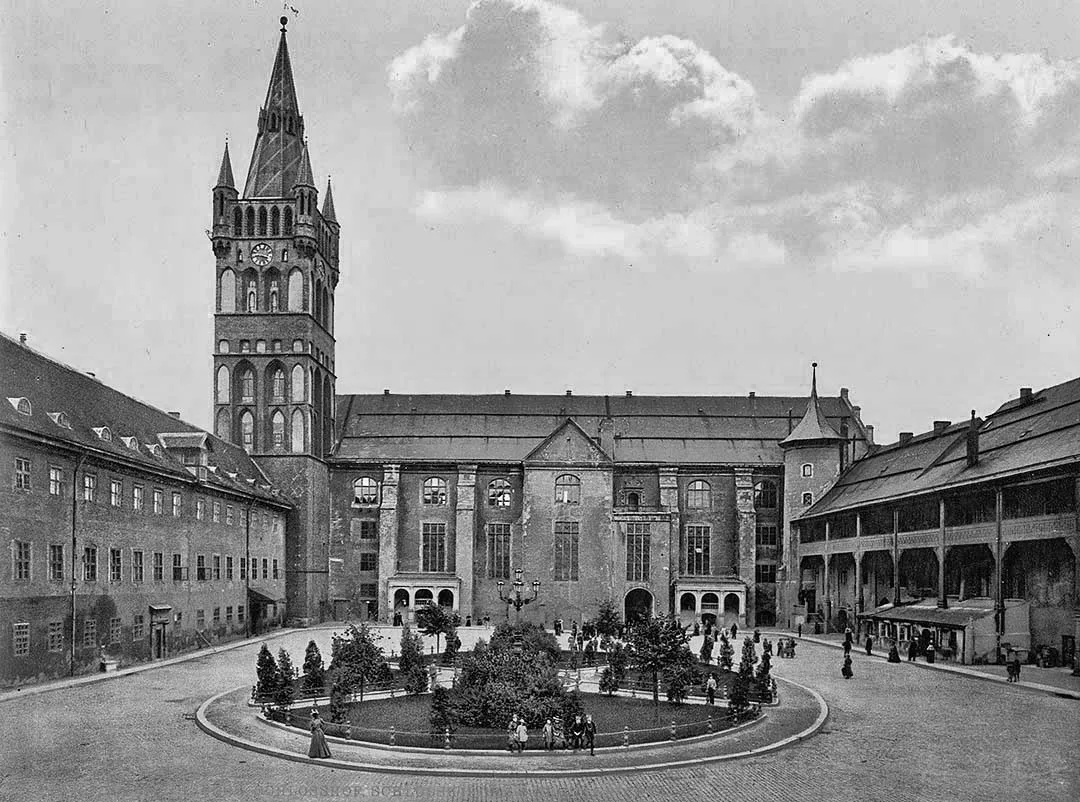
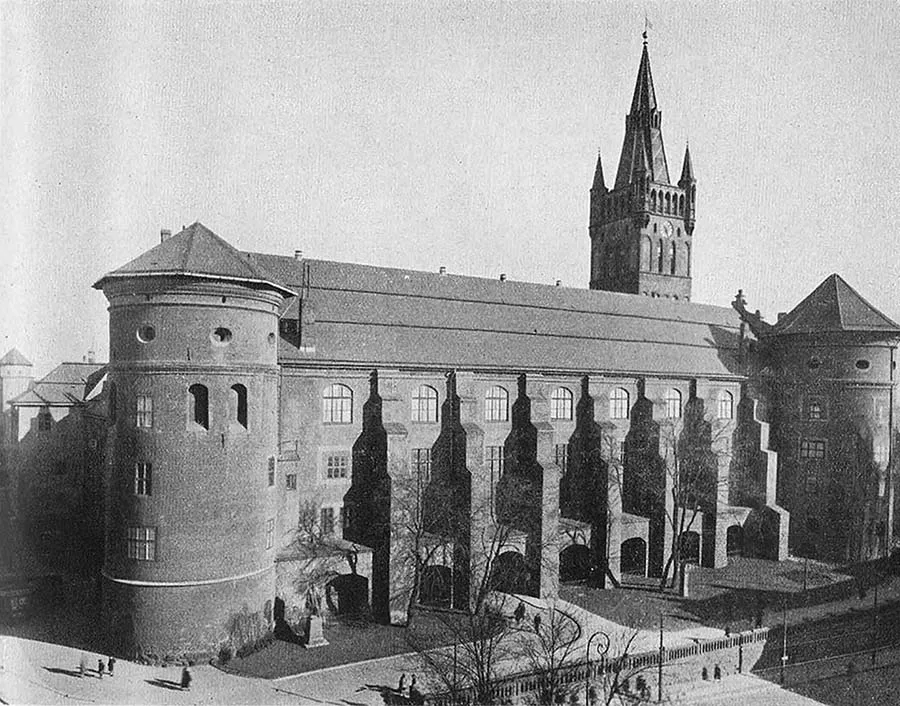 West wing of Königsberg Castle. In the foreground is the Berwart Tower, named after the architect Blasius Berwart, who designed the wing and both of its towers in the 16th century.
This exhibit is a rare five-mark coin struck during the brief months of the reign of one of the most enigmatic monarchs of Prussia and rulers of Germany — Kaiser Friedrich III.
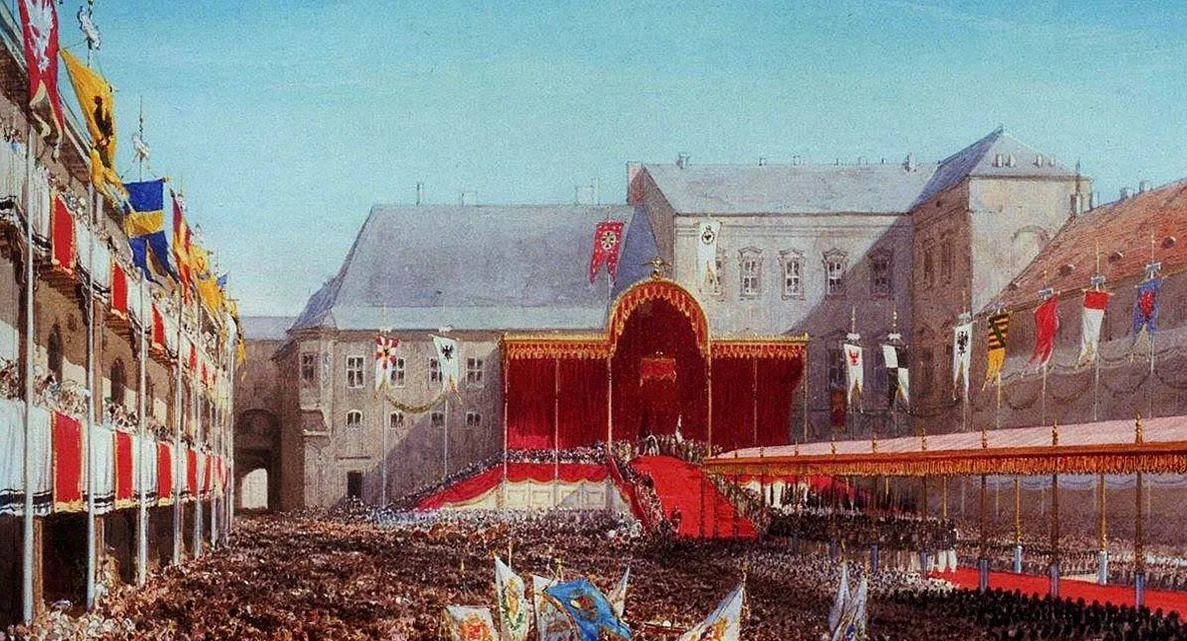
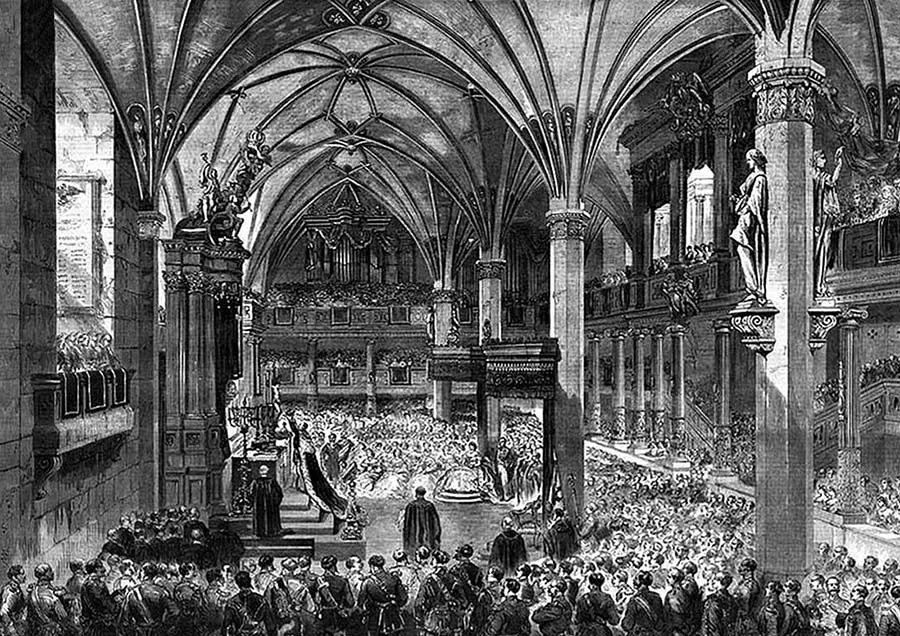 The coronation of Wilhelm I in the Castle Church on 18 October 1861.
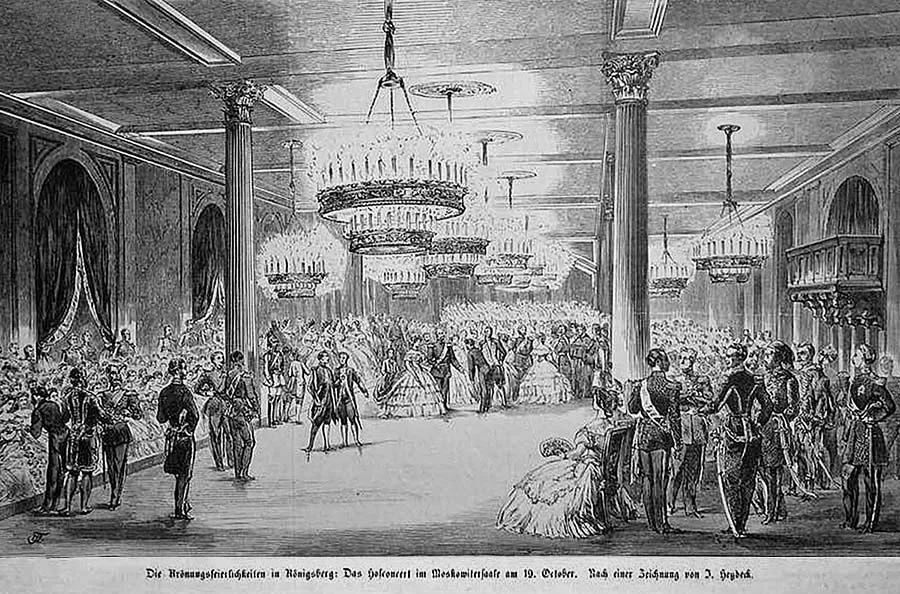 On the day after the coronation of Wilhelm I, a ball was held in the “Muscovite Hall” above the church.
Friedrich III reigned for ninety-nine days in 1888, but before that, while still crown prince, he had helped Prussian archaeology find its feet. With his support, a Prussian section was assembled for the exhibition held to coincide with the 11th congress of the German Anthropological Society (Deutsche Gesellschaft für Anthropologie, Ethnologie und Urgeschichte). The exhibition took place in Berlin from 5 to 21 August 1880, and the Prussian archaeological display astonished visitors with its unique scientific value. It marked the beginning of the rise of Prussian archaeology, whose material still underpins the chronological framework of European antiquities of the first millennium AD.
One result of the crown prince's support was the expansion of the displays and holdings of what was then the Provincial East Prussian Museum, which was reorganised into the Prussia Museum at the beginning of the 20th century.
To conclude this account of the museum exhibition in the “Muscovite Hall”, its historic interior deserves a mention, as it was in itself a fascinating sight for visitors.
In addition, in the west wing, beside the main exit (formerly the West Gate of the castle), through which coronation processions had traditionally passed since the time of Friedrich I, there were small rooms that also belonged to the Prussia Museum.
They displayed works of folk art (above all, Masurian woollen carpets of the 17th century). Admission cost 30 Reichspfennig.
In the early 1920s, the leadership of the Prussia Antiquarian Society and of its Prussia Museum moved, together with their collections, from premises on Königstraße (Königstraße, 65, now Frunze Street) to the second floor of the south wing of Königsberg Castle, and in July 1924 a new museum exhibition (history and ethnography) was opened, occupying virtually the entire western part of the quadrangle formed by the castle buildings. From 27 November 1925 it formed the core of the newly established Prussia Museum.
Owing to the financial difficulties of the years of economic crisis after the First World War, all museum exhibits owned by the Prussia Antiquarian Society passed, from 1925, into the care of the Province of East Prussia.
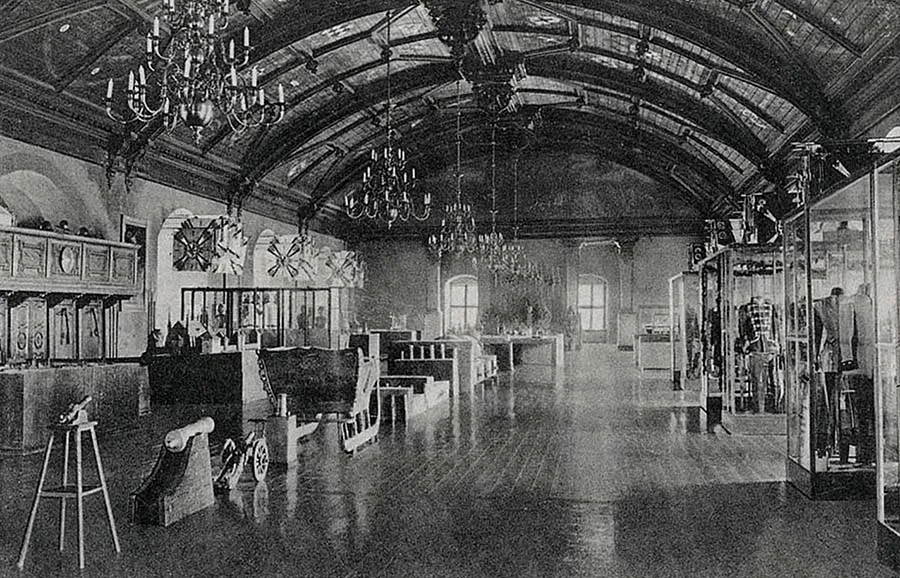 The museum in the “Muscovite Hall” above the Castle Church in the west wing.
Unfortunately, the upsurge in museum activity that had begun in the 1920s came to a halt in the years before the war. The last issue of the yearbook published by the Prussia Antiquarian Society was printed in 1940.
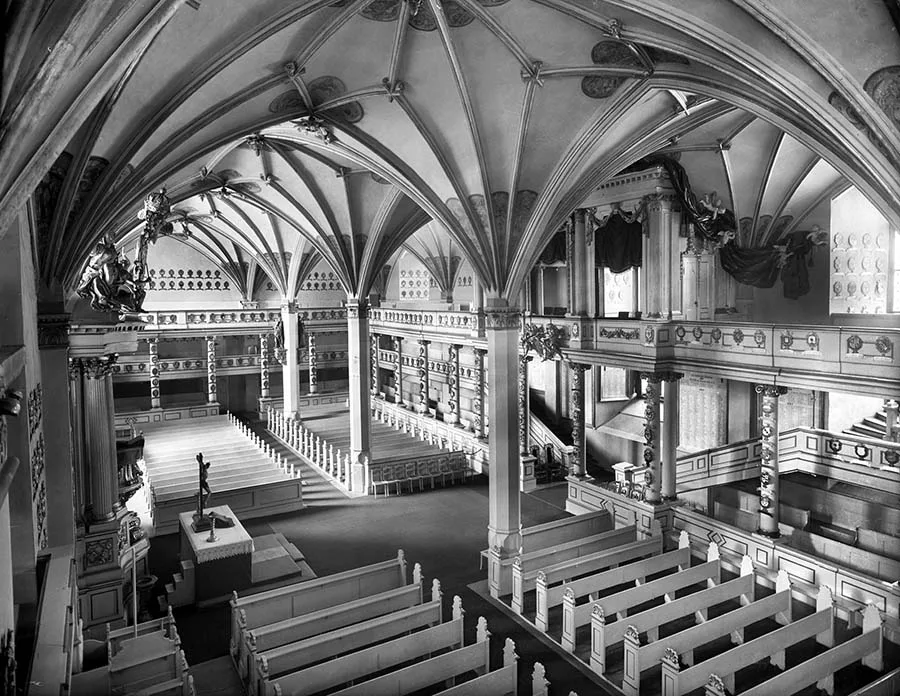 Interior of the Castle Church in the west wing.
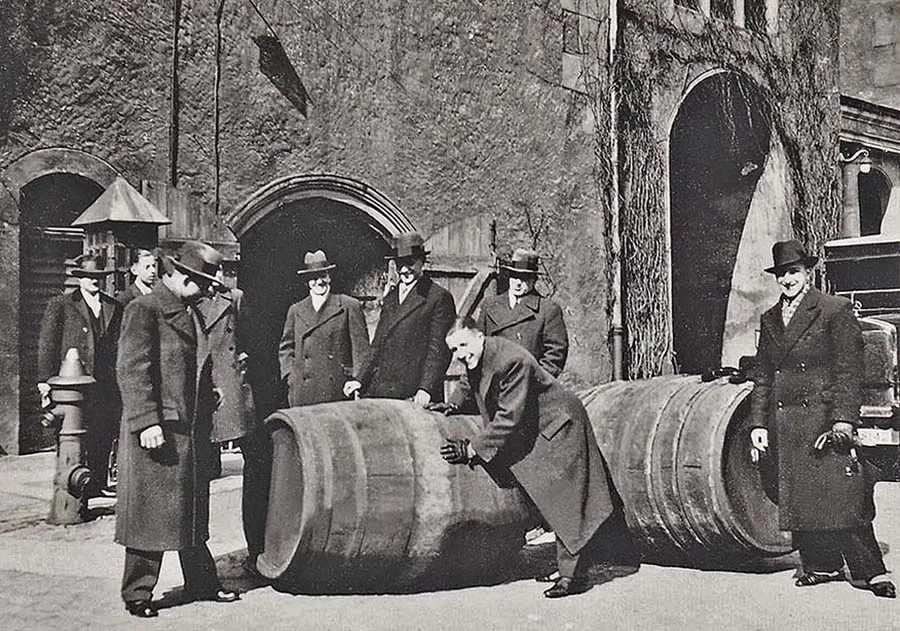 In the cellars beneath the west wing (beneath the church!) the wines of the Blutgericht restaurant were stored.
Mention should also be made of several rooms in the west wing that had no museum function. Among them was a cellar measuring 67 x 13 m, covered by a Renaissance barrel vault. Until April 1945 it housed wine stores and the bottling of wine for the Blutgericht restaurant. According to A. Orlov and Ye. Storozhenko in their book “Secrets of the Royal Castle: A Narrative in Letters, Testimonies and Documents”, the cellar belonged to the firm of David Schindelmeisser (founded in 1738), which from 1921 was run by Karl Matzdorf.
To this day, it is still not entirely clear how the southern façade of the west wing acquired its pseudo-Gothic elements in the form of vertical mast-like shafts built of moulded brick. They evidently appeared in 1866, when the spire of the neighbouring Castle Tower took on the same stylistic features. In the pre-war period, however, this façade of the west wing was already decorated with S-shaped volutes. The change took place during the last restoration of the Castle (1938?).
The South Wing
The semicircular Wirzburger Tower (Wirzburgers Turm, built in 1519), which adjoined the Castle Tower almost directly on its eastern side, housed the office of the museum's director, Dr Wilhelm Gaerte (1891–1958). In the rooms to the west of this “director's” tower was the museum's extensive library, which apparently held not only books but also the manuscript collection of museum inventories.
Further west, a corridor led to the Corner Tower (Hintersterort Turm), where the renowned Prussian archaeologists Carl Engel (1895–1947) and Hans Crome (1864–1943) had their studies.
East of the director's quarters, on the first floor of the south wing of the castle, was the museum's prehistoric exhibition.
It was precisely at this spot in the castle, on the second floor of the south wing next to the Castle Tower, which was also the tower of the Castle Church, that on 25 April 1945 "representatives" of Moscow State University found 20 armchairs from the museums of Tsarskoye Selo and 12 picture frames from the Kyiv Museum of Western and Oriental Art. On the first floor of the south wing, the university envoys also discovered the Donations Book of the City Art Museum, which listed the Amber Room (Bernsteinzimmer) under No. 141.
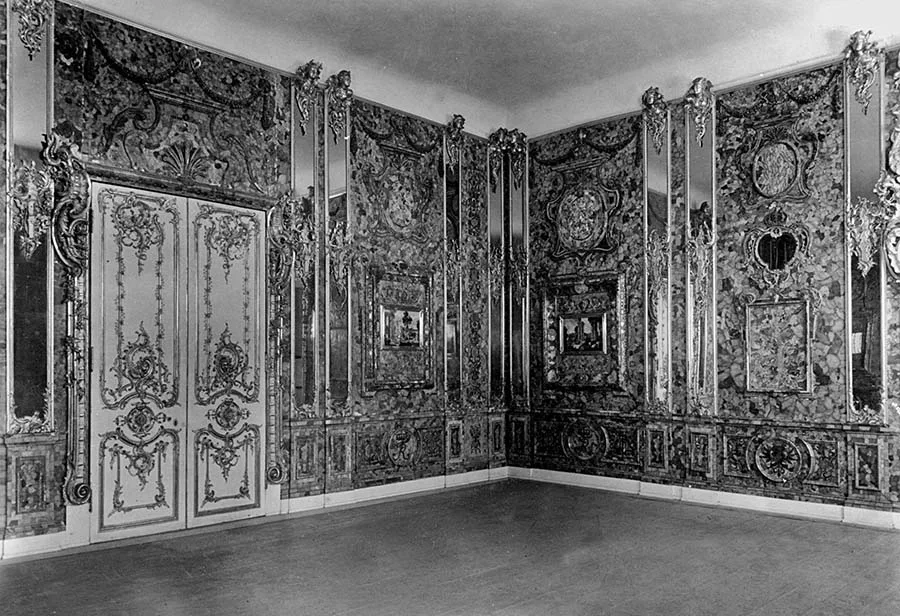 The Amber Room in Königsberg Castle.
The hall on the second floor of the Castle Tower, reached by a corridor from the south wing (?), housed the exhibition “Prussian Crafts of the 17th–19th Centuries”.
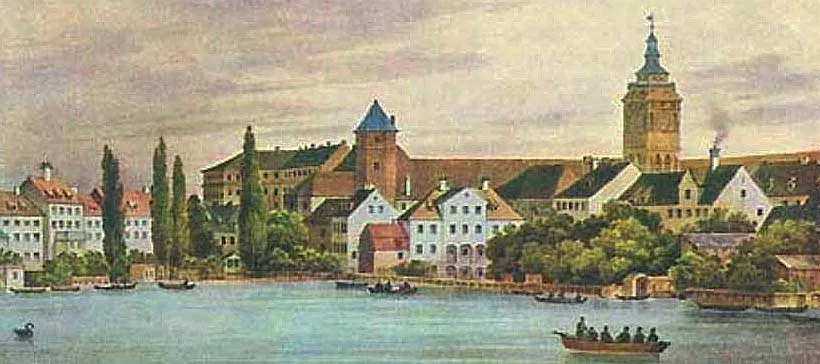
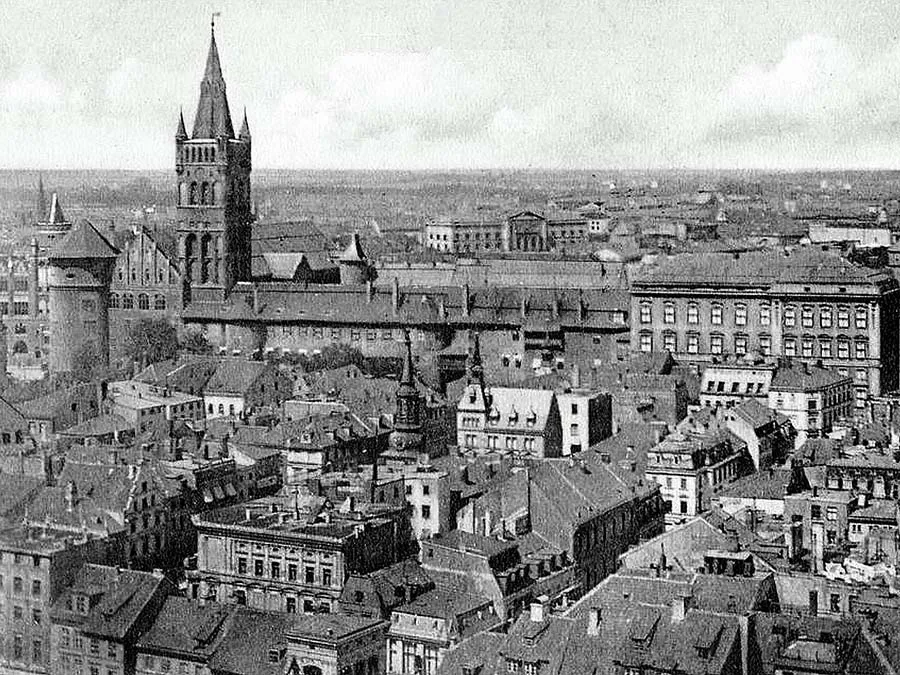 The south wing of Königsberg Castle faced the Altstadt (in the foreground) and the Pregel.
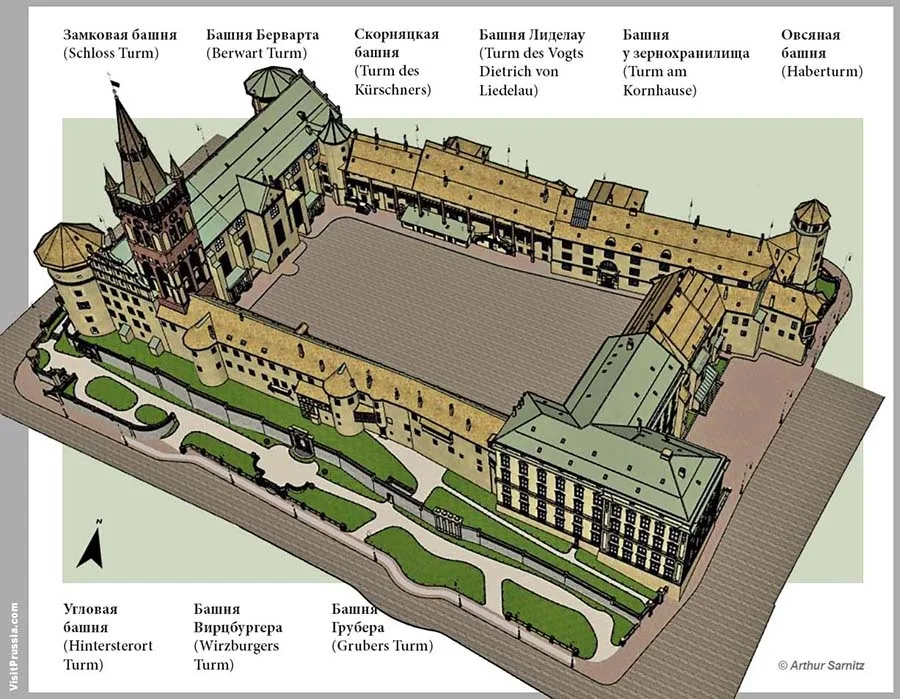 The towers of Königsberg Castle.
According to a 1938 guidebook, admission to the exhibition in the south wing cost 30 Reichspfennig. Here, between the Wirzburger Tower and the Gruber Tower (Grubers Turm), six museum halls were created at the beginning of the 20th century. Hall 1, the largest, contained Stone Age antiquities; Hall 2 displayed finds from the Bronze Age; Halls 3 and 4 presented material from the 1st–2nd and 3rd–4th centuries AD respectively; and Hall 5 was devoted to exhibits from the 5th–8th centuries AD, including material from the West Masurian flat-grave cemeteries of Tumiany and Kielary (Daumen und Kellaren, former district of Allenstein), which contained burials from the 6th–7th centuries AD. This hall also had a section of “late pagan” antiquities of the 9th–13th centuries, where everyone's attention was drawn to the finds from the barrows at Kaup (Kaup bei Wiskiauten, former district of Samland, now the village of Mokhovoye in the Zelenogradsk District of the Kaliningrad Region), a world-famous Viking Age site. Finally, Hall 6 displayed artefacts from the 14th and 15th centuries.
The south wing also housed a carpentry workshop, where the craftsmen Hase and Huse worked for the museum's needs. In addition, the well-known restorer Fritz Jentsch carried out restoration work here.
The museum's scientific and technical staff took an active part in the restoration work; among them was J. Wilczek, who also served as the driver of the museum's car. The tour of the prehistoric exhibition ran from west to east, from the Wirzburger Tower to the Gruber Tower and beyond. Visitors entered this part of the exhibition from the castle courtyard through a portal in the south-western corner (it was there, before the war, that a white marble torso of Aphrodite of unknown origin stood to the right of the entrance, and to the left the Yotvingian stone figure Mankesteen (Mankesteen, also known as Männchenstein), which is now in the archaeology hall of the Kaliningrad Museum of History and Arts). Tickets were bought at the entrance. The exit led into the Castle Garden (Schloßgarten) through the so-called “Little Door Facing the Town” (Turlein gegen die Stadt).
The museum staff were active in research and public education, producing display boards for schoolchildren and local historians with photographs of archaeological sites of particular importance to Prussian history and of the finds made during their excavation. Photographic copies of these boards could be purchased at the entrance.
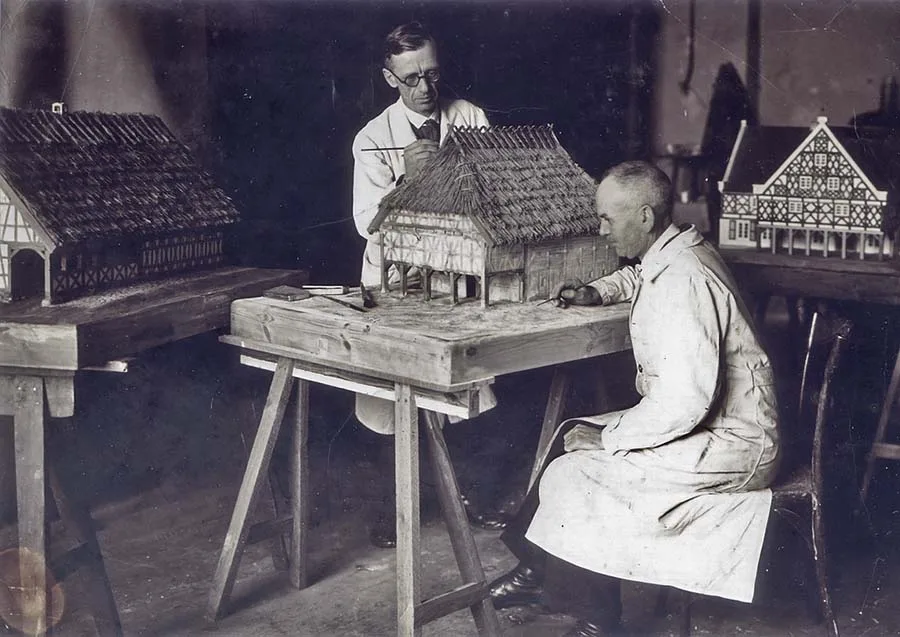 Model makers at work on a model of a farmhouse in the former royal castle.
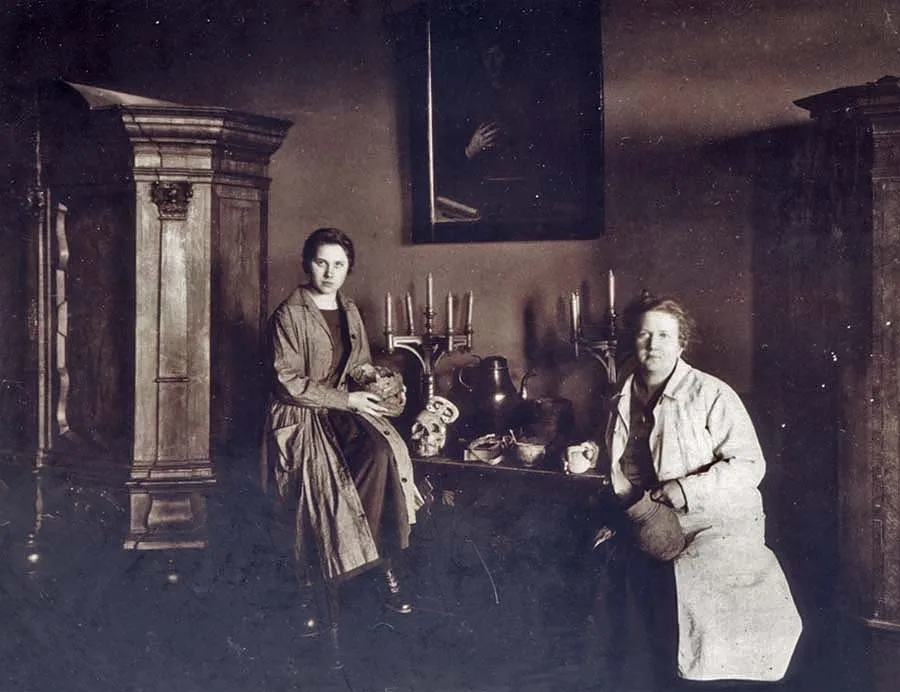 Female museum staff in Wilhelm Gaerte's office.
The cellars of the south wing, which were also used by the Prussia Museum, held a small part of its archaeological holdings (Studiensammlung).
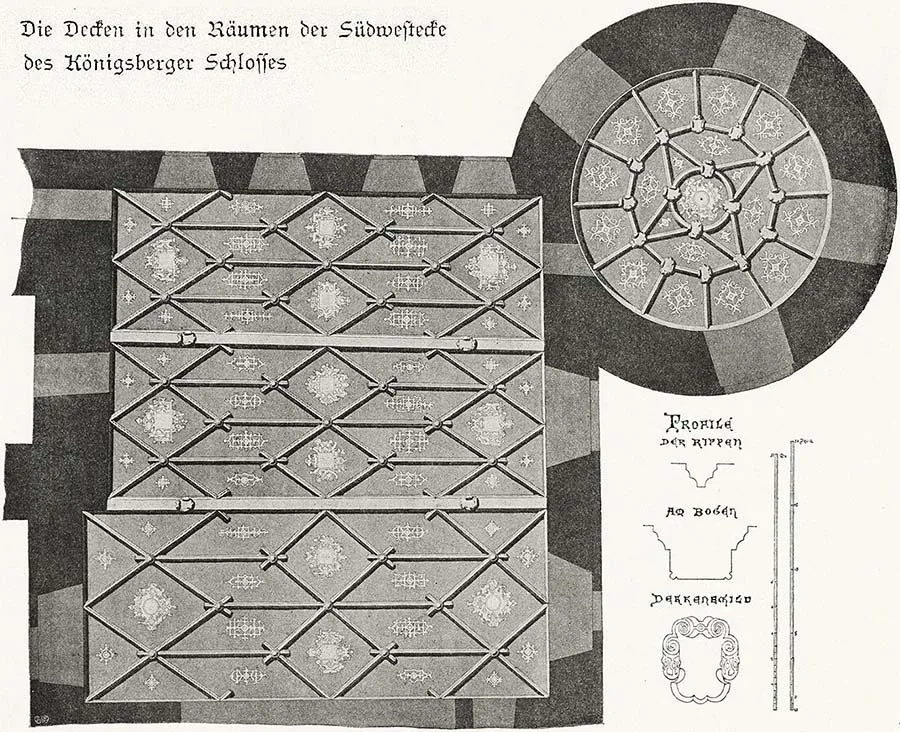 Renaissance ceilings in the rooms of the south wing and the Corner Tower.
Here the finds, grouped by archaeological assemblage, were tagged with inventory numbers, wired onto cardboard boards and placed on shelves. After the war, only a tiny fraction of the museum's archaeological exhibits happened to remain in the castle, and these were found by us during archaeological excavations.
The bulk of the unique artefacts from the museum's exhibition, which had been badly damaged by British bombs at the end of August 1944, was evacuated (regrettably, too late) in January 1945 to Fort No. 3 on the outer ring of Königsberg's fortifications (now the village of Severnaya Gora). For many decades the finds lay under the feet of the fort's occupants. Only at the turn of the century, in 1999–2002, did a group of Kaliningrad museum workers led by A.A. Valuev gather the remains of this collection and incorporate them into the holdings of the Kaliningrad Regional Museum of History and Arts. In its display cases, visitors today have a wonderful opportunity to see the treasures of the Prussia Museum brought back to life by restorers.
Interestingly, in the cold winter of 1945 the Germans removed from the castle not only genuine archaeological finds but also the teaching replicas that the museum's craftsmen had made to show the young people of pre-war Prussia in local history lessons.
Entrance 6a led to the second floor of the south wing, which housed the City Art Collection. Admission cost 20 Reichspfennig.
Works of art from the time of the Teutonic Order up to the present day were displayed here. There was also an extensive collection of amber. These rooms regularly hosted exhibitions organised jointly with the Society of Art Lovers. The art exhibition also extended into the "Unfriedt wing", which formally belonged to the east wing.
The North Wing
The eastern part of the north wing, on the first and second floors, was occupied by the Regional Court. In the western part (the infirmary in the time of the Order), the oldest of the castle's buildings to have survived into the mid-20th century, a passage to the Convent building, destroyed in the 16th century, was preserved on the first floor (or in the cellar?). From 1881, five halls on the second floor of this wing housed the collections of paintings and other exhibits of the Art Society (later the City Art Museum). Part of this exhibition was later moved to the second floor of the south wing and to the "Unfriedt wing".
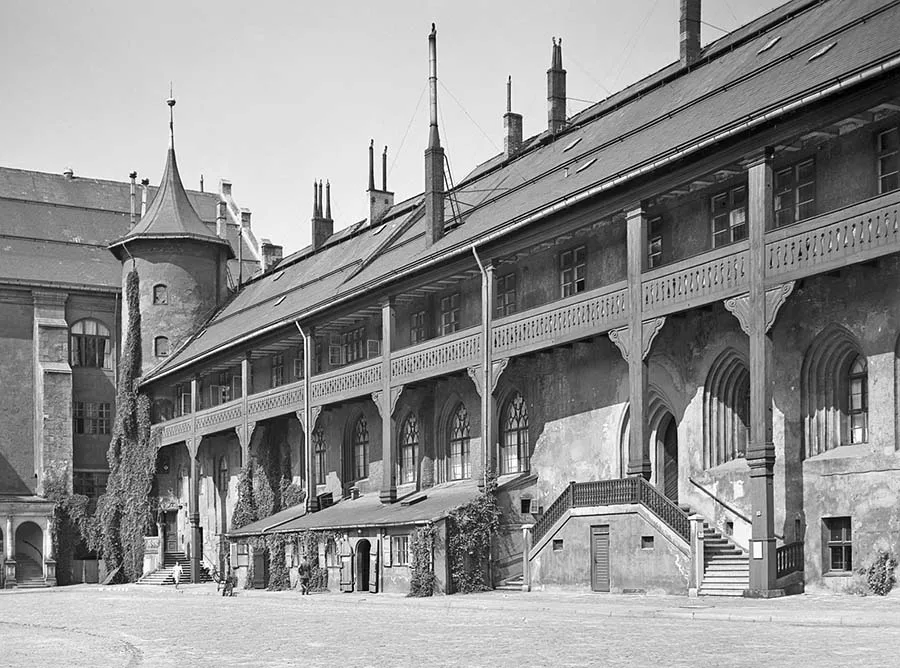 The north wing was most often photographed from the courtyard, where the entrance to the Blutgericht and the Tournament Gallery were located.
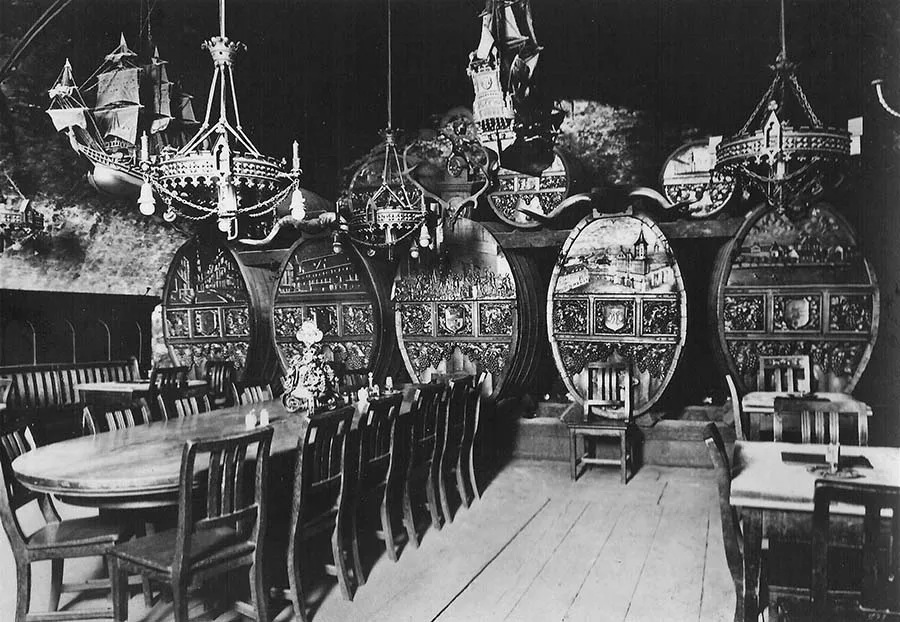 Interior of the Blutgericht restaurant with carved barrels and model sailing ships hanging from the ceiling.
The “Silver Library” remained in the north wing, where it was kept throughout the war years as well.
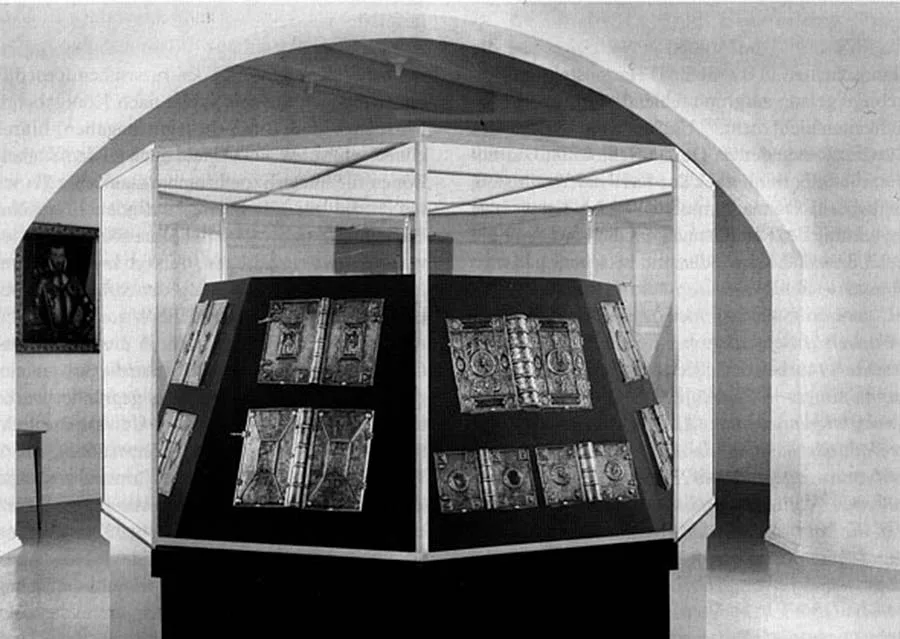 Glass display case with the “Silver Library” in the Consistory room.
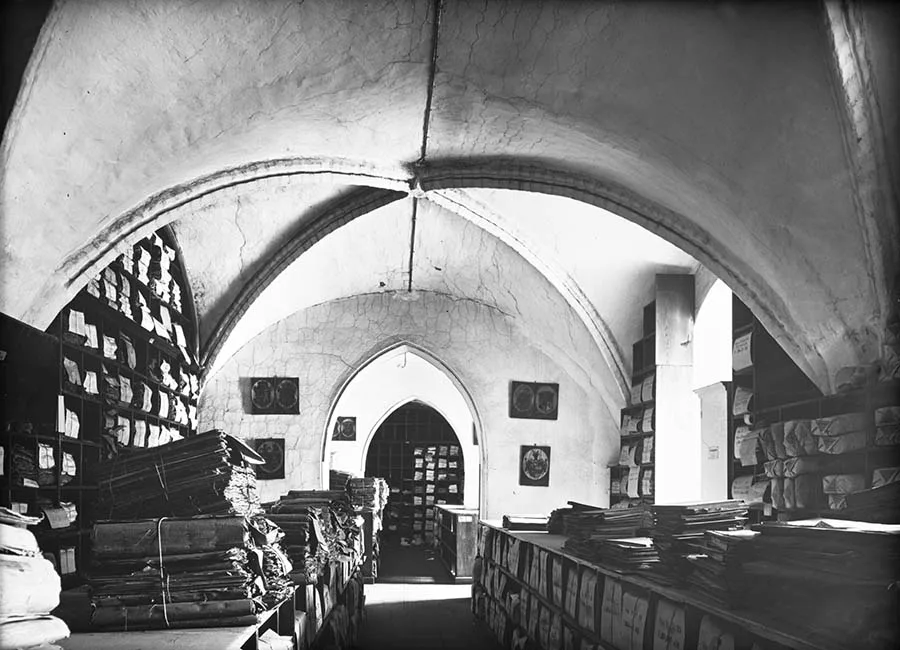 The State Archive was also housed beneath the medieval vaults of the north wing.
According to the 1938 guidebook, admission to the exhibition in this wing cost 24 Reichspfennigs.
According to Heinrich Lange, it was in the tower marking the north-western corner of the castle courtyard, the so-called Furrier's Tower (Turm des Kürschners), that the German surgeon Professor Oskar Ehrhardt found the bas-relief "Man with a Skull" (see below), a work by Hans Schenck dating from 1550. This bas-relief originally stood in the "Albrecht House" in the east wing of the Castle, where it adorned the portal of a hall whose walls were faced with glazed tiles. In the mid-20th century, on the orders of Alfred Rohde, director of the Königsberg Castle Museum, the bas-relief was moved to room No. 13 in the Furrier's Tower. Supposedly, in 1948 the surgeon in question sent this bas-relief (which had been kept for a time at St. Elizabeth's Hospital) to Germany on a hospital train.
A certain Red Army soldier, with whom the bas-relief had been sent, sold it in Germany to a Dr. Franke, from whom in 1958 the piece returned to the care of the Palaces and Gardens Administration in Berlin.
It remains unclear, however, how a nameless serviceman could have carried such a rarity to his new posting and sold it with impunity. Those who remember the Stalin era may well have serious doubts about the accuracy of this version of events.
The north wing housed an exhibition of funerary urns ranging from the Neolithic to the middle of the 1st millennium AD, kept in numerous cabinets in a hall on the third floor directly above the Blutgericht restaurant (Blütgericht). Visitors were not admitted to the urn hall. As the eminent Estonian archaeologist Professor Dr. Marta Schmiedehelm, who visited Königsberg in 1940, recalled in 1974, these urns were the only category of archaeological finds displayed in the Prussia Museum without their accompanying grave assemblages.
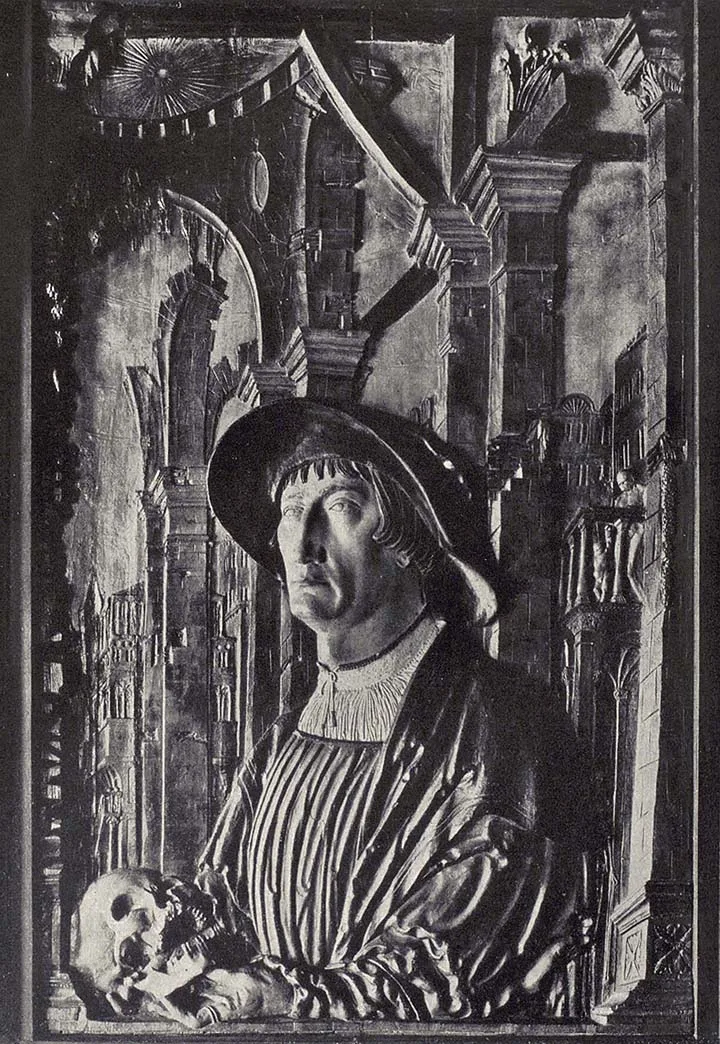
The bas-relief "Man with a Skull". Wood. Hans Schenck, c. 1550.
In 1943 (?) part of this collection (several dozen vessels) was evacuated to the area around Rastenburg (Kętrzyn, Poland) and is now on display in museums in Olsztyn and Warsaw.
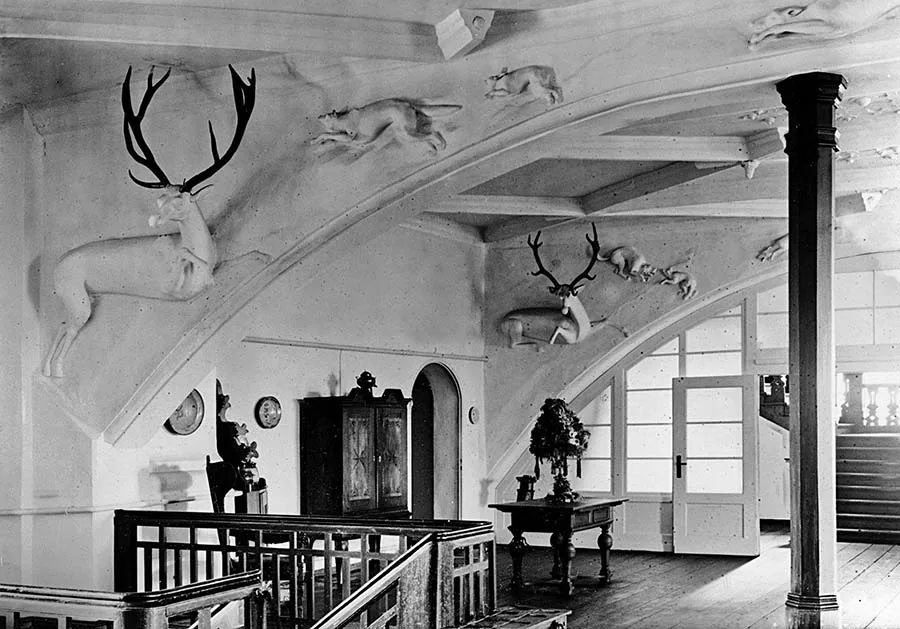 The Hunting Hall in the north wing was, thanks to its decor, one of the most memorable.
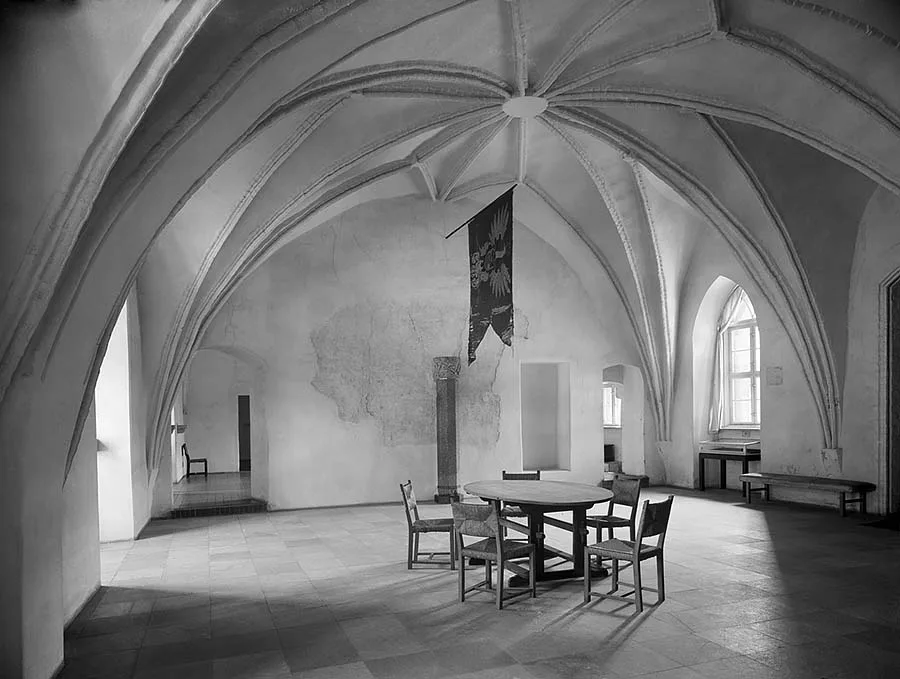 The Order's infirmary once served as a hospital and almshouse.
The information that has come down to us about the museum's collection of urns, as indeed about the museum departments "Folk Crafts" and "Population and Border Policy", which were also located in the north wing, is extremely scant. In the immediate vicinity of this exhibition, from 1738 onwards, were the premises of the historic Blutgericht restaurant, which occupied the cellars beneath the north wing, where, according to local legend, in the late Middle Ages trials were held and cruel punishments carried out.
The last director of this restaurant was Paul Feyerabend, who in the summer of 1945 assisted those charged with searching for cultural treasures.
East Wing
Its rooms, which made up the historic "Albrecht House" — whose exterior decoration retained the features of the 16th-century Baroque — were turned into exhibition halls after the administrative offices moved out at the turn of the 19th and 20th centuries, becoming historical exhibits in their own right. This applies above all to the Banner Hall, which in the 18th and 19th centuries had been the venue for audiences and state receptions held by the Prussian kings and German Kaisers [emperors]. According to Thilo Eggeling, a present-day German specialist in the preservation of historical and cultural monuments, a considerable number of paintings and pieces of antique furniture were taken from the castle westwards in 1944 (?) to Rheinsberg Palace, from where these treasures were subsequently looted and thus irretrievably lost. The inventory records for these works of art suffered the same fate.
The fate of the records of the directorate of the Municipal Art Collections, kept in the cellars of the east wing, is unknown.
Besides the museum complex, until 1944 the east wing housed the East Prussian Building Construction Office. The opposite, west wing was home to another building organisation — the Provincial Building Authority.
The castle had many rooms whose appearance had taken shape in the Middle Ages. This was especially true of the second floor of the east wing, where, above the Albrecht Gate, visitors to the Prussia Museum could see the study of the first Duke of Prussia, the Throne Hall, the Hall of the Order of the Black Eagle (the "Eagle Hall"), the Hall of the Hohenzollern Dynasty (the "Hall of Ancestors") and the room where King Frederick I was born. In the north wing, the Grand Master's chamber, St. Anne's Chapel and the castle kitchen remained open to visitors right up to 1944.
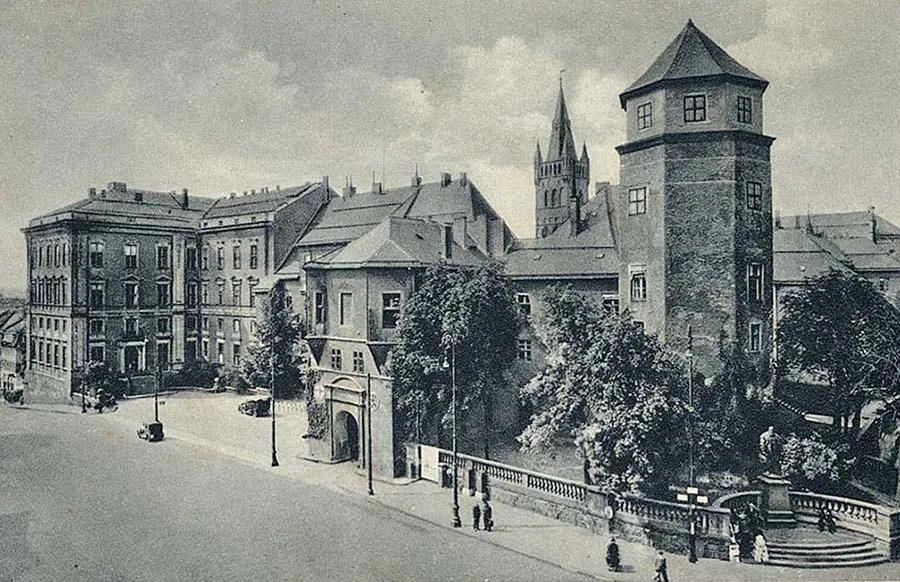 The east wing of Königsberg Castle consisted of the "Unfriedt wing" (left) and the "Albrecht House" with the gate of the same name. The monument to the first Prussian duke originally stood nearby.
The Oat Tower (Haberturm), which rose at the corner of the east and north wings (see above), also retained its original medieval "face".
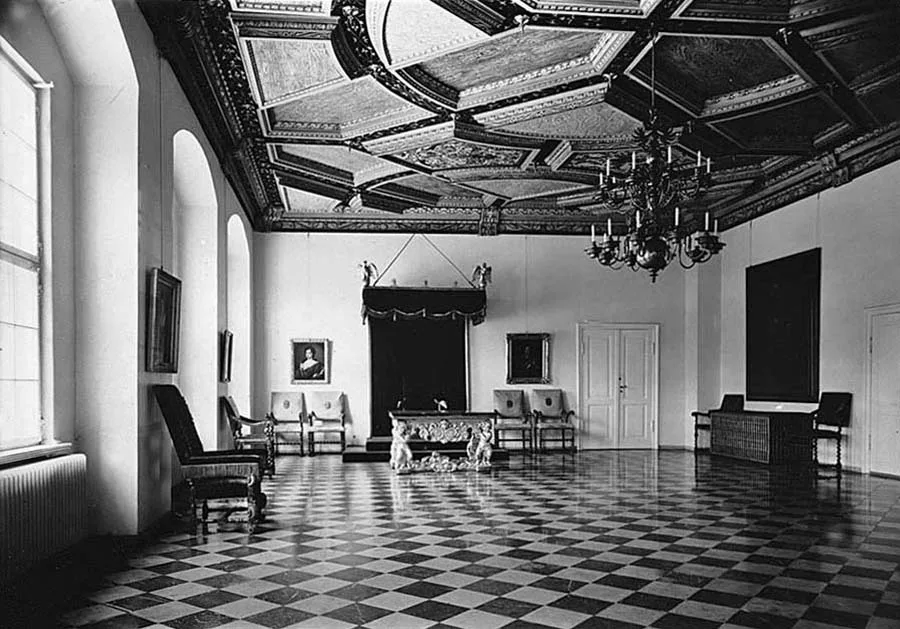 The windows of the "Tiled Hall" looked out onto the castle courtyard.
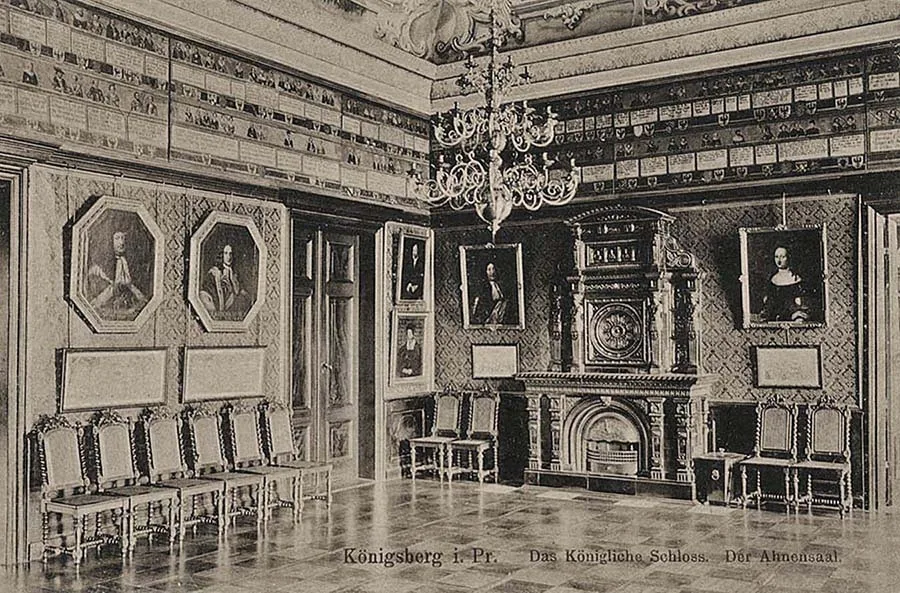 The "Hall of Ancestors" of Königsberg Castle.
Adjoining the east wing to the south-east was the "Unfriedt wing" (Unfriedtbau). Here, during the Second World War, an exhibition devoted to the East Prussian painter Lovis Corinth opened on the bel étage (a raised ground floor) in room No. 36, where sixteen of his works could be seen. The decor of this room included bronze sculptures by Edwin Scharff. Here too, in hall No. 37, the panels of the Amber Room were displayed in 1942–1944 (and possibly in early 1945). All the exhibitions listed above formed part of the Municipal Art Collections.
In early April 1945, a Volkssturm battalion first-aid post was located on the ground floor of the "Unfriedt wing". Remains of its equipment were found in the ruins of this part of the castle both in 1967–1969 and during the excavations in the winter of 2006.
As A. Orlov and E. Storozhenko write in their book, on the morning of 10 April 1945 white flags were hung out on the south façade of the castle and in its courtyard by Paul Feyerabend, the last director of the historic Blutgericht restaurant.
Several dozen exhausted defenders of the castle who had been unable to escape through the underground passages (all other ways out of one of the last strongholds of "Fortress Königsberg" had been cut off) trudged to the prisoner assembly point in the Reichsbank building (the castle's outer bailey).
The first wave of refugees from besieged Königsberg left for the west in January–March 1945. The second consisted of townspeople deported by Stalin (on the advice, it is said, given to him at the Yalta Conference in the summer of 1944 by the far-sighted Churchill, who was already laying the foundations of a skilled labour market in post-war West Germany); in 1947–1948 they ended up in what would become the federal states of Schleswig-Holstein and Hamburg. For all these sufferers who had miraculously survived, the silhouette of the spire of Königsberg Castle, soaring proudly into the sky, remained forever etched in memory as the sacred image of their Prussian homeland. On 28 May 1955, some 25,000 former Königsbergers took part in the celebrations of the 700th anniversary of the first Prussian capital, held in Duisburg. On Lotharstraße they were astonished to see a painted plywood model of the south-western part of the castle, which had become the symbol of their native city. In 1968, the Königsberg city museum "Haus Königsberg" was founded in Duisburg under the auspices of the Society of Natives of Königsberg; it exists to this day [2008 — ed.] under the unbroken directorship of Lorenz Grimoni.
In the early 1990s, Horst Dühring built a model of the castle's west wing as it looked in the 18th century for this museum.
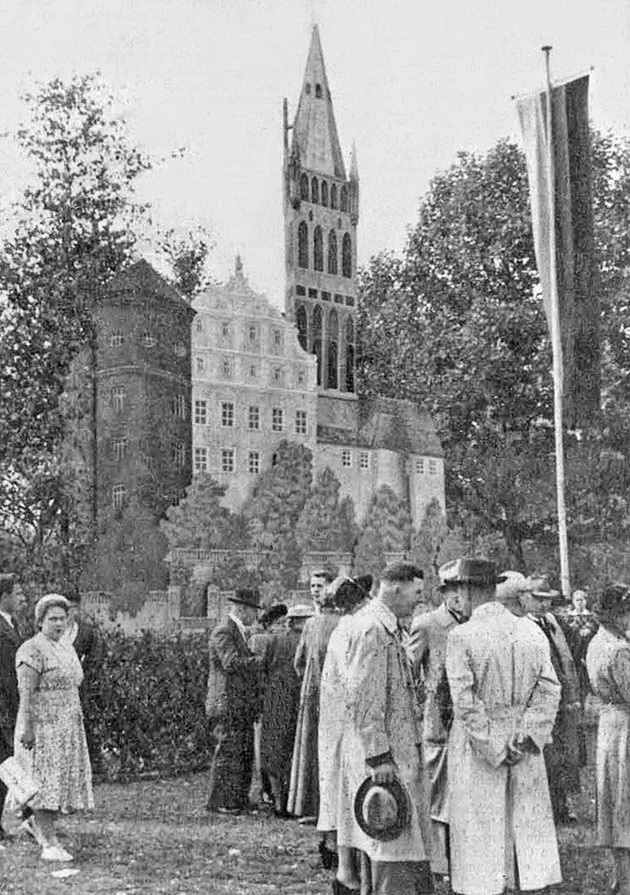
Model of Königsberg Castle in Duisburg (1953).
_______________
In 2008, the Kaliningrad publishing house Zhivyom released the book “The History of Königsberg Castle” by Vladimir Ivanovich Kulakov, Doctor of Historical Sciences and professor; the full book is now available for download on Prussia.Online. With the author’s permission, we are publishing selected chapters.
Translated from Russian with the help of AI (Claude, Anthropic), October 2026.