LEGENDS OF PRUSSIA on the blog of Tatyana Kolivay.
When we think of our dear home city, which of us does not remember the confectioneries of Königsberg with joy and longing? How wonderful it was to sit on the terrace of Schwermer's café (Schwermer) on warm summer evenings, when people strolled along the embankment of the Castle Pond and boats decorated with lanterns glided quietly to and fro on the dark water! And how modestly Schwermer had started out on the west side of Mint Street (Münzstraße)!
Who does not remember the wonderful pastries of Kurt Gehlhaar's confectionery (Gehlhaar)? Who does not recall the splendid confectioner Arthur Tobias of Kneiphof Long Street (Kneiphofische Langgasse), whose father ran a bakery in Königsberg for many years? The “Plouda” confectionery (Plouda), which had a marvellous view of the Hundegatt (Hundegatt) with its granaries? And finally, the “Zappa” confectionery (Zappa)? The last two even featured in the 1914 “Baedeker” guidebook (Bädeker) with the terse note: “In both, marzipan 4 marks per 1 kg”. The “Müller” confectionery (Müller), formerly “Barthel” (Barthel), where street urchins used money begged on the street to buy big bags of cake crumbs, something the author himself witnessed at first hand? The confectioner Ernst Schulte, who invented the best macaron1 cakes in Königsberg? The “Neuhaus” confectionery (Neuhaus) on the Steindamm, just past the church, which sold wonderful orange pastries (sadly, it did not survive the First World War), the “Petschlies” confectionery (Petschlies) and many, many others.
And here we are not even mentioning the cafés of Königsberg: they completely lacked the intimacy peculiar to the confectioneries.
The ever-lively Café “Amende” (Amende), which grew out of the Etablissement Villa Bella, Café “Benther” (Benther), later “Liedtke” (Liedtke) in the Tiergarten, and the “Hammerschmiede” (Hammerschmiede, “the forge”), so charmingly situated under the poplars on the bank of the Twin Pond (Zwillingteich)!
And what delicious pastries they had! The Königsberg philosopher Rosenkranz, a native of Magdeburg, devoted a separate chapter to the confectioneries of Königsberg in his 1842 “Königsberg Sketches”. In it he remarks that the quality of cakes, pastries and biscuits increases the further north-east one travels. Incidentally, any traveller of our own day will confirm this. The pastries of Italy are now quite inedible. In Austria we spoiled Königsbergers wonder how the locals can rave about their dry Linzer and Sacher tortes, for all their “whipped cream”! Munich with its smoke-filled cafés is no better!
But even before the world wars, if you travelled to Mitau, Riga or St Petersburg, you could see for yourself that the refinement of the delicacies increased from city to city, and I mean not only the splendid Russian cuisine but also the most delicious confectionery. This was, of course, largely to the credit of Königsberg confectioners, who were in great demand in Russia.
Rosenkranz investigated the reason for the high quality of our confectionery with scholarly thoroughness: he believed he had found it in the colder climate, in the long cold winters and in the relative scarcity of sweet southern fruit.
The confectioneries of Königsberg and their interiors had long been part of our city's distinctive character and contributed to it, just as the meat eateries (Flecklokale)2 or the wine taverns did.
No one sensed this better than the visitors who came to us from Berlin, Stuttgart, Cologne or Leipzig, for in their cities confectioneries had never been as significant a phenomenon as they were here.
Rosenkranz, for example, opens his chapter on Königsberg confectionery with the terse sentence: “There are a great many excellent confectioneries in Königsberg.” In other words, even the philosopher saw in our confectioneries a piece of Königsberg's cultural history, all the more so since he was writing in the Biedermeier era, which took particular pleasure in the comfort of measured bourgeois life.
Dr. Alexander Jung, who in 1846 wrote a rather unpretentious book, “Königsberg and the Königsbergers”, shared Rosenkranz's opinion, remarking: “Königsberg is not only the capital of Prussia but also the capital of confectioners.” He then writes that Königsberg (in 1846!) had roughly as many confectioneries as Leipzig had booksellers. If this is true, then we Königsbergers were great gourmets even then, as is shown by our love of marzipan, which at Christmas goes as far as devouring it in quite unthinkable quantities.
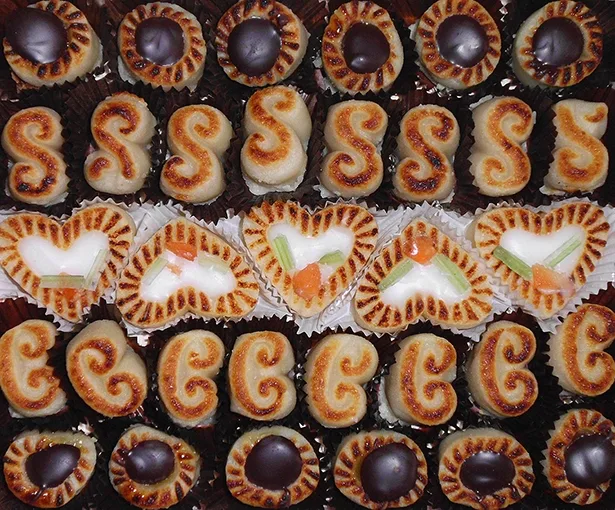
For the sake of historical truth it must be admitted that the first city in Germany to bring marzipan from Italian Venice was Lübeck. Only from there did marzipan reach Königsberg. But it was the Königsberg confectioners who invented browning marzipan and combined it extraordinarily deliciously with icing and candied fruit, creating the most splendid nuances of flavour, while Lübeck to this day simply colours its marzipan, which seems to us thoroughly unappetising.
All in all, marzipan, our signature sweet, far surpassed Lübeck's both in its excellent taste and in the volume consumed around the world.
So if Königsberg was already the “capital of confectioneries” in 1846, the question naturally arises: when did they appear here? The word “confectioner” (Konditor) comes from the Latin “conditus” (= seasoned). But “conditio” in ancient Rome meant not only seasoning for food but also the preserving of fruit. Cane sugar was already known to the ancient Egyptians. Bread baking is as old as the plough, that is, it has existed since prehistoric times. Among the Romans the bakers' trade is mentioned as early as 174 BC. In Germany, baking bread was first and foremost the duty of women and serfs. Soon, however, craft bakeries appeared in the first urban settlements and monasteries.
The Königsberg State Archive preserved a “List of Documents Granted by the Municipal Authorities in Königsberg to the Craft Guilds”3 dating from 1652, according to which the first regulations on bakery products date from 1207, 1407 and 1536. The absurd misprint “1207” unfortunately leaves it unclear in exactly which year the first statute of an independent bakers' guild was issued. The oldest surviving Königsberg document on the subject dates from 1305. It is also beyond doubt that from the very first days of the Order in Königsberg there were already so-called “fixed (or principal) bakers” (Festbäcker), that is, bread bakers, and “free bakers (bakers of loose wares)” (Losbäcker), that is, bakers of white bread and cakes. The latter term, utterly foreign to us today, could still be read everywhere on shop signs in my youth: “Los- und Kuchenbäckerei”4.
The Order had its own bakery in the castle. It is known that in the 14th and 15th centuries its products were sold on Altstadt Long Street, where there were so-called Brotbäncke, bread stalls.
The existence at that time of similar “stalls” of the Order's bakery in the Kneiphof is indicated by the name of Brodbänkenstraße, the Street of Bread Stalls. It is first mentioned in 1563 [among Kaliningrad local historians it is known as the Street of Bread Shops. Ed.]
From the bakers' guild statute of 1507, approved by Grand Master Frederick of Saxony (German: Friedrich von Sachsen), we learn which kinds of baked goods were assigned to the two main guilds.
The range of products of the “principal bakers”:
— Six-shilling bread (German: Esse Schilling Brodt);
— Shilling plaits (German: Schilling Strüczell mit 8 Kneusen [oder Kniestchen]);
— Three-pfennig rolls (German: Drey Pfennig Brodtchen);
— Pfennig flatbreads (German: Pfennigwegke, eben gestuppt).
Assigned to the “free bakers” were:
— Shilling plaits (German: Schilling Strüczel);
— Plain [wheat, white] bread (German: Loosbrodt);
— Rolls (German: Semmel);
— Pfennig butter rolls (German: Pfennigpomel [oder Pamelchen]).
For a long time 12 August 1551 was regarded as the founding date of the Königsberg bakers' guild, because since time immemorial the guild's records had referred to a roll kept in the Königsberg State Archive in which the bakers' trade is first mentioned under that date.
This does not rule out the likelihood that the Königsberg baking guilds are much older. For a long period of history there were six bakers' guilds in the three towns of Königsberg.
While the fixed bakers had craft guilds in each town, the free bakers of the three towns united into one guild on 14 March 1557.
Thus for a time the total number of baking guilds fell to four. However, because of disagreements between the three sister towns, this union did not last long, and by 1600 the bond had been broken again: there were once more six guilds.
So what, in fact, did the free bakers bake?
The answer to this question is given by the craft roll “Free Bakers and Cake Bakers”5 of 1698, kept in the Königsberg State Archive. It prescribes:
“The honourable craft guild of cake bakers and free bakers shall bake its bread from wheat and rye flour differently from the way the craft guild of principal bakers does. Thus the craft guild of cake bakers and free bakers shall bake rolls, oblong cakes (the so-called Strützel), pretzels, pancakes, fritters and mint gingerbread, without brushing the crust with a barley whisk dipped in water6, as the fixed bakers usually do.”
Moreover, the two groups of bakers were obliged to use their baking trays in different ways.
We know that gingerbread is a very ancient bake. A legend from Toruń tells with humour of the invention of gingerbread by a former captive Lithuanian princess, the nun Katharina of Toruń. We also remember Stritzelgasse (Stritzelgasse), first mentioned by Caspar Stein, a traveller from Königsberg, in 1644 7. It was in this lane that the free bakers lived. In his work “The Wanderer” (Peregrinator), Stein, among other things, gives a description of Königsberg and conscientiously lists all the inns and taverns, but he does not name confectioneries in the sense in which we understand them. He does, however, mention “confectioners”.
In 1741 Königsberg had 132 principal bakers and 83 free bakers; in 1800, 78 and 59 respectively.
In one of the chapters of his book “What Strangers Need and Find Useful to Know”8, von Backo (von Backo) writes in 1804:
“There are many eating houses here... The wine houses ... are distinguished by a wreath hung outside; bakers who offer pastries and refreshments for sale are marked by a special sign. The billiard rooms and coffee houses located here are listed in the address calendar ...”
So here again the word “confectioneries” is not used, although they are clearly distinguished from hotels, eating houses, wine houses and coffee houses. On 28 October 1802 a Royal Cabinet Order was issued to the Minister of State Baron von Schrötter abolishing the distinction between principal and free bakers, which the bakers themselves fiercely resisted. In the end everything stayed as it was, since the state soon had other, more important concerns, but from 1856 the government and the Königsberg magistrate again tried to unite the two trades in one guild. Despite stubborn resistance, on 20 October 1858 a new guild was founded under the name “Guild of Bakers, Confectioners and Gingerbread Makers of Königsberg”. It was then that the name “confectioner” was officially used in Königsberg for the first time. The new guild numbered 118 masters and 108 journeymen of the principal bakers, as well as 85 masters and 52 journeymen of the free bakers. The guild's first meeting took place on 21 February 1859. But as early as the following year it became clear that the confectioners and the gingerbread bakers did not wish to take part in its work. And in 1884 the “United Bakers' Guild of Königsberg (Prussia)” was founded, which in 1898 was renamed the “Free Bakers' Guild”, and on 1 April 1894 the “Confectioners' Guild of Königsberg”.
That is how enormously long it took the Königsberg confectioners to gain official recognition!
Besides yeast baking, the free bakers had long made sugar and sour-cream bagels, sponge biscuits, aniseed and cardamom cakes, puff pastry, gingerbread and even simple boiled sweets. And from there it was only one step to confectioners' cakes and pastries; all they had to do was keep learning the secrets of the craft.
Incidentally, as master baker Richard Popp kindly informed me, “confectioners” and “gingerbread bakers” still existed in Königsberg up to our century. The last gingerbread makers were Heyduschka (Heyduschka) of Altstadt Mountain Street (Altstädtische Bergstraße) and Robert Schulz (Robert Schulz) of Löbenicht Long Street. Richard Jarzembowski (Richard Jarzembowski), who later called himself a “manufacturer of sugar goods”, was the last to be called a “confectioner”.
From 1894 the Confectioners' Guild of Königsberg had its own chief master (Obermeister). The last was Ernst Schulte (Ernst Schulte). During the Second World War the two guilds were united again under the bakers' chief master Richard Popp (Richard Popp). The confectioners formed only one of the trade groups within it.
At the turn of the century, in 1800, out of the shadowy existence of the confectioneries, which had undoubtedly existed in Königsberg for a long time before, one name emerges. It would make both the Königsberg confectioners and Königsberg itself famous for centuries: Pomatti.
In 1797 the state treasury bought from the heirs of burgomaster Theodor Gottlieb von Hippel (Theodor Gottlieb von Hippel) his palace on Junkerstraße (Junker Straße). The postal service was moved there from the Post Packhouse building (Postpackhaus). Thus this part of Junkerstraße became Poststraße.
The Post Packhouse building was erected in 1724 and stood on Altstadt Mountain Street (Altstädtische Bergstraße), where today a fountain with a knight of the Order adorns the “Castle Liberty”9.
When the Post Packhouse building became vacant, Pomatti moved into it and opened his confectionery here.
It is not known what drew him here: the favourable location on the square in front of the Altstadt church (Altstädtischer Kirchenplatz), or perhaps the statue of King Frederick William I that stood in a niche of this house? But he was certainly the only confectioner in the world who could treat his guests to an entire monument. Nevertheless, his impeccable reputation was undoubtedly created above all by his superb cakes and sweets. As early as 1842 Karl Rosenkranz reported in his “Königsberg Sketches” that “the court confectioner Pomatti, whose confectionery is on the Altstadt Market, is the foremost master in the Prussian state, and the famous Spargnapani in Berlin is only his pupil”.
The physician and writer Ferdinand Falkson10 tells the following amusing story:
“In the forties Lord Fitz-Morris studied in Königsberg. It seems he had been sent here by his father. His Lordship never explained the reasons for this exile. One day this noble British lord ate a few groschen's worth of pastries at Pomatti's and then presented a 100-pound banknote in payment. When Pomatti explained that he could not give him so much cash in change, milord refused to take the banknote back. In broken German he declared: ‘Leave it, I will eat it all! Times will pass!’ /"Lassen Sie — ich werd's abessen! — Tempi passati!"/.
Pomatti's successor was the confectioner Sterkau (Sterkau). He inherited the firm with its excellent reputation and came to be regarded as the foremost confectioner of Königsberg. From 1900 Sterkau's successor was Petschlies (Petschlies).
In 1907 work began at the castle to partially uncover older architectural surfaces, and the old Packhouse building fell victim to it.
Petschlies decided to move his confectionery to the eastern corner of the Altstadt Market on Altstadt Mountain Street, but in the 1920s he sold these premises to the firm “Alexander und Echternach” (Alexander und Echternach) and built himself a building on the corner of Kaiser-Wilhelm-Platz and Altstadt Long Street. After Petschlies's death in 1930, his son-in-law Liedke (Liedtke), who had inherited Café “Benther” in the Tiergarten, took over the management of his father-in-law's confectionery.
NOTES
1. Macaron (French: macaron): a confection made of egg whites, sugar and ground almonds, whose homeland is considered to be France. It is usually made in the form of a biscuit, with cream or jam placed between its two layers. Finished macarons are very delicate, with a smooth surface, and melt in the mouth. They can vary greatly in taste depending on the ingredients used in making them.
2. Königsberg was the home of once very popular little eateries called Flecklokal (Flecklokal), where a cauldron of “Fleck”, a special dish that has quite unjustly vanished from everyday life, was always steaming over the fire. In bitter frost and strong wind it was the hearty, filling food of East Prussia that gave people strength. The Flecklokal establishments in Königsberg's harbour quarter usually opened before cockcrow. Night revellers, lovers of night life, gathered in them, as did the dock workers.
A large plate of spicy beef tripe. It warmed you up and gave you new vitality. Fleck was eaten with a spoonful of mustard, and on the table there was always a small bowl of marjoram. Then a little glass of beer, which you could wash down with plain water, and you were back in shape!
3. „Verzeichnis der Rollen, so von der Stadtobrigkeit in Königsberg den Gewercken ertheilet" (German)
4. “White bread and cake bakery” (German)
5. „Kuch- und Loßbecker" (German)
6. The process was called “Gerstelung”, from “Gerste”, “barley”. Free bakers were forbidden to “barley the bread” /German: das brot gersteln/, that is, to brush the bread, taken out of the oven a second time, with a whisk of barley straw dipped in water, sometimes mixed with egg white, to give the crust a glossy, appetising look.
7. This refers to the work “Peregrinator” (“The Wanderer”) by the Königsberg physician, theologian, historian and traveller Caspar Stein (1592–1652), written in 1644. This extensive two-volume Latin manuscript was kept in the university library before the war. It described the various countries the author had seen during many years of travel around Europe and included, in particular, a lengthy description of Königsberg. Stein's work was never published in full, and the manuscript was later lost.
8. „Dinge, die Fremden zu wissen nöthig und nützlich sind" v. Backo 1804.
9. The residential district near the castle, surrounded by a fortress wall, was called the Castle Liberty (German: Burgfreiheit, or Schlossfreiheit). The citizens of this district enjoyed certain privileges. Until the 18th century a castle liberty remained a legal form for settlements or individual buildings near residences. It was inhabited mainly by court servants and nobles. It is comparable to the present-day status of embassies or international organisations.
“Königsberg was the residence of the Prussian kings, as was attested by the great palace that stood at its very centre. A considerable part of the city belonged to the territory of the so-called ‘royal liberty’: there were special rights, special dues and a special administration…”
Rüdiger Safranski. “Hoffmann”
10. Ferdinand Falkson (Ferdinand Falkson; 1820, Königsberg – 1900, ibid.): German physician, politician and writer. Born in Königsberg, he was educated at the universities of Königsberg, Berlin and Halle; on graduating from the first of these he received the degree of Doctor of Medicine in 1843. In the same year he began practising in his home city.
LEGENDS OF PRUSSIA on the blog of Tatyana Kolivay.
Translated from Russian with the help of AI (Claude, Anthropic), October 2026.