LEGENDS OF PRUSSIA in the blog of Tatyana Kolivay.
The Curonian Spit. — Its inhabitants. — Shipwreck debris on the shore. — Schwarzort. — The unfriendliness of the locals. — Geographical errors. — Amber. — Nidden. — The life story of the postmaster. — Morning on the seashore. — An accident in the quicksand. — A storm at sea. — Rossitten. — The advance of the dunes. — The pastor. — Bird catching. — Sarkau. — A church without doors. — The sea breaks through. — The origin of the Curonian Spit. — Cranz. — Trutenau.
Parting from the little people of Memel, so fond of strong drink, cost me no tears, for to be honest I had been thoroughly bored here. So I hastened to settle all my business affairs and travelled on.
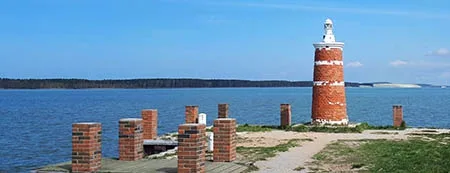
Memel is separated from the Curonian Spit by a strait about 3,000 feet wide that connects the Curonian Lagoon with the Baltic Sea. Travellers are carried across the strait on a barge. At first sight the barge did not inspire confidence, but fortunately it delivered me safely to the opposite shore.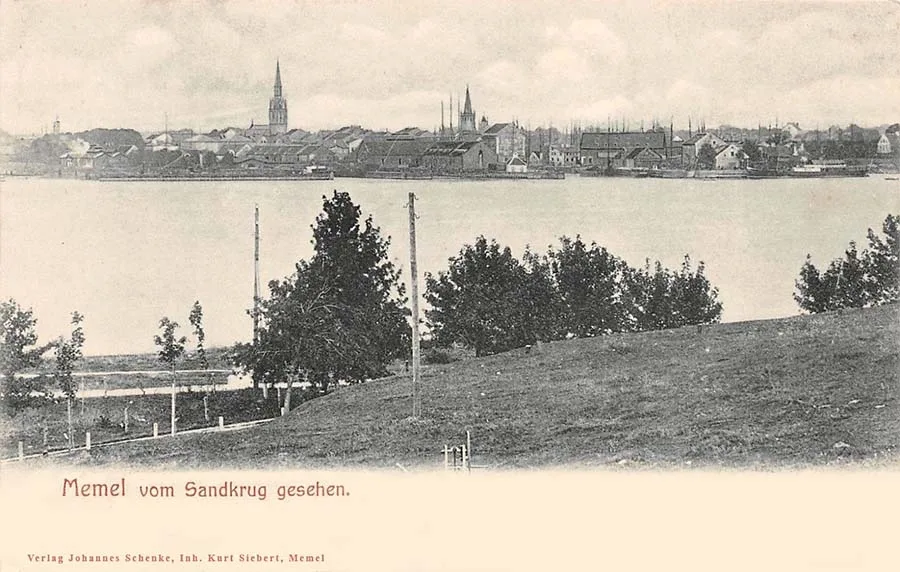 View of Memel from the Curonian Spit.
The current flowing from the lagoon into the sea is so strong that in the strait, and even a considerable distance out to sea, the water remains fresh. It differs from sea water by its darker colour.
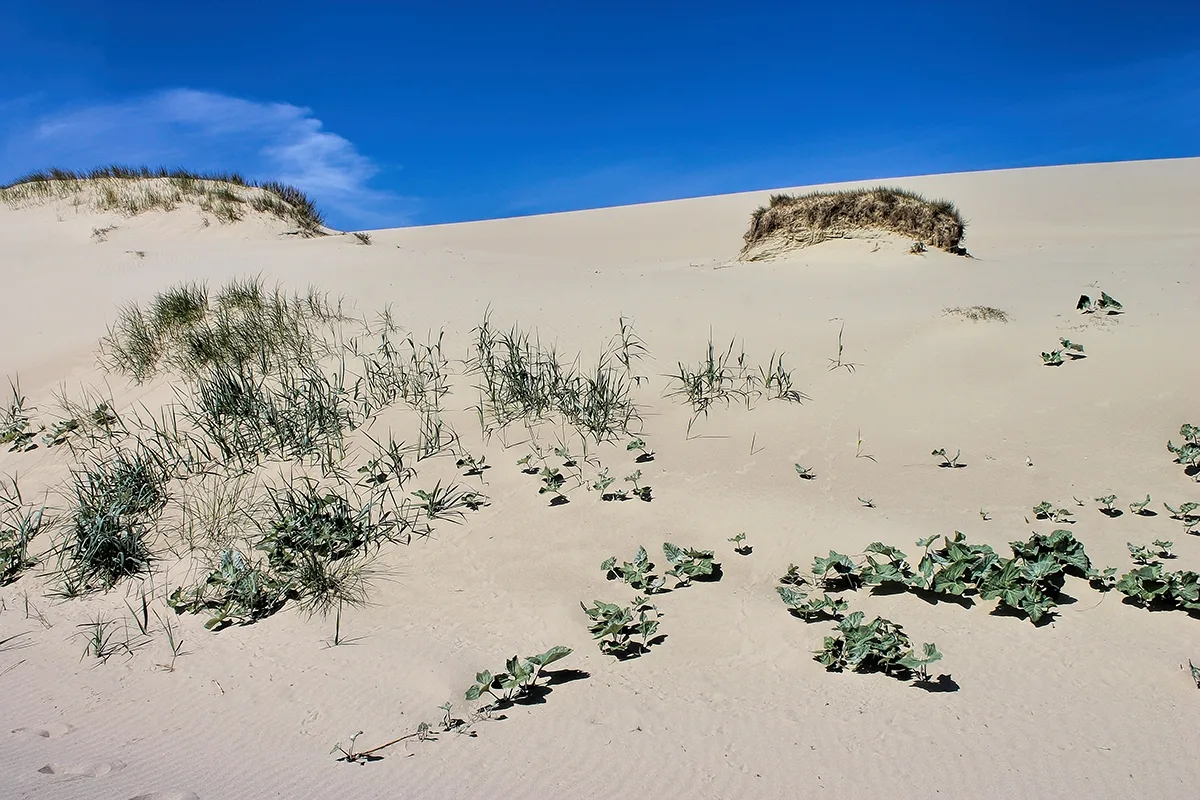
The Curonian Spit is a sandy strip of land 16 miles long and from a quarter to half a mile wide. It separates the Curonian Lagoon from the Baltic Sea and consists of a chain of sand dunes, in some places several hundred feet high. Apart from the village of Rossitten, where there is a ploughed field and a small wood, the spit is devoid of all vegetation: no fields, no trees, not even the tiniest vegetable garden, and the inhabitants of the seven wretched hamlets on the lagoon side of the spit live solely by fishing.
There can be no sadder place on earth than this. Nothing but sand and water: no shady trees, no spring of cool, refreshing water. There is not even a green meadow to enliven the uniform whiteness of the bare sand dunes. How people can live here is beyond me. However, dealing with them shows that, apart from human form, they bear little resemblance to other people.
The unfriendliness on their faces, their smugness, their incomprehensible, barking speech — everything proves that they stand on the lowest rung of human development.
The road runs along the seashore, which is strewn with a multitude of ship fragments. The journey is tiring enough in itself, but it becomes even more unpleasant when one sees so much evidence of shipwrecks along the way. Many an unfortunate lost his whole fortune on this inhospitable coast. And some lost their very lives. These thoughts put me in a melancholy mood that harmonised remarkably with the dismal silence of the drab nature around me, which here seems to bear a mortal grudge against the whole human race.
I breathed more freely when I reached Schwarzort, the first post station on my way, and found myself among people again, although these people were perhaps the most unfriendly I had ever met at any post station. I was travelling with my own horses and did not use post horses. This may well have given them cause for annoyance, for I did not see a single friendly glance, and of ten questions nine went unanswered.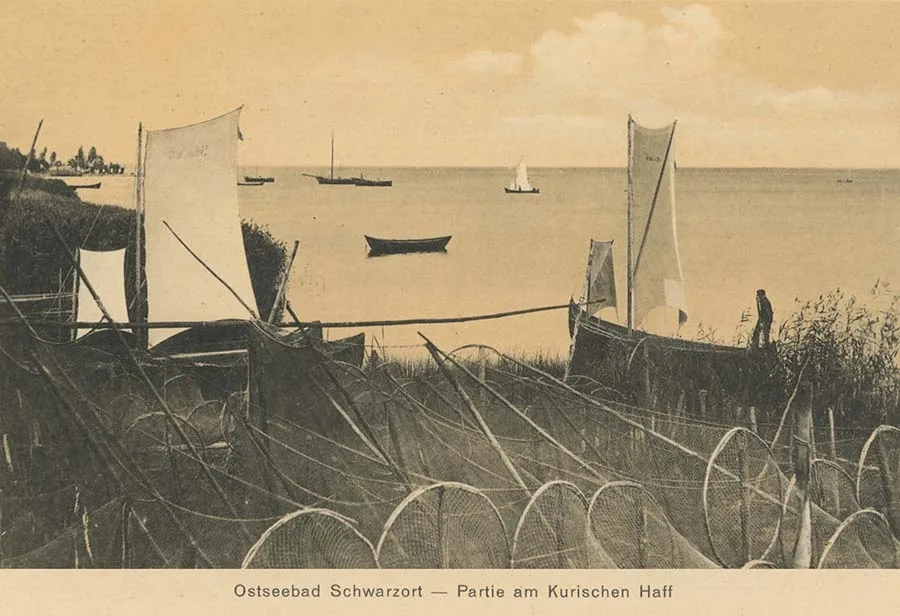 On the lagoon shore in Schwarzort (Juodkrantė, Lithuania).
The food, like the coffee, was bad and unjustifiably expensive, and there was no wine or beer at all. That these people overcharge is forgivable: what could keep them in this dreary desert, if not the chance to earn more than anywhere else?
And, after all, a traveller will be content if he can get something for his money, even a lot of money. But if the hosts, by their surly behaviour, deprive travellers of the pleasure of conversation, this shows that the stepmotherly nature surrounding the locals has had a bad influence on their manners.
* * *
On the road from Schwarzort to Nidden an amusing incident befell me. To ease the horses' way through the deep sand, I got out of the carriage and walked along the beach for a while. Soon I met a coachman furiously arguing with a traveller whom, as I understood, he was driving to Memel. The heated dispute1 was in full swing. The traveller was so irritated that he was about to beat the coachman, who was saved only by my sudden appearance. Then both of them asked me to act as arbiter in their dispute. It was as follows: the coachman claimed that from where they stood he could see the hill called the Dutchman's Cap, while the traveller considered this utterly impossible, believing that the coachman was simply mocking him.
My assurance that they were both right almost drew me into the general brawl. It cost me enormous effort to make them listen to my explanation. On the border with Courland, on the seashore, there really is a hill called the Dutchman's Cap. And it was, of course, visible from where we stood, so it was clear that the coachman had no thought of making fun of his passenger. And the fact that in his simplicity he really believed it to be the coast of Holland could easily be explained by his ignorance of elementary geography. I left them after they had made peace, satisfied that I had managed to prevent the impending fistfight.
* * *
The beach here is covered with countless small, round, multicoloured pebbles that look very pretty on the white sand. They are all either light red or bright blue.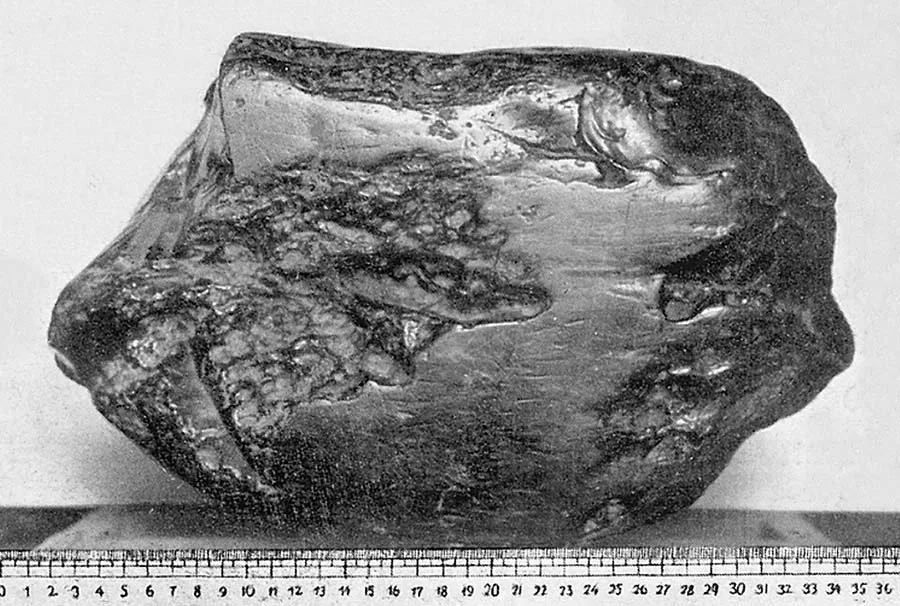 An extraordinary amber nugget.
I found several rather large pieces of amber that could well have been worth a few ducats. And yet I threw them into the sea, as I knew that collecting amber entails severe punishment under local law.
I feared that someone else, out of ignorance or greed, might not resist the temptation to appropriate these beautiful stones. Amber is rarely found on the Curonian Spit, and you will not meet amber fishermen with large nets here, so most of the stones cast up by the sea here are apparently lost.
* * *
Late in the evening I reached Nidden, where the post station was extremely simple but at least had a very friendly host, with whom I had a pleasant conversation while my supper was being prepared. He told me a great deal of interest about the Curonian Spit and its inhabitants. Since this man was not without some education, I expressed surprise that he had settled here. He assured me, however, that he preferred this place to any other, as he had been born and educated here and, apart from three years of study at the University of Königsberg, had spent his whole life in this sandy desert.
His main occupation is fishing, of which he is passionately fond. Besides, passing travellers bring him plenty of news, and the post station earns him a considerable profit. One episode from his life is too characteristic for me to keep it from you. And since he told it to me without making me promise to keep silent, he will not take offence if I retell the story in his own words.
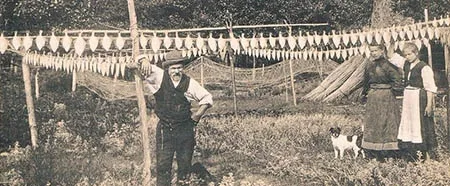
"I had studied in Königsberg for three years," he said, "when my father, the postmaster, whose successor I was to become, called me home and announced that it was time for me to start a family. In itself I had nothing against this, but it turned out that my father had already chosen a bride for me himself.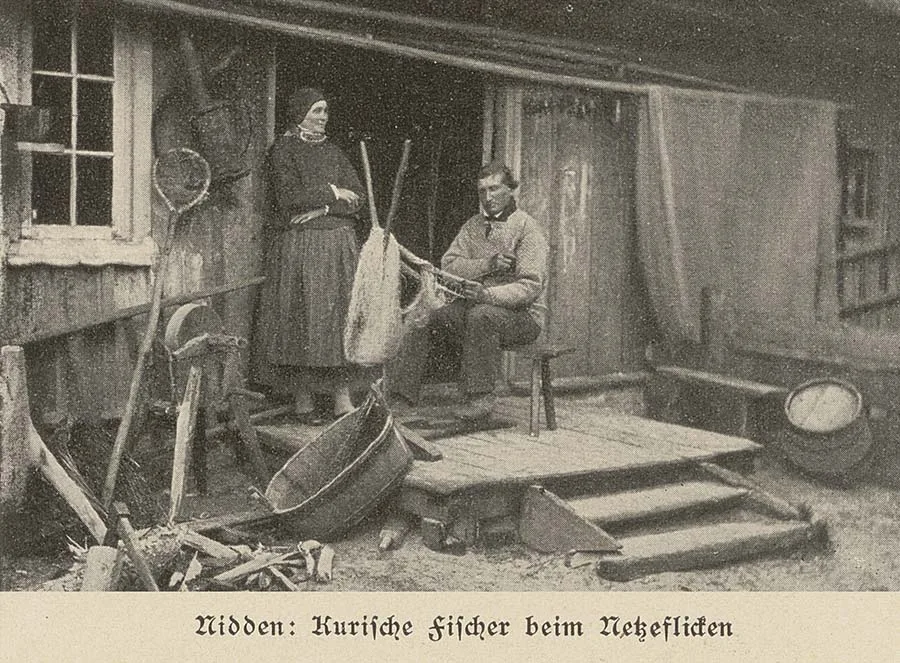 Nidden (Nida, Lithuania): a Curonian fisherman mending a net.
The day of the betrothal came, and I met my future wife, whom I had never seen before, for the first time, and although she was not ugly, I disliked her extremely.
I began to protest violently against this marriage, but my father assured me that he would present certain arguments that would change my mind. Then he took me by the hand, led me into a back room, locked the door firmly behind him, and pulled out from under his frock coat those very arguments, which took the form of a stout whip, with which he began quite convincingly to prove that this marriage would be entirely to my benefit. Well then... The arguments were weighty, and I declared that my father had convinced me and that I no longer objected to the betrothal.
But later, having thought it all over, I decided not to submit my will to the power of my father's whip. So, despite the betrothal, I told my father plainly that I would not marry the girl forced upon me. My father did not deign to answer, and soon sent me to Memel on business, stipulating very precisely the time of my return. Suspecting nothing bad, I returned at the appointed time and found the house full of guests, among them a clergyman. They were all waiting for me in order to begin my wedding ceremony. My father led me, greatly surprised, to the bride and asked the pastor to perform the marriage rite, paying not the slightest attention to my resistance.
Bewildered by what was happening, instead of saying "yes" I loudly yelled "no"! And at that moment my father dealt me such a deafening box on the ear that I recoiled in horror and quickly said "yes". And so, against my will, I suddenly found myself married. Many years have passed since then, my father has long been dead, and I often go to his grave and weep tears of gratitude there because my parent chose a good wife for me, who even now, in the evening of our years, is the happiness of my life."
* * *
… Having slept excellently, the next morning I sent my horses ahead from Nidden an hour early, hoping soon to catch up with them, counting on their unhurried pace, since the road ran through loose sand. I strode briskly along the seashore, refreshed by the cool of the morning.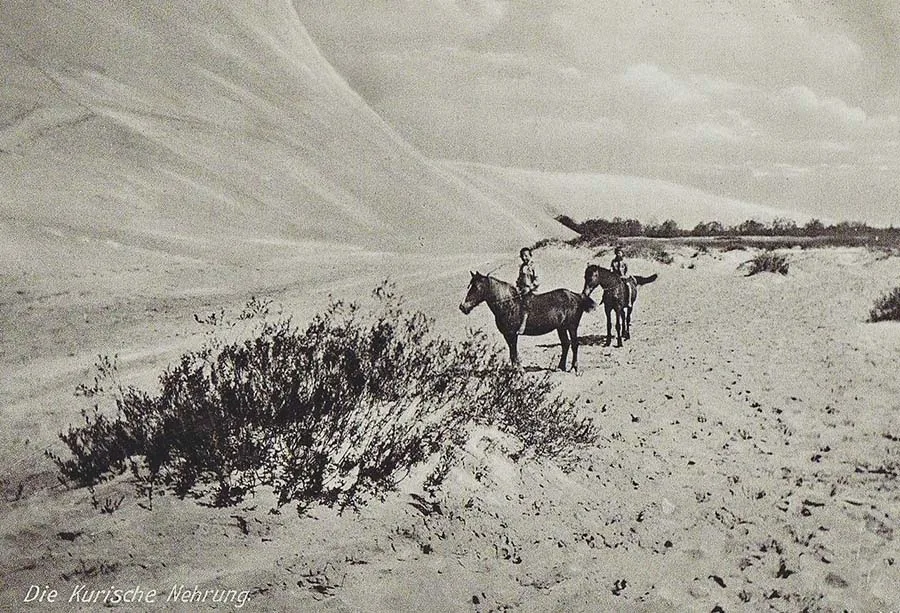 Young riders at the foot of a dune.
A joyful, invigorating morning is beautiful everywhere, even on the deserted shores of the Baltic Sea. The sun, just risen, scattered the golden gleam of its rays over the silver of the low waves, whose delicate mother-of-pearl merged on the horizon with the azure of the sky.
The white sails of several ships floated high above the horizon, and over the waves near the shore there still hung a thin trail of morning mist, which was gradually carried away by a light breath of breeze. The faint sound of the waves was barely audible in the deep silence that reigned all around and seemed like the breathing of awakening nature. Soon the sun, rising higher, blurred the delicate outlines of this beautiful picture, turning it into a dreary daub.
The mist, which had woven itself into fanciful shapes, vanished, not a single ship was to be seen, and instead of the gilded silver surface of the sea, my eyes now beheld a monotonous grey sheet of water without end or edge. You may be surprised that the sight of a calm sea bores me. I readily agree that for many people this boundless mass of water is a sublime spectacle, even when it is calm. But anyone who, like me, has lived for many years by the sea and made several sea voyages becomes rather indifferent to it. However, sunrise and especially sunset over the sea, even when seen a thousand times, arouse admiration anew each time.
Today the sun was the most disagreeable travelling companion in the world. Soon its blinding light began to make walking hard for me and made the already difficult way twice as heavy. The loose sand gave way under my feet at every step. The sun's rays, reflected from the white sandy surface of the Spit, made the heat unbearable, and the faint breeze blowing that day could not refresh a weary traveller. I had walked two miles when I finally managed to catch up with my cart, but the horses, like me, were in need of rest.
I let them rest for half an hour, and in that time had a hearty breakfast, and then did what almost every traveller on this route does: I gave myself up to sweet sleep while the horses slowly drew me on and on. Whoever can resist the desire to sleep in such a situation will undoubtedly endure reading the dullest novel or the most tedious sermon in church. The monotonous view of sand and water wherever you look, the monotonous noise of the sea waves and the lulling sway of the cart, crawling forward like a snail, merge together, beckoning sleep, which wraps the traveller like a cosy cocoon.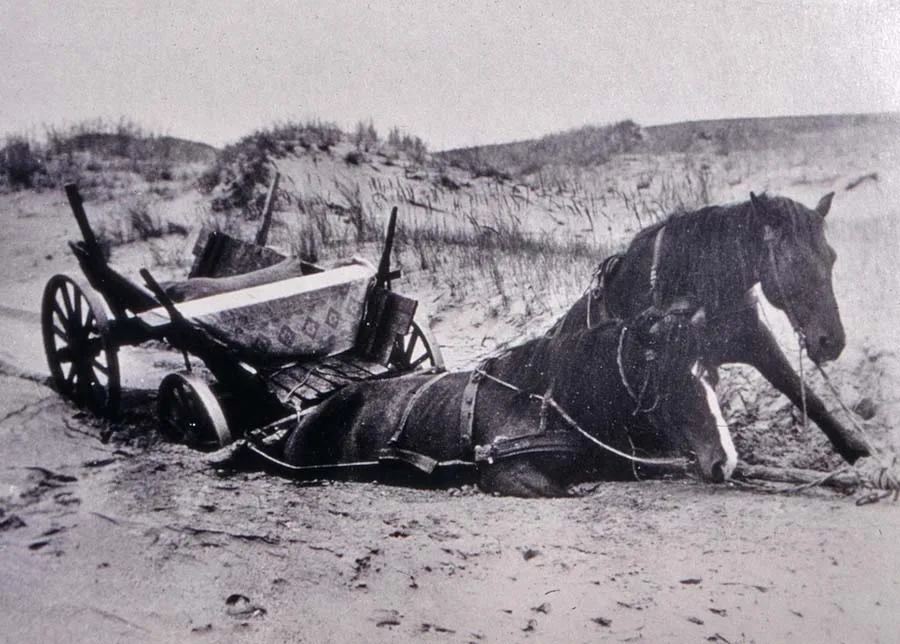 Horses stuck in quicksand.
I was jolted out of my sweet oblivion by the coachman's frightened cries. I came to and saw that my horses had sunk into the sand almost up to their necks.
The point was that the coachman, to make the way easier for the horses, had turned off the well-worn loose track and run into quicksand, into which they sank as soon as they stepped on it.
I had no choice but to run to the village of Rossitten for help, where with great difficulty I persuaded the villagers to help me pull out the horses, promising a considerable reward. For digging out the horses I had to pay four thalers, which was of course unheard-of robbery. However, six men toiled for more than three hours before they could free my horses from their sandy captivity. Since quicksand does not usually occur on the mainland, I suspect you have no idea of it, so I shall try to explain to you this strange phenomenon, typical of these parts.
In the midst of the sands, often far from the sea, there are places that, when a person or an animal steps on them, suddenly collapse like a pit trap, dragging down everything that was on the surface. At the moment the mass of sand collapses, a great deal of water comes out, and the place then becomes so firm that heavy cannon can be driven over it without any fear. Such incidents happen here very often. People, carts, horses sink into the sand, and no one knows where they are or what has become of them.
Those caught in quicksand can be rescued only in very rare cases. The people who came from Rossitten to help were surprised that my horses were still holding their heads above ground. A few years ago the little daughter of an officer from Memel drowned in quicksand. The poor girl was sucked into the sandy trap before the eyes of her friends. Despite all efforts, her body was never found. As far as I know, no natural scientist has ever taken the trouble to investigate the origin of this strange natural phenomenon.
* * *
Towards evening the sky began to darken. Countless flocks of gulls rushed over the lagoon with piercing cries, which was always an unmistakable sign of an approaching storm, so I decided to stay in Rossitten until noon the next day, and there I witnessed this majestic natural phenomenon.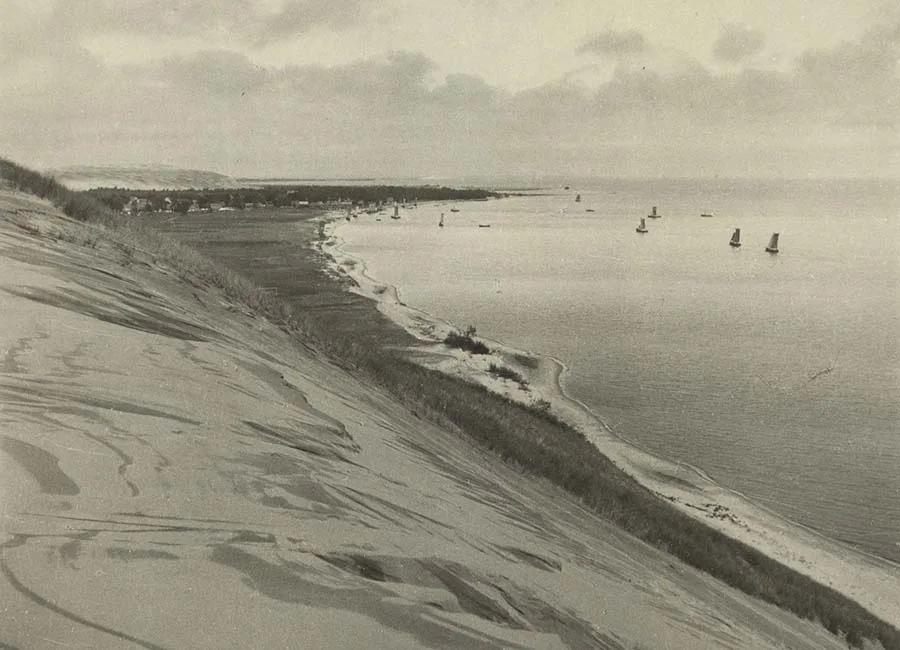 View of Pillkoppen (Morskoye) from the Epha Dune.
What I had expected came to pass. In the night a strong wind began to blow, which by morning had turned into a storm, so I found a guide in the village and asked him to take me to the highest dune, so that I could look from there at the raging sea and the surroundings.
It was a truly grandiose spectacle! Before me stretched the boundless sea, which had taken on the colour of the black, cloudy sky. It furiously hurled its madly rolling waves up towards the clouds, and foaming spray flew from them in all directions. It seemed that these gaping mountains of water were about to engulf our narrow strip of land, against which they broke each time with a deafening roar. In both directions a white chain of hills stretched into the distance, while behind me lay the Curonian Lagoon, calm and smooth as a mirror, and somewhere on its horizon the Lithuanian shore was barely visible.
The hill on which I stood was several hundred feet high, which made the view of the sea even more impressive. It was time to descend, and here my guide saved me from a danger that threatens all visitors in these parts. I was about to walk straight down the hill, but the guide told me that this way I would certainly fall from a height of at least a hundred and fifty feet. From top to bottom the hill was a mass of dazzling white sand, and this created the optical illusion of a gentle front slope. That in reality it was steep and almost sheer could not be seen from above. To convince me of this, the guide stuck a stick into the summit next to the place where he stood, and later, when we had descended by the route he suggested, I looked up from below at the top of the hill and saw that the stick towered practically above our heads.
* * *
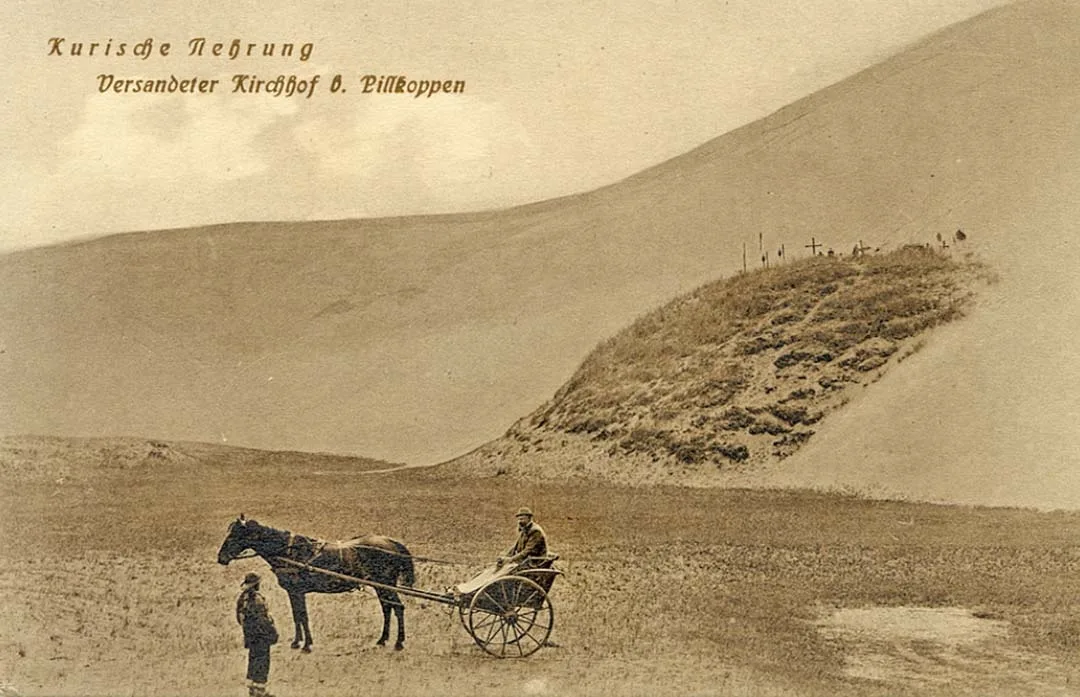
Rossitten lies on a peninsula projecting into the lagoon and has a small piece of arable land, including a small wood of oaks and pines with twisted trunks — the only one on the whole Spit. Formerly most of the Spit was covered with trees, but people thoughtlessly cut them down, and as a result the rest of the forest, except for this small patch, was gradually buried by sand.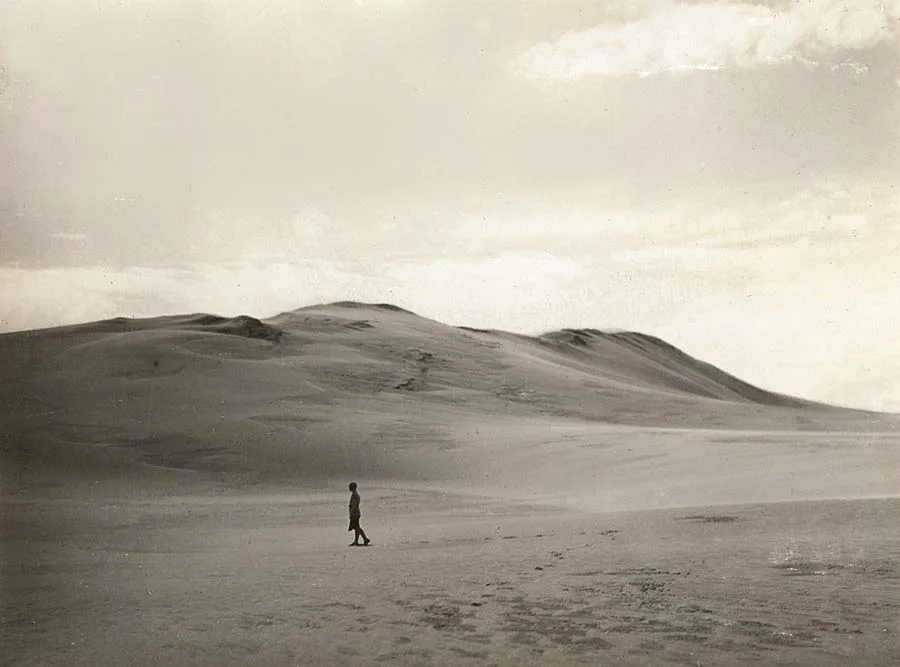 A long road through the dunes.
The encroachment of sand has assumed such proportions here that perhaps soon this village will be gone too, since almost every day the sand seizes new plots of the small area on which farming is carried on.
And since the sand is blown by the wind and washed down by the rain from the high sand hills, no barriers can help against this calamity.
Thus, the village of Lattenwalde has been completely buried by sand, and not a trace of it remains today. All that is left of the village of Kunzen are a few huts on the verge of collapse. The church, the parsonage and most of the buildings of this village are already buried deep under the sand.
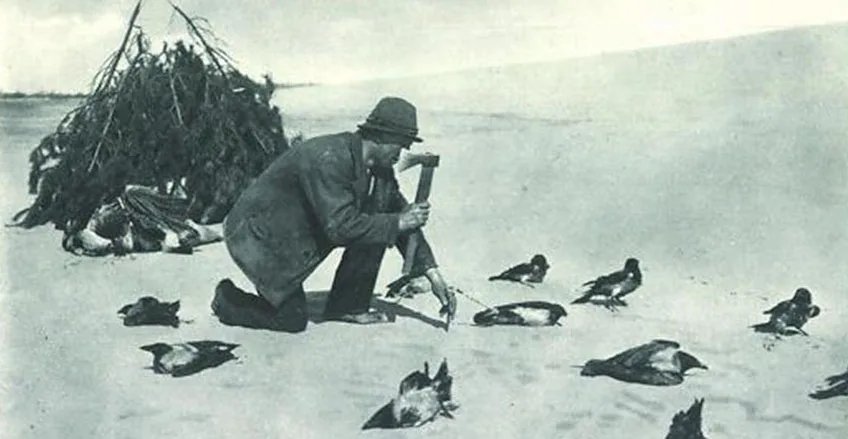
The pastor of the Kunzen parish, who has lived in Rossitten since his village vanished, preaches his sermons in a sort of barn. He has the most wretched post in the country and has barely enough income to sustain his meagre, joyless existence. The clergyman's diet consists mainly of fish and crow meat, which, incidentally, tastes not bad at all. Crows feature in the local diet in large quantities and are considered a delicacy, as no other kinds of meat are to be found here at all.
The pastor receives part of his income from catching birds, which he does in that very small wood near Rossitten. This wood, they say, is very rich in birds. The pastor sends the birds he catches to Königsberg for sale.
The official activity of this clergyman usually ceases completely in summer, because all his parishioners, except for four postmasters and a few farm owners in Rossitten, get into their carts in spring with all their children and households and move to the other side of the lagoon, where they go fishing. They do not return until late autumn. Children born during this time remain unbaptised until they return home. Communions and weddings are not performed either, and all these religious rites are carried out by the pastor all together within a few days.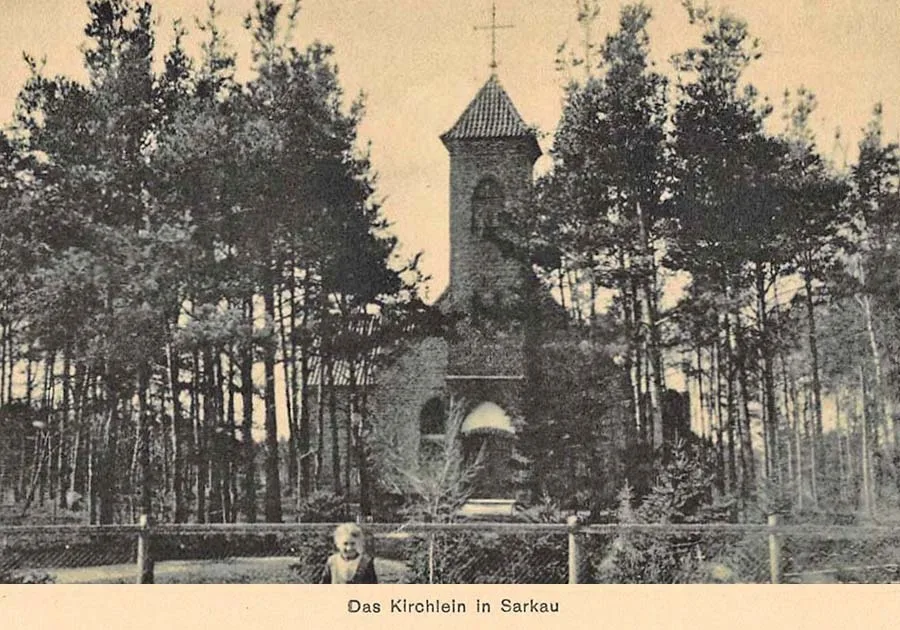 The little church of Sarkau (Lesnoy).
In the village of Sarkau there is a church that is a sort of daughter church of the one in Rossitten. It is administered by the local pastor. This church has no doors; instead there are only two openings in the walls with flimsy shutters.
It is through them that the local Christian congregation enters. There are two pulpits here: one faces the lagoon and the other the sea. The pastor ascends one or the other depending on the direction of the wind. The point is that the wind must blow at his back, otherwise the fine sand that gets into the wooden building one way or another would blow into his eyes.
Between Rossitten and Sarkau I came across such an enormous number of gulls that when they took off all at once, they covered the sun and everything around went dark. There must have been several million birds. Before they rose into the air, I also noticed a few ravens sitting beside the gulls in peaceful proximity. Only a lack of food could have forced these proud, solitary birds to endure the company of hysterical gulls.
Near Sarkau there is a flat place on the Spit where the waves from the sea have several times rolled over into the lagoon, thus washing away the road to Memel. An attempt was made to stop the advance of the sea by building a dyke, but this seems not to have been enough, for the sea already reaches the edge of the embankment, although no storm-surge winds have been observed lately. If the sea ever makes a serious breakthrough to the lagoon here, the marshland areas of Lithuania may suffer badly.
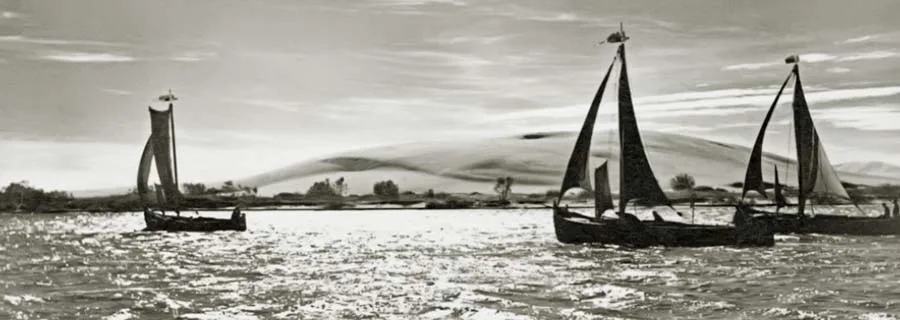
The Curonian Spit undoubtedly owes its origin to some natural cataclysm and in this respect deserves the close attention of scholars. Old chronicles say that it was formed in 1190 after a storm that lasted for twelve long years. All that time a strong wind blew constantly from one and the same quarter of the sky. As far as I know, the chronicles of Livonia say nothing about this.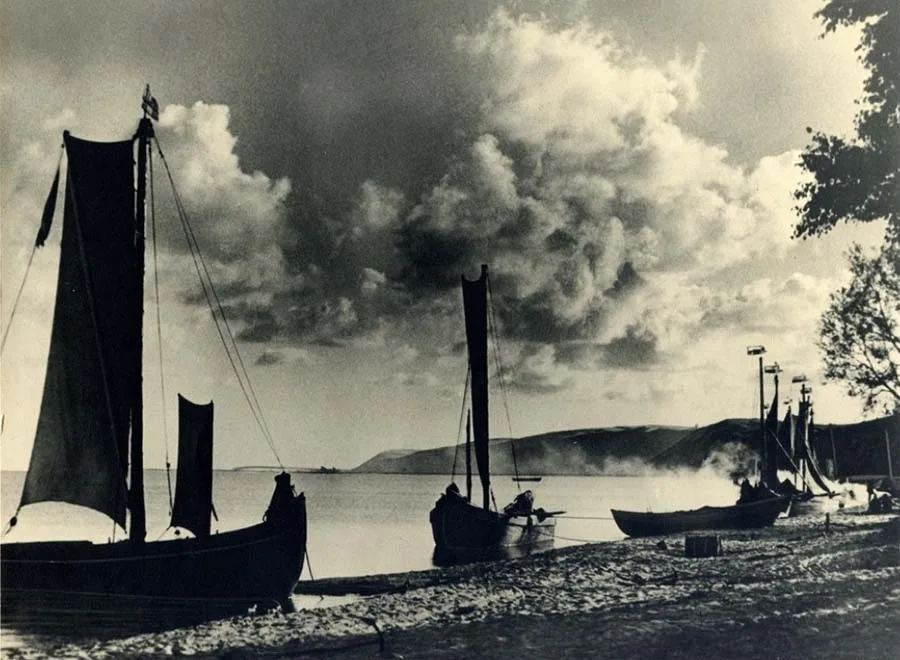 Fishing boats by the lagoon shore.
At that time Prussia had not yet been conquered by the knights, so it had no historians, and since the Germans came here only in 1230, i.e. forty years later, they could have obtained only some scanty information about the origin of the Curonian Spit from local legends.
And this means that, in the absence of reliable evidence, the twelve-year storm may be called into question. However, I have not yet seen the chronicle of Bishop Christian, the oldest Prussian historian. If this rare manuscript can be found in Königsberg, I shall certainly read it. I very much hope so. Perhaps the chronicle contains some information, since Bishop Christian must have been a contemporary of this natural phenomenon.
* * *
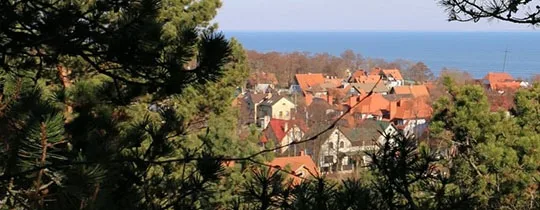
At Sarkau the sands come to an end and a large spruce forest begins, stretching as far as Cranz, a large village with a good inn. I had a very strange feeling when I turned round and looked at the Curonian Spit left behind me. I was once again among friendly, kind people, among whom I would quickly forget this sandy Curonian desert with its half-savages. A well-cooked dinner, at which, among other things, freshly caught boiled herrings, known here as Strömlinge, were served, refreshed me, and after bathing in the sea I went to bed early so as to set off early the next morning and arrive in Königsberg before dark.
* * *
From Cranz onwards the country becomes very fertile. Meadows, orchards, manors and copses succeed one another, delighting the eye. Soon we found ourselves in Trutenau, a beautiful estate with a mill — a large paper factory. Both the factory and the factory owners' houses are extremely picturesque: the red plaster of their walls makes a pleasant contrast with the dark forests and the blue lake whose water drives the mill. Next to the main factory building there is a high hill overgrown with oaks, and behind it a rather deep valley into which the stream of water from the mill rushes noisily.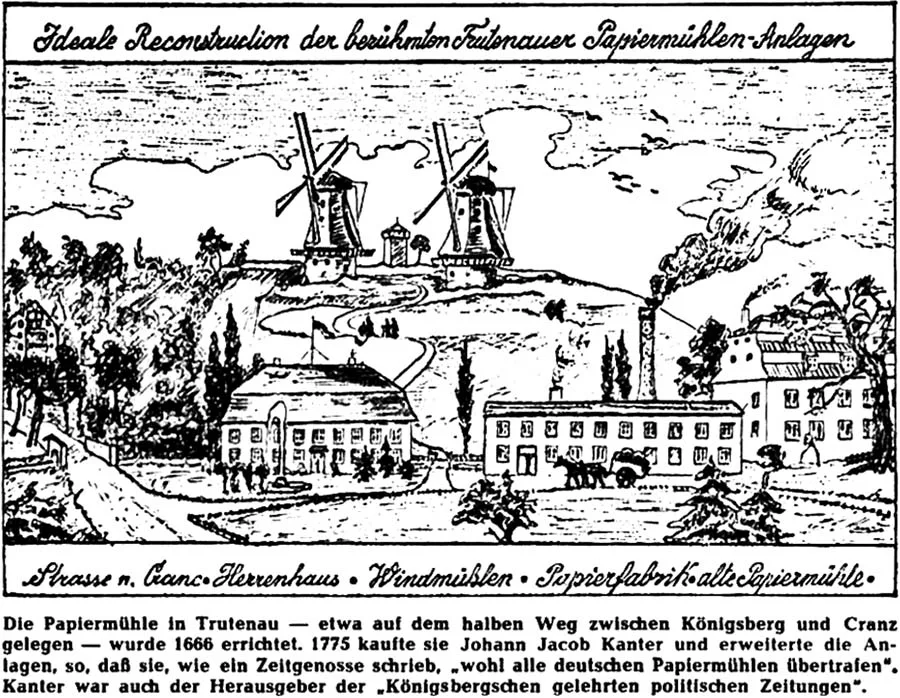 The paper factory and windmills in Trutenau (Medvedevka).
The installations at the paper factory are in excellent condition, but the paper made here is not pure white, which is attributed to the quality of the water.
To solve this problem, the finer grades are bleached, but even so they fall short of good white Dutch paper. English pressboard — pressspan — which cloth manufacturers need for finishing fabric, is also made here, and the production technology is kept secret, so I was not allowed to see the machines. The owner of this factory, Mr Jachmann, a well-known scholar, was away, so it is understandable that the staff could not allow me to inspect the works without his permission. The inventor of this technological process, a man named Kanter2, travelled widely to learn from relevant experience and master the necessary techniques, but had little success, so on his return he carried out countless experiments on his own, on which he spent his entire fortune and 14,000 Reichstaler given to him by Frederick the Great.
At last he invented this technological process, and to such perfection that the pressboard produced here was in demand even among English manufacturers and was much preferred to the Aachen board. But the inventor himself derived little benefit from his discovery, because his life was rather short. However, his heirs now enjoy the fruits of his thought and hard work.
LEGENDS OF PRUSSIA in the blog of Tatyana Kolivay.
NOTES
1. The dispute became a subject of discussion between the translator and the editor. An insider had to be called in. He took the passenger's side, declaring categorically that from the seashore between Juodkrantė and Nida the Dutchman's Cap (Lithuanian: Olando Kepurė) cannot be seen. The small elevation, he said, which lies on the seashore ten kilometres north of Klaipėda, would simply be hidden by the dunes of the Spit. But his claim is based on impressions gained in the 21st century, when the Spit has become covered with forest along its entire length. At the time of the encounter described by the anonymous Russian traveller, there was no forest at all — only sand, so it is quite possible that the Dutchman's Cap hill was visible after all. Besides, back then it may have been considerably higher! Even Wikipedia says that it is subject to severe erosion by the sea. The Iron Dune, the Zipfelberg in Primorye (Gross Kuhren), for example, has become almost half as high over the past hundred years! What its height was in 1814 can no longer be established. Another example: in clear weather, from the viewing platform above Lake Lebed on the Russian side, one can see two high-rise buildings in the centre of Klaipėda, although the distance from there to them is about 50 km. True, this summer the view will be blocked by a growing pine. In short, who was right could not be established. But the fact that our compatriot, on his first visit to the Spit, rushed to teach the locals a lesson in their own geography says something about him both as a person and as a writer...
2. This seems to refer to Johann Jakob Kanter (Kanter, Johann Jakob; 1738 Königsberg – 1786 Königsberg).
Translated from Russian with the help of AI (Claude, Anthropic), October 2026.