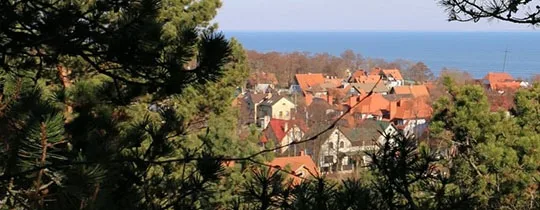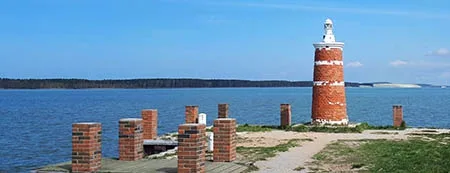
At the southern base of the Spit lies the town of Zelenogradsk, at the northern end Klaipėda (Lithuania). The Russian part has three settlements: Lesnoy, Rybachy and Morskoye. The Lithuanian part has the resort of Neringa, which unites four settlements (Nida, Preila, Pervalka and Juodkrantė), and two more settlements by the strait in the north of the peninsula (Alksnynė and Smiltynė, the latter formally a district of Klaipėda). This Lithuanian port city is separated from the Spit by a strait served by a ferry. The width of the Spit varies from 400 metres (near the settlement of Lesnoy) to 3.8 km (north of Nida). The entire territory of the Spit is protected and divided between two national parks, one Russian and one Lithuanian. In 2000 the Curonian Spit was inscribed on the UNESCO World Heritage List.
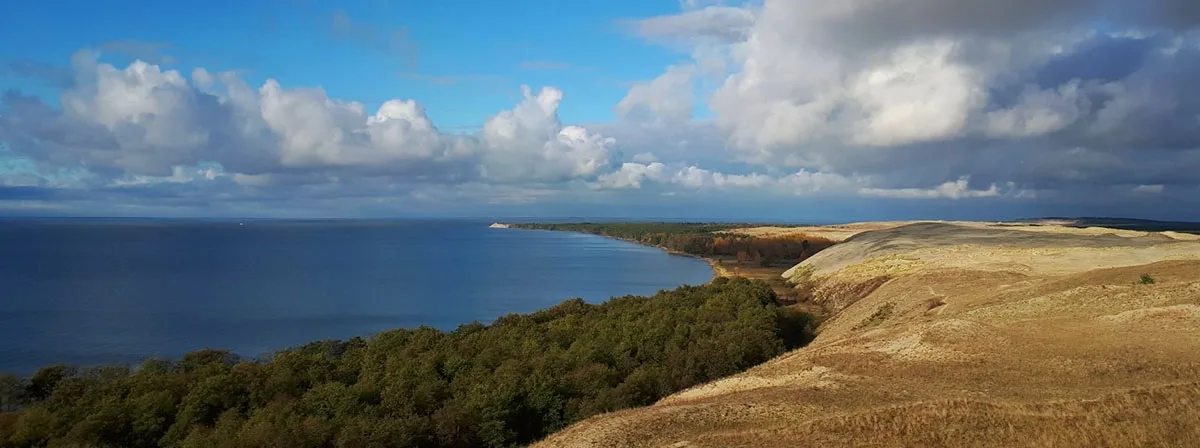
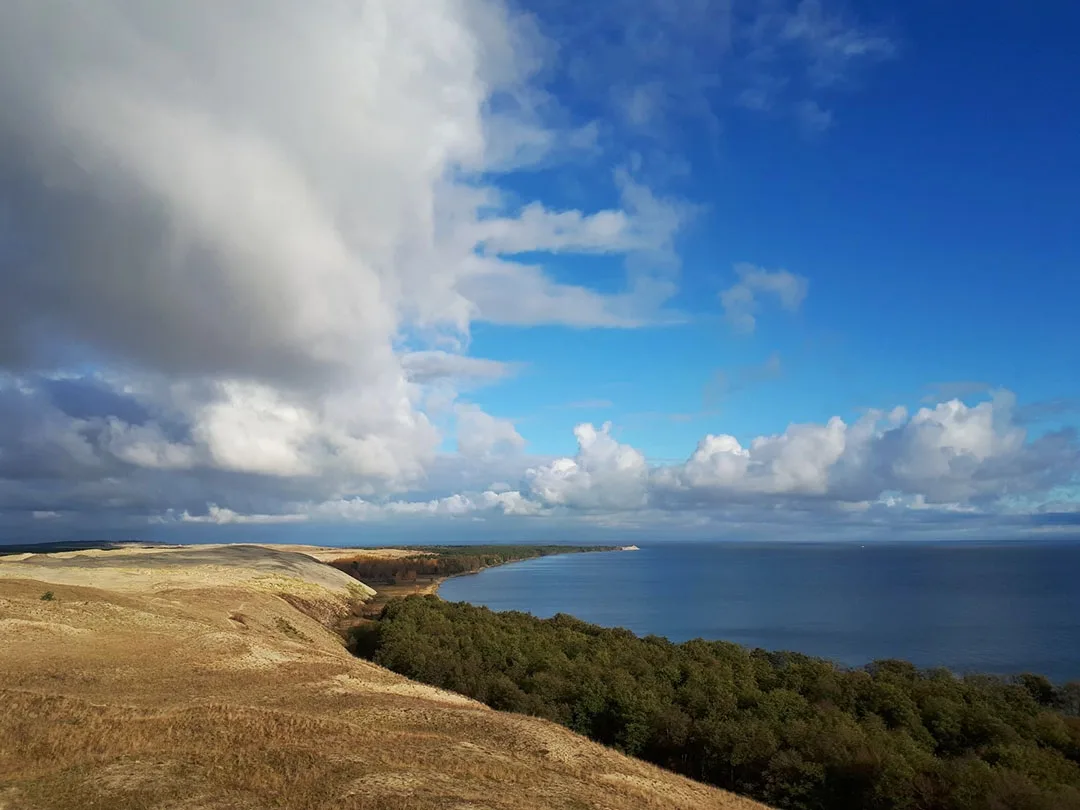
The Spit is worth visiting for the unique beauty of its nature and the best beaches in the Kaliningrad Region alone. But its main attraction is the dunes. Tourist trails – “Müller's Height”, “Efa Dune” and “Swan Lake” – now lead to the best known of them on the Russian part of the Spit. The viewing platforms built on them offer unforgettable views of the Baltic Sea and the Curonian Lagoon.
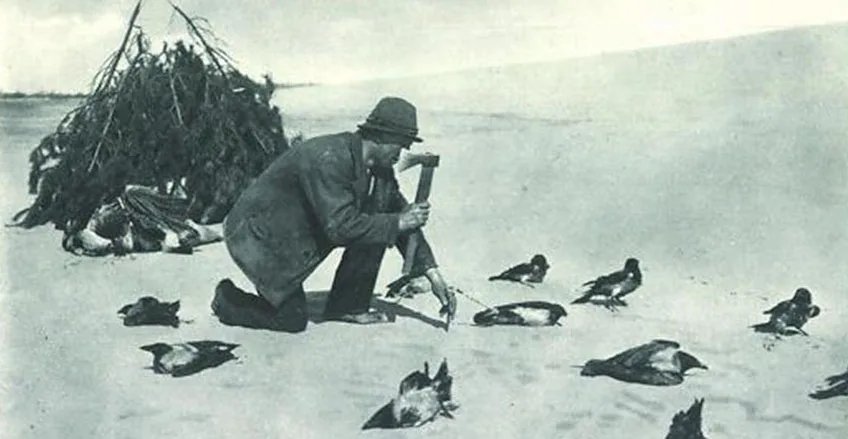
Hardly a trip to the Spit goes by without an encounter with animals. Most often these are foxes and wild boars, which have grown so used to people that they come out of the forest to socialize and beg for a treat. (Since June 2023 feeding wild animals on the Spit has been strictly prohibited. Violators risk a fine.) If you are lucky, you will see elk and roe deer and meet seals, which often rest on the local beaches. Above the Curonian Spit runs a kind of “bird bridge” along which birds migrate twice a year. In 1901 the world's first ornithological station was founded here, and it is still working today. More than half of the Spit's flora consists of introduced species deliberately chosen by people – species that took root in the Spit's poor sandy soil by human design.
Tablets of History
Archaeological finds near the Lithuanian settlement of Juodkrantė suggest that by the third millennium BC the Spit had already formed along its entire length, connecting the shores of Sambia and Samogitia (the Kaliningrad Region and Lithuania).
In the documents of the Teutonic Order the Spit is first mentioned in 1258 as Nestland, which translated from German means "Land of Nests" and echoes its ancient name in the language of the Curonians, a local Baltic tribe – Nerge or Neria. Later the German name of the Spit evolved into Kurische Nehrung (German Nehrung – "spit, sandbank"). Incidentally, the main municipality on the Lithuanian part of the Spit is still called Neringa today.
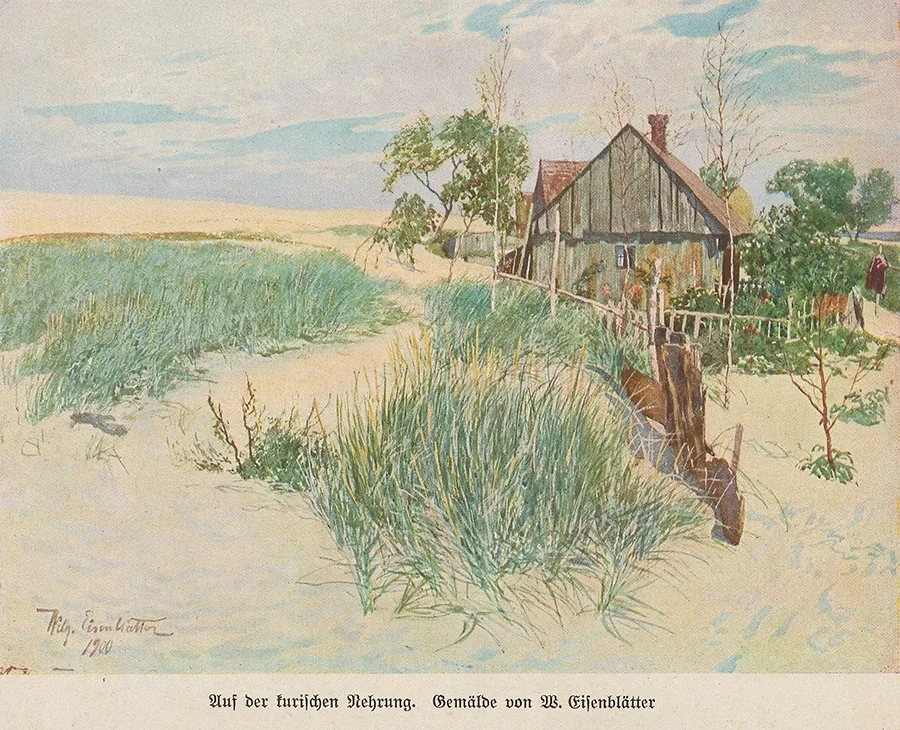 "On the Curonian Spit". Watercolour by Wilhelm Eisenblätter (1866–1934).
Virtually the whole history of the Curonian Spit is one of constant struggle between man and sand, waged with varying success. Between the 16th and 19th centuries the Spit became almost entirely desert, and people even began jokingly calling it the “Prussian Sahara”. Only in the 19th century did people manage, for a time, to gain the upper hand over nature by reshaping the local ecosystem.
The main function the Spit historically served was logistics. Before the Teutonic Order colonized the region, the Spit gave Lithuanians and Curonians a way into the Prussian lands. Up to and including the 19th century, the only road from Western Europe to the northern Baltic – to Riga and St Petersburg – ran along it. By the side of this ancient route the Order built Rossitten Castle in the 14th century (today the settlement of Rybachy). All the settlements that formed on the Spit originally grew up around coaching inns. The Königsberg–Taplacken–Tilsit–Tauroggen highway, which replaced the road along the Spit, was built towards the middle of the 19th century (1830−1834).
The Curonians
The indigenous population of the Curonian Spit is considered to be the Baltic people of the Curonians, after whom the Spit got its present name. It is also worth noting here that the place name Courland, widely known in Russia (as part of the territory of present-day Latvia was once called), likewise comes from the word "Curonians".
In the 6th–7th centuries the Curonians inhabited a stretch of the Baltic coast between the present-day cities of Liepāja (Latvia) and Klaipėda (Lithuania). In the 10th–11th centuries they also settled the Curonian Spit.
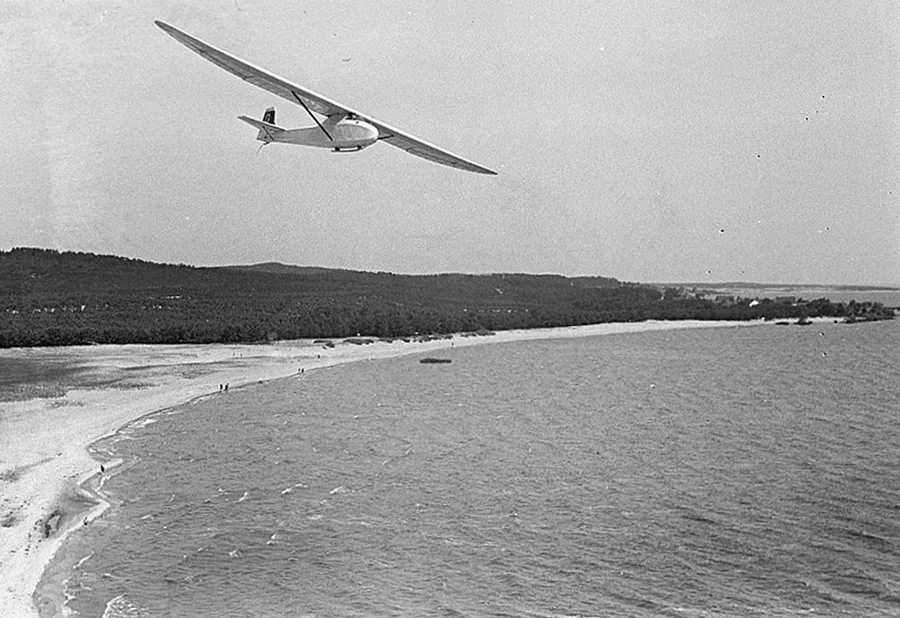 A glider over the Curonian Spit.
The Curonians were a strong and warlike tribe, able not only to repel the attacks of the terror of the seas of that time, the Vikings, but also to launch retaliatory raids on the shores of Scandinavia more than once. In the 12th century one of the most common prayers in the churches of Denmark was “God, save us from the Curonians!”
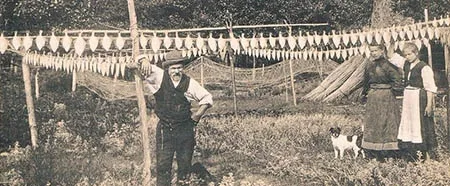
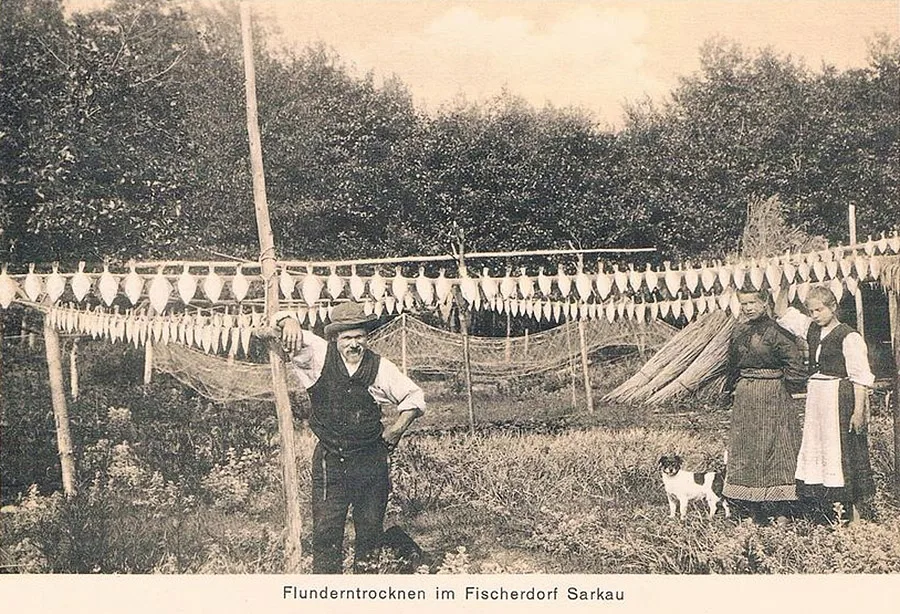 Drying flounder in Sarkau (Lesnoy).
Traditional Curonian culture – in particular the flat-bottomed boats with their distinctive carved pennants on the masts, the costumes and the legends – survived on the Spit until the middle of the 20th century. Today it can only be seen in museums; on the Curonian Spit, in Nida. No speakers of the Curonian language remain on the Spit either. A few Curonian families who preserve it now live in the USA.
The Relief of the Spit
Virtually all of the Spit's relief was created by the wind, and the Spit itself is its offspring. But in the 19th century man intervened in the aeolian1 processes, reinforcing the sea coast and stopping the movement of sand across the surface of the peninsula. The cross-section of the Spit is very clearly structured: sea beach, foredune, palve (marshy valley), dune ridge, lagoon palve, and beach on the shore of the Curonian Lagoon.
The foredune is the Spit's protective rampart and stretches along the entire sea beach on its coast. It consists of natural dunes and of brushwood and reed fences built in the 19th century, which were gradually buried by sand.
The wooded valley in the central part of the Spit, between the protective rampart on the seashore and the dunes along the lagoon shore, is called the palve. The word comes from the Curonian palv – wasteland. It is through this valley that the road runs today. The valley on the lagoon shore is called the lagoon palve.
The magnificent sand dunes that are the Spit's hallmark lie along the shore of the Curonian Lagoon. Until they were planted with vegetation in the 19th century, the dunes were on the move and posed a permanent threat to everything people tried to do here.
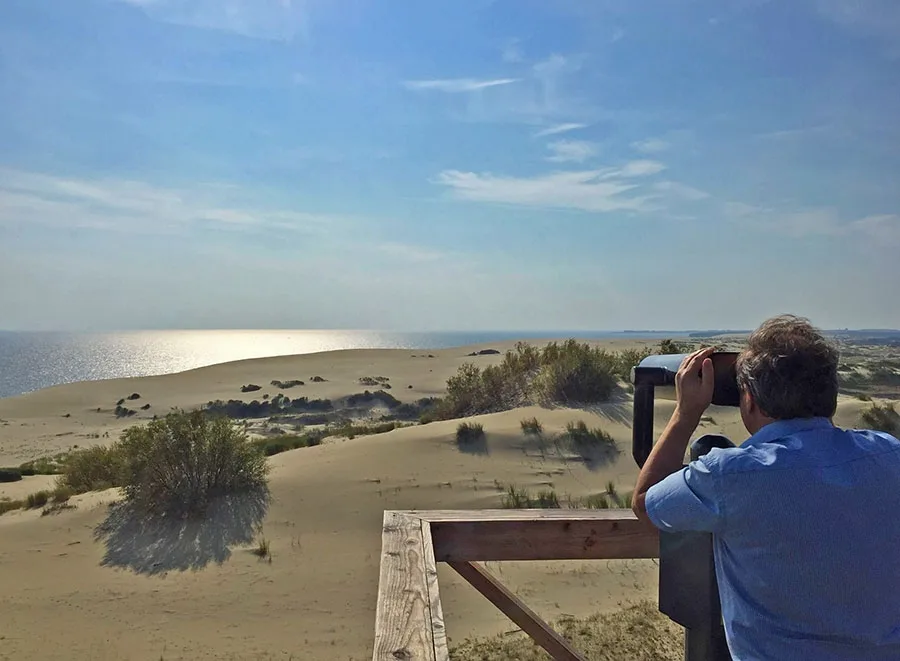 On the viewing platform of the Efa Dune.
Had it not been for the efforts people made in the 19th century to turn the Curonian Spit into a habitable territory, instead of forests, settlements and a road it would be covered with sand and dunes of various heights. Fortunately, however, people found a way to prevent the Spit's transformation into the “Prussian Sahara”, as it was already beginning to be called.
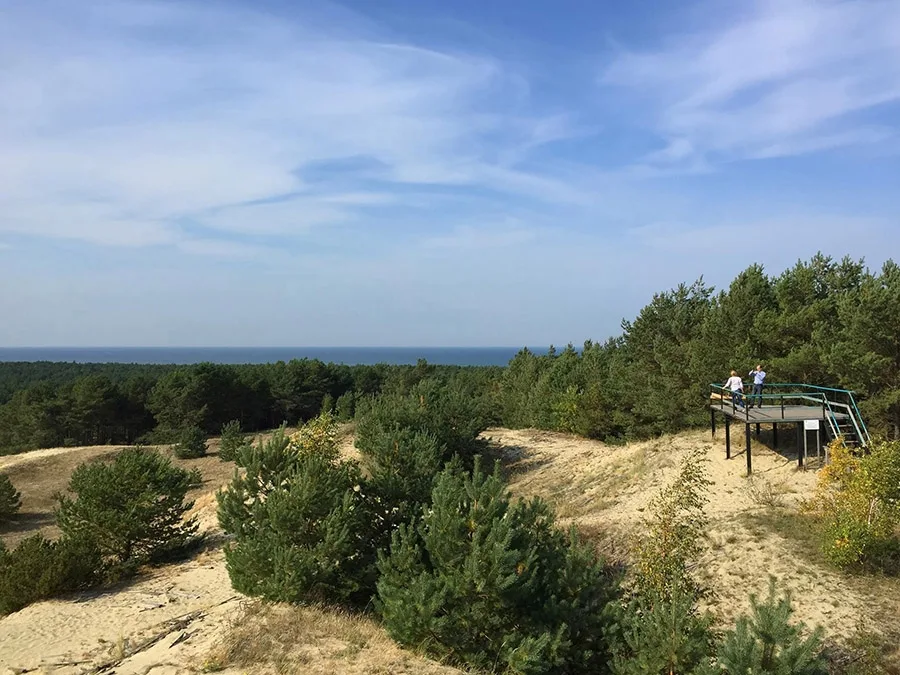 View from the Efa Dune towards the sea.
The desertification of the Spit began in the mid-16th century, when the forest growing on it was ruthlessly cut down and shipped across the lagoon for the needs of Königsberg. The wastelands that formed on the Spit began to be overgrown with heather, which local wild-hive beekeepers regularly burned, having for some reason come to believe that young plants were more attractive to bees. Meanwhile the Spit's sands, stripped of their plant cover, began to move and to swallow everything in their path. Only in the second half of the 19th century were people able to stop them, by planting virtually the entire Spit with sand-loving plants brought from desert regions all over the world, which proved capable of binding the Spit's surface with their roots.
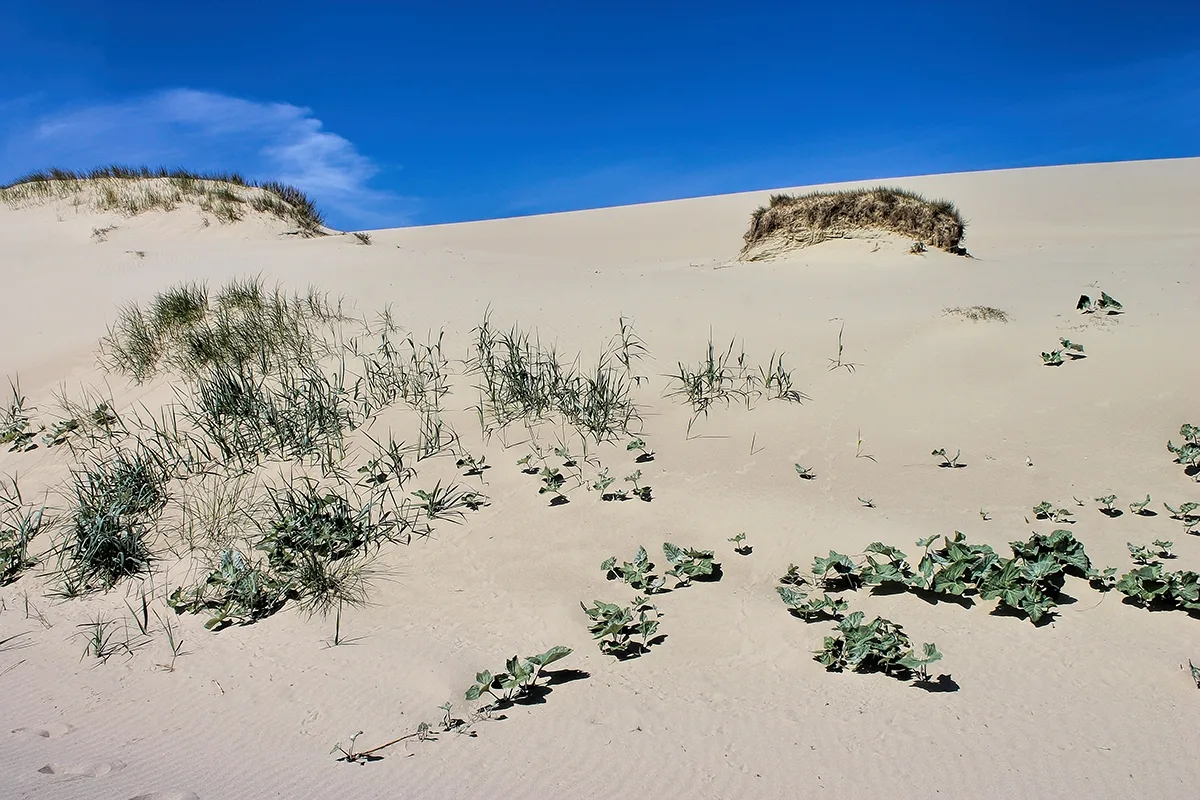
Today the dunes are the adornment of the Curonian Spit and its main attractions. They are divided into green (stable) dunes, on which forest grows, grey (transitional) dunes, covered with grasses and shrubs, and white (mobile) dunes, whose sands keep shifting at the will of the wind. The highest dune on the Russian part of the Curonian Spit is the Efa Dune (h>60 m). It bears the name of the man who stopped the movement of the sands towards the settlement of Morskoye (Pillkoppen), and it awaits tourists at the 42nd kilometre of the Zelenogradsk–Klaipėda road.
A Long Road Through the Dunes
For those living on the Spit and travelling along it, the main problem since time immemorial was sand. People did not know how to control it. Driven by the winds, it swallowed everything in its path, sparing not even whole villages. That is why most of the only road from northern Europe to its central part, which ran along the Spit, followed the shores of the sea and the lagoon. For centuries, carriages with travellers had to roll along the water's edge for almost half the distance from Cranz (Zelenogradsk) to Memel (Klaipėda), with one pair of wheels in the water, where the sand is always flatter and firmer. No mobile phones, no electric lighting, no road surface of any kind – try to imagine yourself in the place of those who travelled here just two hundred years ago!
In the 13th–15th centuries the road along the Spit was operated by the Teutonic Order. Communication between its capital at Marienburg (now Malbork, Poland), Memel (Klaipėda), Riga and the other German possessions on the Baltic shores ran exclusively along the Curonian Spit.
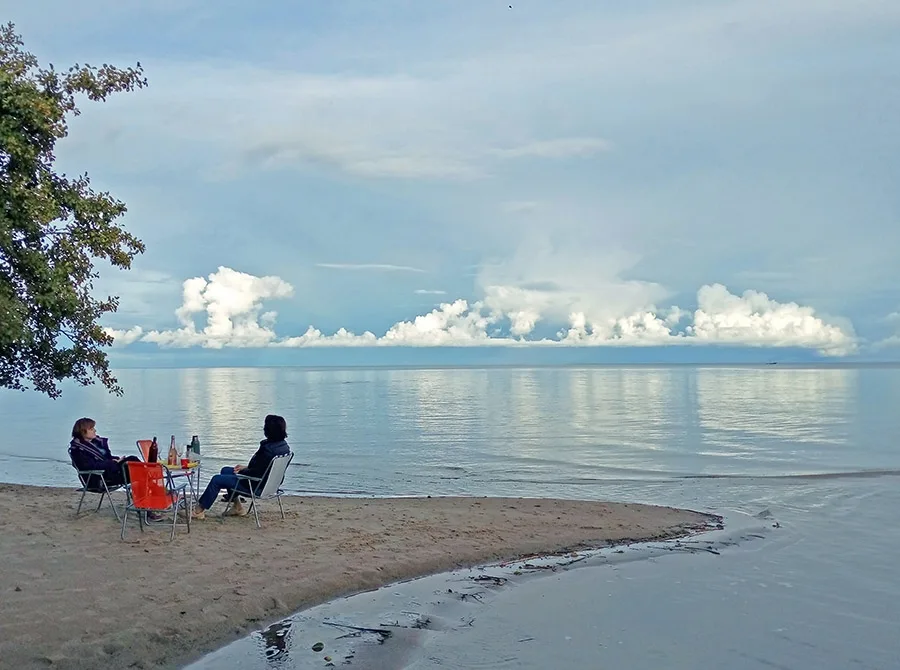 A picnic on the shore of the Curonian Lagoon.
To ensure security, castles were built in the 14th century at the beginning, middle and end of the Spit – Neuhausen, Rossitten and Memel. The first stood in the area of present-day Zelenogradsk, the second in the settlement of Rybachy, the third in Klaipėda.
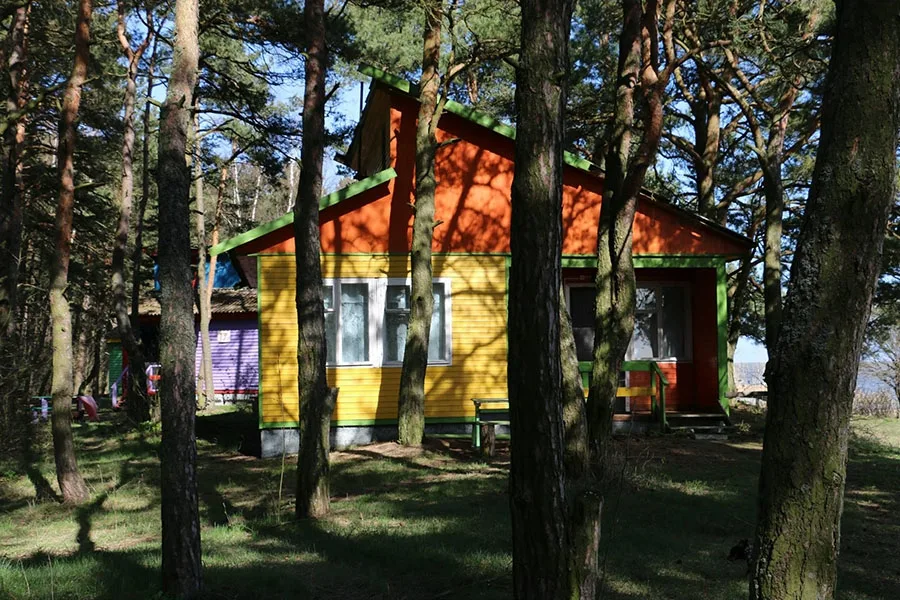 A cabin at a holiday camp on the shore of the Curonian Lagoon.
All the settlements on the Spit grew up around coaching inns, which were also post stations. In the 17th century the road along the Spit became part of the official postal route linking the westernmost point of the “German world”, Kleve on the Rhine, with the easternmost, Riga. Only in 1834, when construction of the new post road from Tilsit to St Petersburg was completed, did the Spit lose its strategic importance.
Until the Second World War, cars were allowed onto the Spit only if they were ambulances or fire engines. Everyone else had to use bicycles, horse-drawn vehicles or boats. Holidaymakers mostly arrived by ship across the Curonian Lagoon, which particularly emphasized the uniqueness of the place.
Plant Life
Coming to the Spit, we are struck by the beauty and diversity of its plant life. Yet people have by no means always helped to preserve the natural riches here. By the beginning of the 18th century practically all the forest on the Curonian Spit had been destroyed, because it was so convenient to ship across the lagoon. This led to an ecological disaster: the sands began to move and swallowed the local villages one after another. Such a state of affairs could not be tolerated, and the Königsberg authorities organized a competition for projects to stop the sands. It was won by Professor Titius, who proposed drawing on the experience of Denmark, where a similar problem had by then been successfully solved with the help of sand-loving introduced plants.
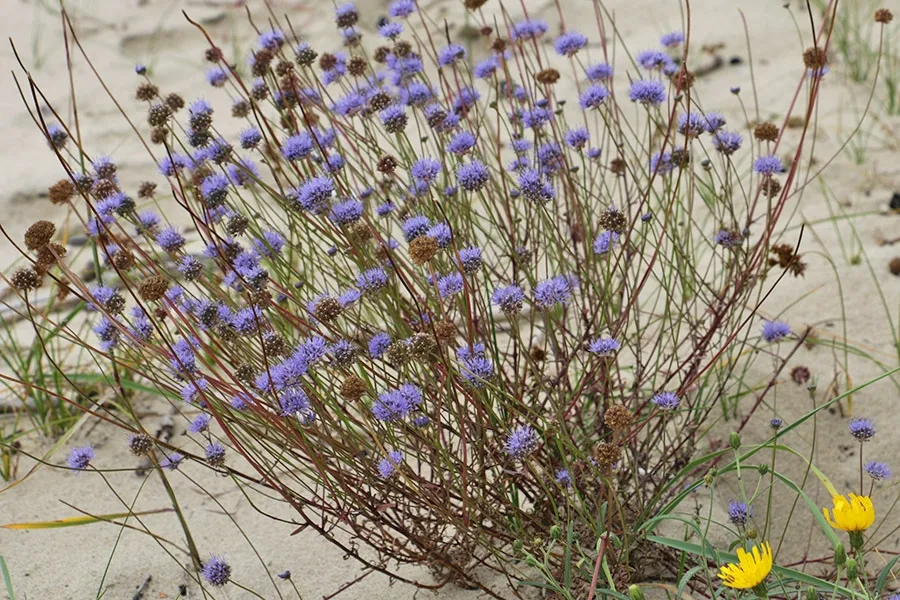 Flowers on the shore of the Curonian Lagoon.
The unprecedented campaign to stabilize the dunes began on the seashore: along the entire length of the Spit a foredune was built to withstand the destructive force of water and wind.
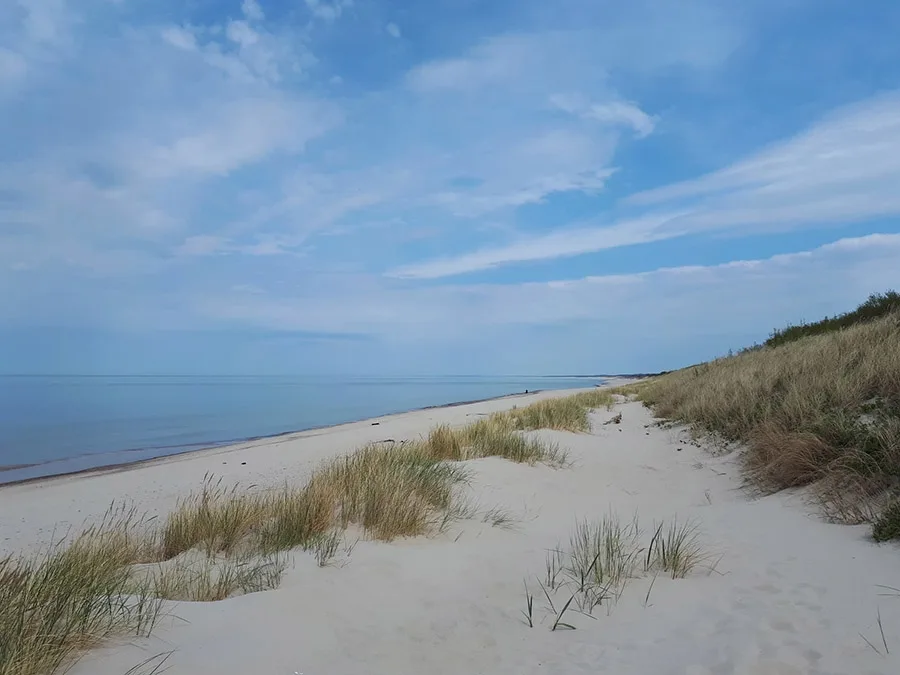 The beach at Morskoye, with the foredune on the right.
At the same time, in the central part of the Spit (the palve), several species of pine were planted, brought from different corners of the world, which proved best suited to the very specific local conditions. Besides trees, sand-loving plants and shrubs brought to the Spit were meant to stabilize its relief. As a result of many years of work the movement of the sands was stopped, and building a road and houses became possible – a new ecosystem took shape that still amazes us with its harmony. Dozens of plant species listed in the Red Data Book grow on the Spit; its territory is a national park and is protected by UNESCO.
Fauna
Nowhere else in the Kaliningrad Region do so many wild animals live side by side with people in such a small area bounded on all sides. Hardly a trip to the Spit goes by without meeting them. Roe deer, red deer, elk, wild boar, fox, badger, marten and other species live here in harmony with humans. When travelling around the Spit, you should be as attentive as possible to its inhabitants, especially when driving on the road, which they often dash across, particularly after dark.
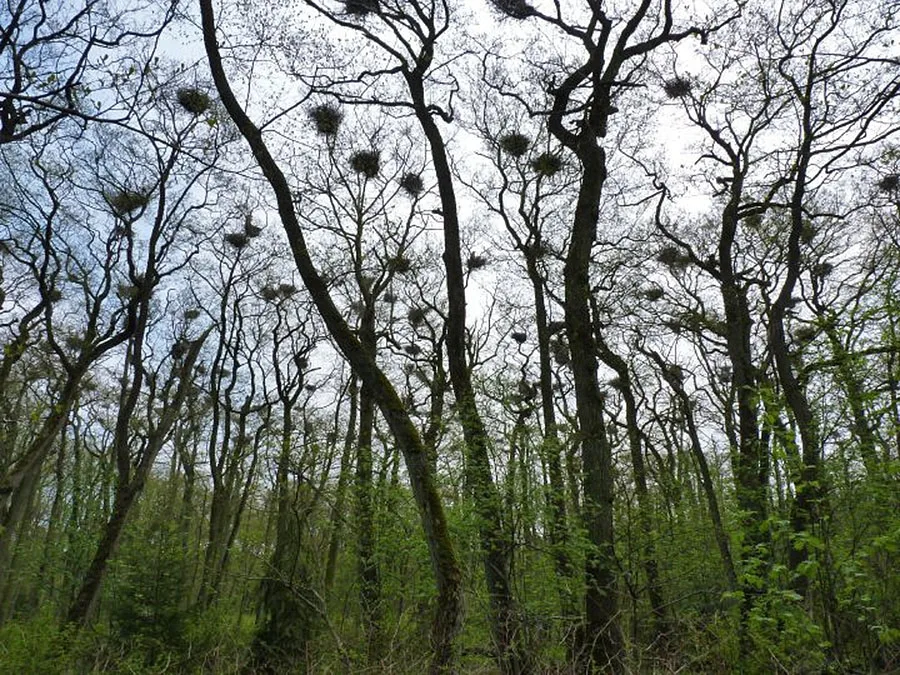 A grey heron colony on the Curonian Spit.
More than 250 bird species can be seen on the Spit, about 100 of which nest here, while the rest pass through during seasonal migration. The largest bird of prey nesting on the Spit is the white-tailed eagle.
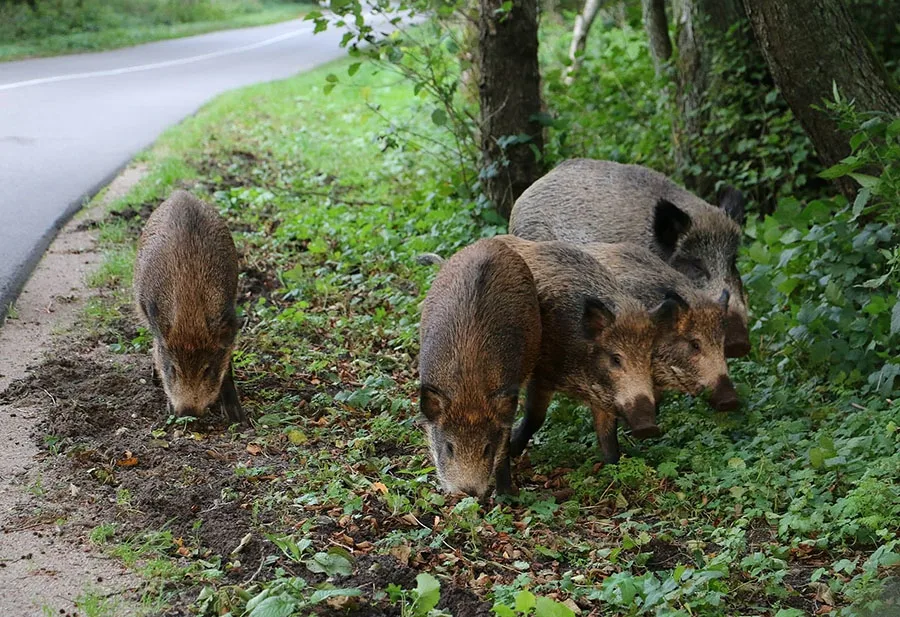 On the Curonian Spit you can come across wild boars in the most unexpected places.
Common cranes nest here, as do herons, which have the largest colony in the Kaliningrad Region on the Spit, with about 400 pairs. Their nests cover the forest over an area of roughly three hectares. Mute swans adorn the lakes of the Curonian Spit. But the most numerous birds here are chaffinches (Lat. Fringílla coélebs). The famous local ornithological station “Fringilla” is named after them.
On the sea beaches of the national park you may come across resting seals. In such a case it is very important not to disturb the animals and not to take advantage of their trust and defencelessness.
The Beggars
If you are an early bird and arrive on the Spit with the first rays of the sun, or stay late and head back after dark, you are very likely to meet its four-legged inhabitants. Usually these are roe deer, elk or wild boars, and if you are lucky, red deer. They may be walking along the roadside or crossing the road, so behind the wheel you should be extremely careful and not hurry, keeping to the speed limits shown on the signs. But among the Spit's inhabitants there are some especially bold and curious ones. Most often these are wild boars and foxes.
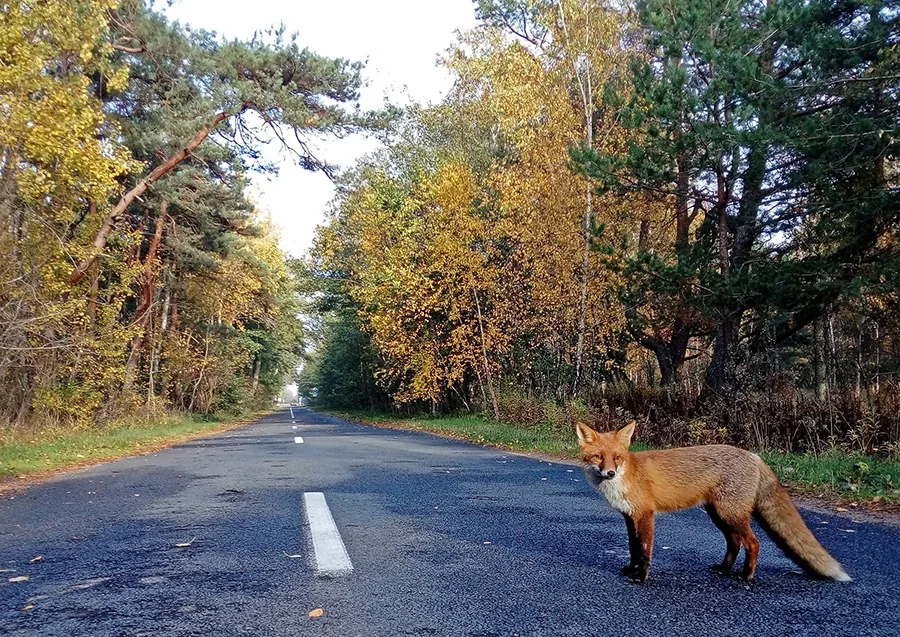 A Curonian fox begging on the road.
The foxes usually beg for food at the border crossing. It is as if they sense that people waiting their turn in their cars under video surveillance cannot get out here, let alone do them any harm. But sharing a treat with them – that happens often.
For some reason the wild boars are not on friendly terms with the border guards, but they may well walk up to you even in the daytime in a car park or at the turning to some local attraction – they know where they are most likely to get something. With them, of course, you should be careful and not feed them straight from your hand. But there is no need to be particularly afraid either. We live side by side with the animals on the Spit all the time, and over many years nothing bad has happened to anyone yet.
Sea and Beaches
The Kaliningrad Region has many wonderful beaches, but no one will dispute that the best of them are here, on the Curonian Spit. Why, you ask? Not only because the whole Spit is one magnificent sea beach almost a hundred kilometres long!
Only here can you, if you wish, choose a spot for your holiday where there will be no one else around. In nine cases out of ten, the path to the beach and back runs through the most pristine forest. And what sand! Try running across it barefoot and you will hear it “sing”. This sound is a unique feature of the local fine-grained crystalline sand.
The very lucky may meet a seal on the local beach. These animals often haul themselves out of the water here to rest a little and bask in the sun.
And the truly fortunate may see elk calves or roe deer cooling off on the shore. In such cases it is important not to frighten the animals, but to watch them from a distance.
Let us not forget the beaches of the Curonian Lagoon either. Because of its shallow depth, the water in the lagoon warms up to 27 degrees, and the sand is just as superb as on the seashore. It is a real paradise for children!
As for precautions, they are the standard ones: if there is a storm at sea, do not tempt fate. But in summer there are no storms on the Baltic, so tourists here are in no danger.
Things to Remember
The Curonian Spit is a very fragile ecosystem whose balance was achieved through decades of titanic human effort. That balance can be upset far more quickly. When planning a trip to the Spit, you should refresh your memory of the restrictions that help us preserve this natural monument for future generations, as well as the rules of personal safety:
► When driving your own vehicle on the Spit, do not exceed the speed limit, especially after dark. Animals often come out onto the road. The Spit is their home. Respect their right to walk and run about in it.
► Feeding wild animals on the Curonian Spit is strictly prohibited.
► Observe all the signs put up by national park staff restricting access to particular places. The Curonian Spit is a national park, and its unique nature is protected by the state.
► Be extremely careful when swimming in the sea, especially in a storm. Rip currents are a real danger here. If you get caught in one (and you will feel it – you will start being carried out to the open sea!), do not try to swim against the current; instead swim out of it sideways, parallel to the shore. Only when you feel you are no longer being carried out to sea should you start swimming towards the shore. The waves will help you.
► Ticks are as common on the Spit as everywhere else in the Kaliningrad Region. When walking in the forests of the national park, take all the necessary precautions. After your walk, be sure to check yourself. If you find a tick attached, don't panic. Go to the outpatient clinic where you are registered or to a 24-hour trauma centre (there are three in Kaliningrad – at the Central City Hospital, the Emergency Hospital and the Regional Children's Hospital), where they will help you remove the insect and treat the wound. The tick should then be taken for testing to the laboratory of the Centre for Hygiene and Epidemiology in the Kaliningrad Region at 27 Kosmicheskaya Street. It is open on weekdays from 8:30 to 15:00, with a lunch break from 12:00 to 12:40. Information line: 53-23-94.
1 — The adjective aeolian comes from the name of Aeolus, the ancient Greek god of the winds.
Contemporary photos by Mikhail Ogorodnikov.
Translated from Russian with the help of AI (Claude, Anthropic), October 2026.