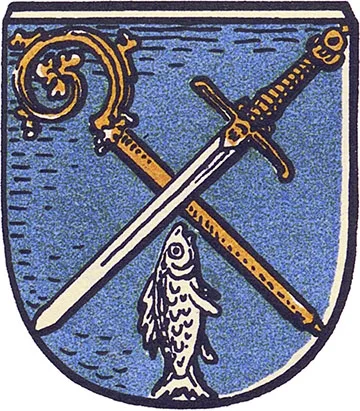
 Coat of arms
of Fischhausen.
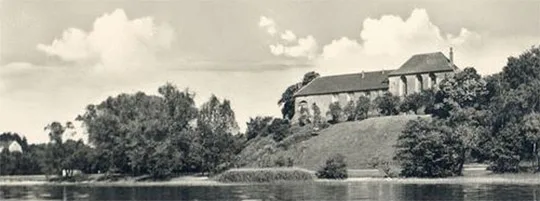
The area where the town of Fischhausen later arose has been mentioned since 1258, although a fishing village existed here even earlier. In 1264, under an exchange agreement, the territory passed into the possession of the Bishop of Samland. In that same year, 1264, by order of Bishop Heinrich von Strittberg / Strittberg, the castle of Schönewik or Schonewik was founded. During the Second Prussian Uprising, the still unfinished castle, which at the time was held by only one knight and one servant-at-arms, was besieged by rebel Prussians from Rinau / Rinau (Chaykino), who for some unknown reason declined to storm it. According to an Order legend, God struck the heathens with temporary blindness.
In 1268 the castle consisted of a rampart with a palisade and two wooden buildings inside. Five vassals were sent to the castle of Schonewik as its garrison. A settlement grew up near the castle. In 1270 the owner of the castle, Bishop Heinrich, handed over its administration to the Order for two years for 80 marks. After his death (before 1274), the Order's nominee Christian von Mühlhausen / Mühlhausen (d. 1294) became the new bishop; on 01.01.1285 he founded the Samland Cathedral Chapter in Schonewik and built a cathedral church. Between 1280 and 1285 the castle of Schonewik began to be rebuilt in stone. In 1297 a dam with a mill was built by the castle. The new castle was a single-wing fortification with an outer bailey. Because of its modest size, the castle did not allow the chapter to hold proper sessions, and in 1302, through the efforts of Bishop Siegfried von Reinstein, the Samland Chapter moved from Schonewik to the new cathedral in Altstadt.
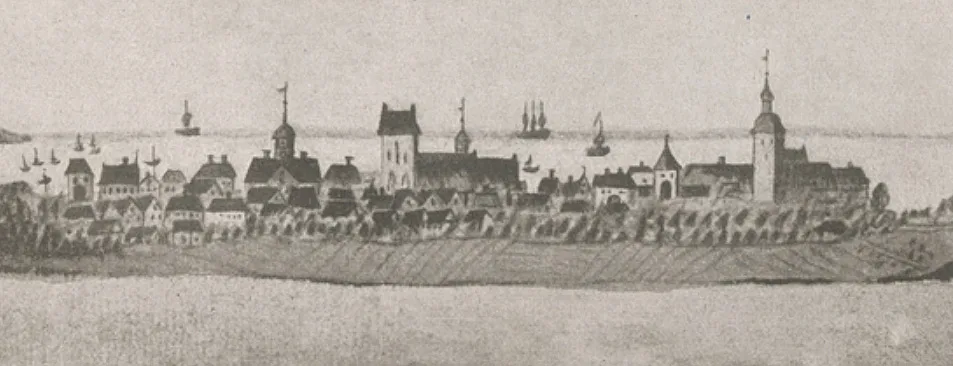
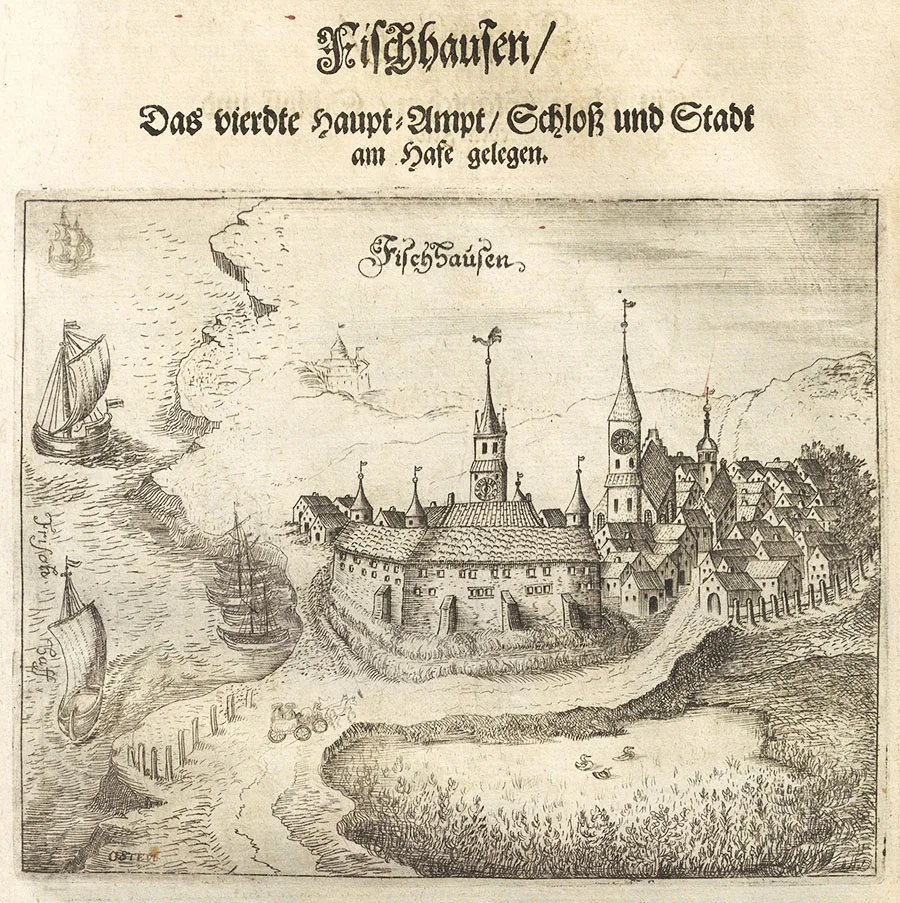 Fischhausen. Engraving by Christoph Hartknoch, 17th c.
On 07.04.1299 a charter was issued for the founding of a proper settlement by the castle of Schonewik. However, the locators1 who received it – Bernard de Barte, Hermann de Grimme, Hennikus Kruse and Hennikus de Bakendorb – failed in their task, and Bishop Siegfried von Reinstein took the initiative himself. On 19.08.1305 the settlement by the castle, which was given the name Bischofshusen, was granted Kulm town rights.
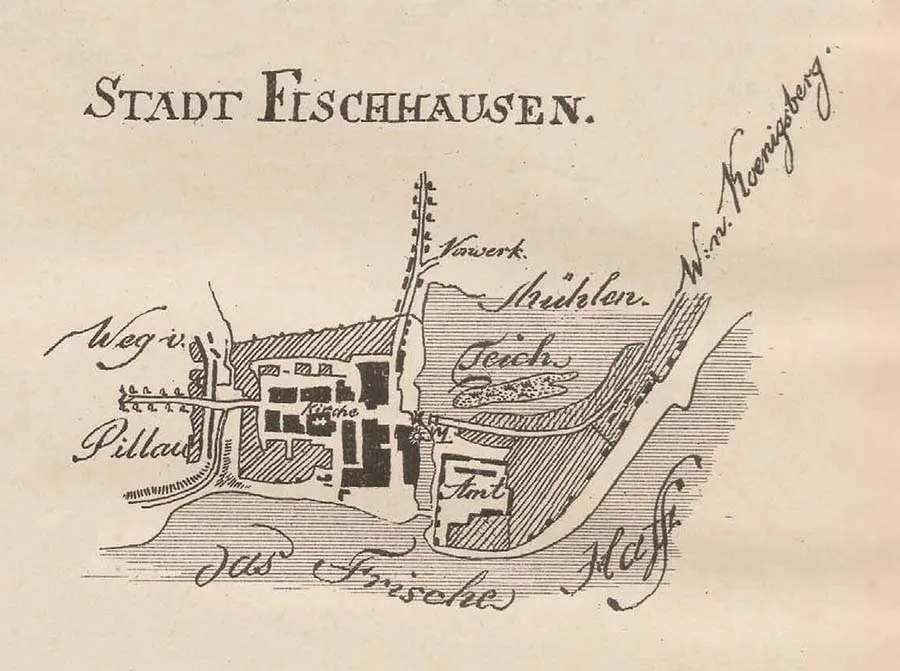
Under these rights the townspeople received 40 plots of land, for which they had to pay eight marks each per year. The right to fell timber and to fish in the lagoon was also stipulated. The town's name soon changed to Bischhusen, and then, by the 1360s, to Wischhusen. In 1436 the town received the name Fischhausen.
During the Thirteen Years' War (1454–66) Fischhausen became the scene of heavy fighting. At the very beginning of the war, on 28.10.1456, the castle was plundered by opponents of the Order from Danzig / Danzig (Gdańsk, Poland). A force of 800 soldiers landed from ships and plundered the surroundings of the town, but the next day it was defeated by the troops of the Order's captain von Blankenstein. The Danzigers, however, had already managed to load the booty onto their ships and carry it off. In 1458 Fischhausen was visited by the Danish King Christian I, who tried to reconcile the Order and the towns, but his mission ended in failure. On 09.08.1462 a force of rebel citizens of Danzig and Elbing / Elbing (Elbląg, Poland) landed near Fischhausen. The town was plundered and burned; only the church and the bishop's castle survived. During the fighting the town's founding charter was lost, and the town council received a duplicate only in 1475. The next attack on the town by troops of the Prussian Confederation took place on 28.09.1463; Bishop Nikolaus and the Grand Master of the Order, Ludwig von Erlichshausen, who were in the Fischhausen church at the time, escaped by a miracle.
From 1522, Fischhausen was the residence of Bishop Georg von Polentz. After the secularization of the Teutonic Order in 1525, the castle became ducal property – a state domain. Administrative bodies were based here: the Amt administration and the amber court, which heard cases of illegal amber collecting and trading.
On 01.07.1526 the wedding of Duke Albrecht of Brandenburg and Dorothea of Denmark took place in the castle chapel of Fischhausen. In 1527 their first daughter, Anna Sophia, was born in Fischhausen. After the death of Duchess Dorothea, Duke Albrecht married a second time, to Anna Maria of Brunswick. The wedding again took place in Fischhausen, on 24.02.1550.
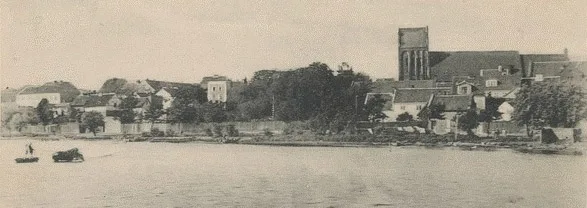
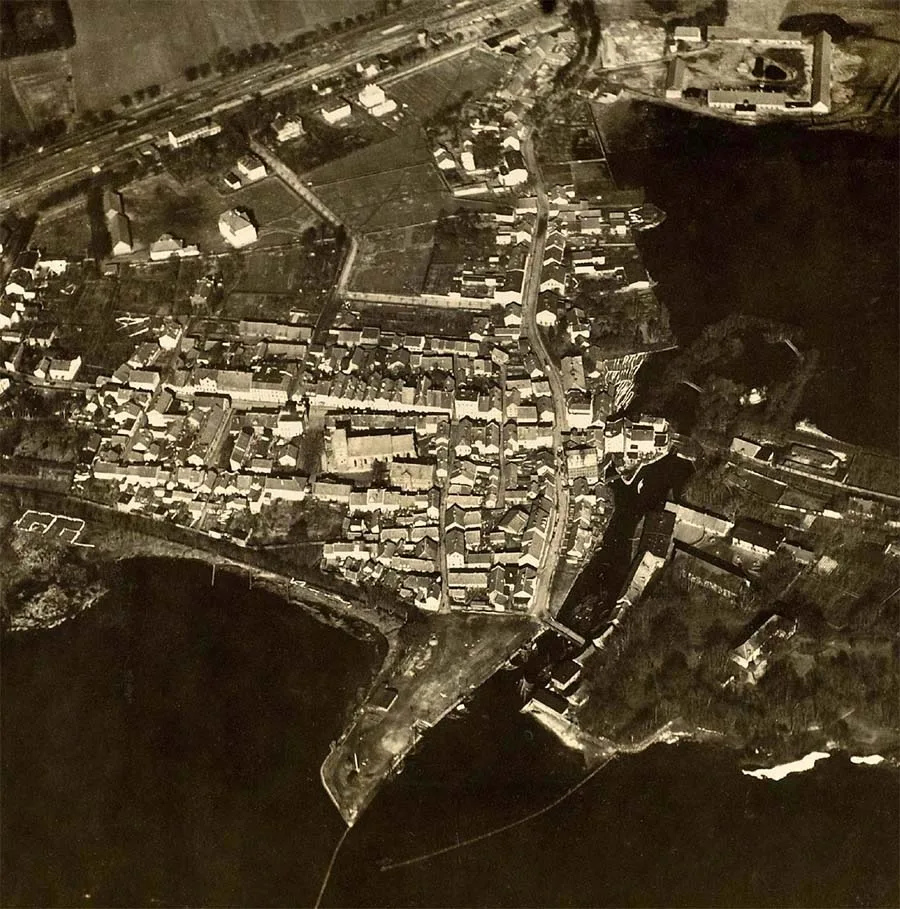
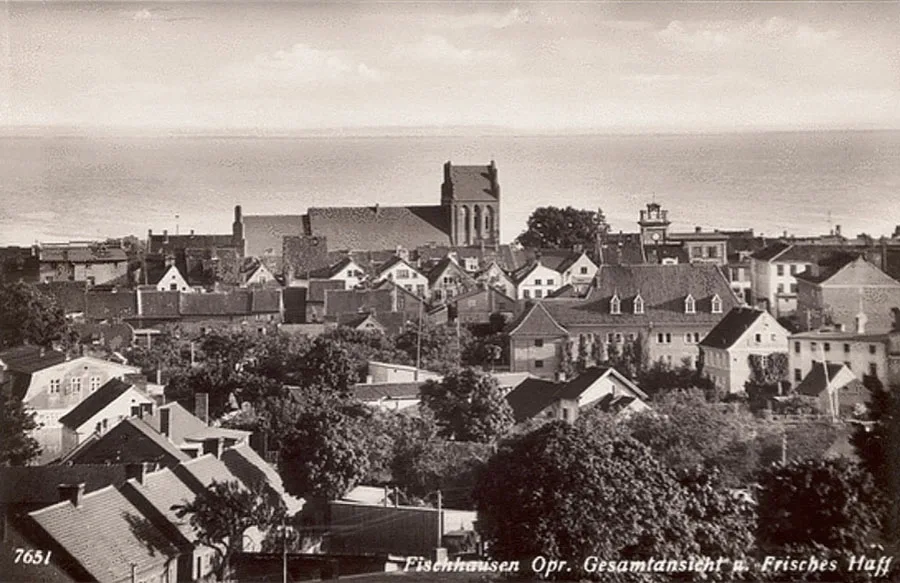 View of Fischhausen from the water tower.
In 1567 the heir to the throne, Albrecht Friedrich, moved to Fischhausen. A year later, after his father's death, he became the nominal head of the duchy, but for health reasons he continued to live in Fischhausen and took no part in affairs of state. In 1580 a plague epidemic swept through the town and its surroundings, and the fair was cancelled as a result. In 1610–18 Fischhausen Castle was the official residence of Duke Albrecht Friedrich and his wife Marie Eleonore of Jülich-Cleves. On 15.02.1613, at the town's request, Elector Johann Sigismund of Brandenburg, who acted as regent for Duke Albrecht Friedrich, issued it a new charter of town rights, since the old one had been badly damaged. The new charter confirmed the privileges of 1305.
In 1627–35 Fischhausen was intermittently occupied by Swedish troops. In 1629 the Swedes added ditches and ramparts to the castle for artillery positions, since the castle itself had long been obsolete as a fortification. On 14.09.1629 a truce between Duke Georg Wilhelm and the Swedish King Gustav II Adolf was concluded in Fischhausen.
It is recorded that after the Swedes left, Fischhausen was in such a desperate state that it was even exempted from paying taxes.
From 1644 the amber court was housed in Fischhausen Castle. In 1671, 1673 and 1677 the town suffered badly from fires. From 1701 Fischhausen Castle began to be dismantled for building materials for the fortifications of Pillau / Pillau (Baltiysk). The demolition was entrusted to the royal master builder (architect) Joachim Ludwig Schultheiß von Unfriedt / Unfriedt (1678–1753). The Amt authorities, headed by Wallenrodt, petitioned for the castle to be preserved, but managed to save only the clock tower.
On 17.06.1702 the future physicist and mathematician Roppolt was born in Fischhausen Castle. In 1709 there came first a severe winter, followed by a plague epidemic. In the Amt of Fischhausen, 916 people died of the plague in 1709, 388 in 1710 and 503 in 1711. After the plague, nine families of religious refugees from Salzburg came to Fischhausen under the resettlement plan. King Friedrich II quartered a company of cavalry in the town, but on 17.07.1740 the town magistrate, in view of the town's dire situation, asked for it to be replaced by an infantry company, which was cheaper to maintain. The authorities met the townspeople halfway and granted the request. Later, two invalid companies (garrison and non-combatant units) were quartered in Fischhausen.
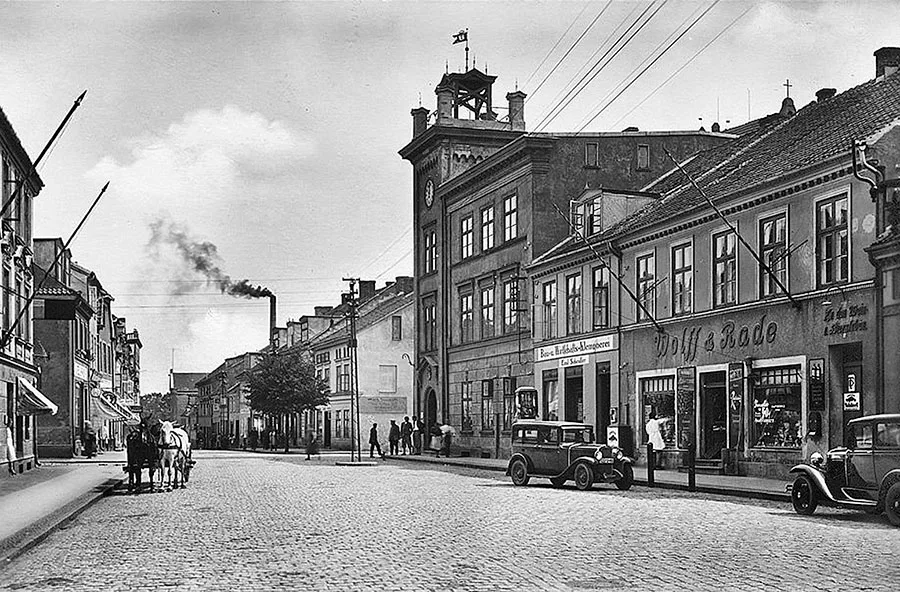 Town Hall of Fischhausen.
During the Seven Years' War (1756–63), Russian troops entered the town in 1758, but they did not linger in Fischhausen and moved on to Pillau (Baltiysk).
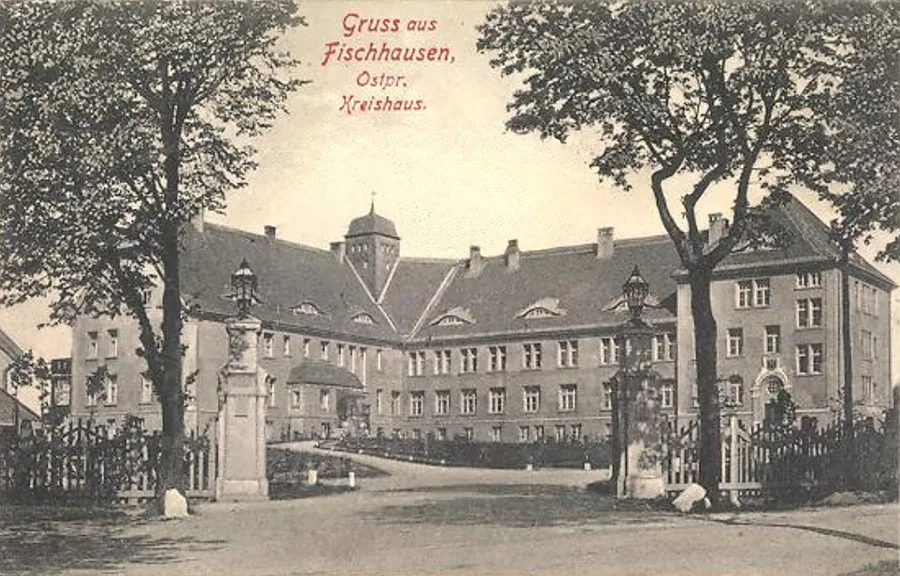 Kreishaus Fischhausen.
In the second half of the 18th century the amber court in Fischhausen Castle was joined by a coastal court. In 1776 lightning struck the castle's clock tower and destroyed it.
During the War of the Fourth Coalition (1806–07), in 1807 the 2nd Pomeranian Battalion of von Röder, 548 soldiers recruited from the local population, was stationed in Fischhausen. It was then reinforced by 10 invalid companies under the overall command of Major von Spiegel. The remnants of the garrison of Danzig, which had capitulated to the French, also retreated here. These troops later withdrew to Pillau, and on 18.06.1807 French units 6,000 strong under General Saint-Hilaire, who blockaded Pillau until 24.07.1807, entered Fischhausen. After the Peace of Tilsit (07.07.1807), a Prussian peacetime garrison was stationed in Fischhausen from February 1808. Because of a poor harvest and exhausted provisions, these units left the town in January 1809. In June 1811 the guarding of the Baltic coast against the smuggling of English goods began. Some 5,000 soldiers were deployed for this, three companies of Major von Bülow being quartered in Fischhausen. Confiscated goods were stored on the grounds of Fischhausen Castle and then sent on to Königsberg.
Since the customs measures were well paid by the French, Fischhausen rode this wave to improve its economic situation somewhat.
French troops passed through Fischhausen twice more: on 15.06.1812, 1,671 soldiers were stationed here on their way to the Russian border, and on 3–5 January 1813 the retreating French passed through in the opposite direction. In all, since the start of the Russian campaign some 16,000 soldiers of Napoleon's army passed through Fischhausen, which was ruinous for the townspeople. The French were followed by the Russians: on 7 January 1813 units of von Pahlen's Riga Dragoon Regiment entered the town, and the townspeople greeted them with festive illuminations; these troops forced the surrender of the Prussian garrison, which was still formally allied with Napoleon. On 09.01.1813 two Cossack sotnias entered the town. And on 22.01.1813 the commander of the siege corps, General Gorbantsov, arrived in Fischhausen. The troops left Fischhausen only after the capitulation of Pillau on 08.02.1813. Fischhausen's "military duties" did not end there, however. In line with the reforms, in September 1813 a Landsturm battalion of 50 cavalrymen and 72 infantrymen was formed from local residents, which drilled weekly. 1814 was another year of poor harvest, but Russian and Prussian troops marching west or returning home were periodically quartered in the town.
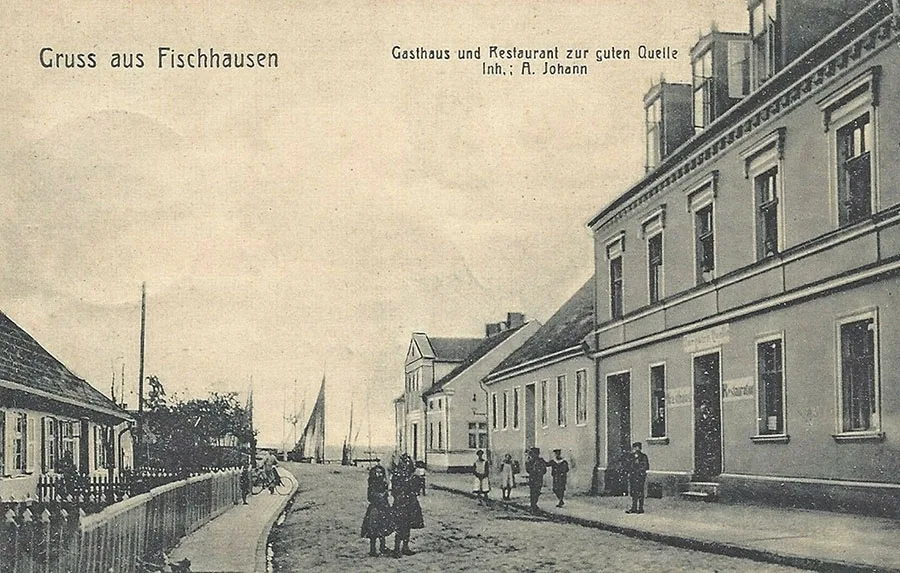 Postcard from Fischhausen (late 19th c.).
In 1818 Fischhausen became the seat of the newly formed Kreis (district) of Fischhausen. Until 1928, however, there were two administrative units on the territory of present-day Primorsk: the town of Fischhausen and the Gutsbezirk (estate district) Domäne Fischhausen / Domäne Fischhausen. In 1831 a cross was erected not far from Fischhausen at the place where St Adalbert met his death.
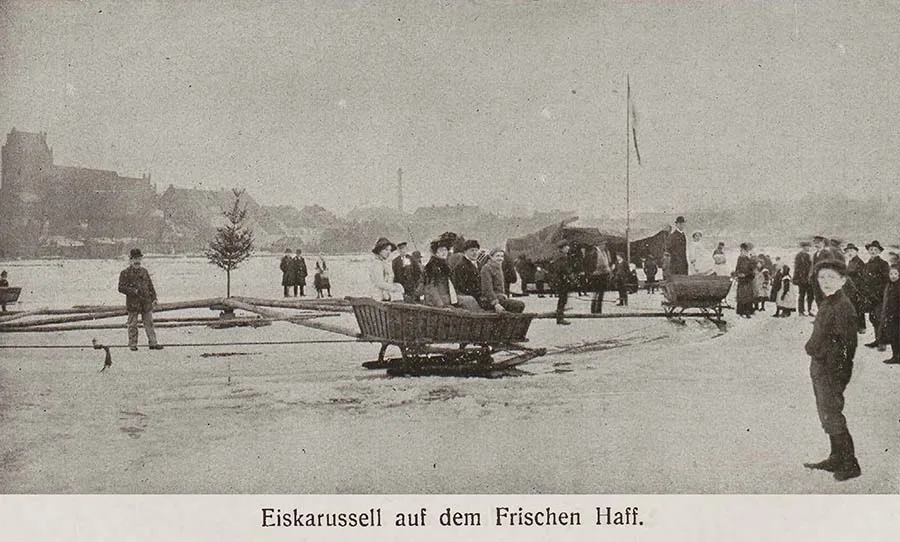 Carousel on the ice of the Frisches Haff.
On 11.09.1865 the Königsberg–Pillau railway was opened, with a station in Fischhausen. In 1871 the town of Fischhausen had 172 residential houses. In 1884 another branch line was built from Fischhausen to Palmnicken. For local freight and passenger traffic, a narrow-gauge railway Fischhausen – Marienhof station / Bahnhof Marienhof (Pereslavskoye-Zapadnoye) was built in 1900. In 1939, when the Landkreise of Königsberg and Fischhausen were merged into a single Landkreis Samland, Fischhausen lost its status as a district seat.
Before the Second World War, Fischhausen had a town hall, district judicial, administrative and financial offices, a hospital, an old people's home, schools, two brickworks, a dairy, a power station, mills, sawmills, a fish factory, a slaughterhouse and various sports and cultural societies.
On 17.04.1945 Fischhausen was taken by the Red Army. The fighting for the town was fierce and lasted two days. The main events took place on the night of 16–17 April, when the 126th Rifle Division of the 43rd Army and units of the 113th Rifle Corps of the 39th Army fought for the town with air support from aircraft of the 1st and 3rd Air Armies. The town suffered considerable destruction in the fighting, the centre being especially badly hit. The buildings on the grounds of Fischhausen Castle were destroyed, including the house of the domain's leaseholder.
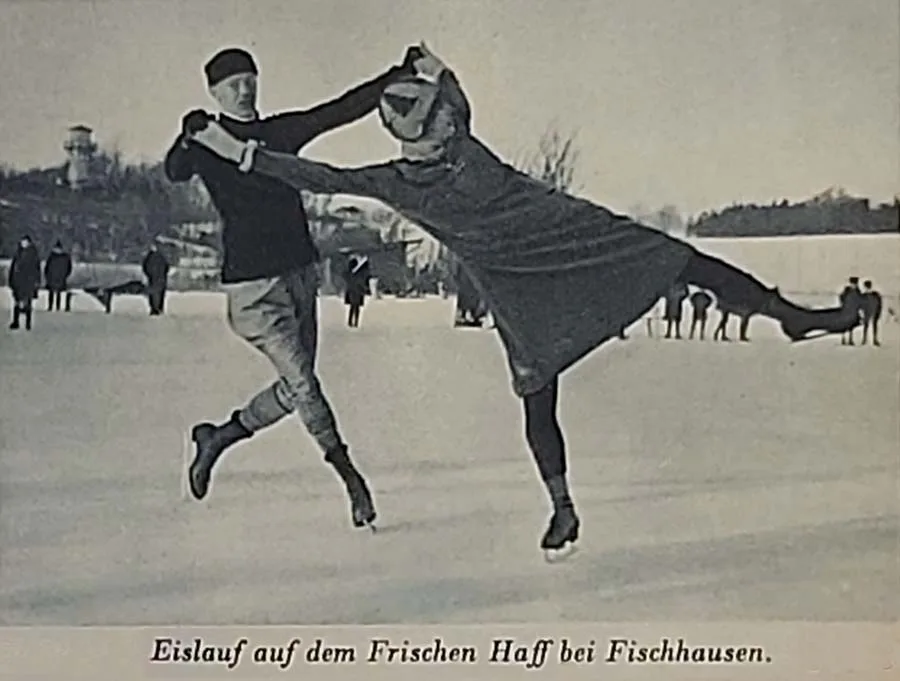
On 07.09.1946 Fischhausen was renamed Primorsk. At the same time Primorsk District was formed, with Primorsk as its centre.
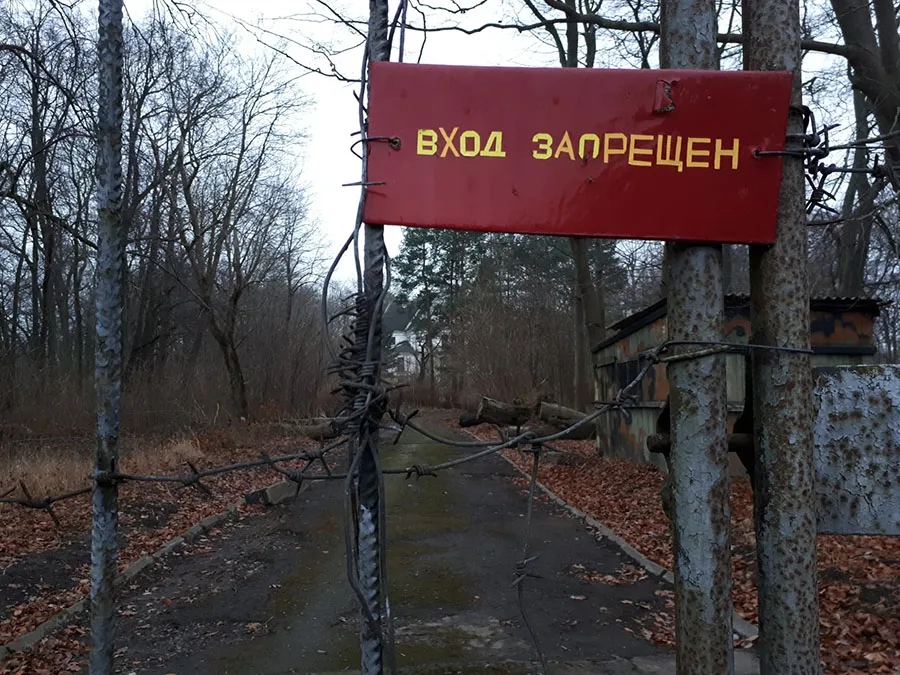 Villa Porr. The town's only sight cannot be approached.
On 25.07.1947 the district centre was moved to Zelenogradsk. Until 1963 Primorsk belonged to Primorsk District, in 1963–94 to the Svetly urban district, and in 1994–2008 to the Baltiysk urban district. In 2005 Primorsk became an urban-type settlement. In 2008 it became part of the newly formed Baltiysk District and regained its town status.
In 1946–47 settlers arrived in Primorsk from the Kursk, Smolensk, Ryazan, Gorky and Bryansk regions. The town centre was badly destroyed, and so the housing stock was drastically reduced compared with pre-war Fischhausen. The town's territory was expanded to include adjacent settlements and industrial areas, but there were still not enough buildings. On 01.09.1946 a primary school opened. The officers' club, opened in the town centre, served as a venue for cultural and public events. In the 1950s a new station building was built. In 1953 a library opened in Primorsk. The sawmill and brickworks that had operated before the war were never restored. In 1958 a Baltic Fleet radio engineering plant opened in Primorsk, which was in essence a repair workshop.
The proximity of Baltiysk and Svetly meant that neither industry nor services developed in the town – the residents of Primorsk commuted to work in neighbouring towns, and went there and to Kaliningrad for any major shopping.
In the town itself several brigades fished in the Kaliningrad Lagoon. The population was supplied mainly through the military trade and cooperative trade networks. Primorsk at that time had one pharmacy and a 10-bed hospital. In 1965 the hospital was closed, and in 1967 it reopened as a polyclinic, which in 1968 became an outpatient clinic with three doctors. In addition, from 1952 to 2011 a military hospital operated on the outskirts of Primorsk in the former Villa Porr; its staff provided medical aid to civilians when necessary.
In 1987 the departmental housing stock was transferred to the town Soviet. At the turn of the 20th–21st centuries, 15 two-storey and five five-storey buildings were built in the town. In 1994 a new town administration building was built, and in 1996 a kindergarten building. Today Primorsk has a secondary school, a children's art school, a kindergarten and a feldsher-midwife station. The Baltic Fleet communications equipment repair plant is effectively the town's main employer. Primorsk is among the Russian towns with the smallest population; in different years it has ranked between 7th and 13th place in this list.
Sights: ruins of the bishop's castle (1266), water tower (1914), railway water tower (1900), memorial on the mass grave of Soviet soldiers (1955, 2,406 people), German military cemetery (1,600 people, restored 1996), monument to those who fell in the First World War (1923, restored 1996), Villa Porr (early 20th c.), the Amt bridge, a war memorial sign (2011).
Population: 1772 – 1,100, 1867 – 2,431, 1871 – 2,463, 1880 – 2,562, 1899 – 3,131, 1910 – 2,613, 1925 – 3,414, 1933 – 3,492, 1939 – 3,879, 1946 – 195, 1947 – 600, 1959 – 2,049, 1970 – 1,730, 1979 – 1,706, 1989 – 1,792, 1996 – 2,000, 2002 – 2,150, 2005 – 2,100, 2010 – 1,956, 2012 – 1,950 inhabitants.
For reference
Domäne Fischhausen. The Domäne (domain) of Fischhausen was formed in 1525 upon the secularization of the Teutonic Order and was an independent administrative unit until 1928, when it was merged with the town of Fischhausen.
In the 19th century the Domäne Fischhausen formed the Gutsbezirk of the same name in the Kreis of Fischhausen. The Gutsbezirk was also sometimes called Fischhausen Castle / Fischhausen, Schloß. At the beginning of the 19th century the house of the domain's leaseholder, with a park, was built on the castle grounds. The Domäne Fischhausen belonged to the parish of Fischhausen. Besides the castle itself, the Gutsbezirk included: the estate of Alt Neuhäuser / Alt Neuhäuser (54°41'26'' N 19°55'19'' E), the estate of Schäferei / Schäferei (Mechnikovo, 54°41'05'' N 19°55'54'' E), the estate of Waldkrug / Gut Waldkrug (Mechnikovo, 54°41'17'' N 19°55'59'' E), the estate of Neuendorf / Neuendorf (Divnoye), the Vorwerk (outlying farm) Fischhausen / Vorwerk Fischhausen (Primorsk, part), the Vorwerk Milchbude / Milchbude (54°42'54'' N 20°03'25'' E), the Vorwerk Schäferhof / Schäferhof (54°44'44'' N 20°00'38'' E), Neuhäuser station / Bahnhof Neuhäuser (Mechnikovo station) and the road keeper's house / Chausseehaus (54°41'23'' N 19°56'10'' E). On 13.04.1874 the Gutsbezirk Domäne Fischhausen was included in the newly established Amtsbezirk Domäne Fischhausen. The first head of the Amtsbezirk, in 1874–92, was Amtsrat Wien / Wien, who lived in Fischhausen Castle. He was also the only one of its heads who lived on the domain itself. Small parcels of land were periodically "nibbled off" the domain, mostly in favour of the town of Fischhausen. On 24.03.1890 the Gutsbezirk lost a considerable share of its holdings near Pillau – the estate of Neuhäuser (Mechnikovo), Schäferei (Mechnikovo, part), Waldkrug (Mechnikovo, part) and Neuhäuser station (Mechnikovo station) were merged into an independent rural community. On 31.01.1900 the estate of Neuendorf (Divnoye) was separated from the Gutsbezirk Domäne Fischhausen as an independent Gutsbezirk. On 30.03.1901 the road keeper's house passed from the Gutsbezirk Domäne Fischhausen to the community of Neuhäuser (Divnoye). On the other hand, on 19.06.1902 Lochstädt Castle / Lochstädt (Mechnikovo, part) with its adjacent lands was incorporated into the Gutsbezirk Domäne Fischhausen. But as early as 15.01.1904 this acquisition was transferred to the forest Gutsbezirk Kobbelbude / Kobbelbude, Forst, administered from the head forestry office of Kobbelbude / Oberförsterei Kobbelbude (Bobrovo). Thus only the estate itself and the Vorwerke Fischhausen, Schäferhof and Milchbude remained in the Gutsbezirk Domäne Fischhausen. On 30.09.1928 the Gutsbezirk Fischhausen was abolished and attached to the municipality of Fischhausen.
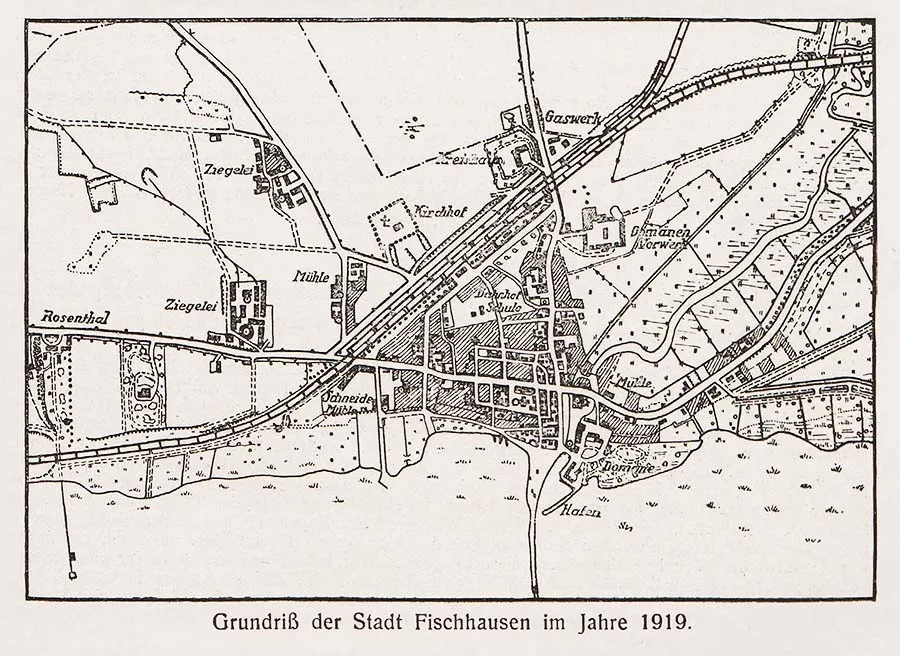
Amtsbezirk Domäne Fischhausen. On 13.04.1874 Amtsbezirk No. 3 Domäne Fischhausen was established in the Landkreis of Fischhausen, comprising three rural communities: Dargen / Dargen (Lunino), Littausdorf / Littausdorf (Zorino), Legehnen / Legehnen (Popovka), and three Gutsbezirke: Domäne Fischhausen (Primorsk, part), Gaffken / Gaffken (Parusnoye) and Osterau / Osterau (Osetrovo). On 31.12.1900 the Gutsbezirk Neuendorf / Neuendorf (Divnoye) was separated from the Gutsbezirk Domäne Fischhausen and came to belong to the Amtsbezirk Domäne Fischhausen. On 29.04.1912 the Gutsbezirk Nöpkeim / Nöpkeim (54°47'10'' N 20°02'03'' E) passed from the Amtsbezirk Gauten / Gauten (Putilovo) to the Amtsbezirk Domäne Fischhausen. Thus the Amtsbezirk Domäne Fischhausen came to consist of three rural communities: Dargen (Lunino), Littausdorf (Zorino), Legehnen (Popovka), and five Gutsbezirke: Domäne Fischhausen (Primorsk, part), Gaffken (Parusnoye), Neuendorf (Divnoye), Nöpkeim and Osterau (Osetrovo).
On 30.09.1928 the Gutsbezirke Domäne Fischhausen (Primorsk, part) and Neuendorf (Divnoye) were abolished and attached to the municipality of Fischhausen (Primorsk). At the same time the Gutsbezirke Gaffken (Parusnoye), Nöpkeim and Osterau (Osetrovo) were merged into the new rural community of Gaffken. On 23.04.1930 the communities of Gaffken (Parusnoye) and Dargen (Lunino) passed to the Amtsbezirk Tenkitten / Tenkitten (Beregovoye), and the Amtsbezirk Domäne Fischhausen was abolished.
Population of the Gutsbezirk Domäne Fischhausen: 1867 – 377, 1871 – 377, 1905 – 216, 1910 – 185 inhabitants.
Population of Fischhausen in 1871 by composition: Protestant Christians – 2,365, Catholics – 19, other Christians – 36, Jews – 43, children under 10 – 614, literate 1,524 (84%), blind – 2, deaf-mute – 4, insane – 4.
Population of the Domäne Fischhausen in 1871 by composition: Protestant Christians – 374, other Christians (except Catholics) – 3, children under 10 – 94, literate – 220 (78%).
Population of the Vorwerk Fischhausen: 1905 – 149 inhabitants.
Population of the estate of Alt Neuhäuser: 1905 – 6 inhabitants.
Population of the estate of Schäferei: 1905 – 64 inhabitants.
Population of the estate of Waldkrug: 1905 – 33 inhabitants.
Population of the Vorwerk Milchbude: 1905 – 3 inhabitants.
Population of the Vorwerk Schäferhof: 1905 – 11 inhabitants.
Population of Neuhäuser station: 1905 – 13 inhabitants.
Population of the road keeper's house: 1905 – 4 inhabitants.
Parish of Fischhausen: Bludau / Bludau (Kostrovo), Bruch / Bruch (54°45'32'' N 20°05'15'' E), Dargen / Dargen (Lunino), Fischhausen (Primorsk), Forken / Forken (Podorozhnoye), Geidau / Geidau (Prozorovo), Kallen / Kallen (Tsvetnoye), Karlshof / Karlshof (Cheryomukhino), Kasperhöfen / Kasperhöfen (Dorozhnoye), Kobbelbude / Kobbelbude (Bobrovo), Milchbude / Milchbude (54°42'54'' N 20°03'25'' E), Littausdorf / Littausdorf (Zorino), Neuendorf / Neuendorf (Divnoye), Sanglienen / Sanglienen (Khmelyovka), Schäferhof / Schäferhof (54°44'44'' N 20°00'38'' E), Wischrodt / Wischrodt (Krylovka).
1 In the time of the Teutonic Order, locators were enterprising people who volunteered to found a settlement on behalf of the Order's authorities. A locator was assigned the boundaries of a territory and granted certain privileges, rights and obligations, after which he recruited colonists (mainly in Germany), built one or several settlements and became the lifelong headman of the area under his authority – the Schulze – with the right to pass the office on to his heirs.
Contemporary photos by Mikhail Ogorodnikov.
Translated from Russian with the help of AI (Claude, Anthropic), October 2026.