
Dedicated to the memory of Paweł Adamowicz —
Mayor of Gdańsk, a man who gave his life
to serving his city and its people.
FIRST THERE WERE PEOPLE
A mere 13,000–14,000 years ago, a glacier lay where the Baltic Sea is now. A great deal of fresh and salt water has flowed since then, and people came to these shores as well. They chose sites for their huts that were protected from flooding and excessive drought. They learned to make stone tools and to strike fire with flint. They farmed, raised livestock, fished and hunted seals. They adorned themselves with amber. The ancient tribes, presumably Germanic, who settled on the Baltic coast firmly believed in the magical power of the sun stone and carved amulets from it — figurines of animals and deities.
In the Bronze Age (3500–1200 BC) the settlements grew more numerous. The archaeological finds from that period are also more substantial; they presumably correspond to the Nordic culture of Pomerania and the north of East Prussia. Burial mounds gave way to collective monuments typical of the Germanic peoples. Who could have imagined that these facts would one day lead to tragic consequences? In 1919 the German Empire would brandish them before the participants of the Treaty of Versailles.
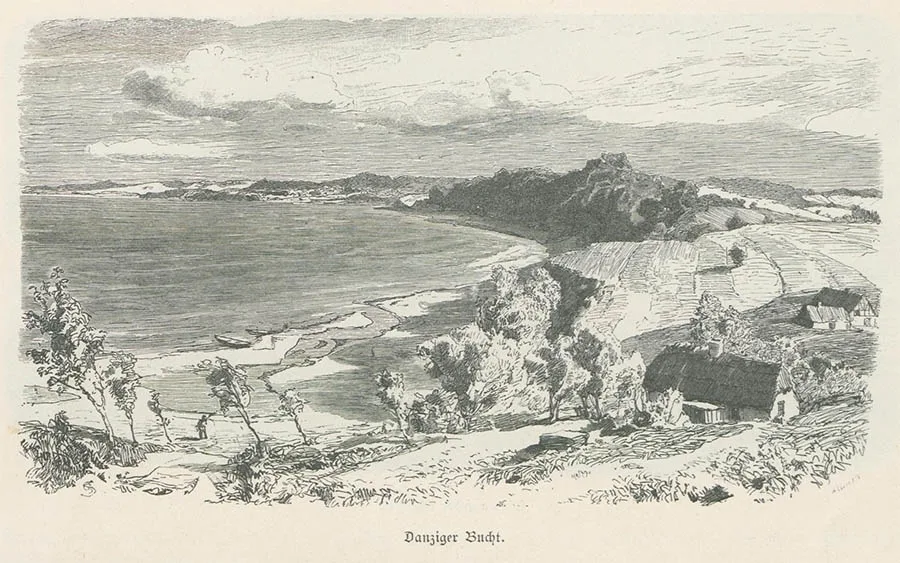 The Bay of Danzig. Illustration by Gustav Schönleber (German: Gustav Schönleber; 1851–1917) from the book “Excursions along the Shores of the North and Baltic Seas” (Küstenfahrten an der Nord- und Ostsee).
From the Hallstatt period (roughly 900 to 400 BC) — at the junction of the Bronze and Iron Ages — ceramic urns containing ashes have been found alongside the customary burials. The pottery bears images of human faces. Between the middle and the end of the 19th century, around two thousand graves were opened here, half of them cremation burials. The finds from this period — tweezers, needles, earrings with pendants and so on — correspond exactly to finds from Scandinavia, Denmark and northern Germany. Even Slavic researchers, as German politicians wrote at the beginning of the 20th century, did not dare deny the Germanic character of this culture and the close kinship between the Germanic and Scandinavian tribes.
At the close of the Hallstatt period everything changed beyond recognition. The existing civilisation came to an end, making way for a new one — the La Tène culture. Settlements now looked more like fortresses, and the beginnings of towns appeared, which by the end of the era had grown into major centres of trade and crafts.
Burial mounds almost entirely disappeared, and cremation prevailed. Everyday objects changed too. Iron was used to make weapons — daggers and swords. La Tène helmets now took the shape of a hemisphere with hollow horns. Horse gear changed, and horseshoes appeared. Moreover, the Celts who came to these parts not only rode on horseback but also travelled in carts. With the arrival of the potter's wheel, earthenware took on more regular shapes. Jewellery became more elegant and varied as well: torcs, beads and bracelets of amber. Faith in its magical power only grew stronger over the centuries. Overland “amber roads” for trade appeared, running along the main rivers, the Vistula among them, and leading south towards the Black Sea, to Rome and to Greece.

The Celts
The Celtic tribes took shape in the first half of the 1st millennium BC in the basins of the Rhine and the Upper Danube. Ancient authors called them Gauls — from the Greek Γαλάται or the Latin Galatae. The Celts were considered one of the most warlike peoples in Europe. To frighten the enemy, they let out deafening howls before battle. In the 1st millennium BC the Celts were the first to fit their chariot wheels with metal rims to make them stronger. In ancient Greek mythology the eponym of the Celts is a son of Heracles or of Polyphemus. When Heracles was returning from Erytheia with the cattle of Geryon, he came to King Bretannus. The king's daughter Celtine fell in love with Heracles and hid the cattle. In exchange for the cattle she demanded that he share her love. Heracles agreed, and Celtine bore him a son, Celtus, from whom the Celtic people took their name. A celt, incidentally, is also a type of ancient axe.
The tribal economy of the La Tène period (500–1 BC) was based on farming. The earth has preserved many pieces of agricultural implements, as well as coins that the Celts minted themselves for trading with neighbouring tribes. Trade was an occasion for different cultures to meet, draw closer and blend into one another. And apparently they drew so close that the neighbours gradually began to push the Germanic tribes out of the lands they had long settled and cultivated. At the beginning of the 20th century German ideologues set about quite seriously searching for the causes of a phenomenon they could not understand. In the absence of written sources, and relying solely on the available artefacts, they concluded that in the last centuries BC there had been a great exodus to these lands from Scandinavia and the nearby islands. Among the migrants were the Burgundians — first mentioned by Pliny in his miraculously preserved “Natural History”. There were probably also the East Germanic Rugii, who moved into the area of the Bay of Gdańsk and were in turn pushed out by the Goths and the Gepids. The latter occupied an islet at the mouth of the Vistula and named it Gepedoios. Perhaps that is how it all happened — unfortunately, no documents from that era have survived.
Ancient historians did, of course, write about the tribes that inhabited the coast. But the question is how reliable this information is. The particularly meticulous Johann Aphagen (Johann Aphagen) delved in his research as far back as the Persian king Darius I Hystaspes, who reigned from 522 to 486 BC, and put forward his own version, citing the earliest Roman geographer, Pomponius Mela, author of the “Chorographia”. Mela had mentioned a people who inhabited the lands where the Vistula flows into the sea and who called themselves Teutons (warriors), or Hermiones. There, too, on territory rich in water meadows on the shore of the bay, the city of Hermionia was founded. Aphagen concluded that the Hermiones were the very same Goths, or Germanic people. This version was seized upon by Friedrich August Vossberg, a native of East Prussia, a numismatist and bank clerk. In his work he boldly declared that it was these very tribes described by the ancient historian that had laid the foundations of the future German Danzig, rather than Polish Gdańsk. For his services to the German Empire, Vossberg was awarded the Order of the Crown, the House Order of Hohenzollern and the Gold Medal for Science and Art.
The first centuries AD in the lower Vistula region passed under the sign of the Great Migration of Peoples. And German trackers once again took up their searches — this time trying to find a Slavic trace in the Vistula lands. Slavs did live here. By the 10th century there were quite a few of their settlements, as archaeological finds indicate.
The Germanic peoples called their neighbours — the Polabian Slavs, the Lusatian Sorbs and the Kashubians, who inhabit Pomerania to this day — Wends.
In their attempts to prove their direct kinship with these ancient lands, German historians wrote entire libraries. Particularly successful in defending German rights to Prussia was a native of Tilsit — the German philologist, professor of Germanic archaeology at the University of Berlin, the best-known researcher of the prehistoric period and founder of the “settlement archaeology method”, Gustaf Kossinna. His ideas were close to National Socialist ideology. He defended a doctoral dissertation on “The Oldest Upper Franconian Written Records” and published several books on the origins of the Germanic peoples. He even — to stimulate interest in the subject — founded the “German Society for Prehistory”.
In his view, the Germanic peoples constituted a national identity with a historical right to the territory they had inhabited since time immemorial. This served to justify the subsequent Nazi seizure of European territories. And first and foremost, it concerned Poland. At some point Kossinna got the idea that it ought to be part of the German Empire. In 1919 Kossinna sent his book “The Vistula Region — Ancient Homeland of the German People” to the Versailles Conference, in order to prove that all the lands where Germanic artefacts had been found were part of the ancient territory of Germany and could not be handed over to Poland.
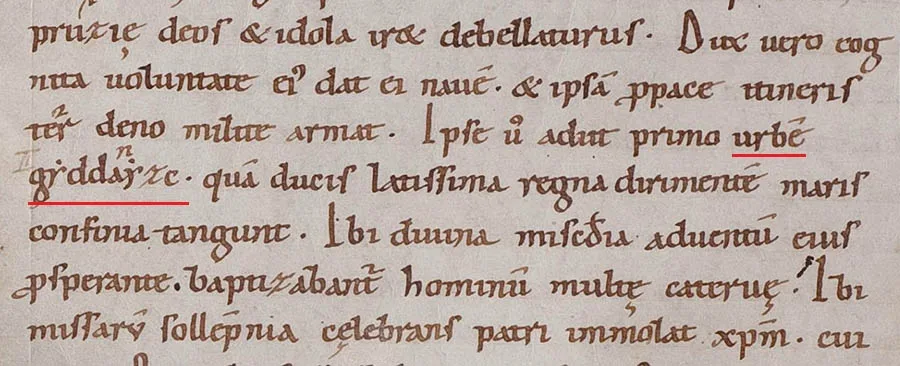 A fragment of the manuscript Vita sancti Adalberti containing the first mention of Gdańsk.
On the same grounds, he advanced his absurd theory that a Nordic Aryan race had existed as early as the Bronze Age and that modern Germans were its descendants. This race, he claimed, was intellectually superior to all others in every respect, and its migration from north to south had changed the entire course of world history. Kossinna also flatly denied that Slavic settlements had ever existed.

The Wends
The Germans used the name Wends for all the Slavic tribes living in their vicinity. The Wends (also known as Veneds or Veneti) once occupied part of present-day Germany between the Elbe and the Oder. The Wendish state, which existed on the Baltic coast from roughly 1040 to 1129, was an early feudal state of the Polabian Slavs: the Bodrichi-Obotrites, the Wilzi-Lutici and the Pomeranians. In Russian literature, the Wends are usually called Lusatians or Lusatian Sorbs. In Germany, the Foundation for the Sorbian People has been working to preserve the language and culture of this people since 1991.
Polish archaeologists, however, have proved the opposite: a Slavic hillfort stood on Gdańsk soil as early as three thousand years ago, during a period of numerous, long-lasting migrations. In the 6th and 7th centuries, permanent settlements took the form of fortified strongholds, known from excavations in the vicinity of Gdańsk as well, at Sopot, Oliwa, Chmielno and elsewhere. In all, archaeologists have found some 50 such strongholds along the Gdańsk coast, through which the ancient "Amber Road" passed. Among the archaeological finds are Arab, Greek, Roman and Byzantine coins. In his "Geography", Ptolemy called the Gulf of Gdańsk the Slavic Gulf.
Konrad Jażdżewski, who led the excavations in 1948, confirmed that the Gdańsk stronghold arose in 970–980. His successor, Andrzej Zbierski, managed to establish the boundaries of the settlement. Researchers were able to determine that the Gdańsk stronghold was “a material confirmation of the state policy of the Polish king Mieszko I, who annexed Gdańsk Pomerania and Szczecin Pomerania to his domains.”
The excavations also showed that this stronghold lay in the area of today’s Grodzka, Rycerska and Sukiennicza streets, and that its outline was shaped by the irregular form of the island between the mouths of the Motława and the Vistula.
The shores of the island were reinforced with 10-metre ramparts of logs and earth built in the “hook” construction typical of the Slavs. They served not only for defence but also held back the pressure of the water. Merchant ships moored at the wooden jetties on the outer side of the ramparts.
The stronghold covered no more than two hectares. Its population (only about 1,200 people) lived mainly by fishing and crafts. A fifth of the stronghold was separated off by an earthen rampart as the prince’s residence. Quite possibly, this is how Gdańsk looked in 997, when it was visited by Bishop Wojciech Adalbert of Prague, a member of the powerful Czech princely dynasty of the Slavníks. He had been sent here by the first Polish king, Bolesław the Brave, accompanied by a retinue of warriors, to preach Christianity, and that same year he suffered a martyr’s death at the hands of the pagan Prussians. Bolesław ransomed Wojciech’s body for its weight in gold. Johannes Canaparius, a Benedictine monk from the monastery on the Aventine, described his stay in “urbs Gydannyzc” (the city of Gdańsk), where the saint was to convert the Pomeranian pagans to the faith of Christ. This is the first written mention of the city, whose inhabitants called themselves Pomeranians (those who live by the sea).
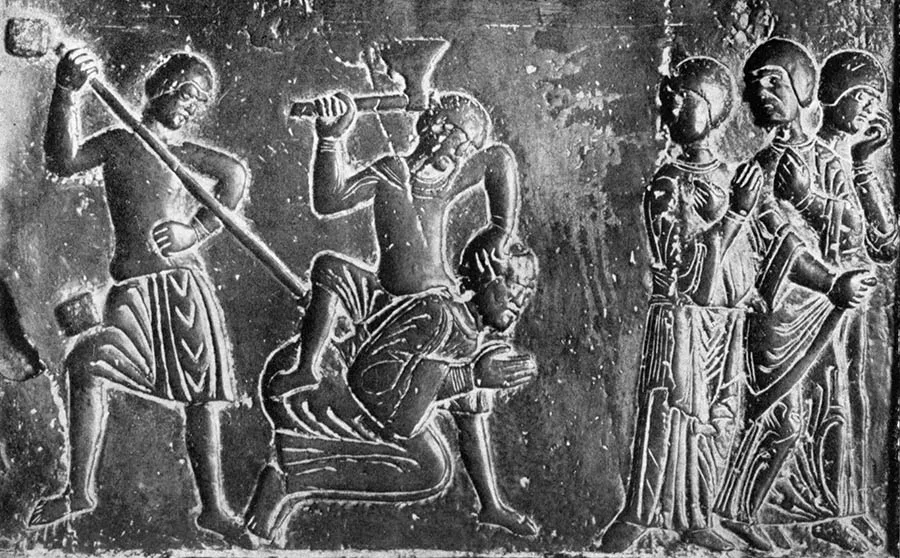 The martyrdom of Saint Adalbert in Prussia. Detail of the Gniezno Doors of the Cathedral of the Assumption of the Blessed Virgin Mary in Gniezno, where fragments of his relics are kept.
The city and port began to develop in earnest in the second half of the 10th century, at the dawn of the “era of amber splendour”. At that time, amber nuggets could be gathered only with the permission of the prince, who held a monopoly. The stone was used to make amulets and jewellery, and after the population was baptised by Saint Wojciech (known as Vojtěch in Bohemia and as Adalbert in Prussia), amber was also used for pectoral crosses. The work of local craftsmen was exported to Flanders and later to other countries as well.
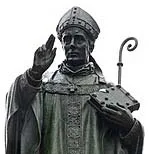
Saint Adalbert
The first Christian missionary to attempt to preach in Prussia was born around 956 into the family of a local prince in Libice nad Cidlinou (Bohemia). As a child he was gravely ill, and he was laid on the altar of Saint Mary in the hope of a cure. Before the altar, his parents vowed that if he recovered, their son would be dedicated to the clergy. The child’s recovery was taken as a miraculous sign. In Libice the youth met Adalbert of Magdeburg, who performed his first confirmation. When Vojtěch, as he had been baptised at birth, turned 15, his parents sent the boy to study at a monastery in Magdeburg. It was there, in Magdeburg, that Vojtěch received his second confirmation and took the name of his spiritual mentor, Adalbert. In his rather short life, devoted to zealous service of the Church, he served as Bishop of Prague, founded the first monastery for men in Bohemia and helped establish monastic orders, but in the end he was forced to flee to Rome, from where he moved first to Hungary and then to Poland, where he became known and venerated as Saint Wojciech.
Adalbert met his death at the hands of Prussian pagans in April 997. By the modern calendar, the saint’s death falls on 28 April. Discrepancies between sources may also be explained by the fact that in the 10th century the year was sometimes reckoned from Easter to Easter.
In the 11th century, various crafts were flourishing in Gdańsk, and trade prospered. Scales; coins, not only Polish but also Danish, English and German; wine vessels from Volhynia; Byzantine fabrics; glassware from the Rhineland; sword scabbards from Sweden — these are only a tiny fraction of the objects found during excavations.
THE RULE OF THE TEUTONIC ORDER
By the 12th century, Gdańsk was already a fairly populous settlement with a market square, a harbour, a town wall and a couple of hundred households. In 1263, the Pomeranian prince Świętopełk II the Great granted it Lübeck town rights. In 1282 came an event that led to the unification of the Polish lands: Mściwój II, son of Świętopełk II and the fifth and last prince of Gdańsk Pomerania, handed over his lands to the Duke of Greater Poland, Przemysł II. Besides the local princes, however, the margraves of Brandenburg and the Polish kings also laid claim to the Pomeranian duchy. In 1294 Przemysł took power over Pomerania, but two years later he was killed by the Brandenburgers. He was succeeded by the Polish prince Władysław I the Elbow-high.
In August 1308, the troops of the Margraves of Brandenburg, Otto IV and Waldemar, invaded Eastern Pomerania and by the end of September had captured Gdańsk. The royal governor Bogusza, who led the city’s defence, was unable to repel the enemy attack with his own forces. Władysław the Elbow-high, being otherwise occupied, refused to send help, but authorised Bogusza to appeal for assistance in person to the Grand Commander of the Teutonic Order, Heinrich von Plötzke, who was then acting in place of Grand Master Siegfried von Feuchtwangen, and to promise a generous reward for his services. In mid-October 1308, 100 knights and 200 foot soldiers arrived in Gdańsk.
The prince’s and the Order’s garrisons agreed to share the duty of guarding the castle equally, which was rather short-sighted on the part of the Poles. The crusaders did their job but received no reward: the prince’s treasury was empty. It was as if the Order had been waiting for just this. It was itself prepared to pay for these lands. Probably what it needed was not so much the money as a pretext to seize Pomerania with its centre in Gdańsk, which offered great economic and political advantages. Naturally, the knights could not miss such a favourable moment to solve their long-standing “Polish problem”: to gain control of a Baltic port that was extremely valuable for exporting grain from the Prussian territories lying far from the sea.
On 14 November 1308, the knights captured Gdańsk, burned it and massacred almost all of its inhabitants. The slaughter carried out by the Teutonic Knights went down in history as the “Gdańsk massacre”.
But this is only one version. Historical sources differ widely on the number of victims. At the papal court, Poland claimed ten thousand dead. The Order insisted that there had been no massacre at all: only 16 brigands had been killed, and they had been handed over by the townspeople themselves. The blame for the burned city was likewise laid on the local inhabitants.
In 1309, the Order concluded the Treaty of Soldin with Brandenburg and bought Pomerania, together with Danzig, from it for 10,000 marks of silver.
In that same year, 1309, Siegfried von Feuchtwangen moved his residence from Venice to the Order's castle of Marienburg, which the knights had founded back in 1274 on the banks of the Nogat in the Vistula delta. As a result, the Teutonic Order acquired all the features of a fully-fledged state, with a unified territory and a capital at Marienburg.
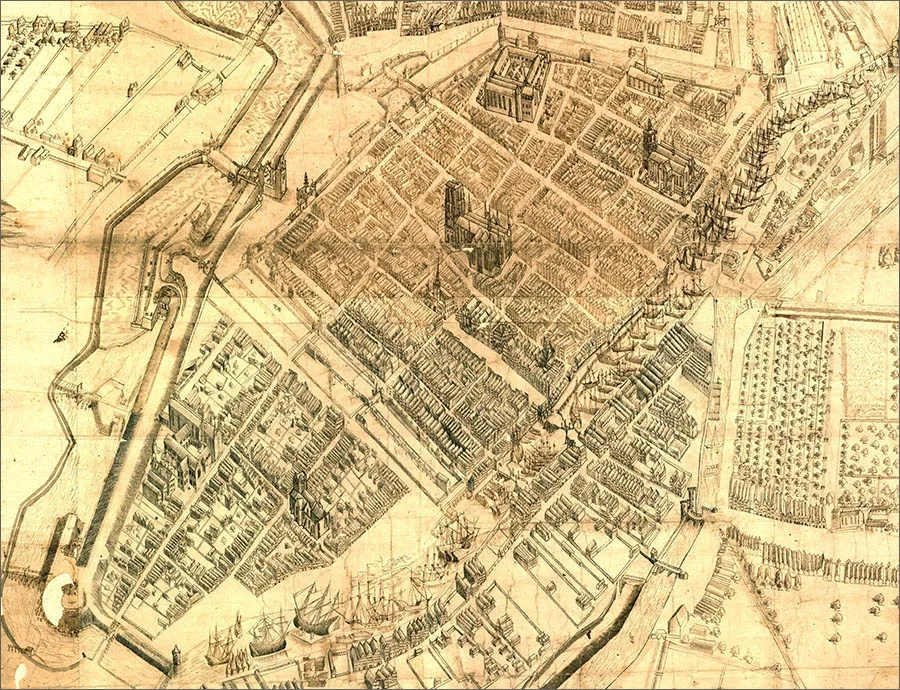 Detail of a plan of central Danzig (1615). The full high-resolution image can be viewed or downloaded via this link.
The bishops of Magdeburg called on migrants to settle the empty Slavic territories. In the Vistula delta, on constantly flooded lowlands and wasteland, Flemish, Dutch and Low German farmers made their homes. They were experienced in draining peat bogs and putting them to use. First and foremost, the settlers built dikes, dams and drainage canals, for the land here lay far below sea level. The work was completed in 1350. By then the area around Gdańsk and Marienburg, all the way to Elbing, was settled mainly by Germans. The small local population that remained underwent Germanisation.
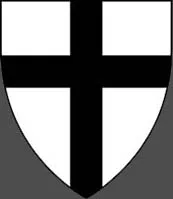
The Teutonic Order
Order of the House of St. Mary of the Germans in Jerusalem
A religious military order founded in 1190 in Palestine. It became known above all for conquering the lands of the Prussians and for the monastic state it created there (1309–1525). From the late 13th century it was engaged in military conflicts with Lithuania and Poland. In 1410 it was defeated by the Polish-Lithuanian army at Grunwald and lost considerable territory. After its defeat in the Thirteen Years' War (1454–66) it became a vassal of Poland. As a state it ceased to exist in 1525, when the Duchy of Prussia was established. The Order survives in nominal form to this day.
Under the rule of the Teutonic Order, Gdańsk enjoyed an economic and political boom unlike anything it had known before, a fact that even modern Polish historians do not deny. The territory grew with new lands and new inhabitants. Buildings and engineering works went up. On an artificial island in a canal of the Radunia River, the knights built a brick mill, the largest in Europe at the time. Its millstones were driven by twelve wheels. After a fire in 1391 the mill was rebuilt, and its millstones were then turned by eighteen wheels. The Great Mill, as the knights of the Order called it, with its annexe and tall loft for storing grain and flour, brought in enormous profits. It supplied the city with grain and flour, and with bread as well, since there was a bakery on the eastern side of the building.
The amber trade also filled the treasury to a fabulous degree. Amber was sold to Bruges, Lübeck, Amsterdam, Antwerp, Cologne, Nuremberg and Venice. Amber stores were closely guarded. Anyone who hid stones they had found faced punishment up to and including the gallows. Every find had to be handed over in full to the so-called “amber lords”. All the amber was sent to Lübeck and Danzig. There it was worked by the so-called Paternostermacher, literally “rosary makers”. They were guild craftsmen, and they alone had the right to work amber.
In 1343 the Order granted the city Kulm law, which was widespread in Pomerania at the time. It not only set out the rules governing relations between the population and the crusaders' administration. It also defined the fishing grounds, the boundaries of the lands granted to the townspeople for their economic needs, the amount of rent, and so on. The rights of the Teutonic Order as “lord of all Prussia” were also spelled out in detail.
Particular attention was paid to securing the knights' right to hunt beaver and to a ban on catching freshwater fish with seine nets. In addition, they were entitled to a shoulder of every game animal taken by the townspeople, and had the right to levy a toll for ferrying people across the Vistula.
Kulm law defined the city's boundaries, permitted the building of fortifications and gave the townspeople the right of self-government. Once Kulm law had been adopted, the trapezoid-shaped urban area became known as the Main Town (Rechte Stadt or Urbs Principalis). At the same time, a site was chosen for the Church of the Blessed Virgin Mary. Its location was probably what gave the town its irregular shape, with broad parallel streets running towards the river and narrow lanes crossing them. The town also lacks the central element of a medieval city, the main market square. Its place was taken by the long street of Długi Targ and the embankment of the Motława River.
Once town rights had been granted, work began on the city walls. The crusaders, however, considered their defensive strength inadequate. So they set about building a new ring of walls, reinforced with twenty towers.
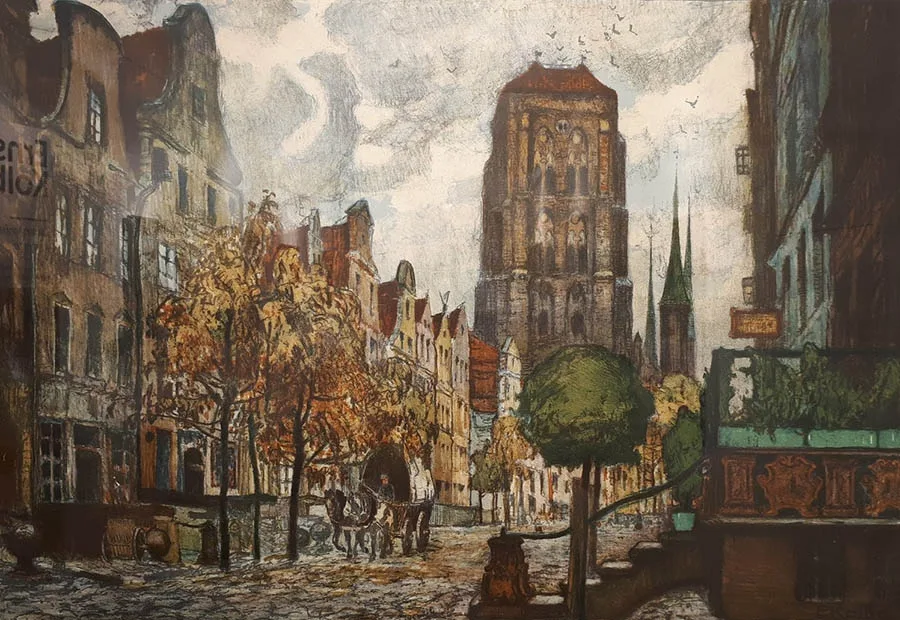 “St. Mary's in Danzig”. Ernst Kolbe, 1928.
In 1361 Danzig joined the Hanseatic League. Its largest cities each had their own role. Lübeck, the chief city of the Hanse, was called the storehouse. Bremen was the key, since the largest deals were concluded there. Hamburg was the lock, a transshipment point. Danzig, meanwhile, was likened to a lion guarding the Hanseatic granaries. The Hanse was a confederation of many cities and regions. It was created for joint trade by sea and land, to protect merchants' interests and to fight pirates and robbers. Danzig remained in the Hanseatic League until the League itself broke up, after the Thirty Years' War of 1618–1648 all but destroyed German trade and shipping. Moreover, trade routes at that time were beginning to shift towards the Atlantic and Western Europe.
For the Slavs of Eastern Europe, the Teutonic Order was the most dangerous force. The Grand Duchy of Lithuania, in alliance with the Kingdom of Poland, sought to win back the lands seized by their aggressive neighbour. The crusaders, by contrast, were intent on keeping them. This clash of interests led to a war that became known as the Great War (1409–1411).
The decisive battle of the Great War took place on 15 July 1410 between Tannenberg and Grunwald and ended in the rout of the Teutonic Knights. The Polish king Władysław Jagiełło, founder of the great royal dynasty of the Jagiellons, noted that “amid the countless dead our own losses were few... We destroyed the Grand Master, … many komturs, forcing the rest to flee... The pursuit went on for as much as two miles. Many were drowned in the lakes and rivers, and many were slain, so that the number of those who escaped is very small.”
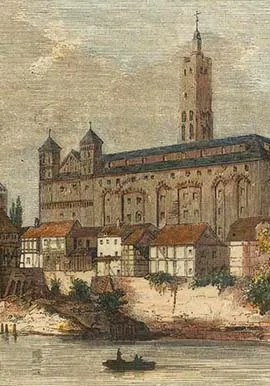
Marienburg Castle (Malbork)
The largest medieval brick castle in the world and one of the finest examples of Brick Gothic, it is a UNESCO World Heritage Site. The castle gave rise to the Polish town of the same name, and from 1309 to 1456 it served as the residence of the Grand Master of the Teutonic Order. The spire of one of the castle's best-known towers, Baszta Maślankowa, is topped by a weathervane in the shape of a woman churning butter in a tub. According to legend, the tower owes its name to a butter tax that the townspeople found exorbitant: the knights locked the discontented residents up in this very tower.
After the catastrophe at Grunwald, the remnants of the Order's forces shut themselves up in their main castle of Marienburg. The Polish army only reached its walls ten days after the battle. By then, the crusaders had managed to prepare to withstand a siege. Jan Długosz, the Polish historian and diplomat, had reason to regret that “the splendid and memorable victory of Grunwald came to nothing and turned almost into a mockery...” On 1 February 1411 the First Peace of Thorn (Toruń) was signed. Under its terms, the Grand Master and the Order were to pay the Kingdom of Poland 100,000 Prague groschen. The king, for his part, was obliged to return all the castles in Prussian lands he had captured by right of war and to withdraw Polish troops from them. The treaty also returned to the Teutonic Knights all the prisoners taken at the Battle of Grunwald and in all the battles that followed it. The signing of the Peace of Thorn brought the Great War to an end. In Długosz's view, it brought the Kingdom of Poland no benefit whatsoever. But that was true only at first glance.
After the defeat at Tannenberg, the problems that kept arising within the Order itself gradually led to its disintegration. Its prestige fell so low that new recruits refused to join the thinned ranks of the crusaders.
What damaged the Order's prestige most of all was the moral decline in its convents, which drew public ridicule. The only remedy for all these ills would have been to restore the country's financial health. The rural estates protested against crushing taxes. Merchants complained that since Tannenberg they had been paying more and more money while receiving less and less protection. The attempt to suppress the protests of the townspeople and the secular nobility had disastrous consequences for the Teutonic Knights. The Thirteen Years' War of 1454–1466, known as the War of the Cities, all but finished the crusaders off. Under its outcome, the Order became a vassal of the Polish king and renounced its claims to Danzig.
On 19 October 1466 the Second Peace of Thorn (Toruń) was signed in Toruń between the Teutonic Order and the Kingdom of Poland, bringing the Thirteen Years' War to an end. Under the treaty, Poland received Pomerelia (Gdańsk Pomerania), the Kulm and Michałów lands, Marienburg, Elbing and the Prince-Bishopric of Warmia.
Casimir IV Jagiellon incorporated Gdańsk into the Kingdom of Poland and granted its inhabitants numerous privileges. The city began minting its own coins. On its coat of arms, the royal crown of the Jagiellonian dynasty appeared above the two crosses.
In 1525 Sigismund I secularised the Teutonic Order, which from then on became the Duchy of Prussia. The secular state was headed by the Order's former Grand Master, Albrecht, who swore an oath of fealty to the Polish king.
THE GOLDEN AGE OF GDAŃSK
The Renaissance reached Danzig, as it did the rest of Poland, by the second half of the 15th century. It was followed by the Reformation, which brought with it a new view of social relations, accelerated the rise of the patriciate and led to educational reform. More and more young people went abroad to study — to Paris, Vienna, Bologna. The former students returned home with a new outlook on the world. Painters, sculptors and architects came to the city from all over Europe.
Danzig entered its great Golden Age. There were countless incentives for the development of art and architecture. King Sigismund I the Old was a great lover of the arts and did everything he could to support new talent. For the entire Polish-Lithuanian realm, his reign and that of his son Sigismund II Augustus became a true "Golden Age". The king was the first to embrace the new fashions and launched a project to rebuild the ancient royal residence at Wawel in Kraków in the modern style, inviting the Florentine architect Bartolomeo Berrecci for the purpose.
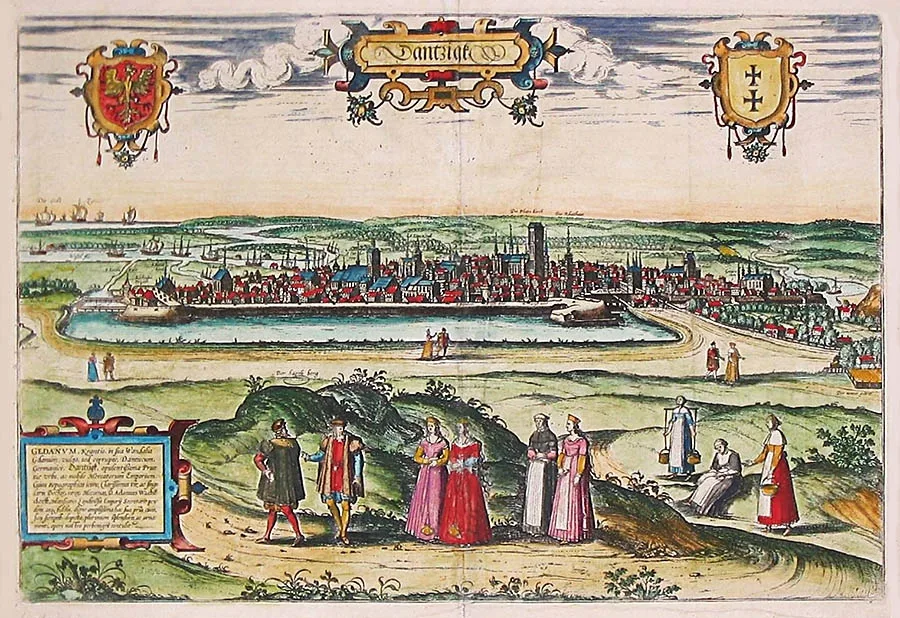
Alongside Kraków, Gdańsk became one of the brightest centres of Renaissance culture in Poland.
Renaissance trends manifested themselves here mainly in sculpture and architecture — in the building of palaces, town houses and town halls — owing largely to Dutch and German masters. Working side by side with them were local builders, who absorbed all the innovations of Renaissance architecture and combined them with local traditions.
A building in the finest Renaissance tradition is the multi-storey Lion's Castle on Długa Street. It was built in 1569 by the architect Hans Kramer and adorned with two sculpted lions. Who made them is unknown. They were probably taken from the porch of the building that had stood on the site of the palace, once the property of the rather wealthy Zierenberg family. In the 17th century the Lion's Castle passed to the Schwarzwald family, who were fond of society receptions and balls. Even the Polish king Władysław IV stayed with them when he visited Danzig in 1636.
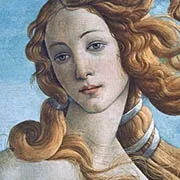
The Renaissance
The era of cultural flowering — in other words, the Renaissance — began in Italy in the 14th century and reached its peak in the 16th. During this period art strove for a realistic depiction of reality, moving away from medieval convention and symbolism. Society came to believe in the harmony that reigns in nature and in man as the crown of its creation. The philosophy of humanism emerged, elevating the role of the individual. The very term "Renaissance" means the revival of classical traditions on the basis of a Christian worldview. The most famous names of the era include Sandro Botticelli, Piero della Francesca, Leonardo da Vinci, Raphael Santi and many others.
Another creation of Hans Kramer is the eight-storey English House, also known as the Angel House, likewise built in the Renaissance style. The imposing building is decorated with sculptures, and decorative cornices visually separate its storeys. The entrance is framed by a triumphal arch with fluted columns on either side.
By the early 16th century a circle of enlightened people had formed, thanks to whom Renaissance art made its way into the Artus Court — the meeting place of the patrician brotherhoods, who spared no expense on the lavish decoration of their residence. The most expensive and rarest works of art were bought by pooling funds. Collective patronage was common practice and a matter of honour.
The Court itself traces its origins to the medieval European chivalric epic — to the valiant Celtic King Arthur. The symbol of brotherhood and equality, Arthur's Round Table, at which all the knights felt themselves equals, inspired the construction of the Artus Court, which served as the official merchants' house. Later the Court became an important centre of the social and commercial life of old Danzig. The entrance was guarded by lions holding the city's coat of arms.
The interior of the Artus Court was rich: canvases by the greatest masters, ship models, and the world's largest tiled stove, more than 10 metres tall. The figures on its tiles are real historical personages. The stove's maker, Georg Stelzener, installed it in 1545 as an important decorative element of the interior. Whether it was ever used for its intended purpose is unknown — every attempt to heat the hall with it ended in repairs.
Gdańsk was also famed for its woodcarvers. The exquisitely beautiful furniture, the staircase and the carved benches in the Court's interior are their handiwork. The carved details (capitals, picture frames) were made by the Gdańsk carvers Master Paul and Adrian Karffycz.
Each brotherhood was assigned its own part of the hall. And each went out of its way to decorate it no less splendidly than the others. The secular patrons vied with one another, adorning the walls of the Court with works by famous masters — mostly on religious themes. Of the historical paintings of that time, only one is known: "The Siege of Malbork in 1460" by Martin Schoninck. The artist painted it in 1533, commissioned by one of the brotherhoods that had taken part in the siege and capture of the fortress.
From the late 15th century onwards, the façade of the building was rebuilt several times — not without the help of Italian masters. By 1618 it had acquired the appearance given to it by Abraham van den Blocke. After the destruction of 1945, the façade of the Artus Court was restored to this very design.
In Danzig, old Gothic buildings and noble residences were often either remodelled in the new style or had their façades decorated with sculptures and fanciful ornament. At times, rivalry among the patricians drove architects to place greater emphasis on outward effect, displaying not merely originality but a certain ornate excess. Distinctive houses unlike any others began to appear, plastered and painted in various colours. It is believed that even the façades of the Main Town Hall and St Mary's Church were painted at the time. It was also fashionable to decorate — and sometimes "overload" — façades with sculptures. The owners of almost every house sought to crown it with some classical or mythological figure, such as a Roman warrior or an ancient Greek goddess.
Carried away by decoration, architects upset the harmonious balance of the Renaissance — a trait most characteristic of Mannerism. Since the Mannerists worked and built beyond their homeland, the style spread from Italy throughout Europe. Danzig was no exception.
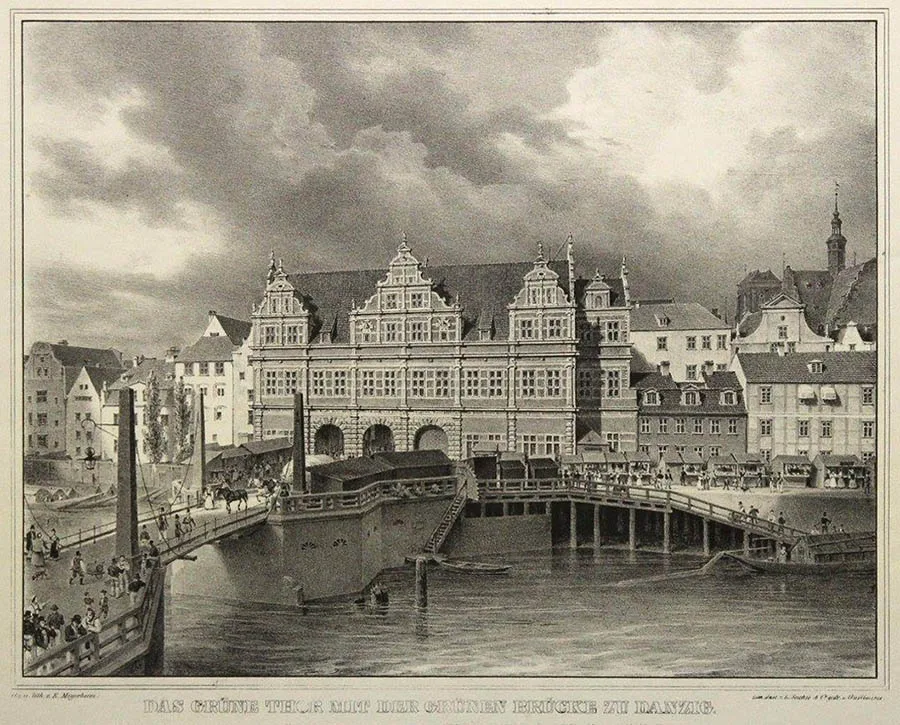
The most typical and expressive Mannerist building in Gdańsk is considered to be the brick Green Gate. It is attributed to a certain Regnier of Amsterdam.
The master worked under the watchful eye of the city architect Hans Kramer, the creator of one of the most striking structures in the city: the Upland Gate (or Upper Gate, as it is also called), whose sculptural decoration was designed and carved by the most celebrated local sculptor, the Fleming Willem van den Blocke. The Polish king's cortège passed through this gate onto the Royal Route and continued on towards the Golden Gate, crowned with allegorical figures. The Golden Gate, in turn, is regarded as an example of both classicism and Mannerism. Its façade bears the words "Peace, Freedom, Wealth, Glory". On the city side are the words "Prudence, Piety, Justice, Concord". The eastern wall carries an ancient Latin maxim: "In concord small states flourish; in discord great ones fall into decline." The western wall carries a blessing in German: "May fortune favour those who love you, so that there may be peace within your walls and happiness within your palaces." Willem van den Blocke's son Abraham, the city's chief sculptor, designed and built this gate in 1612–14 with the help of the builder Jan Strakowski.
Masterpieces of Netherlandish Mannerism include the Torture House, once a Gothic gate and rebuilt by Jan van Oppberhem, and the Great Armoury, which held not only weapons and ammunition but also decorations for festivities, sculptures and the like. The nearby Straw Tower was used to store gunpowder, while bullets were cast in the neighbouring Old Pharmacy building.
Mannerism
Mannerism (from the Italian maniera, "manner") was a Western European literary and artistic style of the 16th and the first third of the 17th centuries. It is characterised by the loss of the Renaissance harmony between the bodily and the spiritual, between nature and man. Giulio Romano, Jacopo Pontormo, Domenico Beccafumi and Francesco Parmigianino are considered the pioneers of Italian Mannerism. The emergence of the style is sometimes linked to a decline in society, which stands out all the more sharply against the backdrop of the lofty Renaissance. Like so much else, the Mannerist bug reached Danzig from Holland.
The interiors of the Armoury were decorated with weaponry: cannons, howitzers, mortars and cannonballs. As if in a museum, a vast number of helmets, suits of armour, stone-throwing machines and other military "rattles" were kept here. The history of the Armoury building differs little from that of other historic monuments. The design by the architect Anthonis van Obbergen was presumably approved in 1599. In 1600 workers demolished an old building to make way for the Armoury and began digging the foundation pit. At that very moment a terrible plague broke out, claiming 17,000 lives. Work was, naturally, suspended. To make up for lost time, the city council decided to bring in masons from Lübeck and to send workers from local workshops to the building site. The work was completed five years later, though the finishing of the façade presumably took about another four years.
The Golden House astonishes with its splendour and beauty. It was built in the Renaissance and early Baroque style by Abraham van den Blocke in 1609–1614 at the behest of Johann Speymann, burgomaster and generous patron of the arts in Gdańsk. Its façade is remarkable for its richness and refinement. Adorned with gilding and with sculptures by the master Johann Voigt of Rostock, the house truly lives up to its name. It has its own legend, too.
The ghost of the burgomaster's beautiful wife Judith is sometimes said to appear in the corridors of the house, whispering: "Act justly and fear no one."
In the decoration of house façades, stone sculpture served either as an ornamental element or covered the entire surface of the wall. The tradition appealed so much to the wealthy citizens of Danzig that they even began to compete with one another. As the houses eventually became, if anything, over-decorated, attention turned to stone porches as well. Stonework was an extremely expensive pleasure, and only quite affluent people could afford such luxury. On the other hand, there was no shortage of craftsmen able to fulfil a client's every wish. Moreover, their services were sought not only by Polish citizens but by foreigners as well.
French architecture certainly influenced the Danzig school, though not as strongly as Netherlandish architecture did. Perhaps the reason lay in the long-standing close ties between the two states: the Netherlands had been Danzig's largest trading partner in the 15th century. Besides, Dutch people sometimes moved here for good. And what drew them was not only the city's high level of prosperity, its religious freedom and good earnings. Strange as it may seem, the lure for thousands of wealthy Dutchmen was precisely the opportunity to rebuild their houses in the new style and the freedom to choose it. All the more so since many stonemasons worked here, Flemish ones among them. Business went well, for example, for Willem van der Meer of Ghent, known for the fireplace he made for the Great Council Hall in the Main Town Hall and for decorating stone façades in the Old Town. The Fleming Willem van den Blocke, who had worked at home in the workshop of his teacher Cornelis Floris, even managed to settle in Danzig for good. On 18 June 1584 he submitted a petition to the city council in which he praised his own skill in every possible way. And he got what he wanted, receiving the exceptional privilege of working without taking citizenship.
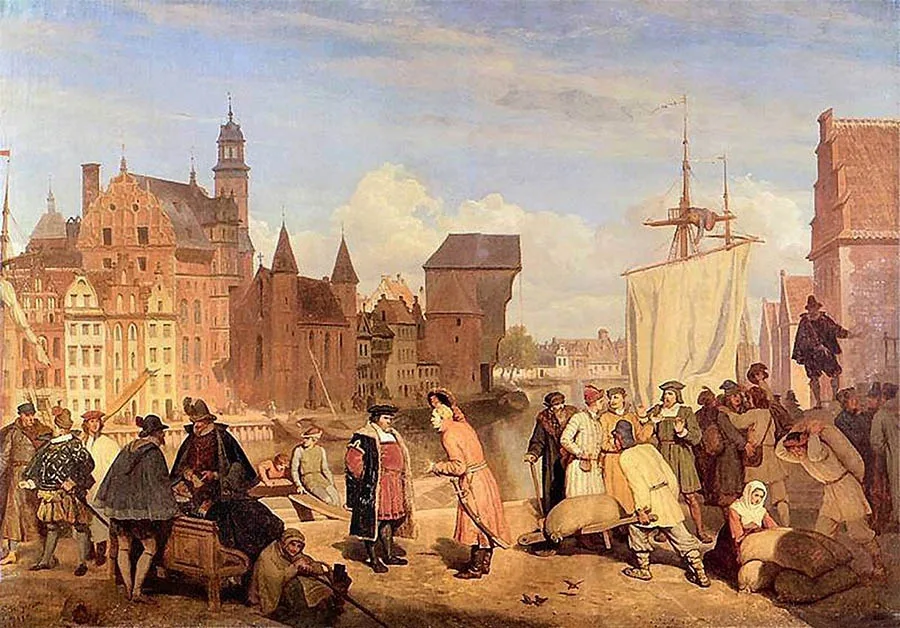 "Gdańsk in the 17th Century". Wojciech Gerson, 1865.
Willem particularly excelled at making lavish tombs. Fame came to him after he created for St Mary's Church the first stone monument of the modern era glorifying the patricians: the tomb of Jan Brandes. After this work, commissions poured in one after another.
Van den Blocke had a masterful command of the vocabulary of ornamental motifs, for which he was indebted to Floris and to Hans Vredeman de Vries, the creator of Mannerist ornament. The need to adapt to the tradition of Polish funerary sculpture led his workshop to produce "works of a special originality, typical neither of the Netherlands nor of Poland — in a word, of Gdańsk", as art historians write of master Willem. Unlike his father, however, Abraham van den Blocke won his fame with Baroque works. And this is already the silver age, of which there are many examples on one of the cosiest old streets, Mariacka Street, which has preserved not only its ancient appearance but also its function as a street of residential houses. Here Gothic, Mannerism and Baroque coexist peacefully side by side.
Baroque
Translated from Italian, "baroque" means "bizarre" or "inclined to excess" — in all the arts, and in architecture especially. Italy is generally considered the birthplace of the style. From the very outset, the Baroque era set itself against classicism and rationalism. According to the generally accepted view, there were three main factors that shaped the formation of Baroque culture in the countries of Western Europe: rapid changes in scientific and geographical ideas about the world, the growing complexity of the system of orders in architecture, and the Counter-Reformation movement in the Catholic Church. The new ideology called for new forms in art as well, and they were not long in coming.
Because of the extraordinary popularity of decorative sculpture, all other art forms in Renaissance Gdańsk seemed to recede into the background.
FROM NAPOLEON TO WESTERPLATTE
Poland reached the height of its power under the last king of the Jagiellonian dynasty, Sigismund II Augustus (1548–1572). In 1561 the kingdom acquired Livonia. And at the height of the Livonian War with Russia, the personal Polish-Lithuanian royal union was replaced on 1 July 1569 by the Union of Lublin. The unified Polish-Lithuanian state became known as the Rzeczpospolita, the Commonwealth. The cities continued to develop. European trade routes passed through Polish territory, which helped the major ports on the Baltic coast to flourish — above all, Danzig.
The centuries that followed in Europe were burdened with wars and conflicts, and these did not pass Poland by.
In 1654, Queen Christina of Sweden abdicated in favour of her cousin Charles X Gustav, and the new government intervened in the Russo-Polish War. Its main aim was not only to weaken the Russian army but also to turn the Baltic Sea into a “Swedish lake”, which would give Sweden complete control over trade in the region. In 1655 the Swedes invaded Poland. This war has gone down in history as the “Swedish Deluge”. Within three years every major Polish city had been plundered, and almost half of all Poles had perished. Blood flowed in rivers. The Swedish army then fell upon the Danes, returned to Poland once more, and afterwards swept on into Ukraine… In this way the civilised descendants of the Vikings depopulated almost a third of Europe. On 3 May 1660, in Oliva, a suburb of Gdańsk, a peace treaty was signed that put an end to this bloody war.
In 1733 a new war broke out – the War of the Polish Succession. On 1 February Augustus II the Strong, King of Saxony and Poland, died, which set off a struggle for the Polish throne between France's candidate, Stanisław I Leszczyński, who had been King of Poland from 1704 to 1709, and the son of Augustus II the Strong, the Saxon Elector Augustus the Saxon. On 12 September, after a split between the factions at the electoral Sejm in Warsaw, Stanisław I Leszczyński was elected King of Poland. His opponents gathered detachments of armed nobility, appealed to Russia for help and on 24 September elected their own candidate to the Polish throne – Augustus the Saxon. Thus two coalitions took shape in Europe: Saxony, Austria, Russia and their Polish allies against France, Spain, Sardinia, Bavaria and their own Polish allies.
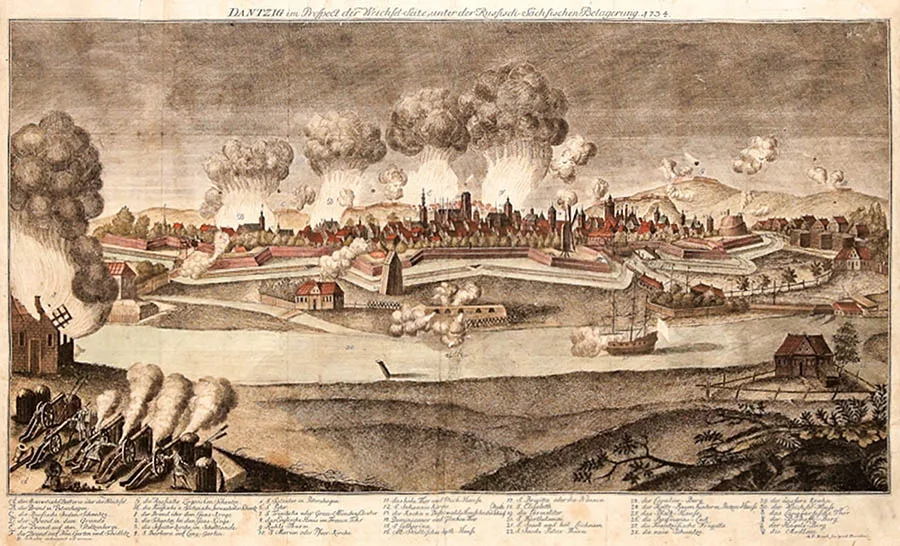 1734. The siege of Danzig by Russian troops.
In July 1733 the Russians occupied Warsaw and marched on Danzig, but they only managed to take the city towards the end of June the following year. On 3 October 1735 the War of the Polish Succession ended in a truce. Stanisław Leszczyński, disguised as a simple peasant (according to other accounts, in women's clothing), fled Gdańsk, first to Marienwerder (Kwidzyn) and from there to Königsberg, where he then lived for almost a year. On 8 November 1738 Austria and France signed a peace treaty in Vienna, and Stanisław I Leszczyński had to cede the throne to Augustus the Saxon. Spain received Naples and Sicily from Austria, while Sardinia helped itself to the western part of Lombardy. Russia, for its part, strengthened its position in Poland, edging out France and Austria.
The “Swedish Deluge”
In 1655 the Swedes decided to take advantage of the weakened Polish-Lithuanian Commonwealth and invaded Polish territory. Within six months the Swedish army had conquered most of Poland and Lithuania. The “Swedish Deluge” severely undermined the Polish economy, yet the people of the Commonwealth put up fierce resistance to the invaders. Partisan units were formed and fought very successfully, even though the Swedish forces had a considerable numerical advantage. The historical events of the Swedish invasion formed the basis of the epic historical novel “The Deluge” by the celebrated Polish writer Henryk Sienkiewicz, published in 1886. “The Deluge” is the second part of a three-part trilogy that also includes the novels “With Fire and Sword” and “Pan Wołodyjowski”.
In 1793, as a result of the Second Partition of Poland, Gdańsk once again passed to Prussia. A crisis set in. Many of the native inhabitants – Poles – scattered in all directions, while Germans came to their land and, tearing down the old buildings, began to rebuild the city in their own traditions.
Meanwhile Napoleon was already hatching his grand designs... The largest strategic port on the Baltic fell within his sphere of interest. He admitted as much in a letter to Marshal Lefebvre of 18 February 1807: “Your glory is bound up with the capture of Danzig. You must go there.”
In March 1807 François Joseph Lefebvre, Marshal of the French Empire, drove the Prussian troops out of the area around Danzig. His corps, made up of French, Baden, Saxon and Polish troops, far outnumbered the Danzig garrison, which besides Prussian and Polish soldiers included three Russian battalions and three Cossack regiments: 27,000 men against 17,000. French preparations for taking the city made scarcely any progress. They waited a long time for the siege artillery to be brought up, held back by rain and impassable roads. But what troubled them most was the incessant fire from the Danzig garrison, commanded by the Prussian Field Marshal Count Kalckreuth and the Russian Prince Major General Aleksey Grigoryevich Shcherbatov.
The French artillery, stuck on its way to Danzig, did not arrive until 13 April, whereupon Lefebvre began his offensive, bombarding the city with 78 guns. The garrison's command rejected the demand to capitulate. Meanwhile, to cut the city off from the sea, the French seized Holm Island. The Prussian and Russian units stationed there were taken by surprise and routed.
The constant bombardment was burning Danzig down. The garrison was holding out, but its strength was running low. Ammunition and food were running out. Napoleon, meanwhile, had already sent Lefebvre reinforcements – the 15,000-strong corps of Marshal Jean Lannes. But on 29 April the besieged city also had cause for hope: the ships of Major General Nikolay Mikhaylovich Kamensky appeared at the mouths of the Vistula. On 3 May they attacked the French on Holm Island but were halted. Lannes, too, threw fresh forces into the battle. An English frigate that had arrived with Kamensky was unable to enter the Vistula because of a strong headwind and could not support the attack. The decision was taken to withdraw. Kamensky wrote to Count Leonty Leontyevich Bennigsen, commander of the Russian army, that it was impossible to break through to Danzig with such small forces, even by water.
Yet Danzig needed support. It was decided to send a sailing-and-rowing vessel down the Vistula carrying 300 centners of gunpowder, 200 centners of oats and 50 Prussian Jäger. But this, too, ended in failure: the French opened fire and damaged the sail. The oarsmen were also hit, and the vessel lost all steering and ran aground. Lefebvre again called on the garrison to surrender, but General Shcherbatov rejected the offer, declaring that the garrison would defend itself to the last man unless it was allowed to leave the fortress with military honours and its weapons and to rejoin the Russian army. Napoleon appreciated this resolve and agreed to let the garrison march out freely – on one condition, however: that it would not fight against the French for a year and a day.
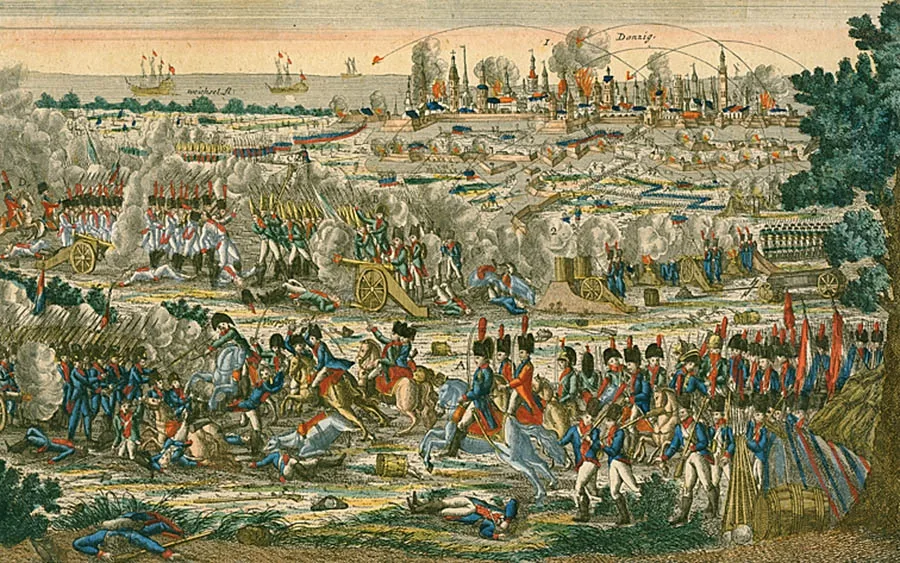 1807. The siege of Danzig. P.J. Fill, 1807 (gedanopedia.pl).
The siege of the fortress city lasted 52 days, until 27 May 1807. And on 21 July Napoleon created a semi-autonomous state, the Free City of Danzig, or the Republic of Danzig, with all its possessions at the mouth of the Vistula and the Hel Peninsula. General Jean Rapp, who commanded the French garrison, was appointed governor.
From the moment they took the city, the French set about fortifying it, building new forts and lunettes. By this time Danzig had become an impregnable fortress, surrounded by a rampart with 22 bastions and a water-filled moat.
On 2 January 1813 patrols of Platov's Cossacks approached the city, and on the 9th they began to blockade it. A week later they were joined by the infantry of Generals Faddey Fyodorovich Steinheil and Fyodor Fyodorovich Löwis. An assault on the fortress, however, was not attempted, as it was deemed inexpedient. In spring the troops of Duke Alexander of Württemberg arrived at the city, and only then did preparations begin for a “regular” siege of the fortress.
The Russians' main problem was a shortage of heavy siege artillery. Help came from Prussia, which supplied fifty guns, while their ally England not only provided more than a hundred howitzers, mortars and heavy cannon, but also several warships. The ally had a stake in the capture of Danzig, since it would thus gain access to yet another well-equipped port. Along with the English aid came a detachment of horse artillery armed with an entirely new weapon designed by Colonel William Congreve.
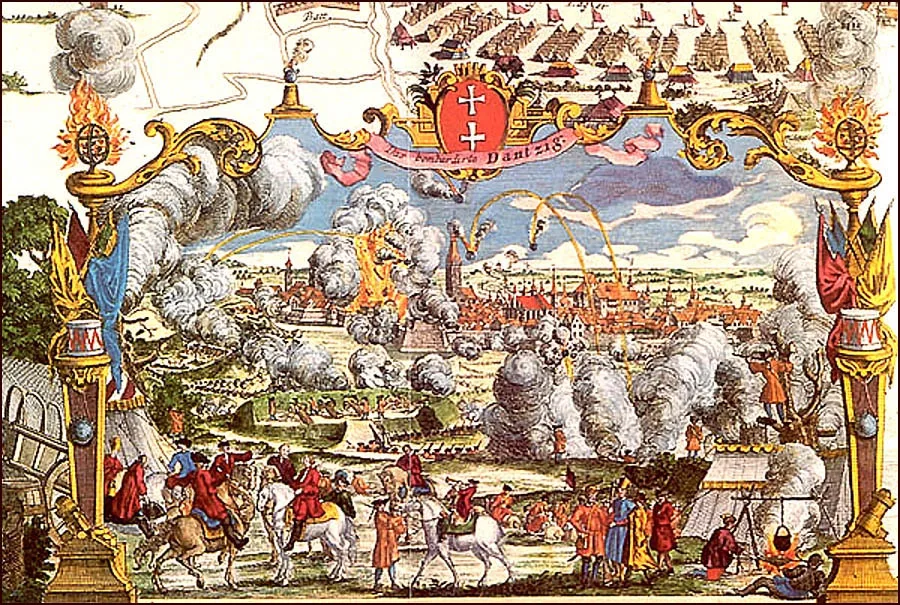 1813. Russian troops bombard Danzig with English rockets.
The British first tested the so-called Congreve rockets in 1806 during attacks on the French base at Boulogne, but at the time found the effect not particularly convincing. The inventor then improved his design, achieving a rocket speed of 330 kilometres per hour and a range of up to three kilometres. Congreve managed to standardise rocket calibres with gun calibres, and the heavy rockets were designated by inches. Congreve tested the power of his new weapon on Copenhagen, burning down three quarters of the city.
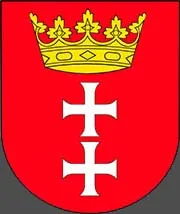
The Coat of Arms of Gdańsk
Gdańsk received its present coat of arms on 25 May 1457, together with Magdeburg rights, granted to the city by the Polish king Casimir Jagiellon. The authority of the Polish king is symbolised by the golden crown at the very top of the red field (red being the traditional colour of the Hanseatic cities). Below it, arranged vertically, are two silver Maltese crosses of St John, recalling the German knights whose descendants settled in the city. In the 18th century the Gdańsk arms served as the family coat of arms of the Counts Sheremetev. According to legend, their ancestor, a certain Prussian voivode, came from Pomerania. The greater coat of arms of Gdańsk is completed by two golden lions as supporters, and on a golden ribbon below is the Latin motto: Nec temere nec timide (Neither rashly nor timidly). The modern version adds: GDAŃSK — city of freedom. (For obvious reasons, we cannot provide a translation here. — Ed.)
Next in line was Danzig. Some 200 rockets were fired at the city, but they failed to have the desired effect. “The English artillerymen launched into the city a few of the so-called Congreve rockets, more by way of trial than in earnest; they made a great deal of noise but did little good,” remarked Baron Steinheil after the failure of this operation. The French, too, laughed at the fiasco. But by 18 October they were no longer laughing. “…at seven o’clock in the morning they launched an enormous number of incendiary rockets, bombs and red-hot shot from four batteries… Fires broke out in seven or eight places, but without consequence. By noon the Russians had stopped firing rockets, but they continued to send bombs and red-hot shot at maximum range, so that they fell as far as the granary island… No one could have imagined such an extraordinary range. The bombardment continued through the night of the 18th to the 19th and all the following day.” This is how Nikolay Rogozhan, in his article “The Use of Rocket Weapons in the Siege of Danzig in 1813”, quotes the French engineer captain Prosper-Honoré d'Artois from his “Account of the Defence of Danzig in 1813”.
Fires raged. The warehouses holding the city’s main food reserves burned down. The Congreve rockets were blamed for everything. And still they kept raining down on Danzig. The strength of the French was finally broken. Before surrendering the fortress, Rapp distributed the remaining food and destroyed the weapons and ammunition. On 29 November the final capitulation was signed.
In his official report Rapp stated: “When, after a seven-month blockade and a three-month siege, hunger forced us to surrender, the enemy was no closer to the fortress than we had been in 1806 at the first strokes of our spades.”
On 2 January 1814 the French garrison laid down its arms. Fourteen generals and 15,000 soldiers were taken prisoner. The Poles and Germans were allowed to go home, while 9,000 Frenchmen were taken captive and sent to Russia, notes the historian Aleksandr Mikhailovsky-Danilevsky in his “Description of the War of 1813”. In 1815, following the Congress of Vienna, the city was returned to Prussia.
The next half-century is customarily described as a period of great crisis, decline and economic disaster for Danzig. Only the middle of the 19th century brought positive change. In 1852 the first railway appeared, linking the coast with Bromberg (Polish: Bydgoszcz), Schneidemühl (Piła), Thorn (Toruń) and Hohensalza (Inowrocław). In 1871 Danzig acquired a modern water supply and sewerage system. Around the same time the first public transport appeared — a horse-drawn tram. The electric tram was only 25 years away.
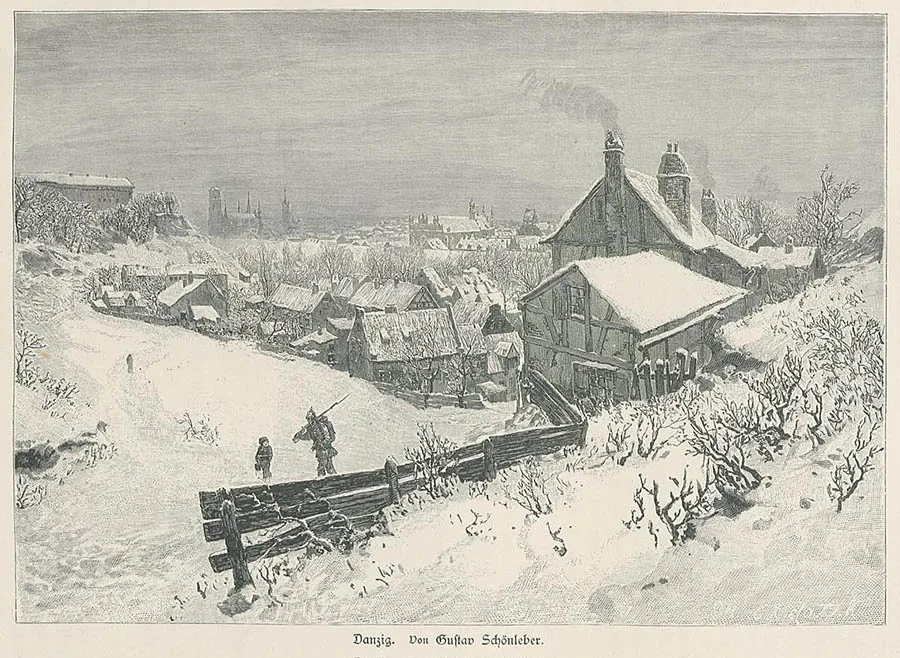 Illustration by Gustav Schönleber from the book “Strolls along the Shores of the North and Baltic Seas”.
In 1914 Germany unleashed the First World War — and lost it. The war passed Pomerania by, but Danzig once again found itself at the centre of events.
In all the countries that had fought against Germany, preparations were under way for the conclusion of the Treaty of Versailles, many of whose provisions gave rise to serious disagreements. The victorious powers were set to tear Germany to pieces and divide its colonies among themselves.
The conference opened on the very same day and in the very same Hall of Mirrors of the Palace of Versailles near Paris where the creation of the German Empire had been proclaimed in 1871. The tone was set by the leaders of the United States (President Woodrow Wilson), Great Britain (Prime Minister David Lloyd George) and France (President Raymond Poincaré and Prime Minister Georges Clemenceau).

The League of Nations
The international organisation known as the League of Nations was created in 1919–1920 on the initiative and at the insistence of the 28th President of the United States, Thomas Woodrow Wilson, ahead of the signing of the Versailles peace treaty in Paris. From 28 September 1934 the League had 58 member states. In its aims — disarmament, the prevention of war, the provision of collective security, the settlement of disputes between countries through diplomatic negotiation and the improvement of the quality of life on the planet — the organisation was the forerunner of today’s UN. In 1946 the League ceased to exist. The principles of a peaceful community of nations were first formulated in 1795 by Immanuel Kant in his treatise “Toward Perpetual Peace”, in which he described the foundations of a future union of peoples, thereby expressing the idea of the League of Nations.
Poincaré opened the conference by putting forward a programme for the dismemberment of Germany. Wilson, however, proposed first considering the creation of a League of Nations, which could become a lever of influence over Europe — a Europe that owed ten billion dollars to the States, the only power to have grown rich from that war. Wilson proposed that the question of the German colonies be decided within the framework of the League. If it were not created, he believed, “the world will say that the great powers first divided up the defenceless parts of the world and then formed a league of nations.” It was decided that trusteeship over the territories separated from Germany would be entrusted, under League mandates, to advanced nations which, by virtue of their experience and geographical position, were able to assume such responsibility. Wilson was in a position to dictate terms. With such a debt, Europe had become a hostage with no choice but to accept its creditor’s proposal.
The Polish question was among the main issues at the conference. In the heat of the debate Clemenceau declared: “When the question of forming a Polish state was raised, the intention was not only to redress one of the greatest crimes in history, but also to create a barrier between Germany and Russia…”
In drawing the border between the states, the primary consideration was the nationality of the population of the territories being separated from Germany. Lands with an indisputably Polish population were to become part of Poland. In addition, it was initially intended to give her Danzig as well, together with the territories adjoining the railway. With the main part of East Prussia remaining with Germany, Poland would gain access to the sea in the form of a corridor running through German possessions. The governments of the Entente countries were wary of returning to Poland the western lands seized by Prussia at various times, since this would inevitably provoke revanchist sentiment in Germany and become the cause of a new war.
In the end Lloyd George, Wilson and Clemenceau decided to make Danzig a separate political entity — a “free city”. The calculation was also that the “Polish Corridor” should include as little territory with a German population as possible. The Polish delegation, for its part, expressed regret that Danzig’s new status restricted the free access to the sea promised to Poland by the leaders of the three leading powers. Only the construction of Gdynia made that access more or less complete.
Thus, in the last century, the remarkable political entity of the “free city” was revived on the map of Europe, this time under the protection of the League of Nations. Its ties with Poland were few: a customs union, and the right of the mother country to set up institutions such as schools and libraries and to take some part in the public life of the new entity. Danzig acquired the main attributes of sovereignty: its own constitution and its own currency, the Danzig gulden — which set alarm bells ringing in Berlin: might this very currency of its own not sever the ties with Germany, which was so anxious to preserve the cultural unity of the Free City and the Reich?!
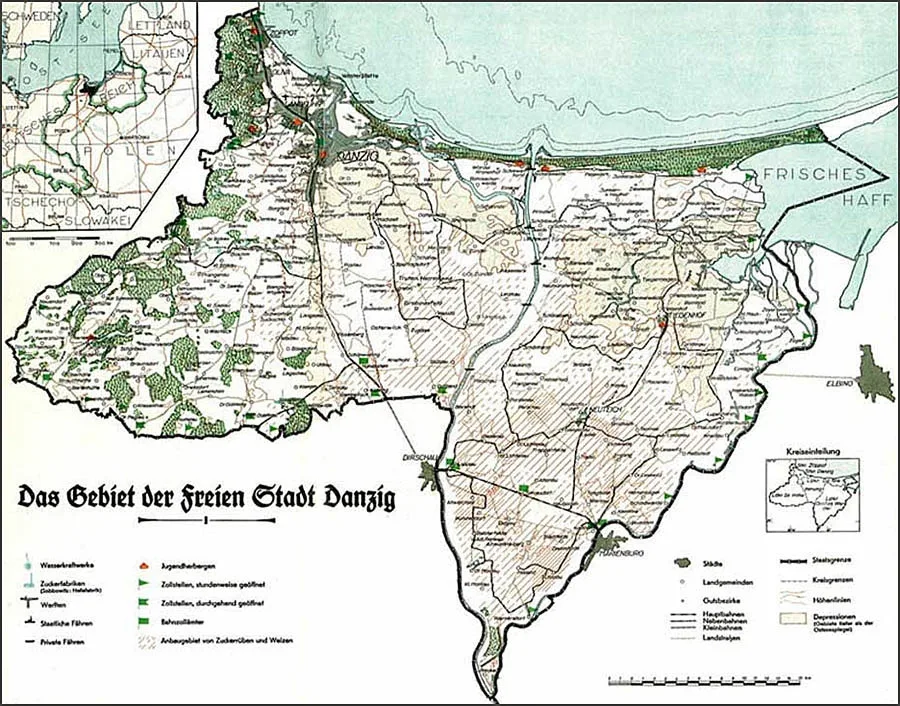 Map of the Free City of Danzig with the adjoining territories (owp-stiftung.de).
Together with its suburbs of Sopot, Oliva and Tiegenhof (now Nowy Dwór Gdański), along with 252 nearby villages and 62 farmsteads, the Free City was separated from Germany but not incorporated into Poland. The Germans were bitterly opposed to this decision. The privileges granted to Poland were entirely unacceptable to them. Above all, however, no one had taken into account the views of the people of Danzig itself, where Germans were in the majority: in 1910 the 1,966 square kilometres occupied by the city were home to some 330,630 people, of whom 315,336 were Germans and only 9,490 Poles. After the First World War this ratio changed very little.
“The arbitrary will of the Versailles dictators has prevailed,” wrote the German publicists Heinrich Schnee and Hans Draeger in their article “Ten Years of Versailles”. “Here lives a population genetically related to the Germans. They fought for their old Hanseatic city. And it is all happening again: before us stand the same rivals, who want the city to become part of the Polish empire once more. They have decided to take away the people’s language and culture. This is outright colonisation.”
In an attempt to refute the German side’s claims, Poland presented evidence at Versailles that half of Danzig’s population was in fact Polish. University professors (Konopczyński, Bujak, Romer, Nitsch) reached a similar conclusion in a memorandum they published: the city should be Polish, since it had been Polish from the outset. But with one proviso: without political pressure from Poland.
The Polish poet Adam Mickiewicz once said: “Danzig, once ours, will be ours again. This is the dream of all Poles.”
The speeches at Versailles were full of talk of the German spirit and German culture: “Danzig is the heart of the German nation.” “The people of Danzig take this oath: whatever may happen, let storms rage at our thresholds, let us be promised any gifts — we are Germans and we remain Germans. We will give everything to avoid colonisation and annexation by Poland. We will fight until the day when we are once again united with our kinsmen in one empire – in a single Germany.”
The German side lamented that “the fathers of the Treaty of Versailles had fallen victim to Polish agitation and the falsification of history” and were ignoring how Danzig had flourished over the past century. And what could Poland offer? To destroy everything the Germans had so carefully organised and built? Danzig would become a heavy economic burden on the already impoverished Poles, unemployment would rise, and the country would fall into even deeper decline. Such were the forecasts made by Germany’s representatives at the Versailles conference. As an alternative, it was proposed that Poland be given Königsberg instead of Danzig, or that some other outlets to the sea be found through East or West Prussia.
The Treaty of Versailles
Signed on 28 June 1919 in the Palace of Versailles in France, the treaty officially ended the First World War of 1914–1918. Its terms were worked out after lengthy secret deliberations at the Paris Peace Conference of 1919–1920. On one side, the document was signed by the victorious powers: the United States, the British Empire, France, Italy and Japan; on the other, by defeated Germany. Peace treaties between the Entente and the states that had fought on Germany’s side were signed later. Delegates from 27 countries took part in the negotiations. Representatives of Germany, Austria and Hungary were excluded from the process. Nor was Russia at the negotiating table: it had not been invited to the conference because of the separate peace it had concluded with Germany in 1918, under the terms of which the Germans had gained a considerable share of Russia’s resources and territory.
“The separation of Danzig from Germany meant an extremely serious strengthening of Poland’s position — the Pomeranian Corridor. Poland will stake everything on maintaining at least the status of a free city, if its outright annexation (incorporation into Poland) is not recognised,” wrote the German historian Karl Thalheim.
This peace, rapacious and humiliating from the point of view of the German Reich, implanted in the minds of the German people a dream of national revival and created all the preconditions for the rise to power of the Nazis led by Hitler.
Having read the text of the treaty, the French Marshal Ferdinand Foch said prophetically: “This is not peace, it is an armistice for twenty years”...
Indeed, relations between Germany and Poland grew more strained by the day. From the very first months after Danzig was recognised as a Free City, both sides bombarded the League of Nations with dozens of appeals to settle disputed issues. The Poles were squeezing out the Germans, who made up the majority of the population.
The privileges granted to the Polish Republic by Versailles, and later by the Warsaw Agreement, also seemed insufficient. A wave of protests over the shifting of the Polish border swept through Danzig and the whole of Germany. The city found itself isolated. There were growing fears that Poland would seize the southern part of the province as well. In one of their declarations the Germans stated that they would “no longer tolerate further acts of aggression”.
Poland repeatedly tried to extend its influence over the Free City, which naturally defended its autonomy. Poland’s interests, too, were being infringed. Under the regulations then in force, Polish officials were entitled to enter Danzig at any time on an identity card, without a passport. However, like all foreigners, they were obliged to register with the police and state the purpose and length of their stay. Otherwise they were expelled as undesirable persons. A humiliating situation. The best solution would have been to annex the city. That was what the struggle was about — in essence, a psychological war between intelligence services, which the German government feared: at that time the Abwehr was weaker and smaller than Polish intelligence.
The Germans were outraged that the Poles were holding openly provocative rallies, “inflaming the population more and more in order to prepare it for war”. Neither side had any greater concern than Danzig. Yet Germany simply had nothing with which to fight a war over it. Inflation was rising. In the summer of 1923 a hyperinflation began such as history had never known. In the four months up to the end of November, the money supply grew 132,000-fold, prices 854,000-fold, and the dollar exchange rate almost 400,000-fold.
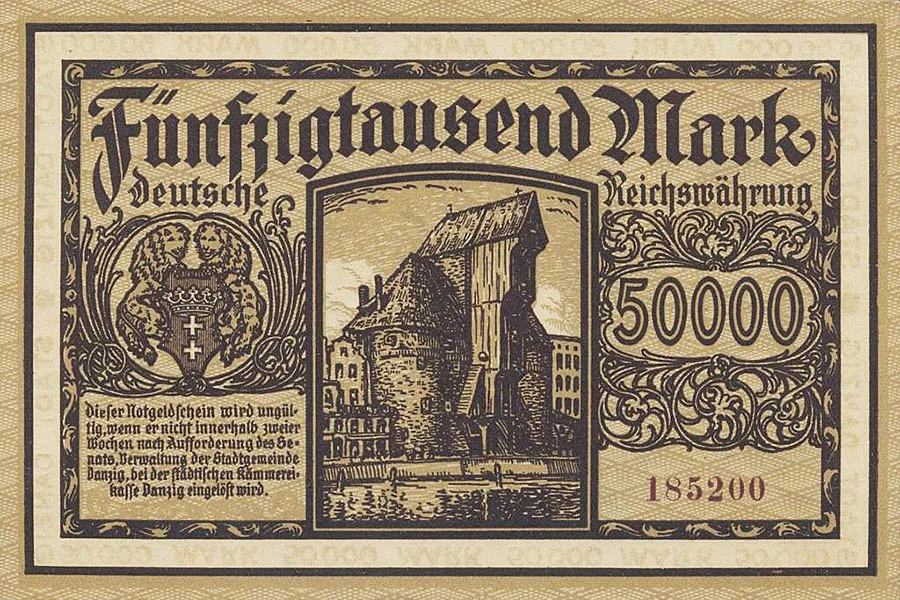
The total of Reichsbank notes in circulation approached 100 quintillion, and by the end of 1923, according to the Reichsbank, it had reached almost 500 quintillion marks.
In March of the following year the Council of the League of Nations added fuel to the fire by permitting Poland to set up an ammunition depot on the Westerplatte. This meant that Germany’s access to the port of Danzig could potentially be cut off altogether. The construction of the depot was opposed not only by the local population but also by the Danzig Senate and even by the Christian churches. A storm of indignation among the local people was caused by the so-called “letterbox putsch”. On a January night in 1925, Polish postal workers put up letterboxes in various parts of Danzig and opened a service for collecting and delivering mail — in breach of the Treaty of Versailles, which permitted them only to supervise and operate their own postal, telegraph and telephone link with the port of Danzig.
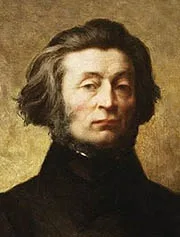
Adam Mickiewicz
In Poland he is regarded as one of the greatest Romantic poets. Adam Mickiewicz is claimed as their own not only by the Poles but also by the Belarusians and the Lithuanians. He was born on 24 December 1798 in the village of Zaosie in Novogrudok district (in Belarus), Vilna Governorate (Vilnius), in the Russian Empire. He studied at a Dominican school and graduated from Vilnius University. Like many students of the university, he belonged to the secret patriotic Philomath Society. Mickiewicz published his first poem, “Winter in the City”, in 1818 in the Vilnius newspaper Tygodnik Wileński. His first collection, “Poetry”, published by Józef Zawadzki in 1822, included the young poet’s “Ballads and Romances” and the preface “On Romantic Poetry”, which became the manifesto of the Romantic movement in Polish literature. The second volume of “Poetry” contained the poems “Grażyna” and “Forefathers’ Eve”. In October 1826 Mickiewicz met Pushkin, and their acquaintance grew into a sincere friendship. Around the same time Mickiewicz’s “Sonnets” were published in Russia, and in 1828 his poem “Konrad Wallenrod”, dedicated to Emperor Nicholas I, was printed in St Petersburg. This work became the pinnacle of the poet’s output. In 1834, by then in Paris, Adam Mickiewicz wrote his most important and largest work, “Pan Tadeusz”. In the autumn of 1855 the poet travelled to Constantinople, where he contracted cholera and died. Adam Mickiewicz’s remains rest in Wawel Cathedral in Kraków.
Poland won concession after concession. Meanwhile, the member states of the League of Nations were already discussing what would happen if Germany attacked Poland. For the League, security meant keeping Germany inactive within the borders assigned to it, but for the Germans this left their hands free and offered hope of regaining the lost territories. They would never forgive Versailles for the loss of Danzig.
As early as December 1925, a package of documents for Germany’s admission to the League of Nations was prepared at the Locarno Conference. Admission followed on 10 September 1926. Amid slogans of “Down with weapons, cannons and machine guns”, delegates wept with joy and clapped their hands. Only Germany’s Foreign Minister Gustav Stresemann, who received the 1926 Nobel Peace Prize for the Locarno Treaties, “applauded with his fingertips”, as eyewitnesses noted. Very soon Germany would once again demand the return of its colonies.
In early 1930, German nationalists launched a campaign marking the tenth anniversary of the separation of Danzig and West Prussia from Germany. Demonstrators in Danzig called for the eastern border to be changed, invoking the right to self-determination of the Germans who had remained in the severed territories. At rallies in Warsaw, meanwhile, there were calls to fight for a “Polish Gdańsk”, which many regarded after Versailles as a kind of Polish-German hybrid. The railways, the post office and the harbour administration became arenas of petty clashes. Even the bookshop at the railway station was divided into German and Polish sections.
Germany did everything it could to sustain the German spirit in Danzig so that the city’s bond with the Reich would not be broken. Exchanges of students and university professors were very actively pursued. Joint cultural and sporting events and all manner of congresses were held.
While politicians argued over territory, the people of Danzig went about their lives. Foreigners from all over the world came to admire the beauty of the Baltic. During the short summer months, social and sporting life sprang into bloom. The tennis centre in Sopot was especially popular: almost all the world’s best players gathered there for tournaments, despite the problems of the time. People went sailing and watched horse races. The beach was crowded with holidaymakers from Germany and Poland. The casino in Sopot was a great attraction. A unique musical event drew thousands of guests: open-air opera performances held at the height of the summer season in the Forest Opera.
It was not only the resorts that were full of holidaymakers, but also the cosy, well-kept villages around the Bay of Danzig. Visitors admired the Gothic architecture and, in snug little taverns, sampled local dishes, the “rose liqueurs” popular at the time and, of course, the famous “Gdańsk Golden Water” — Danziger Goldwasser.
By 1935 the situation had begun to change dramatically. The Danzig Nazis took the majority of seats in the Senate of the Free City. Freedom of the press and of assembly was practically abolished, arrests of undesirable politicians began, and the persecution of Poles intensified. This was felt most painfully by employees of the Polish post office and railway, Catholic priests, teachers and the local Jews. Preparations began for abolishing the constitution of the Free City.
In October 1938, Ribbentrop demanded that Danzig be incorporated into Germany and insisted on the right of land and sea transit through the Polish Corridor. Poland’s refusal is considered one of the pretexts for the outbreak of the German-Polish war and, subsequently, of the Second World War.
In August 1939, Germany began to put psychological pressure on Poland. The information coming from both sides was contradictory. The Poles claimed that the Germans were forming gangs and sabotage units and carrying out attacks. The Germans, for their part, accused the Poles of brutality and of continuing ethnic cleansing. In Bydgoszcz matters escalated into bloody terror — the Bromberg “Bloody Sunday”, which claimed the lives of thousands of Germans. These events, which the Reich exploited for propaganda purposes, later served as a pretext for mass executions of Poles in occupied Bydgoszcz and Gdańsk Pomerania. Hitler’s claims to the Polish Corridor and the intransigence of the Polish leadership only fuelled interethnic tension.
In socialist Poland, people generally avoided mentioning the events in Bydgoszcz at all. Clearing away the historical debris only began once the country had barely recovered from the “shock therapy” of the 1990s.
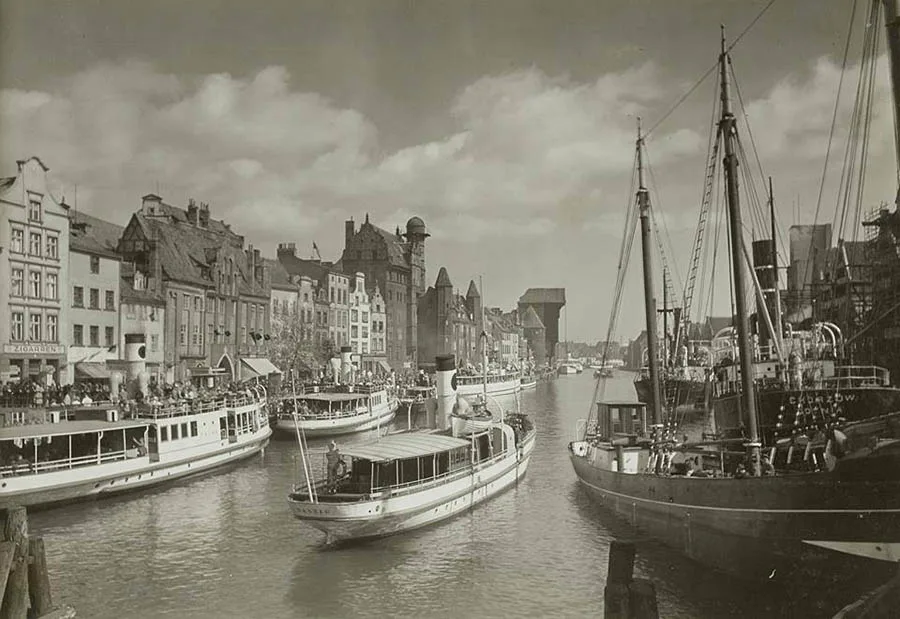 The silhouette of the Archaeological Museum building (left of centre) on the bank of the Motława, whose tower once housed an observatory, is as much a symbol of Gdańsk as the Żuraw crane (right).
Wasting time on disputes and conflicts with a tiny city-state, Poland seemed not to notice that Germany was preparing for war in earnest — and this despite the bilateral non-aggression pact concluded in 1934. The Poles only grew wary when the German battleship Schleswig-Holstein entered the Bay of Gdańsk.
Several other noteworthy events took place before the war. The German intelligence officer Oscar Reile, a personal aide to Admiral Canaris, wrote in his “Secret Operations of the Abwehr” that on 10 August 1939 a special British and French mission arrived in Moscow to sound out whether the Soviet Union was prepared to join them in somehow intimidating Hitler, who was by then making no secret of his intention to annex Danzig and the “Polish Corridor” to the Reich.
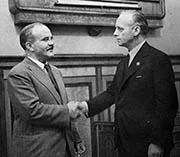
The Molotov–Ribbentrop Pact
23 August 2019 marks 80 years since the signing of the non-aggression treaty between the USSR and Germany, known as the Molotov–Ribbentrop Pact. Under the treaty, the Soviet Union and Germany undertook “to refrain from any act of violence, any aggressive action and any attack on each other, either individually or jointly with other powers”. The pact was signed by the Soviet Foreign Minister Vyacheslav Molotov and the German Foreign Minister Joachim von Ribbentrop. Attached to the treaty was a secret additional protocol defining the boundaries of the Soviet and German spheres of influence in Eastern Europe in the event of a “territorial rearrangement”.
On 22 August, however, Stalin ordered the British and French delegation to be sent packing, and the next day he concluded a non-aggression pact with Germany. He justified his decision by arguing that “… the German proposal should be accepted and the Franco-British mission sent away on a polite pretext. … It is in our interest that war should break out between the Reich and the Anglo-French bloc. What matters for us is that it should last as long as possible, until both groups exhaust each other”.
“Stalin surely knew that peace depended on his decision. Yet he chose war, which supposedly promised advantages for the USSR,” writes Reile.
Hitler, for his part, trusted no one and did not share his plans even with his closest associates, let alone with the intelligence service. It is therefore not known at what point he made the final decision to attack Poland. When he signed the order to attack at 5 p.m. on 31 August 1939, his generals still believed it was nothing more than a bluff. The Führer had already issued a similar order on 25 August at 3.25 p.m., only to cancel it at 8.30 p.m. the same day.
On 1 September 1939, the Westerplatte garrison took the first blows of the Second World War. At dawn (at 4.45 a.m.), the salvoes of the Schleswig-Holstein opened a new and the most tragic chapter in the history of Gdańsk. The Nazis attacked the Polish post office and the small Polish garrison of the fort on the peninsula.
About two hundred men, including post office workers, put up a courageous defence for a week. The command, which had no intention of sending any reinforcements, kept up the soldiers’ morale: “This is a battle for our honour and for Gdańsk. Polish Gdańsk. We will never surrender. We will repay all our humiliations.” But their strength was spent and their ammunition ran out. The wounded lay without medical care. With great difficulty, realising that self-sacrifice would benefit no one, the surviving soldiers raised the white flag. They capitulated without written confirmation of the order. Once again Gdańsk became part of East Prussia as Danzig.
The day after the capitulation, the first transport left Danzig, carrying mainly figures from the world of culture, bound for one of the most hellish concentration camps — Stutthof.
On 17 September 1939, Soviet troops entered eastern Poland. They advanced as far as the borders set out in the secret protocol agreed between the Soviet Union and Germany. On 28 September, the German-Soviet Boundary and Friendship Treaty was concluded in Moscow. As German politicians put it, Stalin wanted to extract the maximum benefit from the Polish-German war.
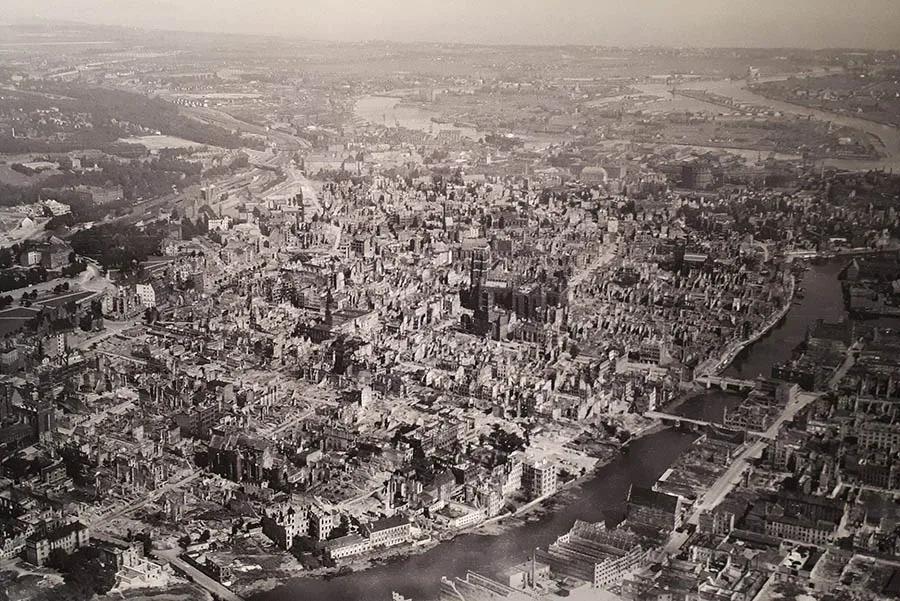 As a result of the bombing and fighting of the Second World War, up to 80% of the buildings in Gdańsk’s historic centre were destroyed.
The Free City remained under fascist rule until the end of March 1945. Its liberation took six weeks and came at a high price, not only for the Soviet army but also for Gdańsk itself, which was practically wiped off the face of the earth by attack aircraft bombardment: up to 90 per cent of its buildings were destroyed.

Danziger Goldwasser
The Polish liqueur Goldwasser owes its name to the Catalan physician Arnau de Vilanova. As early as the 13th century, his herbal elixir, which contained particles of real gold, is said to have cured the Pope himself of a dangerous illness. Goldwasser was first produced in Danzig, today’s Gdańsk, in 1598. It is less sweet than many liqueurs and colourless, but if you shake the bottle, tiny flakes of gold rise up from the bottom. Some brands of the liqueur are flavoured with citrus. The drink is 38 per cent proof. It is said that the tiny gold leaves in Danziger Goldwasser bring wealth and happiness to whoever drinks it. For a very long time, the “golden liqueur” was Gdańsk’s calling card.
But the war was still going on. And, whatever else may be said, the main goal had been achieved. After the Potsdam Conference, at Moscow’s insistence, Poland’s territory grew by a good third compared with its pre-war size. Admittedly, this is another fact that today’s Polish politicians prefer not to dwell on.
Near the Oliwa Gate, a monument to three thousand fallen Soviet soldiers was erected in the Soviet cemetery. In 1949, a memorial mausoleum to the Soviet heroes, a gift from the citizens of Gdańsk, was added. And on Victory Avenue stood the legendary liberator tank, the T-34. With these fighting machines, General Katukov’s tank army and the Polish Westerplatte Heroes Armoured Brigade, also equipped with T-34s, together routed the enemy in Gdańsk and Gdynia.
And yet, despite the undeniable contribution of Soviet soldiers to the victory over fascism, reproaches against Russia continue to be heard... Those who took part in the events do not deny that Soviet aircraft also bombed fascist-held Danzig. Marshal Aleksandr Golovanov, commander of Long-Range Aviation (ADD), writes in his memoirs: “The Red Army struck a blow of unprecedented force along the entire front from the Baltic Sea to the Carpathians. The enemy’s powerful defences were broken through along a stretch of 1,200 kilometres … Strikes were carried out against the railway junctions at Stralsund, Swinemünde, Hela, Gdynia and Danzig. The enemy suffered particularly heavy losses in the port and railway junction of Danzig. A total of 2,177 aircraft took part in nine raids there. Aerial photography recorded enormous area fires. Transport ships, port installations, railway trains, oil depots and timber yards were all ablaze …” The strikes were delivered with pinpoint precision, the author notes. And he continues: “On 7 April, in daylight, we struck the encircled enemy in the city of Königsberg and its fortress, sending more than 550 of our bombers … Everything within the designated target – I am speaking of the fortress – was, in effect, wiped off the face of the earth.”
Danzig and Gdynia were well prepared to meet the Soviet troops. The streets were blocked with barricades and mined, and many houses were rigged for demolition. Danzig was considered one of the strongest fortresses of the Third Reich.
On 18 March, Soviet bombers destroyed the airfield and 64 German aircraft, leaving the German army practically without air cover. And on the night of the 19th, “Danzig, overflowing with refugees, was subjected to a devastating bombing raid in which between 300 and 400 American-built ‘Flying Fortresses’ took part,” recalled one German war correspondent. “We were forced to look on helplessly at this terrible dance of death … On the night of 20 March they appeared again, this time from the east, dropped their entire bomb load on the city almost unhindered and disappeared to the west … Soviet aircraft circled in the sky every day. Attack planes with red stars on their wings strafed every vehicle in the city streets with their onboard cannon and machine guns. The inhabitants hardly ever left their cellars.”
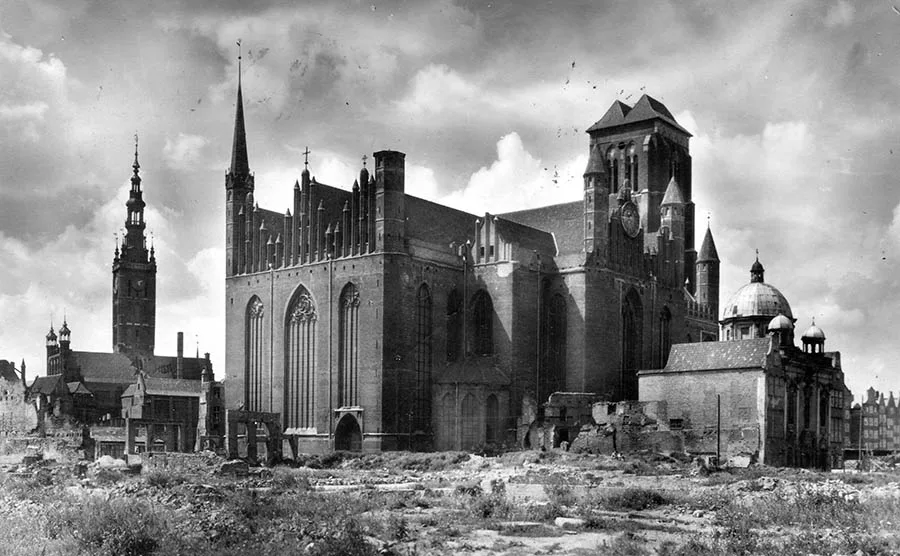 In the post-war years the Polish authorities hurried first of all to rebuild the city’s architectural landmarks. The street-front buildings had to wait. (Photo taken no later than the mid-1950s.)
On the 27th, the assault on Gdańsk began with the support of Soviet aviation. The city was engulfed in flames.
The German military historian Kurt von Tippelskirch writes in his book “History of the Second World War”: “There is a tendency to exaggerate in every possible way the significance of the massive bombing of German territory by the strategic bombers of the USA and Great Britain. However, these massive bombing raids, which played a certain role in disrupting Germany’s home front and transport, in destroying German cities and killing their civilian population, were not a decisive factor in the defeat of the Third Reich.” Tippelskirch points out that “the terror raids against the civilian population and aimed at destroying German cities neither helped to achieve nor hastened the victory of the Western powers. These raids had no military significance, even in the broadest sense of the word.”
“After the Red Army crushed the Third Reich, East Prussia was abolished. Its southern part, about two-thirds of the total territory, including Gdańsk, was handed over to Poland. The German population was deported,” write the authors M. Bezrukov and A. Turovsky in their “Victory Guidebook”.
Someone once very aptly remarked that much of what seems incredible today was ordinary, everyday life in wartime.
FAMOUS PEOPLE OF GDAŃSK
Gdańsk has given the world a whole galaxy of talented and charismatic people – scholars, writers, politicians. Among them is the father of Polish diplomacy, Johann von Höfen, also known as Jan Dantyszek, one of the most celebrated poets of Renaissance Europe. Then there is Philipp Clüver, a renowned historian and geographer who travelled the length of Italy on foot and wrote an “Introduction to Geography” that caused a sensation across Europe, with numerous maps, including one of Poland. Martin Opitz, another poet, author of fine sonnets and tragedies, was born in Silesia and settled in Danzig in 1636, where he died during a plague epidemic. Opitz went down in history as “the German Homer and Horace”. Nor has Gdańsk forgotten Reinhold Curicke, lawyer, historiographer and author of the treatise “Historical Description of the City of Gdańsk”, the first monograph on the city.

“The Tin Drum”
A film by the German director Volker Schlöndorff. In 1979 it was awarded an Oscar and the top prize of the Cannes Film Festival. The film is based on the Nobel Prize-winning novel by Danzig-born Günter Grass. The plot of this bizarre cinematic parable reflects the psychopathology which, according to its authors, is inherent in Nazi ideology and breeds social madness. The action takes place almost entirely in Danzig and its surroundings from the early 20th century to 1945 and includes the tragic events of the first day of the Second World War.
Danzig’s Golden Age was also blessed by the birth, in 1611, of Jan Hewelke. Born into a brewer’s family, the heir not only carried on his father’s business but also became a designer of telescopes and even mayor of the city. Jan received an excellent education. After graduating from the “Athenaeum”, the famous Danzig Academic Gymnasium, he was sent by his parents to study in England, and then in France and Holland. Alongside law at Leiden University, the young Hewelke also studied astronomy – and in great depth. On returning home, he set up the “Stellaburgum” observatory on the roof of his parents’ house, ground the lenses for his telescopes himself and personally designed a 50-metre telescope operated by a crew of retired sailors.
Jan Hewelke published 19 works on astronomy, most of which he printed in his own printing house. The astronomer adopted a Latin form of his name – Hevelius. In 1664 he became the first resident of Danzig to be made a Fellow of the Royal Society in London.
Louis XVI and John III Sobieski granted him permanent stipends. In honour of the Polish king and patron, Hevelius named one of the constellations Sobieski’s Shield and dedicated to the monarch his work “Selenographia”, the results of his observations of the Moon. In 1679 Hevelius’s observatory, with its unique astronomical instruments, manuscripts and splendid library, burned down, and he built a new one.
Those around Hevelius were no less famous. Skilled draughtsmen are associated with his work. At first the astronomer illustrated his writings himself, but for lack of time he turned to professionals for help. The first was Adolf Boy. He then made the acquaintance of the outstanding painter and graphic artist Andrzej Stech and of his friend Jeremias Falck, an equally well-known graphic artist, copper engraver and draughtsman, a Pole by origin, who for that reason sometimes signed his works “Polonus”.
Stech himself was born in Słupsk in 1635. The boy was taught first by his father and then by the aforementioned Adolf Boy. In 1658 Andrzej married his teacher’s daughter, the widow of the painter August Ranisch. Among Stech’s many works are two portraits of Hevelius.
It was also in the artistic milieu of Danzig that the art of Daniel Schultz took shape; he was court painter to three Polish kings: John Casimir, Michał Korybut Wiśniowiecki and John Sobieski. In 1793 the Prussian authorities removed the artist’s works from the Main Town Hall.
A year before the death of Johannes Hevelius, another illustrious citizen was born in Danzig: Daniel Gabriel Fahrenheit, the maker of the first thermometers and the creator of the temperature scale that the British and Americans still use to this day.
Not a native, but a resident of Danzig from 1773, Nathanael Matthäus von Wolf, born in Königsberg, became famous as the first to use inoculation against smallpox. He did so 23 years earlier than Edward Jenner, who is considered the discoverer of the method. Wolf also devoted his time away from medical practice to astronomy.
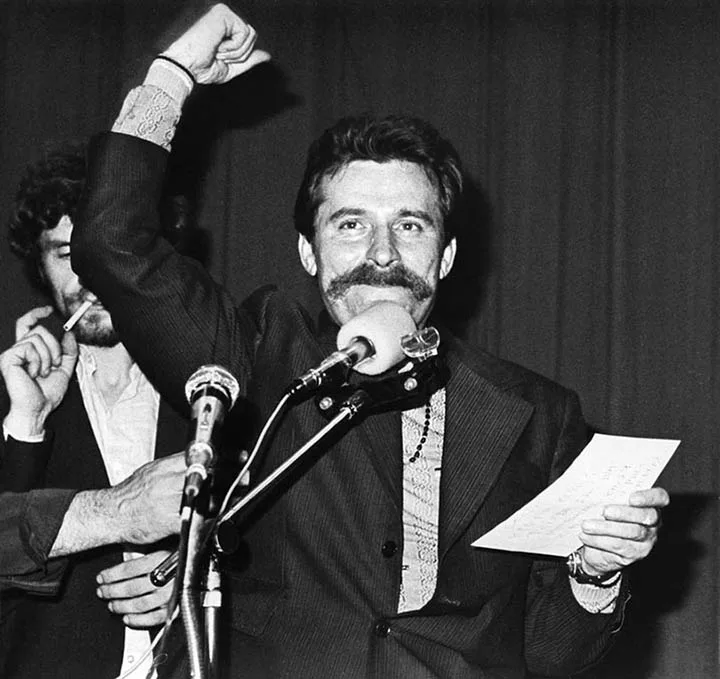
The charismatic Lech Wałęsa (pictured) has become a symbolic figure in the pantheon of famous Gdańsk natives. A trade unionist and politician, an electrician by training, a shipyard worker, leader of the workers’ strikes in the 1970s and one of the founders of the legendary Solidarity, he was awarded the Nobel Peace Prize in 1983. And in 1990 he was elected President of Poland. Donald Tusk, the current President of the European Council and former Prime Minister of Poland, was also born in Gdańsk.
Without doubt, the best-known Gdańsk native in world literature and the city’s chronicler is Günter Grass (1927–2015), also a Nobel laureate and an honorary citizen of Gdańsk. His novel “The Tin Drum” brought him worldwide fame.
In 1979 Günter Grass’s novel was adapted for the screen. Volker Schlöndorff’s philosophical film drama caused an unprecedented scandal. An American fundamentalist religious organisation in Oklahoma declared the film obscene. Nevertheless, the picture won an Oscar and the Palme d’Or at the Cannes Film Festival. Today “The Tin Drum” is regarded as one of the most outstanding films of the New German Cinema.
KASHUBIA
Günter Grass came from Pomerania, from Kashubia. A legend lives on that when God was creating the earth, He completely forgot about the Kashubians. But one of the angels noticed this in time. God looked into His storehouses, and only a little of everything was left. So He showered the Kashubian land with oak groves, pine forests, blue lakes, winding rivers, sandy dunes, green valleys, fragments of rock and drops of the sea. Amid this picturesque beauty, since the most ancient times, has lived a remarkable Slavic people, the Kashubians, the indigenous population of Pomerania and the most numerous ethnic group in Gdańsk, Słupsk, Sopot and Gdynia.
 Kashubians writing in Kashubian include the Tricity as part of Kashubia. Source: Wikipedia.
The Kashubian language
For a long time there was debate over whether Kashubian is a dialect of Polish or a language in its own right. In the end it was recognized as a separate language and even became the only language in Poland with the status of a regional language. In schools, however, it is taught as an additional subject. In 2005, students were granted the right to take their exams in Kashubian.
Like the rest of the population of Pomerania, the Kashubians resisted Germanization and defended their right to their native language. The physician Florian Ceynowa, known as the “father of Kashubian regionalism,” wrote the first grammar of the Kashubian language.
In the first half of the 19th century, the Kashubians began leaving their lands because of an economic crisis. Some sought seasonal work abroad, while others emigrated to Germany, Canada and the United States. The Kashubian writer Hieronim Derdowski, who gathered unique information on Kashubian emigration, calculated that at the end of the century before last some 90,700 Kashubians lived in the USA, 25,000 in Canada and 15,000 in Brazil. A small number of Kashubians settled in Australia and New Zealand.
Another well-known name in Pomerania is the poet and teacher Jan Trepczyk, compiler of a Polish–Kashubian dictionary, author of the unofficial Kashubian anthem Zemia Rodnô and one of the founders of the Museum of Kashubian-Pomeranian Literature and Music in Wejherowo.
In interwar Poland, attitudes towards the Kashubians were ambivalent. On the one hand, the Poles were grateful to them for their inclusion in Poland; on the other, they feared that the Kashubians would start demanding autonomy, with all the consequences that would follow.
During the Second World War, for all their pressure and efforts, the Germans failed to assimilate the Kashubians. That is why the first concentration camp, Stutthof, was created first and foremost precisely to destroy the defiant Kashubian intellectual elite.
After the war the ethnic make-up changed as Germans were moved to Germany and Pomeranians from German Pomerania to Gdańsk – while Poles from the interior of the country were sent, as someone joked, “to the Baltic resorts” to strengthen the unity of peoples. Kashubian autonomy was no longer even contemplated.
Today the Kashubians live in the Pomeranian Voivodeship. They have their own media and a Centre of Kashubian Culture in Szymbark, in “Kashubian Switzerland.” The preservation of their distinct identity is looked after by the Kashubian-Pomeranian Association.
The Kashubian land, rich in traditions, attracts many tourists every year. The world may be fighting smoking, but you can’t leave a word out of a song: one of the most distinctive Kashubian traditions is the use of tobacco – snuff, kept in snuffboxes made of cow horn.
THE TRI-CITY, OR IN POLISH – TRÓJMIASTO
This is the name given to the conurbation made up of three cities – Gdańsk, Sopot and Gdynia – together with their suburbs, which stretch for some twenty kilometres along the Bay of Gdańsk. Their combined population is around one million. In effect, the Tri-City is a single city covering 414.38 square kilometres. On 28 March 2007 the conurbation was formally established by a declaration, the “Tri-City Charter.”
Its history began in 1922 with the construction of the port of Gdynia on a small stretch of the Baltic coast. After the Second World War, Gdańsk and Sopot became part of Poland and, together with Gdynia, built in 1922, formed a conurbation. Such a phenomenon is by no means unique in Europe – take, for example, Belgium’s Antwerp with Mechelen and Turnhout. Closer to home, we may recall that Königsberg (today’s Kaliningrad) also once came into being through the merger of three towns: Altstadt, Kneiphof and Löbenicht.
Linked by excellent transport connections, Gdańsk, Sopot and Gdynia can be regarded as independent cities, each with its own history. The youngest city of the Tri-City is Gdynia, the largest modern port on the Baltic. Today it is hard to imagine that at the beginning of the last century there stood on its site an old fishing village, known since 1253, which gave its name to the modern city. From the start of construction until 1926, Gdynia’s population grew a hundredfold – from 1,000 to 100,000 inhabitants.
Gdynia is called a city with a maritime soul. The first seagoing ship entered the port in 1923. By 1939 there were already six large berths for ships here.
During the Second World War, the Germans who occupied the city renamed Gdynia Gotenhafen and completely destroyed the port and shipyards. Many of the buildings in the city that miraculously survived are fine examples of the Art Nouveau style popular in Europe at the beginning of the last century.
Today two museum ships are moored at Gdynia’s pier. One of them, the frigate Dar Pomorza, has a rich history. She was built in 1909 at the Blohm & Voss shipyard in Hamburg under the name Prinzess Eitel Friedrich and, until the outbreak of the First World War, served as a training ship for the German merchant navy, and later as a base for submarine crews in Cologne. After the war the vessel was first handed over to France as a war prize and renamed Colbert. In 1929 the ship was bought for 7,000 pounds by the Polish community of Pomerania and renamed Dar Pomorza (“Gift of Pomerania”). In 1934–35 the frigate sailed around the world. She spent the Second World War in Stockholm and returned to Gdynia unharmed in November 1945. Today she is a museum ship with cabins in their original interior style and a collection of exhibits gathered by her crew.
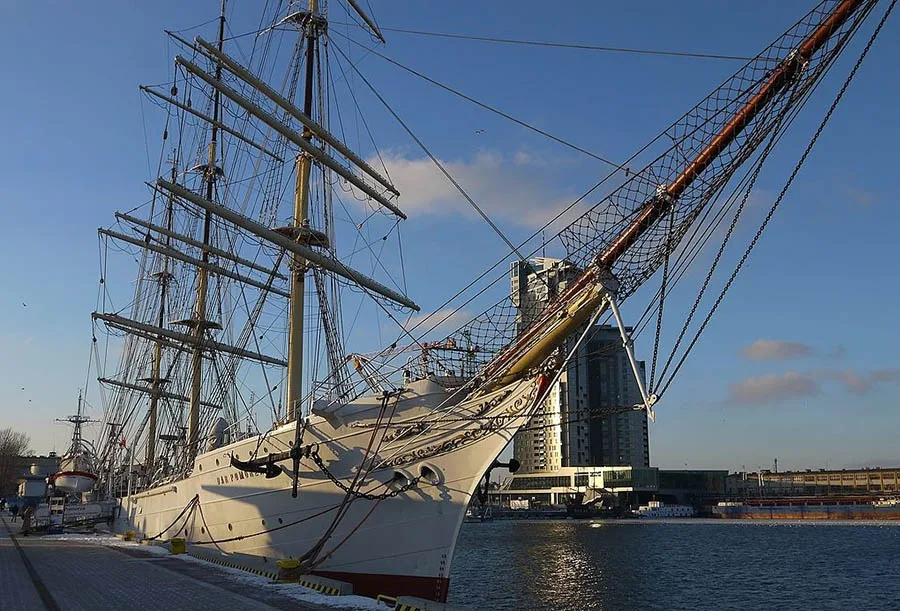 Gdynia. The frigate Dar Pomorza at her berth.
Lech Wałęsa Airport
Gdańsk airport has also undergone major changes in recent years: thanks to the new terminal, the number of flights has increased. The runway has been renovated as well, and an upgraded instrument landing system (ILS) allows aircraft to land in the most difficult conditions. Europe’s largest low-cost airlines will take you on direct flights from Gdańsk to virtually every corner of the Old World.
Dar Pomorza is depicted on Polish silver coins issued for the 15th anniversary of the founding of the seaport of Gdynia. Commemorative coins were also issued for the frigate’s 50th and 75th anniversaries.
Next to the sailing ship lies a true national relic: the Polish torpedo warship Błyskawica, the only surviving ship built before the Second World War, on which sailors and officers of the Polish Navy still stand watch.
Gdynia has none of the narrow streets of old towns, but it does have places of interest from its relatively recent past. For example, 10 February Avenue, which runs right across the city to the beach, is named after the day when, under the Treaty of Versailles, 140 kilometres of Baltic coastline were returned to Poland. On this street stand the surviving historic buildings of the Main Post Office and the City Council.
One of the richest collections in Europe devoted to the history of Polish emigrants who once sailed from Gdynia across the ocean is housed here in the Emigration Museum. A true open-air museum created by nature itself is found in the districts of Orłowo and Redłowo, near which lies the Kępa Redłowska nature reserve, regarded as the jewel of the Tri-City and a favourite spot for walks and sport among local residents.
One of the most popular resort towns on the Baltic and Poland’s unofficial “summer capital” (the winter one being the ski resort of Zakopane in the south of the country) is Sopot, with a population of just over 40,000, nestled between Gdańsk and Gdynia on the shore of the Bay of Gdańsk. The town is known as a health resort thanks to its iodine-rich seawater, healing saline springs and historic bathhouses.
Sopot is famous for having the longest wooden pier in Europe, stretching more than half a kilometre.
The first one was built in 1817 by the Russians for their naval vessels, but they destroyed it when they left the town. In 1827 a new, small promenade pier was built here especially for holidaymakers. It was later extended to its present length. And from the viewing platform of the Old Lighthouse, built in 1904, you can not only admire the panorama of the town but also see the Gulf of Gdańsk and the Westerplatte peninsula.
The area where Sopot now lies was settled by Slavic tribes from the 7th century. In the Middle Ages there was a village here, and later the country houses of wealthy burghers appeared. From 1772 Sopot belonged to Prussia, and in 1919 it passed to Poland. The town’s history as a resort began in 1823, when Jean Georges Haffner, a former doctor in Napoleon’s army, built therapeutic baths here. Since then this seaside town has ranked among Europe’s most prestigious resorts.
The Forest Opera, where the Sopot festivals were held, draws large audiences. It was founded a hundred years ago, in 1909, by Paul Walther-Schäffer, conductor of the Gdańsk City Theatre, in a hollow surrounded by wooded hills. Its performances were enormously successful. The repertoire consisted mainly of operas by German composers, and Wagner was especially popular. Sopot became a centre of musical life. In time for the opening of the International Song Festival in 1961, the theatre was modernised, and the stage and auditorium were covered with a huge canopy.
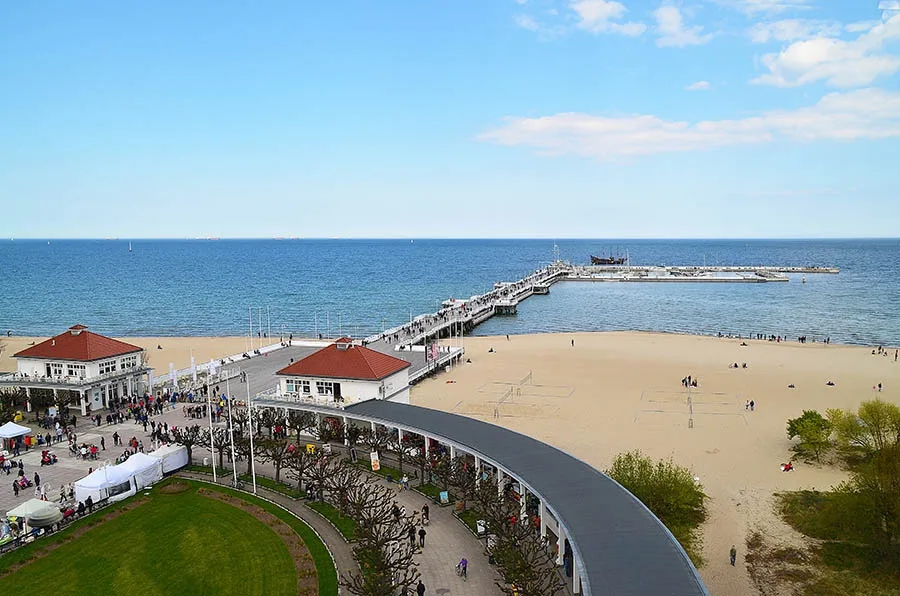 Sopot. The local pier (Molo) is the largest wooden sea pier in Europe.
The town offers sports enthusiasts a wealth of options: sailing, horse riding and tennis. Cycling routes laid out along the coast are very popular; they link the towns and suburbs of the Tricity. Sopot has no public transport of its own: its buses are operated by the municipal transport companies of Gdańsk and Gdynia, and one Gdynia trolleybus route also enters the town. In addition, the other cities of the Tricity can be reached from Sopot by the urban rapid railway, something between a suburban electric train and a tram.
The resort town does not have a great many sights, but there is still plenty to see. One example is the “Dancing House”, built in 2004, which the Poles call the “Crooked House”. It has no right angles; its walls, doors and windows bend as if in a funhouse mirror. Even so, the “Crooked House” fits harmoniously into the architectural ensemble of Sopot's historic centre.
St George's Church on Kościuszko Street was built in 1899–1901 with the support of the Prussian king Wilhelm II and his wife Augusta Victoria, who personally donated funds for its construction. The architect, Ludwig von Tiedemann, declined a fee for his work.
The king approved the design himself and made some changes to it, insisting that the tower be made taller so that it could be seen from the Gulf of Gdańsk. In this way sailors gained an additional landmark on the shore. The queen attended the opening and consecration of the church on 17 September 1901. The town's most famous street, Bohaterów Monte Cassino, or Monciak, as the locals call it, leads up to St George's Church.
An unusual building for the town is the Church of the Saviour, built in the Art Nouveau style in 1919 for Sopot's Protestants. The building was badly damaged during the war, but the church remained in use. It is the only church in the Tricity where Evangelical services are held.
One of Sopot's more controversial sights is the “Jaś Rybak” (Johnny the Fisherman) fountain, which for some reason certain people consider absurd. The fountain was built after the end of the war. A statue of a fisherman with a basket of fish stands among the jets of water. A similar sculpture once stood in the garden of one of the villas.
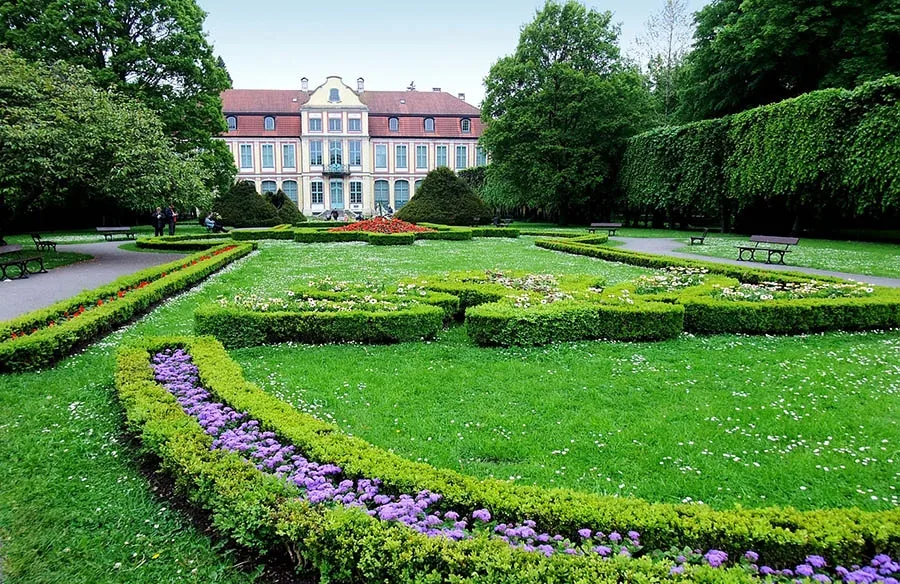 Oliwa. The Abbots' Palace in Gdańsk's main park, Oliwa Park.
No less remarkable is the Tricity suburb of Oliwa. “Spread out at the foot of picturesque hills, the houses clustered around the cathedral and along the course of the Oliwa Stream. From the early Middle Ages a trade route known as the Via regia, ‘the Royal Road’, ran from Gdańsk to Słupsk and Puck. From here, through the wide-open gates of the picturesque Valley of Joy, the road climbed up to the hilltops.” This is how the writer Lech Krzyżanowski describes this quiet, cosy spot in north-western Gdańsk with its magnificent cathedral, palace and park.
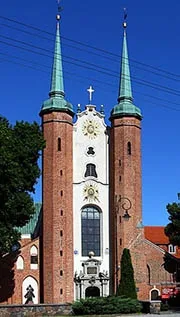
Oliwa Cathedral of the Holy Trinity, the Blessed Virgin Mary and St Bernard
The cathedral served as the principal church of Pomerania and as the burial place of the local princes and dukes. Together with the Abbots' Palace, it formed part of the Cistercian monastery of Oliwa, founded on 2 July 1186. The three-aisled basilica is Gothic with Baroque elements. Its façade is flanked by two tall 46-metre towers crowned with Baroque helmet roofs. Inside are 23 marble altars in the Baroque and Rococo styles. Over the course of its history the cathedral has burned several times. In 1350, after the third fire, it was rebuilt in the Gothic style. In 1925 it was given cathedral status, and in 1992 it became the seat of the Archdiocese of Gdańsk. The cathedral's chief treasure is the organ built by the monk Johann Wilhelm Wulff.
Oliwa is first mentioned in unofficial documents of the Cistercian monastery in 1186, when Prince Sambor invited a Cistercian community from Kołbacz in Pomerania to this land and granted the abbey seven neighbouring villages. Being shrewd people, the monks very quickly expanded their estate, built dams and mills, and improved methods of working the land.
For more than 600 years a Cistercian abbey stood on the land of Oliwa, and over the centuries dramatic events unfolded around it. In the 13th century the monastery was twice attacked by the Old Prussians, who burned it to the ground. Three times it was plundered by the Teutonic Knights. At last the monks built a brick chapel, and by the middle of the century a basilica with side chapels had been erected in a typically Romanesque style. Today the building looks as it did after its reconstruction following a devastating fire in 1350. After all the misfortunes that befell the monks one after another — epidemics, invasions, fires — the abbey's luck turned: by the 18th century many noble families from Gdańsk had firmly settled here. These patricians built their own mills, oil presses, smithies and sawmills, and even helped the monks build a new abbots' palace in 1754–56. After the First Partition of Poland, the town, with a population of 500 and 70 buildings, passed to Prussia, whose authorities seized all the abbey's property. The Oliwa church became a Catholic parish church, while the old parish church of St James went to the Protestants. Thus, with the beginning of Prussian rule, the Cistercian Order in Oliwa ceased to exist.
Peaceful life was interrupted by the First World War. The bells and the pipes of the old cathedral organ were melted down for military needs. Under the Treaty of Versailles, Oliwa became part of the Free City. No sooner had the cathedral organ been repaired than the Second World War broke out, and Oliwa, together with Danzig, came under German rule once more. After the war it was restored and became a beautiful, picturesque district. The Oliwa Cathedral has retained its present appearance since the 16th century. Its façade is adorned by two 46-metre towers with pointed spires.
A hundred metres from the basilica stand the old parish church of St James and the Abbots' Palace. An atmosphere of peace and harmony pervades the beautiful Cistercian park with its neatly trimmed lawns, ponds and swans, tiny canals and waterfalls. In one corner of the park stands a monument to the Polish poet Adam Mickiewicz, whose name this “oasis of quiet and contemplation” bears.
The largest part of the Tricity is, of course, Gdańsk, the capital of the Pomeranian Voivodeship, with a history of more than a thousand years. The city has been reborn from the ruins left by the Second World War.
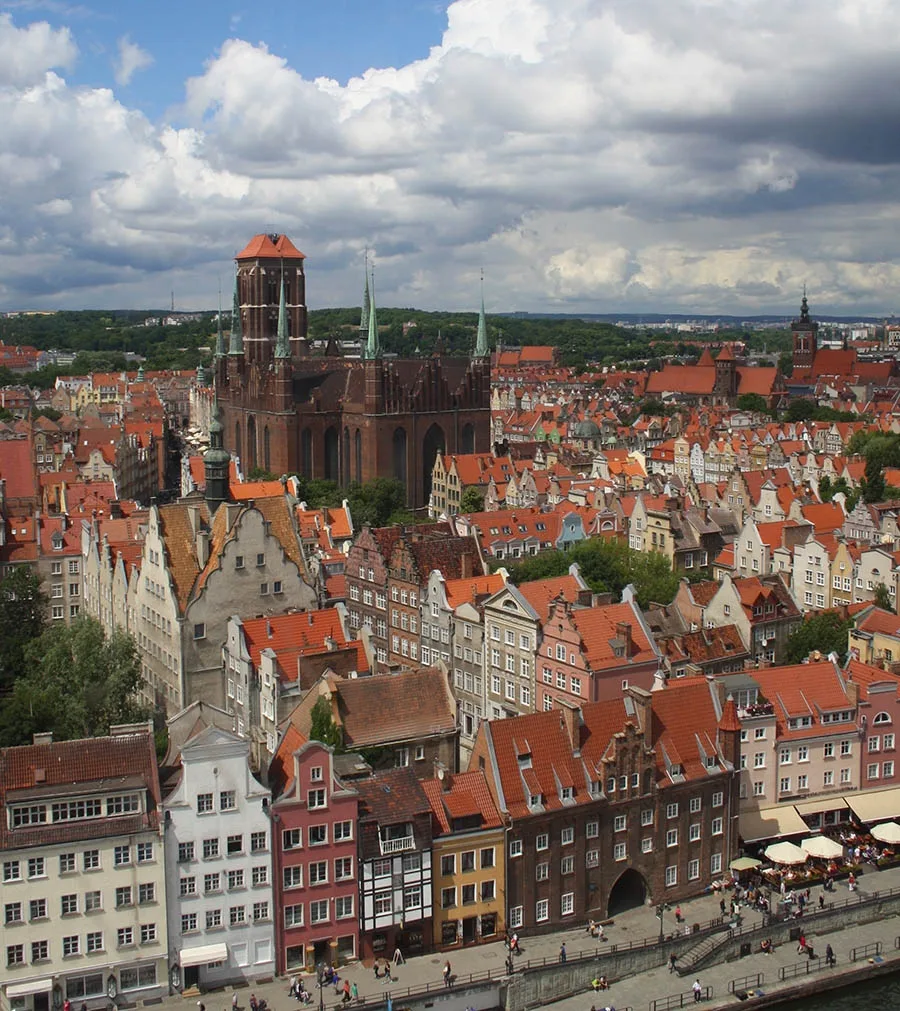 Gdańsk. The city's historic centre, risen like a phoenix from the ashes, is simply breathtaking!
The old stone houses, churches, gates and streets have been restored. The historic buildings have returned to their original places, though some have changed their function. The Town Hall, for example, now houses the Gdańsk History Museum, while right in front of it the Neptune Fountain still delights the townspeople.
A legend still lives on that one day the ruler of the seas grew tired of hearing the clink of the coins people threw into the fountain, and he struck the water with his trident with all his might. The coins turned into gold dust, and the water took on a golden hue and acquired healing powers. And so the “Golden Water” (Goldwasser, or Złota Woda) that made Gdańsk famous came into being. It has, of course, nothing to do with the purely Polish invention of the same name — a liqueur infused with 20 herbs and enriched with costly spices.
Incidentally, in 1881 Stanisław Tarnowski, a professor at the Jagiellonian University in Kraków, described the well-known vodka distillery at 52 Szeroka Street as follows: “The warehouse of Gdańsk vodka, the factory of the famous ‘Goldwasser’ known all over the world; its capital is ‘Under the Salmon’. A Polish inscription survives here to this day, and an enormous wooden salmon has hung above the doors since God knows what immemorial times — perhaps since the day this shop was founded, no more and no less than 1598. I do not know whether the warehouse keeps any archaeological, three-hundred-year-old ‘Goldwasser’ (if it does, it must be good), but the firm itself is already a venerable archaeological monument.” In March 1945 the legendary “Salmon” burned down together with the Main Town. But, as local historians write, in 1976 it “once again hospitably flung open its heavy double doors on the very same spot, confirming the resilience of tradition.”
Along the Motława stretches the Long Embankment, above which towers the oldest and mightiest port crane in Europe, known as the Żuraw (the Germans called it the Krantor, the Crane Gate). Today the exhibits of the Central Maritime Museum housed here tell the story of Polish seafaring.
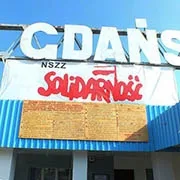
The Solidarity Movement
The Independent Self-Governing Trade Union “Solidarity” grew out of the mass strike movement of August–September 1980 and was founded at the Lenin Shipyard in Gdańsk. Lech Wałęsa became its founder and leader. From January 1982 to May 1986, Solidarity was forced to operate underground. On 17 April 1989 the union was officially legalised once again. As the largest anti-communist movement, Solidarity brought together a wide range of political forces, from Catholic conservatives and right-wing liberals to ultra-left socialists and anarchists. In 1989–1990 the trade unions managed to carry out a peaceful revolution and rid Poland of the communist regime for good.
From the bank of the Motława you can enter the centre of the Main Town through one of the fortified gates. The most beautiful street, Mariacka, is reached through St. Mary’s Gate. It ends at the majestic red-brick Gothic Basilica of the Blessed Virgin Mary, which can hold more than 20,000 people. Beneath its vaults are 31 chapels, three dozen large windows and an ancient astronomical clock. Since the 15th century it has shown the phases of the Moon, the signs of the Zodiac, the date and the time.
In one of the side streets of the Main Town stands the Dominican Church of St. Nicholas, almost untouched by the war, with its gilded multi-tiered altar and great organ.
Alongside the Main Town, the Old Town is developing too, and it also has plenty to admire. The Great Mill built by the Teutonic Knights has survived. Behind it, on the opposite side of the street, is the Old Town Hall. And across from the Great Mill stands St. Catherine’s Church, the oldest in Gdańsk. Right behind it, a couple of centuries later, rose what is perhaps today the most “politicised” church in the city, St. Bridget’s, which in the 1980s served as a refuge for activists of the anti-communist Solidarity movement.
Strangely, as if selectively, a couple of buildings in Gdańsk survived whose loss would hardly have been mourned. These are the former Gestapo building (until 1956 it was occupied by the Soviet NKVD) and the house of Rudolf Spanner, who was a military doctor during the Second World War. In 1943–44 he developed a method of making soap from human fat, conducting his experiments on prisoners of Stutthof. According to witnesses at the Nuremberg trials, these were merely the corpses of inmates. Spanner was never brought to justice, since it was not proven that he had killed the people whose bodies he used in his experiments. By 1957 the sadist was already director of the Cologne Anatomical Institute, where he produced a highly acclaimed anatomical atlas that is still in use today. He himself died of a stroke in 1960.
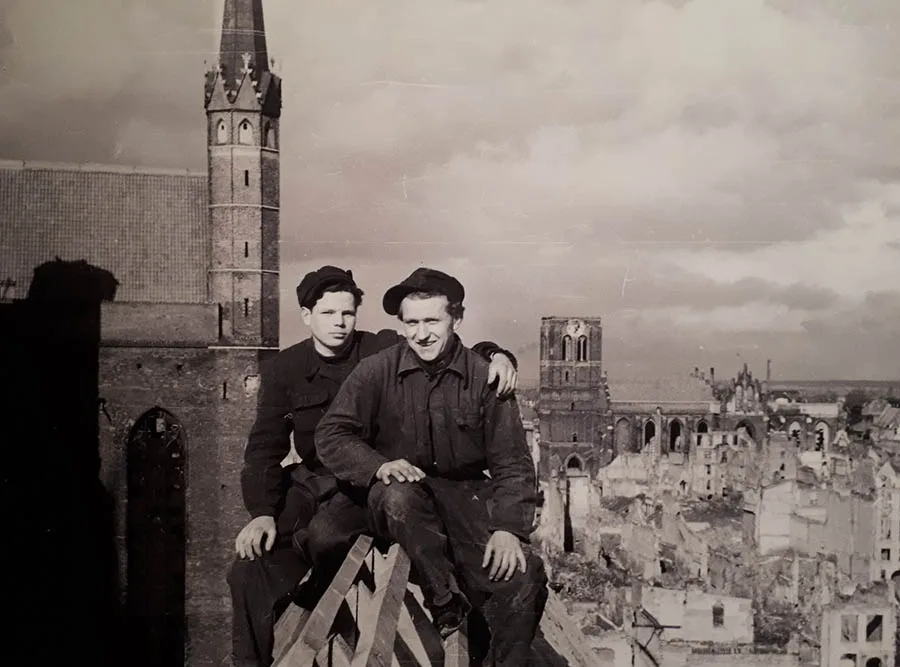
The historic centre of Gdańsk was the most ambitious and unprecedented restoration project ever undertaken.
It required not only labour but, above all, time. The restorers faced an extremely difficult task: finding images of every destroyed house. Pre-war Gdańsk had not systematically compiled documentation, and all the archives had been taken to the west. The historic centre therefore had to be pieced together bit by bit — from drawings, clippings from old newspapers, family photographs and paintings. The first to appear were sketches of the façades of Długa, Ogarna and Piwna Streets. As the post-war ruins were cleared, every architectural detail was gathered in the restoration workshops, one might say speck by speck of dust. Determining which stone fragment belonged to which house was extremely difficult. The restoration and reconstruction work was directed by Jan Borowski and Marian Celiński of the Department of Polish Architecture at the Gdańsk Polytechnic Institute.
There are still districts in the Tri-City that the craftsmen have only just begun to work on. Their restoration is merely a matter of time — work does not stop for a single day. Public debates on the city’s reconstruction projects are continuing as well.
During the 20 years in office of Paweł Adamowicz, the Mayor of Gdańsk who was tragically killed before the eyes of the whole city in early 2019, Gdańsk was transformed from a European backwater into a world-famous tourist centre. The young mayor is remembered for many things by the people of Gdańsk and all those who followed his work — for instance, his original solution to the road problem. In 2013 he ordered the removal of the asphalt in central Gdańsk that had covered the historic cobblestones. Adamowicz believed the old paving had a host of advantages: rainwater does not linger on the cobbles, and there is less dust than on asphalt. It is also a plus for road safety, as drivers are forced to keep to the speed limit. And, of course, the aesthetic aspect mattered to him no less: “You know how pleasant it is to ride in a taxi over cobblestones! The Champs-Élysées are cobbled too…”
Unlike Poland’s leadership, Paweł Adamowicz advocated accepting migrants and creating the most favourable conditions for them. And Gdańsk did indeed become the first Polish city to adopt an unprecedented plan for integrating different peoples. The mayor hoped that the programme would remain in force for at least the next few decades. As he used to say, everyone has the right to be happy.
Maintaining good-neighbourly relations with Russia, Adamowicz established a tradition of laying flowers on the graves of fallen Soviet soldiers on the anniversary of Gdańsk’s liberation from fascism, for which the opposition dubbed him a “Russian element”. He again showed himself to be “not a real Pole” when, after the Polish side abolished visa-free travel with Kaliningrad, he spoke out against official Warsaw. In his view, the decision was driven by political forces that cared little about the interests of ordinary Poles.
The townspeople considered their mayor an honest, vivid and interesting politician, close to the people, and respected him for his strong focus on social programmes. He did not hide behind the thick walls of his office. He talked to people in the street (without bodyguards!), discussed his ideas with them, took an interest in their problems and solved them. Under Adamowicz, the City Development Office — Biuro Rozwoju Miasta — was established; it prepares and oversees all investments in the city, conducts sociological and technical studies, and gathers information on residents’ needs.
Since 2006 Gdańsk has run a scholarship programme for university students in IT fields. Later the mayor introduced an “open city” policy: a register of expenditures is published online, and every resident can find out how much money goes to education, healthcare, culture, road repairs, the upkeep of public institutions… Around the city authorities, Gdańsk has fostered a community of intellectuals and civic activists, which has become the main driving force behind continuous positive change.
The changes in modern Gdańsk have been quite sweeping. In 2011 the PGE Arena Gdańsk football stadium was completed, with seating for 44,000 spectators and an estimated cost of 623 million złoty. Construction had begun in 2008. Until December 2009 the stadium bore the working name Baltic Arena, until PGE Group bought the naming rights.
A year earlier, the indoor multi-purpose Ergo Arena, with 15,000 seats, welcomed its first spectators. It stands right on the border between Sopot and Gdańsk, and both cities contribute to its funding. The sports and entertainment complex opened with a volleyball match, which local residents remember because the Polish team beat Brazil, the reigning world champions. Besides sporting events, the Ergo Arena hosts exhibitions and concerts. Cirque du Soleil has come here, and Lady Gaga, Elton John, Rod Stewart, Jean-Michel Jarre, Sting, Depeche Mode, Scorpions and many others have performed here. In 2014 the arena hosted the World Athletics Championships.
In recent years Gdańsk has gained a new urban railway line, the PKM, and a southern bypass, the Obwodnica Trójmiejska, a high-speed expressway. The pier in Brzeźno and the yacht marina on Szafarnia Street have been rebuilt. Schools and swimming pools with sports halls have been built, the seafront and Fish Market Square have been renovated, and a bascule bridge now spans the water to Sobieszewo Island.
In 2016 a road tunnel almost one and a half kilometres long was built under the Dead Vistula. It is a key link in the Słowacki Route, which connects Lech Wałęsa Airport with the seaport. It is one of the largest investments in coastal Poland in recent years and the first structure of its kind in the country.

Aleksandra Dulkiewicz
On 3 March 2019 the people of Gdańsk elected Aleksandra Maria Dulkiewicz as the city's new president. She had served as Paweł Adamowicz's deputy since 2017 and had been acting president since the day of his death. Before running for office, Aleksandra Dulkiewicz worked at the European Solidarity Centre and at the Gdańsk Economic Development Agency Invest. She chaired the Civic Platform group on Gdańsk City Council. From 17 March 2017 to 14 January 2019 she was Deputy President of Gdańsk for economic policy. During the 2018 local government elections she headed Paweł Adamowicz's campaign team.
The most significant changes of recent years have also affected the Northern Port, construction of which began in 1970; it opened just four years later. A liquid fuel transhipment base, an ore wharf and a liquefied petroleum gas (LPG) terminal were added later. These were the milestones that gave rise to a major port representing Gdańsk in the European league of deep-water ports. In June 2007 the Deepwater Container Terminal opened, followed by a turning point in the port's history: the launch of a regular ocean container line linking Gdańsk with the Far East. The port continues to grow and today is regarded not merely as a facility of regional importance but as the easternmost continental port of a united Europe.
Paweł Adamowicz, who chaired the port's Supervisory Board, said: “The Northern Port is one of the great successes, regardless of how one judges the period of the Polish People's Republic as a whole. At the time it was a substitute for, and a harbinger of, the country's economic sovereignty … It is one of those investments that have stood the test of time.”
Adamowicz's biography includes chapters linked to the Solidarity trade union movement, of which he was a member from 1990 to 1994. On 31 August 2005, in Solidarity Square in Gdańsk, beside the monument to the Gdańsk Shipyard workers killed in 1970, the founding act of the European Solidarity Centre was signed. It was then that Adamowicz initiated the creation of a museum of the Solidarity movement. Construction began in 2010 and cost 232 million złoty, half of which was provided by the European Union. The opening of the museum complex on 30 August 2014 was attended not only by the presidents of Poland and of Gdańsk but also by Solidarity's leader and former head of state, Lech Wałęsa. The five-storey museum building, with a floor area of more than 25,000 square metres, is designed to resemble a ship under construction. Each hall tells the story of a particular stage of the movement.
Gdańsk is also home to the Museum of the Second World War — the largest in the world and the only one of its kind in Europe. The exhibition covers not only Poland's fate but also the Siege of Leningrad, the Soviet partisans and the Battle of Stalingrad, presenting a complete picture of the war. The building itself covers 23,000 square metres, 5,000 of which are given over to the exhibition, most of it underground. The tour begins in the underground levels and ends in the tower, which offers a view of Gdańsk as rebuilt after the war.
Over the past two decades Gdańsk has not only been rebuilding what the war destroyed but also modernising. New trams and comfortable buses have taken to streets equipped with free Wi-Fi. A new tram line has been built from the Piecki-Migowo district to Wrzeszcz, and another three kilometres are currently under construction. New cycle routes almost 100 kilometres long have appeared, some running along the coast and linking the cities and suburbs of the Tricity. Work is nearing completion on Mevo, the city's bike-sharing system. Under a renovation programme, the grey prefabricated blocks of flats built in the 1970s have been spruced up, and they no longer look so dreary.
The major projects could not have been carried out without EU investment. And this, too, is Adamowicz's achievement: he built a team capable of delivering them.
Its unique location and spirit of freedom have given Gdańsk an atmosphere all its own, and much of the credit goes to its president. Paweł Adamowicz never promised the impossible: “We speak concretely about what we want to achieve and where … Everything is calculated, because we are professionals. Gdańsk has no need of amateurs. Gdańsk is too serious and too large a city to be subjected to dubious amateur experiments.” He built a free city for happy people. And when asked where to begin, he would answer: “Simply teach people to love their city. Starting with the children.”
A HISTORICAL CALENDAR OF GDAŃSK
997 – The first written mention of Gdańsk, in the “Life of Saint Adalbert”.
1263 – Gdańsk receives town rights under Lübeck law.
1282 – Duke Mestwin II hands over Eastern Pomerania (Pomerelia), with its capital Gdańsk, to Duke Przemysł II of Greater Poland, the future King of Poland.
1308 – The Teutonic Knights seize Gdańsk and rename the city Danzig.
1309 – The Order concludes the Treaty of Soldin with Brandenburg and buys Pomerania, together with Danzig, from it.
1343 – The Order grants Danzig Kulm law; construction begins on St Mary's Church, the Main Town Hall and the city walls.
1361 – Danzig becomes a member of the Hanseatic League.
1410 – Following the Battle of Grunwald, the city receives royal privileges.
1454 – Casimir IV Jagiellon issues an act incorporating Danzig and the whole of Pomerania into Poland.
1454–1466 – The Thirteen Years' War between the Prussian cities and the Teutonic Order, at the end of which the Order becomes a vassal of the Polish king and loses its claim to Danzig.
15th–16th centuries – The “Golden Age” of Danzig.
1626–1629 – The Polish–Swedish War ends on 26 September 1629 with the Truce of Altmark, concluded near Danzig in the Prussian village of Altmark (Stary Targ, Pomeranian Voivodeship).
1655–1660 – The “Swedish Deluge”. The Swedish attack on Poland (the Polish–Lithuanian Commonwealth) led to the Truce of Vilna in the Russo-Polish War of 1654−1667 and to a joint struggle by the warring sides against the threat of Swedish hegemony. Formally, the Swedish invasion ends with the peace of Oliva.
1660 – The Treaty of Oliva is signed, settling the conflicts between the Polish–Lithuanian Commonwealth and Sweden left over from the Polish–Swedish War of 1600–1629 and the Northern War of 1655–1660.
1733–1735 – The War of the Polish Succession, as a result of which Augustus of Saxony becomes King of Poland.
1772 – The First Partition of Poland. Pomerania and part of Greater Poland pass to Prussia.
1793 – The Second Partition of Poland and the annexation of Danzig by Prussia.
1795 – The Third Partition of Poland. Austria and Prussia receive Polish lands. As a result, Poland ceases to exist as a state.
1807 – Napoleon captures Danzig and declares it a Free City.
1815 – Danzig returns to Prussia.
1852 – The first railway links Danzig with Bromberg (Polish: Bydgoszcz), Schneidemühl (Piła), Thorn (Toruń) and Hohensalza (Inowrocław).
1870 – A horse-drawn tram service is launched.
1895 – An electric tram service is launched.
1919 – Under the Treaty of Versailles, Danzig is granted the status of a “free city”
1939 – On 1 September, the Second World War begins in Danzig (Westerplatte)
1945 – The war ends, and the rebuilding of the city begins.
1970 – Unrest breaks out at the Gdańsk Shipyard.
1980 – The “Solidarity” trade union movement is born.
1983 – Lech Wałęsa is awarded the Nobel Peace Prize.
1990 – Following the first free elections in 1990, Lech Wałęsa becomes President of Poland.
1998 – Paweł Adamowicz is elected Mayor of Gdańsk. He would go on to win four more elections.
3 March 2019 – in an early mayoral election held after the tragic death of Paweł Adamowicz, the people of Gdańsk choose his deputy, Aleksandra Dulkiewicz, as the city’s new head.
BIBLIOGRAPHY
- Freidrich Carl Gottlieb von Duisburg. Versuch einer historisch-topographischen Beschreibung der freien Stadt Danzig.
- Daniel Gralath. Versuch einer Geschichte Danzigs.
- О. Райле. Секретные операции абвера. Тайная война немецкой разведки на Востоке и Западе 1921–1945. Бойцы невидимого фронта.
- Ю. Рубцов. К 70-й годовщине освобождения Гданьска.
- М. Тымовский, Я. Кеневич, Е. Хольцер. История Польши.
- Lokarno-Konferenz 1925. Eine Dokumentensammlung.
- Мирный договор между Союзными и Объединившимися державами и Германией (Версальский договор) 28 июня 1919
- Lorenz. Die Geschichte der Kaschuben.
- Friedrich A. Vossberg. Muenzgeschichte der Stadt Danzig.
- Walther Recke. Der diplomatische Kampf um Danzig vor und in Versailles.
- Lothar Foerster. Die Abtrennung Danzigs von Preußen und dem Deutschen Reich.
- Karl C. Thalheim. Das Grenzlanddeutschtum.
- Табуи Женевьева. Двадцать лет дипломатической работы.
- https://polski.pro/o-polsce/gdansk-gorod-neptuna
- www.gdansk.ru
- https://wikiway.com/poland/gdansk/
- Ernst Ziehm. Die Entstehung der Freien Stadt Danzig.
- Kossinna, Zeitschrift für Ethnologie.
- Лех Кшижановский. Гданьск.
- Л.Е.Горизонтова, В.А.Дьяков и др. Краткая история Польши.
- Герберт Дирксен. Москва, Токио, Лондон – Двадцать лет Германской внешней политики.
- М.П. Безруков, А.Е. Туровский и др. Путеводитель побед.
- А.Е. Голованов. Дальняя бомбардировочная...
- В.А. Зубачевский. Проблема Данцига и «польского коридора» в германо-польских отношениях в 1929–1933 гг.
- Военная энциклопедия под ред. В.Ф. Новицкого. Данциг.
- А. Самсонов. Победное завершение восточно-померанской операции. Штурм Гдыни, Данцига и Кольберга.
- Franz Steffen. 4000 Jahre bezeugen Danzigs Deutschtum: Geschichte der ethnographischen, geschichtlichen, kulturellen, geistigen u. künstlerischen Verbundenheit Danzigs mit Deutschland von den ältesten Zeiten bis zur Gegenwart
- М.Т. Кузьмина. Искусство Польши.
- Мировая экономика, финансы и инвестиции. globfin.ru
Illustrations from the VisitPrussia.com editorial archive, Wikipedia and the Pixabay and PxHere stock photo libraries were used in the design of this article. Other sources are credited in the image captions.
Translated from Russian with the help of AI (Claude, Anthropic), October 2026.