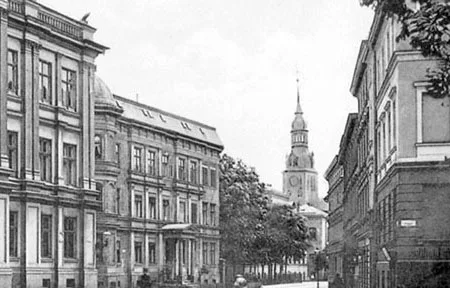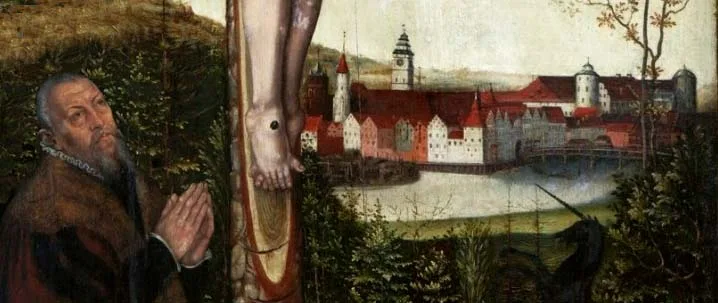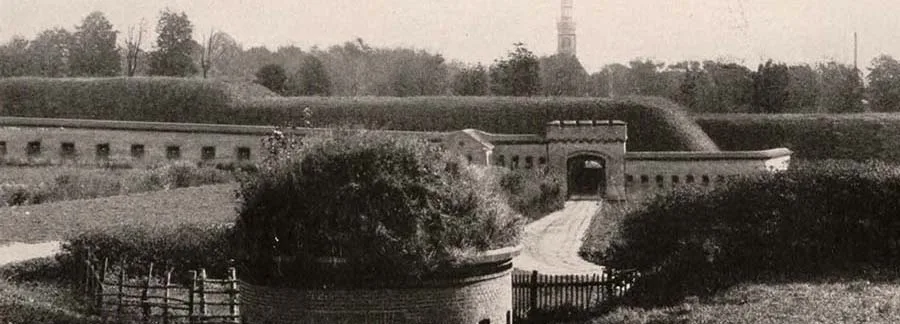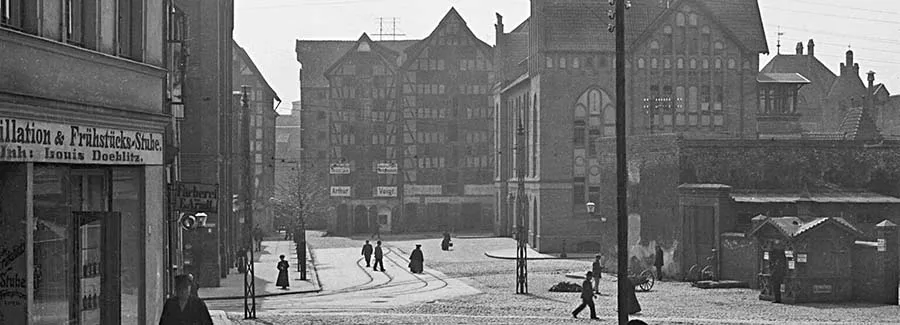
The People's Garden was the green lungs of the densely populated Laak district. It lay in front of the fortress ramparts in the western part of the city, built in 1626–1634. The observatory, built in 1811–1813, stood on one of the bastions of these ramparts. Shortly before 1900 the old park had to give up part of its grounds for the construction of a new observatory. During the First World War a plot of the park was allocated for building a children's hospital, and finally, in the early 1930s, the new building of the anatomy faculty was built on yet another plot of the park.
But the remaining part of the park still delighted the children of Laak with splendid sledging runs down into the deep valley of the narrow-gauge railway, and the grown-ups with one of the quiet, idyllic corners of Königsberg. I do not mean the small green spot around the Victory Column, erected in 1871 by the city building councillor Krüger (Franz Krüger, 1829–1896), although that too was an island of calm amid the bustle of the city, but the so-called "Scholars' Cemetery", as it was called in Königsberg. Officially, of course, it had a different name: the Old Neurossgarten Cemetery (Alter Neuroßgärter Friedhof). But it was rightly regarded as the scholars' cemetery: there were many graves of highly respected local luminaries here.
The cemetery was laid out at the end of the 18th century, when there was no room left in the churchyard around the church. Over the following decades many, many people were buried in it, and together with the cemetery the People's Garden grew as well.
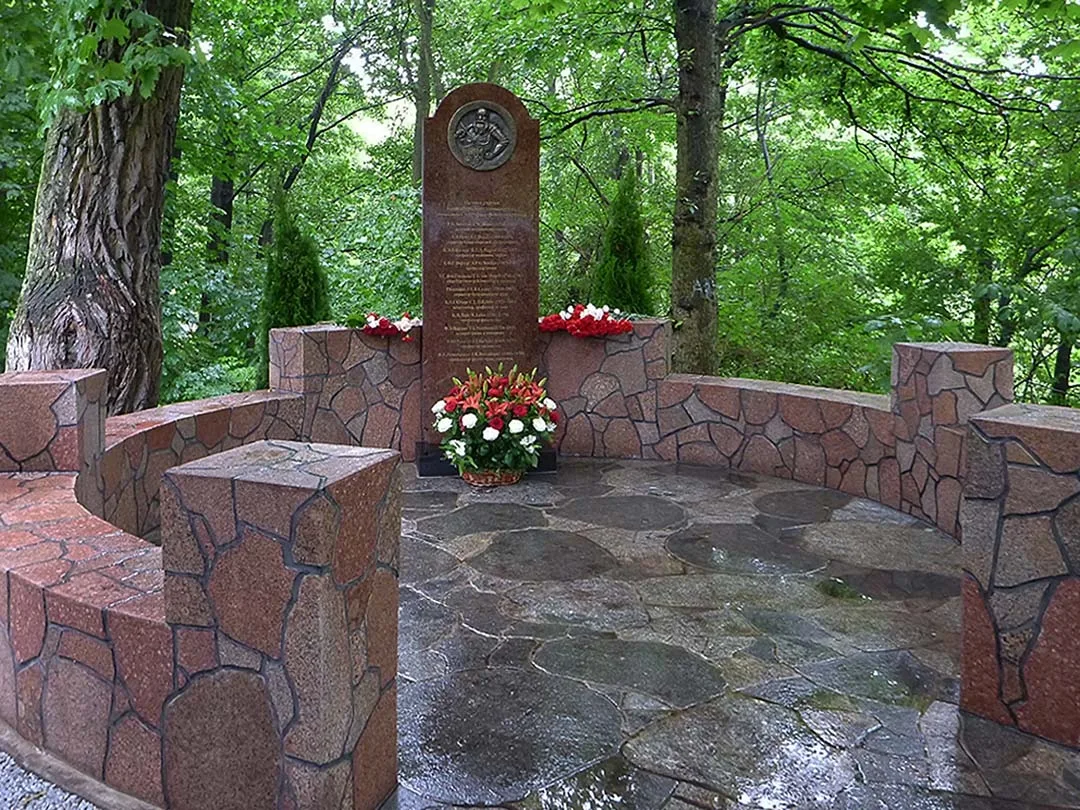
In the end the cemetery was closed, and today only a plot of about 1,200 square metres survives. But the old gravestones still bear illustrious names.
A magnificent Empire-style tombstone tells us that in 1825, during a journey to Königsberg, Magnus von Baer (Johann Magnus von Baer, b. 1765), Landrat of Estonia, died and was buried here.
In 1846 the outstanding Königsberg astronomer Friedrich Wilhelm Bessel (Friedrich Wilhelm Bessel, b. 1784) was buried in this cemetery. The undertakers did not have far to go, since he died in his director's apartment in a simple country house that stood to the left of the entrance to the observatory, which rose above the fortress ramparts very close to the place where he found eternal rest.
In 1871 the surgeon Albrecht Wagner (Albrecht Wagner, b. 1827) was buried here. He died of typhus on 15 February at the age of 44, while serving as a military surgeon in the Franco-Prussian War of 1870–1871. It was in his honour that the lane with the unattractive name of Todtengasse ("Lane of the Dead") was renamed Wagnerstraße. A memorial plaque was put up on house No. 38: "To Dr med. Karl Ernst Wagner, university professor and renowned surgeon". (The eminent physician's full name was Karl Ernst Albrecht Wagner. In the headings of all biographical entries he is Albrecht Wagner. But for some reason this part of his name was missing from the memorial plaque — ed.) In 1933 the Nazis renamed the street Richard-Wagner-Straße, but it had nothing to do with the famous musician.
The composer lived for a very short time on Steindamm, between Wagnerstraße and Heinrichstraße (formerly Monkengasse), as a marble plaque on that house testified.
In 1875 the mathematician Julius Richelot (Julius Richelot, b. 1808) was buried in the Scholars' Cemetery, and in 1878 the Homer scholar and specialist in classical languages Karl Lehrs (Karl Lehrs, b. 1802), whose name and reputation as an eminent classical philologist were known far beyond Königsberg, was buried there too. The tombstone of this outstanding interpreter of the literary heritage of ancient Hellas bore the following inscription:
ΛΟΓΟΣ ΜΟΥΣΙΚΗΙ ΚΕΚΡΑΜΕΝΟΣ
"His speech was imbued with music."
The modest stonemason who was to carve this inscription naturally knew no Greek and therefore did not know the Greek letter lambda. He wanted to correct an "obvious grammatical error" and changed ΛΟΓΟΣ to ΑΟΓΟΣ, and nothing could be done about it afterwards.
In 1879 Karl Rosenkranz (Karl Rosenkranz, b. 1805) was buried in the Scholars' Cemetery: a Hegelian who succeeded Kant and Herbart in the professorial chair. In 1932 the Kant Society put up a new marble monument to him with a portrait relief by the sculptor Georg Fugh (Georg Fugh, 1898–1976).
In 1887 the botanist Robert Caspary (Robert Caspary, b. 1818) was buried here, and in 1895 the outstanding physicist Franz Neumann (Franz C. Neumann, b. 1798), whose bronze memorial plaque hung in the university colonnade.
Finally, in 1914 the city of Königsberg transferred to this cemetery of honour the remains of Theodor Gottlieb von Hippel the Elder (Theodor Gottlieb von Hippel d. Ä., 1741–1796), privy war councillor and Stadtpräsident (a post at that time equivalent to Oberbürgermeister), who had died in 1796. Hippel had originally been buried in the cemetery surrounding the Neurossgarten Church. The sculptor Stanislaus Cauer (Stanislaus Cauer) was commissioned to create a funerary monument in his honour.
Later this red marble monument, adorned with an Empire-style urn, was set into the north-eastern wall of the Neurossgarten Church. I saw it there, still undamaged after the events of that terrible, fateful night in Königsberg.
Hippel was the uncle of Hippel the Younger, author of the proclamation "To My People" and a close friend of E. T. A. Hoffmann. The younger Hippel died in office as governor of Bromberg and was buried there. Moreover, the elder Hippel belonged to Kant's close circle of friends and was a collector of works of art. These small but wonderful paintings in beautiful Rococo frames were bequeathed to the city by his nephew and formed the basis of the Königsberg picture gallery. Hippel was also an outstanding writer. His main work, "Biographies in Ascending Line" (Die Lebensläufe in aufsteigender Linie), was widely popular in its day. He published it anonymously, and even Kant did not suspect that the author of the "Biographies" was his friend Hippel. The satirical work "The Man by the Clock" was likewise published by this highly punctual official under a pseudonym, and, what is more, though a bachelor, he wrote a fine little book on marriage. He was considered an outstanding humorist, and his aphorisms are still widely popular today.
In 1927 the state, the province, the city and the Albertina declared the Scholars' Cemetery a cemetery of honour. Here one could see a botanical curiosity: an old flowering ivy climbing a Norway maple to a height of about six metres. And so this quiet corner of Königsberg has its own history too.
Photo: Mikhail Ogorodnikov (2014).
LEGENDS OF PRUSSIA in the blog of Tatyana Kolivay.
Translated from Russian with the help of AI (Claude, Anthropic), October 2026.