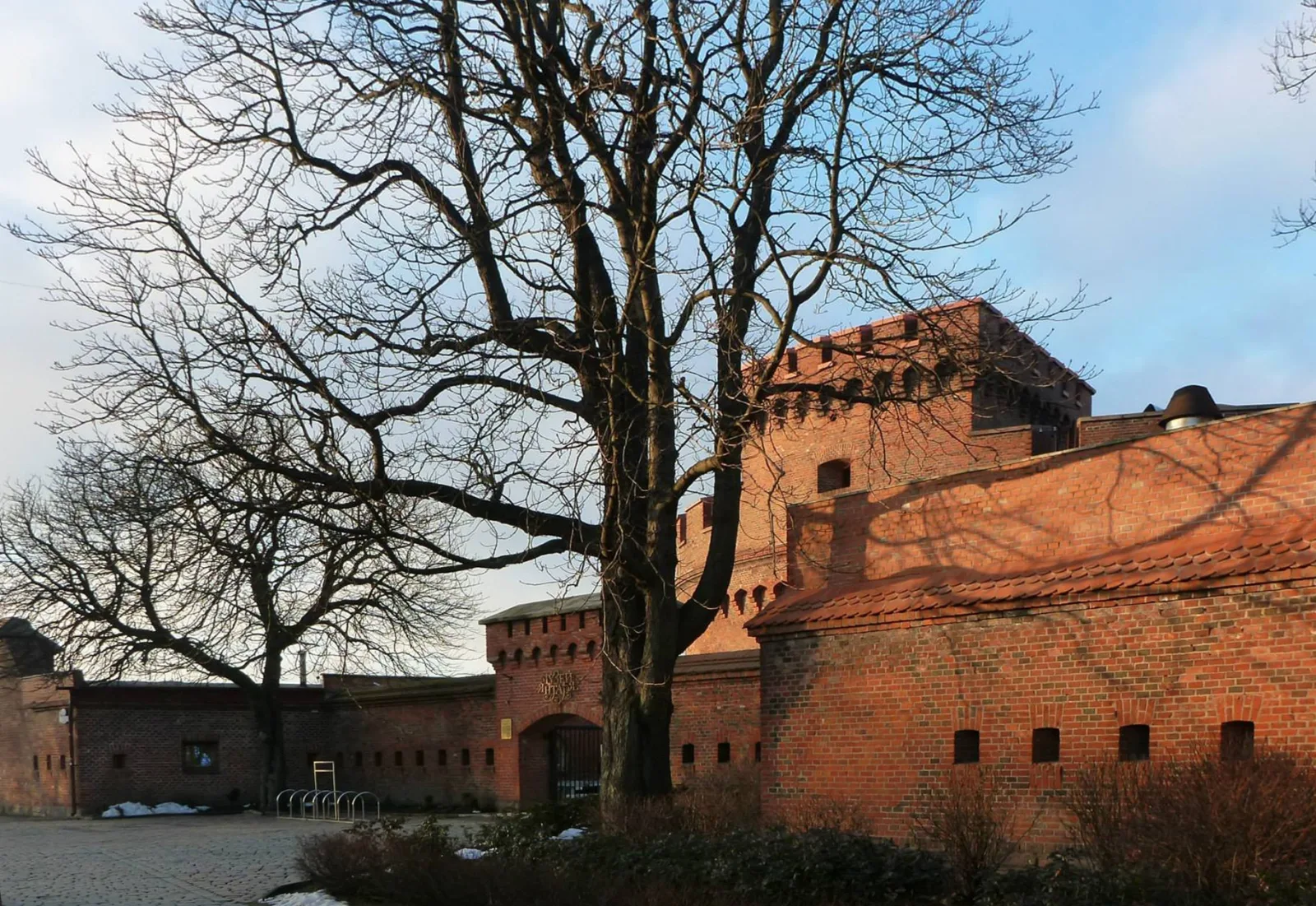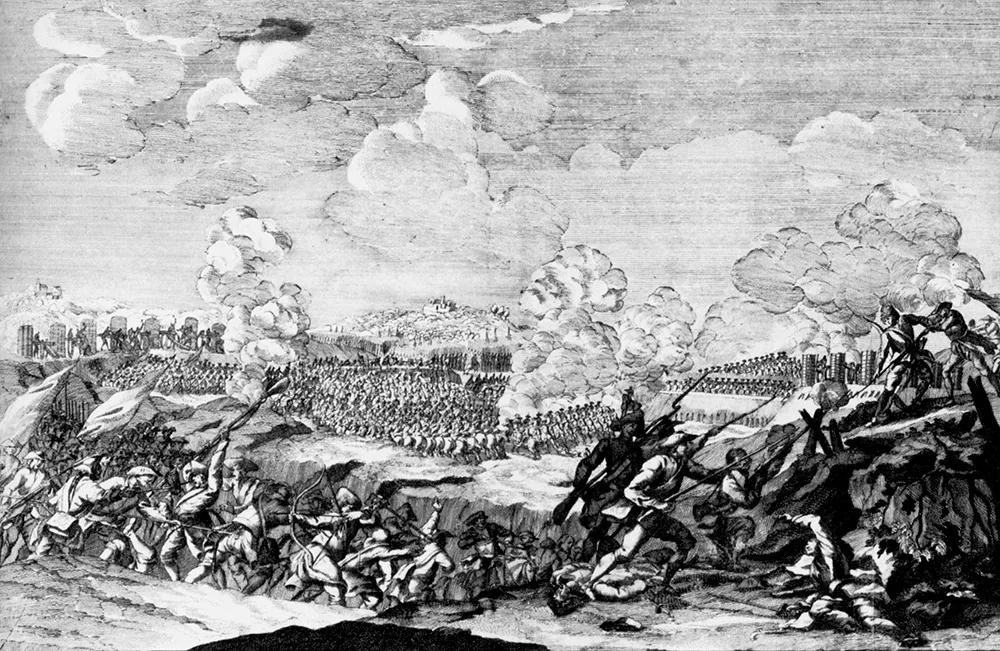
Andrey Bolotov
“The Life and Adventures of Andrey Bolotov, Described by Himself for His Descendants”
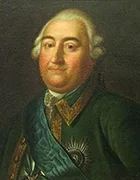
Stepan Apraksin
(1702–1758)
Field Marshal (from 1756), commander of the Russian army in the first Prussian campaign of 1757. He was a relative of Count P.M. Apraksin, a companion-in-arms of Peter I. Thanks to powerful patrons, he rose to become President of the War College, even though he possessed no outstanding gift for military affairs. He loved lavish wardrobes and banquets, which he did not deny himself even on campaign. He had a reputation as a kind-hearted man, given to charity, loyal in friendship and conscientious in his duties.
Early in the morning of 30 August 1757, the Russian army under the command of Field Marshal Stepan Apraksin marched out of its camp near Norkitten (now the village of Mezhdurechye), where it had spent three nights, heading for Allenburg (now the village of Druzhba) and Königsberg (now Kaliningrad). No sooner had the first Russian columns, intermingled with the baggage trains, emerged from behind the forest that screened the camp than they ran straight into the battle lines of the Prussian army. The Prussian infantry, already drawn up in line of battle, immediately opened fire, giving the enemy no time to deploy from marching order into battle order. It is worth noting that the Prussian soldiers, too, had not expected to see the Russians coming out of the forest into open ground. The Prussian army had left its camp near Gross-Jägersdorf at four in the morning in order to attack the enemy in its camp while it was still dark. Either way, the element of surprise was on their side. The Prussian infantrymen managed to fire three well-aimed volleys before scattered musket fire came back in reply from the Russian positions. Thus began the Battle of Gross-Jägersdorf – a battle won by the Russian army without any further advantage to itself. It could have ended in the complete rout of the army covering East Prussia. Its background and the events that followed it are of even greater interest than the course of the battle itself. And so the story of Gross-Jägersdorf must be told from the beginning, with lengthy digressions into politics and military affairs.
Frederick Strikes, Russia Enters the Seven Years’ War
The hostilities of the Seven Years’ War (1756–1763), which historians sometimes call the very first world war, began not in Europe but in faraway America, where the interests of England clashed with those of two other colonial powers – France and Spain. Yet the fiercest and bloodiest battles of the Seven Years’ War were fought on the European continent.
The five leading states involved in the conflict each pursued global and clearly defined aims:
- England – to become the world’s sole colonial empire by defeating its main rival in this field, France, and to some extent the increasingly declining Spain.
- France – to compete with England in colonial policy and to remain the dominant power in continental Europe.
- Austria – to regain the previously lost Silesia and to secure its status as the strongest power in Eastern Europe.
- Prussia – to join the ranks of Europe’s leading states by expanding its territory at the expense of its neighbours.
- Russia – to become a leading player in European politics, to secure its Baltic and western possessions, and to enlist Austria’s help in the war against Turkey.
The other participants in the war had aims of a local nature, which, moreover, were periodically revised.
Of the five main participants in this global conflict, Russia initially had the least motivation to take part in it, but as the fighting developed it was drawn deeper and deeper into the war.
None of the powers ranged against Prussia sought to destroy the Prussian state. A small Prussia suited everyone as a pugnacious ally – so long as it had no claims to anything more.
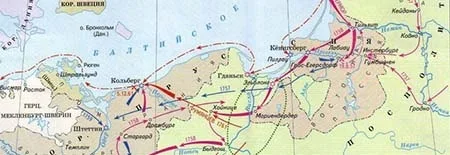
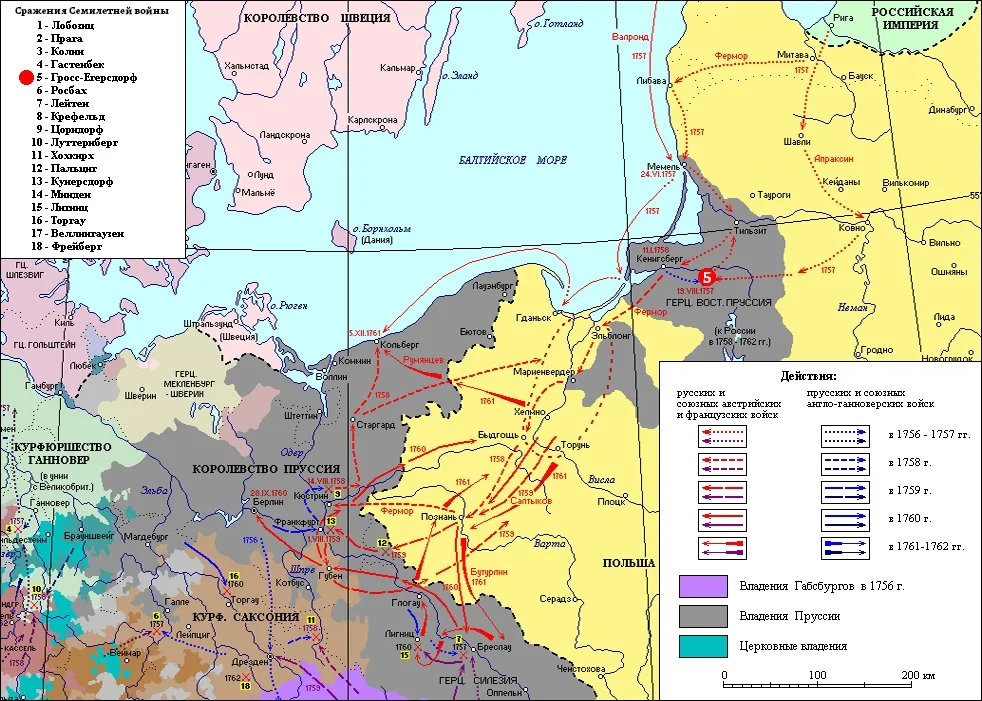 Detail of a map of the battles of the Seven Years’ War.
Seeking to prevent France, Austria and Russia, now united in a coalition, from working out a coordinated plan of action, the Prussian King Frederick II (also known as Frederick the Great, also known as Old Fritz) struck first, seizing Saxony in 1756 and enlarging his army by 20,000 Saxon soldiers. Then, in May 1757, came the capture of Prague, after which Russia and France entered the war.
Prussia: Skill over Numbers
If we compare the main forces of the two military blocs, England–Prussia–Hanover and France–Austria–Russia, what stands out is the overwhelming numerical superiority of the latter in soldiers under arms: 723,000 against 340,000. In fact, in terms of numbers the situation for the Prussian side was even more dismal – Great Britain had no intention of using its small army in battles on European soil. Skirmishes in the colonies were far less bloody, yet they allowed the English government to accomplish the tasks most important to the country: maintaining control over its colonial possessions. In Europe, England fought only with money. Thus the balance of forces in Europe stood at roughly 1:3 against Prussia. Frederick II, however, saw no obstacle in this to achieving his goals, relying on the combat training of the Prussian army and its high mobility, which made it possible to achieve at least parity of forces at a given place at the most critical moments. But since East Prussia was not such a place (at least not at the start of the campaign), different tactics were envisaged there. We will return to them a little later; for now, let us consider what the Prussians could set against the threat of a Russian offensive.
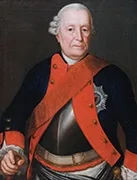
Johann von Lehwaldt
(1685–1768)
Field Marshal (from 1751). Born in Legitten (now the village of Turgenevo, Polessk District). Spent 63 years in Prussian military service. Commanded the Prussian forces at the Battle of Gross-Jägersdorf (1757). In 1760 he successfully repelled the siege of Berlin. From 1762, Governor-General of East Prussia. Buried in Königsberg in the cemetery by the Juditten church.
The Prussian Field Marshal Johann von Lehwaldt had the following forces under his command: infantry – 20,250 soldiers, cavalry – 7,600 horsemen, Prussian militia – 2,200 men. Not much, it would seem. But before drawing conclusions about the Russian army’s unconditional superiority in manpower and artillery, one should recall that on 5 November 1757, at the Battle of Rossbach, Frederick’s army of 22,000 utterly routed a French army of 43,000. And in order to properly assess the chances of success of Lehwaldt’s small but disciplined army, one must understand how victory in battle was achieved in the mid-18th century.
In every European army of those years, the infantry was the principal arm. Infantrymen were armed with smoothbore flintlock muskets. Their range of more or less aimed fire did not exceed 200 metres.
To ensure the required density of fire, infantry battalions were drawn up in line. And to achieve an acceptable rate of fire, most European armies formed their infantry in three ranks. While one rank fired a volley, the others reloaded. To do this, a soldier took a paper cartridge from his pouch, tore off its end with his teeth, opened the pan cover of his musket, poured a little powder into the pan, closed the cover, and poured the rest of the powder from the cartridge into the barrel, after which a lead ball with a paper wad was rammed down with the ramrod. The soldier was then ready to fire. Frederick II’s battalions attained an overall combat rate of fire of up to 5–5.5 volleys per minute. On exercises, Frederick demanded that “every soldier fire six balls a minute, with a seventh in the barrel.”
Now let us picture a battle of those times as it unfolds. Infantry formations drawn up in three ranks begin to close in on each other. The pace of the advance is a slow marching step – only thus could the strict requirement of keeping the line be met. When the distance to the enemy shrinks to some 140–150 metres, the officer gives the order to fire a volley. The shots of hundreds of soldiers merge into one. On the enemy side men fall dead and wounded, but the drilled infantry immediately closes ranks without breaking formation and fires a volley in return.
When the distance shrinks to some 50 metres, and sometimes even 30, one of the sides is the first to give the order “Fix bayonets!”; the soldiers fasten their bayonets to their muskets and, bristling with steel, quicken their pace – without breaking into a run – until they clash with the enemy in a bayonet charge.
And it was here that the Prussian army held no fewer than three trump cards, as noted by contemporary military observers:
- The Prussian infantry managed to fire 4–5, and sometimes even 6, volleys between closing to firing range and launching the bayonet charge.
- Like a well-oiled machine, the Prussian infantry closed ranks whenever enemy bullets or cannonballs tore an entire section out of the line, so the return volley followed without delay and without any loss in the density of fire.
- Prussian commanders showed enviable composure, and the infantry did not launch its bayonet charge prematurely, so it often managed to fire one more “extra” volley at an enemy already advancing with bayonets levelled.
Admittedly, in the bayonet fighting that followed, victory went to the side that still had more able-bodied soldiers in its ranks. That is why those one or two additional volleys that the Prussian infantry usually managed to fire sometimes proved decisive.
In the events of the summer of 1757 on East Prussian soil, its defenders held yet another trump card: the commander himself, Field Marshal Johann von Lehwaldt. Russian historiography has paid relatively little attention to Lehwaldt. Yet it was in his field marshal that King Frederick placed his hopes for a successful campaign against the Russian army. Lehwaldt was suitably cautious, possessed a vast amount of experience (especially compared with that of the Russian commanders), and was regarded as a master of manoeuvre, an improviser and an expert at probing for the enemy’s weak spots. And given that the field marshal was a native of East Prussia and therefore knew the terrain well, Frederick could not have found a better man to carry out his plans.
Speaking of Frederick the Great himself: the question is often asked – what was so great about the military achievements of this king who earned the epithet “the Great”?
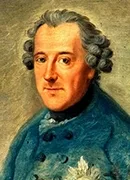
Frederick II
(1712–1726)
King of Prussia from the Hohenzollern dynasty, also known as “Frederick the Great” and “Old Fritz”, and a national hero of Germany. A representative of enlightened absolutism, he carried out a number of reforms and abolished censorship and torture in the country. In battle he personally led his army into the attack. Despite several military defeats, he achieved a political victory, considerably expanding Prussia’s borders and turning it into one of the leading European powers.
As far as tactics go, it would seem not much – just one technique, the so-called “oblique attack”. Its essence was that the line of battalions advanced not in an even line but in echelon. The flank pushed closest to the enemy’s front consisted of the most battle-ready units and was further reinforced by a couple of additional lines of infantry. This created a local numerical superiority on that flank, which the Prussian army used to crush the enemy’s flank, leaving the rest of his units under constant threat of encirclement. More often than not, this threat immediately disrupted the enemy’s orderly musket fire; confusion and hasty re-forming broke out in his ranks, eventually turning into the flight of the infantry and then the retreat of the entire enemy army from the field. For half a century the “oblique attack” was regarded as the pinnacle of field tactics, passing into history only after the Battle of Auerstedt in 1806. “With an army of 30,000 men,” Frederick wrote, “one can defeat 100,000 if one takes them in the flank.”
Frederick’s other achievements did not outwardly look great at all. He “merely” managed to reduce non-combat losses on campaign to an absolute minimum, made care for the wounded and their evacuation from the battlefield mandatory, and succeeded once and for all in putting an end to any form of looting and outrages against the civilian population: a soldier who took a loaf of bread from a peasant, or a foraging party that left a village community without payment or a promissory note, was brought before a tribunal, which could be followed by execution by firing squad.
While paying tribute to “the best army in Europe”, as contemporaries sometimes called the army of Frederick the Great, one should also note its weaknesses. In Prussia – small compared with its adversaries and, moreover, not yet fully recovered in population from the plague epidemic of 1709–1711 – raising an army of 150,000–200,000 men through conscription was extremely difficult. To replenish the infantry regiments, Prussian army recruiters, encouraged by Frederick, resorted to any measures, even criminal ones. Men were taken into the army by deception, for debts, or by outright kidnapping, foreign nationals included.
Captured enemy soldiers were sometimes enlisted into the Prussian army in their entirety. A recruit’s signature on the oath was obtained at any cost, after which his head was shaved in a special way to make deserters easier to catch.
From then on, a recruit could leave the service only by being killed in battle, by being discharged on health grounds, or by being shot for desertion. In view of this situation, the soldiers’ morale was extremely low. To prevent mass desertion, night marches were forbidden, infantry on forest roads was escorted by cavalry, and during battle special companies were posted on the flanks of each regiment, tasked with keeping the ranks closed and stopping any attempt to flee the battlefield.
The Prussian cavalry, in the form in which it appeared on the “stage” of the theatres of war of the Seven Years’ War, was the king’s favourite arm of service, the object of his pride, his own creation, nurtured literally from the cradle.
Unlike the infantry, the cavalry was recruited on an entirely voluntary basis from free subjects of the Prussian state.
The elite of the Prussian cavalry were the cuirassiers – heavy line cavalry. They took their name from the cuirass, a steel breastplate that protected the cuirassier from bladed weapons and even from musket or canister shot if it was fired from long range or at an angle. Frederick personally wrote instructions and regulations on the armament, formation and tactics of the line cavalry. Powerful Hanoverian horses were selected for the cuirassier squadrons. Mounted drill for the Prussian cavalry was held daily. Only in this way, in the king’s view, could a high standard of training and coordination be achieved.
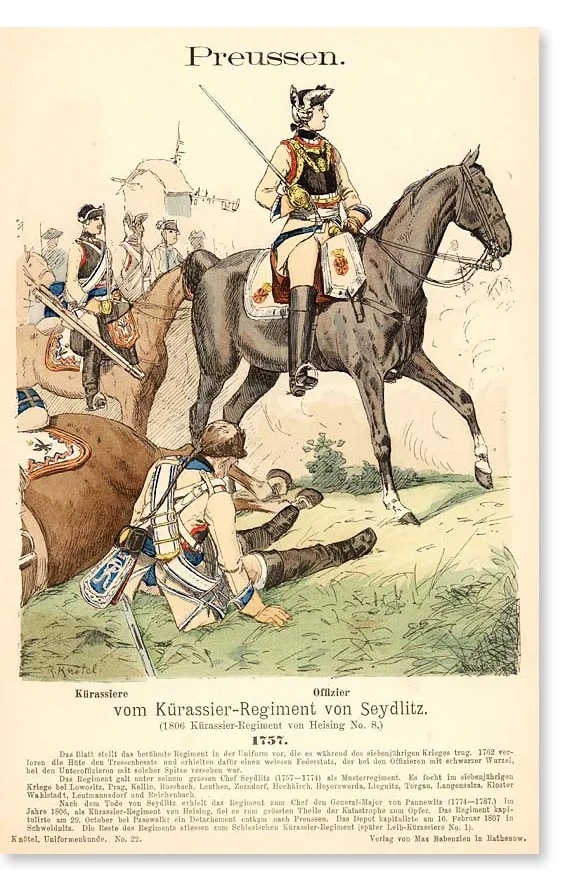
The Prussian line cavalry was trained to charge at the gallop in such tight formation that the riders’ knees touched. Such a dense mass, once it had gathered speed, could be stopped neither by infantry volleys nor by a hail of canister. Even wounded riders and horses, carried along by momentum in the general flow, crashed into the enemy formations, broke the ranks and trampled the infantry, after which the enemy turned into a chaotic mass of men fleeing from the cuirassiers’ broadswords. In accordance with Frederick’s instructions, the Prussian heavy cavalry attacked exclusively with cold steel and sheer impetus – the Prussian king considered firing from horseback a futile exercise, and contemporaries maintain that he was entirely right.
The light cavalry – the hussars – were also recruited into the Prussian army on a voluntary basis. Their main tasks were swift strikes against the enemy’s flanks and rear, pursuit of a retreating enemy, protecting columns on the march (including catching deserters), reconnaissance, and reinforcing foraging parties.
The Prussian hussars were the only hussars in Europe subject to general army discipline.
In other armies a “hussar licence” prevailed to a greater or lesser degree, often causing a great deal of trouble for the command and the other units. But, as in other armies, the hussars’ horses were small, and their schooling, like the riding training of the hussars themselves, was kept to a minimum; it was believed that hussars should improve their skills and training on their own.
As for dragoons, Frederick did not consider it necessary to have them in large numbers. In his view, all cavalry tasks could be handled by the heavy and light cavalry. Like the dragoons of other armies, Prussian dragoons fought both mounted and on foot, and were armed with light, short-barrelled firearms of low accuracy, effective at a range of no more than 150 metres. They were strictly forbidden to fire from the saddle – as, incidentally, was all other cavalry except the hussars, who were armed with pistols for close combat.
Frederick II and the Prussian generals held an extremely high opinion of the Prussian army’s capabilities. Conversely, the Prussian king considered the training of enemy armies to bear no comparison with the fighting qualities of his own troops.
The Russian Army: A Dark Horse
It must be said that Frederick was partly right, except that the thorough reorganisation of the Russian army undertaken by Empress Elizabeth had already begun to bear fruit by the outbreak of the Seven Years' War. During the period of palace coups and intrigues of 1727–1741, the new Russian army created by Peter had fallen into decline. While the Guards were still kept supplied at a more or less decent level, the provisioning of the line units was in a dreadful state. The situation was especially grave in the cavalry. According to an Austrian officer, Captain Paradis, who was in Russia in the 1730s, “the Russian army is greatly lacking in cavalry… True, there are dragoons, but their horses are so poor that the dragoons cannot be counted as cavalrymen… When the dragoons dismounted, they brought their horses down to the ground.”
The reorganisation of the army improved the situation somewhat.
Three new cuirassier regiments were added to the three already in existence. Yet even this number of heavy horse was insufficient. Any further increase in the number of cuirassier regiments, however, was held back by the high cost of buying and maintaining large horses. The backbone of the Russian regular horse therefore became the medium cavalry, the dragoons. With funding inadequate, the Russian command saw a certain advantage in dragoon regiments, since this type of cavalry was intended to serve both mounted and on foot. This versatility did, however, reduce the dragoons' quality as infantry, since they were armed with lighter, shorter-barrelled muskets. Nor did dragoons used in mounted charges have the same impact as a charge by classic line cavalry. As highly mobile fighting detachments capable of handling almost any task of secondary importance, however, dragoons were quite effective.
Regular light cavalry was virtually absent from the Russian horse. As early as Peter's reign there had been an attempt to form hussar units from hired Hungarians, Wallachians and Poles. Over time, however, since no funds could be found to maintain them, the newly fledged hussars were offered land grants in Little Russia in exchange for their readiness to take up arms in the event of war; in other words, the hussars were turned into a kind of Cossack. As a result, by the start of the Seven Years' War the hussar regiments were entirely unfit for combat, and so, to supplement them and to serve as the basis of its light cavalry, the Russian army employed irregular horse: Don and Chuguev Cossacks and the so-called “four-nations detachment”, made up of Kalmyks, Bashkirs, Kazan Tatars and Meshcheryaks.
These units carried the most motley assortment of weapons, from infantry muskets to bows and javelins, which gave rise to countless comical situations and was a headache for the officers and command of the Russian army.
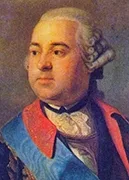
Pyotr Shuvalov
(1711–1762)
Count, General-Feldzeugmeister (from 1756), General Field Marshal (from 1762), head of government under Elizabeth I, military reformer. As head of the artillery department, he carried out a radical reorganisation and modernisation of the Russian artillery, which made it the best in Europe right up to the end of the Napoleonic Wars.
The undoubted pride of the Russian army in the mid-18th century, however, was its artillery. The reforms in artillery armament undertaken by General-Feldzeugmeister Count Pyotr Shuvalov had a beneficial effect, increasing the importance of this arm in the course of military campaigns. Without losing firepower, Russian artillery became comparatively light and mobile, something the enemy's artillery could not boast. The reform achieved a sensible standardisation of calibres and charges, which greatly simplified the supply of ammunition to artillery units. Shuvalov's principal innovation, however, is considered to be the adoption of the “unicorn” howitzers.
To appreciate the significance of this step, we must make a brief digression into the history of 18th-century artillery.
All the guns of that time were divided into cannon, howitzers and mortars. Cannon had the longest barrels. At equal calibres, they had the most powerful charge of any type of gun and the highest muzzle velocity. A large charge required a strong barrel and a sturdy carriage, so cannon were also the heaviest guns in the army. A cannon fired cast-iron round shot at direct range. Thanks to ricochet, the ball bounced several times after striking the ground, which compensated for the inaccuracy of the sights of the time.
A cannonball reliably struck the enemy at ranges of a kilometre or more, could kill three or four soldiers drawn up in several lines, and in addition destroyed fortifications.
The drawback of cannon lay not only in their great weight, but also in the fact that they could fire only round shot: an explosive shell or bomb would be shattered by the powerful charge while still in the bore. Moreover, effective ricochet fire with round shot was impossible on marshy or very broken ground.
A howitzer had a shorter barrel. It fired along a moderately high trajectory, using hollow bombs (projectiles weighing more than one pood) and shells (weighing less than one pood) filled with a powder charge. The shell would burst in the air above the enemy or after landing among his positions, striking men with fragments of its casing. That, however, was the theory; in practice the powder charge of a bomb was not all that powerful, the casing did not produce enough fragments, the shell often split on hitting a hard obstacle, and sometimes the charge failed to ignite. As a result, bombs and shells were not markedly more effective than ricocheting round shot. In close combat howitzers were switched to direct fire and struck the advancing enemy with canister. The effective range of a canister charge was comparable to that of a musket shot; moreover, while the canister's velocity was high it did not spread widely, and by the time the spread reached the desired area the canister was already spent and often failed to pierce the thick cloth of a uniform, let alone the cuirass of heavy cavalry.
The “unicorn”, invented by the artillery officers Danilov and Martynov, was a howitzer with an elongated barrel on a light field carriage.
Unlike an ordinary howitzer or mortar, it could fire round shot (though not as far as a cannon), and canister left its barrel with a higher muzzle velocity. The conical chamber of the “unicorn” (the part of the barrel holding the powder charge) helped expel the residue of burnt powder completely from the barrel and shortened the time needed to clean it with a swab. The Russian army thus acquired a mobile, versatile and rapid-firing weapon that optimally combined all the necessary qualities.
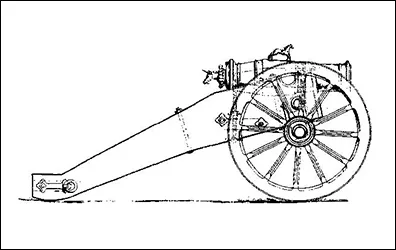
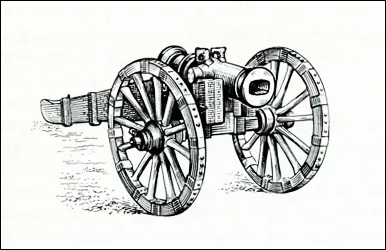
The well-known “secret howitzers” also took part in the campaign in Prussia. Their “secret” lay in an oval bore, set with its major axis parallel to the ground. Their creators intended such howitzers to discharge canister not in an even cone but in a kind of fan, which would give it a wider spread and greater lethality, since it was assumed that most of the balls making up the charge would reach their target precisely at the height of the enemy soldiers. Unfortunately, neither Shuvalov nor the gunsmiths of the time knew the laws of physics governing the flight of canister, according to which the shape of the bore has no effect on how the shot is distributed in space. The glowing reports of officers on the use of these howitzers in battle can therefore be put down entirely to deference to rank, so characteristic of the Russian army (and not only in those days!). Incidentally, after Shuvalov's death the “secret howitzers” were soon withdrawn from service.
As for the Russian infantry, its weak point was definitely its weaponry.
Foreign diplomats, who doubled as spies, reported from Russia that the infantry regiments were armed both with muskets of the new, lighter 1753 pattern and with old ones that had been in service since Peter's time. Small arms in the Russian army were, as a rule, used until they were completely worn out. Barrels were bored out again and again. As a result, each infantry unit was armed with weapons of different calibres, ranges and rates of fire, which hardly made for coordinated volleys under linear tactics. The same sources, however, report the high morale of Russian soldiers and a low rate of desertion.
Lehwaldt's Plans
To say that the field marshal was experienced and well versed in military affairs would be an understatement. At the time of the Russian invasion Lehwaldt was 72 years old, 58 of which he had spent in military service, taking part in both offensive and defensive battles. His task was to keep the Russian army from advancing freely, to tie it down in a multitude of small skirmishes, to hinder its gathering of provisions and fodder, and, should circumstances prove favourable, to give it a mauling in a few battles. At the same time he was to preserve his own army from serious losses and await reinforcements from Frederick. Lehwaldt was permitted to enter into peace negotiations and to conclude temporary truces; he could even surrender Königsberg, so long as it slowed the Russian advance.
Yet the best outcome, in Frederick's view, was the destruction of the Russian army in battle, in which Lehwaldt was to set military skill, surprise and an advantageous position on the ground against the numerical strength of the Russian forces.
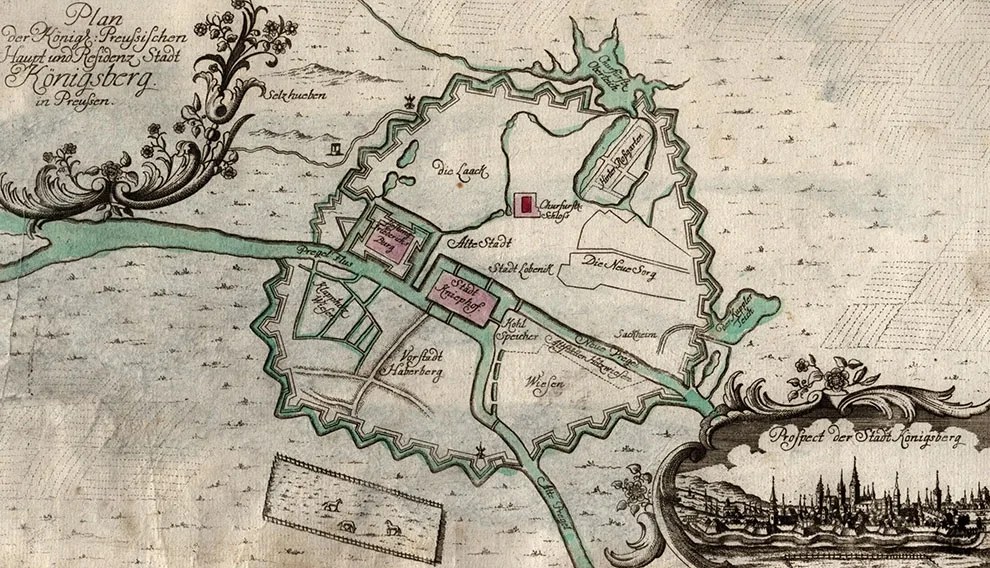
As early as the spring of 1757, when the Russian army set out on campaign, Lehwaldt inspected the fortress of Königsberg and concluded that its earthworks had fallen into disrepair and offered no reliable protection against the enemy. From the very outset Lehwaldt ruled out a determined defence of Memel (Klaipėda) and Königsberg, since the fortifications of these fortresses were not strong enough, and a defence from within the fortress could not accomplish the tasks he had been set. Nevertheless, garrisons were left in the fortresses (3,000 soldiers in Königsberg and 800 in Memel) together with fortress artillery. The fortifications of Königsberg in the area of the Brandenburger Tor were even repaired, so that the fortress would not become easy prey for the advance detachments of the Russian cavalry but would instead pin down the enemy's main forces in an assault.
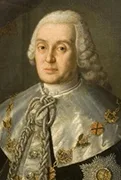
William Fermor
(1702–1771)
Count, general-in-chief, participant in many major battles of the Seven Years' War. During the first campaign in Prussia he directed the siege and capture of Memel. As commander of the Russian army, he occupied East Prussia and Königsberg in 1757–58. The first Russian governor-general of Prussia. In 1759 he handed over command to P.S. Saltykov. After the war he served as governor-general of Smolensk. A street in Kaliningrad is named after Fermor.
As the Russian columns moved towards the Prussian border and the corps of General-in-Chief William Fermor was sent to Memel to besiege the fortress, Lehwaldt's plan of action took its final shape. He did not attempt to prevent the capture of Memel, nor did he send his army or part of it to attack Fermor on his way to join Apraksin's army, since in that case his units could have been attacked from two sides at once. Lehwaldt positioned his main forces near Insterburg (Chernyakhovsk), and after the two Russian armies had joined he began to fall back along their line of advance, keeping the process under control and wearing the Russians down with small harassing actions. Lehwaldt had prepared several advantageous fortified positions where, should circumstances prove favourable, the field marshal could offer the Russian army a general battle. Meanwhile, Russian foraging parties and individual units on the march began to be harried in small skirmishes by detachments of the Landmiliz.
Apraksin's Plans
Apraksin's position was far more difficult than that of his opponent. He did not enjoy the carte blanche and full freedom of action that Lehwaldt had. Reading the memoirs of contemporaries and works on the history of the Seven Years' War by historians of various periods, one involuntarily comes to suspect that Apraksin's main plan was to accomplish something on enemy territory that would win the favour of Empress Elizabeth, to avoid being routed by the Prussians, and to return to St Petersburg as soon as possible. However, all these notes and analyses were written after the sad end of the Russian commander's career and served the established stereotype of an indecisive and timid man devoid of any talent for generalship, and should therefore be treated with a degree of scepticism.
Let us begin, then, with the fact that Apraksin was initially given an order of a very general nature: to advance towards the Prussian border. No clear instructions were given as to the direction in which the army was to move (towards Königsberg or into Silesia).
He was required to advance in a general westerly direction and await further orders or act as the situation dictated.
For a dutiful man without the slightest trace of adventurism, such as our field marshal, this was the most ruinous of orders. However, after the crossing of the border and the capture of Memel, the instructions became clearer and more specific. Königsberg became the main objective of the Russian army.
From the Border to Norkitten
The entry of Apraksin's army onto Prussian soil began with a small but painful embarrassment: a Russian reconnaissance detachment of dragoons and Cossacks under the command of a major of French origin, de la Rua, occupied the village of Kumehlen, which lay between the present-day towns of Nesterov and Gusev. Finding no enemy in the village, the major and his officers gave themselves over to drinking. An attack by the Prussian cavalry caught them off guard. The result was the loss of more than forty men killed and the panicked flight of the Russian detachment. Another 26 dragoons and Cossacks were taken prisoner. The Prussian army suffered no irrecoverable losses.
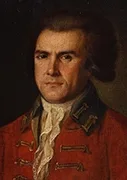
Andrey Bolotov
(1738–1833)
Writer, philosopher, scientist, founder of Russian agronomy. During the Seven Years' War he served in the army and retired with the rank of captain. After the war he took up botany, forestry and agronomy. Author of numerous reference works in these fields. Over the course of 30 years he wrote his autobiographical notes, "The Life and Adventures of Andrey Bolotov, Described by Himself for His Descendants", which are an invaluable historical source on the events of the 18th and 19th centuries.
This incident, according to Second Lieutenant Andrey Bolotov, who took part in the campaign, seriously undermined the morale of the Russian soldiers. Officers noted that talk of the invincibility of the Prussian army and of the defeat awaiting the Russian troops became more frequent. And although de la Rua, the man responsible for these unfortunate events, was reduced to the ranks, everything that followed unfolded under the impression of what had happened.
Several times before Gross-Jägersdorf, Apraksin's army was roused by alarms at night and drew up in battle order, only to see at dawn that there was no enemy anywhere near.
Meanwhile, the Russian troops were constantly harassed by the Landmiliz. By attacking foragers and outpost units, they kept the troops in a perpetual state of nervousness. Apraksin ordered the militiamen to be caught and shot. The Cossacks and Kalmyks acted even more harshly: in villages where armed groups had been spotted, they carried out pogroms and killed civilians, after which such villages were burnt to the ground. These actions immediately produced crowds of refugees who, no longer waiting for a grim fate, set fire to their own homes themselves and left for Königsberg. The army began to suffer shortages, as it was entering villages that had already been laid waste. In the end, according to Bolotov, Apraksin issued an order to keep the irregular cavalry in the rearguard, which deprived the army of its forward mounted reconnaissance...
Frederick took advantage of the pogroms. An information war began: Old Fritz issued reports vividly depicting how a "savage horde of barbarians" was massacring the peaceful population. The reports were circulated throughout Europe, reprinted in newspapers and read out at royal courts. The reputation of the Russian army was seriously tarnished, which could not but provoke the extreme displeasure of Elizabeth, who was doing everything in her power to establish herself as an enlightened and merciful monarch. Frederick's propagandists undoubtedly won this war, at least at that stage. However, to avoid needless casualties, Lehwaldt curtailed the operations of the Landmiliz and ordered its men to march off and join the main army.
The Russian army, overburdened with baggage trains, moved very slowly. Daily marches covered 5–15 versts. Often, after a march, the army would remain in camp for 2–3 days.
Apraksin conducted the campaign "thoroughly", with servants, silver tableware, an excessive wardrobe and the other trappings of a nobleman's peacetime life. After the occupation of Gumbinnen (Gusev), three days were spent swearing in the local population to the Russian empress. On 9 August, on the march between Gumbinnen and Insterburg, a unit of Prussian hussars clashed with a detachment of Russian light cavalry (300 hussars and 800 Cossacks) sent out on reconnaissance with the support of cuirassiers. Both sides claimed that their own losses amounted to a few men, while those of the enemy ran to as many as fifty.
On 19 August, near Insterburg, Apraksin's army joined up with Fermor's corps. At that point the Russian army numbered "up to 134,000 men, namely: 19,000 cavalry, 99,000 infantry and 16,000 irregular troops" (Bolotov). A skilful commander would certainly have turned such an enormous superiority in manpower into a qualitative one: forcing a general engagement on the enemy, outflanking him on the wings and/or from the rear with part of his troops, and compelling him to fight to the last soldier or surrender. But for Apraksin, an indifferent commander, this was beyond his powers. At the same time, the decision to cross to the left bank of the Pregel, so as not to give battle on positions Lehwaldt had prepared in advance, was on the whole correct, if rather unsophisticated.
From 27 to 29 August the Russian army crossed the Pregel. As the troops reached the left bank, they made camp, covered at the rear by the Pregel and the Auxine (Golubaya) rivers. On the side facing the enemy, the camp was screened by dense forest. During the crossing the Russian army was attacked by the Prussian vanguard, which was conducting something like a reconnaissance in force. The attack was successfully repulsed by a detachment of the "four-nation command" sent against it. Only hours remained before the general engagement. Lehwaldt knew this, but Apraksin had no inkling of it…
An Unlooked-for Victory in an Unexpected Battle
Every account of how the battle began opens by stating that, having crossed the Pregel near Norkitten, the commander-in-chief of the Russian army did not trouble to reconnoitre the terrain. This was indeed a strange and inexcusable mistake, all the more so since (as Bolotov notes in his memoirs!) Apraksin had previously been, if anything, overly cautious in such matters. Perhaps the field marshal assumed that Lehwaldt did not know of his manoeuvre and that the Prussian army was therefore not to be expected on the left bank any time soon. On the other hand, it was hard not to realise that the local population, to say nothing of scouts, would be sure to inform the Prussian command of every step the Russian army took. We must therefore note that Lehwaldt achieved the element of surprise largely through the blunder of the Russian command rather than thanks to any original tactical design.
All of the above meant that the Russian army spent the early morning of 30 August 1757, and the rest of that day, quite differently from what its command had planned. The plan was another march in the direction of Allenburg (the village of Druzhba). The Russian regiments and squadrons, in their customary marching order, were preparing to move out through a narrow passage between the forest and the Auxine.
The columns of troops were moving intermingled with the baggage trains and artillery when, to their surprise, they came upon Prussian regiments drawn up in battle order.
Two important points should be made here. First, of the force of 110,000 soldiers under Apraksin's command described by Bolotov, only 55,000 combat-ready men remained. This "shortfall" of half the army is easily explained by losses to sickness (about 11,000 men), by the garrisons left in Gumbinnen and Insterburg, and by the large number of non-combatant (supply) personnel. Second, the start of the battle came as a surprise to both sides, though to differing degrees: the Russian army was not expecting an attack at all, while the Prussian army was forced to attack not a camp but columns on the march.
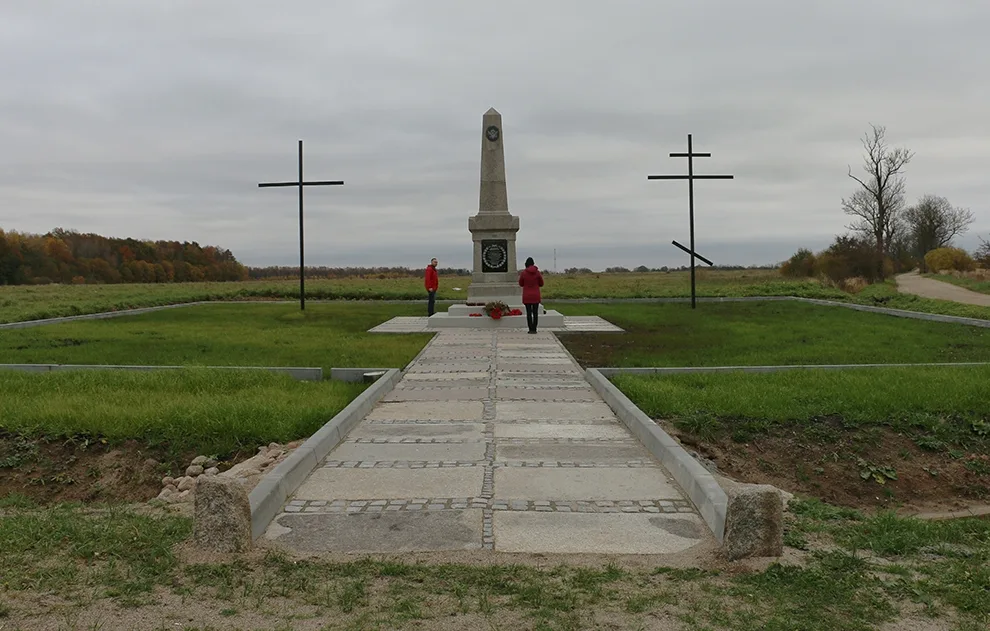 Monument to the victory at Gross-Jägersdorf near the village of Mezhdurechye (Norkitten).
Naturally, the Prussians were the first to be ready for battle. In the centre of the front their infantry formed into line and managed to fire no fewer than three volleys before the Russian troops could answer with rapid musket and cannon fire. It was here, in the centre, that the most dramatic events unfolded. Matters were made worse by the fact that only a small part of the Russian army actually entered the fight, while the rest, owing to the confusion of the command and an extremely unfavourable position, remained idle. The situation was saved by General-in-Chief Vasily Lopukhin. It was he and his division who took the first and heaviest blow, managing to form up the battalions under enemy fire and hold off Lehwaldt's infantry with return fire.
This bought enough time for the Russian army to begin re-forming and prepare to repel the attack instead of being put to flight, which would have had fatal consequences for it.
Having assessed the situation, Lehwaldt launched a powerful cavalry strike with Schorlemer's squadrons against our right flank. A breakthrough by the Prussian cuirassiers threatened to encircle the Russian army and destroy its rear. This blow was halted only by bringing up reinforcements, since the Prussians had routed the first echelons of the Russian cavalry.
On the left flank the Cossacks went into the attack, but on colliding with the cavalry of the Prince of Holstein they fled to the shelter of the Russian infantry. This episode is sometimes described as the Cossacks luring the enemy on; Bolotov, however, states unambiguously that the retreating Cossacks were genuinely running away, thereby putting the infantry units in an extremely awkward position — by parting ranks and breaking the square, the infantry was left powerless against the onslaught of enemy cavalry. Nevertheless, the order came to let the Cossacks through behind their own lines. Now disaster loomed on the left flank. But the gunners saved the day: the advancing Prussian cavalry found itself directly in front of the howitzers of a Russian battery, and the ensuing salvo of grapeshot inflicted devastating losses on it. There was a moment of hesitation, which the troops of the left flank seized upon — the infantry formed square once more, and the cuirassiers moved out to counter-attack. The Prussian horse chose to withdraw.
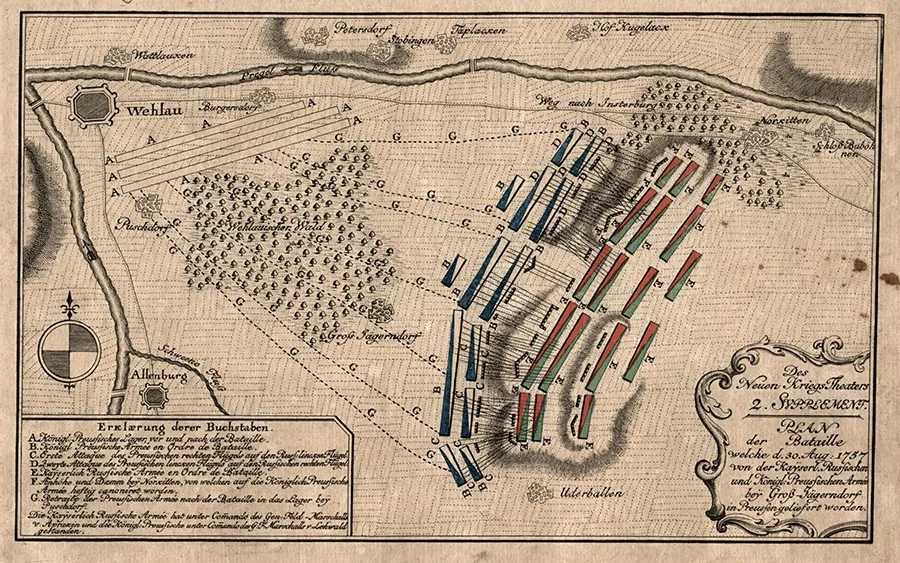
Maps of the battle of Gross-Jägersdorf.
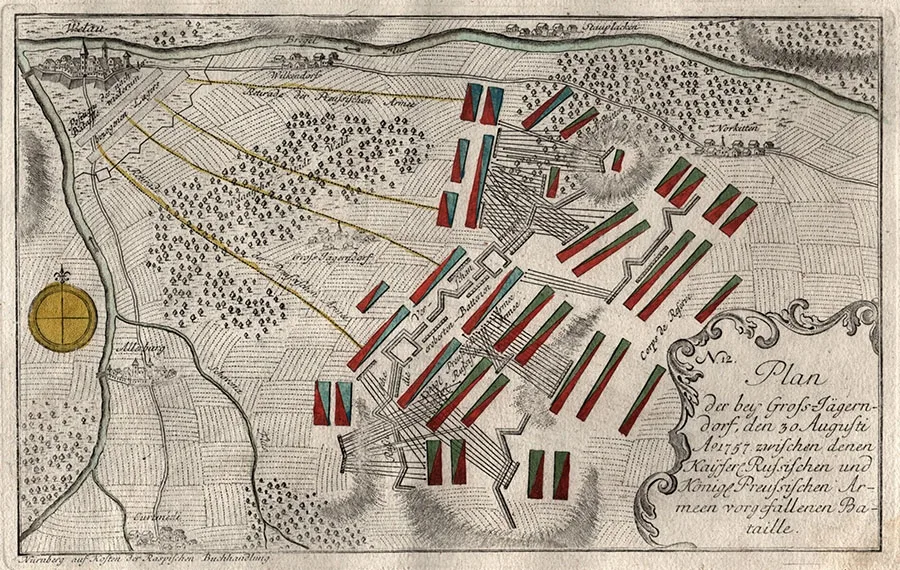
By this time Apraksin had completely lost control of his troops. The outcome of the battle now depended entirely on the commanders of divisions and regiments. General Lopukhin's division in the centre of the front, unable to withstand the enemy's local superiority, was being cut to pieces and slowly falling back into the forest. The situation was saved by another general — Rumyantsev. Entirely on his own initiative, he made a dash through the stranded baggage trains and the forest undergrowth to relieve Lopukhin. The emergence of the reserve from the forest and the organised bayonet charge that followed came as a complete surprise to the Prussians.
The Prussian army began to retreat. By this time two more Russian infantry divisions had entered the battle, and the retreat of Lehwaldt's army began to resemble a rout. The Russian artillery shifted its fire, lobbing bombs at the Prussian rear units and forcing them to join the fleeing forward units. The battle was won.
But was it won? One sometimes hears the view that Lehwaldt achieved his aims — he dealt Apraksin's army a painful blow and withdrew, preserving his own for future battles. Yet it is hard to imagine that Lehwaldt counted on suffering roughly the same casualties as the Russian army, or on leaving all his artillery to the Russians. True, owing to Field Marshal Apraksin's indecisiveness, the Prussian army was not destroyed, since no pursuit of the retreating enemy was organised. But the situation in the East Prussian theatre of war became far more favourable for the Russian army than it had been before the battle.
Taking the Secret to the Grave
Why, then, did the Russian army not take Königsberg, but instead turned back after reaching Allenburg? There is no clear-cut answer to this question. Historians speculate, but only Stepan Apraksin himself knew the real reason. He explained his decision by the loss of men and the lack of provisions and fodder, but this fully convinced neither his contemporaries nor historians. Further details might perhaps have come to light at the commander's trial, but he did not live to see it — age and fear of punishment took their toll. And all the condemnations of Apraksin's actions by his comrades-in-arms on the campaign were voiced only after the order to retreat had met with the empress's disapproval.
Reporting to Elizabeth immediately after the battle of Gross-Jägersdorf, Apraksin did not claim others' merits for himself, yet he made not a single mention of General Rumyantsev, who had brought about the turning point in the battle. He merely paid tribute to the memory of the fallen Lopukhin. All the subsequent events — from the refusal to pursue the beaten Lehwaldt to the turning back of his own army — show that Apraksin was weighed down both by responsibility for the whole campaign and by his own role in it. The most likely reason for the decision that may later have cost Apraksin his life was probably the fear of losing the army to further battles, hunger and epidemics.
The return of Apraksin's army to home ground provoked the utmost displeasure of Elizabeth and most of the court.
The man who, only recently, had been the hero of the "victory over Frederick" (no one at court was troubled by the fact that Frederick himself had been hundreds of versts from the scene), and who had been ceremonially granted the right to add two cannons to his family coat of arms, was now declared by the same circle around the empress to be the chief culprit for the inglorious outcome of the campaign. While the army was in winter quarters, the commander was summoned to St. Petersburg, but he never reached the capital: he was arrested in Narva. In prison he was interrogated by none other than the head of the Secret Chancellery, Aleksandr Shuvalov. Apraksin, however, admitted no guilt and incriminated no one. Nor did an examination of the field marshal's confiscated papers yield anything: no conspiracy, treason or malicious intent was found in them. Apraksin himself sent the empress a letter in which he wrote, among other things: "…and this I can report, that in the whole army there was not a single man who did not wish to shed the last drop of his blood in defence of Your Majesty's supreme interests and in fulfilment of Your Majesty's will…"
General William Fermor, the hero of the capture of Memel (and later of Königsberg), was also hastily questioned. But he merely confirmed his superior's words that "rains and great mud" had deprived the army of its horses, which could barely stand and were unable to haul the baggage trains or carry soldiers in the saddle, and that it had therefore been decided to return to winter quarters rather than remain in Prussia.
The investigation reached a dead end, and there is no knowing how it all would have ended, but Stepan Apraksin could not bear the wait for trial and died on 17 August 1758.
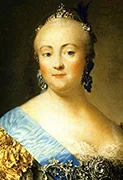
Elizabeth I
(1709–1762)
Empress of Russia (from 1741), daughter of Peter I. She ascended the throne through a palace coup with the support of the Guards. She presented herself as the continuer of her father's work. A prominent representative of enlightened absolutism. Under Elizabeth, the carrying out of death sentences was suspended, Russia's first university was founded and East Prussia was annexed. The empress put an end to foreign dominance in every sphere of Russian state administration, appointing members of Russian noble families to key posts.
According to popular legend, after hearing all the findings of the investigation, Elizabeth said: "Well then, there remains only the last resort — to acquit him." Her words were read out verbatim to the accused, but as soon as the words "there remains only the last resort" were spoken, the exhausted field marshal suffered a stroke from which he never recovered.
In her memoirs, Catherine II offered historians her own version of why Stepan Apraksin decided to withdraw with the army from East Prussia. She wrote that the retreat "…looked like flight, for he abandoned and burned his baggage and spiked his guns. No one understood anything of these actions; even his friends did not know how to justify him, and so people began to look for hidden intentions. Although I myself do not know for certain to what the field marshal's hasty and incomprehensible retreat should be attributed, since I never saw him again, I believe the reason was that he had received from his daughter, Princess Kurakina — who, out of politics rather than inclination, was still in a liaison with Pyotr Shuvalov — and from his son-in-law, Prince Kurakin… fairly accurate news of the empress's health, which was growing ever worse…"
Catherine's words were later developed into the theory that the army had been called back from the campaign by Chancellor Bestuzhev, who had conceived a plan to place Elizabeth's grandson Pavel Petrovich on the throne, bypassing his father, the future Emperor Peter III. This theory is still alive today, although it ignores the fact that, both before 1757 and afterwards, it was always the Guards, quartered in St. Petersburg and its environs, that were used for such purposes.
Looking back from the vantage point of the centuries, one might say that nothing terrible happened. The Russian army conducted a protracted expeditionary operation, did some damage to the economy of East Prussia and tested the strength of its army.
Yet the very attempt to intervene in the course of a global war was unsuccessful: the Prussian campaign had no effect whatsoever on the war's progress, whether in Europe or, still less, in the New World and Asia. Frederick II was at that time fighting only Austria and France, and the events of the summer of 1757 did nothing to upset his plans. As for the war's chief instigator, England, it seems to have had no idea at all of what was going on in faraway East Prussia, and was methodically preparing for decisive victories in the American theatre of war. Paradoxically, Russia utterly failed in the campaign without suffering a military defeat.
Nevertheless, it cannot be said that the first campaign in Prussia was in vain. The Russian army gained the conviction that it was capable of defeating any army in Europe. The Prussians came to see the Russian soldier as a worthy adversary who could only be resisted with equal or superior forces, and so in the next campaign against Königsberg the Russian army met no serious resistance. And the events of the summer of 1757 became one of the most fascinating pages in the history of our region.
Translated from Russian with the help of AI (Claude, Anthropic), October 2026.