LEGENDS OF PRUSSIA on the blog of Tatyana Kolivay.
[ 1814 ]
Quednau. — View of Königsberg. — Getting to know the city. — Information on the founding of the city. — Its size. — Architecture. — Rents for apartments.
On the road from Trutenau to Königsberg, near the village of Quednau, there is a solitary hill on which, at the time of the conquest of Prussia by the German knights, stood the well-fortified castle of a noble Prussian family. I climbed this hill but found no traces of the ancient fortress on it.
Although the hill is sandy, there is some vegetation on it, so it could well be planted with conifers. The fact that such a place so close to the capital remains completely empty does not speak well for the resourcefulness of the local inhabitants — unless, God forbid, they use it for grazing cattle.
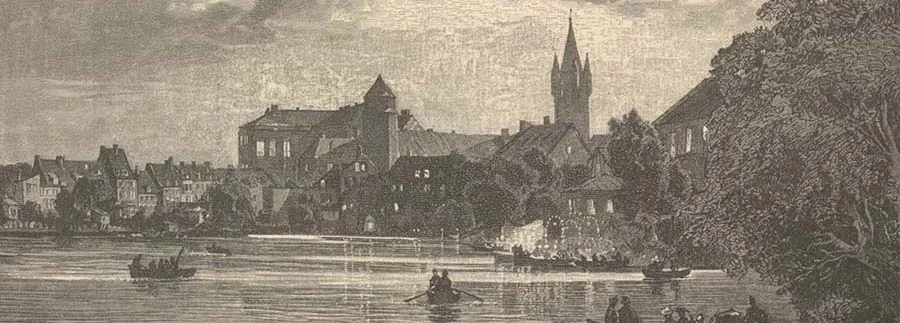
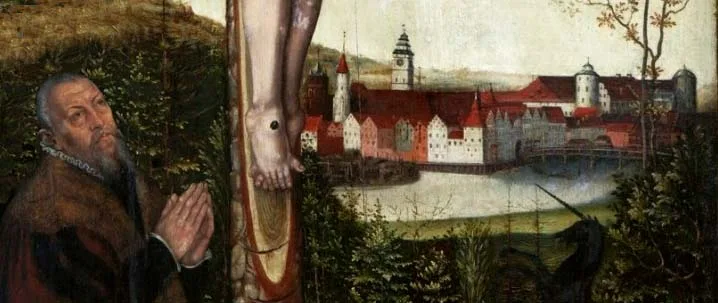
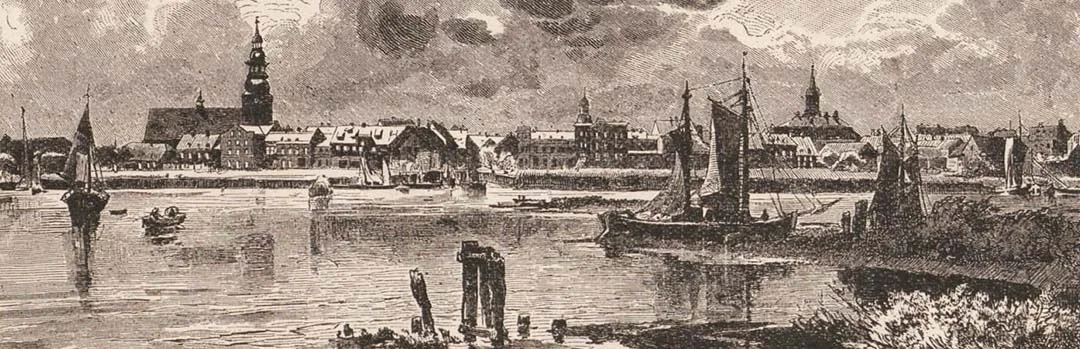
From this hillock, only half a mile from Königsberg, I could view the whole city with all its towers. From here one could clearly see that Königsberg is of very considerable size.
For the rest of the way to the city I was tormented by impatience to reach my destination as quickly as possible, but the horses, which had been heavily overworked in the preceding days, had to be spared. So I drove slowly, and the countryside, well cultivated but flat and featureless, gave my eyes no pleasure.
At last I reached the wretched, dilapidated Rossgarten Gate, utterly unworthy of a capital, and a good half-hour later drove up to the inn "Zum deutschen Haus".
This inn had been recommended to me in Memel, and I really had every reason to be satisfied with the room, its furnishings and the service. But I was mistaken in that I believed this inn to be on the outskirts of the city. This upset me a little, and so I was pleasantly surprised when I was told that it was in the very centre of the city.
After I had done justice to my stomach and dozed a little, I wanted to go out to pay a few business calls. But the innkeeper, a good fellow, talked me out of it, saying that I would not be welcome anywhere today: it was Saturday. On this day the Christian trading houses usually balance their accounts. Besides, Saturday here is the day for cleaning the house, so it is hard to find anyone on that day with whom one could discuss business matters.
On Sundays, for their part, it is not customary here to pay visits, so for two days I was left to my own devices. I want to use this time to wander about the city, get to know it and learn to find my way around it without a guide.
This letter of mine is still too short and will not satisfy your curiosity, so I shall stop for now, but will continue as soon as I have something to report.
* * *
…I continue my letter. I was very glad to meet my travelling companion from the journey across the Lithuanian lowland (Niederung), all the more so as I had unfortunately lost his address. This good man promised to acquaint me with all the peculiarities of the city. We have already seen a great deal and, given the great extent of the place, we seem to be a match for each other in briskness of pace. Below you will learn what I have become acquainted with and what I have seen so far.
Königsberg owes its origin to King Ottokar of Bohemia, who here, on the site of an old Prussian stronghold, built a fortress that was completed in 1255 and was named King's Mountain in honour of the King.
The convenient location on a navigable river induced a number of German colonists, under the protection of the strong walls of the majestic castle and its brave knights, to found a town surrounded by walls and towers, which was granted all kinds of privileges and named Königsberg after the castle.
Soon a second fortified settlement was built on the nearby island, and a century later a third. These three towns were separated from one another only by walls and the river. All of them recognised the Teutonic Order as their suzerain, and yet they had nothing in common with one another.
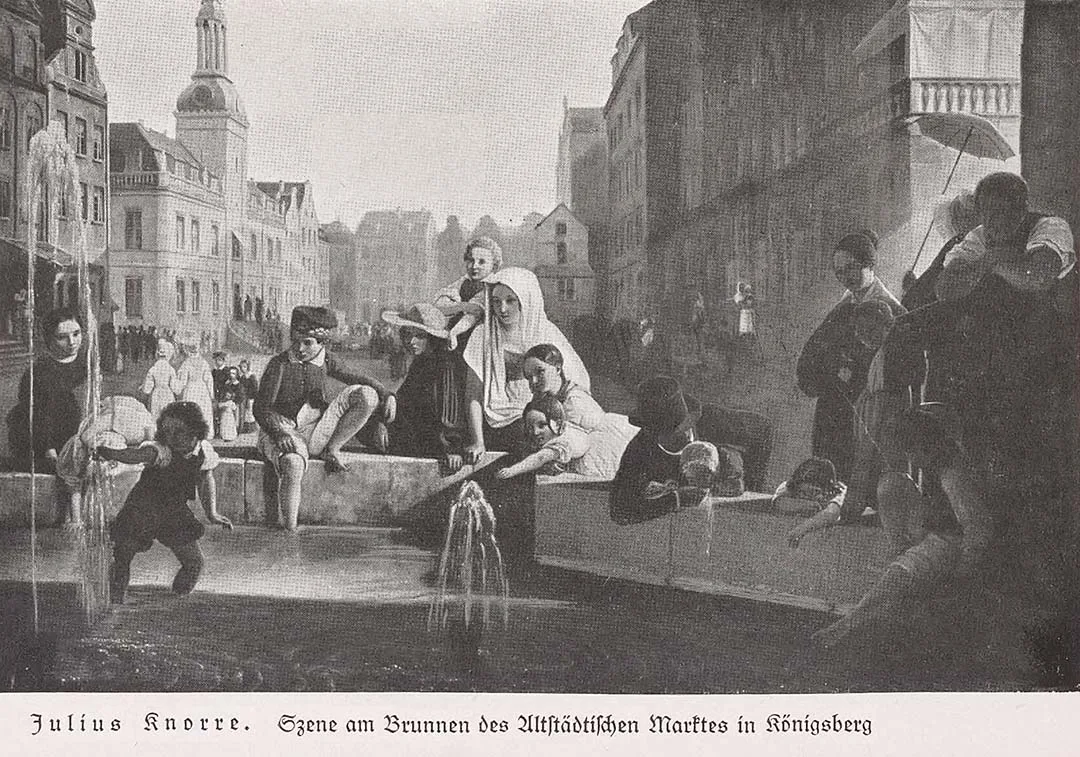
On the contrary, each of them had its own magistracy, and from the very beginning of their existence they waged bloody feuds with one another. Later fourteen suburbs grew up around these three towns, and in the 17th century each of them surrounded itself with an earthen rampart. Until the end of the 18th century they were so separated from one another that if someone acquired civic rights in one Königsberg town or in its suburb, he could not have them in another. Accordingly, a person practising a trade in one town had no right to do so in another. Only recently [in 1724 — ed.] was this absurd state of affairs abolished, and all the towns came under the administration of a single magistracy. These three towns of Königsberg are called Altstadt, Kneiphof and Löbenicht.
The city rampart is two German miles1 in circumference, but with such a considerable area the city has only 60,000 inhabitants. That is why there are so many vacant lots in Königsberg.
The first impression of this extensive city is far from positive. The streets of Königsberg are winding and crooked. Many of them, especially those in the city centre, are very narrow.
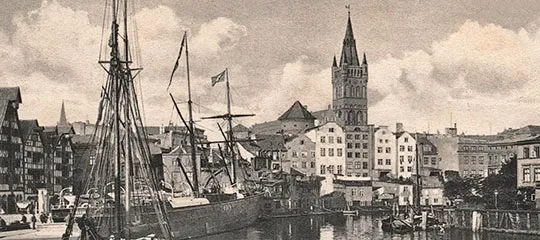
The city itself is hilly and, with the exception of Paradeplatz, which is for the most part not built up, has not a single public square worth mentioning. There are no palaces in the proper sense of the word. There are, however, buildings in a noble architectural style. But most of the buildings of Königsberg are either very old, dating back to the days of the Hanseatic League, or were erected according to the fanciful taste or passing whim of the owner, with no regard for any geometry.
In the very centre of the city there are extraordinarily narrow, dark streets with utterly featureless houses, many of which contain breweries. The owners of these houses received the privileges for opening such a highly fire-prone business long ago, when the suburbs (Vorstädte) were laid out, and since brewing is one of the oldest occupations, to which mankind is far from indifferent, paying compensation to the brewery owners when their breweries in the centre of the old town are closed down is no easy matter.
Here, as in Hamburg, the mills are located mainly in the city centre. Many visitors will find it rather strange that they stand on raised ground. This is because the pond that feeds them lies considerably higher than the city itself. [That is why it was, and still is, called the Upper Pond — ed.].
The cobbled streets here leave much to be desired: the uneven stones are hard to walk on, so until you get used to them you tire very quickly.
Nobody here knows of pavements, and paving them would be impractical, firstly because there is a shortage of dressed stone, which has to be brought from Sweden, and secondly because every house here has a flight of several steps in front of its door, which usually ends at the gutter.
The districts where the merchants live and where the port, the exchange, the bank and the large warehouses are located; the streets nearest the castle, and also the suburbs of Steindamm, Rossgarten and part of Sonkheim2 are very lively and remind us every minute that we are in an important commercial city.
But other districts — Tragheim, New Rossgarten, Laak — are so deserted that one often walks along streets where there are no people at all. Given the great size of the city, which within its boundaries encompasses fields, meadows, ponds and many gardens, this is quite understandable.
Business people settle in the city centre so as not to waste time on the road, while craftsmen working at home, farmers cultivating their land and single young women — in short, those for whom an extra hundred paces is no hardship — choose a remote suburb as their place of residence, where life is freer, quieter and more pleasant.
Thus apartments in the city centre ought to be three times more expensive than in the suburbs. But here, as my friend assures me, they are not at all expensive: for two hundred thalers one can rent a very decent apartment with several rooms for the whole family. And if you pay 300 thalers, you will live splendidly, as well as in Riga for 1,500 silver roubles.
LEGENDS OF PRUSSIA on the blog of Tatyana Kolivay.
TRANSLATOR'S NOTES
1. A German mile corresponds to an arc of the meridian of 4 minutes and is therefore approximately equal to 7.41 km.
2. In the original

Evidently Sackheim is meant.
Translated from Russian with the help of AI (Claude, Anthropic), October 2026.