Kalthof
Kalthof was founded by the Teutonic Order as a manor farm (Vorwerk) of the Order. In 1416 a small copper-smelting works is mentioned next to the farm. Kalthof's landholdings grew right up to the Rossgarten Market, but gradually they passed into the ownership of the suburbs of Rossgarten / Roßgarten (Kaliningrad, area of Klinicheskaya St.) and Neue Sorge (Kaliningrad, area of Frunze St.). At the end of the 17th century the owner of Kalthof was the commandant of Fort Friedrichsburg, Johann von Hille (c. 1609–84). In 1818 Kalthof is mentioned as an estate with six households.
In the mid-19th century Kalthof was an estate let in hereditary lease (Erbpachtgut), forming from 1867 a Gutsbezirk (estate district) in the Landkreis Königsberg (merged into the Landkreis Samland in 1939).
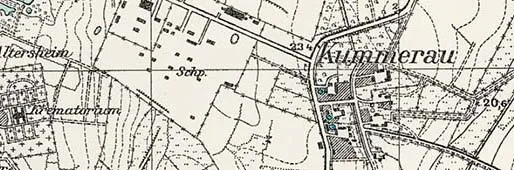
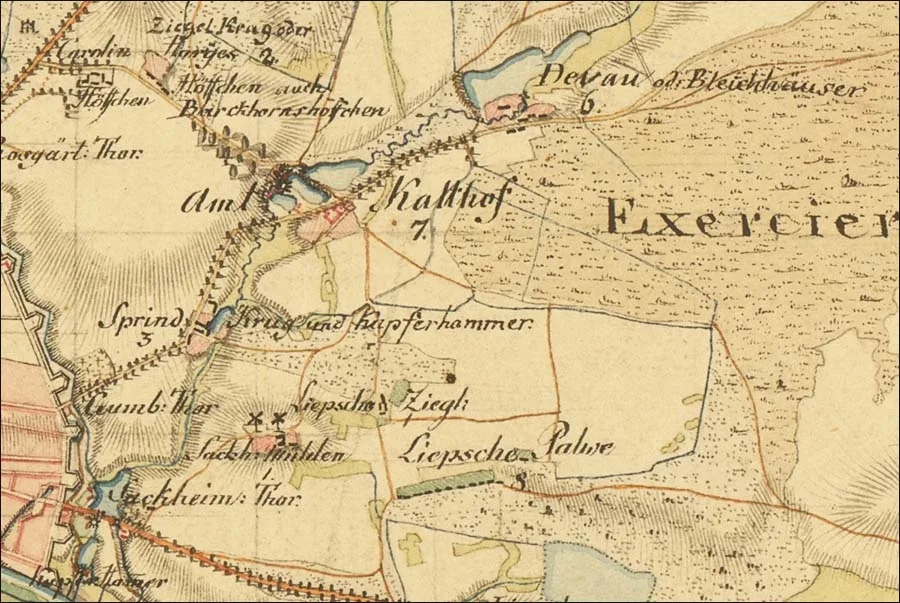 Kalthof and Devau on a map of Königsberg (1796).
The estate belonged to the parish of the Altrossgarten Church / Altroßgärter Kirche in Königsberg. Besides the estate itself, the Gutsbezirk of Kalthof also included the suburbs of Neuhof (Kaliningrad, area of Aeroportnaya St.), Borkenhof (Kaliningrad, Vostochnoye), Devau (Kaliningrad, Rizhskoye, part), the suburb of Friedrichshof (Kaliningrad, approx. 13 Gagarina St.), Harieshof (Kaliningrad, approx. 75 Kuybysheva St.), Ludwigshof (Kaliningrad, 54°43'16'' N 20°32'54'' E), Sprind (Kaliningrad, 54°43'00'' N 20°32'50'' E), Tannenhof (Kaliningrad, area of Yuriya Kostikova St.), a smithy, the highway keeper's house and a mill (Kaliningrad, 54°43'27'' N 20°32'44'' E). In 1871 the Gutsbezirk of Kalthof had 24 dwelling houses, in which 60 families lived. Of these, the Kalthof estate itself had four dwelling houses, Neuhof likewise had four, the farms of Devau / (Rizhskoye, part), Tannenhof and Ludwigshof three each, Borkenhof two, and there was one house each in the suburbs of Friedrichshof and Harieshof, in Sprind, at the smithy, at the highway keeper's house and at the Kalthof mill.
In the course of the administrative reform of 1874 Kalthof was divided into the village and the estate of Kalthof: the former formed a rural municipality (Landgemeinde), the latter a Gutsbezirk.
At the same time Borkenhof, Devau (Kaliningrad, Rizhskoye, part), Friedrichshof, Harieshof, Ludwigshof, Sprind and Tannenhof were separated from the Gutsbezirk as independent estates.
On 30.04.1874 the rural municipality and the Gutsbezirk of Kalthof were included in the newly established Amtsbezirk of Kalthof.
On 10.12.1874 the Harieshof enterprise passed from the rural municipality of Kalthof to the Gutsbezirk of Carolinenhof (Kaliningrad, area of Prazhskaya St.).
In 1879 the Kalthof estate owned 153 ha of land, and its annual net profit amounted to 4,600 marks. The estate was considered small in area (101st place out of 143 in the Landkreis), but in terms of income per hectare it ranked third in the Landkreis Königsberg.
Under the new administrative regulation of 1881 the Gutsbezirk of Kalthof was abolished, and the estate and the farms belonging to it were included in the rural municipality of Kalthof.
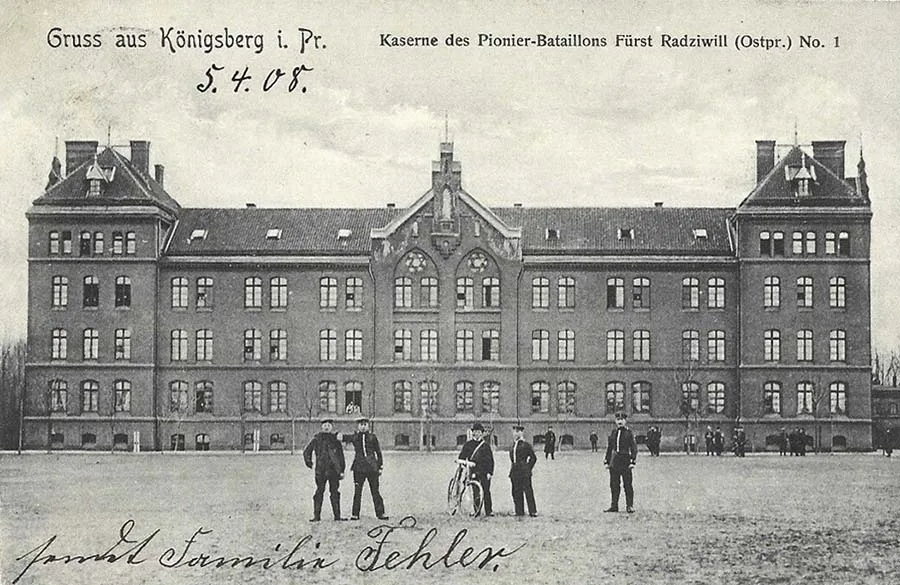 The parade ground and barracks of Pioneer Battalion No. 1 "Fürst Radziwill" on the street of the same name in Kalthof.
In 1893 two engineer battalions of the Prussian I Corps were stationed in Kalthof — the East Prussian Pioneer Battalion No. 1 "Fürst Radziwill" and the Samland Pioneer Battalion No. 18 — for which a complex of barracks, a parade ground and a shooting range were built on the eastern edge of Kalthof.
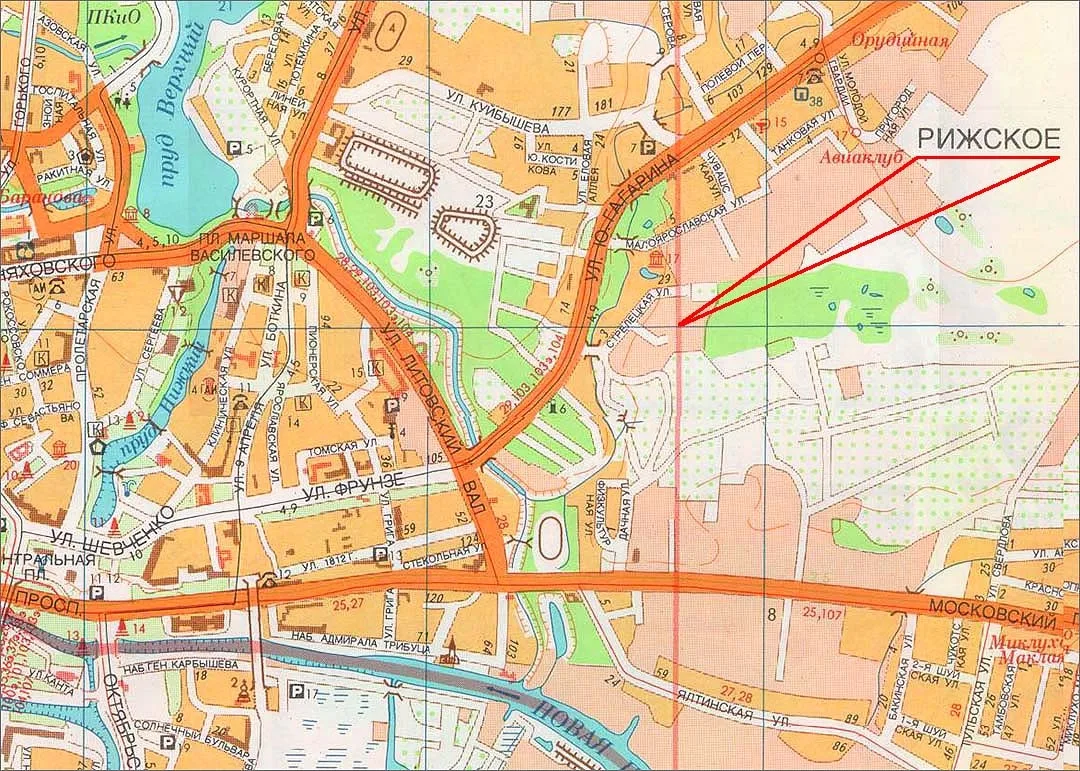
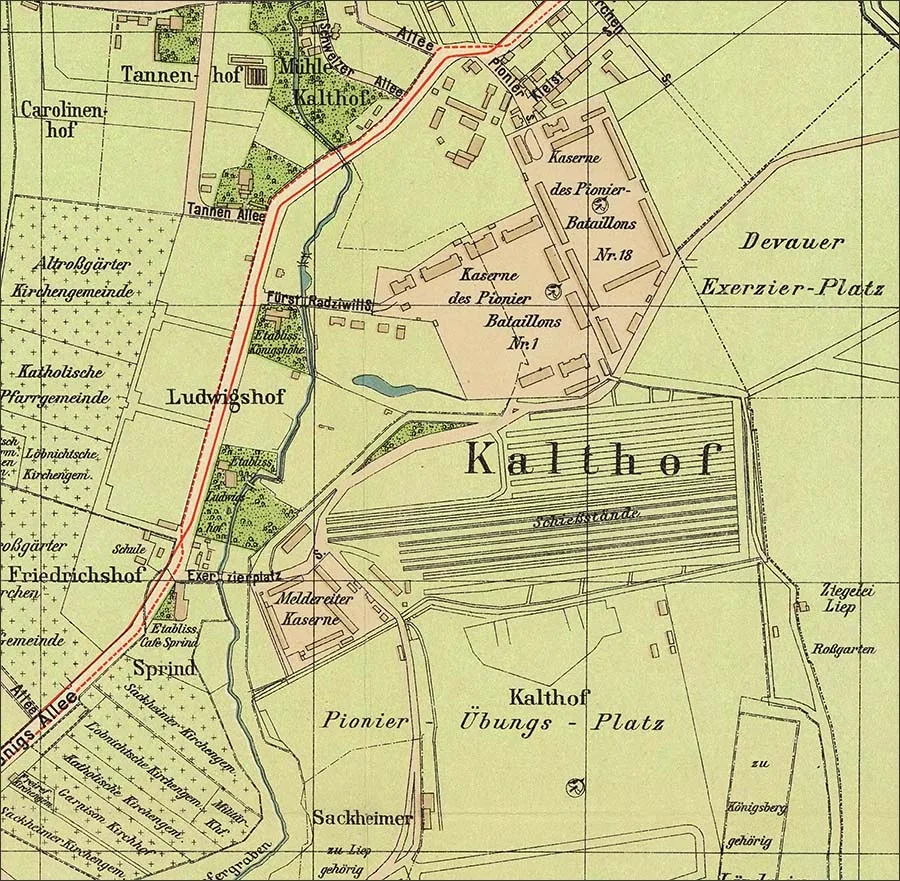 Kalthof on a map of Königsberg (1900).
On 15.01.1900 the narrow-gauge (750 mm) Königsberg – Prawten (Lomonosovo) railway was opened. The line passed through Kalthof, where a passenger platform was built on it.
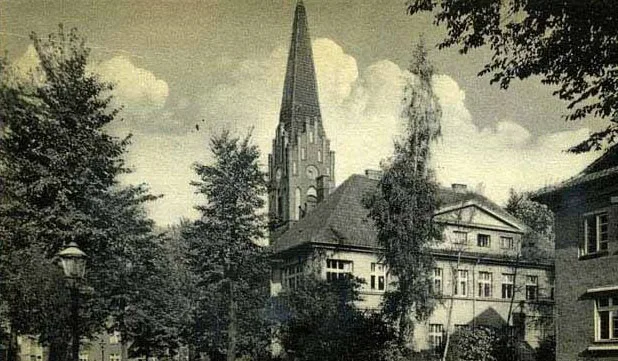
In 1899 the owner of the Kalthof estate, Berthold Kleist (1848–1925), donated a plot of land to the church, and in 1901 he allocated 70,000 marks for building a church in Kalthof. The church, built in 1905–07 on Kleist's instructions, was named after Kaiser (Emperor) Frederick III (Kaiser-Friedrich-Gedächtniskirche). From its consecration it was a "daughter" church of the Old Rossgarten Church. And in 1924 a parish of its own was formed in Kalthof.
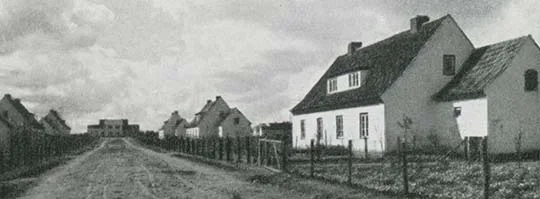
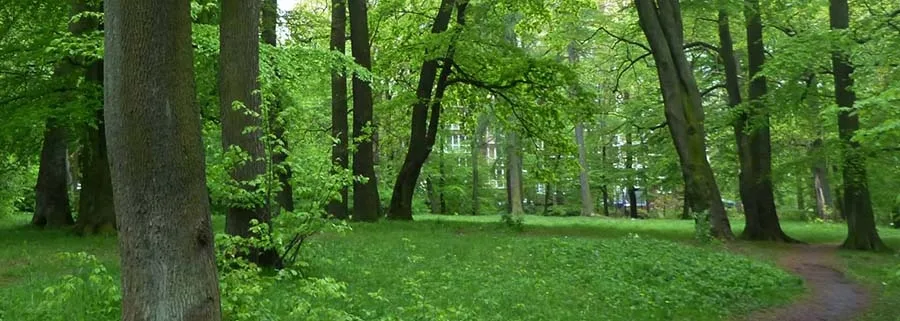
Besides building the church, Berthold Kleist laid out a small park, which was named "Kalthof Park" (Kalthof Park) and later "Kleist Park" (Kleist Park). In 1905 Berthold Kleist, the last owner of the Kalthof estate, sold it to the municipality of Königsberg, after which the estate became a city district.
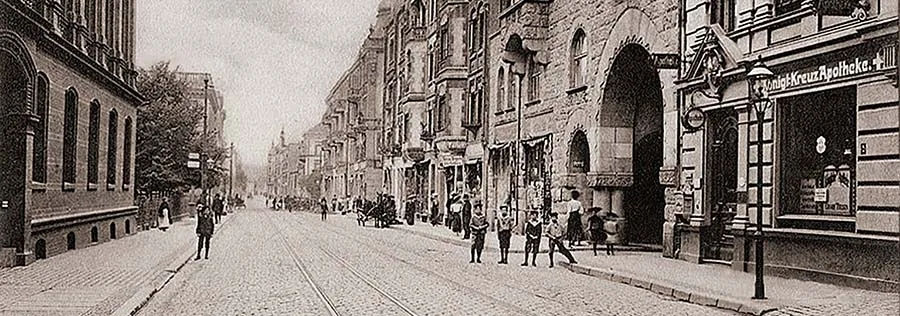
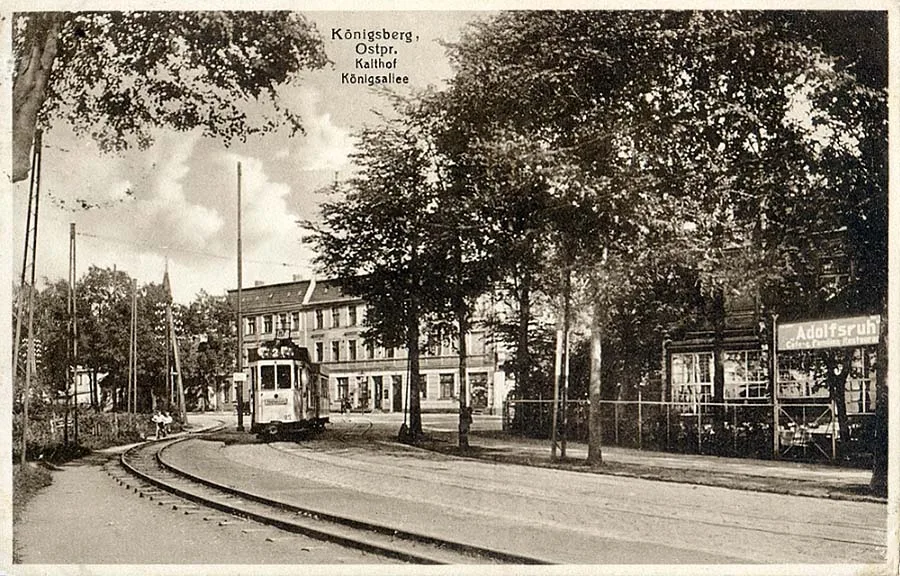 A little tram on the Königsallee in Kalthof.
Before the war there were two significant enterprises in Kalthof: the East German Bread Factory (Ostdeutsche Brotfabrik) and the well-known organ workshop of Terletzki-Göbels.
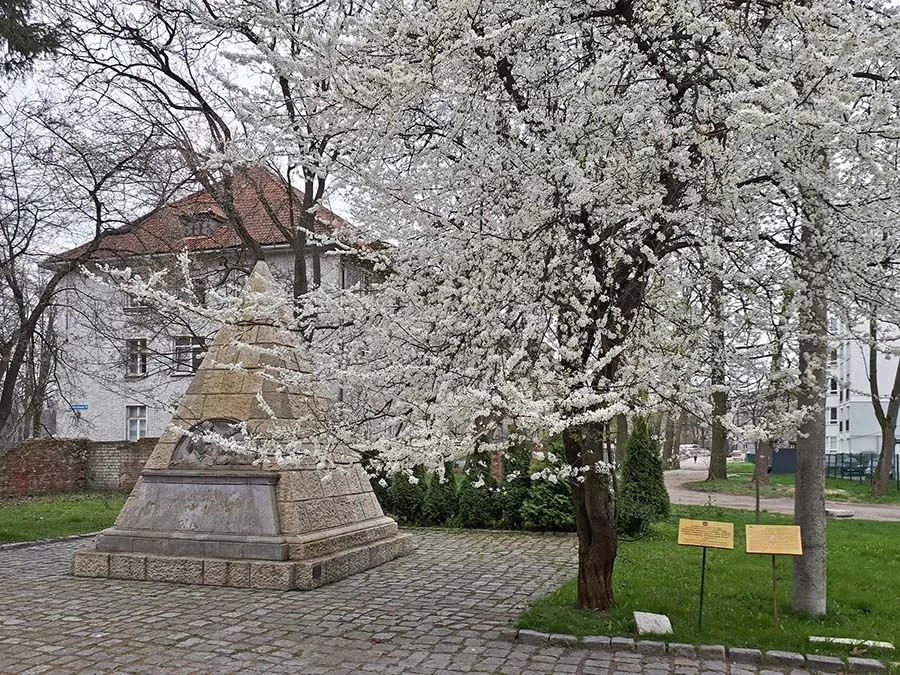 Memorial to the sappers killed in the First World War (1914–18), on Maloyaroslavskaya Street.
Devau
Devau is first mentioned separately from Kalthof, as Dewau, around 1785. East of Devau lay a cavalry training ground (Der große Exercier Platz), where cavalry exercises had been held regularly since 1717. On 20 July 1740, on the occasion of his accession to the throne, Frederick II held a great review of the troops of East Prussia on this ground instead of a coronation. Similar events were subsequently held here many times. On 5 June 1798 King Frederick William III of Prussia took the parade on the Devau parade ground, and in 1808 the French Emperor Napoleon did so.
In 1785 Devau was classified as "royal taverns in hereditary lease" (Königlicher Erbpachtkrug) with adjoining garden plots, which were also used for so-called "grass bleaching". This consisted in spreading fabrics (cotton and linen) on riverside meadows and keeping them moist in the sun until the characteristic greyish-yellow colour of the cloth disappeared (about 3 months for cotton and 6 months for linen). Used white articles of cotton and linen were also bleached on such grounds. In all, Devau had eight households in 1785. Administratively Devau belonged to the Amt of Schaaken (Nekrasovo). By 1818 the number of households in Devau had fallen to three.
In 1814 the "Königsberg" brewery was founded in Devau.
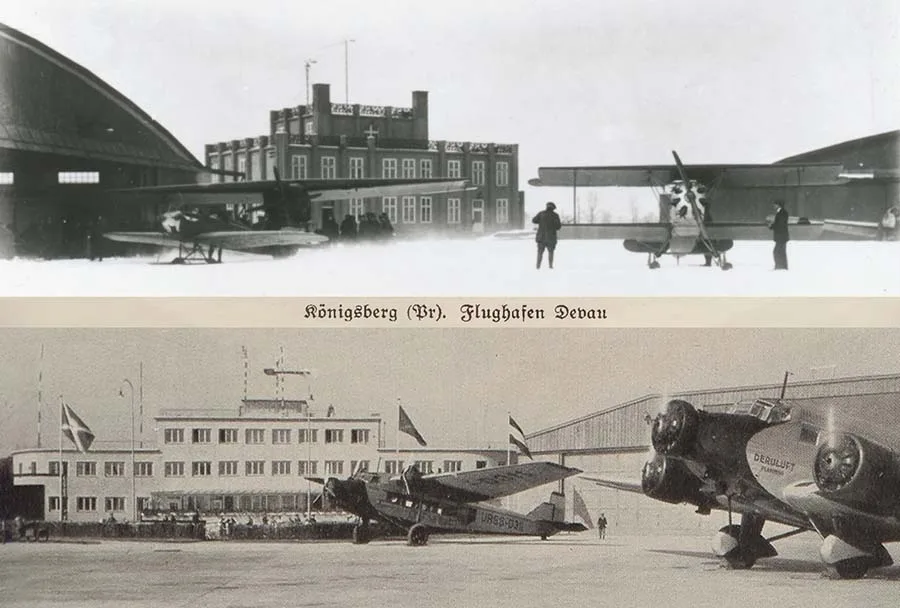 The Devau terminal building before and after its reconstruction.
In the mid-19th century Devau was a farm (Vorwerk) of the Kalthof estate (see above) in the Landkreis Königsberg (merged into the Landkreis Samland in 1939).
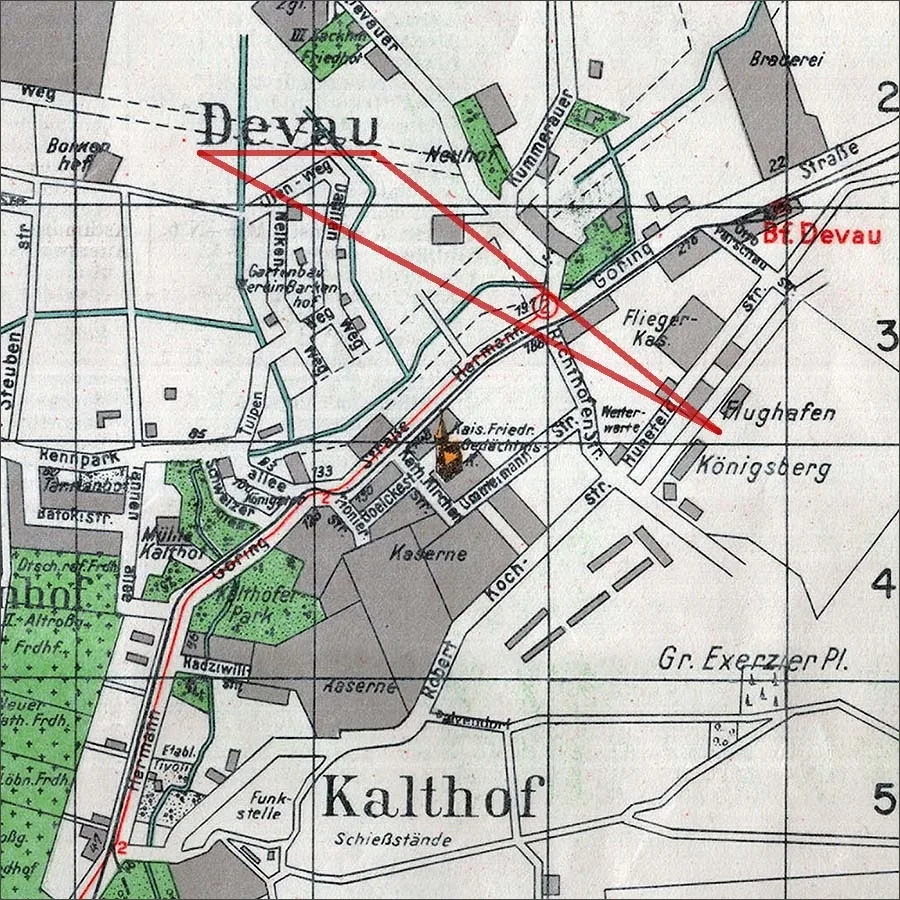 Devau and Kalthof on a map of Königsberg (1944).
The farm belonged to the parish of the Old Rossgarten Church / Altroßgärter Kirche in Königsberg. In 1871 the farm had three dwelling houses.
In the course of the administrative reform of 1874 Devau was made an independent estate, forming its own Gutsbezirk in the Landkreis Königsberg. On 30.04.1874 the Gutsbezirk of Devau was included in the newly established Amtsbezirk of Kalthof (Kaliningrad, Rizhskoye, part). However, under the new administrative regulation of 01.04.1881 Devau again became part of the rural municipality of Kalthof.
On 15.01.1900 the narrow-gauge (750 mm) Königsberg – Prawten (Lomonosovo) railway was opened. The line passed through Devau, where a station was opened on it.
On 01.04.1905 Devau, together with the estates of Borkenhof and Neuhof, formerly part of the Gutsbezirk of Kalthof, was merged into the new rural municipality of Devau.
On 23.03.1906, in connection with the dissolution of the Amtsbezirk of Kalthof, the municipality of Devau passed to the Amtsbezirk of Quednau (Kaliningrad, Severnaya Gora). From then on, plots of land were regularly ceded by the municipality of Devau to the municipality of Königsberg.
In 1910 the "Königsberg" brewery was transformed into the joint-stock company Brauerei "Ostmark" / AG Brauerei «Ostmark», whose main shareholders were the owners of local beer houses.
Even before the First World War the cavalry training ground began to be used as an airfield. In 1921 the ground was officially handed over for an aerodrome. After a terminal building designed by Hanns Hopp (1890–1971) was erected at Devau aerodrome that same year, "Devau" became the first civil airport in Europe. At the same time a building for the world's first permanent meteorological service was built on the aerodrome grounds.
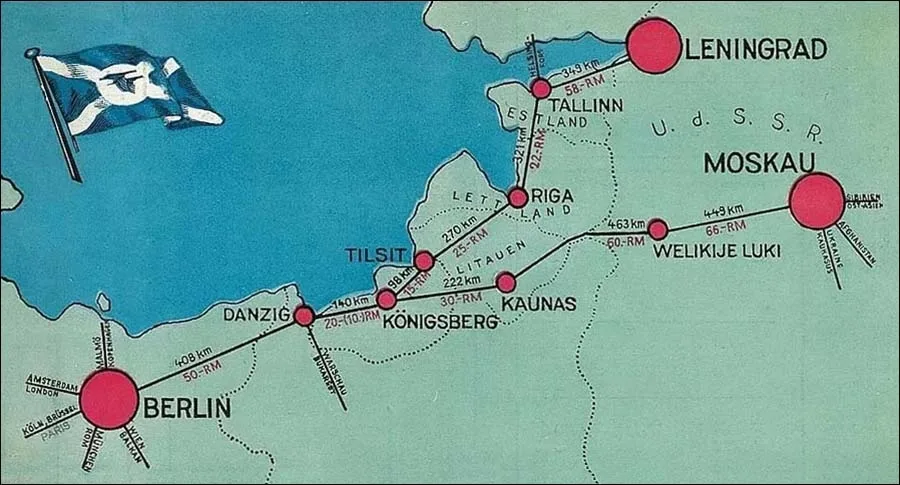
On 01.05.1922 the first flight from Devau took place on the Berlin – Königsberg – Moscow route. In 1926 a night flight to Berlin began operating (the first scheduled night air service), as well as local flights to Memel (Klaipėda) and Tilsit (Sovetsk).
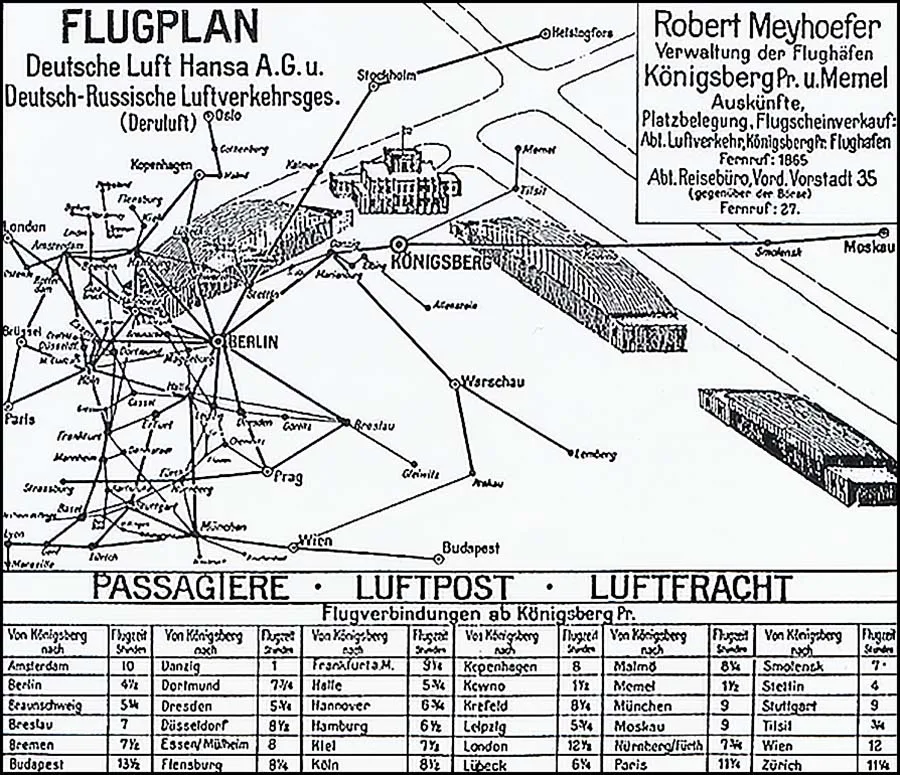
Numerous German and Soviet celebrities of their time passed through the aerodrome, among them Vladimir Mayakovsky and Sergei Yesenin with his wife Isadora Duncan, who flew to the West in transit through Königsberg.
In 1924 the airport was connected with the city centre by a tram route. In the same year Devau came to belong to the new parish of Kalthof.
On 31.08.1926 the famous Tver-born pilot Mikhail Gromov landed on the airfield of "Devau" airport during his three-day flight in the ANT-3 "Proletary" along the route Moscow–Königsberg–Berlin–Paris–Vienna–Moscow. Ten years later, on 1 November 1936, the ANT-25 captained by the legendary Valery Chkalov refuelled at "Devau" on its flight to the Paris Air Show.
On 08.03.1927 the whole southern part of Devau became part of Königsberg, and on 16.06.1927 the municipality of Devau was dissolved and fully incorporated into the city.
In the mid-1930s the old building of "Devau" airport was rebuilt to a design by the same Hanns Hopp, becoming more modern and functional.
During the Second World War Kalthof and Devau were bombed. This happened on 27.08.1944, during the first raid of the British Royal Air Force. 174 Avro 683 Lancaster bombers dropped bombs on the eastern part of Königsberg. The infrastructure of "Devau" airport and nearby quarters were damaged.
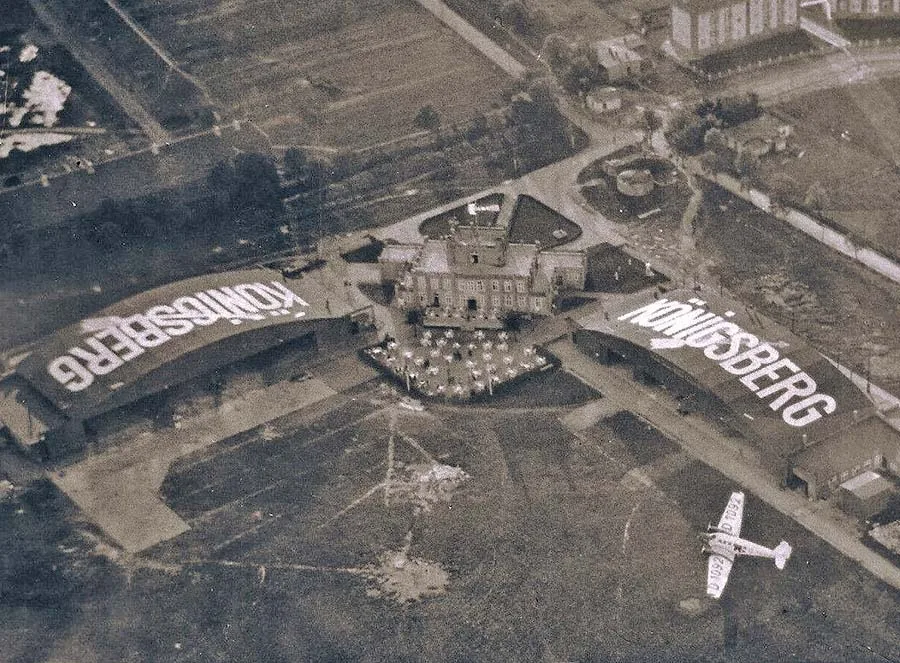 Aerial view of the terminal at Devau.
On 18.08.1949, by decision of the Kaliningrad city executive committee, the city districts of Kalthof and Devau were renamed the settlement of Rizhskoye within the Leningradsky district of Kaliningrad.
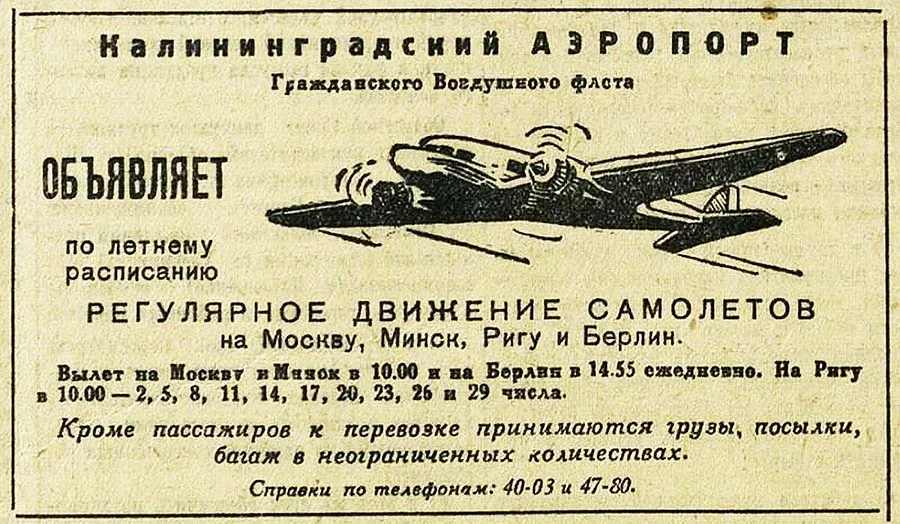 An advertisement in a local newspaper.
Unlike the boundaries of Devau and Kalthof, the territory of the settlement lay only on the right side of Gagarina Street, from Maloyaroslavskaya Street to the settlement of Maloye Isakovo. In the eastern part of the settlement two military units were housed in the former engineer barracks. The "Ostmark" brewery continued to operate under the name Kaliningrad Brewery No. 1. Another significant enterprise of Rizhskoye was the Kaliningrad Knitwear Factory. On the boundary of Rizhskoye was the terminal loop of tram route No. 4.
Until 1962 the airport in Rizhskoye was Kaliningrad's air gateway. But with the arrival of the An-10 turboprops and the Tu-124 jets, its size and its location within the city limits became an obstacle to its further use as the main airport. From 1962 to 1977 An-2 aircraft flew from the former "Devau" airport to towns of the region and to Klaipėda. From 1977 it was converted into a base airfield for agricultural aviation.
In 1986 the DOSAAF aviation sports club was based at the "Devau" airport site.
In 1988 Kaliningrad Brewery No. 1 was renamed "Kaliningradsky Brewery", and in 1993 it was incorporated, with the participation of the German company "AMS Anlagenplanung" of Hamburg, as the open joint-stock company "Ostmark Brewery". The German side carried out a thorough modernisation of the enterprise, and production of "Ostmark" beer in kegs, bottles and aluminium cans began. In the 1990s tram route No. 9 was changed and its terminal loop came to coincide with that of tram No. 4, until in 2008 both routes passed into history.
Unlike the brewery, the knitwear factory did not survive the transition to the market economy and in effect stopped production; its grounds and workshops began to be let out.
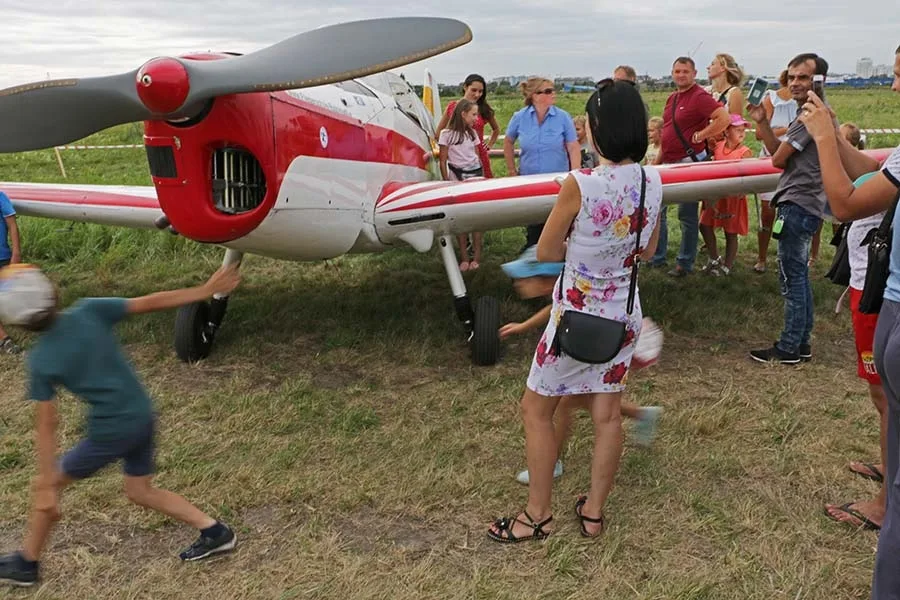 On 18 August 2019 the centenary of "Devau" airport was solemnly celebrated on its airfield.
From 1998 the edges of "Devau" airport began to be built up with low-rise houses in circumvention of the law. DOSAAF's successor, ROSTO, and the public tried to save "Devau" as an operational aerodrome, but despite court rulings the situation developed according to the worst scenario for the supporters of its preservation.
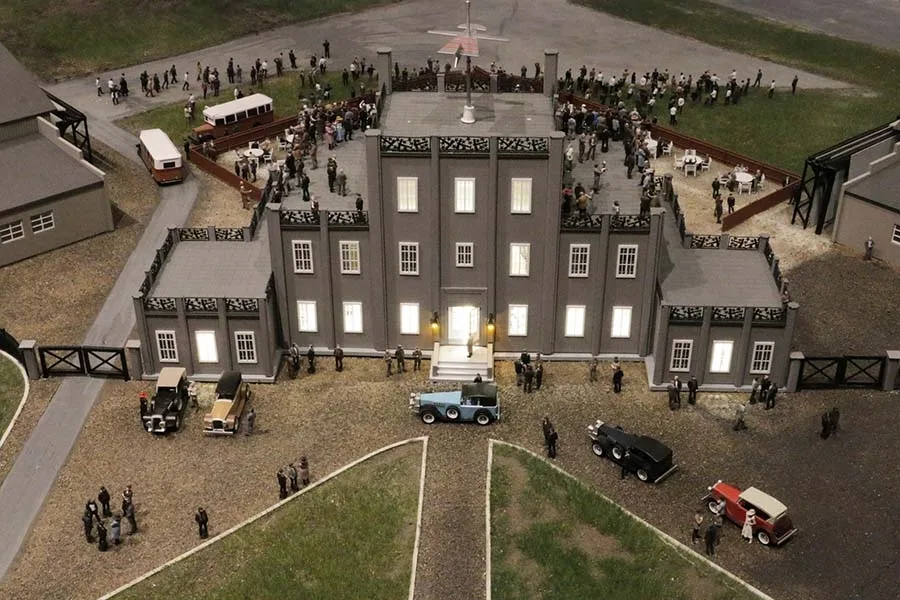 Model of Devau airport in the "Königsberg" Museum of Architecture and History in Zelenogradsk.
Output of the local brewery peaked in 2001 at about 10 million decalitres (in Soviet times the plant produced up to 1.6 million decalitres in the 1970s and up to 1.3 million in the 1980s), but the chase for figures led to a decline in quality, and the products were no longer in demand. The brewery's beer, owned by that time by the American company The Detroit Brewing Co through "Kompaniya PIT" LLC, became a byword for cheap alcoholic ersatz. Nor was the brewery's reputation saved by its sale to Heineken in 2005.
In 2007 the complex of buildings of "Devau" airport was granted the status of a cultural heritage site. In 2012, in the immediate vicinity of the aerodrome's runway, shared-equity construction of a quarter of low-rise houses began; it was stopped by a court, which gave rise to "defrauded co-investors". To solve the resulting problem, the regional authorities began trying to strip the aerodrome of its status as an operational aviation infrastructure facility...
Sights: "Devau" airport, the barracks complex in Kalthof (19th century), the memorial on Maloyaroslavskaya Street to the soldiers of the engineer battalion killed in the First World War.
Population of Kalthof: 1818 – 20, 1871 – 58, 1905 – 807 inhabitants.
Population of the Gutsbezirk and municipality of Kalthof: 1867 – 354, 1871 – 311, 1885 – 540, 1905 – 2,020 inhabitants.
Composition of the population of the Gutsbezirk of Kalthof in 1871: Protestant Christians – 301, Catholics – 10, children under 10 – 69, literate – 183 (77%), insane – 3.
Population of Devau: 1818 – 38, 1871 – 40, 1905 – 61 inhabitants.
Population of the municipality of Devau: 1905 – 182 inhabitants.
Amtsbezirk of Kalthof
On 30.04.1874 Amtsbezirk No. 19, Kalthof, was established in the Landkreis Königsberg. It comprised the rural municipality of Kalthof (Rizhskoye, part) and five Gutsbezirke: Carolinenhof (Kaliningrad, area of Prazhskaya St.), Devau (Rizhskoye, part), Friedrichshof (Kaliningrad, approx. 13 Gagarina St.), Kalthof (Rizhskoye, part) and Ludwigshof (Kaliningrad, 54°43'16'' N 20°32'54'' E). In addition, six more entities were included in the Amtsbezirk of Kalthof with a status equivalent to a Gutsbezirk: the Borkenhof estate (Kaliningrad, Vostochnoye), the Exerzierplatz training ground (Devau airport), Harieshof (Kaliningrad, approx. 75 Kuybysheva St.), Löbenichtscher Zigelhof (Kaliningrad, area of Nevskogo and Dadayeva streets), Sprind (Kaliningrad, 54°43'00'' N 20°32'50'' E) and Tannenhof (Kaliningrad, area of Yuriya Kostikova St.). In the following years, however, the Gutsbezirk of Kalthof was joined to the rural municipality of Kalthof, and Harieshof to the Gutsbezirk of Carolinenhof. In addition, the farms formerly belonging to the Gutsbezirk of Kalthof became part of the municipality of Kalthof. By 1883 the Amtsbezirk of Kalthof was made up as follows: the rural municipality of Kalthof (Rizhskoye) and two Gutsbezirke: Carolinenhof (Kaliningrad, area of Prazhskaya St.) and Löbenichtscher Zigelhof (area of Nevskogo and Dadayeva streets). The Exerzierplatz (Devau airport) also belonged to the Amtsbezirk. On 22.12.1885 the military authorities bought up those lands of the Gutsbezirk of Carolinenhof (Kaliningrad, area of Prazhskaya St.) that lay near the ramparts of Königsberg. On 01.04.1905 the main part of the rural municipality of Kalthof (except the Devau estate and the farms of Borkenhof and Neuhof) passed to the municipality of Königsberg. Devau (Rizhskoye, part), Borkenhof (Vostochnoye) and Neuhof (area of Aeroportnaya St.), as well as Löbenichtscher Zigelhof (Kaliningrad, area of Nevskogo and Dadayeva streets), formed the new rural municipality of Devau. On 29.03.1906 the rural municipality of Devau passed to the Amtsbezirk of Quednau (Kaliningrad, Severnaya Gora), and the Amtsbezirk of Kalthof was abolished.
E p i l o g u e
The numerous city cemeteries on the territory of Kalthof were built over with residential buildings at the turn of the 20th and 21st centuries. Kalthof Park was half cut down in the early 21st century during the construction of the "Bukovaya Roshcha" (Beech Grove) housing estate. The local brewery was closed on 31.12.2016. Its grounds were leased out. The Kaliningrad Knitwear Factory was also finally liquidated in 2018. The last aircraft took off from the "Devau" aerodrome in 2019.
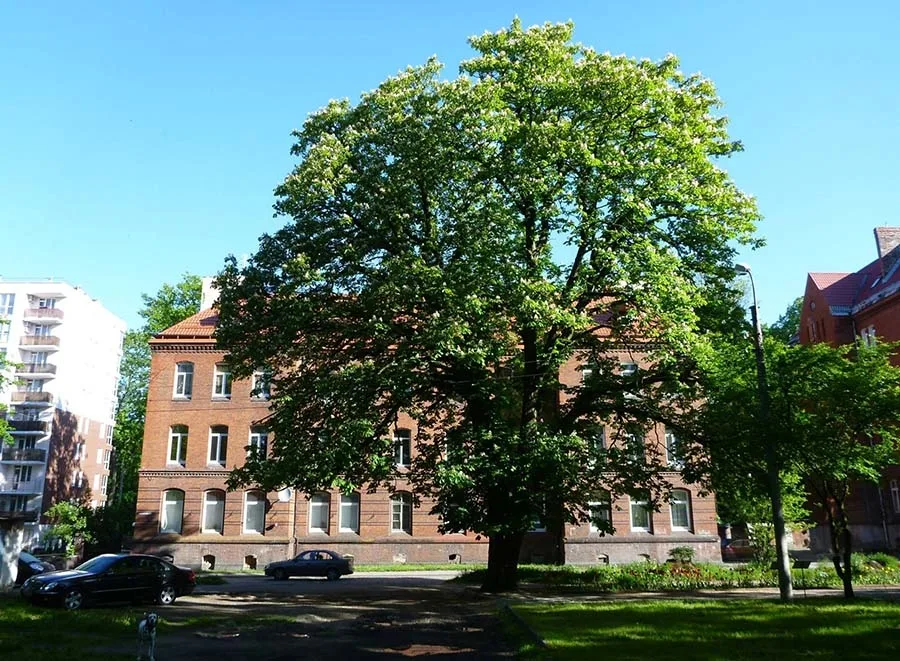 A magnificent chestnut tree on Maloyaroslavskaya Street could have been the symbol of the district, but it too was "caringly" sawn down.
Modern photos: Mikhail Ogorodnikov.
– – – – – – – – –
In 2012–2014 "Pregola", the literary supplement to the "Baltic Almanac",
published a translation, by an unknown translator, of the book by the Königsberg authors Dr Richard Armstedt, professor at the Altstadt Gymnasium, and Dr Richard Fischer, senior teacher at the Kneiphof Gymnasium, "Königsberg Local History" ("Heimatkunde von Königsberg i. Pr.", 1895, Kommissionsverlag von Wilhelm Koch, Königsberg). The idea of the publication belonged to Igor Vladimirovich Afonin. The text was adapted and annotated by Aleksey Borisovich Gubin and Igor Fyodorovich Avtukhov. That book had a separate chapter on the outskirts of Königsberg, containing a passage on the sights of Kalthof. Substantially edited, we offer it to your attention as a supplement to the text by Aleksey Yevgenyevich Petrushin.
– – – – – – – – –
The outskirts of Königsberg
A field path leads us past the cemetery of the Löbenicht Hospital (Löbenichtschen Hospitalkirchhof) onto the plateau to the old pleasure spot "Lilac Mill" (Vergnügungsort Fliedermühle), where the garrison shooting range and the large drill ground are now located. Here too stand the barracks built in 1870 on the so-called Small Drill Ground (Kleiner Exerzierplatz) for French prisoners of war. Later the barracks were handed over to the garrison hospital (Garnisonlazarett); now they house soldiers.
(This part of the city between Moskovsky Prospekt and Yuriya Gagarina Street is now partly built up with new houses; only on a small part do the fortifications, formerly used for training, remain. In the 1970s a huge House of Culture for workers of the pulp industry was begun on the site of the cemetery. Then construction was abandoned, and only by 2010 was the unfinished House of Culture converted into the "City" shopping centre on Moskovsky Prospekt — Ed. note.)
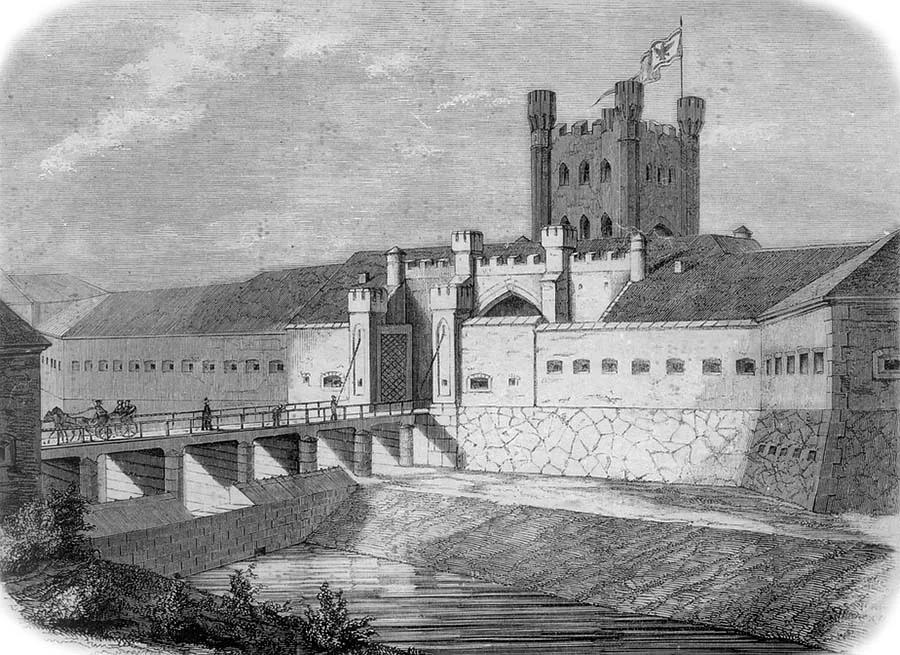
View from Kalthof of the King's Gate in its original appearance.
Through the pleasure spot of Sprind (Sprind, area of the junction of Gagarina and Streletskaya streets) we come out onto the highway leading from the King's Gate (Königstor) towards Labiau (Labiau, now the town of Polessk).
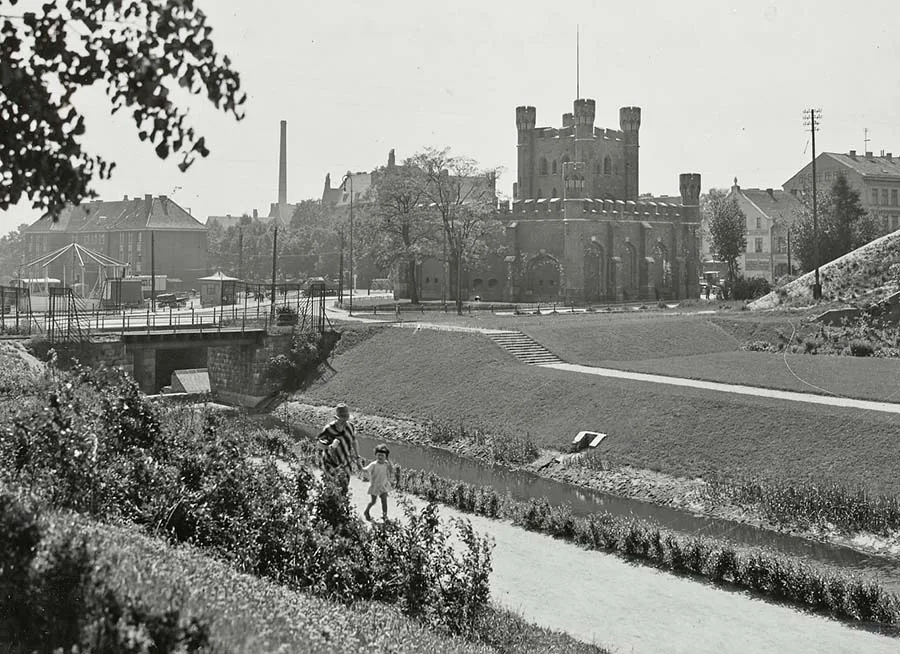 The King's Gate, which in the 20th century became part of Schneider's green belt.
Following it to the glacis in front of the King's Gate, we shall see many crosses and gravestones. This is the former Löbenicht cemetery (Löbenichtsche Kirchhof), moved here because new fortifications were built on its original site. A tall, plain sandstone cross catches the eye; it stands on the grave of Lord Mayor (Oberbürgermeister) Heidemann (August Wilhelm Heidemann, 1773–1813).
August Heidemann studied in Halle and in 1802 became professor of law at the University of Königsberg. In 1810 he was elected Lord Mayor of Königsberg. He was a true patriot and took an ardent part in forming the Landwehr in 1813. He died suddenly on 15 November 1813 from overexertion.
A few metres from Heidemann's gravestone there is a grave surrounded by railings. On it lies a stone with the inscription: "Gustav Friedrich Dinter. He was a teacher who sought the truth, loved freedom and fostered love."
Gustav Friedrich Dinter (Gustav Friedrich Dinter, 1760–1831) was a school councillor in Königsberg in 1816–1831 and from 1822 professor of theology at the Albertina. He won the recognition and love of his fellow citizens through his knowledge of his work, his courage and his wise counsel. To this day the townspeople fondly remember him as "Father Dinter" or "old Dinter". In 1885, with funds from his admirers, a stone was placed on the great educator's grave, and a memorial plaque was fixed to the house at No. 19 Clothmakers' Street (Tuchmacher Straße) in the Löbenicht, where he lived for a long time.
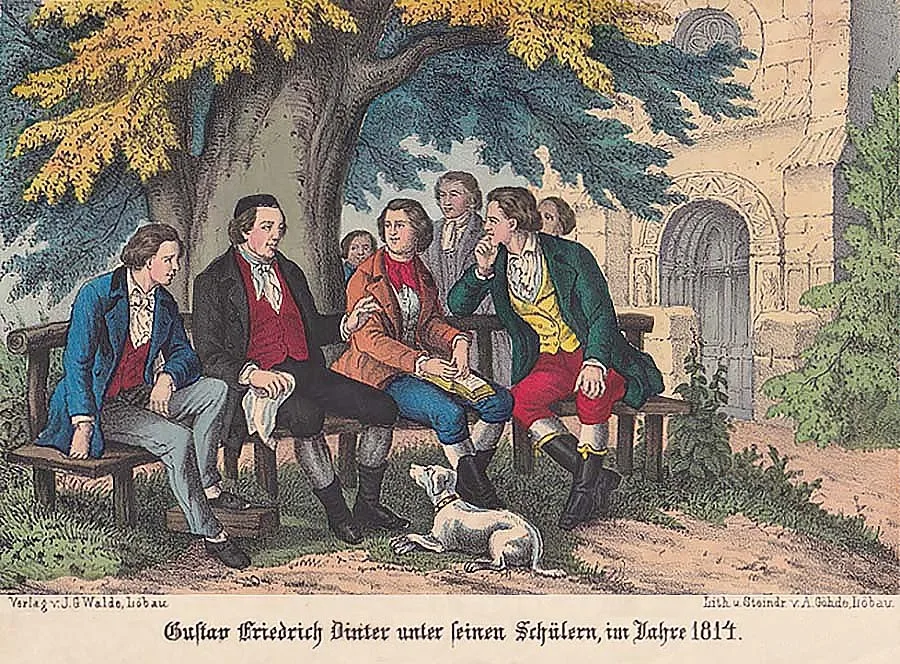 Gustav Friedrich Dinter with his pupils in 1814.
Several cemeteries adjoin the glacis on the outer side. We shall visit the burial ground of the Free Union of the Evangelical Catholic Congregation, because an outstanding citizen of Königsberg rests here — Dr Julius Rupp.
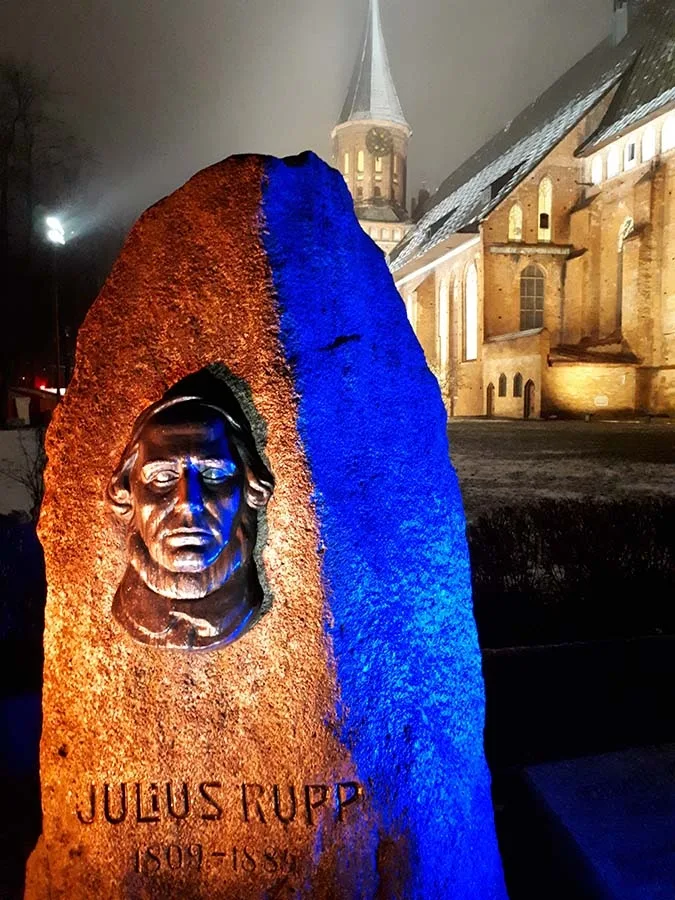
Monument to Julius Rupp on Kant Island (Kneiphof).
Julius Rupp (Friedrich Julius Leopold Rupp, 1809–1884) was born and lived all his life in Königsberg. At the university here he studied theology and philosophy. From 1835 he worked as a teacher at the Altstadt Gymnasium, and in 1842 he became a divisional preacher. On 15 October 1842 Julius Rupp delivered a sermon on the Christian state. The officials listened to his speech with disapproval. When in the same year he was elected director of the Kneiphof Gymnasium, the city authorities did not confirm the election. Soon afterwards Julius Rupp preached a sermon in the Castle Church and protested against the persecution of the Athanasians and their supporters. For this Rupp was removed from the post of divisional preacher in 1845. On 19 January 1846 Julius Rupp, together with his fellow believers (150 people), founded the Free Union of the Evangelical Catholic Congregation and remained its permanent leader. As an orator and writer Julius Rupp won many supporters in Königsberg, who twice elected him to the Chamber of Deputies, in 1849 and in 1862. Julius Rupp died on 11 July 1884, almost blind and having lost the power of speech (owing to a throat disease).
(Athanasians — adherents of the views of one of the "Fathers of the Church", Athanasius of Alexandria, who preached the attainment of immortality through comprehension of the "Creed", a body of religious dogmas requiring no proof. The artist Käthe Kollwitz, Julius Rupp's granddaughter, made a bronze relief of the preacher, mounted on a granite stone near the Cathedral. — Ed. note.)
– – – – – – – – –
The old Kalthof mill
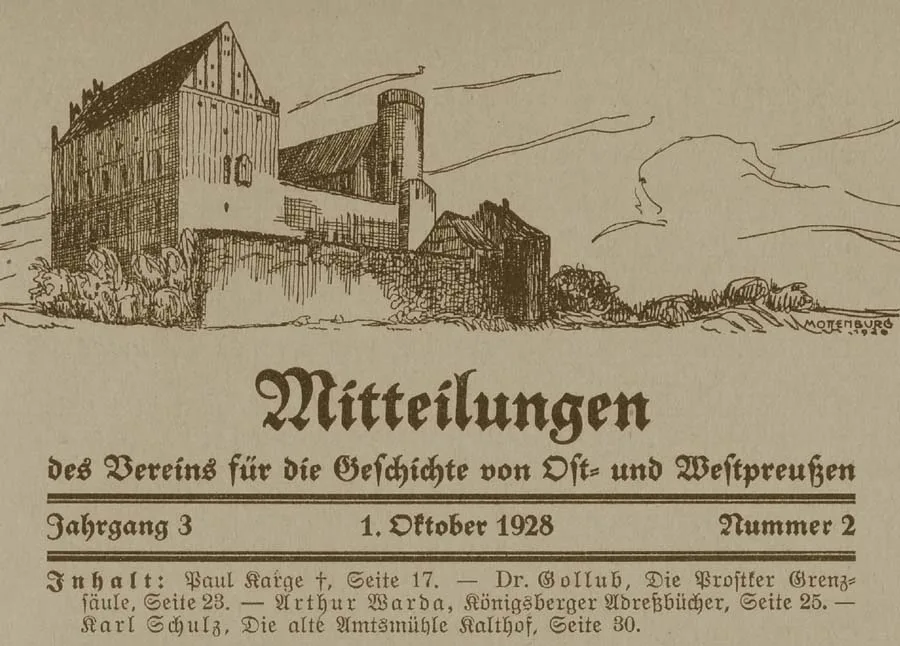
A fragment of a text by Karl Schulz from the journal "Proceedings of the Association for the History of East and West Prussia" (Mitteilungen des Vereins für die Geschichte von Ost- und Westpreußen, 1. Oktober 1928).
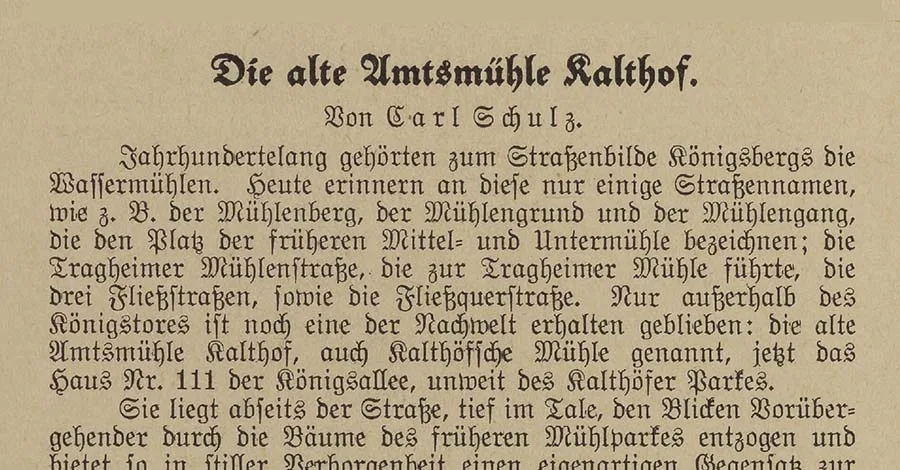
For centuries watermills were a common sight in Königsberg. Today only a few street names survive to recall them: Mill Hill (Mühlenberg), Mill Valley (Mühlengrund) and Mill Passage (Mühlengang), which mark the sites of the former Middle and Lower Mills; Tragheim Mill Street (Tragheimer Mühlenstraße), which led to the Tragheim Mill; the three Brook Streets (Fließstraßen); and Brook Cross Street (Fließquerstraße). Beyond the King's Gate only one mill has survived to our day — the Old Kalthof Mill (Amtsmühle Kalthof). It is now No. 111 Königsallee (Königsallee), not far from Kalthof Park (Kalthöfer Park). It stands back from the main road, hidden from passers-by by the trees of the former mill park, where in quiet and seclusion it offers a pleasant contrast to the noisy Königsallee running nearby.
The tavern in the old mill house with two sloping gables is called "Königstal" (Königstal). It has been operating for half a century already. A sign by the road gives the name of the establishment and points the way to it.
The eastern side, with its unusual entrance, recalls more than the others the old days when millers came here to eat. A footbridge leads straight to the first floor, with no need to climb stairs. On the western side the Mill Brook (Mühlengraben) babbles merrily, winding towards Kalthof Park. However, we look in vain for the three ponds full of fish: the Brewer's Pond, the Smithy or Mill Pond and the Round or Watering Pond (Brauer-Teich, Schmiede- oder Mühlenteich und Runden- oder Roßgartenteich). The last was already being used as a meadow in 1848. The blind Königsberg historian Ludwig von Baczko (Ludwig von Baczko) reports that the driving force for the Kalthof mill wheel was water from the Kumrau Pond (Kumrauschen Teich). The same water drove the machinery of the metalworks beyond the Gumbinnen Gate (Gumbinnischen Tor / Königstor) and flowed into the Copper Pond (Kupferteich), which lies 18 feet above the river Pregel beyond the Sackheim Gate. Then, after driving all the machinery of the Upper and Lower Copper Works (Ober- und Unterkupferhammer), the water flowed along the Copper Ditch (Kupfergraben) into the Pregel...
Translated from Russian with the help of AI (Claude, Anthropic), October 2026.