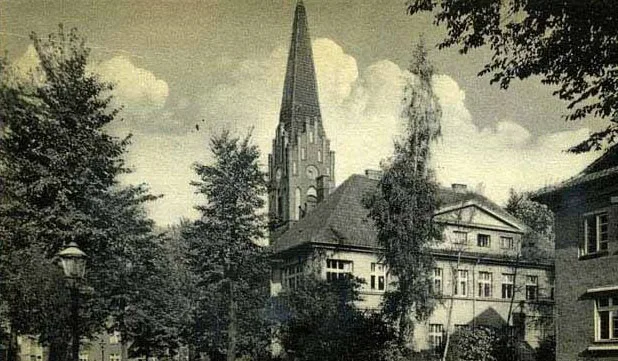
In 1905, in the small north-eastern Königsberg suburb of Kalthof (German: Kalthof, now the area around Gagarin Street), an old estate park was renovated and reconstructed. The suburb had grown out of the estate of the same name, and by the early 20th century most of its territory was taken up by numerous cemeteries (fourteen burial grounds belonging to various religious denominations), barracks, parade grounds and a shooting range. This sparsely built-up but promising part of the city was graced by Kalthof Park (German: Kalthöfer Park), which also bore another name: Berthold Kleist Park (German: Kleistpark).
The Kalthof estate, which had long stood amid meadows and woods far to the north-east of Königsberg Castle, was mentioned as a demesne of Duke Albrecht of Brandenburg, and also as the site of a French military camp pitched here in 1807, when Napoleon’s army took the city.
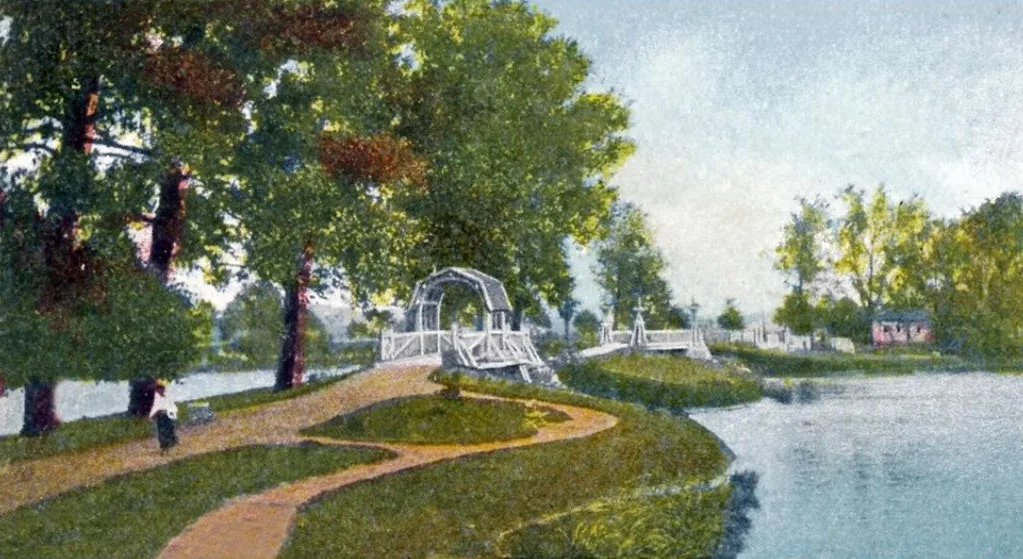
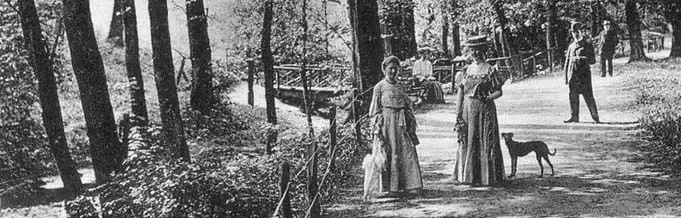
This small green space of 4.2 hectares, which appeared in the district at the beginning of the 20th century, was distinguished by its interesting layout, a charming cascade of ponds in the southern part of the park, old limes, beeches and oaks surviving from the days of the estate garden, and the full-flowing Kupfergraben brook (German: Kupfergraben — copper ditch, now the Gagarinsky), hurrying along beneath the hill. It lay a ten-minute walk from the Königstor (about 1 km) along the Königsallee (now Gagarin Street), and a little longer along the green banks of the brook through a specially laid-out promenade.
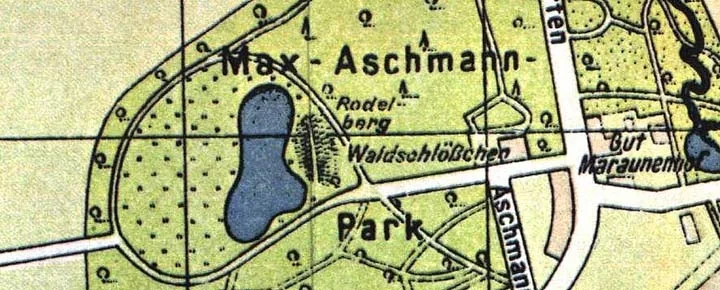
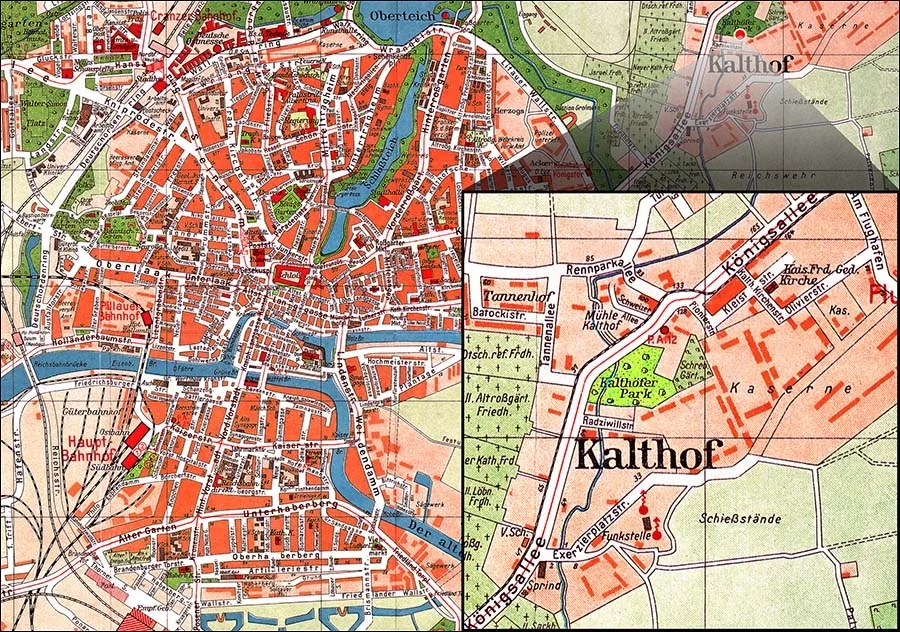 Kalthof Park on a map of Königsberg from the Weimar Republic era.
Having invested in preserving and reviving the estate garden, whose backbone was formed by old lime trees, its last owner, Berthold Kleist (1848–1925), donated the park to the city in 1905 and, according to a 1910 guidebook to Königsberg, placed there a stone bearing an inscription from Horace’s ode “Exegi monumentum”: “Non omnis moriar” — “Not all of me shall die”.
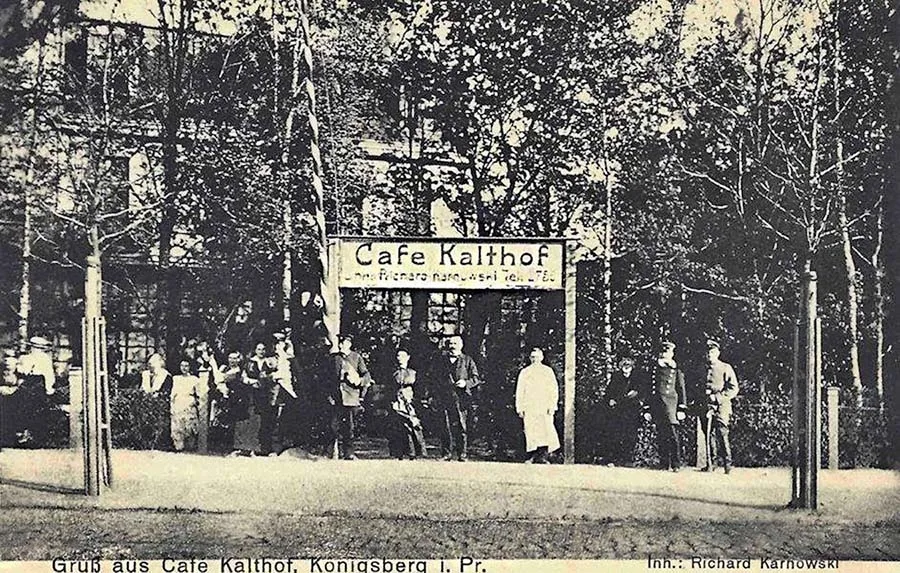 In former times there was a Café Kalthof next to the park.
Later, one of the district’s streets (now Krasnodonsky Lane), leading to the local church, was named after B. Kleist… One is immediately reminded of Pushkin’s poem “Monument”: “No, I shall not wholly die…” — the eternal human longing to leave a memory of oneself to future generations.
More than 100 years have passed since 1905. Do the people living in Kaliningrad take delight in the rustle of the old trees and their mighty beauty preserved in Berthold Kleist Park, in the gleam of the ponds with their two little bridges, and in the murmur of the brook that runs into the city from the northern suburbs — the brook that once turned the Kalthof mill, filled the Kupferteich pond (German: Kupferteich — copper pond, now the Yaltinsky) with its beach and municipal bathing place, and ran on all the way to the River Pregel?
The Gagarinsky brook, 7.3 km long, flows into the Pregolya below Yaltinsky Pond. Today, sadly, it is one of the most polluted watercourses in the city.
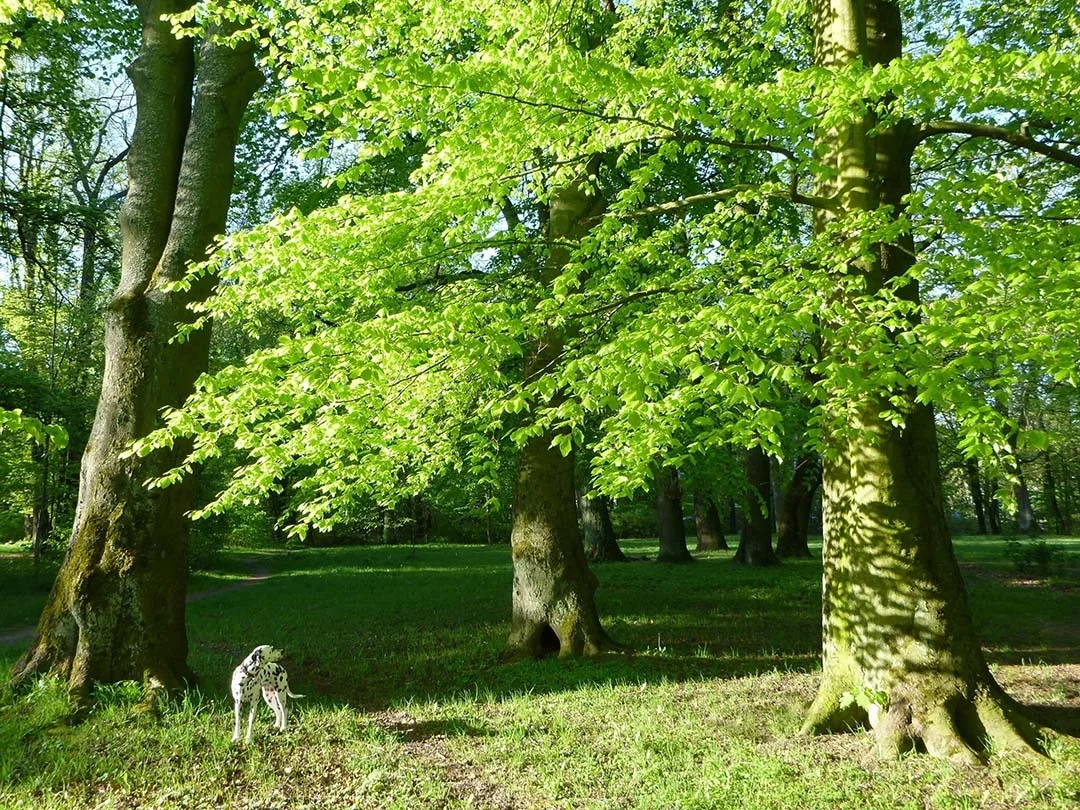
…In April 2004 the park is still alive — “not all of it has died”. It lies north of Maloyaroslavskaya Street and remains a wonderfully appealing, quiet corner reminiscent of a European broadleaf forest, with last year’s beech and oak leaves rustling underfoot, elegantly adorned in spring by the yellow “stars” of yellow star-of-Bethlehem and the “snowflakes” of wood anemone. The main part of the park lies on the high eastern bank of the brook, which is unbelievably cluttered: its waters weave between old tyres, fallen trunks and household rubbish, stubbornly carving out a new channel, so that within the abandoned park the brook splits into two branches, enclosing a stretch not yet washed away — an elongated island with surviving old trees. [In 2022–23 the brook’s bed was cleared.]
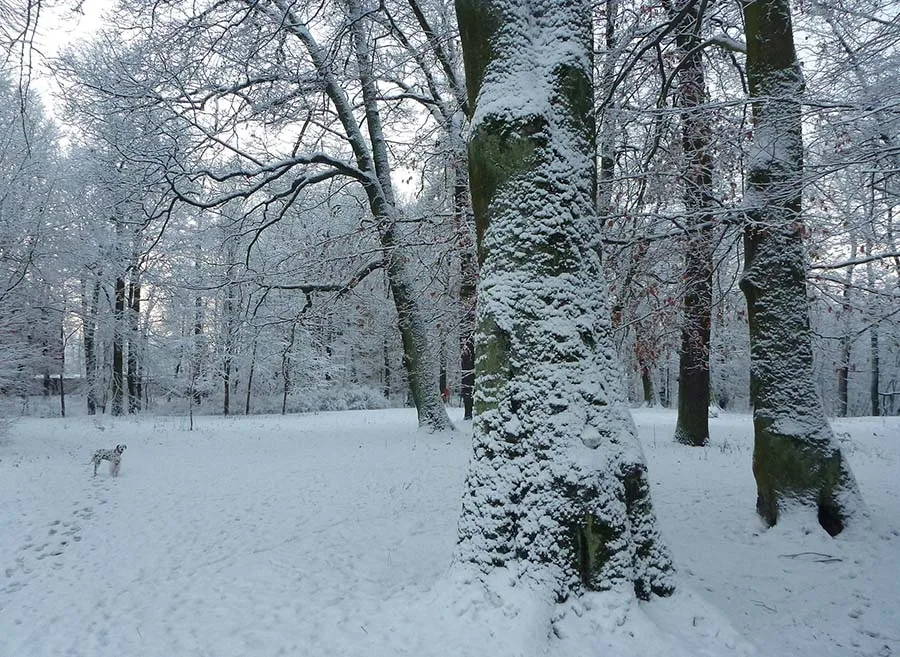 Winter wonderland in Kalthof Park.
Among them, one of the oldest limes in the park stirs particular feelings (its trunk is about four metres in girth — this one, surely, remembers the French encamped here). Its majestic trunk is still held up by waterlogged roots, its old gnarled branches are raised to the sky, but the words of its monologue we humans are unable to hear…
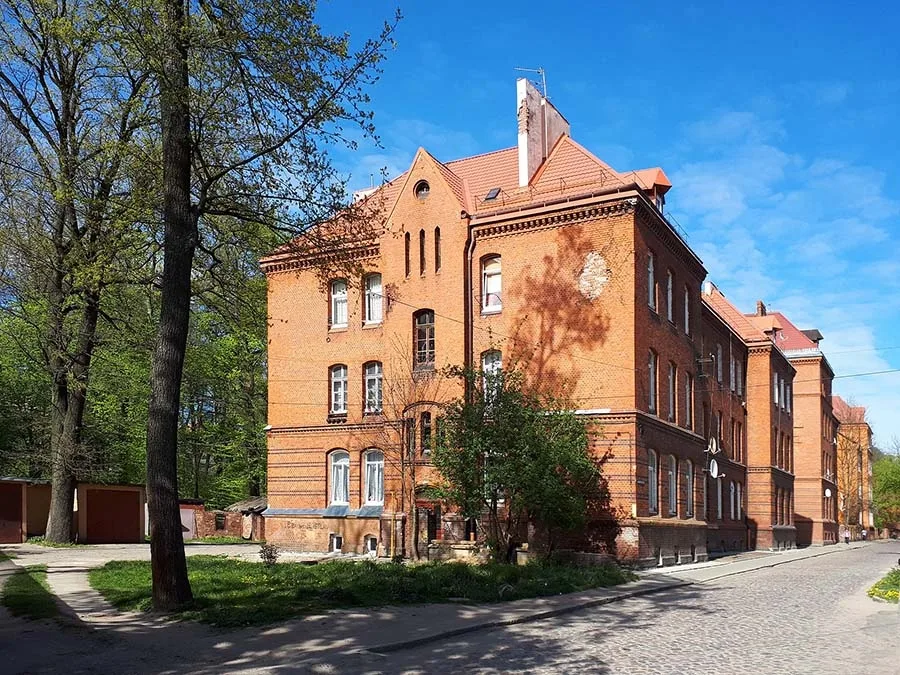 Maloyaroslavskaya Street, sheltering the park from the south.
Astonishingly, incredibly, B. Kleist’s memorial stone is still in the park. Next to it, by a huge tree, lies a second stone, which the guidebook did not mention. Its inscription reads: “Zur ERINNERUNG AN BERTHOLD KLEIST” — “In memory of Berthold Kleist”. There is also a third stone, lying face down and sunk into the ground; we do not yet know whether it bears an inscription or what it might say. [As of 2024, the stone with the quotation from Horace is no longer in the park. Berthold Kleist’s memorial stone has been moved to Maloyaroslavskaya Street, outside No. 16A.]
A small section of the old park — its highest part, and now [in 2004] an unnamed green area — has been taken over by a newly built Christian Baptist church, the “House of Prayer”, crowding out the old limes of the Kalthof estate that had been preserved during the park’s reconstruction at the beginning of the century.
On the pond side, the southern boundary of the park is formed by red-brick residential buildings of German construction from the late 19th century (they now make up Maloyaroslavskaya Street — pictured above). Near the houses, a few enormous beeches mark the beginning of the park grounds. This is where the promenade along the brook led, all the way from the Kupferteich (Yaltinsky) pond.
On the eastern side, new blocks of flats press up against the park. The pond in the southern part of the park has been partly filled in with soil dug out during the construction of the new housing estate. There is little water here and a great deal of rubbish, so the already miniature cascade of ponds trickles as a thin stream into the Kupfergraben brook, which divides the park into two landscape sections unequal in size and position: the western one, closer to Gagarin Street and low-lying [still without any protected status in 2024], and the eastern one, high up on the opposite bank. There, of course, the park’s former layout has not survived, but many trees have — standing singly, in groups and even in a still discernible avenue along the pond, which now runs up against the new housing estate on the Chuvashskaya Street side. Despite its neglect and desolation, this part of the park is still beautiful: in the centre, in a large clearing, stand groups of trees — oaks, beeches and two tall larches.
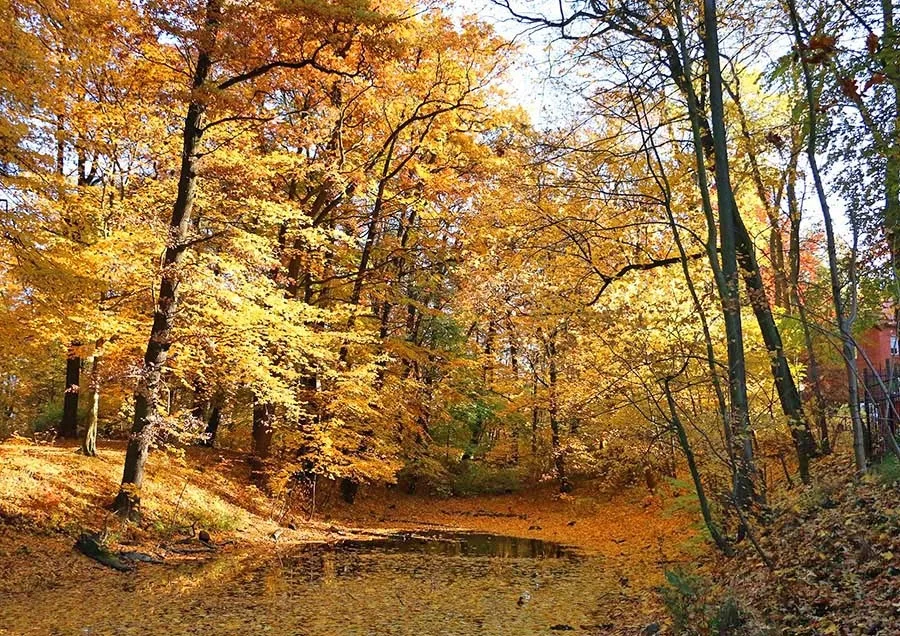
Autumn landscape by the cascade of ponds in Kalthof Park.
Above the brook, bordering the clearing on the west, rise old oaks, at whose feet the flowers of yellow star-of-Bethlehem dot the green grass with spots of gold (and this just twenty metres from Gagarin Street, with its endless stream of traffic and air blue with exhaust fumes!).
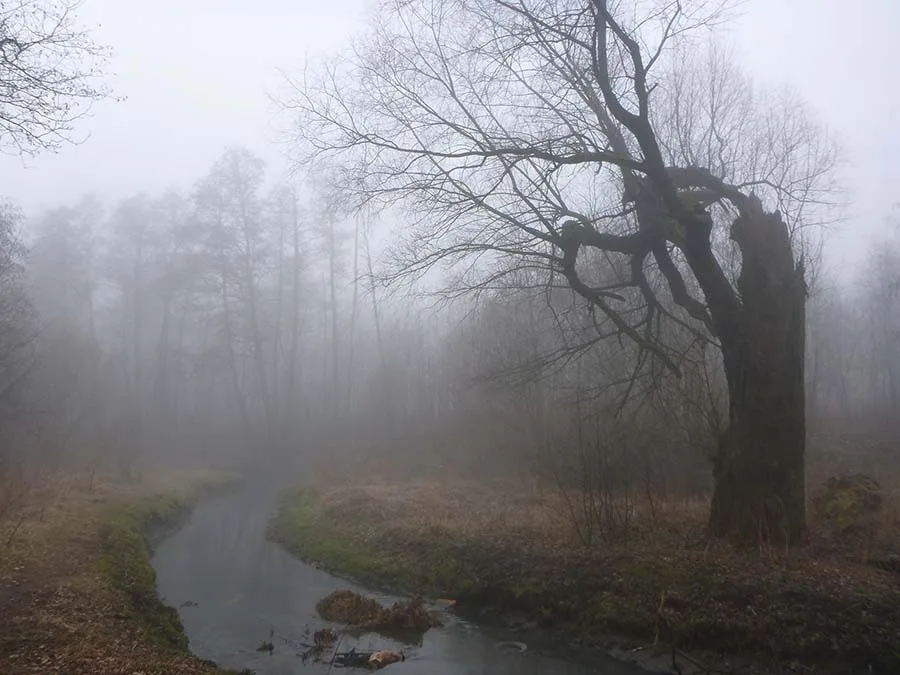 The Mill Brook (Mühlengraben | Gagarinsky), better known as the Copper Brook (Kupfergraben).
Some fifteen limes, mentioned in the 1910 guidebook as a legacy of the old manorial estate park, each 3–4 m in girth, grace the hill in the north-western part of the park near the church [by 2024 there were far fewer limes as well].
The neglected yet surviving park, perhaps greeting its last spring, hemmed in by the city, with neither status nor protection, the stubborn stream with its centuries-old history, the song of carelessly joyful birds: all of this was enchanting in the spring of 2004, a year before the 750th anniversary of our city of Kaliningrad…
[On 17.06.2020 the “City Park of Culture and Recreation on Maloyaroslavskaya Street – Yu. Gagarin Street” was granted the status of a specially protected natural area: the City Park of Culture and Recreation.]
On Maloyaroslavskaya Street (German: Fürst-Radziwill-Straße), next to the park, in the middle of a tiny, neat, landscaped square, stands, surrounded by three tall spruces and a chestnut tree, a memorial to German soldiers killed in the First World War. Judging by the date carved into the monument itself, it was erected in 1923. The memorial (sculptor Paul Borchert, 1838–1930) is a low (4.4 m) pyramid of stone dressed into square blocks, with a bas-relief set within a semicircular niche depicting a dying soldier leaning on his right arm, beside which lies the helmet of a victim of that first terrible war of the twentieth century. [The “Pyramid” was restored for the 750th anniversary of Königsberg-Kaliningrad; the chestnut tree that stood beside the monument was cut down in the late 2010s, when the city was headed by A.G. Yaroshuk.]
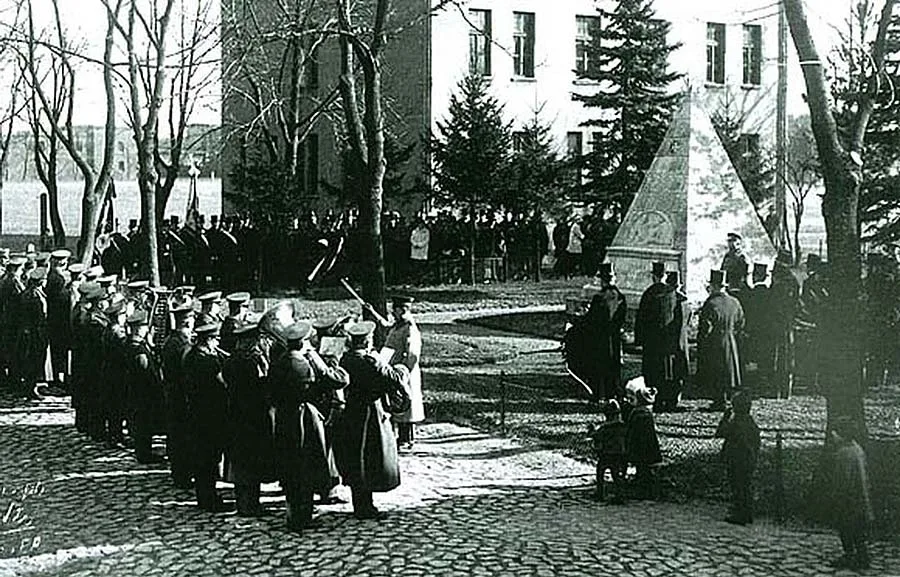 The ceremonial unveiling of the memorial to fallen sappers on Prince Radziwill Street, 27 May 1923.
On the front of the “Pyramid” [the monument’s unofficial name] the inscription UNSEREN GEFALLENEN KAMERADEN. 1914–1918 (To our fallen comrades) has survived.
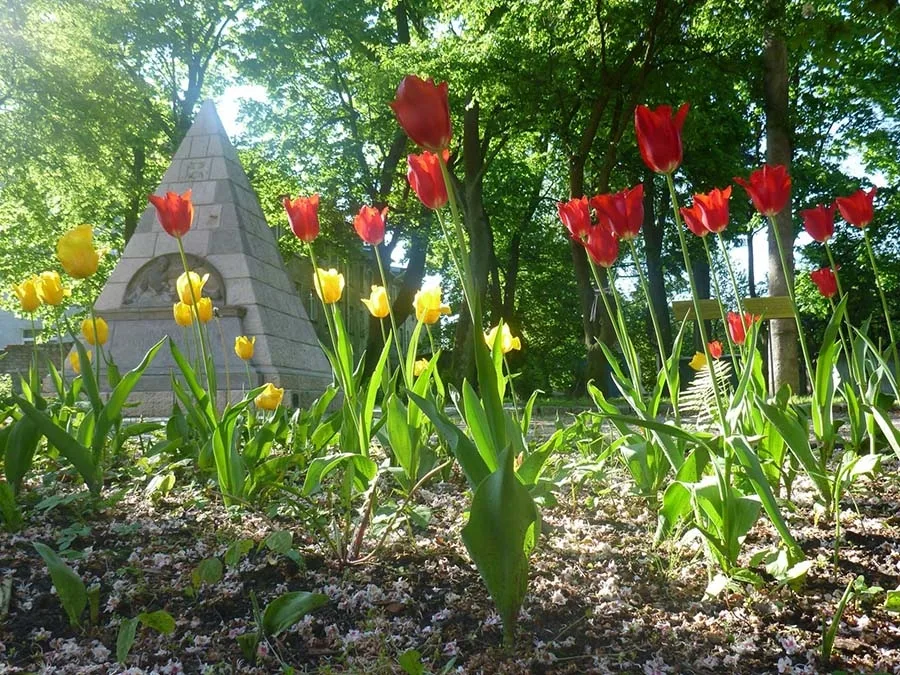 The “Pyramid” on Maloyaroslavskaya Street today.
On the reverse side there is a marked-out “panel” with an inscription that reveals which units the fallen soldiers belonged to:
Pionier-Bataillon Fürst Radziwill Ostpr. №1
Samland Pionier Bataillon №18
2 Westpr. Pionier Bataillon №23
Eisenbahn-Regiment №1
Eisenbahn Bataillon №4
622 Feldformationen vorst Truppenteile.
…Gardens and parks appear around human dwellings in those periods when, even if only for a short time, people are not threatened by war, when they believe in their future. Gardens and time… The eternal struggle between the urge to create beauty and destructive human aggression…
Modern photos on this page by Mikhail Ogorodnikov.
Translated from Russian with the help of AI (Claude, Anthropic), October 2026.