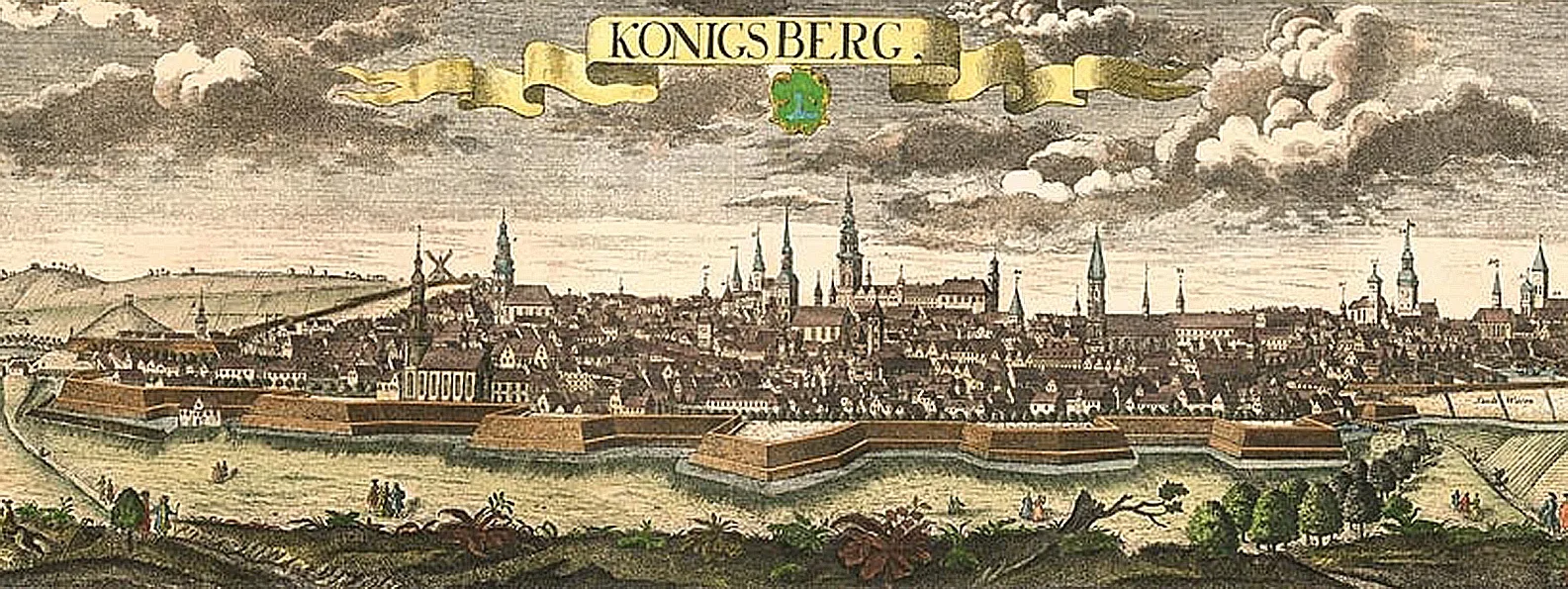
LEGENDS OF PRUSSIA in the blog of Tatyana Kolivay.
Human nature is such that we sometimes ponder unfathomable things that have no practical sense at all: how many shoes and boots people wear in Königsberg, how many stockings and gloves lie in its ladies' wardrobes, and so on.
We may also wonder how many whales swim in the polar seas or how many ships with countless treasures rest on the bottom of the sea. And someone else imagines a building in which every room has yet another door leading into the next, so that we never have to turn back – only onward, through an endless architectural universe of stone, wood and glass. We can dream of such immense buildings, whose walls are measured in miles, whose towers reach the clouds and whose staircases and passages are beyond number: stairs up, stairs down, vaulted terraces passing one into another, and airy galleries winding around the storeys like tropical lianas.
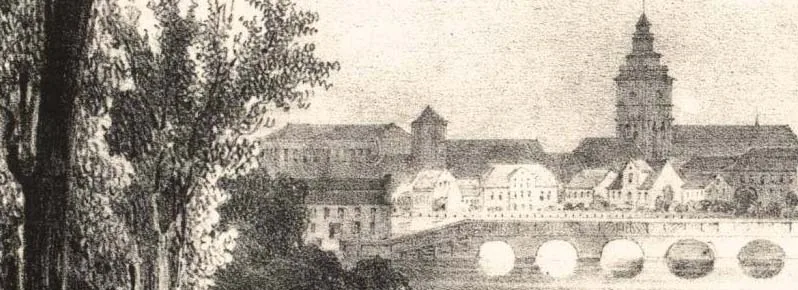
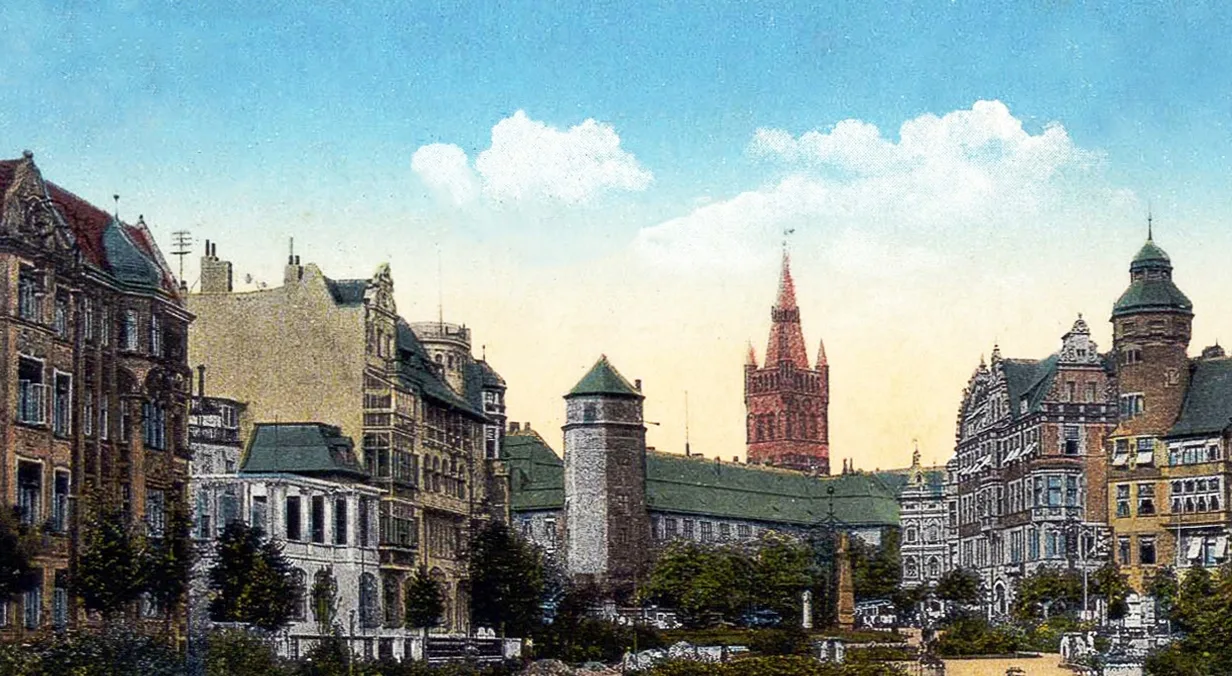
And what a delight it is to picture such grandiose forms in one's imagination and to be able to bring them to life! Truly, architecture is one of the most mysterious and captivating fields of human genius!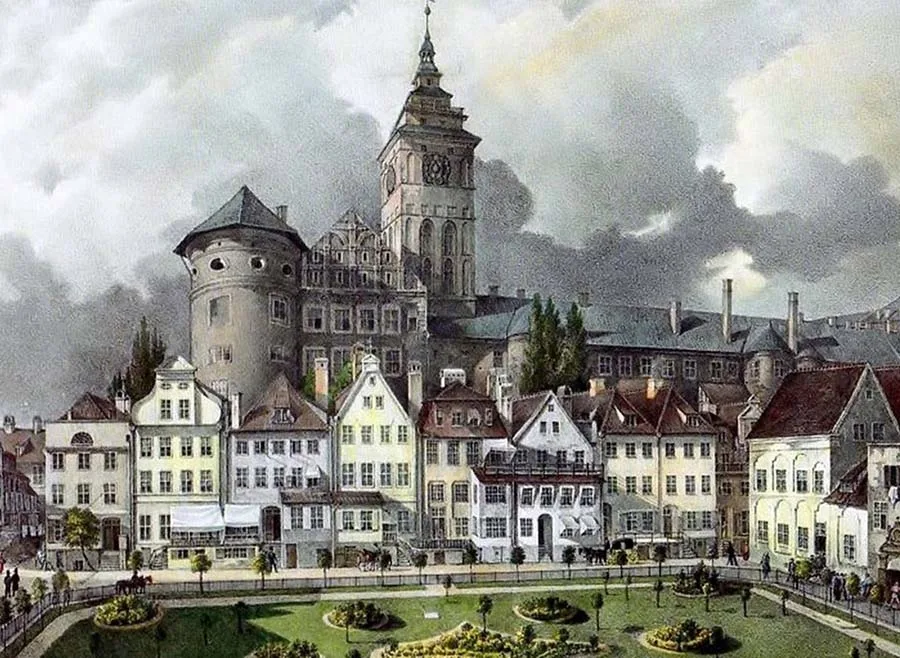 View of the castle from Altstädter Kirchenplatz.
Here in Königsberg there is no Heidelberg Castle, in whose picturesque ruins owls, mice and spiders nest. There is no Prague Hradčany, within whose solidly built walls costly state rooms, imperial drawing rooms, dining halls and magnificent picture galleries spread out with careless elegance and at the same time with noble sweep. But we in Königsberg also have a castle, and the very word sounds in my soul like enchanting music.
I am already too old to share today's young people's dislike of ancient chivalry1; I still have too much sympathy for the Middle Ages, which I once admired, and I still cherish the passions of my youth – in short, I still associate the word "castle" with something magnificent, with an idea of earthly paradise. The architecture of a castle ought indeed to embody such notions as grandeur and dominion.
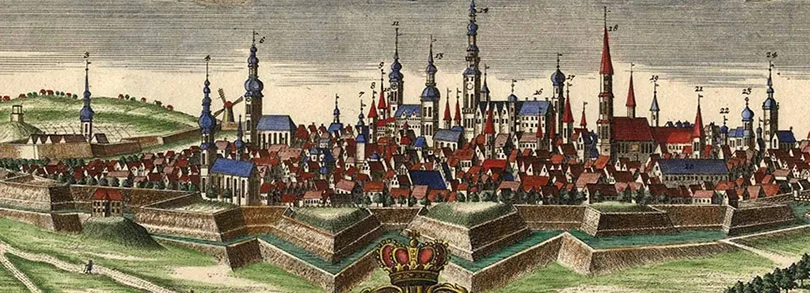
Our castle makes a majestic impression above all because of its position [on a hill]– it dominates the city. The castle tower is the tallest building in the city and is therefore the lookout post of the local fire brigade. Moreover, Königsberg Castle is of very imposing size.
Several infantry regiments could easily fit into the castle courtyard. One wing with a separate entrance [the Unfried wing] was built relatively recently, in order to provide the King's noble guests with temporary accommodation befitting their status and, at the same time, so that His Majesty could show himself to his subjects assembled on Castle Square from the windows or the balcony. This addition differs in style from the rest of the castle because it was built later than all its other parts (1705–1712).
Our castle at once proclaims itself the most important building in the city, whether you look at it from somewhere far away or approach it from a neighbouring street. A very impressive view of it opens up from the Altstadt Market [Altstädtischer Markt] and from the square in front of the Altstadt Church [Altstädter Kirchenplatz]: the castle rises solemnly above both Pomatti's elegant court confectionery and the houses around, dominating the cityscape.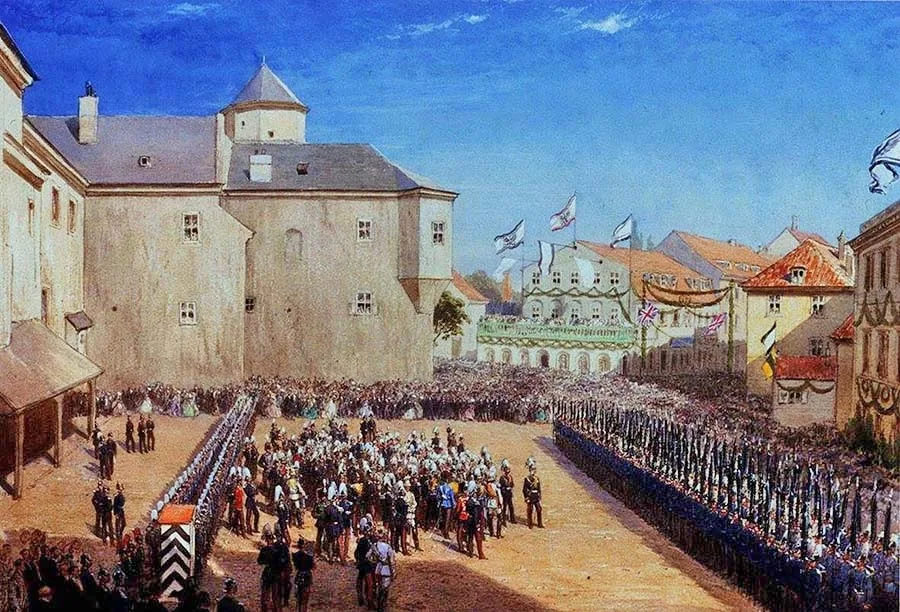 Ceremonial parade on Castle Square.
The uniqueness of our Royal Castle, witness of many eras, lies, in my view, in the variety of its architectural styles. The oldest of them is the style of the Teutonic Order period, in which the tower and the Castle Church2 were built.
Beneath the church lie extensive vaults, now used as wine cellars, and above its vaults is the enormous Muscovite Hall, with large bright windows on all four sides, from which there is a most beautiful view of the city and its surroundings. Passages lead into the hall from the side towers, and the towers themselves have no shortage of small, elegant chambers. The present church was once the assembly hall [refectory] of the knight-brothers of the Order, while services at that time were held in the chapel. Later the knights' assembly hall was converted into a church, and that is why its architecture is so complex and confusing.
The vaults, the columns, the allegorical grisaille paintings "grey on grey" and the coloured heraldic painting are excellent in themselves, but on the whole the church falls short of what our castle would seem to deserve. Inside it the eye simply cannot find the centre of the composition. It does not know whether to cling to the organ hanging at the side, to the pulpit, or perhaps to the pews of the nobility rising opposite. The light from the windows barely glimmers, lost somewhere among the upper galleries, choirs and stained glass, so that the church always makes a gloomy, dreary impression.
It is striking that all these wooden structures are made in a style completely out of harmony with the original: these angular, ugly boxes in which the worshippers sit, these bare surfaces painted white and yellow, all these crude forms and the tasteless gilding around the pulpit and altar simply scream their ugliness against the background of slender columns and graceful vaults. Add to the abundance of visual dissonances listed above the large flat tablets bearing the names of warriors who sacrificed themselves for the fatherland in cruel battles, and you will get a rough picture of this strange place where God is worshipped.
But there are places in the castle that make the most fantastic, fairy-tale impression. In them, as in the Archive, which also serves as the meeting hall of the Royal German Society, we find magnificent arches and beautiful Gothic windows.
The Gothic windows are followed by windows of more intricate shape. Then come square and rectangular ones again, running for several arshins in a perfectly straight line, then diverging in a whimsical zigzag. There are grand portals here, as well as walled-up windows and doors. It is these that make the strongest impression, a special effect of mystery. Where did this door once lead? What lies hidden behind it? These thoughts awaken the wildest fantasies in us, and we dream of returning, if only for a while, to the age when the impregnable stronghold of the Teutonic Order on the Pregel was surrounded by moats with drawbridges, prisoners were brought here, and a vast territory around the castle was ruled by local commanders.
Here, next to the stairwell, the mouth of a cellar peeps out, and above it hangs, spanning two storeys, a handsome wooden gallery, badly dilapidated but picturesque, as if inviting one to climb to the doors above. Where this mystical part of the castle ends, a later building in a strict Romanesque style extends as far as the front corner tower. It at once proclaims its connection with jurisprudence, or rather with justice, since it bears its symbol, the fasces – a bundle of rods with an axe in the middle3.
The façade parallel to the church is now designed in the dry style of a country house of the second half of the 17th century, but the wing between them, which houses the apartment of the Oberpräsident (!), is built entirely in a plain bourgeois style. Finally, the most modern part of the castle [see above – the Unfried wing] reminds us in its architecture of Italian palaces, more precisely Florentine ones.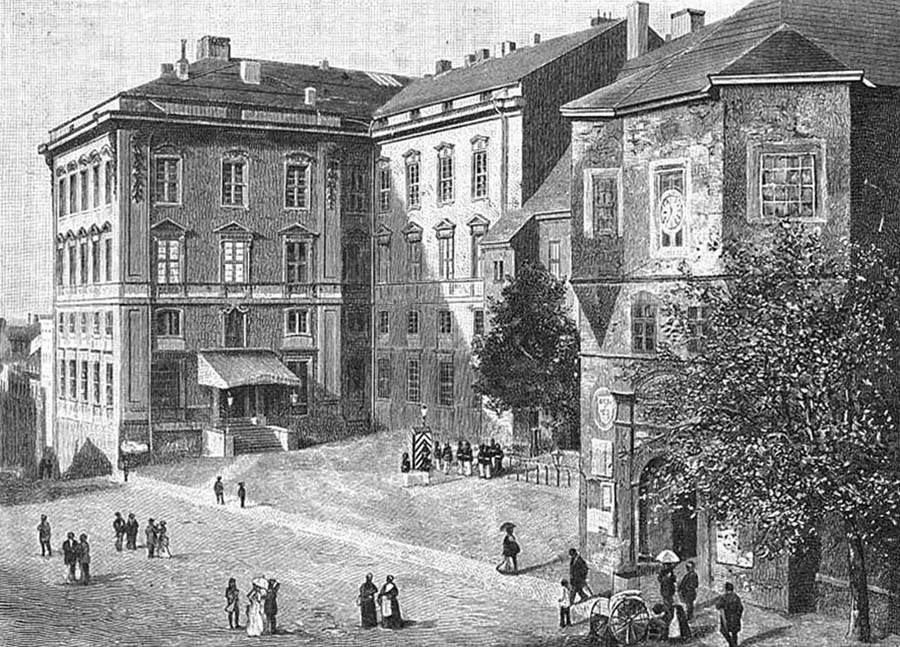 East wing of Königsberg Castle and Castle Square below its walls.
If you look at the castle from the square named after it, the east façade, beginning with the above-mentioned Unfried wing on the left and ending with the Oat Tower on the right, is the most picturesque, since it combines many contrasts of high and low, symmetry and irregularity, splendour and simplicity, smooth and angular.
And this spectacle is heightened in winter, when snow lies on the ground and the moon pours its magical light on the red-black, black-blue and white-brown masses of stone, edged below and above with glittering snow.
In this enormous castle there are halls that receive guests perhaps only once in several decades (the royal apartments) or are decorated for celebrations, such as the Muscovite Hall, which, by the gracious permission of the present King, we used quite recently for an art exhibition.
There are halls with the green tables of the tribunal, the consistory, the Higher Regional Court and so on. Here are archives, libraries, cabinets of antiquities, schools of arts and crafts, official apartments for the families of some employees, castellans and others.
The castle hosts the meetings of a whole range of learned societies which, being public, regularly bring together almost all the educated people of the city. There is excellent water here in a remarkable well, and in the cellar under the north wing there is a cosy wine restaurant with the grim name "Blood Court" [Blutgericht].
There is room here for the city guard as well, and over there, in the far back corner, towards Prinzessinstrasse, stands a massive prison tower resembling a cannon [the Oat Tower, German: Haberturm]. And for all of us crossing Castle Square, an accurate standard clock shines from the large window of the meeting hall of the Physical-Economic Society. In short, the most varied activities go on in this enormous castle.
People constantly pass through the castle gates, carriages drive in and out. Just stand in some corner of the courtyard and watch the figures passing in different directions beneath its high walls, as if on a stage that is always filled with new actors.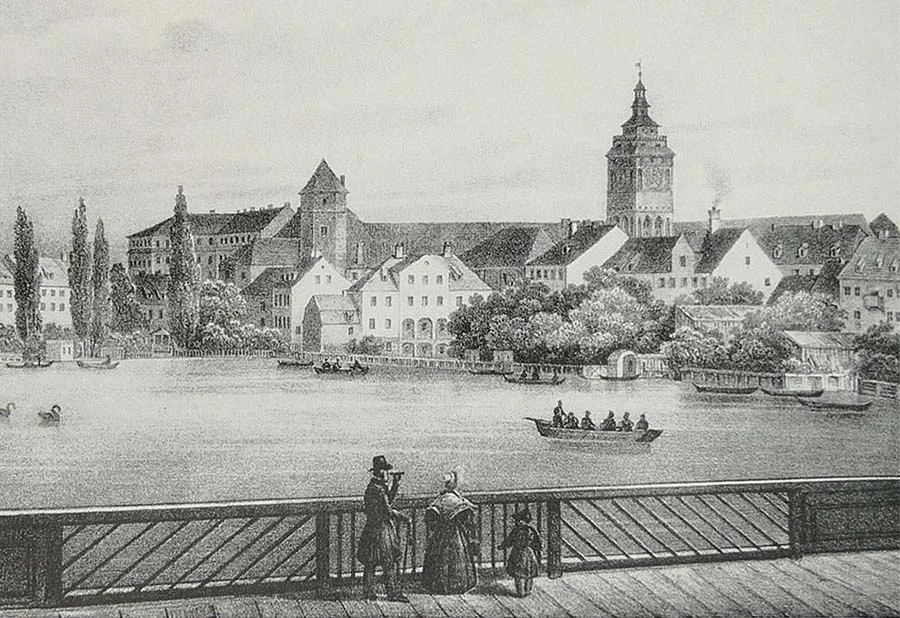 View of Königsberg Castle from the pond.
But for all the fullness of its inner life, the castle does not alter the general character of Königsberg. Thanks to the rectangular shape of its courtyard and the absence of any statues and other often inappropriate decoration (apart from a couple of coats of arms), its appearance fits very logically into the surrounding urban space.
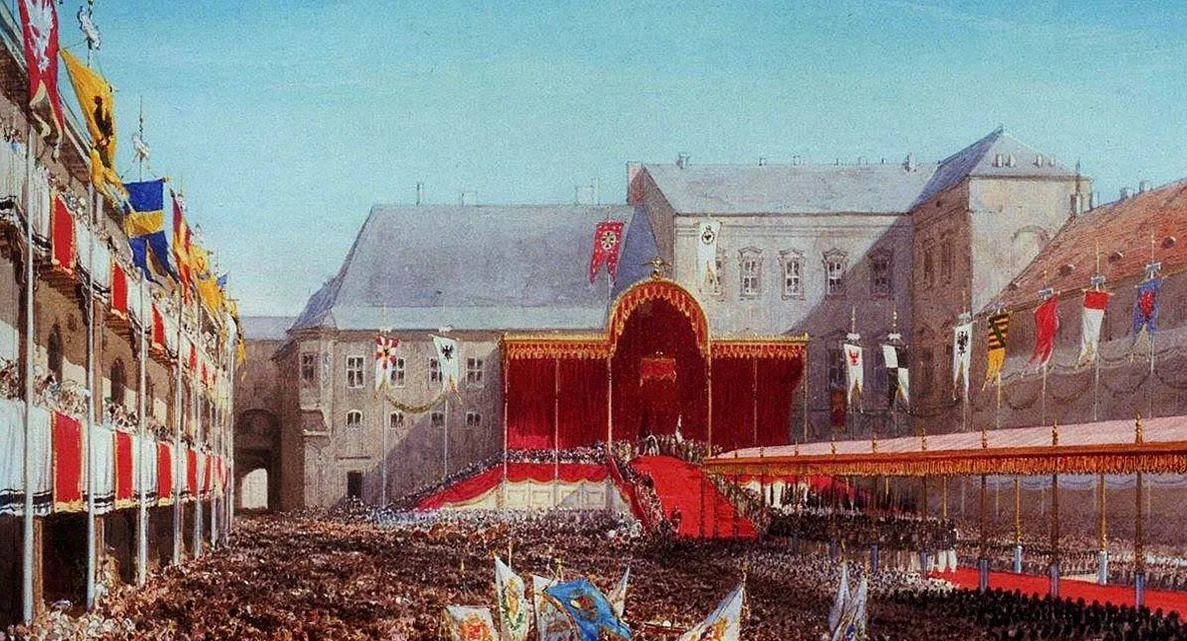
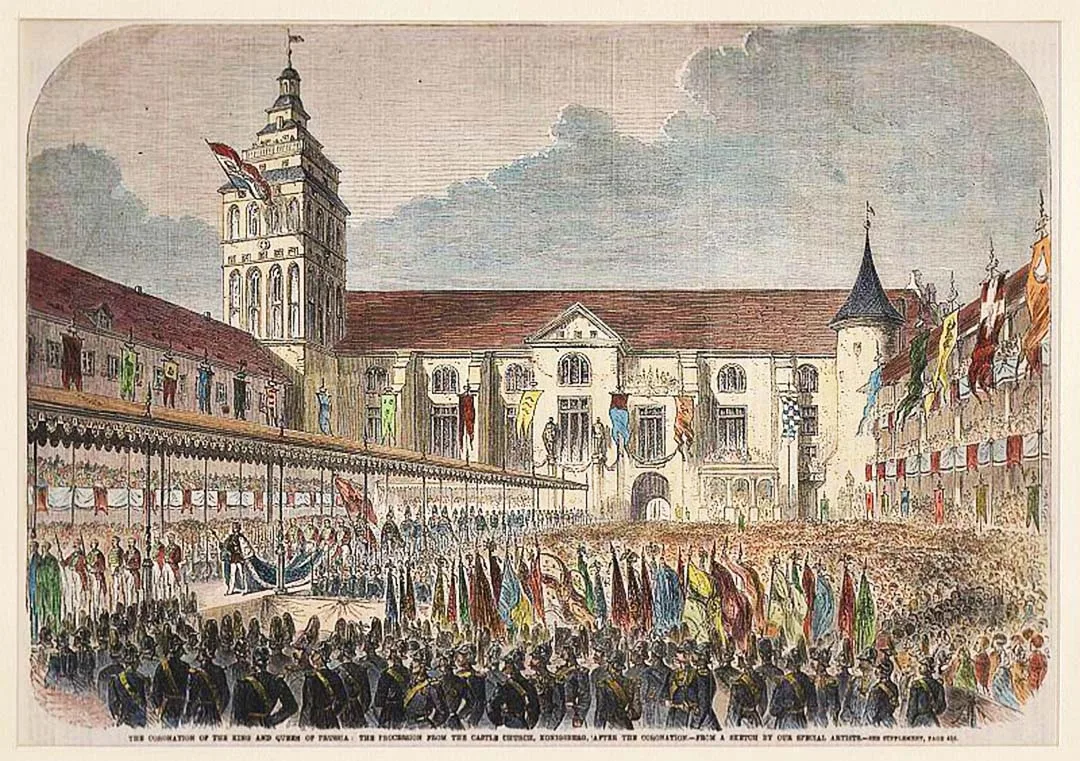
The elevation from which our monarch, at his coronation on 10 September 1840, delivered a speech4 that set his subjects' hearts aflame is a very prosaic porch. Yet every word that came from the King's stirred breast echoed in the castle courtyard so that everyone present could understand its meaning quite clearly. And even centuries later this spot will be shown with reverence as the altar at which the King made his vow to his people before God.
TRANSLATOR'S NOTES
1. At the time he wrote the "Sketches", Karl Rosenkranz (1805–1879) was not yet forty.
2. Here the author shows that he is not well informed: the oldest part was the north wing of the castle, built even earlier than the keep and the church.
3. The fasces – a bundle of rods with an axe in the middle, tied with a strap – was a symbol of the power of the highest officials in ancient Rome.
4. Frederick William IV (German: Friedrich Wilhelm IV; 15 October 1795, Berlin – 2 January 1861, Potsdam) was King of Prussia from 7 June 1840, of the Hohenzollern dynasty. He was the elder brother of William I, the first emperor of a united Germany, and of the Russian Empress Alexandra Feodorovna, wife of Emperor Nicholas I. The text refers to the speech that the newly minted emperor of Prussia delivered to his subjects in the courtyard of Königsberg Castle.
LEGENDS OF PRUSSIA in the blog of Tatyana Kolivay.
Translated from Russian with the help of AI (Claude, Anthropic), October 2026.