Nasser Garten is mentioned in the 16th century as a settlement with garden plots belonging to Haberberg (Kaliningrad, the area of Bagrationa and Olshtynskaya Streets, German: Haberberg), which in turn was a suburb administered by the municipality of Kneiphof (Kaliningrad, Kant Island, German: Kneiphof). Nasser Garten bordered on the Alter Garten district (Kaliningrad, the area of Bagrationa and Elblongskaya Streets, German: Alter Garten). In 1626 the main defensive rampart of the bastion ring was built between Alter Garten and Nasser Garten. From then on Nasser Garten lay in front of Königsberg's Brandenburg Gate. Nasser Garten lived up to its name (which translates as "wet garden"), since it lay in a natural hollow and was periodically flooded by the Pregel and by groundwater, which was pumped out by horse-driven pumps.
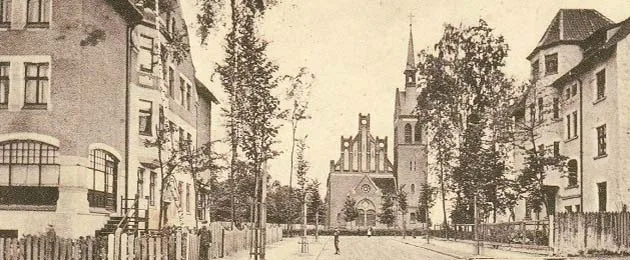
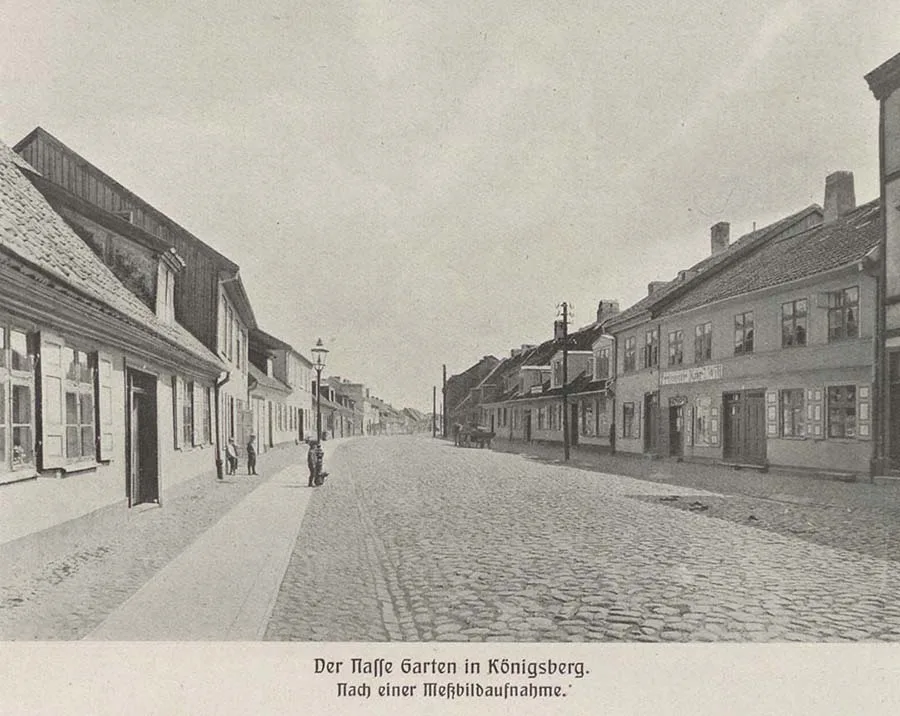 Nansena Street (German: Der Nasser Garten) at the beginning of the 20th century.
By the beginning of the 19th century Nasser Garten had become a sizeable suburb of Königsberg.
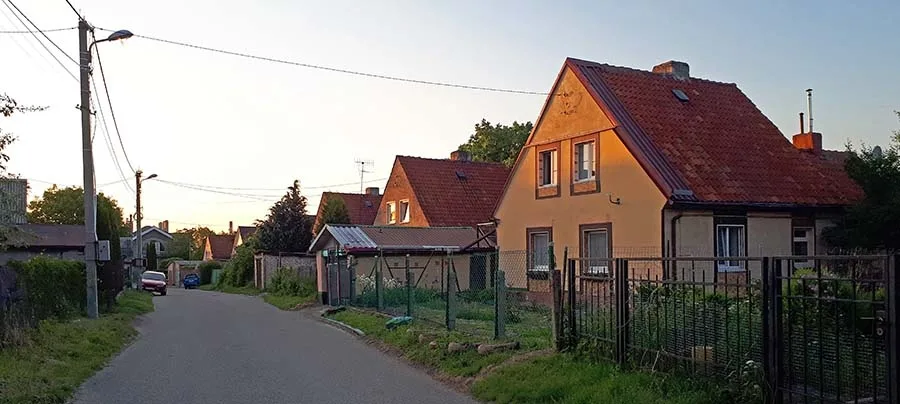
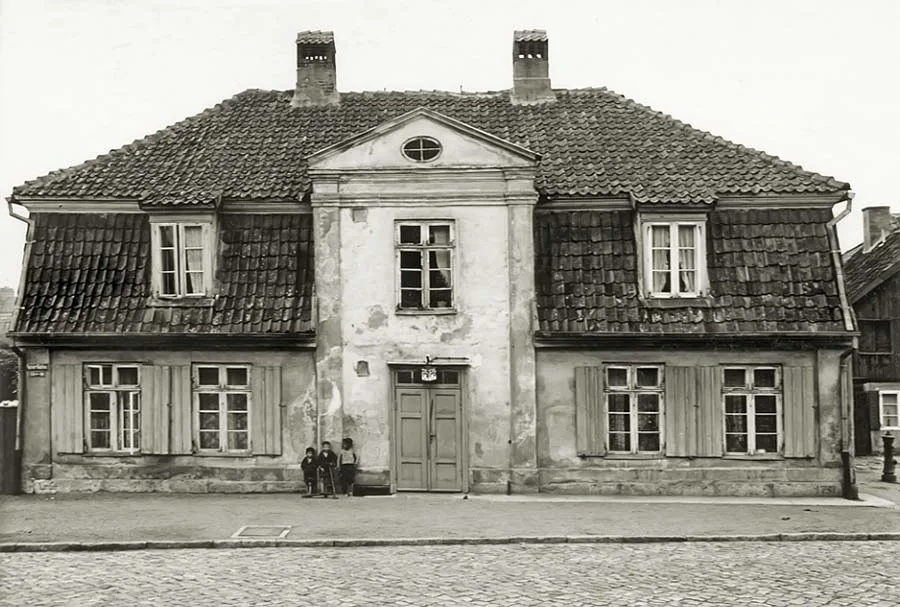 The façade of one of the little houses on Nasser Garten street (No. 75).
At the end of June 1807 the commandant of the fortress of Königsberg, Ernst von Rüchel / Ernst von Rüchel (1754–1823), while preparing the defence of the fortress against Napoleon's army, ordered the houses and gardens of Nasser Garten to be burned, since they stood on the glacis1 and obstructed the fire of the fortress artillery. 36 houses and nine windmills were burned in Nasser Garten at that time. On 1 July 1807 the corps of Marshal Nicolas Jean-de-Dieu Soult / Nicolas Jean-de-Dieu Soult (1769–1851) entered the burned-out Nasser Garten. After the garrison of Königsberg refused to surrender, Soult ordered an artillery bombardment of the city from Nasser Garten, which, however, was unimpressive and caused only a few fires. It never came to storming the city, since on 3 July 1807 the Russian general Nikolay Mikhaylovich Kamensky (1777–1811) and the Prussian general Anton Wilhelm von L'Estocq / Anton Wilhelm von L'Estocq (1738–1815) received orders to abandon Königsberg and proceed towards Tilsit to join the main forces.
After the end of the Napoleonic Wars, Nasser Garten was rebuilt.
From the Brandenburg Gate began Berlin Street (German: Berliner Straße), which in the 19th century was called the Brandenburg Highway (German: Brandenburger Chaussee). Today Berlin Street bears the name of Suvorov. Parallel to the Berlin road ran the settlement's main street, which bore the same name – Nasser Garten (German: Nasser Garten, now Nansena Street). In the second half of the 19th century there was a cavalry riding hall between these streets.
From Nasser Garten street three streets led north to the Pregel; their common name can be translated as "drove" (for domestic animals, livestock): the First, Second and Third Droves (German: 1. Trift, 2. Trift, 3. Trift). Between them lay polder lands used for grazing.
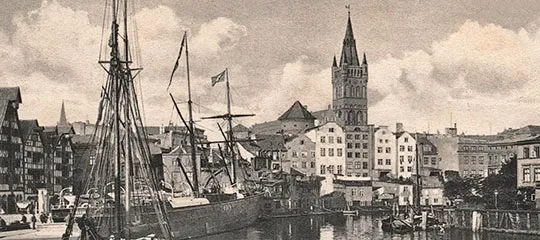
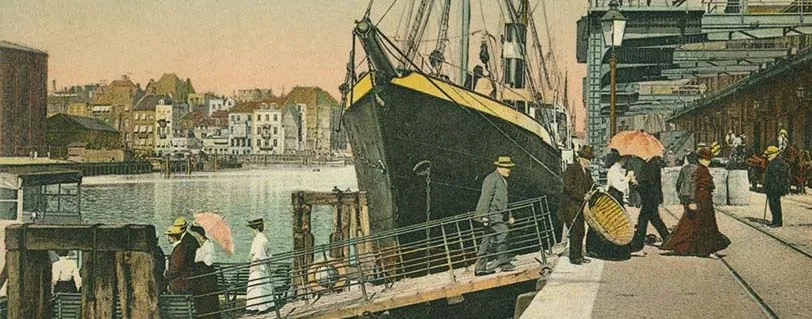
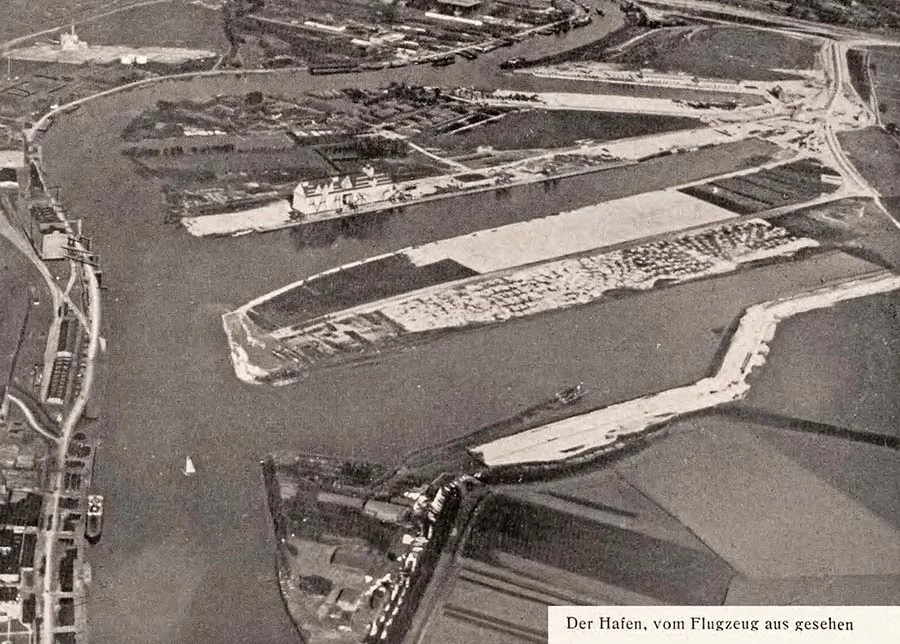 The port of Königsberg from a bird's-eye view (1925).
On the north these lands were protected from the waters of the Pregel by the Poets' Dam (German: Poetendamm), which served as both a dam and a road.
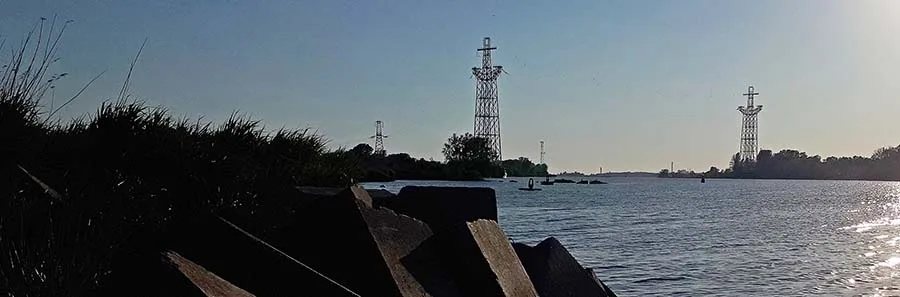
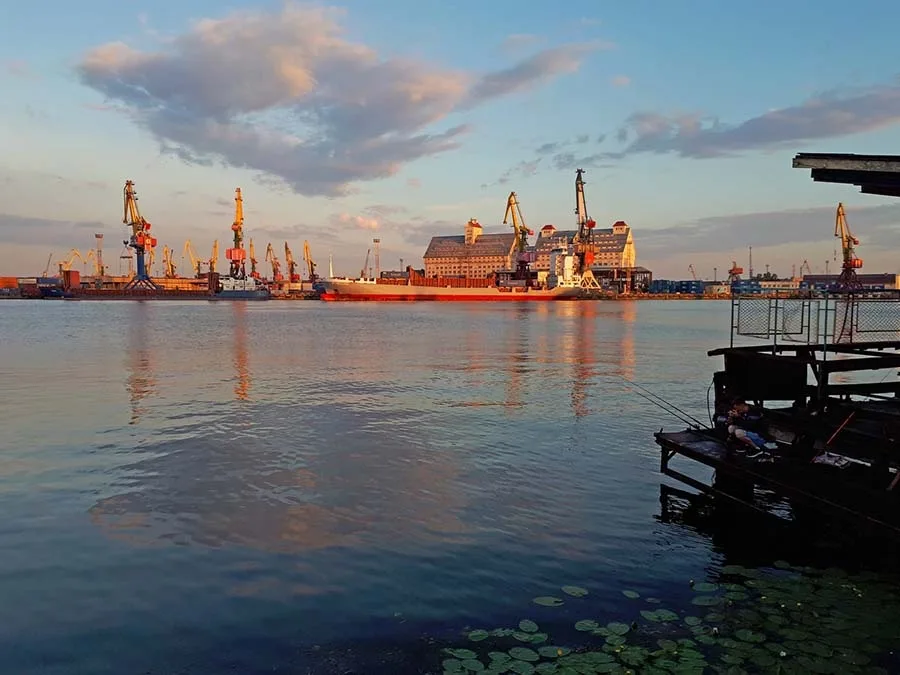 From the opposite bank of the Pregolya the Portovoye district looks very picturesque.
All these streets had already taken shape at the beginning of the 19th century. In the second half of the 19th century Charles Street (German: Carlstraße, now Uzlovaya Street) and the Street of the Virgin Mary (German: Marien Straße, now Morskaya Street) appeared. Next to them were artillery barracks. At the far end of Nasser Garten (further from the city centre) lay the New Haberberg Cemetery, already marked on the map of 1883.
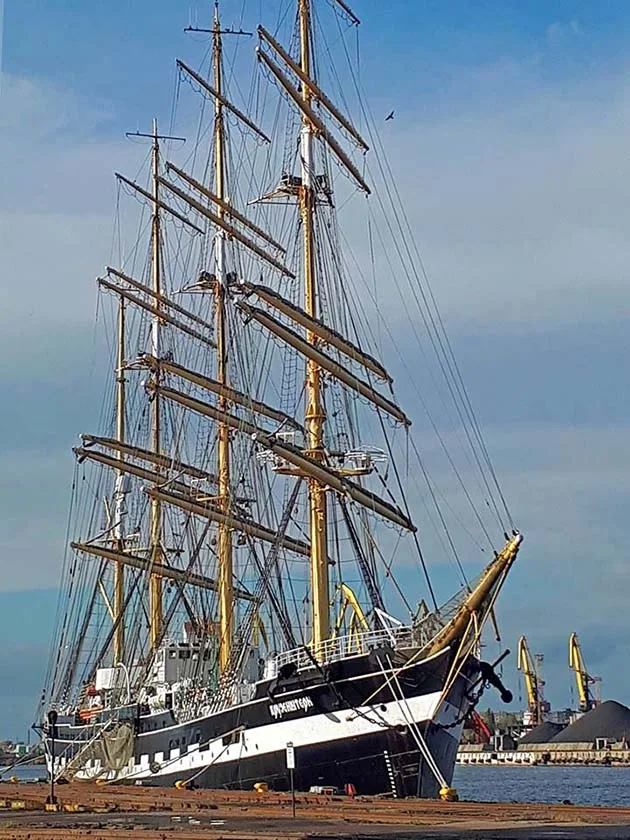
After the port of Königsberg was moved in 1924 from the centre of Königsberg to Nasser Garten, Port Street (German: Hafenstraße) was formed, which still bears that name today. The ceremonial opening of the new seaport took place on 13 June 1924, on the 200th anniversary of the creation of the unified city of Königsberg. At about the same time, on the site of the former cavalry riding hall, another street appeared – Nassergärter Feuerweg (German: Nassergärter Feuerweg), which can be translated as "Fire Access Road to Nasser Garten". Today it is Chaadayeva Street. Before the war Königsberg tram route No. 8 ran through Nasser Garten.
During the Second World War Nasser Garten was not damaged by the raids of the British Royal Air Force, but it was bombed during the storming of the city on 7 April 1945.
The offensive here was conducted by the 18th Guards Rifle Division (Major General G. I. Karizhsky, 1895–1971) of the 36th Guards Rifle Corps of the 11th Guards Army. To hinder the advance of Red Army infantry and armour, the defending side flooded the local polders. Since then four ponds have formed in their place, now known as the Nansen Ponds. The ponds are popular with anglers from all over the city who "specialise" in crucian carp.
After the end of the war, by order of the commander of the troops of the Special Military District, Guards Colonel General K. P. Galitsky, of 23 November 1945, streets were renamed: Carlstraße became Uzlovaya Street, Marien Straße Morskaya, and Berliner Straße Varshavskaya Street. The first two have kept their names to the present day (2024), while Varshavskaya was renamed Suvorovskaya on 1 August 1946, and later became Suvorova Street) at the same time all three Droves (German: Trift) were renamed, becoming the 1st, 2nd and 3rd Dambovaya Streets. Nasser Garten street was given the name of Nansen, and Hafenstraße became part of Portovaya. The few surviving houses, after repair and restoration, were used as housing for seaport workers.
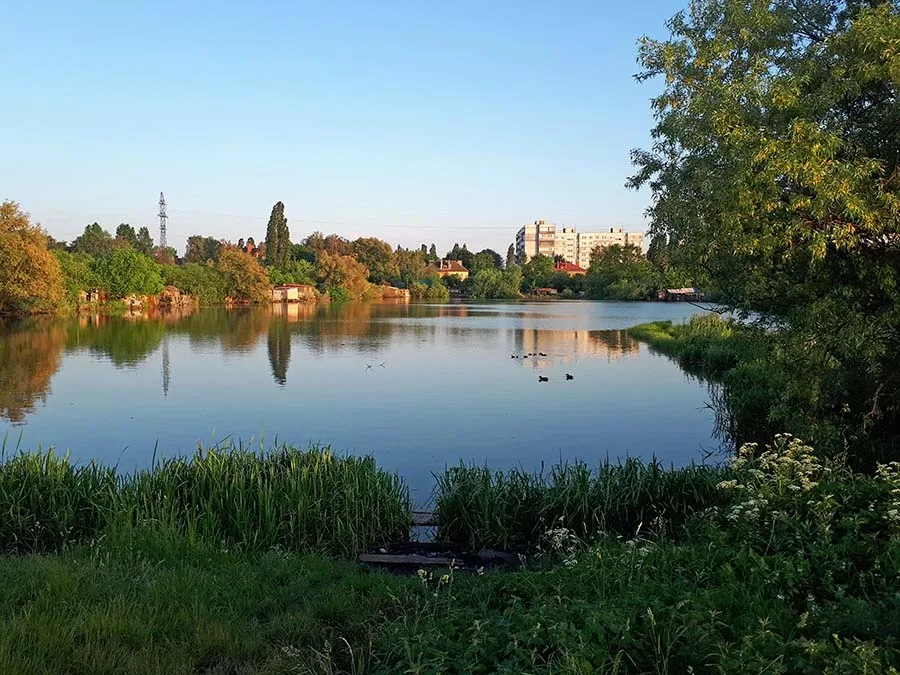 The banks of the Nansen Ponds are one of the cosiest spots in Portovoye.
On 18 August 1949, by decision of the Kaliningrad City Executive Committee, Nasser Garten was renamed the settlement of Portovoye, part of the Baltiysky district of Kaliningrad.
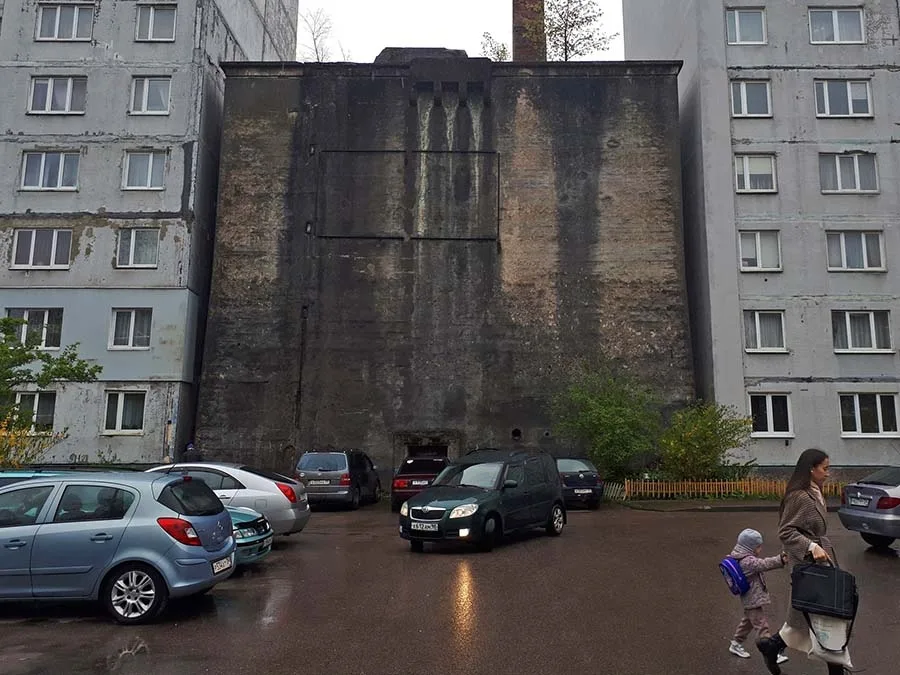 A bomb and gas shelter on Chaadayeva Street.
The last to receive Soviet names were Chaadayeva Street and Nansena Lane. In 1957–61 two-storey houses were built on the foundations of pre-war buildings on Nansena Street. Tram services were resumed along Suvorova Street as far as the Yantar shipyard. Tram No. 9 consistently ran here until the route was closed in January 2010. In 1973 School No. 28 was built on the site of the former New Haberberg Cemetery. In 1975–80 five-storey houses with improved layouts ("Brezhnevkas") were erected in the settlement of Portovoye. In 2008–16 builders completed several six- to twelve-storey buildings. Besides the school, Portovoye has a kindergarten, which is the pre-school branch of School No. 28. On Suvorova Street is the Border Directorate of the FSB of the Russian Federation. The place name Portovoye is now practically forgotten.
Sights: above-ground bomb and gas shelters (Suvorova Street 21, Chaadayeva Street 17), the bust of A. V. Suvorov, the Alley of Heroes.
1. Glacis – a gently sloping earthen bank in front of the outer ditch of a fortress.
Photos: Bildarchiv Ostpreußen, Mikhail Ogorodnikov.
Translated from Russian with the help of AI (Claude, Anthropic), October 2026.