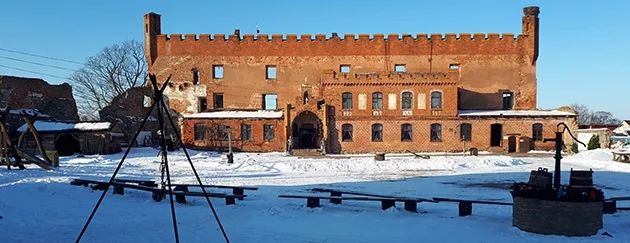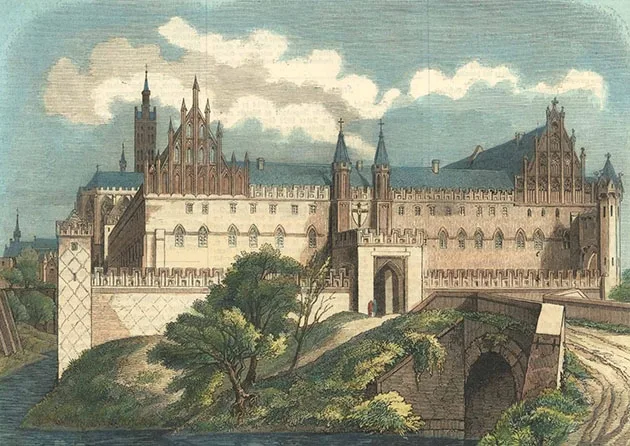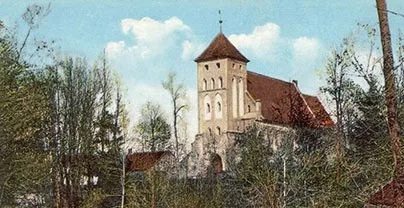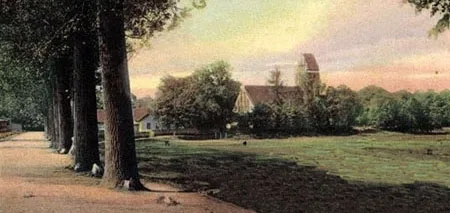
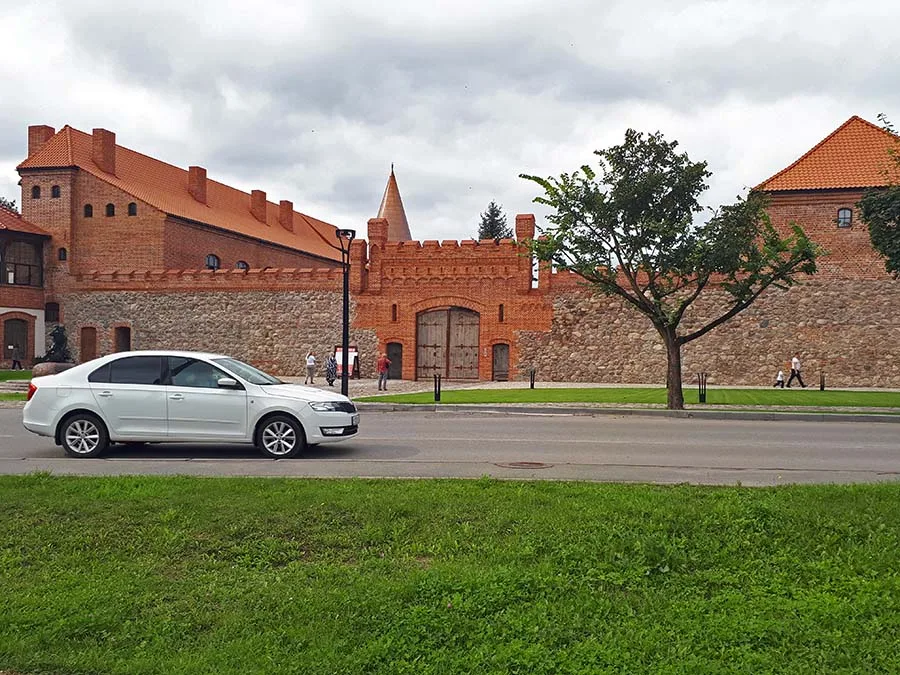
In 1258, under an agreement between the Teutonic Order and the Bishop of Samland, the territory where Neuhausen later arose passed into the bishop's possession. In 1292 construction of a timber-and-earth castle began on the site of an old Prussian stronghold. In the 14th century the castle was rebuilt in stone. Originally it was a small castle with one or two wings and an outer bailey (Vorburg). At the same time a church was built next to the castle, and by the end of the 14th century also a mill on the dammed stream by the castle.
After the secularisation of the Teutonic Order, the bishop's estates also passed into ducal ownership. For some time Neuhausen was the home of Bishop Georg von Polentz, who had converted to Lutheranism. Later the castle housed the summer residence of Duke Albert and the domain administration (Domänenamt). In 1528 a settlement (a "Lischke") of three plots of land belonging to craftsmen – a tailor, a shoemaker and a blacksmith – arose by Neuhausen Castle. In 1550, after the death of Bishop Polentz, Neuhausen Castle passed to Anna Maria of Brunswick (1532–68), the wife of Duke Albert.
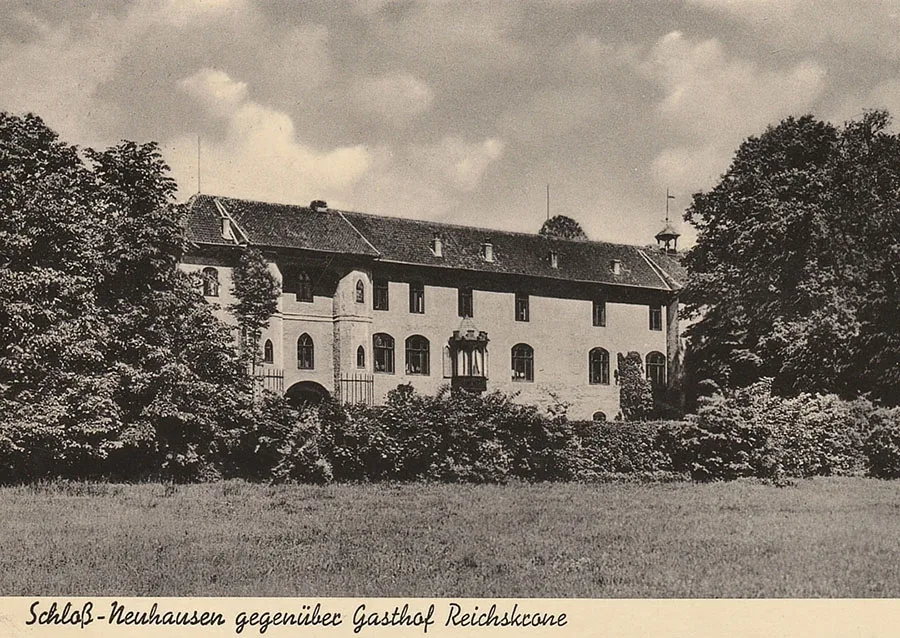
Neuhausen Castle in the first half of the 20th century.
On 29.04.1553 the heir to the ducal throne, Albert Frederick (d. 1618), was born at Neuhausen Castle. On 20.03.1568 Anna Maria, while at Neuhausen Castle, received the news of her husband's death, which, according to the official version, she could not bear, and she died. Many historians suppose that she was murdered by supporters of the Brandenburg Hohenzollerns.
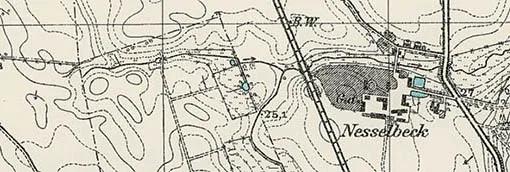
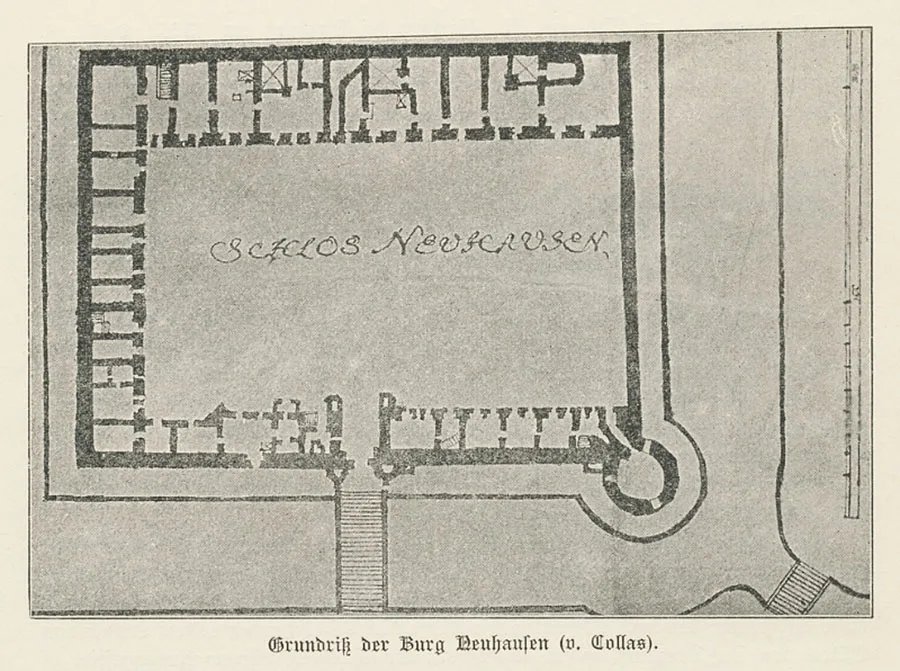 Plan of Neuhausen Castle.
In 1564 Neuhausen Castle held as a prisoner the Croatian adventurer and ducal favourite Paul Skalich (1534–73), accused of crimes against the state, sorcery and fraud, who later escaped from here to Poland.
In the 17th century, under Duke George William (1595–1640), the castle became a hunting lodge. Nearby, across the little Mühlenfließ river (Guryevka), a zoological garden (Tiergarten) was laid out. The domain office also continued to operate in the castle. In 1770 the judicial office moved into Neuhausen Castle as well.
In 1814 Field Marshal Friedrich Wilhelm Bülow von Dennewitz (1755–1816) received the castle as his property for his services in the Napoleonic Wars. In 1820 Neuhausen had 43 houses. In 1842 Bülow's descendants sold the castle to Count Adam Ferdinand von Luckner (1802–77). At the end of the 19th century the owner of the castle became the general agricultural director Louis Bon.
After the reform of 1818 Neuhausen consisted of two administrative units: the village (rural municipality) of Neuhausen and the domain of Neuhausen (from 1867 a Gutsbezirk).
The settlements belonged to Landkreis Königsberg (merged into Landkreis Samland in 1939). The church in Neuhausen was the parish church for the surrounding villages and estates. In 1871 the village of Neuhausen had 23 residential houses and the Neuhausen estate 12 houses. The village was home to 74 families, the estate to 38 families. On 30.04.1874 the rural municipality and the Gutsbezirk of Neuhausen were incorporated into the newly established Amtsbezirk of Neuhausen. The first head of the Amtsbezirk was the owner of the Neuhausen estate, Louis Bon. Later, residents of Neuhausen held this office in 1899–1908 (the estate owner Kunz) and in 1930–45 (the pensioner Laubmayer).
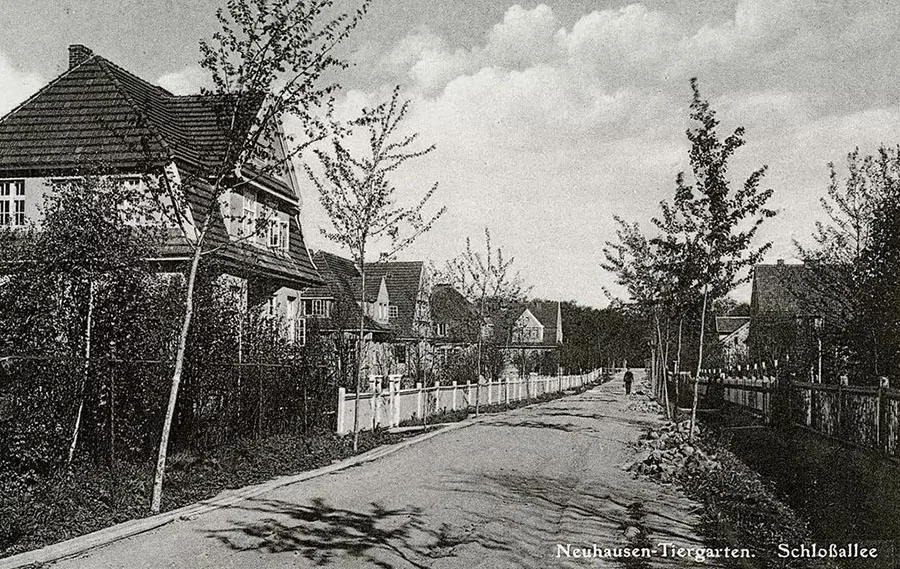 The Neuhausen-Tiergarten villa colony, which grew up on the site of the zoo.
In 1889 the Königsberg – Labiau (Polessk) railway was built past Neuhausen; in 1891 it was extended to Tilsit.
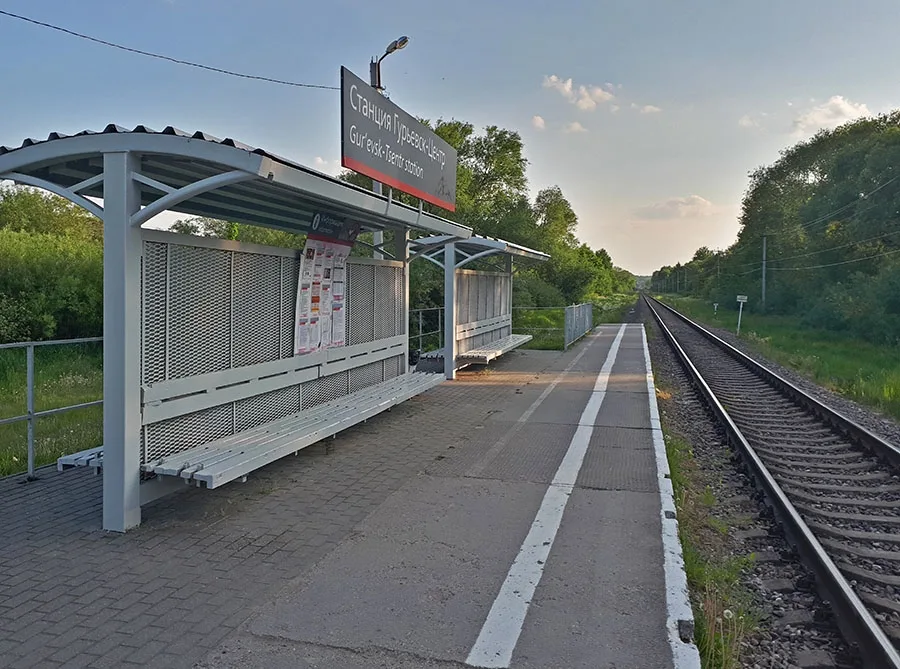 The railway station Guryevsk-Tsentr.
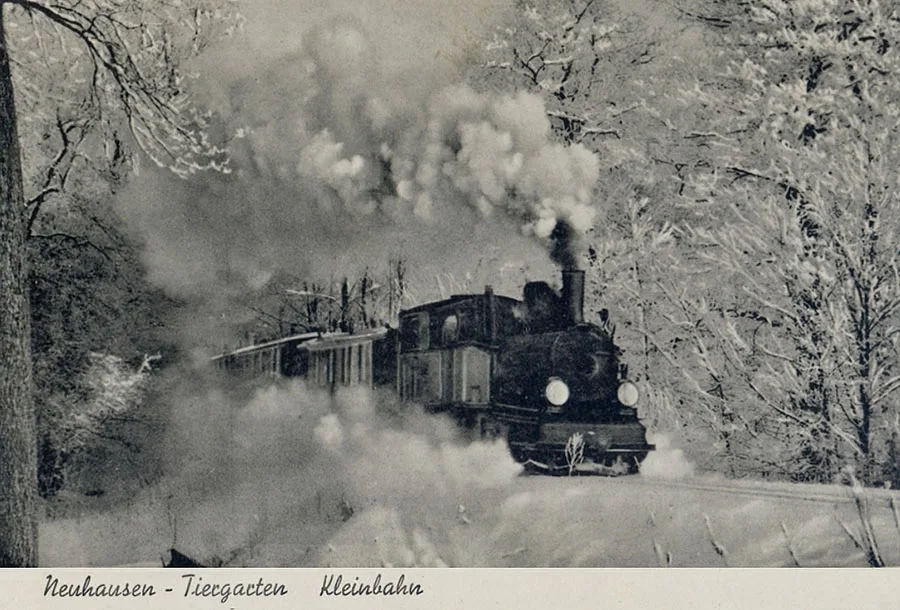
On 15.01.1900 the first line of the Königsberg narrow-gauge railway (Königsberger Kleinbahn) opened, running from the King's Gate in Königsberg to Prawten (Lomonosovo); it was later extended to Tapiau (Gvardeysk). In Neuhausen this narrow-gauge line had a stop near the zoo and Neuhausen station. At the end of the 19th century the zoo was closed, and small houses began to be built on its site, some of them designed by the well-known architect Otto Walter Kuckuck. The place was named the Neuhausen-Tiergarten villa colony (Villenkolonie Neuhausen-Tiergarten). It later became the main part of Neuhausen (Guryevsk).
On 30.09.1928 the Gutsbezirk of Neuhausen was abolished and incorporated into the municipality of Neuhausen. In 1935 the Behring Institute opened in Neuhausen. On 01.04.1938 the municipalities of Kleinheide (part of Guryevsk) and Trausitten (part of Guryevsk) became part of the municipality of Neuhausen.
On 26.01.1945, during the East Prussian Offensive, units of the 39th Army reached Neuhausen. However, with the help of fresh units brought up at short notice, the German forces managed to halt the Red Army's advance. The town was taken on 28.01.1945 by soldiers of the 192nd Rifle Division (Col. L. G. Basanets).
On 07.04.1946 Neuhausen became the centre of the newly formed Königsberg District. On 07.09.1946 Neuhausen was renamed Guryevsk in honour of Hero of the Soviet Union Major General Stepan Guryev. Commen, Trausitten and Kleinheide were not renamed and in effect became part of Guryevsk. A military unit was stationed in Guryevsk, which had received town status, and this made it considerably harder to turn it into the administrative centre of the district. All the main civil authorities and services were temporarily housed in the settlement of Isakovo (Bolshoye Isakovo). Only the District Soviet and its executive committee were located in Guryevsk. In October 1947 a House of Culture with a film projector opened in the former Neuhausen church, and the district newspaper "Kommuna" began to be published. By the end of 1947 Guryevsk also had a primary school, a post office, a hairdresser's, and workshops for making and repairing clothes and shoes. In 1948 a seven-year school, a kindergarten, a library, a collective-farm market and a savings bank opened in the town. In 1949 the town park was landscaped. Street lighting on the central streets was restored and a stadium was opened. By the early 1950s the town already had a secondary school, a first-aid post, a pharmacy, a book kiosk and a canteen. In 1952 the Avrora cinema opened, and in 1955 a crèche.
On 09.02.1953 the administration of Guryevsk District was officially moved from Guryevsk to the settlement of Isakovo (Bolshoye Isakovo), but as early as 01.02.1960 it was returned to Guryevsk. At the same time a people's court, a prosecutor's office, a district hospital and a bank branch appeared in Guryevsk.
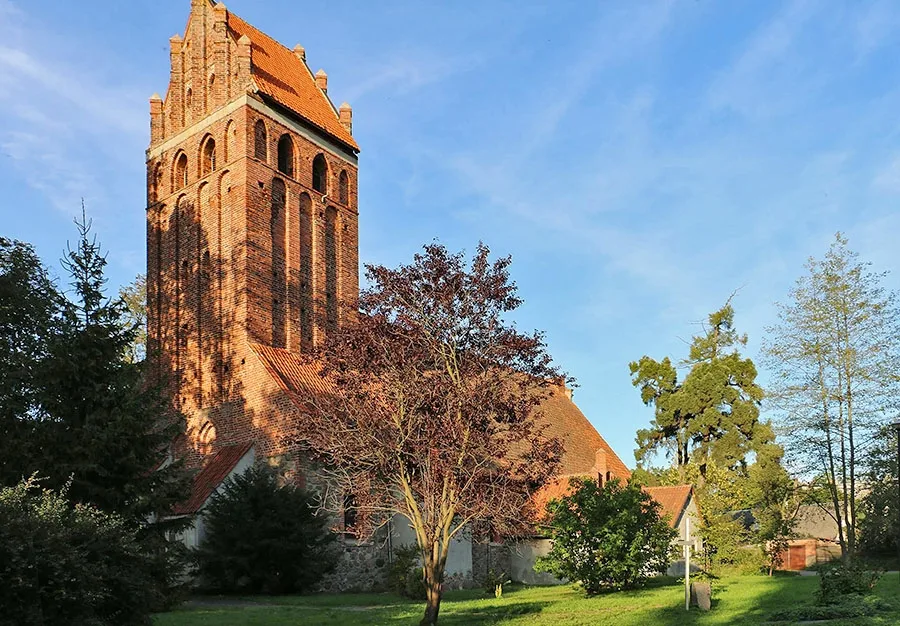 The church of Neuhausen.
In 1962 a new House of Culture opened in Guryevsk, and the district newspaper "Zarya Kommunizma" replaced "Kommuna"; in 1964 the district veterinary station began operating, in 1965 a children's library, and in 1967 a children's music school. By that time it had been noted that the town's population was growing much faster than the plans had envisaged.
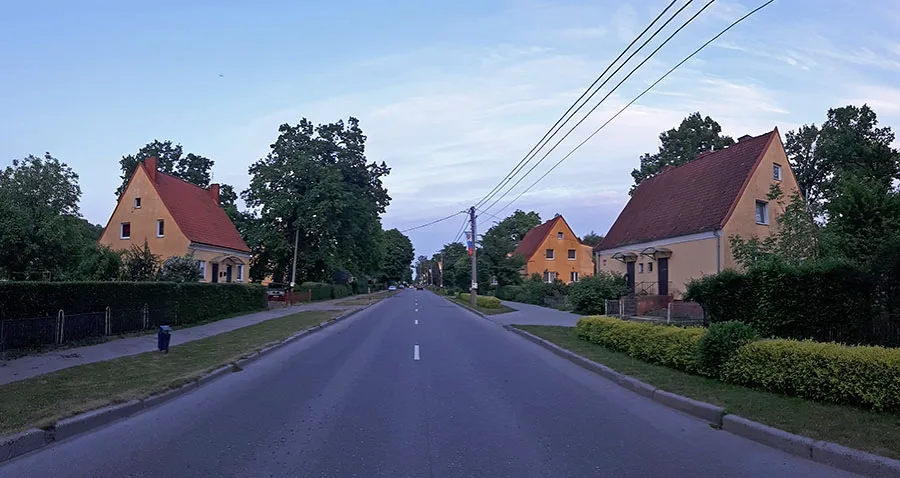 Small houses built in 1938 on Lenin Street.
In 1972 the first two five-storey apartment blocks were built in Guryevsk. In 1973 the Guryevsk poultry farm for 200,000 laying hens was commissioned and long remained the town's main enterprise. At the same time another crèche and a kindergarten were built. In 1978 a vocational school opened, training machine operators for agriculture. In 1979 the House of Pioneers opened, and in 1984 a new outpatient clinic was built. Among the enterprises operating in Guryevsk were the production association "Guryevskagrokhimiya" and a mobile construction unit of the "Kaliningradselkhozmontazh" trust.
In 1990 Secondary School No. 2 opened in Guryevsk. On 25.11.1996 the local history museum of Guryevsk was opened. In the 1990s reconstruction of the abandoned Neuhausen church began. In 2001 a children's hospital opened in the town, and in 2003 a children's and youth sports school. As of 2018 the town had a gymnasium and a secondary school, a college, a children's and youth centre, a children's and youth sports school, an arts school, three kindergartens, a district hospital, children's and adult outpatient clinics, a women's health clinic, two libraries, a House of Culture, a sports centre with a swimming pool, a stadium, several sports grounds, a hotel, a bathhouse, a restaurant, several cafés and a park of culture.
Sights: Neuhausen Castle (14th century), Neuhausen church (14th century), the park, a memorial on the mass grave of Soviet soldiers (1981, more than 550 people), the Museum of History and Culture.
Population trends: 1820 – 329, 1831 – 503, 1858 – 554, 1864 – 620, 1867 – 587, 1885 – 604, 1905 – 980, 1910 – 1067, 1933 – 1707, 1938 – 4198, 1947 – 1625, 1959 – 2368, 1966 – 2800, 1979 – 5910, 1989 - 9,734, 2002 – 10,913, 2010 – 12,431, 2012 – 12,711, 2014 – 13,628, 2016 – 15,007, 2018 – 17,295, 2020 – 19,314 inhabitants.
For reference
The Amtsbezirk of Neuhausen
On 30.04.1874 Amtsbezirk No. 33 Neuhausen was established in Landkreis Königsberg, comprising four rural municipalities – Knöppelsdorf (Rassvet), Neuhausen (Guryevsk), Prawten (Lomonosovo) and Trausitten (part of Guryevsk) – and seven Gutsbezirke: Berthaswalde (54°47'00'' N 20°39'34'' E), Dunkershöfen (Dubosekovo), Commen (part of Guryevsk), Kleinheide (part of Guryevsk), Neuhausen (Guryevsk), Schmeckenkrug (part of Guryevsk) and Sensen (Bolshoye Derevenskoye). By 1883 the Gutsbezirk of Schmeckenkrug (part of Guryevsk) had been abolished and incorporated into the rural municipality of Neuhausen. On 06.11.1883 the Commen estate also became part of the rural municipality of Neuhausen. By 1908 the Amtsbezirk of Neuhausen was made up as follows: five rural municipalities – Knöppelsdorf (Rassvet), Neuhausen (Guryevsk), Prawten (Lomonosovo), Sensen (Bolshoye Derevenskoye), Trausitten (part of Guryevsk); four Gutsbezirke – Berthaswalde, Dunkershöfen (Dubosekovo), Kleinheide (part of Guryevsk), Neuhausen (Guryevsk); and also the Neuhausen mill (Mühle Neuhausen, part of Kumachevo), which belonged to the municipality of Mandeln (54°45'34'' N 20°36'27'' E).
On 23.10.1926 the Gutsbezirk of Berthaswalde was converted into a rural municipality of the same name. On 30.09.1928 the Gutsbezirke of Dunkershöfen (Dubosekovo) and Kleinheide (part of Guryevsk) merged to form the new rural municipality of Kleinheide. On 15.11.1928 the Gutsbezirk of Neuhausen was abolished and incorporated into the rural municipality of Neuhausen. The Amtsbezirk of Neuhausen now consisted of seven rural municipalities: Berthaswalde, Kleinheide (part of Guryevsk), Knöppelsdorf (Rassvet), Neuhausen (Guryevsk), Prawten (Lomonosovo), Sensen (Bolshoye Derevenskoye) and Trausitten (part of Guryevsk).
On 01.10.1934 the municipality of Sensen (Bolshoye Derevenskoye) lost its independence and was joined to the municipality of Knöppelsdorf (Rassvet). On 01.04.1938 the municipalities of Kleinheide (part of Guryevsk) and Trausitten (part of Guryevsk) became part of the municipality of Neuhausen. On 01.04.1939 the municipality of Zigelau (54°46'18'' N 20°33'22'' E) was transferred to the Amtsbezirk of Neuhausen from the Amtsbezirk of Quednau (Severnaya Gora). The Amtsbezirk of Neuhausen now consisted of five municipalities: Berthaswalde, Knöppelsdorf (Rassvet), Neuhausen, Prawten (Lomonosovo) and Zigelau. Its composition did not change thereafter.
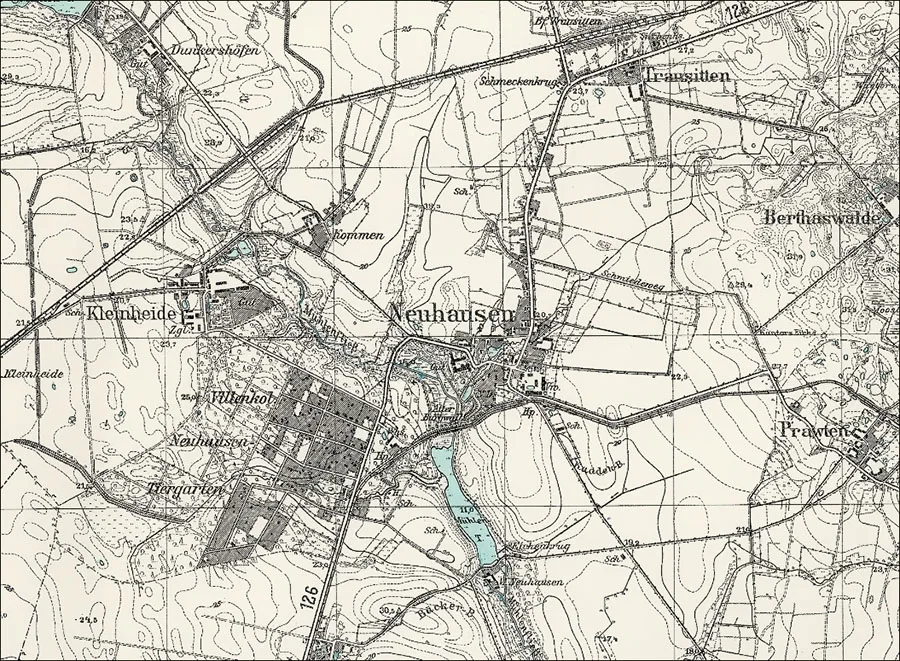
Kleinheide
Kleinheide is mentioned in 1667 as Poßkerden; after 1820 the name Kleinheyde became established.
In the 19th century Kleinheide was an estate which from 1867 formed a Gutsbezirk in Landkreis Königsberg (merged into Landkreis Samland in 1939). The estate belonged to the parish of Neuhausen (Guryevsk). In 1871 Kleinheide had eight residential houses, home to 29 families. On 30.04.1874 the Gutsbezirk of Kleinheide was incorporated into the newly established Amtsbezirk of Neuhausen. Residents of Kleinheide held the office of head of the Amtsbezirk in 1877–79 (the estate owner Gaedeke), in 1879–99 (the estate owner Ballo) and in 1912–21 (the estate owner Quadt). In 1889 the Königsberg–Labiau railway (Kaliningrad–Polessk) was built past Kleinheide; in 1891 it was extended to Tilsit (Sovetsk). On this line Kleinheide station was opened west of the estate. On 30.09.1928 the Gutsbezirke of Dunkershöfen (Dubosekovo) and Kleinheide merged to form the new rural municipality of Kleinheide. On 01.04.1938 the municipality of Kleinheide lost its independence and became part of the municipality of Neuhausen (Guryevsk). In the pre-war years a brickworks operated on the estate.
Trausitten
Trausitten was founded in 1334 as Trausdytin; after 1540 it was called Trusietten, after 1542 spelled Trusitten. From 1840 the name changed to Traussitten.
In the 19th century Trausitten was a village which from 1818 formed a rural municipality in Landkreis Königsberg (merged into Landkreis Samland in 1939). The village belonged to the parish of Neuhausen (Guryevsk). Besides Trausitten itself, the municipality included the Schmeckenkrug inn (part of Guryevsk). In 1871 Trausitten had six residential houses, home to 16 families. On 30.04.1874 the rural municipality of Trausitten was incorporated into the newly established Amtsbezirk of Neuhausen. In 1889 the Königsberg – Labiau railway (Kaliningrad–Polessk) was built through Trausitten; in 1891 it was extended to Tilsit (Sovetsk). On this line a station was opened in Trausitten (Guryevsk-Novy). On 01.04.1938 the municipality of Trausitten lost its independence and became part of the municipality of Neuhausen (Guryevsk). In the pre-war years Trausitten had a hospital.
Commen
Commen was founded in 1355 as Komen. It was probably originally a farmstead with an inn. After 1785 it was called Commen Krug, after 1820 Kommenkrug.
In the 19th century Commen was an estate which from 1867 formed a Gutsbezirk in Landkreis Königsberg (merged into Landkreis Samland in 1939). The estate belonged to the parish of Neuhausen (Guryevsk). In 1871 Commen had four residential houses, home to 16 families. On 30.04.1874 the Gutsbezirk of Commen was incorporated into the newly established Amtsbezirk of Neuhausen. On 06.11.1883 the Gutsbezirk of Commen was abolished and the Commen estate became part of the rural municipality of Neuhausen.
The parish of Neuhausen comprised: Berthaswalde (54°47'00'' N 20°39'34'' E), Bladau (Vladimirovka), Bulitten (Avangardnoye), Charlottenwiese (part of Vasilkovo), Dossitten (Cheremkhovo), Dunkershöfen (Dubosekovo), Eichenkrug (part of Novy), Fürstenwalde (Poddubnoye), Kleinheide (part of Guryevsk), Knöppelsdorf (Rassvet), Kondehnen (Slavyanskoye), Lapsau (Zaozyorye), Lauth (Bolshoye Isakovo), Mandeln (54°45'34'' N 20°36'27'' E), Neidtkeim (part of Poddubnoye), Dorf Neudamm (Maloye Vasilkovo), Gut Neudamm (Maloye Vasilkovo), Neuhausen (Guryevsk), Palmburg (Pribrezhnoye), Prawten (Lomonosovo), Rachsitten (54°45'53'' N 20°40'29'' E), Rachsittenthal (Zakharovo), Rodmannshöfen (Kalinovka), Sensen (Bolshoye Derevenskoye), Sonnigkeim (Sazanovka), Tharaunenkrug (Zaozyorye), Trausitten (part of Guryevsk), Tropitten (Kumachevo), Waldhöfen (Ulyanovo), Wange (Yarovoye), Wangnicken (Zaozyorye).
Population trends of the municipality of Neuhausen: 1867 – 505, 1871 – 393, 1885 – 361, 1905 – 380, 1910 – 409, 1925 – 942, 1933 – 1,707, 1938 – 4,198 inhabitants.
Population trends of the Gutsbezirk of Neuhausen: 1867 – 197, 1871 – 216, 1885 – 243, 1905 – 206, 1910 – 180 inhabitants.
Population trends of Kleinheide: 1867 – 170, 1871 – 193, 1885 – 167, 1905 – 163, 1910 – 212, 1925 – 200 inhabitants.
Population trends of Commen: 1867 – 44, 1871 – 74, 1885 – 57, 1905 – 43 inhabitants.
Population trends of Trausitten: 1867 – 81, 1871 – 76, 1885 – 62, 1905 – 188, 1910 – 266, 1925 – 298 inhabitants.
Population of Kleinheide railway station: 1905 – 6 inhabitants.
Composition of the population of the municipality of Neuhausen in 1871: all 393 Protestant Christians, children under 10 – 66, literate 208 (72%).
Composition of the population of the Gutsbezirk of Neuhausen in 1871: Protestant Christians – 215, Catholics – 1, children under 10 – 60, literate 115 (74%), deaf-mute – 1, insane – 3.
Composition of the population of the Gutsbezirk of Kleinheide in 1871: Protestant Christians – 186, Catholics – 1, other Christians – 6, children under 10 – 71, literate – 65 (54%).
Composition of the population of the municipality of Trausitten in 1871: all 76 Protestant Christians, children under 10 – 18, literate – 49 (86%).
Composition of the population of the Gutsbezirk of Commen in 1871: all 74 Protestant Christians, children under 10 – 24, literate 31 (62%).
_________________
* The official date of the town's foundation (according to Soviet encyclopaedic publications), 1262, is apparently the result of a widespread misconception that the first Neuhausen castle was built in that year.
Present-day photos: Mikhail Ogorodnikov.
Translated from Russian with the help of AI (Claude, Anthropic), October 2026.