The Great Elector Frederick William*, Kings Frederick I and Frederick William I
The State of the Great Elector's Lands after the Thirty Years' War. Dutch and German Colonists
Never has any war so devastated any country as the Thirty Years' War devastated Germany. The well-known historian and novelist Freytag does not in the least exaggerate the gloom of the real situation when he says: "A vast region of ancient culture, where great cities were counted by the hundreds and hamlets by the thousands, where meadows alternated with cultivated fields, was so ravaged that wildernesses were now met with everywhere in it; nature, grown wild again after long subjection to man, began to bring forth the old enemies of the human race – thickets and wild beasts. Only people past the middle of life remembered what a village had been before the war, how many couples had danced then under the lime trees, and how many cattle had walked in the herd grazing on the meadows..." Of these national calamities no small share fell upon the lands of the Elector of Brandenburg as well. The Mark alone lost 140,000 souls out of 300,000. Famine, pestilence and armies, by their combined efforts, turned entire districts into absolute deserts. In 1639 a courier sent from Dresden to Berlin complained that once, during a whole day's journey, he had not come upon a single house where anything to eat could be had. "There is no business," wrote the Berlin town council in 1640. "There is nothing to live on. It happens that over a whole four miles of road you meet neither man, nor beast, nor dog, nor cat. Neither shepherds nor schoolmasters are paid any longer. Many have drowned, hanged or stabbed themselves. Others are perishing in poverty with their wives and children!" It happened that vagrants who had made their way into a hamlet visited by every misfortune at once recoiled from the thresholds of houses where crows, dogs and wolves were fighting over the corpses of people and animals. But this does not yet exhaust all the horrors. In a report of the Prenzlau town council of 9 February 1639 we read:
"Since the war has for many years now kept the husbandman from working, life has become so dear that the groans, cries and howls of the starving are now heard everywhere. People feed on the most unseemly things: they eat dogs and cats, and even in the streets, in broad daylight, they gnaw the bones of the dead. Shall everything be told to the end? Hunger rages with such cruelty that in the villages and even in the town itself people fall upon one another; the stronger kill those who are weaker, roast them and eat them."
Those who had known better days, watching the evil grow and grow, no longer believed that those days could return; and the young, who had not known them, did not even believe that they had ever existed. Work was abandoned! Was it worth sowing when one did not know whether one would reap? No one set his hand to anything, and to keep the peasants from utterly neglecting even their farmstead land, the Elector had to issue a decree that no one be married who had not planted at least six fruit trees in his garden.
It was in this wretched condition that the Mark of Brandenburg was found in 1640 by Frederick William, whom his contemporaries were rightly to call the Great Elector. In his other provinces matters were no better: under the pretext of protection the Dutch had completely drained the Duchy of Cleves, the Swedes and Poles had laid waste the Duchy of Prussia; the neighbouring regions of Pomerania and the territories of Magdeburg, Halberstadt and Minden – these acquisitions of the Great Elector – groaned no less than the old provinces. Everywhere depopulated towns, ruined villages and abandoned fields loudly called for people.
Without losing time, the Great Elector set about finding them. First of all he tried to bring back those of his subjects who had fled from the horrors of war, reminding them that after the Peace of Westphalia there was nothing more to fear. He opened wide access to himself to all the homeless, the exiles, the wandering soldiers and even the robbers who wished to become honest men again by buying themselves an estate with stolen money. His iron will and the traditions of strict discipline hereditary in the Hohenzollern family were his guarantee that this whole motley rabble would bend under the yoke of law. Holding Holland in high esteem – he had spent his youth there and married there – Frederick William attracted a large number of colonists from that country. Among them were engineers who helped him create a whole system of canals on the model borrowed from Holland; then painters, sculptors and architects, who instilled respect for art in a country that had previously had no notion of it. The main body of these colonists, however, consisted of farmers, who drained the marshes and on their farms – the so-called Holländereien – taught the inhabitants of Brandenburg to tend cattle. The Elector's wife herself, a true Dutchwoman in her simplicity, modesty and industriousness, kept her own cowshed and a model kitchen garden, where she did not disdain to work with her own hands. In this garden the first potatoes of the Mark were grown – the Mark that is now one of the world's leading consumers of this product.
But among the settlers whom Frederick William drew into the Electorate, the Dutch did not yet hold first place – either in number or in the importance of their services. Fortunately, this sovereign, while populating his devastated lands, that is, while serving his most vital interests, at the same time won fame as a hospitable sovereign, a patron of the persecuted and a defender of freedom of conscience. Brandenburg had long been a place of refuge. This country had given the Reformation not one of those fiery preachers, half theologians and half poets, who kindled in the souls of the Germans an ardent sympathy for the new religion, nor one of those martyrs whose blood made Luther's preaching fruitful. Yet of all the German states it was precisely this one to which the Reformation brought the greatest benefit, because here it was free of intolerance. While elsewhere the sects it had spawned waged irreconcilable feuds and mercilessly persecuted one another, in Brandenburg they had to get along with one another, because the Hohenzollerns so ordered. The Hohenzollerns hesitated long before they accepted the Reformation. Joachim I remained an ardent Catholic until his very death in 1539, and Joachim II, having gone over to Lutheranism and solemnly taken communion in both kinds as a sign of it, nevertheless did not let himself be carried away into hatred of popery and did not declare himself a champion of Luther. "I no longer wish to believe in the one holy Roman church," he said, "but neither shall I come to believe in the one holy Wittenberg church." His successor John Sigismund adopted Calvinism: great consternation among his subjects, who tremble at the prospect of being required to change their faith once again. But the Elector does not even think of it – he had gone over to Calvinism for political reasons, wishing to secure the friendship of the Netherlands, which he needed in order to obtain the inheritance of Jülich.
In his religious views he was almost a freethinker and contented himself with forbidding the preachers of both sects to insult each other from the pulpit. He even attempted to merge the two confessions into one national church, with a view to strengthening his power. In this he did not succeed, but tolerance made such progress in his reign that Lutheran pastors would on occasion ordain Calvinist ones without scandalizing anyone by it.
How unlike other German princes this Elector behaves! It was not to win freedom of conscience that the Germans had fought so long and suffered so much. In the Peace of Augsburg the Lutherans agreed with the Catholics to grant the Calvinists nothing; the latter, in their turn, having barely obtained under the Peace of Westphalia the right to exist that had previously been denied them, would not hear of freedom for other Reformed persuasions. Moreover, the right to be Catholic, Lutheran or Calvinist was recognized only for the princes, and the 30th article of the treaty stipulated that each prince, "in accordance with the custom already adopted earlier in the Empire, may change the religion of his subjects, and that the subjects, for their part, if they do not wish to adopt the religion of their prince, may emigrate." Both princes and subjects made ample use of these rights. A great migration of peoples began throughout Germany, and thousands of people set out, the exile's staff in hand, to seek a new fatherland. This must be understood literally: the shape and length of the exiles' staffs were fixed by princely regulations, and before the staffs were handed to the exiles, inscriptions were carved on them. Many of these inscriptions have come down to us, and among them are not a few curious ones. Thus, on the staff of one Czech it is stated that he was banished for asserting that "no one has power to dispose of the human conscience."
The main migratory movement came from the south and the west and was directed eastward. But there only one country could attract it. It was not Austria, which served as the instrument of the Catholic Counter-Reformation, nor Saxony, where prince and people had set fast in a narrow Lutheranism and where it was taught that on 23 points the Calvinists think like the Arians and on 67 like the Turks. It was Brandenburg. Its princes, professing Calvinism amid a Lutheran population, could receive at the same time both Lutherans and those whom the Lutherans had driven out. The Electors made tolerance a principle of their government. In their poor state, which had survived amid so many dangers only thanks to their constant care and solicitude, they professed above all the religion of the state. They had too few subjects to be able to allow themselves the luxury of strict orthodoxy, and their means did not permit them to become persecutors of heretics. First to live, and only then to engage in theology – such was their common motto. All those who suffered for their faith in Germany turned their eyes to this distant land, and there came a day, ill-fated for France, when the flat plain whose sands drink the waters of the Havel appeared as a promised land to the inhabitants of the picturesque Cévennes and of the banks of the Loire.
* Hohenzollernsche Colonisationen, von D-r Max. Beheim-Schwarzbach. Leipzig, 1874.
French Colonists
When the government of Louis XIV, having exhausted all the preliminary measures of persecution, passed to open violence against the Huguenots, the Protestant states began vying with one another to offer their hospitality to the fleeing French. The Great Elector was especially distinguished by his zeal. Fearing that England and Holland, by virtue of their position, their old connections and their wealth, would draw all the emigrants to themselves, he made himself known with particular insistence and made the most tempting offers. In the Edict of Potsdam of 29 October 1684, which he circulated in France in five hundred printed copies, the Great Elector promised all who wished to move to his state an allowance for the journey, travel directions and guides; then, upon arrival, duty-free import of money, movable property and goods, the free grant of empty or abandoned houses, plots of land and building materials, exemption from taxes for ten years, and citizenship rights or free admission to the guilds. To farmers he offered land, to manufacturers loans of money, to noblemen whatever posts they pleased, and to all in general the right to form communities with the preaching of the word of God in their native tongue and with an elected French court. And Frederick William kept everything he had promised. Following these directions, emigrants from northern France made for Amsterdam and those from southern France for Frankfurt, whence the Prussian commissioners waiting in these two cities conveyed them to Brandenburg at the expense of their state. Settlers who needed assistance did not have to beg for anything. Voluntary donations, to which even the Catholic clergy contributed, compulsory levies introduced after private charity had been exhausted, and finally sums borrowed from the military budget formed a special relief fund, and all the needs of the settlers were met from it so generously that word of it reached the emigrants who had settled in other countries, and many left England and Switzerland in order to join the ranks of the new subjects of the Elector Frederick William.
In official documents the number of French emigrants who found refuge in Brandenburg under the Great Elector is put at 20,000, which amounts to more than a tenth of the entire population of that province at the time.
But the services rendered by our compatriots to their new homeland cannot be measured in figures. Can one calculate what Berlin owes them! After the Thirty Years' War, when Frederick William established his residence in this capital, it numbered about 6,000 inhabitants and 950 dwelling houses, whose wooden façades, adorned by way of decoration with heaps of dung and pigsties, looked out onto unpaved streets. In bad weather, which is frequent in these parts, movement through the streets became almost impossible. There were bridges over the Spree, but of such a kind that a carter, before driving onto them, commended his load and his soul to the mercy of God. The Great Elector did much to clean up and enlarge this wretched little place: in his reign the population of the capital grew, according to some, to 14,000 and, according to others, to 20,000 souls. This number included 6,000 French emigrants. They, beyond any doubt, contributed most of all to the transformation of the town. Among them were many wealthy people, and the poor ones were skilled craftsmen. The poor set up their little shops at every crossroads and in every corner of the Elector's palace, while in the Dorotheenstadt quarter, which the French called the noble quarter, the rich built houses whose occupants were, of course, too well-bred to offend the eyes of passers-by with the sight of filthy sties from which the grunting of foul-smelling animals constantly came.
There is an opinion that much that is French has remained since that time in the very cast of mind of the Berliners. Others deny it. This is one of those disputes in which there can be no irrefutable proof. It is certain that the Berliner is fond of joking, but his joke is inelegant, is not softened by the least amiability, and therefore more often offends than amuses. He is a sceptic, contemptuous of conventional theories and phrases; he has no cult of historical tradition. All these are, of course, happy or unhappy traits of our own national character. Some maintain – and I myself have more than once had occasion to hear this in Berlin – that among the liberals who now strive with such zeal to destroy in Prussia and in Germany the last fragments of the feudal past, the descendants of the French émigrés are distinguished by a particular ardour of rationalism. I repeat once more: these are questions that can be argued endlessly. But no one can in good conscience deny the great services rendered to the Electorate by Frederick William's guests as workers and merchants, scholars and artists, farmers and soldiers.
2,043 families, comprising 10,215 people, took up various branches of industry. These were no ordinary workers. Honesty and industriousness were the common property of these people, who had sacrificed everything for the sake of peace of conscience, and their work was of inestimable importance for Brandenburg, for they introduced it to branches of labour unknown to it.
It is well known what progress the manufacture of woollen cloth made in France in the time of Colbert. In Prussia it had completely vanished after the war, and new woollen mills were set up by settlers from France in Magdeburg, Frankfurt an der Oder, Brandenburg and Königsberg.
The silk industry had reached a high degree of prosperity in our country under the patronage of Henry IV, Richelieu and Colbert: the French émigrés planted the first mulberry plantations in Brandenburg. They also brought with them the art of dyeing and printing fabrics. Pierre Babry set up the first stocking frame in the Elector's dominions. François Flerton successfully established the first paper mill. In France a guild for the making of candles had arisen as early as the Middle Ages, whereas in the Electorate even in the 17th century noble houses were lit with wax torches and small ones with smoky lamps in which a wick floating in fish oil burned. The French founded candle factories, and since this was a great novelty, they kept the secret of manufacture to themselves. In all these branches our compatriots were innovators. And how many other trades they revived or developed! For example, tanneries, morocco-leather and glove factories, the making of clothes, toilet articles and fashion goods. Watchmaking, which before them had been a craft, rose in their hands to the level of an art. The glassworks of Brandenburg had previously produced only window glass and bottles; the French colonists cast the first mirrors. Finally, metallurgy owes them important improvements; one of the emigrants was director of the Elector's ironworks and foundries.
A smaller number of our compatriots took up trade, but the services they rendered were enormous. Trade had never been particularly brisk in this country lying east of the Elbe, that is, on the fringe of Europe's commercial belt, where there was so little to sell, and by the middle of the 17th century it had ceased altogether. The Frenchmen Girard, Michelet, Baudouin, Mangin and Perrault founded the first large houses that entered into relations with foreign countries.
The number of émigrés who took up farming is not known exactly, but there were many French colonies. They settled mainly in the Uckermark, whose villages had suffered most from the war. However, they rendered special services only in tobacco growing and market gardening. The people of Brandenburg were no great lovers of vegetables and mockingly called the French "bean-eaters". The Elector, who was very fond of vegetables, had to have them sent from Hamburg or Leipzig. But soon he no longer had any need to send so far for them. French gardeners settled in the suburbs of Berlin – in Charlottenburg and in Moabit, a dreary sandy quarter to which they gave the biblical name of the land of Moab, which it has kept to this day. Thanks to unheard-of industriousness and skill they soon achieved magnificent harvests of vegetables and fruit. The local inhabitants would not believe their eyes and did not even know whether pious people ought to put these unseen marvels in their mouths. Ruzé, a famous gardener from the Köpenick suburb, was accused of witchcraft. But little by little people grew used to this miracle, and the gardens of the suburbs became a favourite destination of the Berliners' Sunday outings into the country, where they went to dine in the open air.
Even now, travelling by horse tram from the Brandenburg Gate to Moabit, one sees many French names on the walls of the market gardens.
So far we have enumerated the material services rendered by the emigrants; now we must speak of their merits in the field of enlightenment. These victims of religious persecution brought their pastors with them, or, rather, came following their pastors, many of whom were very well educated men of taste. Their sermons served as a model of sacred eloquence for the pastors of Brandenburg, whose whole oratorical art had previously been reduced to bombastic verbiage sprinkled with coarse sallies and abuse. There were quite a few lawyers in the colony who exercised judicial authority, but the new rulers also demanded these lawyers for their own service. The Parlement of the Principality of Orange emigrated in its entirety. It kept its name and its organization. At solemn ceremonies, as for instance at the funeral of its sovereign Charlotte, it was present in corpore in red robes: Frederick William's successor made this parlement his court of appeal. The Mark was in dire need of physicians, as the whole business of healing there was in the hands of charlatans and quacks, who were paid separately. The colonist Jacques Gautier became court physician, and the name of the famous Duclos is still given by the Berliners to one of the remedies against fever. We have seen that there were no architects in Berlin. Abraham Quesnay worked hard at its embellishment; others rendered similar services elsewhere. The painters gave excellent lessons in their art, but – truth to tell – they had no pupils at all. The French College and the Academy of Sciences founded in 1700 took pride in the names of French scholars. The French also contributed to the flourishing of the University of Frankfurt and to the founding of the university at Halle. One could compile a long list of French names gloriously inscribed in the annals of German learning. Let us recall La Motte-Fouqué, Michelet, de Lacourbière and, finally, the great brothers Humboldt, whose mother was French by birth.
The émigré noblemen took their place at court and in the army. Many of them were made generals. For a time Marshal Schomberg himself placed his rich military experience at the disposal of the Great Elector. Many French soldiers entered the Elector's army, where they filled about five regiments. The corps of Musketeers of the Guard and of mounted grenadiers consisted to a considerable extent of Frenchmen. French engineers joined the newly founded detachment of the Elector's sappers. Saddest of all is that these emigrants, without a second thought, tried their strength in the struggle against the fatherland that had cast them out.
In the War of the League of Augsburg the regiments of Varenne and Briquemault distinguished themselves, and in the battles and sieges on the banks of the Rhine, at the most dangerous points, the red, gold-embroidered uniforms of the Musketeers of the Guard shone.
It would be vain to hope that all German writers would unanimously recognize the importance of the services rendered to Prussia by the French settlers. As early as the end of the last century König, in his "Attempt at a Historical Sketch of Berlin", wrote that in the 17th century the Mark owed far more to the simple and practical settlers from Holland than to the French Huguenots, since the latter, along with refined manners and customs, brought much that could very well have been done without. "It is far better," he says, "to give people bread than to teach them to garnish it prettily." Of course. But did not the Huguenots, along with the art of garnishing, bring bread as well? Can one forget the capable craftsmen and skilled farmers and look only at the bakers and cooks who acquainted Brandenburg with white bread and cleanliness in the kitchen, or at the innkeepers who opened the first decent hotels in Berlin, such as the Hôtel de Paris on Bruderstrasse? Besides, such irritation towards the humblest members of the French colony is not altogether understandable, since the French cooks, innkeepers, tailors and hairdressers did not at all succeed in corrupting the simplicity of German manners: they taught their adoptive fellow citizens neither to dress with taste nor to cook well. To the credit of Germany, her serious writers stand above such petty cavilling. Beheim-Schwarzbach, who recently brought out an excellent book, "Colonization under the Hohenzollerns", built entirely on previously unpublished archival material, gives no quarter in it to König's patriotic prejudices.
King Frederick I
Waldensian and French Colonists
The Elector Frederick III, who later turned into King Frederick I, was not at all like his predecessor Frederick William: intellectually there is the same gulf between them as between Louis XIII and Henry IV. But Louis XIII was at least aware of his own inadequacy, whereas Frederick I did not suspect his and, trying to look like a great man, became all the more ridiculous to everyone around him because of it. He was a real upstart. No soldier risen from the ranks ever rejoiced so much in his officer's braid as this Elector in his golden crown: he melts with pleasure feeling it on his head and, to show it off, gives festivities of unheard-of splendour in Berlin and Königsberg. He is the prodigal son in a family of misers. But all the same he did not entirely forget the family precepts. Life in Prussia makes certain demands so inexorably that one has to submit to them willy-nilly. For all one's extravagance, one cannot help keeping accounts there. And can one keep accounts without thinking about increasing one's revenues? Thus the reign of Frederick I was in some respects a continuation – a rather poor one, it is true – of the reign of the Great Elector.
Frederick I did, however, have good qualities as well: he was kind and genuinely generous, though he was too fond of making a show of his generosity.
He did what his predecessor would perhaps not have done, and what his successor would certainly not have done: he let the homesick colonists go and even tried himself to help them return to their fatherland.
Shortly before his death Frederick William gave orders that the town of Stendal, which still lay in ruins, should receive a colony of Waldensians. He took under his protection this unhappy little people, these forefathers of all who suffered for the Reformation, and wrote letters in their defence, which do him honour, to Duke Charles Emmanuel of Savoy and to King Louis XIV. He even managed to save them for a time from the frenzies of a crusade and from the solicitude of the "Congregation for the Propagation of the True Faith", whose members had devoted themselves to the pious mission of buying with money the conversion of the poor mountaineers. But after the revocation of the Edict of Nantes the example set by the greatest sovereign of Europe outweighed, with the Duke of Savoy, the influence of the Elector of Brandenburg, who lived so far away. He hurled at the Waldensians a savage edict that brought in its train a merciless war, in which three thousand people were slaughtered and two thousand children taken from their families. Ten thousand Waldensians were taken prisoner. All that the Protestant powers could obtain was the banishment of these unfortunates, half of whom had already perished in terrible prisons by the time the ducal troops at last appeared to escort the survivors across the border. They were conducted to Switzerland. The Great Elector sent commissioners there with an offer of refuge in Prussia. The exiles agreed and arrived in Brandenburg, where it was already Frederick I who received them. But the inhabitants of Brandenburg proved less hospitable than their sovereign: the Waldensians were warmly welcomed in Spandau, but very badly received in Stendal and Burg. Nothing had been prepared for their reception. The newcomers had to be quartered in the houses of the inhabitants, but these assigned them attics and sheds and, despite the harsh winter, would not let even the sick and nursing women near the hearth. The groans of the unfortunates reached the ears of the Elector, but he was unable to find the means to settle their lot and was very happy merely to be able to help them return to their homeland after the Duke of Savoy, having quarrelled with Louis XIV, granted the Waldensians an amnesty. His kindness showed itself in the care with which he sought to ease their long journey. He even sent them money in their homeland when he heard that they had found their houses there in ruins and were suffering cruelly from the harsh season.
Nor was it Frederick I who kept the French colonists from returning to their homeland. When peace negotiations began at Ryswick, these exiles were filled with hope of seeing France again, which they had not forgotten. They managed to arouse sympathy for themselves in all the states of Europe, and Frederick interceded for them with the utmost insistence, the futility of which he no doubt foresaw. His envoy in Paris worked on their behalf together with the English one. At the congress the representatives of the Protestant states made a joint representation in favour of the emigrants. In all Protestant countries, on an appointed day, a special solemn service was held during which people prayed to God to incline the heart of Louis XIV to mercy. Louis replied that his former subjects could return to France only on condition of solemnly joining the Catholic Church. The die was cast: the Huguenots ceased to look upon the foreign land as a halting place; from a refuge it became their homeland.
Colonists from the Palatinate and Switzerland
Advertisements and Manifestos
One must not think, however, that Frederick I only sent colonists back, or tried to send them back, to their homeland. The wars of Louis XIV brought him many new settlers. From the Palatinate – burnt, conquered and forcibly converted to Catholicism – crowds of people fled to seek a new fatherland. When they turned to Frederick, he met their request with complete readiness, for he intended to rebuild and repopulate Magdeburg. The Great Elector had not been able to raise this town from the desolation into which it had been cast by the famous fire and massacre that carried off thirty thousand people and left in place of the town only a hundred and thirty empty fishermen's huts, without utensils and without inhabitants. It was to Magdeburg that Frederick invited the emigrants, promising them every kind of privilege.
He circulated in the Palatinate a kind of advertisement extolling all the conveniences and charms of the town. "Magdeburg is situated," says the compiler of this notice, written in French, "on a vast plain, on the bank of the Elbe, one of the most beautiful and most navigable of rivers." Playing on the etymological meaning of the word Magdeburg, he adds in the style of the 18th century: "It is said that the town received its name from Venus and the Graces, her handmaidens..." How could one resist such temptations? 1,376 families, comprising 7,000 people, came to Magdeburg and settled in the town and its surroundings. Among them were scholars, theologians, lawyers, craftsmen and farmers. The last introduced the cultivation of tobacco, which became a source of the country's wealth, and with the help of all these settlers the unfortunate town managed to regain part of its former prosperity.
Meanwhile the local inhabitants looked askance at the foreigners, who were showered with privileges and who crowded them out in trade and industry. The Elector constantly had to explain himself to his subjects and calm them down.
Now he exhorts them to be more compassionate if they do not want the Lord God to grow angry with their town again; now he explains to them at length that they misunderstand their own interests. He even issued, in the form of questions and answers, a veritable treatise on the advantages of colonization, which set out the whole programme of the Hohenzollerns on this question. Here are a few excerpts from it, slightly abridged.
"Is it beneficial for countries and their native population that their sovereigns should attract foreigners with certain privileges and liberties? – Yes, it is beneficial, for experience proves that where there are more inhabitants, industry too develops more successfully. Moreover, nothing is more convincing than the example of the incomparable hero, His Electoral Highness of glorious memory, Frederick William, who took under his most gracious protection the French driven from their homeland by religious persecution, and thus introduced useful manufactures. His Majesty the King of Prussia has merely followed this laudable example in most graciously receiving the inhabitants of the town of Mannheim and of other places utterly ruined by the French invasion. – Could not the local inhabitants have done the same as has been done by the new ones, had His Majesty granted them similar privileges? – That is very doubtful, for in sixty years they have done nothing. – His Majesty spends money on the colony every year. Does this bring any profit? – From the time of their arrival in Magdeburg up to and including the year 1708, the colonists who came from the Palatinate cost 114,462 thalers in all. Meanwhile, on the purchase and construction of houses they spent, after deduction of the loans granted to them and the price reductions made in their favour, 102,846 thalers from money they had brought from the Palatinate or earned by their labour. Their tobacco and woollen manufactories, even if one takes into account only the most important of them, namely those working for export, have brought 667,395 thalers into the country. Finally, the foreigners have spent about 1 million thalers on their keep alone; and it is enough to compare the town's budget for 1689 and for 1708 to see whether its revenues have grown or diminished... Therefore those who have hitherto been ill-disposed towards the poor foreigners will do well to cease their enmity and, out of Christian charity, to rejoice that the poor people can earn, to no one's detriment, a morsel of bread. And now, may the Almighty deign to grant the treasure of His blessing equally to the old and to the new inhabitants!" Thus this budget, written in the form of a catechism, ends with a prayer. It shows, as we have pointed out, that Frederick I knew very well how to count, that the Hohenzollerns' sympathy for the persecuted was not entirely disinterested, and that Christian charity was in Prussia a very profitable – though perfectly legitimate – investment of capital, yielding far more than 100 per cent.
To gain admission to Prussia it was not necessary to be persecuted. When in 1693 the governments of Zurich and Bern asked Frederick to turn his attention to the Protestant subjects of the Abbot of St. Gallen, who complained of oppression by their sovereign, he replied that he would gladly receive them, but that he would also be very glad of the arrival of craftsmen from any cantons whatsoever, "provided only that they have some money." He specifies exactly what kind of craftsmen he needs: in some places spinners, in others masons, at certain points traders and farmers. All are promised privileges and exemptions. The farmers will have to buy themselves land, but they will be offered favourable terms; it is necessary, however, that they bring with them at least 200 thalers each. He would gladly have released them from this requirement "were it not for such hard times!" On the other hand, their families will be carefully looked after: the king guarantees the children free training in crafts, and if there are talents among them, he even promises them a place at the Joachimsthal College in Berlin and then a scholarship at the University of Frankfurt.
These promises drew a good many Swiss to Frederick's state, where there was always both room and work for newcomers. The king directed the new colonists eastward, to the Duchy of Prussia and to Lithuania. Here, too, it was necessary to efface the traces of a multitude of the most terrible calamities, perhaps even more dreadful than those whose picture we have seen!
In the war that broke out towards the end of the 17th century between Poland on the one side and Sweden and Brandenburg on the other, the Poles turned to the Tatars for help. 50,000 of these savages flooded the Prussian provinces. In less than a year the Tatars and Poles burned 13 towns and 249 hamlets and villages. They slaughtered 23,000 people and carried off 34,000 into captivity. But still more terrible was the plague that came after the war: Königsberg lost 10,000 inhabitants in 8 months, and the Insterburg district 66,000. The total number of victims exceeded 200,000, so that this province took on the appearance of a desert. To populate all these deserted places, veritable hosts of emigrants would have had to come from Switzerland, but only 6 or 7 thousand came, part of whom settled in Brandenburg. To increase this all too small number, Frederick began to seek colonists of another kind in Switzerland.
In the cantons of Bern and Zurich there lived at that time a handful of disciples of Menno, that peculiar reformer contemporary with Luther, who wanted his followers not to content themselves with professing a pure religious doctrine but, beyond that, to open the eyes of the world to the whole perversity of the laws governing it and to prepare people for the introduction of better ones. In no case were they to resort to violence. With their gaze fixed on an ideal state where there would be neither falsehood, nor injustice, nor hatred, they opposed abuses only with passive resistance, refusing the oath, which presupposes falsehood, and military service, which presupposes hatred. Such conduct was not to the liking of sovereigns. Many of them turned to Luther, asking his opinion on how these innovators should be dealt with. The reformer, citing the Apostle Paul, replied that they must not be tolerated, and from the 16th century the Mennonites began to be persecuted in Switzerland, but they nevertheless continued to live there. At the end of the 17th century the government of Zurich wished to compel those of them who lived on its territory to perform military service: they refused. The government demanded of the Mennonites that instead of the oath they should at least answer "yes" or "no" to the questions put by the court: they did not agree even to this. The government ordered them to emigrate: they stayed where they were. Then persecution began. At the same time edicts were issued in Bern against the Mennonites, condemning them to banishment, branding, the galleys and death. At last Frederick I took up their cause; but he met with rivalry from the States General of Holland, which also offered the Mennonites refuge in their country. The two states watched each other closely, for each of them would gladly have taken the wealthy colonists into its care while leaving the poor to the charity of the other. And so the Mennonites arrived in East Prussia, where they could worship God as they wished without fear of the royal recruiters. The number of these settlers is not known exactly; in any case there were few of them, and their arrival changed little in the situation of the unfortunate province.
Frederick I did not have enough consistency and energy of character to remedy the ills from which Prussia suffered. After his death the country remained in its former state.
Vast expanses of land lay uncultivated, weeds grew freely over the vast graveyards that stretched for immeasurable distances wherever war and plague had raged, and huge forests, which still exist today, rose high towards the sky there, entwining with their roots the bones of a generation that had perished so ill-fatedly.
Frederick William I. Mennonites and Deserters
The Colonization of East Prussia
On the very day of Frederick William I's coronation it became clear that the new sovereign intended to reign quite differently from his predecessor. Instead of spending 6 million thalers on the coronation, as Frederick I had, Frederick William spent only 2,547 thalers 9 pfennigs on it, and even that probably seemed expensive to him. The Prussian court was transformed on the spot. Costly attire vanished: the king does not wear it and does not tolerate it around him. His favourite fashion is a short coat and a long sword. He does not admire his royal dignity, as Frederick did – but could one find a king more imbued with the consciousness of his duties? For him there are no trifles, and he wants to see everything with his own eyes. His walks are inspections, and in the streets of Berlin his cane also takes a stroll across the backs of idlers. To working people, on the other hand, he shows, in his own way, real tenderness. Thus, for example, he takes a personal interest in the peasant girls whom he admits to the butter-making school he set up in Königsberg. If they had been diligent and obedient during two years of unpaid training and proved, in his view, capable of spreading the "science" they had acquired in the villages, he would count out 100 thalers for their dowry so that they could marry "good lads".
This active and hard-working man did not, however, fritter himself away on such trifles: he had given himself an exact account of the needs of his states, had thought out the best means of meeting them and, once he had taken a decision, arranged his whole life in accordance with it.
Like the Great Elector, he sees that the best remedy for the ills of his state is colonization. But he does not want to let in just anyone, and from those whom he accepts among his subjects he demands work and obedience. From him came the motto of the Prussian monarchy: Nicht raisonniren – "No arguing!" The Mennonites, in his view, argued far too much, and in general these seekers of the ideal were not at all to his taste. The passion of the "Soldier King", as he was nicknamed, for giant soldiers, whom he called his "dear long fellows", is well known. No authority in the world could protect from his brazen recruiters the unfortunates whom nature had endowed with tall stature. Once his agents seized a preacher in Italy at the foot of the pulpit. They also plied their trade on the high roads, where on one occasion they captured an imperial envoy. Was it possible that they would let themselves be troubled by the religious scruples of the Mennonites? Of course, they were prepared to respect the feelings of beings of medium height, but they held that freedom of conscience disappears at a height of six feet above the ground. Having picked up the trail of a Mennonite family of giants, they broke at night into the house where it lived, committed gross violence there and carried off six fine young men to Potsdam. There these poor philosophers were put into the ranks and ordered to learn drill. Only one gave in; the other five stood their ground so stubbornly and for so long that they finally had to be let go. Wounded in his most heartfelt attachment and offended by the tone of the protests he received, the king ordered the Mennonites to leave the kingdom so as to make room for "other good Christians who do not consider military service sinful". Later he retreated from so severe a decision when he was written to from Königsberg that the collection of taxes would suffer from the expulsion of the Mennonites. He could not remain insensible to an argument of that kind: not for nothing did he call himself the finance minister and the war minister of the King of Prussia. The finance minister brought the war minister to reason; but in the depths of his soul Frederick William never forgave these Christians who would not join his guard.
He demanded that the colonists, once settled in the places assigned to them, should give no further thought to returning to their homeland. In his eyes, leaving was desertion.
When several Lithuanian peasants from the border, at the instigation of the Poles, went off to Poland, taking with them, with Polish help, their herds and all their belongings, down to the doors and windows of their houses, the king flew into a rage against the whole of Poland and gave orders that not a single Pole be admitted among the colonists any longer, "on pain of death". Indeed, he generally considered it inadvisable to admit into a country bordering on Poland, which had not yet been Germanized, colonists who did not speak "good German". He was also very wary of the Jews, "for they cannot settle down in one place and everywhere teach evil". He hurled the thunderbolts of his decrees against "these vagabonds and other bad people", accusing them of inciting the peasants to desert. "Anyone who seizes one of these Jews," he said, "must at once be given a large reward."
Frederick William understood that the best means of keeping the colonists in the country was the conscientious fulfilment of the promises that had attracted them. Woe to anyone who committed any injustice against the guests of the Prussian monarchy! One war councillor allowed himself to extort money from the settlers: he was seized and hanged forthwith. So that his efforts should bear the desired fruit, the king set up a special colonization commission and issued, in the form of letters patent, a kind of code of the rights and duties of the colonist. Everything down to the details was regulated in this code for settlers of all categories, and liberties and privileges were granted them with a generous hand. For them this miser became a spendthrift. At a time when all the revenues of his state did not exceed 7,400,000 thalers, he spent a million a year for six years on Lithuania alone. The intellectual and moral interests of his new subjects concerned the king no less than their material ones. He respected their freedom of conscience, for the spirit of tolerance of his predecessors lived on in him. He celebrated the centenary of Luther's birth on an equal footing with the anniversary of John Sigismund's conversion to Calvinism. Having set up arms factories in Spandau and Potsdam, he provided Catholic priests for the workers brought in from Liège: it mattered little to him that they were papists, as long as they knew how to make good muskets.
Only rationalists and atheists found no mercy with him: those he put in prison. But he did not regard ignorance as a bulwark of faith and opened a great many schools in the provinces to which he had called the most colonists.
"What use would it be to me," he said, "if I managed to populate the country with tillers of the soil but did not manage to make good Christians of them?" Despite all sorts of difficulties, he founded 1,380 schools in Lithuania and East Prussia. This labour received its reward. In 1725, 9,539 new settlers came to Prussia; many towns and 460 villages were founded. But this was only the beginning. Religious intolerance was preparing once again to provide Prussia with numerous sons.
Colonists from Salzburg and the Austrian Lands
The Religious Policy of Prussia and Austria
The Archbishopric of Salzburg was one of the oldest and most illustrious German principalities. It had 200,000 inhabitants, among whom the Reformation doctrine had managed to take root despite severe persecution on the part of the prince-archbishops. At the end of the 17th and the beginning of the 18th century, when two prelates full of tolerance ruled here one after the other, the number of dissenters grew still further, and Baron Leopold Firmian, from the very moment of his accession to the archiepiscopal throne, began to display strong anxiety and displeasure on this account. After a whole series of clumsy measures, unsuccessful missions, fruitless pilgrimages and useless threats, the archbishop, despite the representations of the Protestant powers and relying on the support of Emperor Charles VI, resorted to open force. But this too led to nothing. Then, invoking a well-known article of the Peace of Westphalia, he ordered all non-Catholics to go into exile, but without granting them the period of grace laid down by the treaty. For a time he withdrew his decision, then returned to it again. In short, he realized that he had made an enormous blunder only when 30,000 of his subjects – and the best of them – crossed the border after enduring every kind of cruelty.
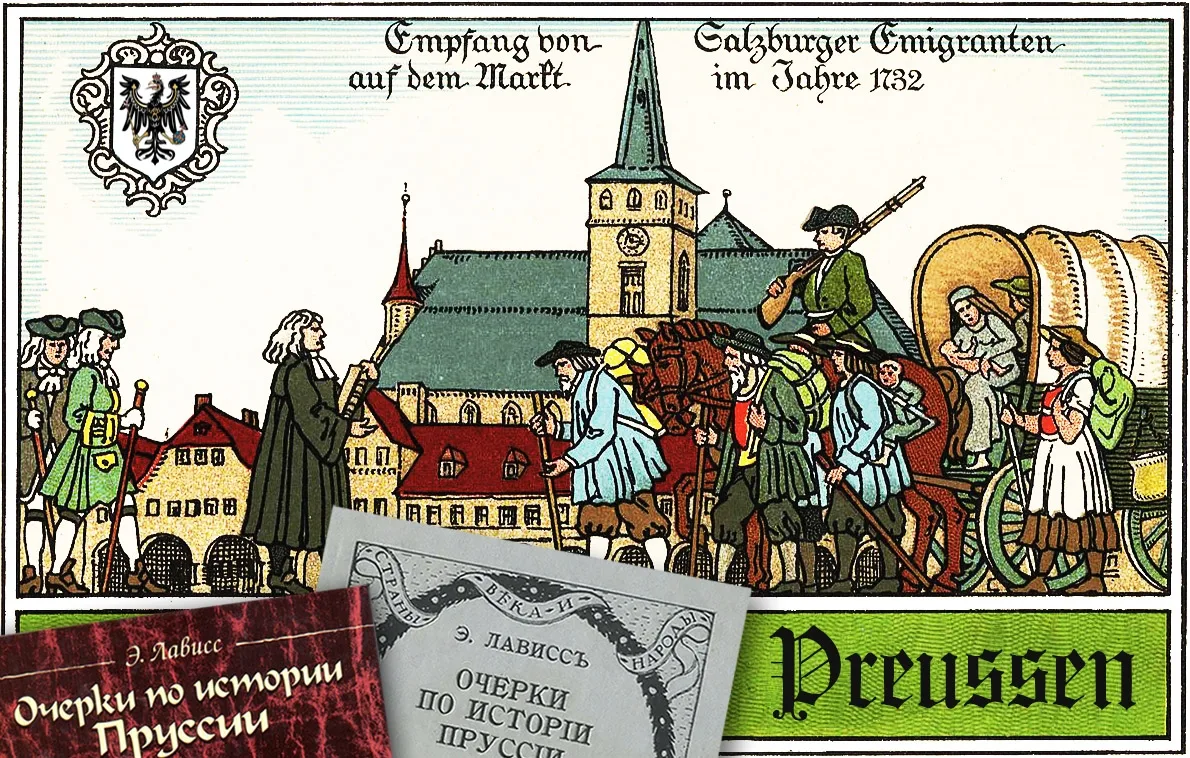
Frederick William had long been on the alert; he was one of the first to protest against the persecution. Catholic writers assert that he sent emissaries into the archbishopric to foment discontent. This is quite plausible, but the reputation of a land of refuge that Prussia had enjoyed for more than a century thanks to the conduct of its sovereigns is in itself enough to explain why the Salzburg Protestants turned to Frederick William. In 1731 the king received two deputies sent by them. He promised them that even if many thousands of their compatriots wished to seek shelter in his country, he would receive them all "graciously, kindly and compassionately". Soon afterwards he issued an open manifesto to the exiles and sent his agent to Ratisbon with the task of guiding them with his advice. Then most of these unfortunates set out for Prussia. One of them left a detailed account of this Odyssey; in it one senses at once the sorrow of the exile, the ardour of the believing Christian and the gratitude of the persecuted for the welcome given to this part of God's people on its way to the promised land. Whole processions came out to meet the travellers; they were greeted in the biblical spirit, in towns and villages, amid the acclaim of the people and the singing of psalms; solemn speeches were made to them – so that their flight resembled a triumphal procession. From this account we learn that many princes tried to stop and keep the Salzburg emigrants in their own lands, but all these attempts were fruitless: "The sovereign of Württemberg did us much good, both for the body and for the soul; may the Lord our God reward him for it and send him His blessing! But he would not let us go to Prussia; one day three men came to us and divided us into three parts; we all at once rushed towards one another and, mixing up the ranks, cried: 'We will not move from this spot until we are sure that we are being led to Prussia'; and then the three men said: 'There is nothing to be done with this people, for it will go nowhere but to Prussia.'"
Frederick William was waiting for the Salzburgers. At first he had counted on only 5 or 6 thousand settlers, but a report sent to him announced that more than 20,000 were coming. "Excellent!" he wrote in the margin. "Praise be to God! What grace the Lord sends to the House of Brandenburg! For this grace surely descends from God!"
When the first party was passing through Potsdam, the king wished to see it. This was on 29 April 1732. The court preacher, the clergy and the schools came out to meet the newcomers and greeted them with speeches, while one of the physicians offered his services to the sick. Then came the order to go to the royal park and line up in front of the palace. The king did not keep them waiting. Coming out to them, he at once turned to the court preacher and asked him: "Have you spoken with them? What sort of people are they?" The preacher replied that he had found the pure evangelical faith in their souls. "And you," said the king, turning to the commissioner who had brought the party, "are you satisfied with them? Did they behave well on the road?" The commissioner praised their conduct. After this the king called forward several of the emigrants and began to put questions to them about their beliefs. He found the answers modest and in accordance with the Gospel. Then he ordered money to be distributed to them, began talking now with one, now with another of them, and kept repeating: "Things will go well! You will be well off with me, children! Things will go well!" Some time later, meeting another party of settlers, he stood at the edge of the road, let them march past him and ordered them to strike up the psalm "God is our refuge and strength!" The settlers did not know the tune and asked to be excused. Then he himself began to sing it at the top of his voice, and the moved crowd joined in. When the last ranks had passed, he said: "Go, go, God help you!" Sometimes he arranged something like a public confession. "I hope," he would say, "there are no revellers, gluttons or drunkards among you!" – and he always ended his speech with a promise of his sympathy and favour.
When the colonists were distributed among the regions, the greater part of them fell to the share of Prussia: it took in 15,508 people and, thanks to this, was soon completely transformed. The skill of the Salzburg craftsmen created the prosperity of the small Prussian and Lithuanian towns, which had known no industry before them, and the industriousness of the farmers freed the soil of wild plants. Moreover, the colonists also drew money into their new fatherland. In the Protestant countries about 900,000 florins were collected for their persecuted fellow believers in Salzburg; the greater part of this sum was sent to Prussia. Among Frederick William's new subjects there were also some who had left considerable property in their homeland, but they could now draw only very little income from it. The king obtained permission from the archbishop for them to sell their property, and after many difficulties this operation succeeded, bringing in several hundred thousand thalers. But the true wealth brought into the country by the exiles was their labour, which aroused the emulation of the native inhabitants. Frederick William knew how to appreciate the services they rendered at their true worth. For their sake he forgave the distrust they had shown towards him over the sale of their property and patiently bore their complaints about the burden of taxes and the multitude of obligations that rose immediately after the years of exemption expired. This man was capable of patience and even of gentleness when the good of the state was at stake.
Little by little he accustomed the newcomers from Salzburg to the idea that in the Canaan to which he had called them nothing is given for free, and that the land and the sovereign demand payment for their generosity: the land – the sweat of the workers' brows, and the sovereign – a share of their income, of their labour and, if need be, of their blood.
After the Archbishopric of Salzburg, the most colonists were supplied to Prussia in the era of Frederick William by Austria, Silesia and Bohemia. What a sharp contrast there is in religious policy between Austria and Prussia in the 16th and 17th centuries! After a brief hesitation, the Habsburgs fall upon the countries subject to them with all the horrors of the Counter-Reformation. Ferdinand II, in whose reign the Thirty Years' War begins, leaves his Protestant subjects only the choice between abjuration and exile. Ferdinand III and Leopold follow the same ruinous path with perhaps even greater severity. These sovereigns proclaimed as their rule: "Better to reign over a desert than over a country inhabited by heretics!" – and they followed it so zealously that in the end they themselves recoiled in fear before the work of their own hands. By 1636 the Habsburgs had lost so many people that they finally had to moderate their zeal and forbid emigration. But the people went on leaving secretly, and then, with a new surge of the spirit of intolerance, the Protestants began openly to use the right of emigration granted to them by the Peace of Westphalia. All the regions of the Habsburg monarchy suffered cruelly from this policy. It achieved its aims in the Archduchy, but at what a price! Almost all the old nobility and the old bourgeoisie emigrated; a considerable part of the population of Vienna gave up its place to newcomers, and many once flourishing trading towns, such as Freistadt, fell into a decline from which they were never to recover. The same spectacle in Silesia! From the time of the Peace of Westphalia until the moment when Frederick II took possession of this province, emigration from it never ceased, and since the Reformation doctrine had been adopted chiefly by the Germans, the Slavic element again gained the upper hand in a country that had already been three-quarters Germanized. In Bohemia the calamities were still more terrible and brought still graver consequences in their train.
Having become kings of Bohemia in 1526, the Habsburgs at once pursued the most tactless policy imaginable. The memory of Hus, who had perished at the stake around which soldiers of the German emperor stood guard, was still alive in the country; and since the terrible Hussite wars, despite the religious concessions made to the Utraquists – so called because they took communion in both kinds – a burning national and religious hatred of everything bearing the German name had survived among the people.
A German professor, merchant or worker was hated no less than a Jew. The Czechs were ardent guardians of their national traditions, recalled with tears the fate of the Slavs of Meissen, Brandenburg and Prussia, once exterminated by the Germans, and the cherished dream of every good patriot was "to cleanse forever the golden, most Christian kingdom of the German vermin that threatens to overrun it".
However, when Germany in its turn put forward its own reformer, whose doctrine was adopted by most of the Germans living in Bohemia and at the same time made great progress among the Czechs themselves, the community of faith ought, it seemed, to have assuaged the tribal enmity. Had the Habsburgs not been doomed by some fate to serve as the instrument of the Catholic reaction, they could have completed the work of this reconciliation, to the great benefit of Germany. But they were guided only by a blind hatred of the Reformation. They tried to bring the Utraquists closer to the Catholics and to this end began to flatter Czech patriotism: Emperor Matthias issued in 1615 the famous decree by which the German language and Lutheranism were simultaneously banished from Bohemia. This act, unheard of for a German emperor, brought no advantage to the one who signed it: Lutheranism had already made enormous progress among the Czechs, and when the persecutions began, as many Czechs as Germans became their victims.
We cannot set out here the martyrology of Bohemia, handed over by the Habsburgs to the Jesuits as prey during and after the Thirty Years' War, but we shall cite one figure that by itself speaks more eloquently of the calamities inflicted on Bohemia by war and intolerance than the longest accounts. From four million, the population of Bohemia fell to 800,000! Even now there are quite a few places in it where the population has not risen to the figure of 1620, and yet heresy was not stamped out. There were many Czechs who, returning from Mass, where they had had to stand with rosaries in their hands, shut their windows and doors tight and sat down to sing Protestant hymns. The forbidden doctrine was handed down secretly from father to son until the day when the belated edict of toleration issued by Joseph II at the end of the 18th century allowed everyone to profess his faith openly and showed how many sparks were still smouldering under the ashes on the site of Bohemia's conflagration.
Meanwhile the exiles went their various ways. Quite a few of them must have come to Brandenburg and to Prussia as early as the time of the Great Elector and Frederick I, but precise information about this new immigration has come down to us only from the time of Frederick William I. The Czechs did not then come straight from Bohemia to Prussia. Earlier they had stopped in the immediate neighbourhood of their homeland, in Saxony, where they formed large colonies, enjoying the hospitality that the Electorate of Saxony extended to Lutherans. But soon too many of them gathered there; besides, those of them who were not strict adherents of the Augsburg Confession feared for their freedom of conscience, especially after the Saxon Electors' conversion to Catholicism. When word spread of the reception the king had given the Salzburg settlers, eight Czechs, headed by a pastor, went to Potsdam and asked Frederick William for an audience.
Frederick William received them at once. They presented to him the most touching picture of their misfortunes and fervently begged him for help; meanwhile he paced up and down the room, weighing, as usual, all the pros and contras. "Send them," he said at last, "I shall settle them in my lands." They were already on the way. At first only 500 of them had gathered, but then this party grew to several thousand souls. The Saxon government at once became alarmed and protested. But Frederick William himself already regretted his overhasty decision. He did not know well what sort of people these Czechs were, and from people who wanted to change their place of residence for the second time he expected nothing good. He still had a great deal of trouble with the Salzburgers, and he was rather afraid that German public opinion would in the end take the side of the Catholics, who called him a thief of subjects.
He sent a commissioner to meet the new arrivals and inspect them, and when the latter reported that they were for the most part extremely wretched paupers dressed in rags, he gave orders not to admit them at the border.
The unfortunate Czechs had to disperse, but even after this they did not cease communicating with the king, hoping to soften his heart. At last Frederick William announced to them that he agreed to admit them to his dominions, but on condition that they cross the border in small parties without attracting anyone's attention. He distributed the Czechs among all his provinces, but in Berlin he allowed them to form an entire colony, which numbered 2,000 souls. The new colonists first had to prove their respectability. After they had behaved in exemplary fashion and worked admirably for three years, the king began to show great solicitude for them. A new quarter was built for them in the capital. Wilhelmstrasse, where the descendants of these exiles still live today, was widened for them. Each of them – as one of these unfortunates wrote to his friends who had remained in Bohemia – could calmly earn and eat his piece of bread, praising God with a joyful heart and lips! The king built for the Czechs on Friedrichstrasse a special church, named the Bethlehem Church in memory of the church in Prague where Jan Hus had been a priest. Yes, the Hohenzollerns always had such luck: in practice they took care to gather taxpayers and soldiers to populate and defend their dominions, and the result was that they entrusted Prussia with the mission of righting all manner of injustices and securing freedom of conscience for all the persecuted.
The Results of Colonization under These Three Sovereigns
In this historical sketch of the colonization of Prussia under the Great Elector, Frederick I and Frederick William I we have taken into account only the settlers who came in large parties. They were counted at the border; the official figure reaches 53,000; but to this must be added a great many colonists who found shelter in the Hohenzollern dominions before the Peace of Westphalia, as well as those who came there after that peace either singly or in small parties.
If we take into account that the colonists, who lived in a healthy and fertile country and enjoyed great privileges compared with the native population, must have accounted for a large share of the annual population growth, the upshot is that in 1740, after the death of Frederick William, 600,000 of the King of Prussia's subjects were foreign immigrants and their children; and the King of Prussia had at that time only 2,400,000 subjects in all.
Many conclusions beg to be written down here, but it is better to wait with them until we have become acquainted with the history of colonization in the reign of Frederick II, who followed the same path as his predecessors, only with bolder and larger strides. Yet even now the history of the Prussian monarchy appears to us in a new light, and we clearly see at least one of the reasons for the extraordinary success of this state, which, starting from very little, soon rose to the rank of a great power in defiance of France and Austria, which were then autocratically dictating laws on the Continent. The mistakes made by both these countries all, without exception, worked to the advantage of their future rival. How instructive it is to compare the religious policy of Prussia and Austria! And how many invaluable services Louis XIV rendered to the Great Elector! And what a contrast between the Soldier King and Louis XV! In that very year 1732, when Frederick William stopped the Salzburg exiles on their way to Prussia in order to teach them a new psalm, the French court was occupied with the question of whether Madame de Mailly would succeed in becoming the king's acknowledged favourite. The Archbishop of Embrun, Guérin de Tencin, a manifest perjurer and simoniac, and the Bishop of Laon, La Fare, of whom Barbier says that "he would have been considered a daredevil among the musketeers", thundered against the Jansenists. The Parlement defended the rights of the secular power against the claims of the bishops and the Pope in defiance of the king, who began with measures of extreme severity against it and ended with capitulation. And all Paris ran to the cemetery of the church of Saint-Médard to watch paralytics regain the use of their arms and legs on the grave of a visionary deacon.
One should not turn away from these memories, however sad they may be for us. Whoever wishes to understand the subsequent course of events, all the marvels of Frederick II's rule and all the shame of the reign of Louis XV, must picture clearly to himself Frederick William, dressed as a workman and wholly absorbed in building the Prussian state, at a time when dissolute Parisian society, dressed in silk and velvet, was light-heartedly preparing to hold the funeral feast of the age-old order with which, fortunately, the destiny of our country was by no means inseparably bound.
Frederick the Great
Colonization as a Branch of Administration
The reign of Frederick the Great opens a new period in the history of the colonizing sovereigns of Prussia. Indeed, whereas the Great Elector, Frederick I and Frederick William I had made use only of a fortunate concurrence of external circumstances to acquire new subjects, Frederick II organizes a regular immigration into his state according to a plan drawn up in advance. A pupil of the school of the Physiocrats, which had so many famous followers in the 17th century, he recognizes that "the peasants are the foster fathers of society", and to increase their number in his provinces he spares no effort from the first day of his reign to the last minute of his life. Under him colonization becomes a purely economic enterprise. His predecessors had played on religious zeal – he finds this quite superfluous. In his letters, notes and marginal comments not a single biblical metaphor is to be found. His state is no longer a promised land but land put to exploitation, and since he knows to the last penny what each colonist costs him, he never speaks of any special grace of God towards the royal House of Brandenburg. Of course, his predecessors had laboured hard for the colonization of the monarchy, but much work still remained for him too. When Frederick came to the throne, his state comprised 2,145 square miles and had a population of about 2,500,000 souls. Yet now Brandenburg alone, whose area is only 734 square miles, has 2,900,000 inhabitants. Thus many gaps remained to be filled in the old provinces, and not a few turned up in the new ones too – in Silesia and in East Prussia, conquered by Frederick. Their population was so sparse, and the Slavic element in it so strong, that it was necessary to introduce much German blood into their veins. To this must be added the War of the Austrian Succession and the Seven Years' War, which carried off such a multitude of the king's subjects. Running counter to Frederick's work and destroying its fruits, they forced him to redouble his efforts in order to efface the traces of the calamities they had caused and to bring to completion the work begun by his ancestors.
Frederick decided to make colonization as distinct a branch of the Prussian administration as tax collection or the levying of the militia.
The chambers of the individual provinces, which were administrative bodies on a collegial basis, were to collect precise information about the needs of their regions, draw up lists of empty houses and abandoned plots of land, determine the number of colonists who could find a place in their districts, and methodically enter all this information in the columns of special detailed tables. The model of these tables was worked out by the king himself, and he studied them carefully, as he generally kept these provincial chambers under unrelenting supervision. Traces of his personal intervention are met at every step: how many promises signed with his name, but how many threats too! The zeal of the officials had to be roused. They were already swamped with the business of bureaucratic administration, and now they also had to seek out settlers, supervise their movement, establish them in their places of residence and, on top of that, find the means to cover these new expenses, since the king, while not refusing to help the settlers and often even granting very generous loans, nevertheless laid down as a general rule that the costs of colonization must fall on the same provinces that would subsequently profit from it. Many requests for money were mercilessly rejected by him. "I haven't a penny," he writes in the margins of petitions; or: "I am as poor as Job"; or again: "I am somewhat hard of hearing today and cannot quite make out what you are talking about." And yet he demanded the precise and unswerving execution of his instructions. The tireless activity of this innovator bewildered his officials, accustomed to strict routine. Since everything new seemed ruinous to them, these old servants often took the liberty of submitting most respectful representations in which the words "useless" and "impossible" occurred at every step. Frederick could not bear this. By sharp rebukes and implacable exactingness he finally managed to break all open and covert resistance. But one must hear with what indignation the king speaks of the obstinate: he cannot find words strong enough for them; he calls them wicked and unscrupulous people; he accuses them of having entered among themselves into "an infernal agreement to oppress the settlers summoned by his patriotic cares"; he orders them to change at once their "shameful, godless conduct, harmful to the country".
When a sovereign like Frederick begins to speak in such language, there is nothing left but to obey. And so it was done – and those who in the depths of their souls cursed the royal orders often had to receive reprimands for excessive zeal in carrying them out.
The settlers themselves gave the king a good deal of trouble. These were not the staid and pious Protestants of former times, who placed their conscience above all else and, in the name of submission to God, at once became obedient servants of the king. The provincial chambers complained, not without reason, that among the colonists there were quite a few adventurers who resorted to every kind of trickery to profit from the good intentions of their new sovereign. Some contrived to receive travel money twice, others left Prussia several times and returned to it again for the sake of the settlement bounty. Many naively thought that their presence was enough for the king and that he would demand nothing of them – except perhaps children. "Here the grain is ripe," they would say to the inspectors, "who is going to reap it?" They put on airs and, when they were dissatisfied, threatened to leave, handing in, so to speak, their resignation as colonists. Once one of them, despite all the privileges granted him, had the impudence to tell the king to his face that he intended to leave with his whole family for somewhere where people lived better. "And you will do well, my friend," Frederick replied. "If I knew of some place where I would be better off, I would go there myself." Yet the settlers' flights infuriated him; but he blamed them on the provincial chambers. In vain did the latter try to persuade him that those who ran away were all drunkards whom it was a pleasure to be rid of: he flew into a rage, ordered the strictness to be doubled and held inspections twice a week. It was proposed to him that the settlers be bound by an oath. "There is no point," he replied, "in multiplying oaths: enough of them are broken as it is." To prevent these flights he turned to a surer means – he obliged the local authorities to repay the sums spent on the runaways. When people complained to him about the character of these newcomers, he did not argue, remarking that "often the first generation is good for nothing". He was working for the future and wanted others too to arm themselves with patience while awaiting the day when Prussian discipline would do its work.
Prussian Agents Abroad
To make it easier for the provincial chambers to recruit colonists, Frederick set up two special agencies: one in Frankfurt am Main – for southern Germany, the other in Hamburg – for northern Germany. The latter was charged with stopping emigrants bound for America. Both agencies printed advertisements in the newspapers, and to places where these advertisements were banned they sent special employees for secret propaganda. The recruiters were paid "per head": three thalers for an unmarried journeyman craftsman, five for a married one. This trade had its busy season and its lull. "Spring has come," Frederick's Frankfurt agent writes to him, "now is the very time to look for colonists." But business went best of all when some calamity befell the neighbouring countries. Frederick never once missed an opportunity to take advantage of it. Let religious persecution flare up again in the very heyday of the 18th century – as happened in Saxony and in Austria, where in 1752 heretics were again being thrown into prison and sent into exile, or in Poland, where the Jesuit-educated nobility added intolerance to the whole mass of evils from which that country was preparing to perish – and the King of Prussia would at once address official representations to the governments and official ones to the persecuted. There was no trifle he would neglect once it came to attracting settlers. Thus, in 1742 it was reported to Frederick from Glogau that "now is a very convenient moment to turn to Silesia's advantage the persecutions from which the neighbouring countries suffer". The king need only order two Protestant churches to be built in two villages on the borders of Poland and Bohemia, where services would be held in Polish and Czech; this would attract many settlers, and besides, every Sunday about 7,000 people would come there, who would drink beer and vodka there and leave their money in the country. The churches would cost little; they could be built as simply as possible, and "there is not even any need to hang doors". How noticeable in these details is the shrewd thrift of a small household that wants to grow into a large one!
But the best means of attracting the persecuted was to continue the successful policy of the Hohenzollerns. And that is what Frederick did. His tolerance knew no bounds. In my state, he said, everyone may save his soul as he thinks best.
Fate even gave him occasion to prove this tolerance in a rather surprising way. Most of the exiles he had received were victims of Jesuit zeal. But when one fine day the Jesuits themselves found themselves expelled from the Catholic states, the king, without a second thought, opened his doors to them too.
But it was not the scourge of religious persecution alone that helped the work of the Prussian agents. In 1747 Bohemia suffers from a terrible famine. Frederick is immediately informed of it. He is touched to the depths of his soul by "what dreadful bread these poor Czechs are eating" and expresses the hope that "his subjects will take advantage of the circumstances and think of means to attract" some of the starving. In 1767 the town of Lissa was destroyed by fire for the third time in a single century. "Could something not be done?" Frederick is written to. The king at once issues a manifesto in German and Polish in which, after a few words of condolence on the misfortune that had befallen the poor town, he declares that rumours have reached him that many victims of this calamity "express the wish to settle in Silesia", and then, as usual, lists the privileges awaiting them. Bad government in Poland, where anarchy reigns, and in some small German states, such as Mecklenburg, where sovereigns with a negligible budget ruin themselves imitating the court of Louis XIV – everything serves Frederick as a pretext for luring subjects away from his neighbours. One after another, they all complain about him. The Elector of Saxony, who had had to endure a great deal from Frederick, writes to the King of Prussia that his "mode of action completely violates the rules of good neighbourliness", and expresses the hope of a speedy change for the better. But this hope was not destined to be fulfilled, for the Prussian agents merely received instructions to act with greater caution. In a letter to his representative at the Court of Vienna, Frederick himself depicts in every detail the conduct that a skilful man privy to his sovereign's plans must observe in a foreign country in order to lure colonists successfully without losing the outward signs of honesty. "You will endeavour to circulate the decrees I am sending you, but cautiously, without giving the slightest appearance of being involved in it. If you learn that one or several families, not without means, show an inclination to move to our state, you must encourage them in this intention. If they present any desiderata, send me at once a detailed report on it. Rest assured of my particular favour towards you for your labours; but act with the greatest caution and give not the slightest grounds for the reproach that you are inciting subjects to abandon their sovereign." These counsels were evidently carried out to the letter, so that foreign governments never managed to track down Frederick's recruiters. They multiply decrees punishing "criminal emigration". In some of these decrees fury clearly shows through against the "emigration agents and emissaries", who are to be "seized by the scruff of the neck at the slightest suspicion and, depending on the circumstances, subjected to various severe punishments, up to and including the death penalty". But nothing helped.
When Frederick had to value good relations with one of his neighbours, he would moderate the zeal of his recruiters for a time. But if the neighbour was not to be feared, or there was nothing to be expected from him, he no longer held back at all.
His conduct in Poland was outrageous: he took from that unfortunate country absolutely all the skilled and industrious workers that could be found in it. These were for the most part Germans, who had concentrated in their hands almost all the industry of the large towns. The Prussian agents did not hold back in the process. "With me emigration is run on a grand scale," one of them wrote to Frederick. But then several magnates decided to oppose the departure of the settlers. This was in April 1769, when Prussia was still at peace with Poland. The king, however, at once sent three regiments there. This small army, under the pretext of meeting a consignment of remount horses, advanced as far as Posen and returned with the settlers, having cut down and scattered a handful of Poles who tried to prevent them from crossing a bridge. Thus it was not enough for Frederick that the calamities befalling neighbouring countries enriched Prussia, as "the plague enriches black Acheron". When these sinister allies were slow to come to the aid of Prussian propaganda, he did not hesitate at armed intervention that looked very much like brigandage.
The Distribution of Colonists among the Individual Provinces of the Prussian Monarchy
The settlers obtained by all these means were divided among the various provinces of the Prussian monarchy. Of the old provinces, Lithuania and East Prussia received at least 15,000 of them; the provinces of Magdeburg and Halberstadt 20,000; Pomerania also 20,000; the Neumark 24,000. But the most generously endowed of all was Brandenburg – the country that was before Frederick's eyes and that he particularly loved as the cradle of his monarchy; he even wanted to write its history himself. Immediately after his accession to the throne the king ordered careful inquiries to be made as to whether the number of settlements in the Mark had declined and whether their size had decreased compared with the period before the Thirty Years' War. He demanded a detailed report, to which were to be attached considerations as to whether a number of new villages ought to be founded and the old ones enlarged. He was told that there were now more villages in Brandenburg than before, that everything was going as well as could be, but that room could still be found for 111 families of five souls each, that is, 555 people could be settled. Frederick fully agreed with the conclusions of the report, thanked the authors of the work and, from 1740 to 1756, found room in Brandenburg for 50,000 colonists! True, in the process marshes were drained and the damp, fever-breathing river banks were made healthy; cattle began to graze, and peasants began to sow and reap in places where, within living memory, the foot of neither man nor beast had trodden. The urban population grew to enormous proportions.
Thus Berlin, which under the Great Elector had been a wretched little town of 6,000 inhabitants and still numbered only 68,931 at Frederick's accession, held 100,336 souls 15 years later, that is, it had gained 32,000!
And then, amid such prosperity, the Seven Years' War broke out. The whole state was covered with ruins, and Brandenburg suffered cruelly. But why describe once again the devastation of this province? We would meet here once more the same terrible pictures that we drew when speaking of the Thirty Years' War. Yes, few countries have had to labour so much and endure so many storms as this long-suffering Prussia! Frederick wished to give himself an exact account of the extent of the calamity in order to match his efforts to it; it turned out that the population had decreased by 66,840 people. Then he set to work and brought iron energy to it. Frederick sharply declared to those who ventured to make remarks to him that he gave orders and did not accept advice; and to those who dared to resist he replied that he would carry his work through to the end, even if "people were to clamour against him until the end of the world". And by 1778 the damage had been more than made good. The population of Brandenburg increased by 207,000 souls in the reign of Frederick alone. Here, of course, one must take into account the natural growth of the population through births and not forget that a great many foreigners settled in the Mark without becoming colonists in the strict sense of the word. But all the same, by the most moderate estimate, the number of colonists came to 100,000.
To gain a clear idea of the astonishing activity of the King of Prussia, one would have to trace in every detail the history of the colonization of each province; but in doing so we would run the risk of getting lost in an endless multitude of particulars. Nevertheless, we cannot avoid speaking in more detail about Silesia, for here it was a matter for Frederick not only of increasing the number of inhabitants and raising the public wealth in the interests of the army and the treasury: he set himself the task of turning this new region, his most important acquisition, into an organic part of the Prussian state.
Lying on the northern slope of the Carpathians, between Bohemia and Poland, and, like them, populated by Slavs, Silesia was in the Middle Ages bound up with both these states. In 1526, when the Habsburgs became kings of Bohemia, it too became part of the possessions of the House of Austria. How differently the fate of Germany would have turned out if Austria, instead of indulging in cosmopolitan ambition and fighting to acquire possessions in Spain and Italy, the Netherlands and Hungary, entangling its relations and exhausting its strength in this all too vast arena, had simply tried to consolidate its rule over Bohemia and Silesia! The German element was already so strong in these countries that Austria could have carried out the Germanization of the upper reaches of the Elbe and the Oder with the same success with which the margraves of Brandenburg carried it out on the lower reaches of these once Slavic and now German rivers. And once the Habsburgs had firmly established themselves in the whole of south-eastern Germany, no power could have stopped their advance in the west. Prussia would not have prevented them from annexing Bavaria, as it did in 1779, for Prussia would then never have become a great power.
Silesia – that Austrian vanguard in lower Germany, outflanking Brandenburg and thrusting its northern end between Berlin and Posen – would have made any further expansion of the Prussian monarchy towards the east impossible*.
That is why Frederick, in the year of his accession to the throne, at the first news of the death of Charles VI, which opened the question of the Austrian succession, leapt from the bed to which fever had confined him and, leaving his ministers to compose the diplomatic lies befitting the occasion, himself hurled his whole army at Silesia**. The conquest of this province of 600 square miles with 1,200,000 inhabitants, which increased the size of Prussia by a whole third, was the work of a few months. Astonishing activity at once seethed throughout the province. Frederick's first concern was to secure his acquisition. He found the fortresses in complete ruin and in a short time made them fit for defence. The province received a special governor, subordinate directly to the king. Skilful financial administration increased the taxes without provoking protest, because they were better distributed. Besides, the money was no longer sent, as before, to the imperial palace in Vienna, but remained in the country and went to its defence and to the introduction of all sorts of improvements. Of 3,300,000 thalers Frederick took only 17,000 for himself. The intellectual liberation of Silesia began the very day after the conquest. Bales of books were brought into a country where previously there had been almost nothing to read: so long was the list of books forbidden by the Viennese censorship, which proved stricter than the Roman congregation itself that compiled the Index. The inhabitants of Silesia could not believe their eyes when they read pamphlets that took the liberty of subjecting to analysis, sometimes very bold, even the actions of their new sovereign. The religious quarrels between the two confessions that stood face to face there were fairly strong, and the Protestants, who had endured much oppression, imagined that their turn had now come. But Frederick did not let the Catholics be wronged. He reduced the excessive number of holidays, on which, according to the calculation of a contemporary, 5,100,000 man-days of work were lost. But in all other respects he treated the Catholic clergy with the utmost deference, to the point of even leaving the Bishop of Breslau the privilege, unheard of in his state, of minting coins. He would not tolerate the slightest encroachment on freedom of conscience.
Once, on the very day after the Battle of Striegau, when the king was in Landeshut, 2,000 peasants came to him and, surrounding him, asked him to give them no more than his most gracious permission to slaughter all the Catholics in the district.
A sudden inspiration then descended upon the philosopher king. "Love your enemies," he exclaimed, "bless them that curse you, repay evil with good, pray for them that despitefully use you and persecute you, if you would be true sons of my Father which is in heaven!" The peasants, who had never expected to hear such a reference to the Sermon on the Mount, took the admonition to heart and quietly withdrew.
Meanwhile immigration began. First of all came an army of Prussian officials. Customs inspectors, for the most part old retired non-commissioned officers with an eternal pipe between their teeth, sat down at the gates of the towns and did not leave their posts from morning till night, contenting themselves with the most meagre pay for it. The tax collectors opened their offices, whose only furnishing was a wooden chest in which they locked up the money collected and which they guarded like the apple of their eye. Stern, dutiful and incorruptible, they gave the Silesians a high notion of a state that had such zealous servants. Together with the officials came the Prussian soldiers. Austria had kept only 2,000 men in Silesia; Frederick stationed 40,000. Their equipment, their bearing, their Prussian discipline, their constant readiness to march – all this was in sharp contrast to the garrison laxity that the local inhabitants had been accustomed to see among the Austrians, and involuntarily led the population to comparisons that did not turn out in Austria's favour. No sooner had Prussia taken possession of the conquered region than its new subjects already felt that this was for ever.
Then came the turn of the colonists. In the first year after the conquest Frederick refused to concern himself with colonization. "Fortresses first!" he said. "You can't flay two hides off one ox." The King of Prussia had very sound reasons for refraining from double expenditure: after the conquest of Silesia he had no more than 15,000 thalers left in the treasury. But as soon as he had some free funds, he at once put them into the realization of his favourite idea. The province was in a deplorable state. Owing to the utter negligence of the Austrian administration, traces of the devastation caused a hundred years earlier by the Thirty Years' War were still often to be met with in the province. In the villages abandoned farms could be seen, and in the towns whole quarters were covered with tumbledown, fire-blackened houses. In the year the Peace of Dresden was signed*** two royal decrees summoned colonists here, and soon the hamlets in the mountains were populated by spinners, who rinsed their linen in the water of mountain streams and on market days filled the squares of the little towns, such as Hirschberg, Landeshut or Waldenburg, bringing prosperity to them. In 1759 and 1762 new decrees were issued specially for Silesia and drew whole crowds of settlers into it.
Here, as in Brandenburg, the work was interrupted by the Seven Years' War. This stubborn war, which covered Frederick with such glory, was waged chiefly over Silesia, for the loss of which the Queen of Hungary could not console herself. Maria Theresa, as is well known, loved Silesia so much that she could not see a Silesian without tears! Frederick too loved this province, but his was not a sentimental attachment; it was the passion of a miser who had obtained a priceless treasure and for a time trembled lest it be torn from his hands. As soon as the danger had passed, he set to work again. Being the victor's prize, Silesia had also been the main theatre of the war – in other words, after the war it was unrecognizable. Against so severe a disorder Frederick considered it necessary to resort to strong remedies as well. He went himself to visit this "child born to him in sickness", as he himself put it.
Nothing could escape this broad and at the same time piercingly clear royal gaze, which strove to penetrate everywhere and was endowed by nature with the gift of grasping everything. The king recognized the quality of the land, so to speak, by instinct, with an accuracy that would have done credit to the most experienced farmer.
His correspondence with the governor of Silesia could be taken for the correspondence of a landowner with his steward. "See," he writes on one occasion, "whether some large works could not be undertaken somewhere that would yield a good income, such as, for example, the draining of marshes... I am almost certain that something will be found, for instance in Oppeln and its surroundings." – "There is nothing to be had here," replies the governor. "The soil is peat; not a single settler could feed himself from it." – "Do not lose sight of it, however," the king retorts, "and keep the necessary sum of money in reserve." The following year – a new dressing-down for the governor, new complaints from the latter about the poor soil. "Then take the trouble at last," writes the king, "to examine the soil carefully instead of talking idly, and call in knowledgeable people to help you." It turned out that Frederick was right: the upshot was that enormous expanses of new land in Silesia were brought under cultivation. But it was not enough for Frederick to populate the crown lands alone: he wanted the landowners too to establish new villages on their vast, poorly cultivated estates. To overcome all resistance, he took up the propagation of his ideas himself. He put much passion into it and readily imagined that everyone agreed with him. The slightest hint of sympathy was enough – and he believed, or pretended to believe, that his opinion was triumphing. Once in Cosel he began to persuade Count Posadowsky of the need to give the Silesian forests to settlers for clearing. The count, a known opponent of this project, kept a prudent silence, interrupting it now and then, purely out of politeness and deference, with timid "yeses". But Frederick needed nothing more. A few days later, setting about persuading another interlocutor, he told him that he had recently had an interesting conversation with Posadowsky, who had now gone over to his side unconditionally. When this was passed on to Posadowsky, he was very frightened, knowing in advance that such a compliment would not come cheap to him. And indeed he did not have to wait long – soon he received an official invitation "to submit a report on his further projects of colonization".
Whoever wished to please the king built a village on his land. "I can no longer serve my king as a soldier," writes an old nobleman on retiring, "but I wish, as a vassal, to prove my zeal to him, for his will shall be for me, to my very grave, the most sacred of laws." And he founds a colony. Summoning settlers was the best means for a tenant of crown lands to obtain the renewal of a profitable lease, and anyone who had to pay a large fine to the treasury could get out of it in the same way. If someone was seized by the ambitious desire to adorn his name with a resounding title and to turn from a simple mortal into "Herr Privy Councillor", Frederick would tell him: "Build a village." Finally, when the ground in society had been well prepared, he issued the decree famous in the annals of Silesia, entitled: "Most Gracious Declaration by virtue of which new villages are to be built in suitable places, with the ample assistance in ready money that His Majesty has most graciously deigned to grant to landowners".
"Such is our most gracious will, that each of our faithful vassals shall build one or several villages on his land, provided only that he is in a position to do so."
So the decree begins, and in order to judge for himself whether the faithful vassals were "in a position" to obey him, the king demanded information about the size and situation of the forests that could be cleared only by colonists, about the glades to be found there, about marshes that could be drained by ditches, about ponds, and about fields left uncultivated because of their distance from the farmsteads. He fixed the minimum size of the allotment that landowners wishing to receive a loan from the treasury were to assign to the new villages, provided a plan of the houses and specified the building materials. He determined the state's share in the costs of setting up, declared all the colonists personally free, ordered that care be taken "of schooling, which is so necessary", and that there be special premises for "good schoolmasters". Finally, he demanded that work be begun at once, so that by the following year "a decent number of villages" would already be ready. The decree worked wonders. The local administrations went after its opponents so hard that the latter were forced to give in. The king, for his part, spared neither money nor favours. Several times a year reports were sent to him on the founding of new settlements. He praised and congratulated, but at the same time reminded them that this was not yet enough. Towards the end of his reign he saw with pride that, thanks to him, the province of Silesia had gained 60,000 new inhabitants.
He showed no less solicitude for West Prussia. As is well known, this region, together with the Bishopric of Ermland and the Netze District, fell to Frederick's share in the First Partition of Poland. When the moment came to realize this long-cherished dream of his, Frederick was fully prepared: he occupied these lands without fuss, and the bold seizure did not cost a drop of blood. Thirty years had swept over Frederick's head since he had won Silesia, but his ardour and fearlessness in the face of the most difficult undertakings remained the same. He went himself to inspect this "bit of anarchy" that had fallen to him, as he cynically put it. It must be admitted that he found it in a truly terrible state. The country is in complete desolation, says an official report on the Netze District; the cattle are poor and degenerate, the agricultural implements most primitive: here they do not even know the iron plough. The fields are exhausted, overgrown with weeds and covered with stones; the meadows have turned to marsh, the forests have been cut down. The fortresses and most of the villages and towns are in ruins. The houses are such that one would not believe people could live in them: they are wretched hovels of mud and straw, built in a primitive fashion by primitive means. Endless wars, fires, epidemics and abominable government have ruined this land and killed in it all desire to work. The peasant estate has been utterly destroyed; a town-dwelling estate does not exist at all. Marshes and thickets occupy places where formerly (in the era of the Teutonic Order), to judge by the German cemeteries, a numerous population lived. The gloomy colours of this picture are not exaggerated. It is certain that at least a quarter of the land of this province remained uncultivated and that its towns were not worth some villages: in Bromberg, which now has 30,000 inhabitants, there were then barely 800.
To raise up this wretched land, Frederick at once brought all means into play, both material and moral: the abolition of serfdom, the proclamation of the equality of all before the law, the granting of freedom of conscience, the founding of schools, and at the same time financial aid to the towns, interest-free loans to impoverished noble landowners, the breeding of Dessau horses and Spanish goats, and finally the free distribution of seed.
The whole country was divided into small districts, each of which had its own head, its own court, its own post office and its own medical organization. There was no town in which at least one quarter did not rise from its ruins. Everywhere the plough and the pick were at work, everywhere building was going on. A year later Frederick writes to Voltaire: "I have abolished slavery, I have done away with barbarous laws and put reasonable ones in their place; I have opened a canal that links the Vistula, the Netze, the Warthe, the Oder and the Elbe; I have rebuilt towns that had lain in ruins since the plague of 1704; I have drained 20,000 square miles of marshes; I have established in the country a police of which it had not known even by hearsay." The canal referred to here was built with incredible speed: it was completed in 16 months thanks to the fact that 6,000 workers laboured on it day and night and that Frederick did not grudge 740,000 thalers on it. By the summer of 1773 Frederick could already watch with joy as ships loaded on the Oder sailed down the Vistula. At the same time he spent enormous sums to protect the country from the scourge of periodic floods. And the colonists were already flocking here from all sides. The provincial chamber received the most precise instructions. "Quod bene notandum," is written in the margin of one order. "All this must be carried out to the letter, or woe to the chamber! My orders must be executed exactly and immediately." And so they were. It would be tedious to enumerate what was done for each town. Let us take Culm alone as an example. When this unfortunate town passed to the Prussians, its old walls and old churches were still intact, but of many houses there remained only cellars gaping along the sides of the streets, in which the wretched poor huddled. Of the 40 houses on the Market Square, 28 had neither windows nor roofs. Frederick began to shower money: he gave 2,635 thalers for paving, 36,884 for 25 industrial establishments, 5,106 for repairing houses, 3,839 for public buildings, 80,343 for private construction, 11,749 for the church and school, 73,223 for setting up the new settlers – shoemakers, tailors, gardeners, masons, carpenters, clothmakers, merchants and so on. When all these people had settled in and all these buildings had been erected, Frederick could say with pride that he had built a new town. And when the same work had been completed throughout the country, he could say with equal pride that he had created a new province.
* It should be noted that in the question of the Bavarian succession, as at many other decisive moments of its life, Prussia owed a very great deal to the assistance of Russia. Only Catherine II's threat to send Russian troops to the aid of the Prussian ones forced Austria to renounce its claims to Bavaria and to conclude the Peace of Teschen (13 May 1779), which was unfavourable to it. (Translator's note).
** In December 1740. Frederick II not only gave no grounds whatever for his attack on Silesia, but even considered it possible to cross its border without declaring war on Austria. (Translator's note).
*** 25 December 1745.
The Results of Colonization before the Death of Frederick II
The Origin of the Colonists. Greeks and Gypsies. Merging with the People. Political Consequences
All in all, in the course of his forty-six-year reign Frederick II brought 300,000 new subjects into the Prussian monarchy. He distributed them among the old towns, nine hundred new villages and several thousand settlements founded specially for the purpose. If we recall the results of his predecessors' activity and add them to the results of Frederick's, it turns out that in 1786 almost a third of the Prussian population consisted of colonists who had settled in Prussia since the time of the Great Elector. No similar fact can be found in the history of any other modern state.
We already know where, under Frederick's predecessors, these travellers in search of a new fatherland came from. In Frederick's reign the greatest number of them was supplied by Germany, and within Germany by Saxony, Württemberg, the Palatinate and Austria. Outside Germany the Prussian recruiters exploited Poland most of all. But there is not a single country in the world that was not represented among the colonists gathered by Frederick.
Among the Silesian settlers we find Frenchmen, though in very small numbers. In almost all the towns there were Italian shops of "haberdashery" goods and food "delicacies", in which pride of place was taken by all sorts of sausage and ham. Frederick also wanted to attract Greeks to his lands, in order to establish trade relations with the South and the East through their mediation. He instructed his agent in Venice to promise the Greeks the most tempting terms if they agreed to go to Prussia. This agent entered into relations with a Greek cleric, one Theocletus, who solemnly styled himself thus: Orientalis ecclesiae Graecae humilis praelatus, abbas infutatus et chorepiscopus Poliadiae et Bandorum in Macedonia, etc. The results, however, were not brilliant: only a few Constantines and Demetriuses came to Silesia. The most astonishing guests of the Prussian monarchy were, of course, the Gypsies. Frederick wanted to tie to the soil of his state even these strange newcomers from the East, who continued the nomadic life of bygone times, roamed in huge crowds through East Prussia and Lithuania and aroused in the inhabitants a hatred mixed with fear. Frederick I fulminated against them with menacing decrees. He ordered gallows to be set up on the border with the inscription "Punishment for Gypsy rabble, men and women" and the militia to be summoned by the tocsin whenever their camps appeared. But the Gypsies kept appearing, taking advantage of the fear that their reputation as sorcerers inspired in the Prussian authorities. Frederick II at first renewed his father's threats against them, but in the end decided to try whether something worthwhile could not be made of these vagabonds. He began to use them as spies for the army, made them collect rags for his paper mills and finally set up in various places several special Gypsy colonies, whose inhabitants have to this day preserved their type, their ways of jesters and wandering musicians and their habit of stealing, especially pronounced among the women, victims of an age-old atavism.
Thus the Prussian population in Frederick's time was a patiently and skilfully assembled mosaic. Its component parts are still noticeable even now, although time has worn away and somewhat blended the colours. Thus, among the main groups of settlers in East Prussia, we easily distinguish the descendants of the newcomers from Salzburg by certain peculiarities of language and dress, by folk memories, by songs and tales. In West Prussia the Swabians summoned by Frederick II at once catch the eye; their black hair, dark eyes and slender build contrast sharply with the fair heads, blue eyes and stoutness of the natives of the North, who fall far short of them both in enterprise and in capacity for strenuous work. Almost all these Swabians came to their new fatherland as paupers. Tempted by Frederick's decrees, which his agents read to them in the shade of the village lime trees or in taverns, they gathered up their belongings and set off. The rich travelled in carts crammed with everything they could take, from household utensils to bundles of useless junk, and drove before them their pitiful herds of pigs and geese; but most carried all their possessions on the end of a stick. Almost all of them were craftsmen. Nevertheless, on arrival in Prussia they were given land, and they turned into farmers without further ado. Many a man who had come to work as a mason now went off to sow a field in the apron of his guild. Behind the plough one could see young women who bravely took the place of their husbands who had died on the road.
In the hands of these tireless workers, thrifty to the point of stinginess, the land increased fivefold in value.
Their descendants have preserved the stamp of their national character: they are fond of coarse mockery, like to play jokes on a neighbour without stopping to think that he may get angry, and, as used to happen in southern Germany, their hamlets exchange crude jibes with one another. It is said that their women easily yield to temptation – this too is considered an echo of their Swabian origin. The superstitions of these children of settlers are still the same as in Swabia, whence their fathers brought with them magical or prophetic books, such as the famous collection "Albert the Great, or Sympathetic and Natural Egyptian Secrets, Faithfully Preserved, Tested and Approved for Animals and Men". The Swabian folk dialect has remained their mother tongue. In it are composed those free-spirited songs that they sing on certain holidays on the dancing greens or under the windows of their sweethearts. The village schoolmasters rail against "this dreadful language", against this Schwoabsch, as they say, mimicking the coarse pronunciation of the Württembergers. But the children of the settlers remain faithful to it, and if they need to tell each other something in secret in the presence of strangers, they boldly say it aloud in their old dialect: the schoolmasters themselves understand nothing of it.
Right next to Berlin lies a village that is a most curious object of observation for the historian. In this village, called Rixdorf, there are up to some seven thousand inhabitants: part of it is populated by Germans, the other part by Czechs. The Czechs are divided into several religious communities: Calvinists, Lutherans and Bohemian Brethren, who are the last remnants of the Hussites*. Having at last found shelter on the hospitable soil of Brandenburg after long persecutions and wanderings, they have kept to this day such a vivid memory of their former fatherland as if they had arrived from there only yesterday. They live a secluded life, forming a kind of small republic with very strict moral laws. All amusements, dancing and even card playing are forbidden. A whole series of punitive measures is laid down against offenders – a reprimand from the pastor, a summons before the assembly of "elders", a demand for amendment, temporary exclusion from communion and, finally, complete expulsion from the community. The Bohemian Brethren speak German, and their preachers, by virtue of royal decrees, must use this same language in church. But the Brethren have not forgotten Czech: they speak it at home and teach it in their schools. They read the Bible in Czech; the psalms are written and sung in both languages, and on Christmas Eve, after the German prayer, there suddenly rings out čas radosti – a Czech hymn of three stanzas with an ancient, original, stirring melody that profoundly moves the souls of those present. For a long time the Bohemian Brethren could not get on either with the Calvinist or with the Lutheran community, which also got on badly with each other. These three exiled sisters harboured feelings towards one another that were far from sisterly; in their endless quarrels they did not stint on insults and comparisons with various apocalyptic beasts. But they nevertheless had to make peace: the Calvinists and Lutherans still have separate churches, but their school is shared. They are not as stern and fanatical as the Bohemian Brethren, and they have not so strongly preserved the stamp of their origin. Yet they too have not forgotten their language.
In Rixdorf the Czechs say "Z panem bohem" in farewell instead of the German "adié", and in the evening, depending on which streets you are walking along, you hear now "gute Nacht", now "dobrá noc".
The French language has not been as fortunate as Swabian and Czech – it has fallen out of use. If there are still a few churches where – as, for example, in Berlin – sermons are preached in French, more Germans than children of the Huguenots come to hear them: for the Berliners it is an exercise in the French language. In some places, for example in Ziethen, in the Uckermark, where the French colony, living far from the towns, has better preserved the memory of its homeland, quite a few French words still occur in German speech, though in a very distorted form. Children say to their parents: pir, mir; a bed is called kutsche – this is the French word couche pronounced in the German manner; groseille has turned into gruselshem. Surnames have been distorted in the same way: Urbain has turned into Irrbenk, Dupont into Dippo, Vilain into Villing. French names – Jean, Jacquet, Rachel – continue to be given at baptism, but they are pronounced so that you would not recognize them. Yet to this day the descendants of the Huguenots learn a few things in French in childhood. Thus they often learn the Ten Commandments in the mighty French of the 16th century, and it is strange to hear little girls recite one of them: "Tu ne paillarderas pas". All German Huguenots also know by heart, though without understanding a word, the Calvinist confession of faith: the last memory of the fatherland lives on in these few lines, for the sake of which the ancestors of the Urbains and Duponts went into bitter exile.
There are other signs too by which colonists of French origin can be recognized. They have preserved the national type to such an extent that a Frenchman who suddenly found himself transported from a French village to a hamlet like Ziethen would experience a very strange sensation at the sight of these peasants, who look exactly like ours. He would certainly feel the desire to speak French with them, but they would not understand him, and they would turn out to have nothing in common with him. During my last journey through Germany I myself came across striking proof of this persistence of the French type. One evening at the theatre, which was filled from top to bottom, I was occupying myself during the interval with studying the audience. Suddenly my neighbour said to me: "There is a compatriot of yours here; look carefully and you will find him." My gaze soon came to rest on one of those present, and I unhesitatingly pointed him out to my companion. I was not mistaken; the person I had so quickly discovered turned out to be a member of the German parliament with a purely French name inherited from Huguenot ancestors. Looking more closely, however, I noticed something strange about my compatriot: it was a French face without a French expression. Beheim-Schwarzbach briefly and accurately defines how the descendants of the French exiles differ from their compatriots and in what they have remained like them.
"Almost all of them," he says, "have dark hair and dark eyes with a lively and inquisitive gaze; they are of medium height with a slender figure; the graceful, long and slender fingers of their women differ sharply from the thick, clumsy fingers of German women; but their faces bear the stamp of calm, the phlegm of German good nature, which completely changes these French physiognomies."
The more time passes, the more these differences are smoothed away. Families of different origins, which once kept aloof from one another, intermingle more and more often through marriage. On the other hand, the increasing speed and convenience of communications break up and scatter these small associations of foreigners, which once held together so firmly. The legal privileges of a civil and political character granted at the time to the colonists have long since disappeared, and the children of the settlers have submitted to the general laws. Only the Mennonites retained until our own day exemption from military service, which had been granted to them by the Great Elector and confirmed by Frederick the Great. Even after Prussia received a constitution and the king's will ceased to be the only law, the ministers still placed the privilege of the Mennonites above the constitution. But in 1867 the parliament of North Germany, despite the protests raised in defence of the Mennonites, voted Article 57: "Every German is liable to military service, and no one has the right to have himself replaced in the performance of this duty." Since then these enemies of war have been emigrating en masse. Having come from Bohemia to Prussia, they are now leaving Prussia for America. "But what of it!" says Beheim-Schwarzbach. "They have long since given all they could give. The state rewarded them generously enough, and the state is a living organism, subject to the laws of growth, and cannot allow itself to be kept in bonds imposed on it several centuries ago."
Thus these foreigners, who came from all corners of Germany and Europe, merged into a single whole with the people that received them. Now there are only Prussians in Prussia. In times of danger they all showed the same love for their adoptive fatherland: in 1814 the Mennonites, unable to fight, gave their money to the common cause. It is useless for Frenchmen even to try to talk with the descendants of French émigrés about a common origin; the most amiable of them then hasten to declare that they are "true Germans to the depths of their souls". Some of them even offend the Germans themselves with the excesses of their Germanophilia, as was the case with the gentleman who, just before the outbreak of the war of 1870, begged forgiveness of God and men from the chair of the University of Berlin for his French name. Allowing myself once again to turn to personal memories, I will say that if I was very cordially received in the small French colony in Hanau, where the ladies so compassionately tended our sick prisoners, on the other hand, the only serious quarrel I had in Germany after the war was precisely with a Berlin Frenchman.
These foreigners, having dissolved in the Prussian population, passed on to it the particular gifts they had received from nature and made it unlike any other people. From the mixture of different races a new race was formed.
Let us recall in this connection that the native population itself, taken as a whole, was not indigenous to this country. The provinces ruled by Frederick – Brandenburg, Pomerania, East and West Prussia, Lusatia, Silesia – were in the 6th century populated exclusively by Slavs. In the course of the Middle Ages whole crowds of new settlers constantly flowed there from all regions of Germany and Holland. Monks going forth to preach the Word of Christ, merchants seeking new markets, peasants attracted by freedom of property, knights in pursuit of adventure and of the chance to acquire new lands at the expense of the heathens, margraves wishing to extend their dominions – this whole motley crowd of preachers, traders, farmers and warriors made its way into the small Slavic states and, now insinuating itself among the inhabitants, now driving them out, little by little prepared the expansion of Germany far beyond the limits indicated by Tacitus. By the end of the Middle Ages something like a distinct Brandenburg nation had formed, speaking a language of its own – the dialect of the Mark, which Luther speaks of approvingly in his Table Talk. But the upheavals of the 14th and 15th centuries, the religious wars of the 16th century and, finally, the terrible Thirty Years' War all but destroyed the fruits of centuries of work. It was then that the colonizing sovereigns set about their work, the course of which we have just traced. It was then that new colonists, flocking not only, as before, from all corners of Germany, but even from abroad, filled the gaps of the old colony. In short, the Hohenzollerns then completed the work begun by the Ascanians of creating that artificial, but extraordinarily cleverly and solidly organized political body which is called Prussia.
Is there any need to point out that the influx of each new wave of settlers called forth in the country a new influx of working energy as well? Native inhabitants struck by some catastrophe lose heart after it: they do not pull up the weeds that take over their fields, they do not rebuild the deserted quarters of their towns. In Magdeburg or in Breslau they could not clear away the rubble left by the fire in 100 years. But the colonist, having come from afar for the very purpose of ploughing his field or building himself a house, pulls up the tares and clears the ruins. It is well known that the most careless idler from Europe, once he finds himself on a plot allotted to him in America or in Algeria, feels energy awakening in himself. It is to the example of these foreigners that the Prussian population owes to a considerable degree that stubborn zeal for work which enabled its subjects to draw unexpectedly large resources from a poor country, and its kings to maintain military forces wholly out of proportion to the number of their subjects, which allowed Frederick to fight a coalition of the mightiest powers in the world.
* The sect of the Bohemian Brethren arose in the 15th century. Its founder was Petr Chelčický. The Brethren set as their main task the realization in life of the principles of Gospel morality. The most famous member of this sect was the renowned educator Jan Amos Comenius. (Translator's note).
_________________
All three editions of Ernest Lavisse's "Essays on the History of Prussia" can be found and purchased on the second-hand book website alib.ru.
Translated from Russian with the help of AI (Claude, Anthropic), October 2026.