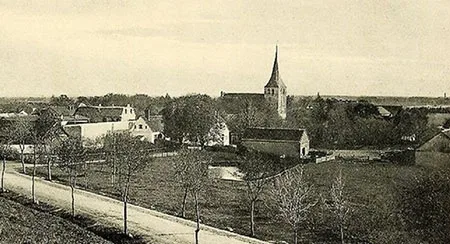
The locality of Quednau is first mentioned around 1255 as Quedenow in the description of the campaign of King Ottokar II Přemysl (1233–78). In 1302 it was called Qedemnowe, around 1540 Qednow; after 1540 it is mentioned as Quednaw, after 1565 as Quedenow, and after 1785 as Quedenau. In all likelihood the Prussian Nalubo (Nalube, Nalubus) of the Sklodo clan, who was baptised in 1255 and became one of the leaders of the Second Prussian Uprising (1260–74), came from Quednau (Quedenow). After his army was defeated, his relatives persuaded Nalubo to surrender and accept Christianity again. For this the Sklodo clan received Quednau as a fief. It is claimed that Nalubo invited Dominican monks to the area to continue the baptism of the Prussian population, and that it was he who built the Quednau church on the top of the hill, dedicated to St James. The latter was the patron saint of sailors and fishermen, and the Quednau church came to be mentioned in the Order's chronicles (for example, in 1320) as a place of pilgrimage for fishermen and seafarers.
Around the middle of the 14th century Quednau Castle was built, belonging to the Bishop of Samland. Very little is known about the castle itself; quite possibly it stood on the hill where Fort No. 3 "König Friedrich III" was later built. It is also quite possible that the castle site had earlier been occupied by a Prussian earthwork fortification.
Quednau Castle is mentioned in connection with the events at Rudau in 1370. It was from Quednau that the army of the Order's Marshal Henning Schindekopf set out to rout the Lithuanian forces that had invaded the Order's lands. And it was here that the body of the marshal himself, mortally wounded in the battle, was eventually brought. According to legend, the marshal's armour was long kept as a relic in the Quednau church.
Quednau again became the centre of historical events in 1427. That year the bishop's rebellious vassal Andreas Wogedde seized Quednau Castle and also the village of Trutenau (Medvedevka).
By the middle of the 15th century Quednau Castle had evidently fallen into decay, as it is not mentioned in the Second Peace of Thorn (1466), which listed all the castles then in use.
In 1507, on the instructions of Grand Master Friedrich von Sachsen, a new church building was erected in Quednau of fieldstone and blocks of brick masonry from the old church, and then plastered. The new church was moved from the top of the hill to its foot. The reason given for this move is that seafarers in the distance confused the church spire with the tower of Königsberg Castle. However, the very fact of the church's move in 1507 is disputed by some researchers (Altshuller). On the basis of the masonry it is suggested that the building at the foot of the hill was constructed at the turn of the 13th and 14th centuries, and that in 1507 only reconstruction work was carried out on the building or additional rooms were added to it. In any case, for 1507 there is documentary evidence of the dimensions of the Quednau church: 75x33 feet (23.5x10.4 m) in plan and 20 feet (6.3 m) high.
In 1525, during the peasant unrest in Prussia, Quednau became the site of the rebel peasants' camp.
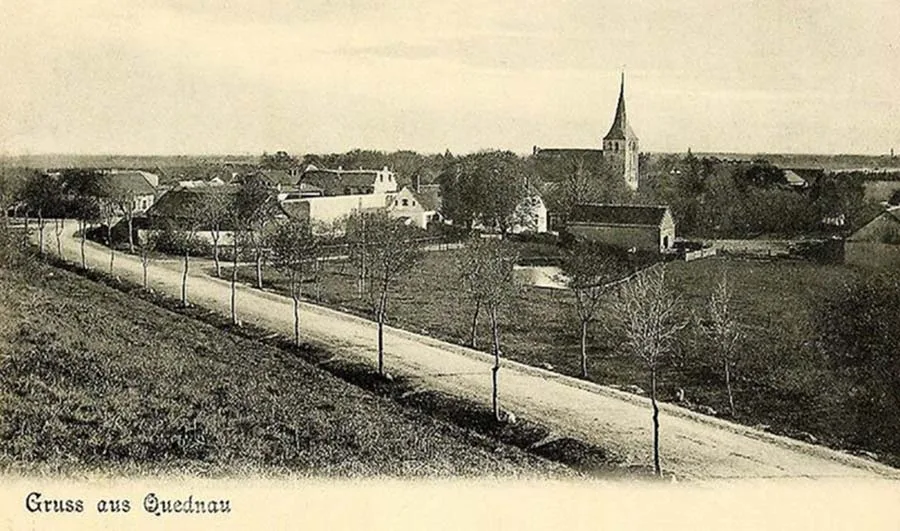
In 1687 the church building and bell tower were badly damaged by a storm. Restoration took 10 years.
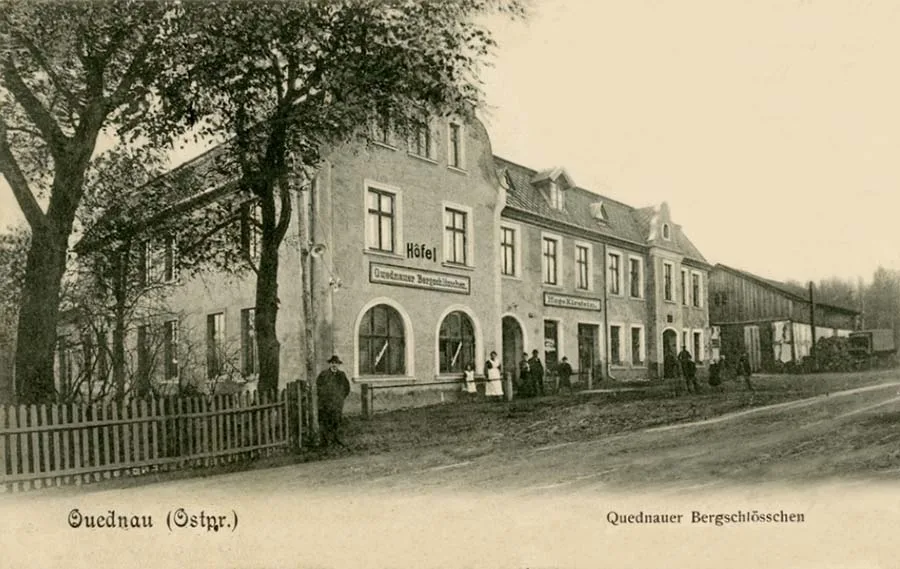
In 1785 there were three administrative units on the territory of Quednau. The first was a village under Kulm law (Cölmisch Dorf), with a church and a royal manor farm let on hereditary lease (Königlich Erbpachtvorwerk). It had 16 households. The next was a noble estate (Adelich Gut), which was also the centre of a rural district, the Schulzenamt. It had six households. The third was a noble manor farm (Adelich Vorwerk) with two households, which belonged to a Königsberg chamberlain.
In 1807, after their victory over the Russian army at the Battle of Friedland (14.07.1807), Quednau was occupied by French soldiers, who thoroughly plundered both the village itself and the church, in which they set up a stable. At the same time the altar was taken away, though in 1814 it was returned to its place.
In 1818 Quednau was classified as a village under Kulm law and a royal manor farm let on hereditary lease. There were 16 households in all.
By 1818 the Quednau church had become so dilapidated that a storm wind destroyed its roof, and the rotten beams and rafters collapsed and damaged the star vault of the ceiling. The building was dangerous for parishioners, and in 1828 the police banned services until the damage had been fully repaired, which was done by 1830.
In the 19th century Quednau was a village which from 1818 formed a rural municipality in the Landkreis Königsberg (in 1939 merged into the Landkreis Samland). The Quednau church was the parish church for the surrounding villages and estates. In 1871 the rural municipality of Quednau had 27 residential buildings, home to 75 families. Of these, 22 houses were in the village, four belonged to the Rothenstein brickworks, and one more to the Dammbruch estate (54°48'30'' N 20°27'22'' E).
On 30.04.1874 the rural municipality of Quednau was included in the newly established Amtsbezirk of Quednau. At the same time the Quednau estate (owned by the Schnell family) was separated from the municipality of Quednau and became part of the Amtsbezirk of Quednau as an independent unit. The first head of the Amtsbezirk, in 1874–75, was the owner of the Quednau estate, Hermann Schnell. The next resident of Quednau to hold this post, in 1923–39, was the head of the municipality of Quednau, Steinbeck, who also became the last head of the Amtsbezirk.
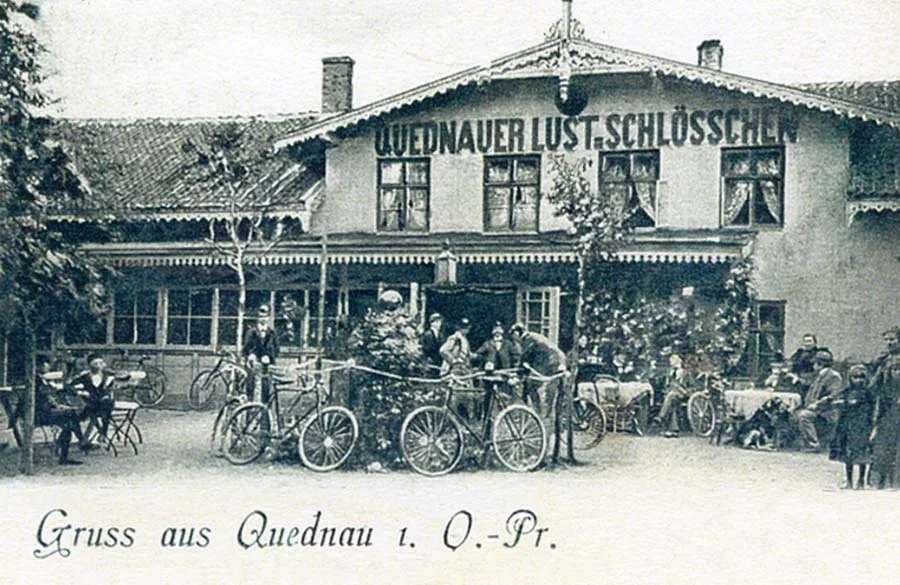
In 1879 the first of Königsberg's forts (by the date construction began) was built in Quednau (No. 3), originally named "Quednau". In 1885 the Königsberg – Cranz (Zelenogradsk) railway was laid through Quednau, and a station was opened on it in Quednau.
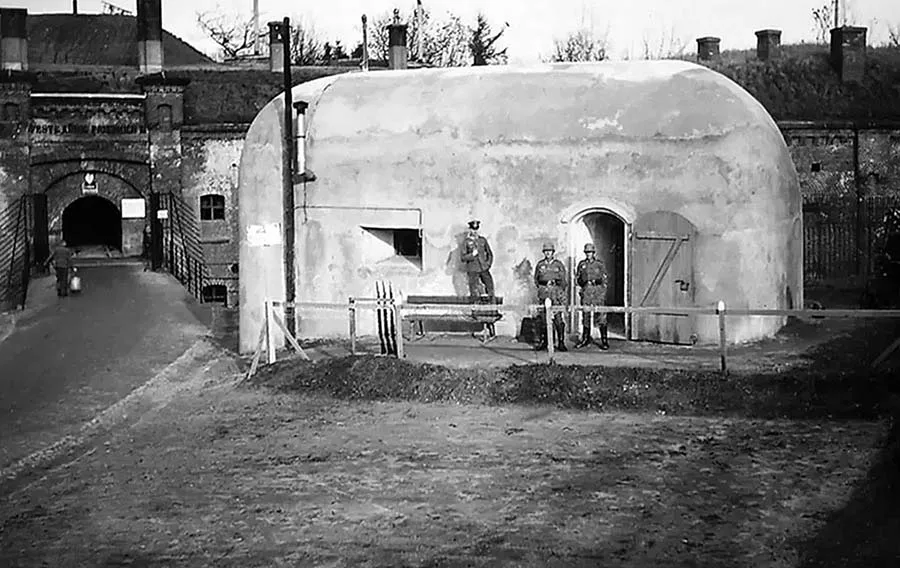 Guards at the entrance to Fort No. 3 "König Friedrich III".
On 30.08.1895 the Quednau estate lost its independent status and became part of the rural municipality of Quednau. On 16.06.1927 part of the territory of the rural municipality of Quednau south of the Ringchaussee (now 3rd Bolshaya Okruzhnaya and 4th Bolshaya Okruzhnaya Streets) was transferred to the Königsberg municipality. This area was bounded to the north by the Ringchaussee (3rd Bolshaya Okruzhnaya and 4th Bolshaya Okruzhnaya Streets), to the west by the waste ground around today's Vilora Buslovskogo and Bogatyrskaya Streets, to the south by Rothensteiner Straße (Krasnokamennaya Street) and the waste ground around today's Pekhotnaya Street, and to the east by the waste ground around Starosapyornaya Street. This area was at first called Quednau, but later its western part changed its name to Rothenstein. On 30.09.1928 the abolished Gutsbezirk of Fräuleinenhof (Kutuzovo) became part of the rural municipality of Quednau.
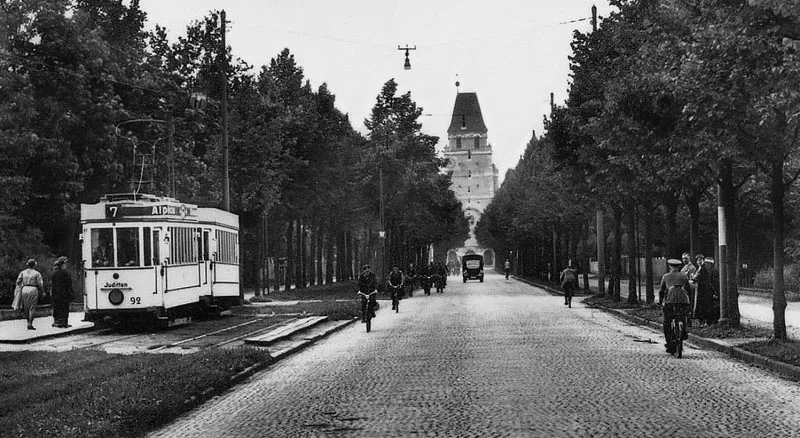
On 01.09.1939 the municipality of Quednau was dissolved and Quednau became part of Königsberg as a city district. The boundaries of the new district ran in the south along the Ringchaussee (now 3rd Bolshaya Okruzhnaya and 4th Bolshaya Okruzhnaya Streets), in the west along the waste ground around today's Tsentralnaya Street in the Iskra garden partnership, Krylova Street and Korsunskaya Street, in the north along the city boundary, and in the east along the Königsberg – Labiau – Tilsit railway line (Kaliningrad – Polessk – Sovetsk). The Quednau district and the territories of the Quednau municipality that had earlier passed to the city were built up with private houses and small blocks of flats with garden plots (the "Garden City" project). In the pre-war years Quednau had a school, a railway station and a dairy, and there was a hunting shooting range.
Quednau was taken during the storming of Königsberg on 06–09.04.1945. The garrison defending Fort No. 3 put up practically no resistance: after the fort had been bypassed by the advancing Soviet troops (the 5th Army of Colonel General N.I. Krylov, 1903–72), its defenders abandoned their positions.
Because Quednau lay away from the directions of the main thrusts of the armies of the 3rd Belorussian Front, the district suffered less than many other districts of Königsberg. Even the church survived. The commandant's office set it aside for the religious needs of the remaining German population.
On 29.07.1948, by decision of the city executive committee, the Quednau district was given a new name: Gvardeysky Gorodok. But it did not catch on. By a new decision of 18.08.1949 the city executive committee renamed Gvardeysky Gorodok the settlement of Severnaya Gora (North Hill). Probably the popular name of the locality that had already taken root was chosen.
In 1964 the badly dilapidated Quednau church building was surveyed by a commission of the Central Scientific Restoration Workshops led by the architect Altshuller. In the survey report the building appears as an "architectural monument of the 14th–16th centuries", and recommendations for its conservation were issued at the same time.
The Quednau church was demolished after the war. For a long time its site was waste ground, but later a 9-storey residential building was built on the site of the church and the adjoining cemetery. The Quednau railway station did not operate after the war. In Soviet times the district was built up mainly with restored German and partly Soviet small blocks of flats and private houses. After 1991 multi-storey buildings began from time to time to be "inserted" into the low-rise housing here, which has undoubtedly reduced the historical and aesthetic appeal of the district. A considerable part of the territory is occupied by an industrial zone: warehouses, production facilities and shopping centres. The name of the settlement of Severnaya Gora is perhaps the most widely used by city residents of all the renamed city settlements. This name is shown on the Kaliningrad master plan and on public transport routes. But the area that people now call "Severnaya Gora" extends beyond the boundaries of the former municipality of Quednau, of the former city district of Quednau and of the settlement of Severnaya Gora within the boundaries once set by the city authorities. It now begins at Max Aschmann Park and Kolkhoznaya Street, is bounded in the west by Malaya Lesnaya Street, borders the settlement of Kutuzovo in the north, and in the east its boundary now runs along the railway line to Polessk.
Sights: Fort No. 3, mass grave of Soviet soldiers (more than 20 people).
Population of the municipality of Quednau: 1818 – 189, 1867 – 341, 1871 – 464, 1885 – 7231, 1905 – 7482, 1910 – 802, 1925 – 1,012, 1933 – 1,519 inhabitants.
Composition of the population of Quednau in 1871: Protestant Christians – 456, Catholics – 8, children under 10 – 132, literate – 270 (84%), blind – 1, insane – 1.
For reference
The Quednau church parish comprised: Absintkeim (54°46'12'' N 20°34'09'' E), Achtmorgen (54°48'56'' N 20°33'03'' E), Aweyken (Sviridovo), Ballieth (Pervomaysky), Beydritten (Pervomaysky), Dammbruch (54°48'30'' N 20°27'22'' E), Ernsthof (Kaliningrad, Narvskaya Street – Admirala Makarova Street), Fräuleinenhof (Kutuzovo), Kummerau (Nevskoye), Maraunenhof (Bolshiye Prudy), Matzkahlen (Bogatovo), Nesselbeck (Orlovka), Neuhof (Timofeyevka), Quednau (Severnaya Gora), Rothenstein (Kutuzovo), Schäferwalde, Sammitten (Dubosekovo), Sandlauken (Dorozhny), Stantau (Mitino), Stiegehnen (Sokolovka), Sudau (Maykovo), Trutenau (Medvedevka), Wilky (Mendeleyevo), Ziegelau.
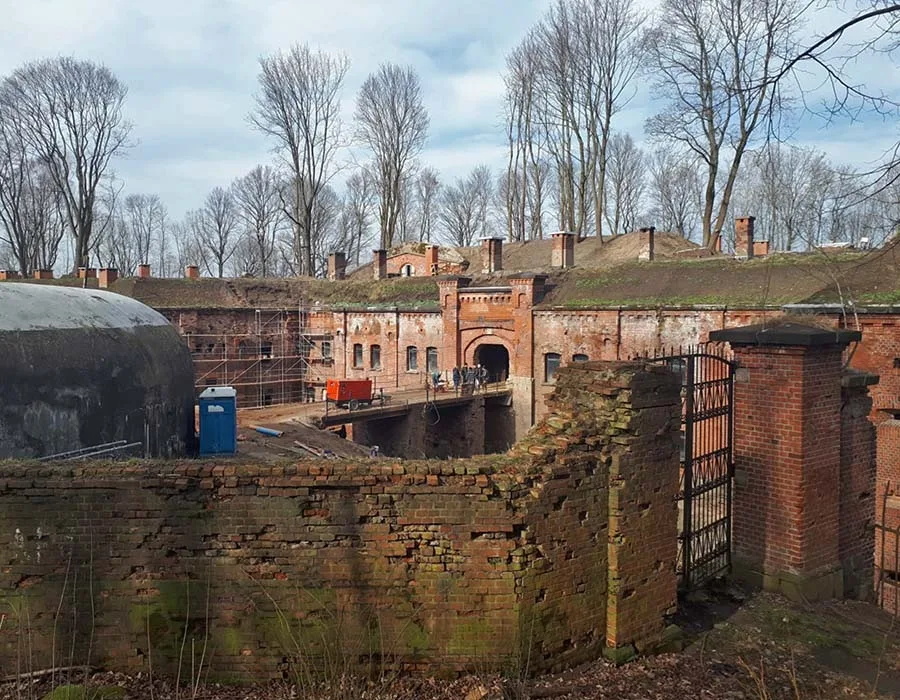 Spring 2024. Work is in full swing in the third fort to transform it into a hotel.
Amtsbezirk of Quednau
On 30.04.1874 Amtsbezirk No. 18 Quednau was established in the Landkreis Königsberg, comprising four rural municipalities: Kummerau (Nevskoye), Quednau (Severnaya Gora), Stiegehnen (Sokolovka) and Ziegelau (54°46'17'' N 20°33'23'' E), and 11 Gutsbezirke: Absintkeim (54°46'12'' N 20°34'09'' E), Ballieth (Pervomaysky), Beydritten (Pervomaysky), Ernsthof (Kaliningrad, Narvskaya Street – Admirala Makarova Street), Fräuleinenhof (Kutuzovo), Maraunenhof (Bolshiye Prudy), Quednau (Severnaya Gora), Schäferwalde (54°47'37'' N 20°28'28'' E), Sammitten (Dubosekovo), Sudau (Maykovo) and Zögershof (Kaliningrad, Goncharnaya Street). The Ernsthof estate, however, was legally constituted as a Gutsbezirk only in 1883, and the Quednau estate never quite managed to become a Gutsbezirk at all. On 31.08.1895 the Quednau estate (Severnaya Gora, part) became part of the rural municipality of Quednau (Severnaya Gora). On 29.03.1906 the municipality of Devau (Kaliningrad, Prigorodnaya Street), previously part of the Amtsbezirk of Kalthof (Rizhskoye), became part of the municipality of Quednau. By 1908 the Amtsbezirk of Quednau comprised five rural municipalities: Devau (Kaliningrad, Prigorodnaya Street), Kummerau (Nevskoye), Quednau (Severnaya Gora), Stiegehnen (Sokolovka) and Ziegelau, and three Gutsbezirke: Absintkeim, Fräuleinenhof (Kutuzovo) and Maraunenhof (Bolshiye Prudy). On 16.06.1927 the rural municipalities of Kummerau (Nevskoye) and Devau (Prigorodnaya Street) and the Gutsbezirk of Maraunenhof (Bolshiye Prudy) lost their independence and became part of the Königsberg municipality. On 30.09.1928 the Gutsbezirk of Absintkeim was abolished and incorporated into the rural municipality of Ziegelau, and the Gutsbezirk of Fräuleinenhof into the rural municipality of Quednau. As a result the Amtsbezirk of Quednau came to consist of three rural municipalities: Quednau (Severnaya Gora), Stiegehnen (Sokolovka) and Ziegelau. Its composition did not change again until its dissolution on 01.04.1939.
1 – including the Gutsbezirk of Quednau (276 inhabitants in the municipality of Quednau, 447 in the Gutsbezirk of Quednau).
2 – including 499 inhabitants in the village of Quednau itself.
Translated from Russian with the help of AI (Claude, Anthropic), October 2026.