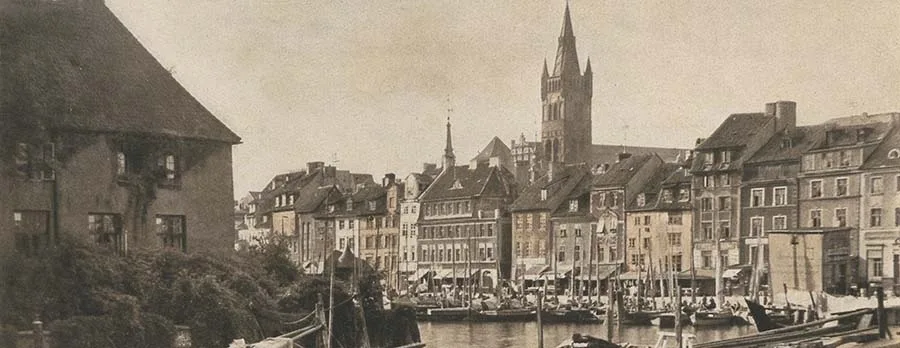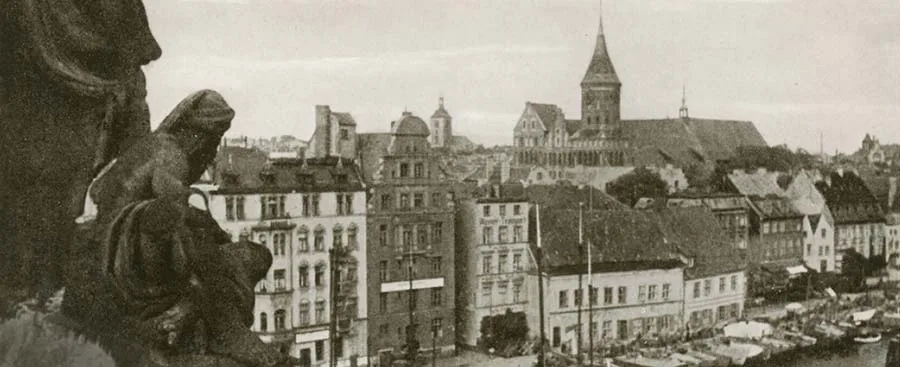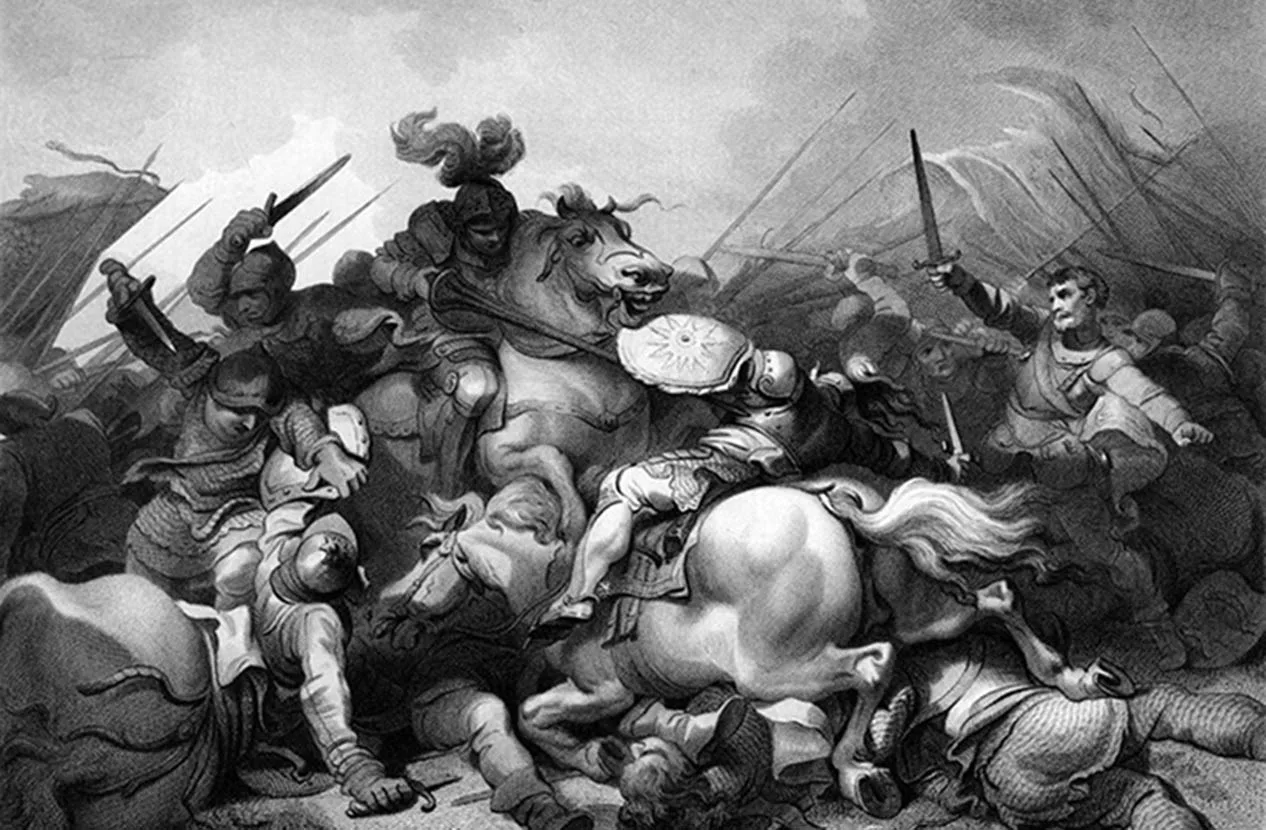
According to legend, this privilege was won for his fellow townsmen by Hans von Sagan, the celebrated cobbler's apprentice from Kneiphof. At the battle against the Lithuanians at Rudau in 1370 he caught up the banner of the Teutonic Order as it fell from the hands of a slain knight and led the troops into the attack. The enemy was routed, the Lithuanians failed to take Königsberg, and the grateful Order granted Hans Sagan the noble particle "von" before his name for his feat, and also promised to fulfil any request he might make. And good-natured Hans asked for the privilege of treating whomever he wished, once a year, to as much beer as they could drink in Königsberg Castle at the treasury's expense.
* * *
The legend Das Schmeckebier zu Königsberg1, which might be rendered as "The Beer Treat in Königsberg", was recorded in the 19th century by the German literary historian and bibliographer Johann Georg Theodor Grässe (1814–1885).
The earliest known mention of this beer festival is found in the "Prussian Chronicle" of Lucas David2, who, as court councillor to Duke Albrecht and an eyewitness, describes the ceremony as follows:
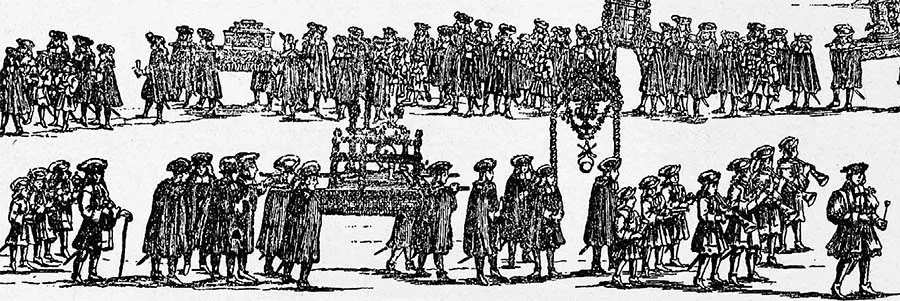
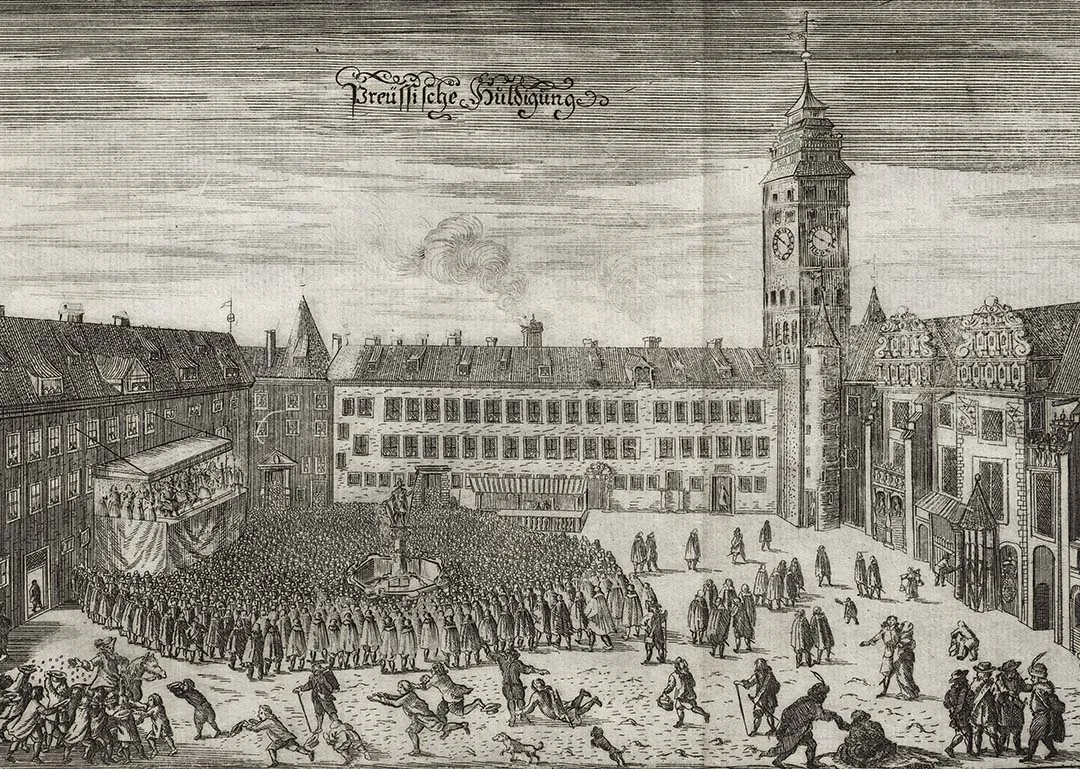
"A few days before Ascension Day the burgrave of Königsberg sends his servants to the burgomaster, the councillors and the merchants, and also to the common townsfolk in both gardens — the merchants' garden and the public one — of the town of Kneipabe3. In the Duke's name the servants invite everyone to an evening meal at Königsberg Castle on Ascension Day. They, in turn, as obedient subjects, accept the invitation to attend the yearly festivity, and some three hundred people arrive at four o'clock in the afternoon, lined up in a long procession three abreast.
A little earlier the burgomaster and several councillors cross the market square of the Altstadt and go up to the castle. All the other guests of honour follow them. At the castle the burgomaster receives the most distinguished guests, while the other well-to-do townsmen are received by the Duke's councillors and the nobility. Everyone is shown inside. There the tables are already laid, and each person is seated according to his rank and treated to all manner of dishes and drinks — wine, mead and the finest March beer. And so it goes on until everyone has had his fill.
When the roast is brought to the table during the feast, everyone raises his cup to the Duke's health, and at that moment all the trumpets in the banqueting hall begin to sound and the army drums to beat. The meal in the castle chambers usually lasts an hour or more. Then, after supper, between seven and eight in the evening, benches are set out in the castle courtyard, everyone goes out, sits down on them, and a good drinking bout begins.
The trumpeters take up their places, one in the corner of the courtyard near the barber's4, another in the middle by the castle well, a third at the entrance to the church, a fourth somewhere else. And each of them blows his trumpet as is customary in a solemn procession — when one stops, another begins. The army drum sounds almost without pause… And all this in memory of Hans von Sagan, until the last guest has left. Thus, year after year, generation after generation, the memory of the glorious cobbler is preserved. This good old tradition was interrupted only in years of war.
After the feast, until nine in the evening, the burgrave and others accompany the guests to the gate through which they entered the castle. There, by established custom, everyone is again treated to good drink. From there they are escorted further through the castle's outer bailey5 to the stairs, from where they all walk past the Mint to the Altstadt market, where they stop once more to wet their whistles "for the road", for good friends cannot part so easily. But by now the town boundary has been reached, and more than enough has been eaten and drunk, so it is time to bid one another farewell. The burgrave and his retinue go back to Königsberg Castle, while the burgomaster and the townsmen of Kneipabe (though fewer in number than at the start of the festivities, and in less orderly ranks) return across the Altstadt market to their own town, Kneiphof, as it is commonly called".
* * *
And this is what Caspar Hennenberger writes about the custom in his work "A Brief and Truthful Description of the Land of Prussia" (1584)6:
"Every year on Ascension Day the people of Kneiphof come to the castle for supper, where they are fed their fill, treated to unlimited beer and entertained with music. This custom is called Schmeckbier. On this day beer is drunk in abundance. Some even have to be escorted home."
* * *
A list of provisions has survived from the beer festival held on 5 May 1597:
– 5 oxen;
– 34 calves;
– 70 hams;
– 2 kopas7 of pike;
– 10 kopas of beer;
– 4 kopas of hens and capons;
– 66 kopas of crayfish;
– 252 stoups of Rhenish wine;
– 25 barrels of March beer;
– Pastries.
Michael Lilienthal, in his work "Prussia, with Explanations…", published in Königsberg in 17238, gives the following account:
"In 1619, on Ascension Day, His Princely Grace the Elector George William held the Schmeckbier festival (which had not taken place for many years), and a great number of people came to it.
The councillors and judges sat in the Muscovite Hall. The Elector treated everyone to a good dinner. But since he was unwell at the time, he instructed the regents (the regimental or supreme councillors) to act as hosts at table together with other noble Junkers, so that we were fed and given drink in princely fashion.
The burghers sat in the castle chambers, but there was not enough room for all, and so several tables and benches were set up on the parade ground."
* * *
There are no later records of this tradition, so we may conclude that it apparently came to an end during the reign of Elector George William (1619–1640). Yet one question remains: even if our ancestors believed the latter, might the custom not have had some motive other than the feat of Hans von Sagan?
Not only in Königsberg but in other Prussian towns too it was the custom to brew so much beer between Michaelmas9 and Easter that it lasted the whole summer until autumn. These quantities were mostly brewed in the month of March and put into storage (the so-called Lagerbier10). And at the time when these barrels were brought up from the cellars and tapped, merry feasts were held in the Junkerhof, at which the March beer was served, called Schmeckbier, literally "tasty beer". Lucas David notes this as well in the passage quoted above, and the following ordinance of the Kneiphof Council of 1539 shows clearly that March beer and the so-called Schmeckbier are one and the same:
"If the lord burgrave of the castle, in place of and on behalf of His Princely Highness, should invite the Council together with the community, as is fitting according to old and laudable custom, to taste the March beer on the Ascension of Christ, then the Council shall appear in full, showing loyal respect to His Princely Highness and to the honour of this town. But should anyone fail to appear without good reason and without the burgomaster's leave, he shall be fined one Hungarian gulden."
* * *
An ordinance of the magistrate of the town of Elbing of 1640 concerning the mashing of malt and the drinking of the malt brewers' beer11 states:
"At the insistence of the masters and elders (of the guilds) of the malt brewers, the following articles are revised and confirmed:
1) Fourteen days before Oculi12 (in March) the masters and elders shall ask the presiding lord burgomaster, and also the members of the guilds, that the "Great Beer" (das Große Bier) be brewed according to ancient custom.
2) When the malt is mashed, the masters (of the brewers) shall serve the brethren pike, boiled or cured in salt, together with pretzels and bread, and in addition a good quantity of Elbing beer shall be served — at the expense of the masters of the brewers' guild.
3) Three weeks after Easter it is forbidden to drink the beer, without any additional expense.
4) On the Monday after the first Sunday after Trinity (in June) the drinking shall begin and continue up to and including the middle of the week, namely starting on the appointed days at noon after one o'clock and ending no later than ten o'clock in the evening, after which the cellar shall be closed.
5) On the Saturday before, the masters and elders (of the brewers) shall invite the honourable Council and the reverend clergy, and the tapster all the other brethren, to gather on the following Monday for the beer treat.
On the gentlemen's table there shall be served: pike in salt, roast beef, salted meat with the appropriate accompaniments, and other bread. To the junior brethren, however, only a piece of salted meat with bread and the like."
* * *
It is very likely that similar rules for brewing and drinking March beer were also in force in Königsberg, although no records of them have been found. Therefore it cannot be claimed that the Schmeckbier custom was introduced at Hans von Sagan's request as a reward for his feat and in his memory. It is more likely an old tradition of the brewers' guild.
The musical accompaniment of the festival by trumpeters and drummers in Königsberg in all probability had nothing to do with feats of arms of bygone days, since in Elbing, too, musicians were required to play, stationed at both ends of the Junkergarten, performing the so-called "court right"13.
And if in Elbing guests were invited to a three-day tasting of March beer, the same must have happened in Königsberg. Moreover, the Teutonic Order had its own brewery in the local castle.
So if the brewers' guilds of Kneiphof enjoyed the honour of inviting the Marshal of the Order (the castle commander, or later the burgrave) every year to taste their signature March beer, he in turn returned the courtesy by inviting the townspeople of Kneiphof to the castle to "savour the beer".
True, the chronicles tell us only of the townspeople of Kneiphof enjoying this privilege. And it is entirely unclear when, how and where they acquired it.
TRANSLATOR'S NOTES
1. The name of the festival can be translated as "tasty beer" (Schmeckbier) and also as "taste the beer" (Schmeckebier), especially if one goes by the second spelling, as in Johann Grässe's legend.
2. Lucas David (1503–1583) was a Prussian court historiographer and judicial councillor to Duke Albrecht (1490–1568), on whose commission he worked on a fundamental history of Prussia. The work was never completed, but it is one of the important primary sources.
3. The town of Kneiphof appears in the chronicles under the following names: Kneibabe, Kneipabe, Kneippabe, Knypabe, Knypafe, Knypawe, Knyphabe, Knyphoff’s. Königsberg-Kneiphof.
4. So in the chronicle ("die Trommeter stellen sich, der eine fast in den Winkel beim Barbier, der andere bei dem Born doch fast mitten...”).
5. Lucas David uses the word Zwinger here.
6. Caspar Hennenberger (1529–1600) was a Prussian Lutheran pastor, historian and cartographer, author of "A Brief and Truthful Description of the Land of Prussia", 1584.
7. A kopa is a unit of count equal to 60 items of something.
8. Michael Lilienthal (1686–1750) was a German Lutheran theologian, historian, bibliographer and numismatist.
9. Michaelmas — 21 November.
10. Lager (from German Lagerbier, "beer matured in storage") is a type of beer made by bottom fermentation followed by maturation at low temperature. Today it is the most widespread type of beer, accounting for up to 80% of world consumption.
11. The name itself is interesting — "the malt brewers of Kneiphof" (German die Kneiphöfer Mälzenbräuer, as recorded in the chronicle).
They were members of the upper bourgeoisie (besides the malt brewers, this included the great merchants, owners of trading houses; both groups were called Junkers).
Those in Königsberg who owned (or leased) a house with brewing rights usually attained great prosperity. The malt brewers (Mälzenbräuer) as a rule did not brew the beer themselves but left this to guild members, the actual brewers and maltsters. Most of Königsberg's malt brewers lived in Löbenicht. In this (rather proletarian) part of the city they led a very comfortable life. In educated circles it was held that only soldiers or monks could lead such a life. There is still a saying, derived from the well-known Latin expression Aut Caesar aut nihil (Either Caesar or nothing):
Aut miles, aut monachus, aut Mälzenbräuer im Löbenicht. (Either a soldier, or a monk, or a malt brewer in Löbenicht).
12. Oculi (a Christian term): the third Sunday of Lent. From the Latin oculi, "eyes", the first word of the introit of that Sunday's liturgy, Oculi mei semper ad Dominum, "Mine eyes are ever toward the Lord" (Psalm 25:15).
13. The musicians' duty to play at town festivities was called Hoff-Recht (in the old spelling), i.e. "court right".
SOURCES
1. Lucas David. «Preußische Chronik», 1575.
2. Caspar Hennenberger. «Kurze und wahrhaftige Beschreibung des Landes zu Preussen», 1584.
3. Johann Georg Theodor Grässe. «Sagenbuch des Preußischen Staates», Band 2, Glogau, 1871.
4. Википедия. Mälzenbräuer.
LEGENDS OF PRUSSIA in the blog of Tatyana Kolivay.
Translated from Russian with the help of AI (Claude, Anthropic), October 2026.