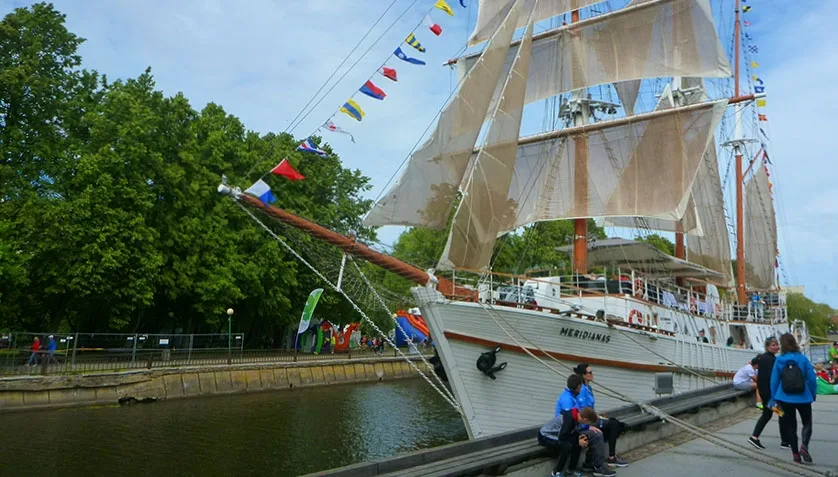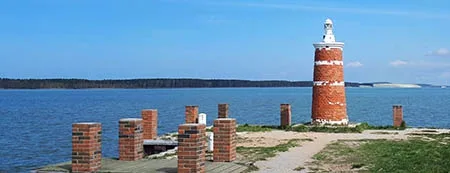
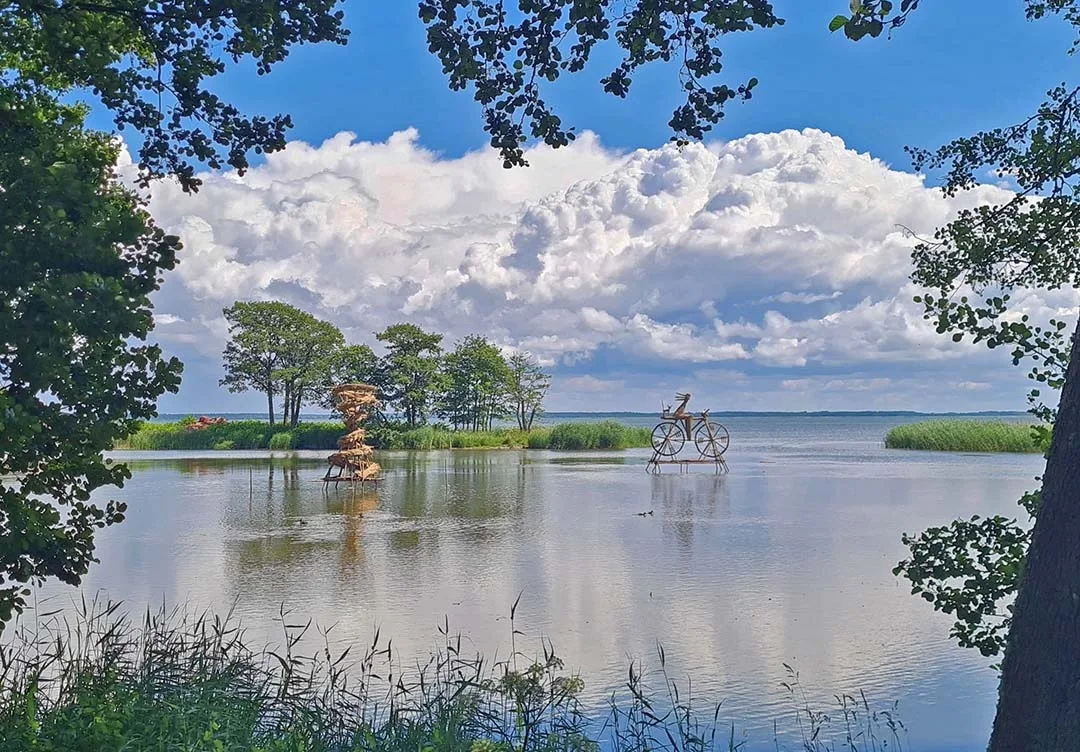
The mouth of the Vistula near Danzig (Gdańsk), framed by wooded hills that form a broad, picturesque bay, is one of the most magnificent natural landscapes in Central Europe. The country around Elbing (Elbląg) is in no way inferior to it in beauty. Further still to the north-east, an expanse of water glitters on the horizon through the green landscape. This is the Curonian Lagoon, ringed by massive dunes. A steamer carries us across it to the village of Schwarzort, our destination. The gentle charm that delighted us around Elbing near the Vistula Lagoon gives way here to a Nordic grandeur that would have been hard to imagine. If we look through a telescope from Schwarzort across the smooth water towards the mainland, we will see neither coastal mountains nor picturesque vistas. There, all the way to the flat horizon, stretch only green meadows adorned with trees and houses, and the landscape appears in all its simple, friendly beauty.
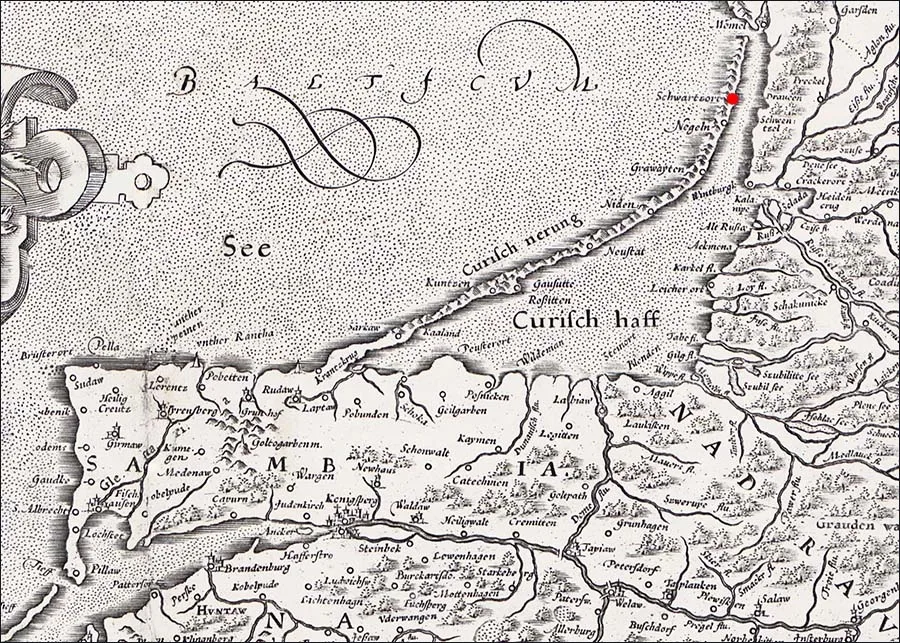 Schwarzort on a map of Prussia from 1628.
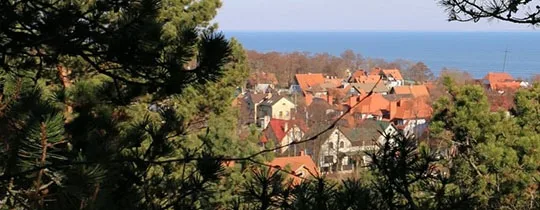
Schwarzort is a pleasant village on the shore of the Curonian Lagoon. It nestles in a dense forest of stately pines, spruces and juniper thickets.
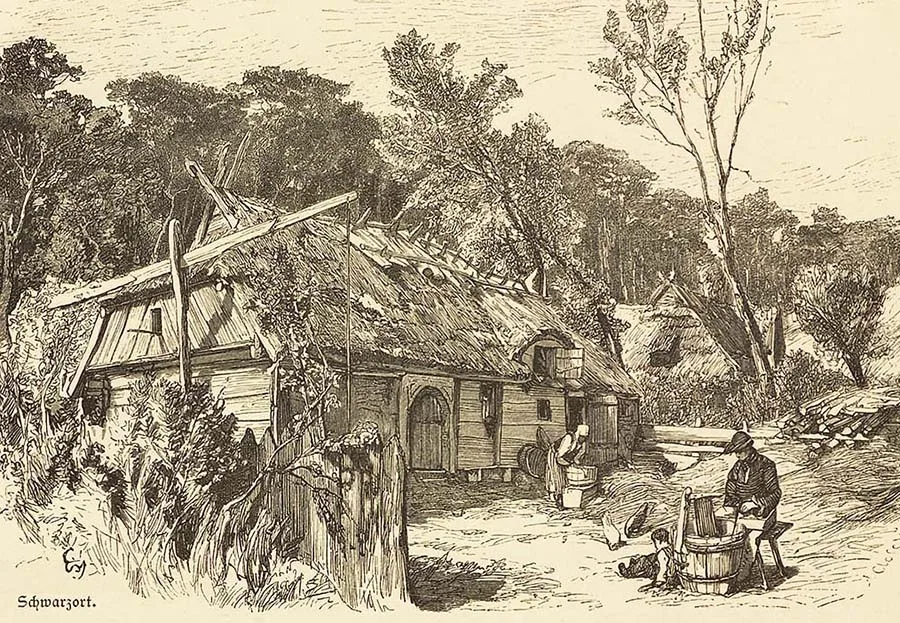 A street scene in the fishermen's quarter of Schwarzort. Illustration by Gustav Schönleber.
A charming little Gothic church of red brick stands out gracefully against the green background, with fishermen's cottages clustered around it. Further on, amid the greenery, on low hills and among elegant gardens, are country houses, villas and neat Swiss-style chalets. In the summer months people come here on holiday to enjoy the mild, fragrant air filled with the scent of pine needles, or to bathe in the sea, which is just a fifteen-minute walk across the dunes from the village.
Among the many Prussian summer colonies on the Baltic coast, Schwarzort is probably one of the youngest. Yet it is one of the most climatically favourable, interesting and unique places. Its charm is like no other.
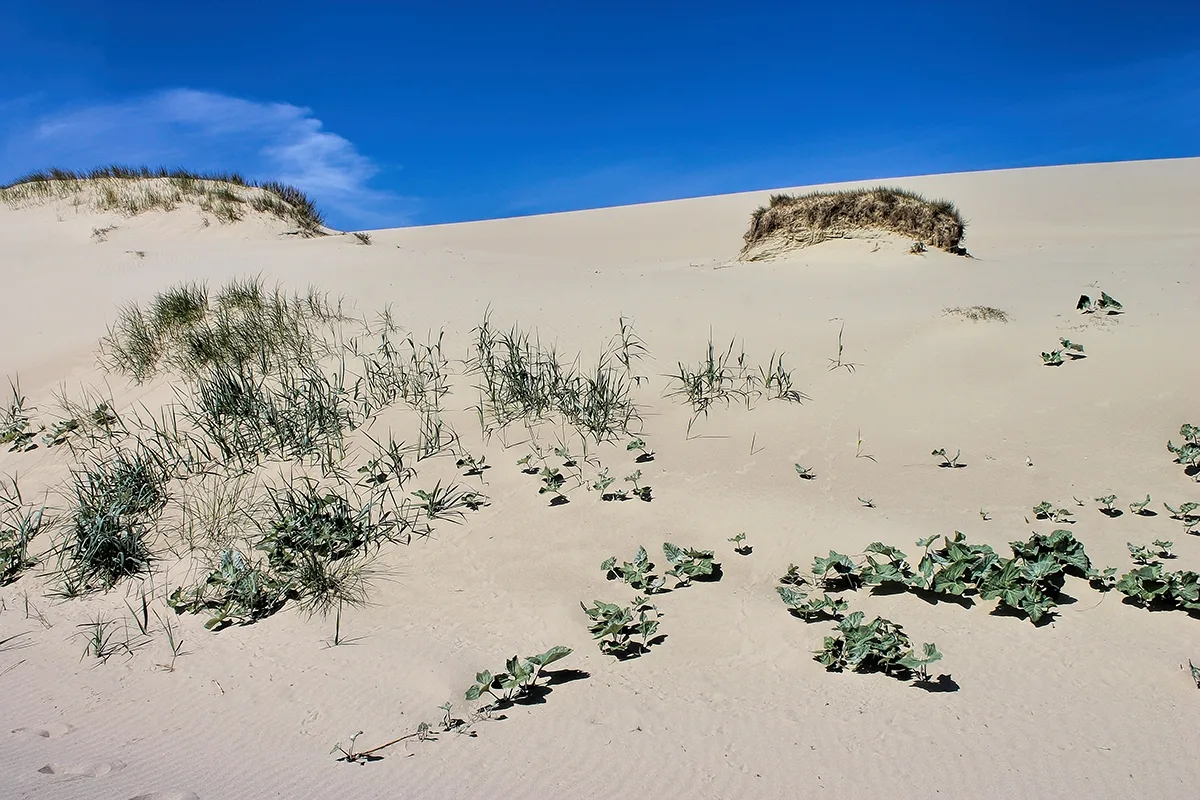
Elsewhere we know dunes as a firmly rooted ridge of sandy hills, raised centuries ago by warring elements.
Here, however, the dune is still alive and changing, and where it has come to rest, clear traces still bear witness to the fury of a battle of the elements that has barely ended.
Sea storms drive through the air clouds of sharp crystalline grains of quartz, of which the dune sand is made. When these clouds of sand meet an obstacle, they are deflected from their course. The whirlwinds break up, and deep hollows form with high, steep walls that rise in an almost completely closed circle, in the middle of which one suddenly comes upon a meadow, a grove of lush broadleaf trees, or a clearing thickly overgrown with ferns. Here there still grows a rare child of the Scandinavian flora, Linea borealis — the twinflower, the favourite plant of the Swedish botanist Carl Linnaeus.
And the shifting dune moves ever onward, burying everything in its path. Under the relentless onslaught of the sand, more and more ground disappears, and although plantings of shrubs and trees, along with other protective measures, are meant to halt its advance, no one has yet managed to solve the problem for good. The sharp, fine grains of quartz, hurled by the wind with furious force, gnaw at and erode the tree trunks, killing the trees and burying them.
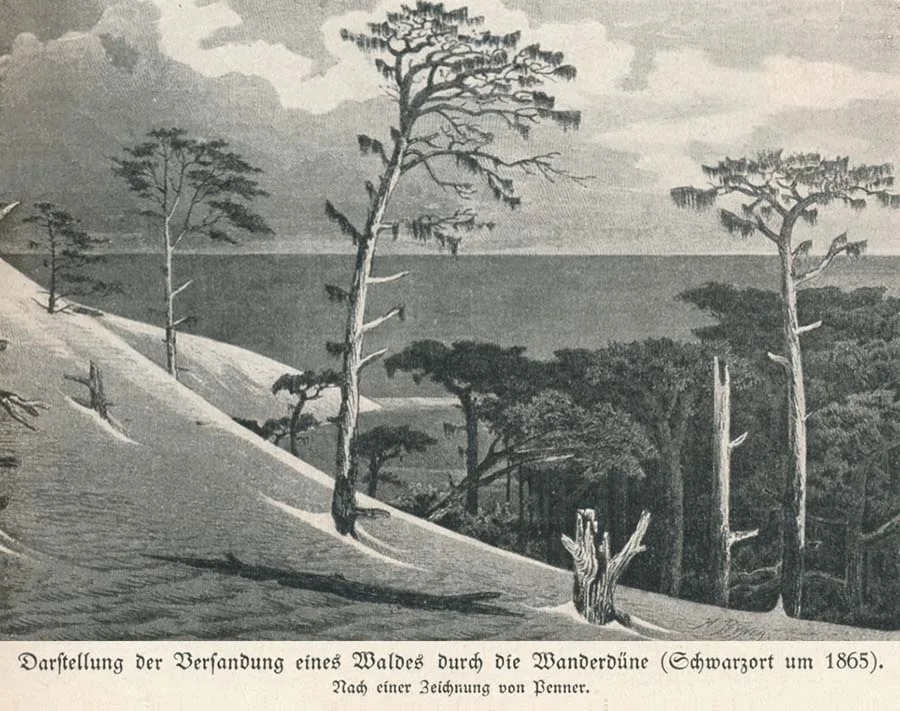 The dune swallows the forest near Schwarzort. Illustration by Hermann Penner.
The dunes of the Curonian Spit, the narrow strip of land that separates the lagoon from the sea, possess an astonishing beauty. Footpaths lead to several of the ridges and summits of these grand sand hills near Schwarzort.
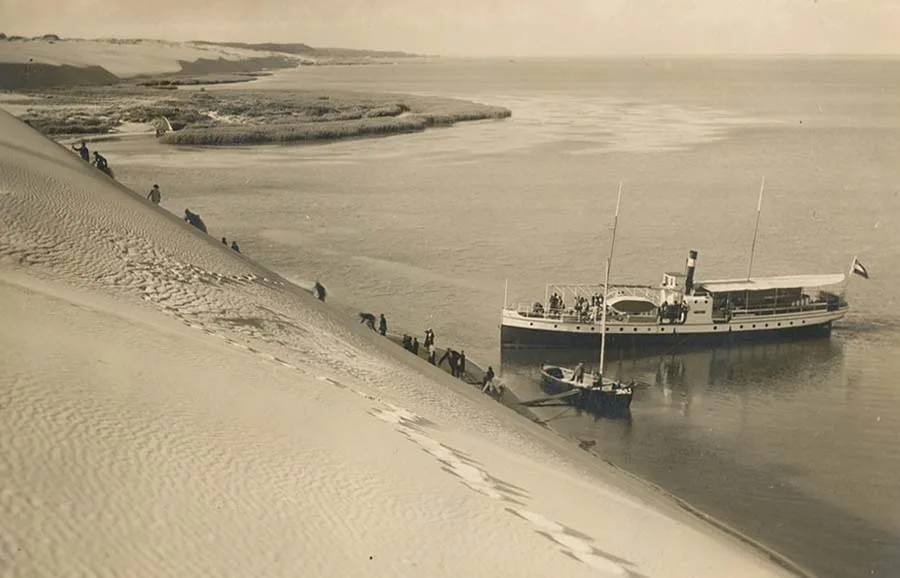 Tourists climbing a dune.
From up here one can take in the whole chaotic landscape of the dunes, gazing at the bizarre forms created by the masses of sand, by storms and natural upheavals. Clefts and dry ravines, and the arena-like hollows mentioned above, make for striking scenery. The barren, pale sand cliffs and the dense green forest spreading around Schwarzort lend the majestic landscape a variety of colour, heightened by occasional reddish fields of sand made of fine grains of porphyry, as well as by views of the boundless sea, the calm mirror of the lagoon, the lush greenery and the sunlit towers of Memel (now Klaipėda — ed.).
Yet these life-affirming views are in sharp dissonance with what we see in the foreground: here and there, from the chaotically piled sand hills and the valleys and ravines between them, ghostly remains of trees stick out. Their stiff branches reach upwards, and some have already fallen.
Their wasted trunks, stripped of bark and bleached by air and sun, still stand upright and make an oppressive impression.
The unexpectedly sombre mood of this landscape, a perfect example of the wildest romanticism, is gracefully offset by the charming village of Schwarzort with its cosy little houses, surrounded by tall forest and water.
From this vantage point we can catch a glimpse of one of the most unusual industrial installations anywhere. More than a quarter of a century ago amber was discovered in the lagoon — long, narrow seams which, as investigations showed, extended far beneath the lagoon bed. At that time dredging was carried out to determine the richness of the deposit and the quality of the fossil resin. At first the amber yields were very modest, but soon the efforts brought such a rich harvest that in time a full-scale industrial enterprise grew up here. Now the dredgers, whose number has risen to nineteen, can be seen everywhere on the waters of the Curonian Lagoon.
All of them are steam-powered. You can watch their buckets dip into the water, each one digging into the lagoon bed and bringing the soil to the surface so that its contents can be examined. The channel thus formed silts up again in time, and amber may well appear in the newly deposited soil too.
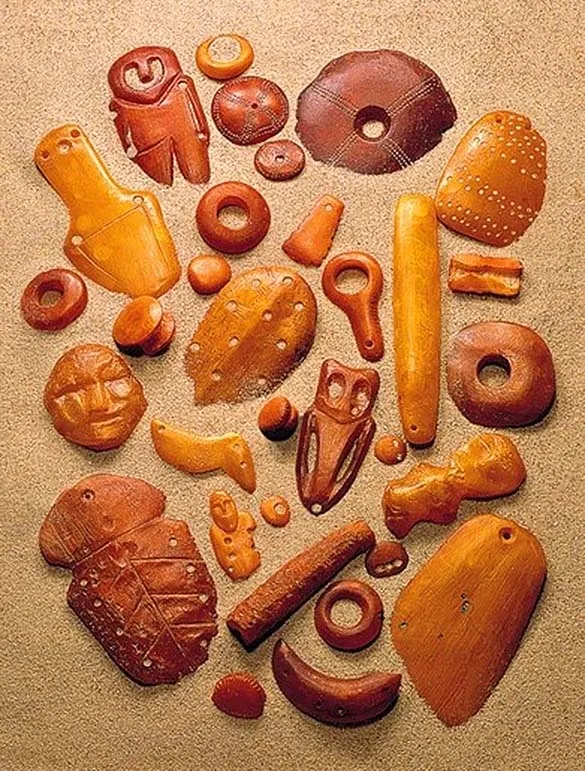
Amber artefacts found in the Schwarzort area.
And so, day after day, day and night, one can see the smoking funnels and the rows of buckets descending into the water. Work stops only on Sundays, and the winter frosts also force a break.
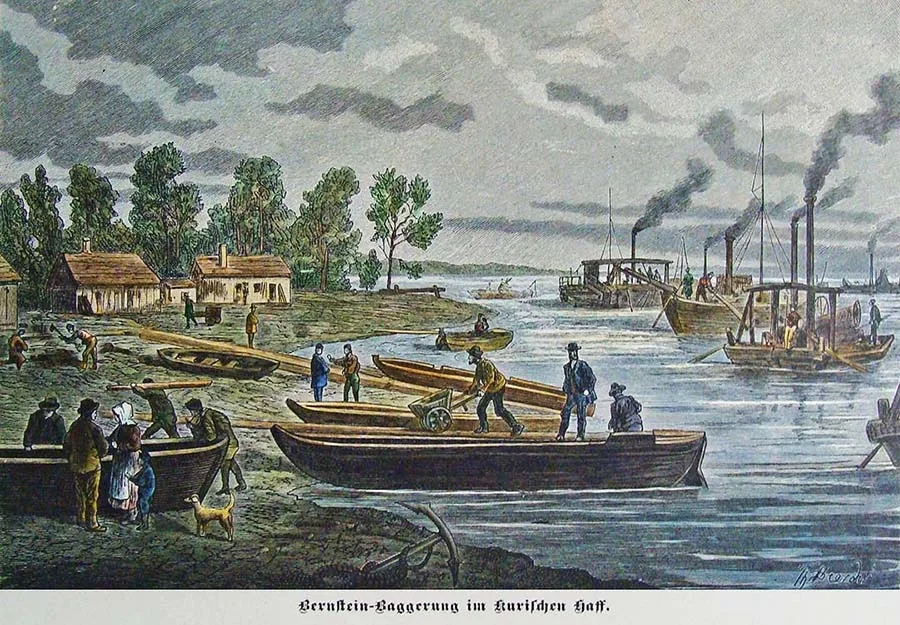 Extracting amber from the bed of the Curonian Lagoon.
The bottom soil raised by the dredgers is received by broad, flat-bottomed barges. This soil consists of muddy masses of sand, which are tipped onto large sieves that let the sand and silt through but hold back the larger particles. From what remains, the amber is picked out and packed tightly into sacks. These are sealed and then taken ashore for weekly shipment by steamer to the head office in Königsberg, from where East Prussian amber sets off on its journey around the world, mainly to Asia, Africa and America. For Persia, Armenia, Turkey and the interior of Russia, Moscow serves as the transhipment point. Amber is extremely valuable, so the workers are kept under strict supervision. This is necessary to prevent pieces of amber from being hidden in their clothing. The great masses of sand taken from the lagoon bed are carried to the Schwarzort shore, where a steam pump delivers the sand onto land; there it is spread out, thus creating new ground. Cultivated and planted with trees and shrubs, it forms a beautiful, ever-expanding coastal plain.
In the evenings electric light illuminates the whole industrial zone, lighting up the ceaselessly working machinery, which looks wonderfully picturesque in this glow.
To the layman, given the weekly deliveries to Königsberg, amber production at Schwarzort seems remarkably abundant. But compared with the output of the works near Palmnicken, it is said to be negligible. Thus two large amber deposits are being worked industrially on the Baltic coast, both owned by the Königsberg firm of Stantin and Becker, the largest amber producer in the world. Here at Schwarzort the treasures of an extensive deposit lying beneath the lagoon bed are recovered by excavation.
In Samland (the Sambia Peninsula), deep inland, lie far more extensive and abundant layers of blue earth, densely studded with amber, and in large pieces at that. There it is extracted by mining methods. Tunnels and shafts are driven into the ground, making it possible to extract enormous quantities of this precious fossil resin.
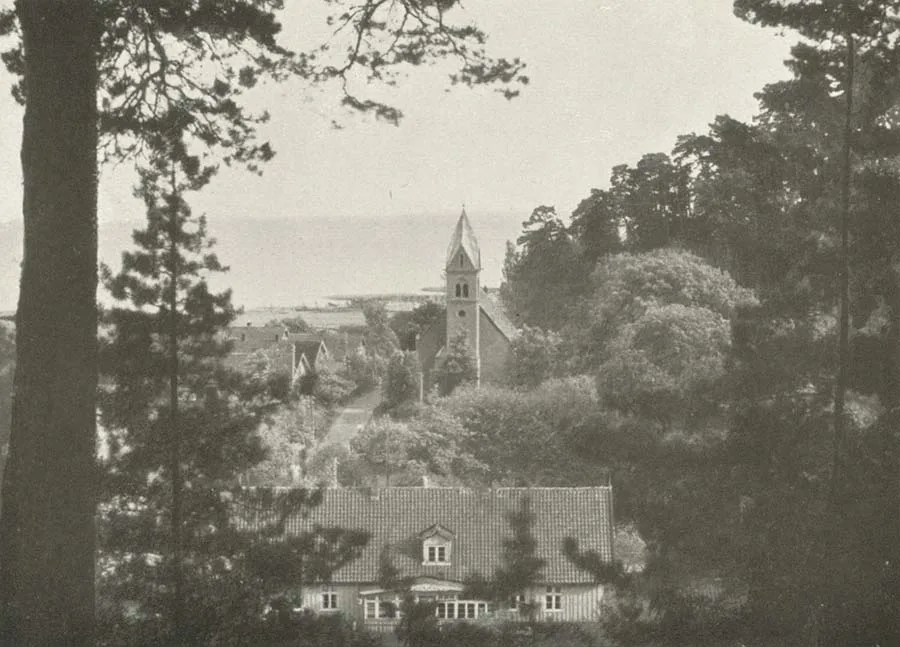 The main street and church of Schwarzort.
Now let us turn for a moment to the industrial colony which, over the past decades, seems to have sprung up out of nowhere!
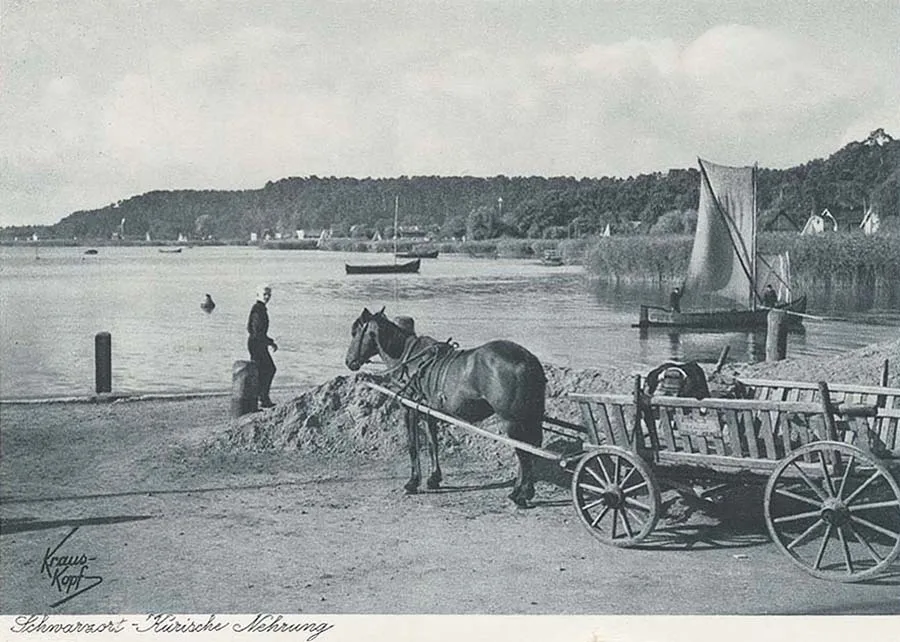 View of Schwarzort along the shore of the Curonian Lagoon.
It stands almost entirely on new ground created by the dredging — a whole world of activity, labour and well-organised business. Here rise a steam boiler works, a smithy with sixteen forges, steam hammers, a rolling mill, fully equipped steam-powered machine shops, a foundry for brass, cast iron and steel, a joinery, repair workshops and equipment for the electric lighting of the harbour, as well as a plant producing the gas that lights all the works and workshops.
Provision must also be made for housing and feeding the workers, who could hardly find lodgings in neighbouring Schwarzort. This required three houses for 600 people, a huge workers' kitchen with 12 stoves, each serving 16 workers, and a dining hall where wet clothes can be dried.
There are also several houses for officials, an office and a residential building that can accommodate 16 families.
This colony, which employs hundreds of workers and a great many technicians and officials, whose harbour is constantly plied by more than two hundred craft — steamers, dredgers, barges, transport vessels, sailing boats and inspection launches — and where it is hardly ever dark, is one of the most magnificent and versatile industrial enterprises on the entire Baltic coast of Eastern Europe. And it is certainly unrivalled in the uniqueness of its setting amid a lonely ridge of dunes.
When the winter storms begin — and here in the north that happens very early — work stops, and everyone hurries to protect their equipment from their destructive onslaught. The dredgers and ships of the whole flotilla hasten to find a berth in the harbour to avoid broken chains, lost anchors or vessels being driven off. But even in winter the Schwarzort colony is never entirely quiet. The forges blaze, hammers ring, machines clatter; for now there is enough free time to carry out all the necessary repairs and to build new dredgers, steamers and barges, since Schwarzort produces all its equipment itself.
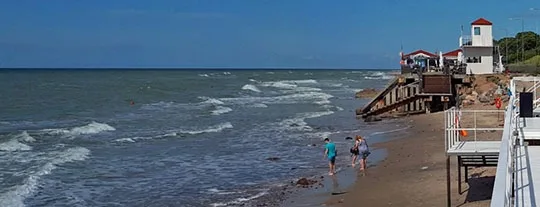
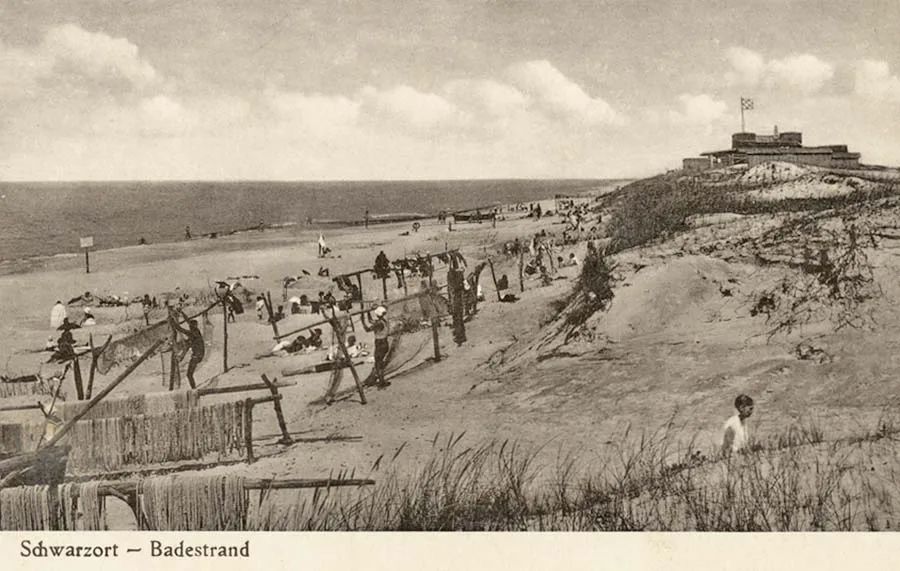 The beach on the seashore.
New life is awakening everywhere here, and yet much suggests that the culture of the Curonian Spit is very ancient.
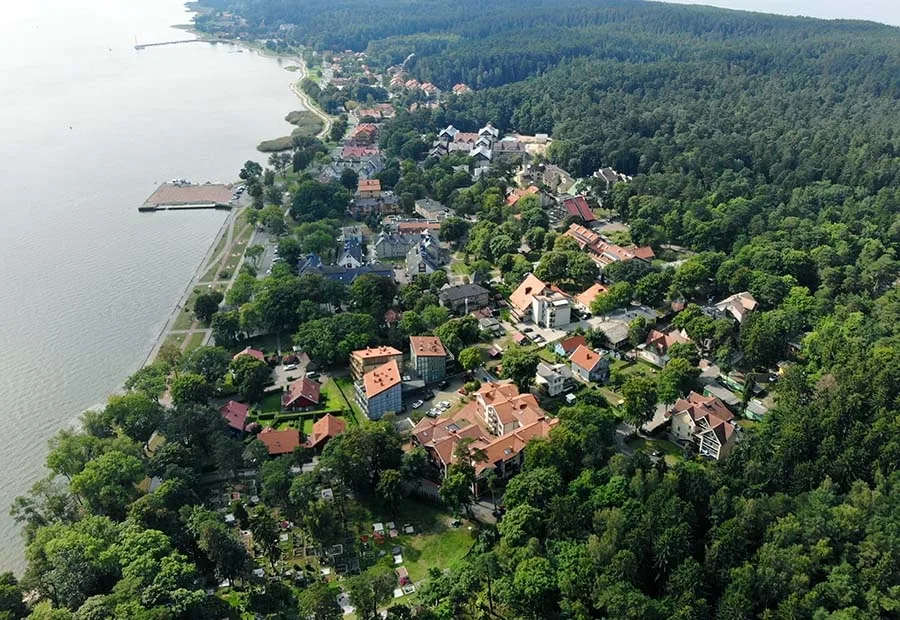 Present-day Juodkrantė from a bird's-eye view.
Among the pieces of amber raised from the lagoon bed we find roughly worked objects from the distant Stone Age, and these finds are represented here in great variety. This is why Schwarzort is especially attractive to students of prehistory. How this area has changed since then! In those days there were probably none of these hills, ravines, sinkholes or cliffs. Since then the dunes, with their constant movement, have transformed the local landscape. But even this can be brought under control.
Along with the stabilisation of the wooded shoreline through the steady deposit of reclaimed soil, more and more of the drifting dune sand is being held back. The forestry administration first set about building brushwood fences and planting certain grasses, and then pine plantations were established there. And one may hope that in a few decades extensive forests will again grow on the pale dunes around Schwarzort and bind the sand firmly to the ground.
Fritz Wernick (Fritz Wernick, 1823–1891)
German writer and traveller
Photos on this page: Bildarchiv Ostpreußen, Wikipedia.
Translated from Russian with the help of AI (Claude, Anthropic), October 2026.