The capital of the Order's state was valiantly defended by Komtur Heinrich von Plauen, who had taken on the duties of Grand Master. He had to fight both the enemy without and the enemy within — traitors in his own camp — while enemy troops went on plundering the country. And so, accompanied by a trusty escort, he set off for the Polish king's camp and offered to make peace in exchange for handing several provinces over to the Poles. The king replied haughtily that these lands were already his, and that he, the King of Poland, would seize the whole of Prussia. Let the knights first surrender to him their chief citadel, Marienburg, and then... then let the Order's envoys come to him and beg for mercy. Perhaps then he might agree to peace. This arrogant answer outraged von Plauen, and he replied that he was returning to the fortress confident that God and the Holy Virgin would not withdraw their protection from the Order, and that the king would never take Marienburg.
And yet, for the time being, towns and fortresses were surrendering to the victor, and one after another the bishops of the Prussian lands swore allegiance to him. The Polish king was sure that Marienburg, the knights' last stronghold, would capitulate too as soon as he appeared beneath its walls with his allied Lithuanian and Tatar troops. But he was mistaken.
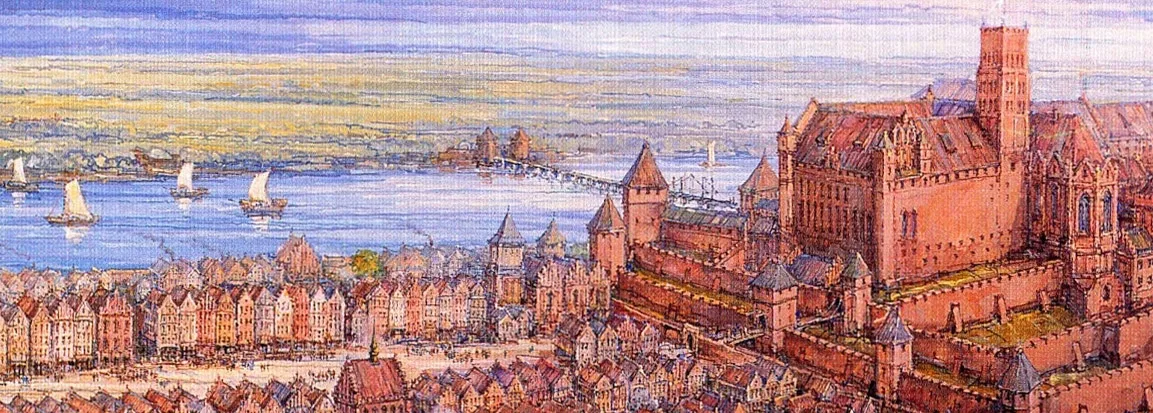
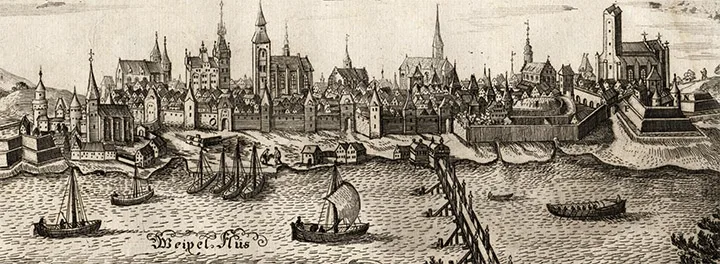
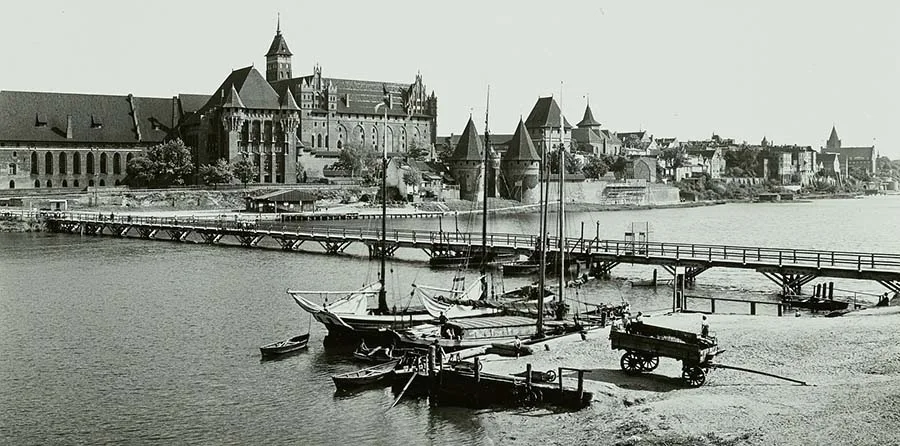 Marienburg Castle stands where waterway and overland trade routes cross.
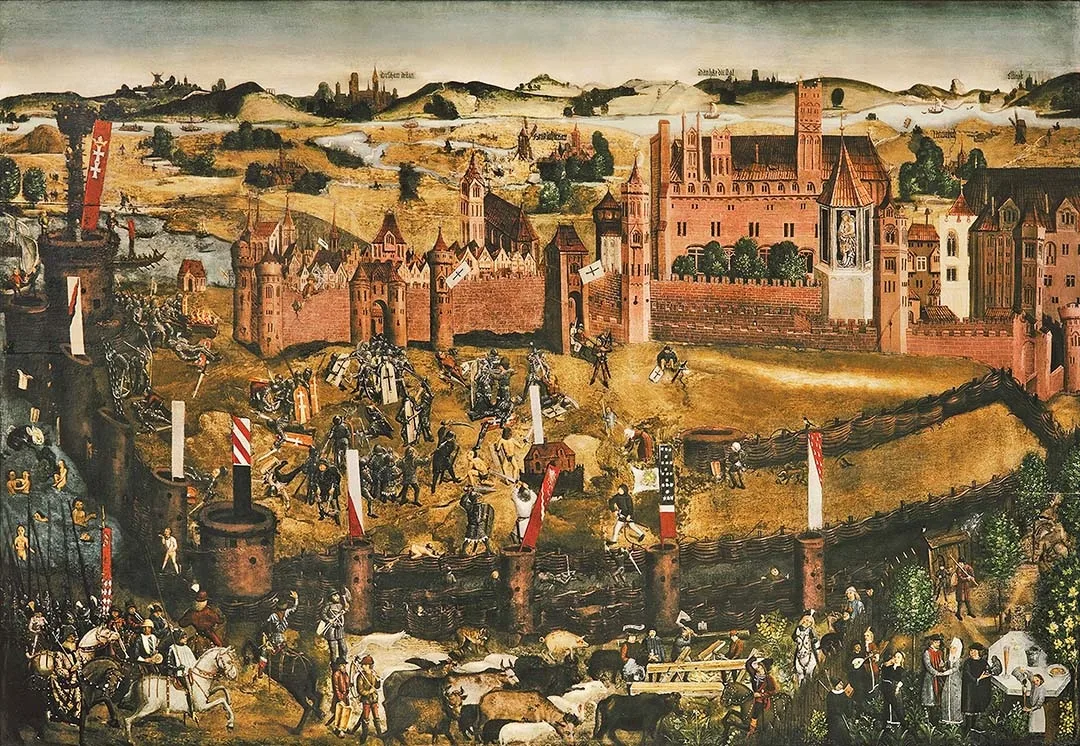
The Polish vanguard sent on ahead found that the bridge over the Nogat had been blown up, that every house around the castle had burned down, and that wherever one looked, the ruins were still smouldering. The Poles advanced on the fortress very slowly and with great difficulty. And on the walls of Marienburg and behind the battlements of its towers stood armed men in armour; all the gates were securely barred and the drawbridges raised.
So the King of Poland and his allies had to decide on a lengthy siege of the fortress. But soon the besiegers began to suffer privation and hardship. Their combined army was too large to be kept in one place for long: there were problems with discipline, provisions and quartering the soldiers. Disease raged among the mercenaries, who had to sleep in the open for weeks on end. Thousands died of dysentery.
Then for the first time the king grew uneasy and began to pray with his bishops that God would not turn away from him. But his prayers brought him neither comfort nor peace, for a strange thought had taken hold of his soul...
In the wall of the castle church at Marienburg there stood an indescribably beautiful statue of the Mother of God with the Infant in her arms. It could be seen from afar, for it was twelve ells1 high, and the gilding on the image of the Holy Virgin sparkled brightly in the sun. A master had worked on this statue for many years. In the years he spent creating it he had grown grey and old. But at last the sculpture was finished, and the time had come to hand it over to the church. And on the night before, the sculptor went to his workshop once more. The old master lit the candles and knelt for the last time before the holy image. And in the morning his lifeless body was found lying on the workshop floor, beside his beloved creation...
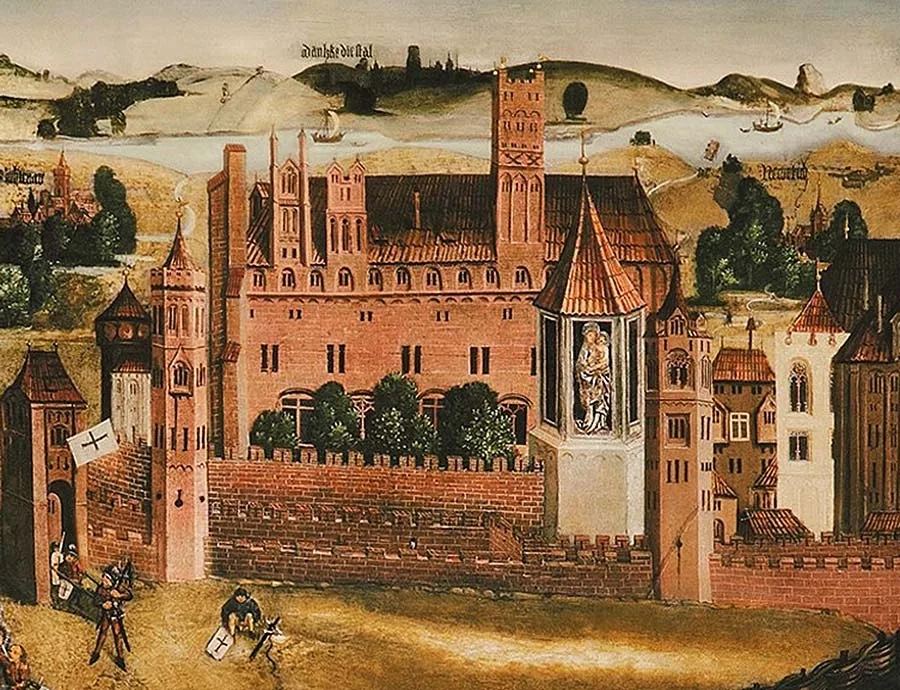 "The Siege of Marienburg in 1460", detail of a painting by an unknown artist, late 15th century.
It was the previous Master, Konrad von Jungingen, brother of Ulrich who was killed at Grunwald, who had ordered the statue to be placed in a niche of the choir of the castle church. The patroness of the Order gazed sadly from on high into the distance: at the river, at the lands around the castle and at the Polish troops encamped all around as far as the horizon.
And it was an unaccountable fear of this image that tormented King Jagiełło day and night. Soon he summoned his commanders to a council.
"All our bullets and cannonballs are powerless," he said. "The Virgin Mary turns them aside to protect the besieged. Believe me, as long as this image of the Mother of God with the golden crown upon her head looks down on us, all our efforts are in vain. The Most Holy Virgin in heaven sees to it that God does not hear us."
These words of the king reached the chief bombardier of the royal army. He was cruel, superstitious and ambitious, and so he suffered greatly, for he had so far done nothing to distinguish himself here at Marienburg. Now it suddenly seemed to him that he understood why. And if that was so, he thought, he could easily dispel his king's anxiety.
And he began to set up his bombard opposite the Church of the Virgin Mary, where the miraculous image stood.
The gunners helping him took fright and began to talk him out of it. But he laughed at them: "You fools shall see that this statue is nothing but stone and brick. It will crumble as soon as my shot strikes it. Once Mary's crown rolls to the ground, the resistance will end and our king will take the fortress. Call everyone here who wants to see it with their own eyes. I have made many good shots in my life, but now I shall make a Master's shot. The king will reward me generously, and you won't go away empty-handed either."
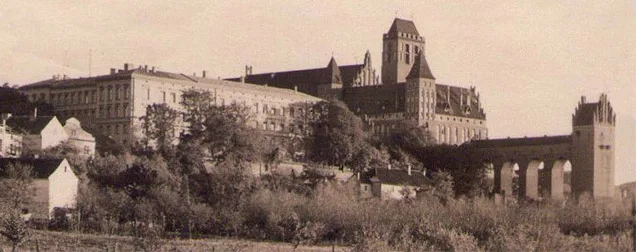
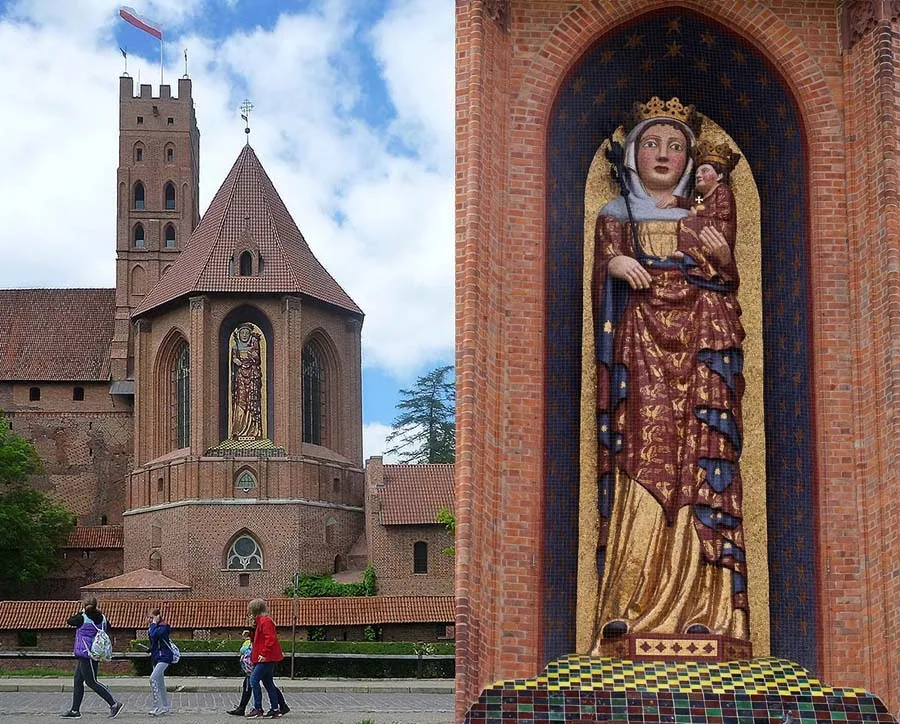 Today the castle is still under the protection of the Holy Virgin Mary.
In an instant his words spread throughout the camp. A great crowd gathered around the bombard. People said all sorts of things to one another. Some claimed that the king had ordered the shot because an angel had revealed to him that night that he would take the castle if he destroyed the stone statue and thus made a breach in the wall of the citadel.
Others shook their heads in fear; someone swore he had heard that there was no holiness in this statue, that it was an idol, that the knights of the Order practised idolatry and had therefore been cursed by the Pope in Rome. And that was why rooting out such a sin was a pious deed.
The bombardier paid no attention to all this talk, nor did he look at the frightened faces of those present. He poured coarse powder into a small bag — twice as much as a powerful shot required — and then pushed it deep into the wide mouth of the barrel. He took the rammer and three times drove it home into the barrel of the gun. Having done this, the gunner picked from the ground the heaviest and smoothest of the stone balls and tossed it into the air to see whether it would break when it fell to the ground. The ball proved sound; it was loaded into the barrel, and a wad of grass was rammed in after it. Now the bombardier took his place at the gun and began to take aim.
The crowd looked anxiously now at him, now at the statue of the Mother of God. Suddenly someone cried out: "The Christ Child has raised his hand and shaken his finger. Give it up, master!" Another stammered, trembling: "Look, look: the Virgin's eyes flashed with anger!" A general commotion arose. Most of those present fervently wished that the shot would never be fired at all.
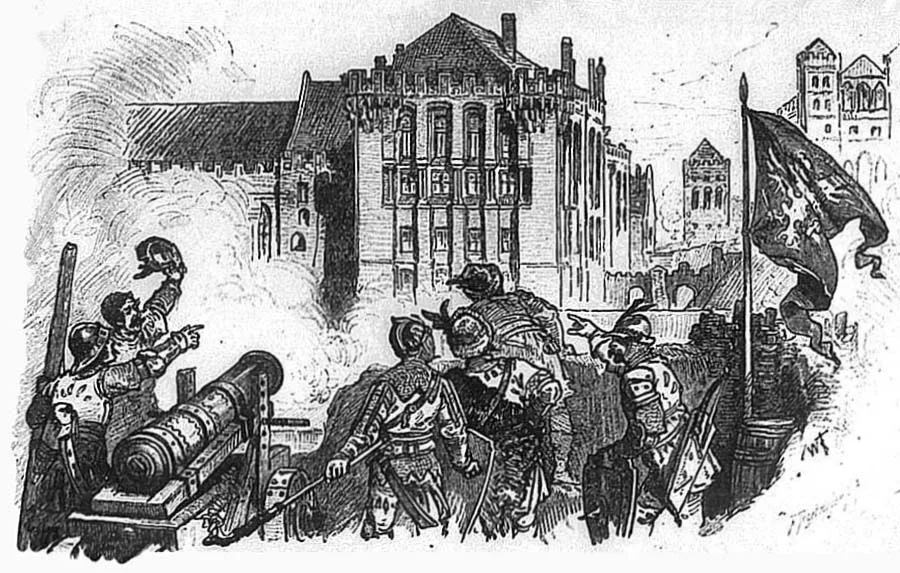 Mere seconds before the shot that put an end to the Polish king's ambitious plans.
Meanwhile the bombardier, refusing to be put off, sprinkled fine powder on the plate around the touch-hole and set up a metal shield against the wind so that the powder would not be blown away. Then he took a burning match from his assistant's hand and shouted deafeningly: "Now look out!" Carefully, from behind, he brought the match to the powder...
For a second there was a ringing silence, and then came a terrible explosion, and a huge cloud of smoke enveloped the gun.
...The image of Mary remained untouched. The Virgin with the Infant in her arms still smiled gently upon the world. But the barrel of the gun had cracked and flown off its carriage. The bombardier lay on the ground with a blackened face and singed hair, covering his eyes with his hands and groaning. His assistants lifted him from the ground and carried him away. And he kept muttering piteously: "My eyes, my eyes! I can't see anything!"
At that, fear and horror seized the crowd. Many fell to their knees, stretching out their hands towards the statue and praying for the forgiveness of their sins. Most hurried away and spread the terrible news that the royal bombardier had lost his sight for sinning against the Mother of God. King Jagiełło, too, learned of what had happened. He tore the mantle on his breast and cried: "Woe to us — this is an evil omen! Now our enemies will mock us, and our friends will lose heart. Pray, pray that we may not suffer still worse!"
Soon the news of what had happened reached the fortress. There it was taken to be a miracle worked by the statue of the Mother of God.
The shot had done her no harm, but had struck the impious bombardier, depriving him of his sight forever. The confidence of the besieged grew; they demanded to be led against the enemy. The knights began to make frequent sorties, inflicting heavy losses on the enemy.
For eight long weeks the enemy troops stood beneath the walls of Marienburg. The town was destroyed, but the castle itself was never taken. Having failed to break the resistance of the besieged, King Władysław Jagiełło at last lifted the siege and ordered the trumpets to sound the retreat.
Away went the Poles, and away went the Lithuanians and the Tatars. And was not the holy protection of the Virgin Mary the reason for it!?
TRANSLATOR'S NOTE
1. Sources indicate that the statue was eight metres high.
SOURCE
"Legends and Tales of the Province of Posen". 1893. (Sagen und Erzählungen aus der Provinz Posen)
● Editor's note: Read on VisitPrussia.com an interview with the translator of German and, in particular, Prussian fairy tales, our regular contributor Tatyana Kolivay, who runs her own blog, where countless other parables, legends and fairy tales in her translations have been published.
Translated from Russian with the help of AI (Claude, Anthropic), October 2026.