LEGENDS OF PRUSSIA in the blog of Tatyana Kolivay.
The single proletarian goes to work every morning. He rents a bed in a shared room, that is, he has a place to rest, to which he returns late in the evening. This worker, of course, does not enjoy the comforts you do. It is early morning, you are still in bed, and your servant is already making your coffee. By the time you wake, your morning meal is ready. All you have to do is sit down at the table and begin your breakfast, and if it should happen that you have to wait a little while the invigorating hot mocha is made, the servant will get a dressing-down for his slowness.
But the proletarian, who pays for a bed in his temporary lodging, to which he returns each time like an animal to its den, has not a single soul near him to look after him or cook for him… Or is that so? No. Do not think he is left to fend for himself.
Over there, on the street corner, his breakfast is already waiting for him. Let us look around. It is still early morning. Many of the window shutters are still closed. The carters – masters of the privy trade, from whom the few pedestrians in the streets keep a respectful distance – drive their unhurried horses from house to house, calling out from time to time, "Schuett' opp, Schuett' opp!" – "Empty it out, empty it out!" They are busy with a thankless but very necessary job: carting away in their barrels the valuable fertiliser that has accumulated in the town's houses overnight.
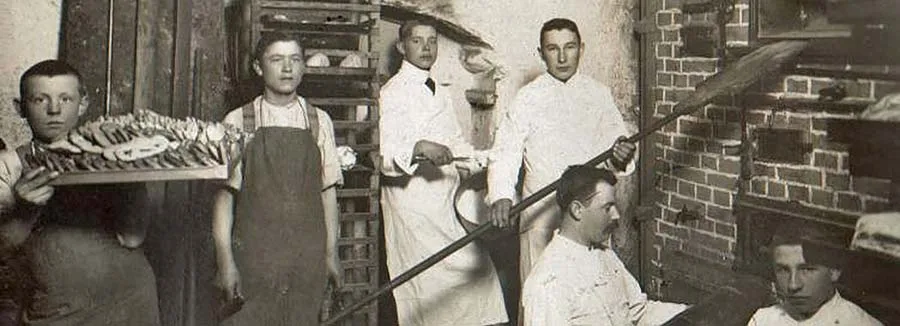
The air is still very damp and cold. Now and then maidservants run into the bakery with hand baskets and plates. Night revellers who have spent the whole night drinking, gambling and indulging in other debauchery stagger home with glassy eyes.
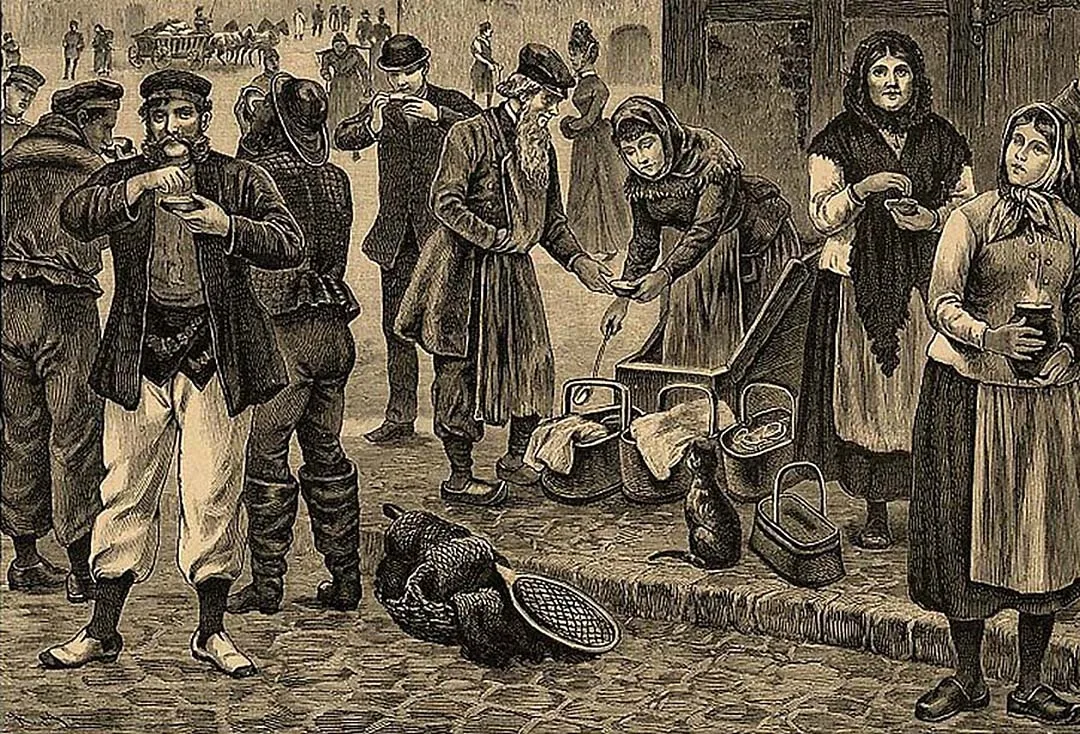
But now such a strong, appetising smell wafts through the air that even they come out of their trance, stop and join the crowd of workers gathered around a stout woman sitting on a kerbstone at the edge of the road. Beside her on the pavement stand several baskets giving off steam. She is the Fleck seller. Fleck is what they call offal in Königsberg: the guts, tripe and paunch of animals. Fleck is the cheapest and most accessible food you can buy from the butcher.
Overnight the Fleck simmers in large cauldrons with potatoes and herbs. The dish is tasty and nourishing. It is ladled into bowls. A fairly large and filling portion of Fleck, which the workers usually eat standing up, costs one copper groschen, that is, four pfennigs. At noon and in the evening these true benefactresses of the people appear again in the same spot to dole out their simple food to all who hunger.
They also carry bread, sausage and so on with them, but the main thing is the principal dish: chopped offal – a thick, hot stew. Those workers who cannot pay at once are given credit. The Fleck seller writes her debtors down in a book and keeps strict account of them.
The Fleck sellers should be distinguished from the sellers of ordinary food. They too trade in the streets. It is said that there is a common practice here – which, I must admit, I have not yet had occasion to witness – whereby for a couple of pfennigs you are allowed to bite off a piece of a long sausage, up to the seller's thumb, which marks the limit of what is permitted.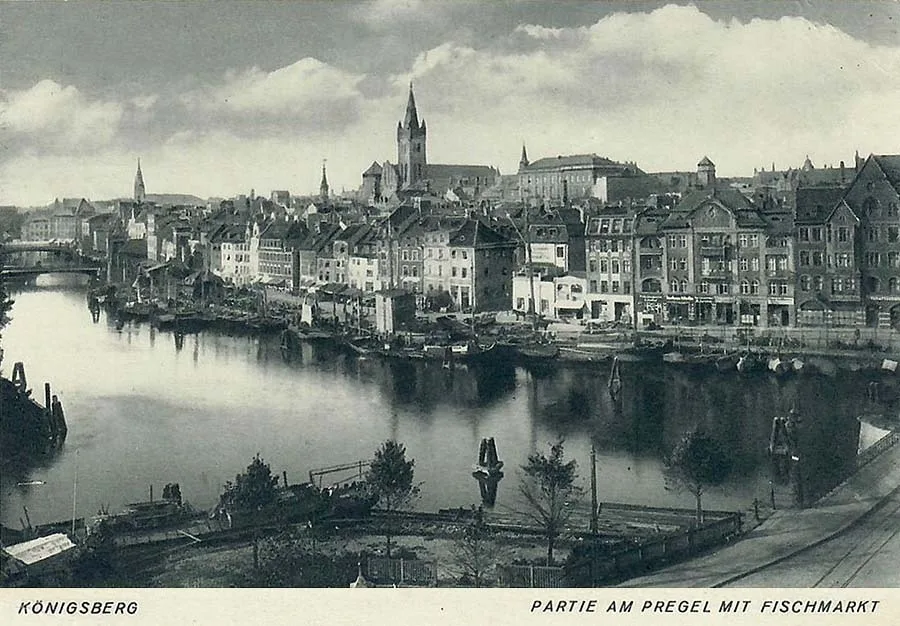
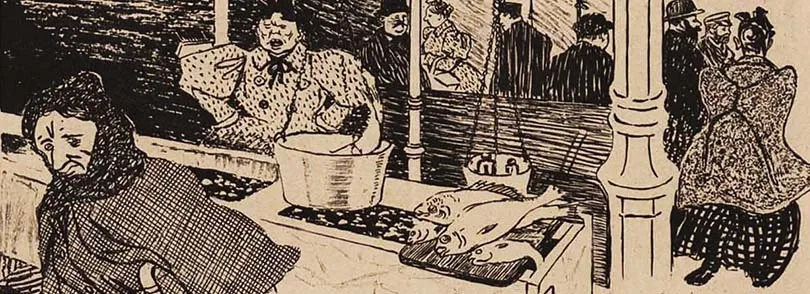
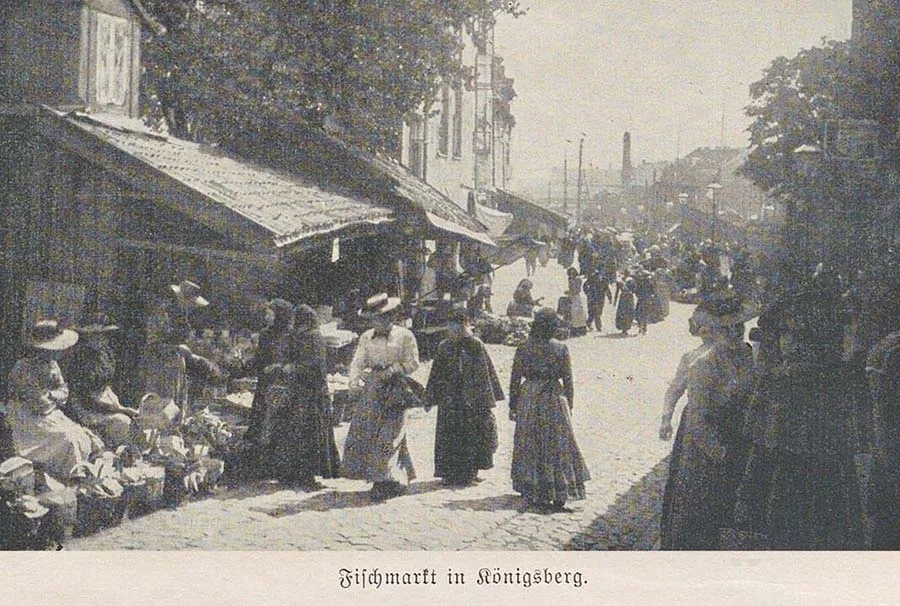
At the Fish Market (Fischmarkt), on the bank of the Pregel between the Kramerbrücke and the Holzbrücke bridges, are concentrated the main establishments where ordinary mortals can satisfy their hunger.
 The Königsberg Fish Market on the bank of the Pregel in Altstadt.
It is here that you find a multitude of food stalls selling herring, but also huge quantities of fried fish, bacon, sausage, cheese and bread. Right there on the bank stand large barrels of soured milk. Hanging on the barrels are big wooden ladles, known here as a "Schleef". For a small fee you can scoop yourself a ladleful of milk from the barrel.. Apart from workers, most of the customers are common soldiers. And one can only marvel at the sturdy northern stomach when one sees the quantities in which they consume all this.
How astonished a Bavarian would be – he who first orders his beer and eats it with plain bread and salt, being not much used to butter – if he saw the huge chunks of Elbing cheese and the mountains of fried cod, flounder and herring, not to mention that, by Bavarian standards, little beer is drunk here. The fact is that beer drinking is a separate ceremony, a kind of sacred rite. It takes place in the nearby taverns, in whose windows huge pewter beer tankards with lids beckon invitingly.
Also of the common people are the small shops, usually painted red. They are often built into houses, garden walls or passageways. They are scattered all over the town but are most common in the Sackheim1. These shops sell literally all sorts of odds and ends: from coarse-ground bread to sweets for children. Bread rolls, pretzels, doughnuts, some fruit, raisins, bread and pastries, sausage, bacon, beer, schnapps and so on.
However, selling food comes second in these shops. Something quite different comes first. The proprietress, a staid lady of very venerable years who once sold her wares in the street, knows in enviable detail everything noteworthy that has happened in the neighbourhood lately – from the attic to the cellar of the humblest house.
All the maidservants round about are her confidantes and trusted friends. She in turn can share with them the juiciest details about their employers, for she remembers every former housemaid back to the year dot and can tell why each of them left and whose fault it was: the master's, the mistress's, or perhaps the maid's own.
All the masters and journeymen of the neighbouring streets enjoy her favour and receive the same kind of advice. But above all, she is privy to all the love affairs of her charges. The old woman tells a maid at what time in the evening and to which well she should go for water, because a carpenter or tailor who called on the old matchmaker at noon has arranged to meet her there. The need to buy something in the little shop is often merely a pretext for learning and passing on the latest news. For the convenience of visitors, the shop where the old woman sits is furnished with a bench and a chair, where it is pleasant to rest and still more pleasant to chat. In short, for many streets of Königsberg her abode is roughly what Une loge de portier2 is in Paris.
NOTES
1. Sackheim (German: Sackheim) is a historical district of Königsberg. The name derives from the Prussian words "saks" (resin) and "kaimas" (village).
2. Porter's lodge; the place where the concierge sits (French).
LEGENDS OF PRUSSIA in the blog of Tatyana Kolivay.
Translated from Russian with the help of AI (Claude, Anthropic), October 2026.