As we now know, the Teutonic Order, once renowned and highly successful in its day, never fully managed to formulate its laws with precision. In its statutes the Order reserved for its supreme leadership certain rights that would more conveniently have been delegated to lower-ranking officials. Nor did the laws specify how the authority of individual offices was to be clearly and precisely delimited.
Under these circumstances, and out of practical necessity, the Order created a “provincial system” with heads of the House (castle), the province and the land, and a general head, to whom the General Chapter (Großkapitel) was attached as the Order's supreme legislative and executive authority. Consequently, there were no fully independent Houses in the knightly Order, nor any sovereign leaders.
The Teutonic Order of Knights had the following provincial divisions:
1. The House of the Teutonic Order, headed by a Komtur, a Vogt (administrator) or a Pfleger (custodian).
2. The province, more often called a bailiwick (Ballei), headed by a Landkomtur.
3. The Land (Land), headed by a Landmeister (Landmeister).
4. The Order itself was headed by the Hochmeister (Hochmeister), the Grand Master.
Each of these four heads had his own advisers (Berater) and a group of subordinate officials (Unterbeamteten). The territorial division was not strict, since the southern bailiwicks, like some others, were not subordinate to any Landmeister.
The Order's highest authority was the General Chapter (Generalkapitel); executive power belonged to the general head (Generalobern), the Hochmeister. He was assisted by advisers and officials known in the Teutonic Order as the Großgebietiger (Großgebietiger, the high command). Thus the General Chapter, the Hochmeister and the Großgebietiger together formed the circle of the Order's general officers.
The General Chapter, or Großkapitel
The Order held three kinds of assemblies of its brethren, each called a “chapter”. Under the statutes, the brethren of a Komtur's convent met every Sunday to discuss matters concerning their House or convent; these were the so-called house convents. When, however, the issues concerned the Order in Prussia or the administration of that territory, the Grand Master summoned the officials and Komturs – either all of them or the greater part – to the principal House. This was usually called the “Landkapitel” (land, or provincial, chapter), or simply the chapter. Finally, there were matters that concerned the Order as a whole. To these chapters were invited the Landmeisters of Germany and Livonia with their councils and convents, as well as the high officials and the most important Komturs from Prussia. Such an assembly was called the “General Chapter” or “Großkapitel”. From the day of the Order's foundation this chapter stood above the entire Order, and even the Grand Master was accountable to it.
The Order entrusted the General Chapter with a vast range of duties, which can be divided into five groups.
1. The Chapter held the exclusive right of legislation for the whole Order. This right was very extensive, since laws could be issued, confirmed, excluded and repealed by interpreting and extending existing law, creating new laws and abolishing old ones. (With regard to the last point, by virtue of the papal bull of 9 February 1244 mentioned earlier, the Chapter could even abolish articles of the Rule itself if they contained no educational or spiritual benefit.)
2. The General Chapter reserved to itself the disposal of funds exceeding 500 gold bezants (Goldbyzantinern) in all economic transactions, such as major sales, grants and loans. In most cases this was a sound arrangement, but when, a few decades later, the Hochmeister and the Landmeisters became rulers of sizeable states, it proved not only cumbersome but often simply unworkable.
3. An important right of the Chapter was to appoint and dismiss the Order's highest officials, including the Hochmeister. These officials included the Landmeisters, the Landkomturs of the southern bailiwicks of Armenia and Greece, Apulia and Sicily, and Austria, as well as the castellan of Montfort (Starkenberg).
4. The admission of brethren taking perpetual vows – knights, priests and sergeant brothers (in the Holy Land) – was reserved to the General Chapter.
5. The General Chapter supervised the Hochmeister's performance of his duties. The Chapter had the right to summon the Hochmeister and, should he fail to appear after the summons had been repeated three times, to remove him from office. The consent of the General Chapter was also required if the Master wished to travel by sea. Under what circumstances the Hochmeister could be summoned by the Chapter is not known.
“Every year the General Chapter shall be held on the feast of the Exaltation of the Cross” – 14 September. Since it was impossible to invite all the brethren to the Chapter, it was further prescribed: “To this Chapter shall be summoned the Komturs of Armenia and Cyprus and anyone whom the Master deems it necessary to invite.”
Because the Hochmeister's right of cassation was ill-defined, the Chapter's decision-making could give rise to irregularities. These became apparent as soon as the Order acquired possessions in the West, since the local centres were in practice cut off from the Order's supreme leadership, which still resided in the East.
Despite the clearly recognised inconvenience, no attempt was made to amend the statutes of the Chapter as long as the Hochmeisters' residence remained in the East. Nor were such changes undertaken after the fall of the commanderies in Armenia and Cyprus. Conservative thinking was so deeply rooted in the Order that only under Hochmeister Siegfried von Feuchtwangen (Siegfried von Feuchtwangen) was it decreed: “We ordain that the Master shall each year, on the Day of the Holy Cross (14 September), according to the custom of the Order and of the Holy Land, hold the Chapter in the principal House.” In the Middle East this was at Acre or Montfort, then in Venice, and later at Marienburg. In the time of Hermann von Salza, however, there were occasions when General Chapters were held in other houses of the Order, for example in Marburg.
At the same time as the statutes of the General Chapter were revised under Siegfried von Feuchtwangen, another chapter was created, whose composition corresponded far more closely to a “renewed” General Chapter. Its statute read: “The Master shall every six years, on the feast of Philip and James (3 May), hold a Chapter in the principal House. To it shall come the Gebietiger (Landmeisters) of Germany, Prussia and Livonia, each with two brethren useful for the purpose, and the Landkomturs of Austria, Bozen and Welschland (Italy and Greece), each with one brother. This Chapter shall appoint inspectors (Visitatoren) to examine the Chapter itself and its members, including the Hochmeister, and report thereon to the Chapter for its decision.”
The reason for this law is unknown. This “narrow” chapter might have opened the way to a properly organised General Chapter. No further steps, however, were taken.
It was probably because of the General Chapter's excessive duties that some of its provisions quietly fell into disuse. The Order's General Chapter had its own seal. It showed a half-length figure of Mary with the Child and the inscription: S. Hospitalis Sancte Marie. The Chapter's seal was kept with special care: it was locked away with three different keys, which were to be held by the Grand Master, the Grand Komtur and the Tressler. If one of the three was absent, he was obliged to hand his key over to a trusted member of the Chapter.
As a rule, the General Chapter was held in the Order's principal House, the Master's residence. According to the old Middle Eastern tradition, the General Chapter was to meet annually on 14 September. But as the Order's possessions spread across the Mediterranean and Europe, assembling all the officials at once became ever more difficult. In later times, unless there were special circumstances, it was the Landkapitel that met on that day. By law, only the Grand Master or his deputy (regent) had the right to convene the Great Chapter of the Order.
The chapter oversaw the enforcement of the Order's laws and refined the legislation governing the Order as a whole. Laws drawn up by the master together with his council of officials took effect only once the Order's chapter had approved them. The chapter guaranteed the observance of the existing statutes, which neither the Grand Master nor a provincial chapter could amend or revoke. The general chapter was the highest authority for the entire Order. It had permanent representatives in the provincial and house chapters who every Sunday informed the brethren of the latest news and new laws. In some cases the news and laws were read aloud. Any member of the Order, from the master down to an official or an ordinary brother, who neglected his duties, broke his vows or the laws, or committed any of many other offences was brought before the court of the Grand Chapter or a provincial chapter. The case was investigated, and the offender was punished according to the gravity of the offence.
The general administration of the Order was concentrated in the general chapter and its branches, the provincial chapters. It was at the chapters that new members were solemnly admitted to the Order and that the high officials and commanders were appointed. The Order had an old custom whereby, at the annual chapter, those holding office had to give an account of their administration to those present and resign their posts.
If their administration was found to be beyond reproach, the chapter entrusted them with their offices once again. If an official had failed in his duties and did not meet the necessary requirements, he was to be relieved of his post. Should the Grand Master make mistakes or exceed his authority, the general chapter had the right to remove him from office. If the master wished to step down voluntarily, he had to explain the reasons for his resignation to the chapter and then await its decision. The Grand Chapter began with a Mass and ended with a prayer. The Grand Master opened the meeting and presided over it. Only matters concerning the Order, its laws, its rules and so on could be discussed at the chapter. Everyone had a vote, and all decisions were taken by majority. One of the most important vows made on entering the Order was never to disclose the outcome of chapter meetings. It was forbidden to invite laymen or foreigners to the chapter.
The Election of the Master
The Rule of the Order and the whole force of its statutes rested on three fundamental vows: chastity, obedience and poverty. The Grand Master, “who, as the law states, is among his brethren the wellspring of our Lord Jesus Christ”, was obliged to be a model for those under him. He was to unite piety and knightly valour in his person and be the most perfect embodiment of all the virtues of a knightly Order. The election of the master was therefore the most important matter for the whole Order, one in which prudence and conscientiousness were held to be a most sacred duty. The procedure was as follows: a dying master could appoint one of the high officials as his lieutenant to govern the Order until a new master was elected. If he did not manage to do so, the lieutenant was most often the Grand Commander, the master's chief adviser on administration. In that case the lieutenant at once assumed virtually all the master's powers. He directed the entire administration of the Order and the state and had the right to negotiate with foreign rulers. He was merely not permitted to wear the master's mantle and shield or to occupy the place of honour at table and in church. It was his task to summon to the general (electoral) chapter at the principal House1 both Landmeisters, from Germany and from Livonia, as well as the commanders, land commanders, Vögte and other officials from the Order's lands. Once these officials had gathered, a day was set for the election. It began with a Mass of the Holy Spirit, after which the law on the election of the master was read aloud. The lieutenant then appointed the so-called election commander (Wahlkomtur). The convent could accept him or demand another. If it agreed, the election commander withdrew from the chapter hall to the election chamber to form the electoral college. From there he was to name the next brother (taking him “upon his soul”); these two named a third, and so on, until their number reached thirteen (the number of those present at the Last Supper). Each of them had to be approved by the general chapter. Of these thirteen, one was to be a priest, eight were to be knight brothers and four serving brothers. As far as possible they were all chosen from different bailiwicks. If any member of the college of thirteen was put forward as a candidate for the office of Hochmeister, he had to leave the election chamber. The members of the electoral chapter, once approved by the General Chapter, came out of the election chamber and swore on the Gospel that, without hatred, without love and without fear, with a pure heart, they would elect only the worthiest among the brethren. The lieutenant reminded them of the gravity of their duty, “for the whole honour of the Order, the salvation of the soul, the strength of life, the path of justice and the defence of decency all fall to the good shepherd and head of the Order”. All participants in the general chapter swore to serve whichever master the choice fell upon. Anyone who objected or voiced a different opinion after the election was to be expelled from the Order as a traitor.
In the election chamber the election commander exercised his right by naming the man he considered most worthy, and the other electors did the same in turn. As soon as one name received an absolute majority, the election was deemed duly conducted, final and incontestable. The name of the man elected was then announced to the general chapter. To the ringing of bells and the singing of “We praise thee, O God”, the lieutenant escorted the new master to the nearest church of the Order.
There, before the altar, he handed him the ring and the seal of the Order. In a solemn ceremony, with a reminder of his lofty duty and of his responsibility before the judgement of God to come, the man elected was proclaimed Grand Master. Once the solemn investiture was over, the new master immediately assumed all the rights of his office, since neither papal nor imperial confirmation was required: Innocent III (1178–1180) had already guaranteed the orders complete freedom to elect their master independently, and Honorius III (1216–1227) confirmed these guarantees. Until 1498, in electing the Hochmeister attention was paid not to his origins but to his practical abilities. Among the masters of the Order there were two imperial princes, four counts, five barons (freie Herren), seven ministeriales and 17 members of the lesser nobility
The Grand Master — Hohemeister
The title of master was introduced in the Order in 11982. In the course of the 13th century the highest officials of the Order in Germany, Prussia and Livonia were granted the title of master, and from then on the head of the Order came to be called Magister Generalis or Magister Hospitalis S. Mariae Theutonicorum3. In German this title was always rendered as Hohemeister (Hochmeister), the Grand Master.
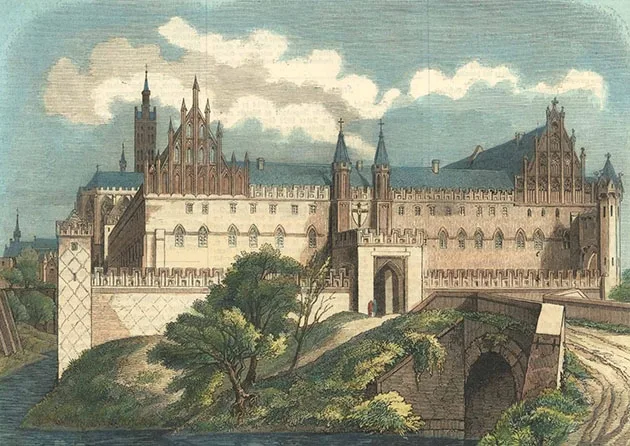
After his election the Hochmeister moved into the master's residence, the castle of Montfort (Starkenberg), and from 1309 to Marienburg, where the assembly hall (Remter) and the master's living quarters were located in the High Castle. Whereas in the Middle East the master's court was constrained by the strict law of the Order and looked plain and modest, in Marienburg it was highly imposing. Here the Hochmeister acted not only as master of the Order but also as ruler of Prussia.
The Hochmeister's duties were to attend to the needs of the Order, to ensure that its rules and laws were observed, and to lead the knightly corporation and its representatives beyond the borders of the Order's lands. The Hochmeister had no legislative powers: he could appoint and dismiss the Grossgebietiger, the Landmeisters, certain land commanders and the castellan of Montfort (Starkenberg) only with the consent of the general chapter, except in cases where he discovered gross violations during a tour of inspection. For expenditure exceeding 100 bezants he needed the consent of ten brothers, and for expenditure of more than 500 bezants the permission of the general chapter. Without the chapter's permission the master's financial latitude was even smaller than a commander's. The Hochmeister himself had no access to the Order's treasury. While the residence was at Acre (Akkon), he could set off for Europe “by sea” only with the chapter's consent. When the residence was in Venice, right up to the move to Prussia, he could “travel over the mountains” across the Alps only when summoned and with the consent of the Landmeister. This requirement seems all the stranger in that the ruler of the Order could visit a province only with the consent of the Landmeister who was his subordinate. The old rule of the Order reveals an effort to make the master dependent, in all important matters of the Order, on the consent of the general chapter or the councils of the high advisers, the Gebietiger.
The position of the Hochmeister changed entirely once the residence had been moved to Prussia. From then on, in the eyes of the brethren, he was not only Master of the Order but also the ruler of a state, and this undoubtedly had a strong effect on his standing. As early as 1226, an imperial bull had formally granted the master the jurisdiction and authority of an imperial prince, although he was not admitted to their college. The Hochmeister held no imperial fief and was not a vassal of the emperor.
Moreover, a papal bull of 15 December 1220 forbade the master or the Order to swear a feudal oath to any ecclesiastical or secular authority, and it forbade secular rulers to demand such an oath from the Order. It has never been fully established whether the master, as ruler of Prussia, was obliged to coordinate his decisions with the General Chapter or the high councillors.
As Master of the Order, he could decide many matters by virtue of the powers vested in him. Yet the law strongly recommended that he listen graciously to good counsel and seek the advice of his brethren himself, "…for," it said, "where there is much counsel, there is much good." Consequently, many questions were settled in the small council with the consent of the high officials. The master kept a close watch on the situation in the convents and on relations among the brethren. No knight of the Order could leave one commandery for another without his permission. If tensions grew in a particular convent, the master could transfer knights from one of the Order's castles to another on his own authority. He could appoint brethren to minor posts at his own discretion. However, if an appointment could affect the corporation as a whole, it was made only on the advice of the officials and commanders around him. Appointments to the highest posts required the consent of the small council or of an assembled chapter. When appointments or dismissals were decided by vote in councils of officials or commanders, or in the chapter, these decisions were confirmed by the Grand Master. In the event of a tie, the master's word was decisive. He could not remove a single commander from office without consulting the high officials. Again with the consent of the high officials, he had the right to send so-called visitors4 from time to time to the various territories of the Order. These visitors held the authority needed to gather information on the brethren's way of life, on divine service, on the observance of the Order's Rule and laws, on the condition of its castles, and so on. If the visitors collected unfavourable reports about a commander or another official, the master summoned him before the chapter to account for himself.
The Grand Master had the right to oversee the Order's treasury. The Tressler, the Order's treasurer, had to present a financial report every month and every year. A later law required the master to submit an annual balance of receipts and expenditure of money and property to the council of high officials, which the treasurer presented on his behalf. The master could personally dispose of only a very small sum. Larger expenditures required the consent of ten brethren of the Order, and the largest required the permission of the chapter.
The master could be called to account only by the General Chapter. If he failed to appear after the third summons, he was removed from office for disobedience. The Grand Master was under constant supervision and was obliged to obey the laws of the Order without question.
The Master of the Order was granted honorary privileges and insignia of office: a ring and a seal. It is unclear when these insignia were introduced, and nothing reliable is known about the ring5, but the seal is well known. It showed a full-length figure of Mary with the Child and bore the inscription: S: MAGRI HOSPIT. S. MARIAE THEUTONICOR. This simple seal remained in use up to Hochmeister Friedrich of Saxony. It was used to seal documents and letters, impressed in black wax. Unlike those of ordinary brethren, the master's shield, mantle and closed tunic (Waffenrock) bore a gold cross with lily-shaped ends on a black ground. At its centre, on a gold shield edged in black, was a black single-headed eagle. When in the East, the Grand Master was entitled to an escort of two knight brothers, a priest and a scribe, a Saracen scribe6, a turcopole (a warrior recruited from the local population) to serve as messenger, and a treasurer, as well as a serjeant brother to act as steward. On campaign he was also to take two more serjeants and a cook, two Knechte for messenger and courier duties, and a large tent. Both the master and his retinue kept a stable befitting their station. The Grand Master was to have "one war stallion and three further horses, and on campaign an additional riding horse." Each member of the retinue had between one and three horses. Among the Hochmeister's honorary privileges was a private bedchamber of his own. At the convent table he received four plates of fish and meat so that he could share them with brethren undergoing penance. At the same time, his office exempted him from the usual restrictions on daily life imposed on ordinary knights. His high rank as ruler gave him greater freedom. He was permitted to absent himself from divine service. The convent statutes were not binding on the Hochmeister. He could also release individual brethren from certain rules and laws. He was allowed to carry money and to take part in hunting and falconry, which the law strictly forbade to the other knights of the Order. A special fund existed at the residence for the Grand Master's upkeep. When a Hochmeister died, every brother of the Order had to say the Lord's Prayer one hundred times for him.
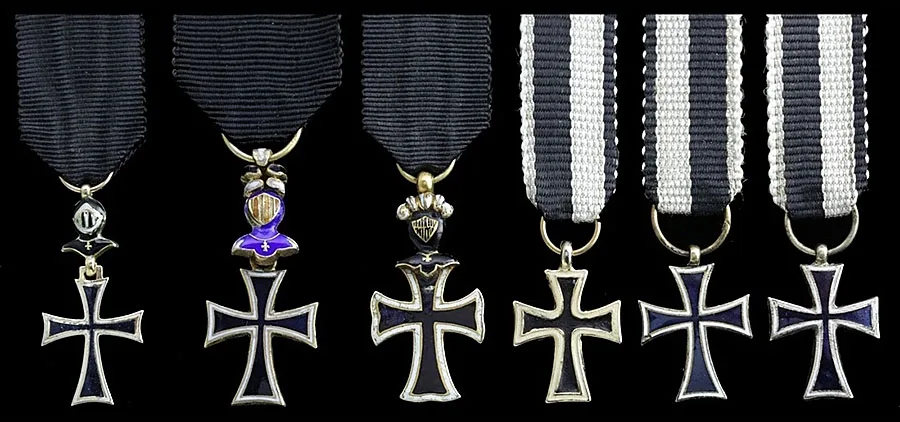
The High Offices of the Order
Grossgebietiger — the High Councillors
Originally, the Grossgebietiger were five officials of the Order who held the most important offices at the Order's headquarters. They later formed the Grand Master's "inner" council.
The old laws of the Order already stated: "Lesser matters requiring deliberation he (the master) discusses with experienced brethren," and "On other matters and offices (not reserved to the General Chapter) he decides after consulting the fratres discreti (Lat. worthy brethren)." To this end, specific matters were listed that the Hochmeister was to decide only after consulting the fratres prudentiores, discreti (Lat. experienced, worthy brethren) or the brethren of the high offices. These included the founding of hospitals, the arming of the brethren, the permissible amount of drink allowed them, expenditures exceeding 100 bezants, and the like.39 The laws did not specify who was to be counted among these "experienced" brethren or what form such decisions were to take. Clearly, those consulted were the brethren who headed the most important offices of the main House and had the greatest experience in affairs. Over time, these high officials of the main House secured for themselves the right to serve as councillors to the head of the Order. It is not known when this happened.
The Teutonic Order had five principal offices (the Templars had more): the Grosskomtur, the Marshal, the Spittler, the Tressler and the Trappier. The first three are mentioned as early as 1208. The Trappier first appears in 1228, and the Tressler only in 1240. The formation of a council of high officials was thus a rather slow process.
In the early period, the Grossgebietiger were officials of the main House at Akkon and Montfort. For lack of evidence, it is unclear whether their authority extended to all the castles in the East at the time when the Order held possessions only in the Holy Land. Their official powers in the western lands cannot be determined.
When the Hochmeister's residence moved from Venice to Marienburg, the Grossgebietiger remained his councillors but ceased to perform their duties within the main House. The clearest sign of this is that the Spittler, the Trappier and the Marshal took up their seats not in Marienburg but in Elbing, Christburg and Königsberg. These three Grossgebietiger did not move their residences from Marienburg to other castles immediately after the Hochmeister settled in Prussia, but the move had been completed by 1330.
The Grossgebietiger were elected by the General Chapter, and they had no right to decline these offices. In theory, their term lasted only one year. At every General Chapter, once the reports had been delivered, the mandates of all the high officials except the Hochmeister came to an end. However, they could be re-elected again and again without any time limit. If the chapter accepted a resignation, the official removed from office returned to the convent as an ordinary brother or was transferred to a less important post. Such a demotion was not regarded as a slight to his honour.
The order of precedence (hierarchy) among the individual principal offices (Großämtern) was never fixed by statute, but it became established over time. The highest place in the hierarchy belonged to the Grand Commander. He was followed by the Marshal, the Spitler, the Trapier and the Tressler. None of these officials drew any income from his post. All the Order's offices, from the highest to the most minor, were unpaid and held as a service to the community. Only the servants of the Master or of an Order official received a set wage. Outwardly, the Großgebietiger were no different from the other brethren. They wore the same clothing, ate at the convent table and slept in the common dormitory. They remained entirely among the other brethren. They were entitled to no honorary privileges. That the "brethren of the principal offices" could keep one more horse than the others was a matter of necessity rather than a reward. Only the Grand Commander, the commander and the Marshal enjoyed certain privileges: each of them was always to be accompanied by a knight brother, a sergeant brother and a turcopole, and the Marshal could invite guests to join a campaign.
Yet these privileges were by no means regarded as honorary rights; they were a precaution made necessary by the duties of office.
The Grand Commander — Grosskomtur
The Grand Commander, in Latin originally praeceptor — "ruler" — and later called only Magnus Commendator — "great commander" — was in German Komtur, head of a district or commandery, or Große Komtur. The Grand Commander was the Hochmeister's closest adviser. Both in the Middle East and in Prussia, the Grand Commander was constantly at the Master's side; he was always informed of every circumstance of the Order's affairs and was directly acquainted with all of the Master's official business. Originally he served as commander of the residence at Acre and head of all the brethren there, as well as of all the House's finances. Alongside this, he shared in the supervision of the Order's treasury and of all incoming and outgoing funds. On campaign, he was charged with directing the baggage train. During the Master's brief absences he deputised for him; for as long as the residence remained at Acre, he acted as lieutenant (Statthalter). If the Master was out of the country or died, the Grand Commander was as a rule chosen by the chapter as lieutenant or representative of the Master and, together with the lesser council, governed the Order until the Master's return or the election of a new one. After the residence was moved to Marienburg, he initially remained commander of that castle. With the appearance of the Hauskomtur, he was apparently relieved of the duties of commander of Marienburg. Alongside this, he oversaw the Order's treasury together with the Tressler, since everything connected with the management of finances took place with his knowledge and approval. The Grand Commander also supervised the grain stores and warehouses, both in the principal House and in the other castles and towns of the country (wherever the Order had storehouses). He was likewise entrusted with the direction of trade and, later, of shipping. Together with the Marshal, he monitored the condition of the Order's castles, travelling round them every year and supplying them with whatever they could not provide for themselves locally. The Grand Commander delegated the execution of such decisions to the Großschäffer (see below). For certain of the Order's castles this duty was assigned to the Marshal. If for some reason the Marshal was unable to carry out his functions or was removed from office, the Grand Commander in most cases took command of the knightly army and led it in battle.
The Grand Commander was at the same time also the commander of Marienburg. Upon him fell all the official duties and obligations borne by every commander in his district; he oversaw the state of the armament, the firmarie (almshouse), the living quarters for the sick, and the main archive — or, as it was then called, the Order's chamber of records.
Subordinate to him were the Hauskomtur and his closest assistants in office, including knight brothers and priest brothers, as well as all the court and household servants. Because of his profound knowledge of the Order's affairs he was often sent abroad, in which case the Hauskomtur deputised for him in Marienburg. In his everyday life the Grand Commander, like every official, was subject to all the requirements and laws of the Order.
The Grand Marshal
The Grand Marshal, often simply called the Marshal of the Order, had charge of all military activity. On campaigns in which the Hochmeister did not take part, it was his duty — even in the presence of the Grand Commander — to command the troops and direct military operations. In Prussia the Marshal, like the Grand Commander, held two offices at once: that of commander of the Order's castle of Königsberg, where he resided, and that of the Order's supreme military commander. Because the eastern border districts of Prussia lay so far from the centre at Marienburg, a situation arose in which the Marshal of the Order took over the administration of the East in these remote districts. Under his control were the armament and fortification of the Order's castles, siege engines, military equipment and war materiel, the supervision of the storage of armour and of the arsenals, the armourers' workshops, the karwans — or harness rooms — and the baggage train (the wagons). Order brethren appointed for the purpose looked after all this property and were answerable for it.
On military campaigns against the enemy, the Marshal led the army, and everyone was obliged to obey his orders. When the Grand Master himself led the army, he often relied on the Marshal's directions. In the field camp, the Marshal convened the council of war (the war chapter), at which his voice carried the greatest weight.
He presided over the field court, or military court, to which not only the knights of the Order but also the auxiliary mercenary detachments and the servants were subject. He was constantly accompanied by a standard-bearer or two (who on the battlefield conveyed the Marshal's orders by particular movements of the banners) and by a knight of the Order acting as his kompan — his adjutant. The decision of the Marshal and the war chapter was an order to be obeyed unconditionally by the commanders on the battlefield. Every manoeuvre undertaken against the enemy had to be agreed with him.
The Marshal very rarely concerned himself with trade or with journeys abroad, but he usually accompanied the Master during negotiations with neighbouring rulers.
The Grand Hospitaller — Spitler
The Spitler was head of the medical service of the principal House, and the care of the sick extended to those who were not members of the Order as well. This office was the oldest of all, having existed even before the knightly order was founded: the German hospital at Acre was headed by a hospitaller warden responsible for the care of the sick. For this reason the office was regarded in the Order's tradition as one of the most important. The Order's law required that a hospital for the care of the sick be maintained not only at the Grand Master's residence; it was also recommended that hospitals be kept in the commanderies. Consequently, hospitals arose in most of the commandery castles that housed convents, supervised and directed by an Order brother appointed to the post of hospitaller. In addition, one of the Order brethren was often entrusted with the supervision of the hospitals in the towns.
In Prussia, the supervision and necessary control of this entire hospital system was the duty of the Grand Hospitaller in Elbing, where he was at the same time commander of the local convent. This may have been because the oldest hospital of the Order in Prussia was located there.
The Spitler was obliged to visit the hospitals of the country, to inspect in person the state of the premises and property, to oversee the treatment of the sick and to demand reports on the state of affairs. He could recommend physicians to the Grand Master for appointment, and the entire system of health care was under his supervision. But this was the formal side of the office; in reality things looked somewhat different. When the Master's residence was moved from Venice to Marienburg, the Grand Hospitaller also came to Prussia. For the first few years he remained at the Master's court, and only on 24 June 1314 does information appear on the combination of the office of commander of Elbing with that of hospitaller. In the early period after the move, until 1312, the office was called "hospitaller" — or Gospitalartus. At that time he did not yet direct a hospital; the title merely indicated his membership of the Master's council. The title obrister spitaler (Grand Hospitaller) first appears in 1327, and only from the mid-14th century did it come into permanent use.
In terms of his official activity, the Spitler was first and foremost the commander of Elbing, and formally an adviser to the Master. He had his own seal of office, which depicted a brother of the Order washing the feet of a sick man; the inscription on the seal read: S. Hospitalarii Dom.Theutonicor.
He headed the principal hospital in Elbing (the Hospital of the Holy Spirit) only by title, in his capacity as Komtur. In practice the hospital was run by the Unterspittler, the junior hospitaller. As the Master's councillor he could naturally direct medical affairs, the physicians for instance, and also resort to administrative measures. The combination of the offices of Komtur of Elbing and Grand Hospitaller was not always strictly observed. Siegfried Waldbott von Bassenheim (Stegfried Waldbott v. Bassenheim) was Grand Hospitaller from 1388 to 1396. While holding that office he is recorded in 1384 as Komtur of Thorn and in 1388 as Komtur of Christburg.
The Grand Trapier (Keeper of the Wardrobe)
As his title suggests, from Trapus or drappus (cloth, clothing), the Trapier was responsible for the clothing of the brethren of the chief House, with the exception of military equipment such as mail shirts, armour and the like. These fell within the remit of the Marshal.
His most important task was the purchase and supervision of everything relating to the clothing, table and bedding of the knight brethren, as well as their equipment. The pedantically strict regulations on the brethren's dress and military attire, once laid down in the statutes, required constant official oversight. Every castle of the Order had a room, the trappery, where cloth for garments was kept. These stocks were overseen by a knight brother called the Trapier. From him every knight and every servant of the Order's house received the clothing he needed. Overall supervision of these convent Trapiers lay with the Grand Trapier in Christburg, where he was at the same time Komtur of the House. Through the Großschäffer the Trapier purchased everything the brethren of the Order required and distributed it among the commanderies. He put a stop to abuses and demanded accounts from the Trapiers. Once the Trapier became Komtur of Christburg, his office turned into a merely honorary title, since responsibility for the brethren's clothing in Marienburg now passed to the local Komtur of the castle.
The Grand Tresler (Grand Treasurer)
The office of Tresler was the last to appear in the college of the Großgebietiger, that is, it was the youngest. The reason is that until 1240 the treasury of the chief House was administered by the Grand Komtur. The Tresler managed this treasury in Prussia as well. In addition, he was entrusted with the Hochmeister's purse. As this purse gradually developed into the state treasury, he may be described as the finance minister of the Prussian state of the Order.
The Tresler was unquestionably one of the most important officials of the Order in the internal administration of its chief seat. Unlike the other high officers, he combined his post with no other and had no influence on the Order's foreign policy. Together with the Grand Komtur he managed the Order's finances in Prussia and was in charge of the Tressel, the Order's treasury in the chief House, as well as the Master's purse and the separate treasury of the castle convent of Marienburg.
He kept three account books recording income and expenditure for these three treasuries. The law required of him particular care, conscientiousness and strict secrecy regarding the state of the Order's treasury. The Tresler was obliged to report regularly to the Grand Master on the reserves of gold and silver. The Master, for his part, had to hand over to the Tresler for safekeeping any sums that came in through him, and the two drew up a joint account of them. Every month the Tresler had to present a current account and report on the state of the treasury to the Grand Master or the Grand Komtur and to a commission of knights chosen for that purpose. At the end of the year the Master, through the Tresler, presented his council with an annual report on the state of the treasury. At the same time the Tresler audited the accounts of all the Komturs, who sent him their reports at the end of the year. The Großschäffer in Marienburg was answerable to him, as was the mint in Thorn as far as the striking of the Order's coinage was concerned. The Tresler was responsible for all transfers of money and payments, both within the country and to foreign rulers. He was also charged with all matters of accounting and with the financial affairs of the Order as a whole.
The Landmeisters
The great distance between the Order's centres in Germany and its headquarters at Acre in the East inevitably caused difficulties of leadership and supervision. In these circumstances the centres, the houses of the Teutonic Order in Germany, had to be placed under a deputy of the Hochmeister bearing the title of Deutschmeister.
The first to hold this office, in 1219, was Brother Hermann Balk, who would later become widely known. The office existed without interruption until the first third of the 16th century. Then, when the Order embarked on its Prussian and Livonian ventures in 1230 and 1237, the question arose of what authority to grant the high officials appointed there. It also had to be decided whether to set up several bailiwicks there or to treat these lands as a single bailiwick. In favour of the latter was the fact that neither Prussia nor Livonia exceeded in territory such large German bailiwicks as Franconia, Bohemia or Austria. In fact, the question of creating separate bailiwicks in Prussia and Livonia seems never to have arisen. At that time the Kulmerland was regarded as a separate region, and until 1336 it was governed by its own Landkomtur, who in military matters was subordinate to the Landmeister of Prussia. The standing of the Landmeisters was far higher than that of ordinary Landkomturs: the latter were the highest spiritual officials of merely a few houses of the Order located in a given region, whereas the Landmeisters of Prussia and Livonia, by virtue of their position and duties, were regents of considerable territories. Although the Landmeisters of Prussia and Livonia were not Deutschmeisters, each had several commanderies under him, which put them on a par with the Deutschmeister. Initially, it seems, there were plans to unite Prussia and Livonia under a single leadership. Hermann Balk, Landmeister of Prussia, went to Livonia as Landmeister in 1237 while retaining the title of Landmeister of Prussia. This and two further short-lived attempts proved that joint leadership of both lands was hardly feasible because of the considerable difficulties of transport. And so the Order was left with three Landmeisters: of Germany, of Prussia and of Livonia7.
The office of Prussian Landmeister was abolished after 1309, when the Grand Master moved his seat to Prussia and took over the government of that land in person.
The Deutschmeister never had authority over all the bailiwicks within the Kingdom of Germany. The bailiwicks of Etsch and Austria, Bohemia and Koblenz were directly subordinate to the Hochmeister. In 1360 the Deutschmeister was also forced to hand over to him the debt-laden bailiwick of Alsace.
In the old Empire these five bailiwicks were known as the Hochmeister's chamber bailiwicks (Kammerballeien). In them the Grand Master himself exercised the rights that the Deutschmeister enjoyed in the so-called German bailiwicks8.
Towards the end of the 14th century, for his part, the Deutschmeister annexed the bailiwicks of Welschland (Italy, Greece), and from then on he was styled Master in the German and Welsch Lands. This title, Meister in deutschen und wälsdien Landen, appears from 1401. The German designation "Landmeister" for the senior officials of Germany, Prussia and Livonia became established only in the 14th century. In the 13th century one still encounters the Latin titles Commendator, Praeceptor and Magister (Latin for "ruler") Alemanniae, Prussiae, Livoniae, that is, ruler of Alemannia (Germany, the Alemanni being a Germanic tribe), of Prussia and of Livonia, used interchangeably in an entirely haphazard fashion, though the word "magister" occurs ever more often. In German the Landmeister was mostly called Meister. The seal of the Deutschmeister shows the enthroned Virgin Mary with the Child and a lily, with the inscription S. Preceptoris Alemanniae (seal of the ruler of Alemannia); the seal of the Prussian Landmeister depicts the Flight into Egypt, with the inscription S. Preceptoris Domus S. Mariae Theuth. in Pruszia (seal of the ruler of the House of St Mary of the Germans in Prussia); the seal of the Livonian Landmeister shows the Nativity of Christ, with the inscription S. Commendatoris Domus Theut. in Livonia (seal of the ruler of the German House in Livonia). Minor deviations do occur, however. Thus historians of the 18th and 19th centuries used the title "Heermeister" (leader of the army) for the Livonian Master, a term found repeatedly in documents but never in the old chroniclers.
According to the statutes, the Landmeister was to be elected at the General Chapter. Under Siegfried von Feuchtwangen, however, it was laid down that the Landmeister's territories should propose two candidates to the Chapter. For Livonia and Prussia, where death on the battlefield cut down Landmeisters and the elite of the brethren in rapid succession, this provision was scarcely practicable.
There was even an occasion when a Hochmeister had to be elected at a German chapter.
Under the provisions of the Order's statutes, the Landmeister, as a Großgebietiger of the Order, rendered account and resigned his office at the annual chapter. This may well have been the practice while the headquarters were at Acre, and it was done in writing, since the Landmeister had no opportunity to make the journey to the East every year.
The Order's laws say almost nothing about the powers of the Landmeisters, and customary law reveals very little. As regards the Deutschmeister, it is known that he made decisions on the most important financial matters in the commanderies of his territory, such as major contracts, expenditures on fiefs and so on. His most important right was to convene the Landkomturs each year at a provincial chapter (Landkapitel), receive their reports and reach decisions together with the chapter. Likewise, the two Landmeisters in Prussia and Livonia were required to convene a provincial chapter with their Komturs every year. Their rights were naturally broader, since they were not only Landkomturs but also regents of their lands. The necessary provision for the two Landmeisters may have been supplied by the provincial commanderies of Riga and Elbing respectively.
The Deutschmeister was to have his own chamber houses, which were obliged to hand over part of their revenues to him. These are named as Horneck, Ramersdorf and Prozelten, Breidbach, Weißenburg, Speier and Weinheim. Later he was also entitled to the “mortuaria”, a share of the estates of deceased Landkomturs.
Landkomturs
The Landkomtur was the highest official of an Order province. These provinces were always called “bailiwicks” (Ballei), in Latin Ballivia. Originally the title was rendered as “Praeceptor” or “Commendator” combined with the name of the province, just as the title of Landmeister was later. In time the title “Commendator” prevailed, finally and exclusively. In German the office appears always to have been called Landkomtur.
The rights and duties of the Landkomturs are described in the Order's laws better than those of the Landmeisters. They decided on the admission of half-brothers, half-sisters and familiares, on the food and drink of the half-brothers, on changes to the Order's fast days, on taking over hospitals, on the appointment of physicians, of secular priests to the Order's parishes and of commandery officials, on the distribution of alms, on the granting of loans and on the construction of stone buildings.
In addition, they were to ensure that the Order's discipline was upheld in the castles of their bailiwick. On many occasions they used their rights to appoint Komturs. However, like the Grand Masters, they followed in everything the law according to which no important matter could be decided without the consent of the chapter.
For this reason the Landkomturs had to convene a chapter with the Komturs, examine their reports and resignations, take the necessary decisions and make replacements.
Originally the Landkomturs were most likely elected by the General Chapter. By the time the Order's statutes were compiled, the Deutschmeister (the Landmeister of Germany) may already have had the right to appoint the Landkomturs in his territory, since election of Landkomturs by the chapter survived only in Armenia, Achaea (Greece), Apulia, Sicily and Austria18.
In the 14th century nothing was ever heard in the Deutschmeister's territory of Landkomturs being elected by the General Chapter. Instead, the Grand Master together with the Grossgebietigers appointed and dismissed the Landkomturs of his chamber bailiwicks. In the German bailiwicks, however, it became an established right that, on the death of a Landkomtur, the Komturs of the bailiwick were consulted by the Landmeister or even directly exercised the right of nomination.
Komturs and Other Officials of the Teutonic Order
From the 14th century onwards the title “Komtur” for the principal officials became predominant, displacing all other titles. Originally the titles Praeceptor (administrator) and Commendator (one entrusted with a charge) alternated in an entirely haphazard way. Who appointed the Komturs cannot be established without thorough research. In the early period such appointments may have been made by the Hochmeister. In Prussia, under a regulation of 1251, the right of appointment passed to the Landmeister and the provincial convent. The same may be assumed for Livonia, since it was even more remote from the Hochmeister than Prussia. The Deutschmeister (the German Landmeister) probably had the same powers.
According to the Order's statutes, a convent consisted of 12 brethren of the Order and a Komtur, on the model of the 12 apostles of Christ. Later, however, after the conquest of Prussia, the situation changed considerably, and the number of brethren making up a castle convent varied greatly from castle to castle. Small castles had from 10 to 12 knights, medium-sized ones from 18 to 30, while the large ones, such as Elbing, Marienburg and Königsberg, numbered from 50 to 70 knights.
The convent accordingly consisted of the Komtur, the Hauskomtur (the castle commander responsible for running the castle's household), several knights of the Order who managed the various offices in the castle, ordinary brethren, as well as chaplain brothers (preachers) and priest brothers responsible for holding church services in the castle. Castle and court servants who were not members of the Order did not belong to the convent.
At the head of each convent stood a Komtur, who in some cases also held the office of one of the highest dignitaries (Grossgebietiger). Within the convent the Komtur saw to it that the rules, laws and customs of the Order were observed. The law obliged him to pay close attention to the moral conduct of his convent brethren. He was bound to punish negligent and frivolous knights and to use every means to set them on the right path, and if there were refractory and disobedient brothers in the convent, to report them to the Master. On Sundays, at the house chapter (the assembly of the convent), a passage from the Order's code of laws was read out to the knight brothers, so that no offender could plead ignorance of the law. The statutes required the Komtur to heed the advice of the members of the castle convent, to seek the approval of the oldest and wisest among them, to discuss matters constantly with the brethren under him “…and to regard himself more as a servant of others than as their lord”. The Komtur supervised the proper conduct of divine services, the observance of the prescribed fasts, and order and care in the infirmaries (the hospital, if the castle had one), and saw to the proper clothing and food of the convent brethren; for this purpose he was obliged to eat at the same table as his knights, and only visits by distinguished guests allowed him to make an exception. If the Komtur was negligent, neglected his official duties or ignored the remarks of the members of his convent, they had the right to submit their complaints to the Grand Master and await his decision9.
The Komtur reported to the Master on the state of his convent, on the number and conduct of the brethren and so on. He oversaw the management of the castle's offices and the purchase or sale of grain, saw to the necessary provisioning of his castle and managed the convent's treasury, of which he gave an account every year to the Order's Treasurer at the chapter in Marienburg. He was obliged to keep all the weaponry and the appropriate fortifications of his castle in good order. He directed building work both in the castle and at the court, reported on it to the Master and kept an account book. If visitors (Visitierer) arrived from the Master, the Komtur had to present them with full information on income and expenditure and on the state of the stores and the castle. Every convent brother had the right to report his Komtur's shortcomings. As a rule the visitors convened a house chapter and there subjected the entire management of the castle to rigorous scrutiny.
The Komtur, like any other brother of the Order, could own no money or property of his own. Whatever he received in the course of his duties he was obliged to use for the needs of the castle convent, and at the annual accounting he had to confirm whether or not there was money in the commandery. If unrecorded money or property was found after his death, his body was buried in the open field.
He could borrow, or pay out cash from the commandery's coffers to anyone, only with the Master's permission or on his instructions. He was also in charge of the forwarding of letters — the old postal service in Prussia, under which every castle had to assist in conveying letters to the Master or other high officials. For this purpose every Komtur kept several messengers constantly at the ready — letter boys (Briefjungen) or post riders (Postreiter) — together with special post horses, the so-called Briefschweike. Failings in this matter brought reprimands from the Master, as stipulated in the statutes. Komturs were also not permitted to admit brothers, half-brothers, half-sisters, familiares or servants into the Order, with the possible exception of messengers.
In managing property, Komturs were not allowed to sell land or to conclude leases on large and valuable holdings.
The Hauskomtur, Vogts and Pflegers
The komtur was assisted by the hauskomtur, who acted as his deputy in his absence and often served as his aide in his varied official duties. The hauskomtur also directed the convent as master of the castle and managed all its stores and finances, and all the services of the House were subordinate to him. Larger komturies also had a Zinsmeister, who saw to the regular receipt of dues in money and in kind and was therefore also responsible for overseeing loans and keeping records of arable land. The Zinsmeister was required to keep a book of dues. Practically all the brethren of the castle convent held official duties and were responsible for the area assigned to them. This might be the kitchen (Kuchmeister), the cellar (Kellermeister), the bakery (Backmeister) or the mill (Muhlenmeister). There was a keeper of the grain stores (Kornmeister), an official responsible for the supply of fish (Fischmeister) and a head of the infirmary (Firmarienmeister). The castle hospitaller (Hausspittler) was responsible for feeding and caring for sick and elderly knight-brethren, the Glockmeister looked after church property, the Haustrapier served as the castle’s trapier and sacristan, and the Karwansherr was in charge of the baggage train, military equipment and farming implements. The Schuhmeister, responsible for footwear, supervised the shoemakers, the Zimmermeister the carpenters and the Steinmeister the stonemasons. The Schnitzmeister oversaw the stone carvers and the craftsmen working in the Schnitzhaus, where crossbows, arrows, bows and the like were made and stored. There were officials in charge of the smithy (Schmiedemeister), the stables and horses (Pferdemarschall) and the cattle yard (Viehmeister, who also managed the nearby farmsteads of the Order). Because most of the Order’s komturies kept large herds of livestock, this post was especially important. The Thormeister was responsible for guarding the castle, the Gartenmeister for the garden and the Waldmeister for the forest. Every Friday a chapter was held at which the hauskomtur heard reports from those in charge of the various areas. All of them were knights of the Order and supervised the craftsmen and workers under them, as well as the stewards of the castle and komtury estates. If a komtury convent had only a few knights of the Order, each of them was entrusted with several posts. The convents and bailiwicks had other offices as well.
To run these services in the castles, the Grand Master or the chapter selected the most capable of the knight-brethren. Each of them managed his service purely out of obedience, without any pay or reward. No one could refuse an appointment. The official responsible for finances had to account to the komtur at the castle convent; anyone who failed in his task was removed from office.
The convent also included the pflegers (Pfleger – custodian, administrator) who lived in nearby castles of the Order, and sometimes the vogts (Fögte). Although they were heads of separate territorial districts and lived in their own castles, they had no convents of their own and were attached to a komtury.
In the Marienburg komtury, for example, the vogts of the castles of Stuhm, Grebin and Leske and the pflegers of Montau, Meselanz and Lesewitz were members of the chapter. Similar arrangements existed in other komturies. These officials were in essence hauskomturs, only without convents. Besides the vogts who administered castles, there were also vogts of territories – Sambia, Natangen and Courland. The komturs of the higher-ranking convents were their superiors, whose orders they obeyed as members of those convents.
The entire hierarchy of the Order’s officials was carefully calculated and organised, and every official was subject to supervision and control. The Grand Master was answerable to the General Chapter, the high officials and komturs to the Master and the chapter, and the castle officials to the komtur. The law defined for each of them his sphere of activity and the chain of command to his superiors. At the same time, not a single official of the Order, from the Master down to the humblest post, was exempt from taking part in military campaigns.
The Clerical Brethren of the Convent
From early times the convent of an Order House included clerical brethren – priest-brothers and chaplain-brothers. The Order’s statutes speak of their purpose: “Among the members of the Order there are also priests (clergy), who hold a worthy place, so that in time of peace they may work among them like shining stars and instruct the lay brethren to observe their rules strictly and to perform their divine services… If battle must be given, they must strengthen them for the fight… for God too suffered on the cross for their sake. Thus they were to prove themselves in deed and to watch over the healthy and the sick, and they must render service to all in the name of the Holy Spirit.”
The task of the clerical brethren of the convent was to conduct divine services, and their foremost duty was to maintain the strictest order in them. They were under the authority of the komtur, whom they were bound to obey unconditionally. They were not subject to the local bishops. On entering the Order, a clerical brother spent a year as a novice. The clerical brethren were divided into priest-brothers and assistant brothers. The former were ordained, celebrated Mass and, above all, were charged with the care of the souls of the knights of the Order. They frequently visited hospitals, led church processions and so on. During Mass the assistant brothers served as assistants at the liturgy.
The order of divine service was laid down to the smallest detail and had to be observed with the utmost rigour. This was supervised by a superior prior. Without permission from higher authority, a priest-brother could not abandon his duties (take off the habit of the Order). The habit consisted of a white surcoat or cassock fastened at the front, as prescribed by Pope Innocent IV; outside the House a grey cloak was worn.
The priest-brothers, like all the brethren of the convent, were strictly bound by the law of the House. They shared a common table and dormitory and could not leave the castle walls without the komtur’s consent. They had a vote in the castle chapter, and in matters of religion they served as a kind of church police for the knight-brethren. The most important position among the Order’s clerical brethren was held by the Master’s chaplain, who always accompanied him on his travels and at the same time directed part of the country’s spiritual and church affairs. His constant presence at the Grand Master’s side and the special trust the Master placed in him gave him considerable influence over those around him, and people often approached the Grand Master through him. The Master’s chaplain also handled part of his correspondence.
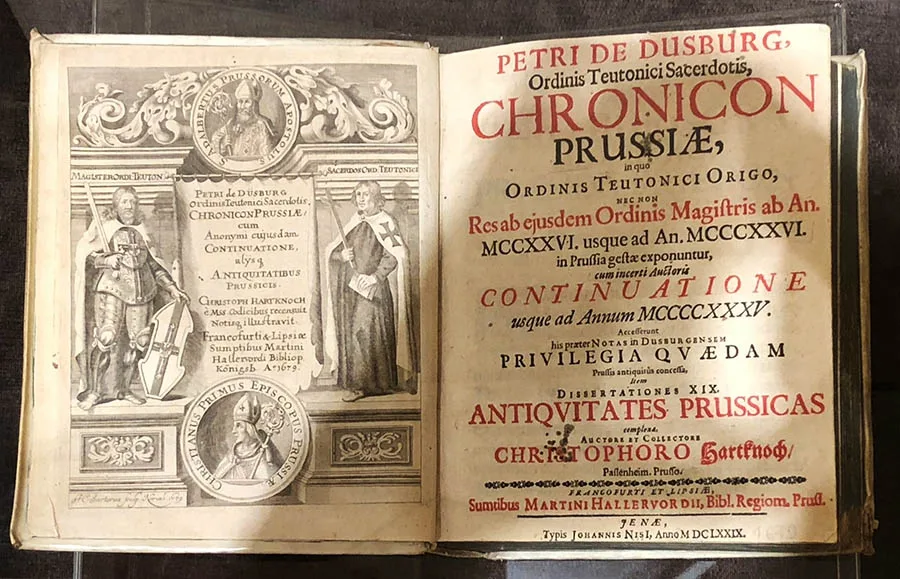
Truly educated clerical brethren were few in the Order, as its statutes attached no particular importance to learning. Even so, some outstanding figures were to be found among them, including Peter of Dusburg, who wrote the oldest chronicle of the Order, and the priest-brother Nikolaus von Jeroschin, who rendered it into German verse.
The Grand Schäffer — Großschäffer
Already in the section of the Order’s statutes entitled “Customs”, the Master’s immediate circle included, besides two companions (secretaries), a knight in a grey cloak called the “schäffer”. His official duties concerned exclusively trade and commercial relations: selling the goods produced in the country and purchasing everything needed from abroad.
Later the number of schäffers grew, and they were no longer subordinate to the Master alone. The office of schäffer appeared in the Order’s state as early as the beginning of the 14th century: the statutes of Werner von Orseln state that the schäffers kept account books, and the laws of Dietrich von Altenburg permitted them to trade, in particular in cloth. The institution of the großschäffers took its final shape by the 15th century and became an official enterprise of the Order’s state for replenishing its finances.
Alongside the großschäffers there were also kleinschäffers in Königsberg, and schäffers in Christburg and Ragnit. The schäffer in Ragnit received money for guarding the border (Wartgeld) from the treasury of the Tressler (treasurer), serving as a kind of banker to the komtur of Ragnit.
The main business of the großschäffer in Marienburg was the grain trade with England, Scotland, Scandinavia, the Netherlands and various Hanseatic cities. The granaries of the nearby castles were at his disposal.
The großschäffer of Königsberg dealt mainly in amber, chiefly with the Netherlands and Lübeck, and earlier with Lviv (Lemberg). The Königsberg schäffer and the Marshal of the Order, under whose supervision he stood, concluded agreements with amber buyers on the prices and deliveries of the various grades of amber, especially with the rosary makers’ workshop in Bruges. He was in charge of receiving, issuing and sorting the different grades of amber and shipping it by the boatload to permanent trade representatives and commercial agents. In addition, he also conducted important business in wax, honey and squirrel fur in the Netherlands, especially in Bruges.
The Grossschäffers also controlled a considerable volume of imports. Through their trading agents abroad they purchased the goods the Order needed and shipped them to Prussia on their own vessels. Every year large quantities of English and Dutch cloth, Westphalian linen, salt, weapons and all manner of other necessary goods were brought into the country. The Grossschäffers then distributed them among the convents, and within the convents the commanders allocated them to the various offices. The Grossschäffer in Marienburg was responsible for supplying the Master's storerooms and kitchen, as well as for meeting the needs of the convent in the main House. There were specific regulations governing the proper way of life of the convent.
In addition, the Grossschäffers maintained constant trading contact with the towns of Prussia. They supplied town merchants with considerable quantities of goods on credit, against a pledge or a guarantee. For this purpose there were trading agents in the larger towns of the country. In order to sell foreign cloth within Prussia, the Grossschäffer of Königsberg maintained trade links as far as Thorn.
His official duties also included shipbuilding (Rhederei). For its international trade the Order needed new ships to be built, and it often acted as co-owner of new vessels. The Schäffers supervised the construction of ships, paid the costs and drew up the accounts. They kept a highly detailed record of their activities and of the financial state of their office in a book that was subject to inspection by the Grand Commander, the Tressler and the Marshal. Their funds were often very substantial: in 1369, for example, the Königsberg office had a working capital of 30,000 marks, from which it had to cover the expenses of the convent in the town without any compensation from the Königsberg commandery. The funds of the Grossschäffer in Marienburg in 1405 and 1406, after deduction of all expenses, amounted to a net 46,000–48,000 marks.
Given the extent of their business, each Grossschäffer had an assistant, the under-Schäffer (Unterschäffer), who acted as his deputy (representative) during the Grossschäffer's frequent absences. Also under the supervision of the Grossschäffers were the Pfundmeisters (Pfundmeister) in Danzig and other major ports, the collectors of poundage (Pfundgeld), brokers, shipbuilders, skippers and the so-called ship's boys (Schiffkinder), or sailors.
The Procurator General (the Order's representative in Rome)
Like all the orders of knighthood, the Teutonic Order had a permanent representative at the papal see. The work of the Procurator General was of the utmost importance to the Order. The post was given to a brother of the Order with good diplomatic skills. On the instructions of the Grand Master he negotiated with the Pope, defended the Order's interests and conveyed its complaints and requests. His great achievement was to win the Pope's favour, which made it possible to obtain additional privileges for the Order or to secure papal support in international disputes. Particularly well known is the Procurator General Laurentius Blumenau, who began his career in 1447 as an envoy and lawyer to the Grand Master. At the end of his career he wrote a chronicle, the “History of the Order of Teutonic Knights”.
The way of life of the knightly convent
A knight of the Order spent a considerable part of the day at regular divine services. The day was divided by fixed hours into six periods, with services by day and by night. All the brothers of the convent, both clerics and lay brothers, had to attend them together. Services and prayers followed a single pattern throughout the Order. Only certain brother officials engaged in urgent business were permitted to be absent. Those who missed a service or arrived late were punished by the commander or the house commander after several warnings. By law every brother admitted to the Order had to know the Lord's Prayer and the Creed. If he did not know these prayers, he was obliged to learn them from the priests within a set period of time. No brother of the Order could make his confession outside the Order without the permission of his superior. Besides the daily services, there were special church feasts celebrated in the Order. For every brother who died the convent held a requiem. Each brother was told how many times he had to say the Lord's Prayer for brothers of the Order who had fallen or died.
In the castle of the Order all knights were equal, whether of princely, comital or noble birth; none of them enjoyed any privilege or preference. Every brother of the Order wore the same clothing as all the others. Anything costly or conspicuous was forbidden. Every deviation was noticed and put a stop to by the Trapier.
In winter only goat or sheep fur could be used to make clothing warmer. The rule did not allow costly laced shoes, boots with long uppers, shoes with long pointed toes or high heels; nor was there any embroidery (braiding) or expensive lining on clothes, no silk jackets or doublets bearing family coats of arms or with many pleats. Even the hairstyle was prescribed: the hair was to be short at the back and longer at the front; the knight brothers left their beards untrimmed, whereas the priest brothers were obliged to shave.
The brothers' living quarters consisted only of a refectory, known in the Order as the Remter, and a common dormitory (Dormitorium). All healthy brothers had to sleep in this dormitory, while the Remter served them as a common hall, something like a living room. The furniture in the Remter was simple: a rough oak table and heavy benches. Even in the great Remter at Marienburg the brothers' furniture was the same. The furnishings of the dormitory can to some extent be reconstructed from the statutes of the Order. They stated that each brother was to be content with a straw mattress (Sack) with coarse wool combings (Kotze), linen sheets and a blanket. The bed was to be hard and simple, and no one was to wish for anything else; only in individual cases (old wounds) could it be improved, and then only with the commander's permission. It is possible that each brother had a space in the dormitory partitioned off by wooden boards and fitted with a lattice door. The chapel and the chapter house were furnished just as simply.
The chapter house may have resembled the one at Marienburg, but with stone benches along the walls. In the chapel and the chapter house wall decoration was also permitted, especially frescoes. They adorned the rooms in the castles of Marienburg, Königsberg, Lochstedt, Sachsenhausen and elsewhere. The commander's apartments and the rooms for the sick were simply furnished but richly decorated with frescoes, an example being the commander's chamber at Lochstedt.
In Prussia the Order created exemplary heating and sanitary installations. Ordinary stoves and open fireplaces were not enough to heat large halls in this relatively harsh country. The halls were therefore equipped with central heating, which had in the cellar a large stone-built furnace with a hollow, pyramid-shaped vault lined with fieldstones. Above this lined chamber rose a flue with branches of clay pipes that ran beneath the floors of the heated rooms and opened into round vents in the rooms. The pipes and vents could be closed with disc-shaped metal lids. The furnace was fired with wood while the flue was open. The fieldstones of the lining became red-hot and retained the heat, while the smoke escaped through the flue. When the wood had burnt down, the ashes were removed, the flue was closed and the disc-shaped metal lids in the living quarters were opened. Dry, clean, intensely heated air then streamed into the rooms, filling them with a pleasant warmth for a long time. This method of heating was hygienic and at the same time economical.
Even more interesting was the solution to the delicate question of latrines. In Prussia these were always placed in towers standing over running water: not very convenient, but hygienic. These utilitarian structures were given a highly striking architectural form. In Prussia such latrines were called Danzkers (Danzker). Why this was so is unknown.
Everyone, including the commander, gathered at one table for meals. The food was simple but nourishing; the drink was beer and strong mead. There was no wine and no refined dishes at the table. The Grand Master, too, was content with this fare at the convent table. Meals were usually taken in the Remter at three tables: at the first, called the lords' table, sat the commander with the officials of the House and the brothers of the convent; at the second, the Witinge table, the servitors; and at the third, the young men's table, the Knechte. None of the brothers was allowed to eat outside the convent. For sick and elderly brothers there was a better table in the infirmary.
Members of the convent were to appear in the Remter only with their mantles fastened. During meals they kept strict silence while a table reader read passages from the Bible, “so that, as the law says, not only the palate hungers for food, but the ears also hunger for the word of God.” If guests were present at table, the Komtur lifted the rule of silence. No one left the table until everyone had finished eating and a priest-brother had said the prayer of thanksgiving. On fast days the brethren gathered in the Remter after Vespers for a light collation. On days when two meals were eaten, there was no collation. Strong drinks, such as warmed Lutertrank, were forbidden. Evening prayer was followed by the time of rest. All healthy brethren of the convent slept together in the same dormitory. Here, too, the law enjoined strict silence until the first morning prayer. If the rule happened to be broken, the offence was atoned for by reciting the Our Father and the Ave Maria.
The knights of the Order were forbidden to keep their belongings under lock and key. No one could accept a gift without the approval of his superior, and no one was allowed to possess money or take it into safekeeping. No brother holding an office could give money to a member of the convent without his superior’s permission. The statutes also forbade a brother of the Order to carry his family seal, or to send letters, or read those he received, without the permission of his superior. Only the Komturs and other officials had access to the Order’s funds.
In their free time the knights gathered in the Remter for conversation, games and other pastimes. The statutes allowed chess and Zackunenspiel (?), but forbade playing for money. Dice were also prohibited. At times the brethren were entertained in their leisure hours by wandering musicians, blind singers, artistic whistlers, animal trainers, itinerant conjurers and jesters. Hunting with hounds and falconry were permitted only to the Grand Master, the officials and the Komturs. When necessary, the knights of the Order could shoot wolves, lynxes, bears and other wild animals, and occasionally they were allowed to shoot birds.
In castle life the law enjoined the knights to live in brotherly peace: accordingly, all the brethren were to take care not to be a burden to anyone, but to treat one another with love, helpfulness and humility. If brothers of the Order quarrelled, they were obliged to make peace without delay. Every brother was to be an example of decency and honesty; no secret gossip, foul language, lies, curses, abuse or arrogant chatter was to pass his lips.
The knights of the Order were obliged to set lay people an example of a pure, pious and blameless way of life. Only in exceptional cases could they appear at great feasts, knightly gatherings, banquets and entertainments. In public places they were not permitted to speak with women, especially young ones. No one was allowed even to kiss his own mother or sister. No one could enter a convent of nuns. Brothers were not permitted to stand as godfathers, except in cases of emergency baptism. The statutes forbade close dealings with lay people and long absences from the convent. A Komtur could permit a knight of the Order to travel only as far as the nearest house of the Order. For a longer journey the permission of the Master was required.
If a brother of the Order rode out on an errand, he was not to linger at courts or in houses for more than two nights, and he was not permitted to lodge overnight with lay people or at inns. When travelling to another castle of the Order, a knight had no right to visit a nearby town without the permission of the Komtur and without being accompanied by a brother of the Order. A young knight of the Order was obliged to travel only in the company of an older one.
A brother of the convent owned no property whatsoever. He could not dispose of his horse or his weapons, and he could neither sell nor give away even his old, worn-out clothing. Only the Trappier could distribute clothing to the Knechte (servants) or to the poor. It was the Komtur’s duty to see to the proper equipment (armour) and the three good horses a knight required. Anyone who neglected his armour or lost it was punished with a long term of confinement. Decorations on armour and harness were forbidden. A brother of the Order had no right to hand over his sword, the pride of a knight, to another.
Many of the Order’s castles had infirmaries for old and sick brethren, and Marienburg even had two: one for the knights and priests of the Order, the other for the Knechte (servants) and household staff. These were entire complexes of sickrooms, with their own administration, a separate chapel, a bathhouse, a kitchen and living quarters for the old brethren. Order was kept by the Master of the Infirmary. If a brother of the Order fell so gravely ill that he needed the last rites, the Hauskomtur sealed all his effects, and after his death everything of value was sent to the Treasurer in Marienburg. No brother of the Order could make a will; before receiving the last rites he could only give his fellow brothers small items from his effects and belongings as keepsakes. When a brother died, a so-called death letter was sent to the Master without delay. Every house of the Order held a requiem with a Mass and a vigil for a brother who had fallen or died, and each lay member of the convent recited the Our Father a hundred times for him.
On the battlefield the statutes bound the knight of the Order to strict discipline and order. Unconditional obedience to the Marshal of the Order and his deputies was his supreme law. A fixed military order regulated the knights’ conduct in the attack and on campaign. Anyone who cowardly abandoned the banner or left the army received the severest punishment. When camp was pitched during a campaign, a field service was held at the portable altar. On campaigns the supply of provisions for the knights of the Order was the responsibility of the provisions Komtur or the Proviantmeister.
A herald was constantly at the Marshal’s side, a crier who called out the orders he received. If the Marshal wished to attack the enemy on horseback, a serving brother raised the banner of the charge (pursuit).
The law prescribed that the brethren conduct themselves bravely and courageously on the battlefield, and gently and caringly towards the poor and the sick. Caring for the sick in hospitals was the first and highest vow of the knights admitted to the Order. Clothing and food were often given to the poor. After a brother of the Order died, his best garment was given to a poor man, and food was distributed to the needy for 40 days.
The House Chapter and Punishments (Penal Law)
In every convent a house chapter met on Sundays, which all the knight-brothers and priests were required to attend. It began and ended with prayer. Its essential purpose was to keep the statutes of the Order constantly before the brethren, and to this end specific passages from the Book of Statutes were read aloud at every meeting. At the house chapter matters concerning the administration of the Komturei and other affairs of the house were heard and discussed. It also served as a court for the members of the convent and punished offences.
There were four degrees of punishment according to the gravity of the offence or crime: a light, a grave, a graver and an especially grave fault was distinguished. If a brother committed an offence of one of these degrees, the matter came before the chapter, and the testimony of two brothers of the Order was sufficient to convict him. The chapter then passed a “judgement of penance”, always taking into account the opinion of the brethren about the accused. He could find mercy (leniency) with the chapter. The better part of the brethren decided whether to pardon him or to carry out the punishment. The law of the Order laid down a great many cases in which different degrees of punishment were to be applied depending on the gravity of the fault. For light offences the accused was sentenced by the chapter to one to three days of confinement and received Juste at the chapter on Sunday. For a grave fault the brother lost the cross of the Order on his mantle until his superior decided otherwise and his brethren showed mercy. If he remained without the cross, he was punished for a term of one year, until his superior and the brethren eased his punishment.
For a graver fault he was given a corresponding year-long punishment: the accused had to spend a whole year in the position of a Knecht, eat at their table, sleep on the ground (on the floor), serve without the mantle with the cross, and live on bread and water three days a week (though this could be reduced to two days).
If the offence had become known to lay people, the guilty brother was punished publicly in church on Sunday. If his guilt was exceptionally great and he refused to submit to the punishment imposed, he could be put in prison, where he spent a year in chains, and in exceptional cases he was sentenced to life imprisonment. The gravest offences resulted in expulsion from the Order
Disobeying a superior's orders, breaking the laws of the Order or disregarding them was severely punished. For such offences a knight of the Order was stripped of all ranks and honours, and he no longer had any chance of obtaining an office. The Grand Master or his senior official could revoke certain punishments. But the law required the master not to be too lenient towards transgressions and not to overlook even the most trivial offences, “for,” it stated, “when an offence has been committed, its measure must be determined.”
Grey Mantles, Half-Brothers and Serving Brothers
The brethren of the Order belonged to two different estates (classes) and were divided into lay members of the Order and priest-brothers. The priest-brothers, as the clergy of the Prussian land, were seldom of noble birth and were mostly “citizens of the country”. Among the lay brothers, a clear distinction was drawn between the knight-brothers and the “grey mantles”, or half-brothers. The knight-brothers formed the political and ruling stratum of the Order. The grey mantles were fighting brothers of non-knightly birth. Most of them came from the local Prussian population. These half-brothers, who wore grey mantles, usually held the lower offices in a commandery or castle. Some of the Großschäffer, who handled the Order's foreign trade, came from the burghers of Danzig. In Prussia there were also a few half-sisters of the Teutonic Order.
The first laws for half-brothers were probably issued under Hochmeister Burchard von Schwanden. These laws stated: “In the name of our Lord, the first condition for admission as a half-brother is a decent way of life.” The person being admitted swore an oath of loyalty to the Order and promised to work for its good as far as he was able. In return, as a half-brother, he received the remission of sins granted to the Order by God and the Church for the salvation of his soul. The half-brother continued to live outside the Order's House, without the strict monastic vows of asceticism and seclusion. He served the Order and furthered its welfare — as a warrior on the battlefield, as a benefactor in times of peace. When such a half-brother grew frail and could no longer work, the Order provided him with material support for the rest of his life, even if he lacked everything necessary to care for himself. After his death all his property passed to the Order as a gift. For services rendered to the Order, the master, by means of fraternal letters (Bruderbrief), admitted German and foreign rulers (princes) into the Order as half-brothers (though without the gift mentioned above). Even King Sigismund and Alfonso V of Aragon considered it an honour to be received into the Order as half-brothers. Since a person of any estate could become a half-brother, they were often well-to-do burghers, renowned scholars and wealthy Bauern (peasants). When such a half-brother died, a solemn requiem was held in his honour in the nearest House of the Order. In the Palestinian period there was a class distinct from the half-brothers — the serving brothers. To them belonged the so-called Turcopelen, lightly armed fighters on foot and on horseback. Following the example of the Templars, they were called Sarjanten or Sergenten (sergeants) and were subordinate to their Turcopelier. From among them the master and the marshal chose heralds and adjutants. Because of the colour of their mantles, they too were often called “grey mantles”.
The law permitted women to join the Order as half-sisters. The wife of the Roman King Sigismund was a sister of the Order. Women were not allowed to be admitted to the “full community of the Order”; they were accepted as half-sisters to nurse the sick in hospitals and to look after animals. On admission they took a vow of chastity and wore religious dress, but lived outside the Order's House, wherever the commander determined.
In fact, the legal status of the half-brothers is not entirely clear, as the sources say very little about them. Half-brothers could be servants as well as benefactors of the Order, who were not bound by the rules and vows. The Order also counted Konrad of Masovia and Sambor of Gdańsk among its half-brothers. Tertiaries (tercjarze), who could wear a grey mantle with half a black cross, were also half-brothers. As the “serving” brothers began to perform various administrative and economic functions, the difference between them and the half-brothers became blurred. Everything indicates that the wearers of the grey mantle never carried great weight in the Teutonic armed forces. Nor has it been possible to establish their exact numbers. Sample checks of large convents show that half-brothers made up as much as 15%. It may be said that a half-brother in the Teutonic Order was a layman who performed military, economic or other service and did not hold knightly rank. In the view of G. Kunze, the position of the half-brothers implied not their exclusion from the life of the Order but, on the contrary, their participation in its affairs, including its politics.
________________________
1 – Initially the residence was in Acre (Akkon), then at Montfort (Starkenberg); after the loss of Montfort, again in Acre, and later in Venice, Marienburg and Königsberg.
2 – Magister — German: Meister. Magister — Latin: leader.
3 – Latin: “universal or chief ruler” or “ruler of the German Hospital of St Mary”.
4 – Visitirer, from the word visitieren — to make the rounds, inspect, search — that is, an inspector.
5 – Dusburg says that Hermann von Salza received a ring from the Pope as a gift. Under what circumstances this happened is unknown. It has always been believed that the plain gold ring in the Order's treasury is that very ring. Dudik B. Des Hohen Deutschen Ritterordens Munz-Samlung in Wien. S. 61.
6 – A scribe with a command of Arabic.
7 – Prussia and Livonia were united in 1237–1241 (?), in 1279–1280 and in 1282 (?).
8 – The exact date when the four above-mentioned bailiwicks were subordinated to the Grand Master is unknown.
9 – The brethren of the Rehden convent complain to the Grand Master about the commander, who fails to arrange the weekly bath. Probst C. Helfen und Heilen. S. 131.
The book “The Teutonic Order” by the leading Kaliningrad expert on the subject,
(17.01.1949 – 28.11.2023)
was published by “Zhivyom” in 2020. With the kind permission of the author, we are publishing an excerpt in which he describes the internal structure of the Order.
Translated from Russian with the help of AI (Claude, Anthropic), October 2026.